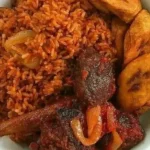
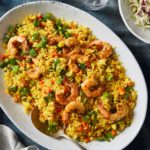
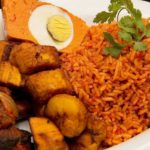
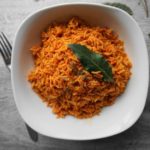
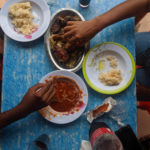
In Nigeria, the good Lord of food blessed us with rice as a staple meal. That would’ve been all well and good if we Nigerians were not extra, experimenting and creating all sorts of recipes out of rice. From the king of rice itself: Jollof rice, to bottom of the barrel, white rice, take this quiz and we’ll tell you which type of rice you are.
If you’ve not been living under a rock you’ve probably heard a lot about the longstanding feud about whose jollof rice is better–Nigeria’s or Ghana’s?
While the jollof rice war is a friendly debate that keeps the harmony going between some West African countries, such as Senegal, Ghana, Nigeria, Gambia, Sierra Leone, Liberia and Cameroon, it can really get tiresome for people who don’t even CARE about the argument.
Here are 7 things you’ll find relatable if you roll your eyes every time you see yet another; “who has the best jollof rice?”
You wonder who exactly started the argument in the first place
Aren’t there better things to do than argue about food?
What’s the big deal about the rice sef?
As long as you can eat something, you are fine.
You don’t even like rice
You can totally survive without it.
Surely, there are more important things to talk about?
Like, “can the Nigerian government do a census so we know what the population really is?”
Why exactly is jollof rice considered a “national treasure”?
Can the Spanish get on this jollof war? Because they have one too.
What’s the prize for the winner of this jollof rice debate?
Abeg what’s the end game?
Will there be feud’s about other meals?
Or is it just this rice sha?
Meanwhile, while everyone else is clamoring for jollof rice supremacy, making short films, getting people enraged by their oopsies; our Jollof Road team is currently touring West Africa to discover what the fuss is really about. They are sampling different foods along the way, understanding different cultures and interacting with different people, but they’re really just spying on the jollof rice recipes of other countries so they can come back with the results and end the friendly feud.
Let’s face it, there’s jollof, there’s Jollof and then there’s JOLLOF. Have you ever wondered how the different kinds of Jollofs you’ve had in different places match your personality? From burial Jollof to Sunday Jollof aka boarding school Jollof there’s a wide spectrum of Jollof rice.
If you’re still wondering where you fit in on the spectrum, wonder no more, we’ve created the perfect quiz to help you find out.
Now that you’ve taken this quiz, head on to jollofroad.com where a small team of creators from Zikoko are taking over the world on an 80-day road trip around West Africa. They’re chronicling stories about what it means to be West African in West Africa today and investigating how much Jollof, the staple West African meal unites or divides us.
One meal that connects all of West Africa is Jollof rice. Although we have different names for it and can never agree on who has the best recipe, Jollof rice has overtime become a West African marker.
However, travelling on the Jollof road, the team discovered that beyond Jollof Rice, we have so many similar meals. They left Nigeria on the 22nd of September and since then, have been to four West African countries: Benin Republic, Togo, Ghana and Côte d’Ivoire. In each country, they’ve discovered so many similarities especially in terms of food.
It’s World Food Day, so we decided to compile a list of different Nigerian foods and their #JollofRoad country version.
Eba
Attiéké (pronounced A-CHE-KE) is a traditional Ivorian dish. Let me tell you, Attiéké and Eba are one and the same. The only difference is that while Attiéké is cooked in tiny lumps, Eba is cooked till it’s a firm dough.
Eba
Attiéké
Pounded Yam
Igname Pilée (pronounced EE-nyam Pee-lay) is the Beninese version of pounded yam. It is also eaten in some other parts of West Africa. And as the name suggests, it is cooked with boiled yam. And someone’s sweat, possibly.
Amala Lafun
Amala is known as Pate de Manioc in the Republic of Benin. Wherever you are, legend has it that every consumer of this epicurean goodness always succeeds in life.
Okra
“Le Gombo” is the Ivorian name for Okra soup. It’s also the same name in some other West African countries. The Nigerian and Ivorian version have similar recipes. You either hate it or love it. There’s no in-between. Absolutely no grey area here.
Ivorian
Nigerian
Fufu
Across all the Jollof Road countries we’ve visited so far, Fufu has been the most common. It’s usually accompanied by different soups that are specific to each country and as a result, the taste is never the same.
Watch the Jollof Road team tell us about some of these foods:
Calling on all UNILAG Alumni and current students, I stand to be corrected but I’m pretty sure these are the top 5 places to eat in UNILAG.
Bet you didn’t know Shop 10 is just a nickname and Glamos Rarebits is the real name of this legendary food place, From when it was known as Shop 2 in Red Bricks, to when it became known as Shop 10 behind Jaja Hostel, Glamos is most famous for one thing – it’s Jollof rice which is arguably one of the best in Lagos.
Mavise
For many people, Mavise was considered to be Shop 10’s number one rival. Although I personally thought Shop 10 served the best jollof rice, Mavise fans would beg to differ.
Salado
Like the name might connote, you already know that Salado is all about making great, fresh salads. It’s funny how people found a way to combine their salads with anything they were eating from rice to chips to even beans.
Ewa-agoyin Palace
Eating ewa-agoyin in any other place in UNILAG is unheard of. Ever had ewa-agoyin you don’t even want to eat your mum’s own again? That’s how good it is. In fact, there were many a people who thought she was adding a bit of jazz to the mix.
Iya Moria
Iya Moria started off at Ozolua before expanding to DLI. Anyone who stayed in those areas ate her food on a daily basis.
Olaiya
Even though they only opened their UNILAG branch in 2015, it didn’t take too long for Olaiya to become a household name for UNILAG students. Known for their fire amala and gbegiri, there’s no way you’d pass through UNILAg without stopping for their food.
Korede’s Spaghetti might be the newest kid on the block but anyone who has tried it out will agree that he deserves a place on this list.
Did we leave your favourite place out? Do you think it deserves a place on this list? Let us know!
It’s a packed hall of about a thousand people, and an M.C. is speaking in an accent that he probably acquired off binging American shows. One side of the Hall is a streak of turquoise blue Gele and caps, the other end is Burgundy.
The MC’s jokes aren’t as funny as they were 30 minutes ago, and it’s not because he’s run out of good ones.
It’s the guests who have run out of patience.
An aroma is sifting through the hall, but no waiters come bearing good news. People are putting their hand fans to work, even though the air-conditioning is doing a decent job.
And in a seemingly random moment when the MC hands over what is left of the audience’s attention to the live band, the waiters start rolling in.
Huge trays holding fistfuls of beef, coleslaw, and mede-mede. All of them, sitting pretty on small heaps of Jollof Rice in plates.
The party has now began proper, the music will sound better, guests will aww more, because Jollof Rice is libation to Enjoyment.
But this is not where the Jollof Story begins—you’d have to travel westward, out of Nigeria, to a small Island off the Coast of Senegal, St. Louis.
Djolof a.k.a. Wolof Empire
West Africans disagree on many things about Jollof—especially on who has the best—but on the origin of Jollof Rice, there is no debate.
The Wolof Empire was a West African State that ruled over Senegal and Gambia sometime between the 1350s and 1540s. A 1549 Battle of Danki—which had nothing to do with rice—led the four vassal states of the Wolof Empire to become mostly independent.
And so, Djolof—which used to be the old metropolitan capital of the Empire—became a kingdom by itself.
“Give me a pot and I’ll cook up a storm.” – Penda Mbaye (Not exactly her words, but they’ll suffice.)
Fast forward to the 1800s, there lived a chef, cooking meals at ceremonies, experimenting as she went. Penda Mbaye wasn’t exactly a Jollof woman. In fact, she’s believed to have come from Walo, another one of the four vassal states from the old Wolof Empire. As White People came into West Africa with their colonialism, they also brought a wide variety of food from their travels, mainly from South America. They came with food like cassava, pineapples, and even tomatoes.
For Penda Mbaye, fresh food meant fresh opportunities to experiment. One recipe led to another and Penda landed a job as Chef at the Colonial Governor’s Residence in St. Louis.
One meal had a reputation in the governor’s residence; it was a one-pot combo of barley, fish and vegetables cooked together.
A barley shortage came around the time that Asian rice was landing on Senegal’s shores, and in typical Penda fashion, she substituted rice for barley. The magic is created, Penda called it Thiéboudienne (Cheb-oo-jen).
And so, Jollof Rice as we know it was born. It went on to become Senegal’s pride.
Senegal to West Africa
There’s another theory about Jollof’s origins. According to Mamadou Diouf, a Professor of African History at Columbia University, Jollof Rice is military.
Look at it this way. You’re a Colonial Officer, how do you feed a large Senegalese Colonial Army? You get rice, tomatoes, fish or meat, and throw all of it into a big pot.
According to this theory, it’s probably how Jollof travelled across West Africa, militarily, as colonial forces found effective ways to feed their soldiers, especially around the World Wars.
What is certain of course, is that Jollof Rice diffused across West Africa, just like everything else diffused; fashion like the Senegal fabric or music. It could also have been the Djula people, a tribe of merchants who travelled across West Africa, selling goods, and leaving bits of their culture everywhere they went.
There are few accounts of its footprint in Nigeria, the oldest that we know of being in the Kudeti Book Of Yoruba Cookery, first published in 1934.
“I suspect the original recipe for Jollof was in there,” Ozoz ‘Kitchen Butterfly’ Sokoh says. Ozoz is a culinary wizard and food enthusiast and she has a 1947 “The Ibo Cookery Book” to back this original recipe theory up. In fact, the recipe from this book included “Cabbage or Spinach (tete)” as an ingredient. It also used to be spelt ‘Jolloff’.
“It references the Kudeti The Kudeti Book of Yoruba Cookery in its forward,” she says. “I don’t have that (1934) edition, but I do have a 2002 repackaged edition that can still be purchased at the CMS Bookstore.“
Jollof Rice evokes a different nostalgia for the generation at the heels of this book. Take Maimuna Atta-Ahmed, who was a teenager at the dawn of an Independent Nigeria.
“When I lived in Kano, there used to be canned Jollof Rice,” the septuagenarian says. “And it was made in Kano. In the 60s, Kano had everything you can imagine. There were the groundnut pyramids, there were textile and hide industries. The canned Jollof Rice was popular.”
But even as Jollof Rice had a reputation, it wasn’t exactly a party choice.
“Jollof Rice wasn’t at parties when I was young,” Sherifat Hassan, a 51-year old caterer in Abuja says. “What was common was Pounded Yam, Amala and all that.”
Imagine this;
You’re planning a wedding party in the 60s. It’s not a big ceremony, so you’re expecting 200-300 people. “Let’s cook rice,” someone suggests. You think about it for a moment and know it’s never going to happen. Not rice.
The problem that stood in the way of people and their Party Jollof was stones.
“In those days,” Sherifat explains, “the rice had stones. Even some local rice these days still have stones. The only rice that didn’t have stones were Uncle Ben’s and Aunt Caroline Rice.” But the price of Uncle Ben’s mostly kept Jollof Rice in family kitchens, and on special events like Sunday afternoons and festival menus.
By the late 60s and early 70s, oil had become more attractive for the Nigerian government, and agriculture was taking a backseat. One consequence of this, besides the disappearance of the industries and groundnut pyramids, was higher importation. In fact, the share of rice in the Nigerian diet went from 1% in 1960 to 7% in 1980, and that rise is mostly because we imported more.
The Asian Flood
Uncle Ben’s was a luxury choice and especially sold in retail quantities. Asian rice, on the other hand was cheaper, especially since there was a drop in imported rice tariffs in the mid-70s.
And with cheaper and stoneless rice, came Party Jollof.
Since Asian rice came into our lives, it has never left. As long as it powered our Jollof Rice, we chose it above all else, even at the expense of local rice.
Soft Jollof. Soft Power.
You’re a Nigerian or Ghanaian, living or studying in the West, most likely the U.S. or U.K. You have a small get-together with your friends, some of them are White. You offer them Jollof Rice.
They try the first spoon, and their mouths are on fire. The heat is nothing like they’ve ever tasted, and by the time they’ve gotten used to it, they love it. This is most likely how modern Westerners first experienced Jollof Rice, although their ancestors already tried it from the ones their slaves made.
The world might be a harsh and cold place, but it still deserves good things, and so Jollof Rice has been gifted to the world, just as West Africa has gifted it Afrobeat.
Jollof Rice on Twenty-twos
When something is a big deal, you pick a date and throw a party for it every year. But how did the 22nd of August every year become the date?
“In 2015, I woke up to see the date set on social media,” Ozoz says. “I had no idea who created it. We just stuck with it.”
It turns out there was an origin, and Ozoz found it. Or them.
In 2015, Queen “AsoebiAfrica” thought it’d be a great idea to pick the 3rd Saturday of August as a good day to celebrate Jollof Rice. That day was the 22nd.
Her friend WestAfrikanman loved the idea, and so it stuck.
And even though they didn’t have a permanent date in mind, brands like Etisalat and Maggi jumping on it made August 22 stick.
Despite how removed Queen felt from the date being the permanent choice at first, she says;
“I’m so glad I was able to create a special day for my darling Jollof!”
And so August 22 has become the day we gather around the pot and celebrate Jollof.
Nigeria’s culinary map is diverse, with Tuwo as Warden in the North, Starch making its strongest mark in the South-south, Akpu in the Southeast, and Amala the rockstar of the Southwest. But when we gather round to sit at a table as one people, it will be Jollof Rice making the rounds. Because Jollof Rice is libation to Enjoyment.
Jollof is forever.
Jollof is a whole lot more versatile than we like to give it credit for. Here are some surprising and creative Jollof combos as proof.
Let’s start with a combination we all know and love. Jollof rice, chicken and dodo.
Just in case you are tired of combining your Jollof with dodo, there’s always coleslaw to come to the rescue. And if you really want to live your best life try combining all three.
If you are trying to use enjoyment to kill yourself, Jollof rice and asun is the best way to go.
Are you even Nigerian, if you’ve never tried this combo?
What’s the best Jollof Rice combo you’ve ever tried?
Jollof rice is more than just a blessed delicacy from God himself…
It is a way of life. Just look at this.
Jollof Rice has proved its culinary excellence and has become so popular all over the world that there’s actually a day to celebrate it.
Yup, World Jollof Rice Day is actually a thing. If you’re curious as to what exactly makes this food so special, I’m going to give you 22 reasons… or ingredients.
1. Love and affection
I mean, this is why your mom’s Jollof Rice is still the best you ever had.
2. Experienced hands
Hands that are almost fireproof, and have evolved into automatic measuring machines.
3. Sweat
Y’all already know this is why proper party Jollof Rice tastes so much better than homecooked. 🌚 Ingredient X.
4. Firewood
If you want to make amazing Jollof Rice, you need to cook it with firewood. It’s in the Constitution.
5. Cast iron pot
Akon is from Senegal. What do you think he was talking about when he sang Pot of Gold?
6. Good rice
No matter your level of skill, if you do mistake and buy bad rice, your Jollof Rice is going to be bad, plain and simple. Shine ya eye.
7. Fresh tomatoes
Get those fresh, healthy-looking juicy tomatoes that usually come from the North. Just go to the market and ask for it.
8. Tomato puree
AKA tin tomato/tinned tomatoes. This is like the photoshop for Jollof Rice. It gives it an extremely attractive pop of colour.
9. Onions
The type that will make you shed tears at its beauty.
10. Scotch bonnet
AKA rodo. Because a little fire is good for the soul, and tastebuds!
11. Salt
I mean… This one is a given.
12. Chicken or beef
Because is your Jollof Rice really complete without ‘animal’?
13. Beef/chicken stock
Keyyy ingredient! The absence of this can spell doom for your Jollof Rice.
14. Vegetable oil
Preferably the one you just used to fry the chicken that has soaked up the spices.
15. Seasoning cubes
Because you need to season that rice well!
16. Bay leaf
For that extra, fabulous ‘scent’ and flavour.
17. Curry and thyme
This is a big part of what gives Jollof Rice that wonderful, endless flavour.
18. Cooking butter
This gives the Jollof Rice the most delectable texture!
19. Mixed vegetables
See ehn, Jollof Rice is an institution on its own. It doesn’t need to be messed with; it’s not fried rice. However, you can add mixed veggies if you want to give it small international exposure.
20. Dodo
Dodo is the perfect sidekick for almost any dish, but there’s just something about dodo and Jollof Rice. A match made in heaven.
21. Moi-moi
This one is for taste and nutrition balance and pure enjoyment.
22. Coleslaw/salad
Because it’s not a bad thing to use enjoyment to kill yourself.
Happy Jollof Rice Day! May the Jollof be with you. Let’s go out and celebrate!
“Hello funke, I’m getting married and I’d like you to be on my bridal train” What? Me? Wow! I’m honoured. I can’t stop crying, wow I’m so happy.
That’s the first type of bridesmaid you’d find at every wedding. The extremely emotional one.
While Funke is crying, her friend is thinking of how she will meet Prince Charming at this wedding.
“And I’m sure her husband has fine friends o. Jehovah this is my time. This is it”
There’s also the bride’s best friend who is also her P.A throughout this wedding. This is the person who actually gets to decide who is on the bridal train.
She’s the assistant bride, and if she doesn’t like you. Sorry, your bridesmaid benefit is canceled.
You know those people you can never go shopping with because they never find anything they like? Yes, you will find them on the bridal train.
If you like pick 15 different clothes, they would not like anyone. “This dress is too big o, no no that’s too small, but the colours are too much, lets have that one, too its too dull”
While the other bridesmaid is being dramatic with clothes. There’s one who just observes, because she has been on her bridesmaid duty for years.
And she knows the dress everyone picks is what you will still wear. Whether you like it or not.
There’s the bridesmaid who has suddenly taken the wedding planners job. She is everywhere and in everything.
Except her actual bridesmaid duty.
This persons only mission for the wedding is to catch the bouquet. So if they throw the bouquet and this next person doesn’t catch it.
Let’s just say things won’t end well.
There’s the one that’s friends with every and any one because she’s not bothered about husband or wife or dress or anything.
She just want’s to pop bottles and party.
The last person on this list is at this position because she is always late. For everything.
“Wait where’s Toke? She’s not here yet”
If you have ever been a bridesmaid. And you fall under any of these categories.
You’re a real G.
Whether you do it in your father’s village or it’s a destination wedding in Dubai, no Nigerian wedding can be complete if the menu doesn’t include these dishes.
Small chops
It’s written in the Nigerian constitution that you must serve small chops as a starter at your wedding.
Jollof rice
We’ve not done proper research but it might be a criminal offense not to serve Jollof rice at your wedding. In fact, it’s just unheard of. And if it’s not firewood Jollof it doesn’t count.
Moin-moin
What’s jollof rice without spicy leaf wrapped moin-moin to go with it?
Fried rice
A standard plate of Nigerian wedding food has Jollof rice on one side and Fried rice on the other. The two just compliment each other.
Coleslaw and/or dodo to go with the rice.
Do you expect your guests to just be eating rice and meat like that? You have to garnish the rice with either coleslaw or dodo, and if you are feeling generous you put the two.
Ofada Rice & Ayamashe Sauce
Jollof and fried rice are great and all but it’s when the Ofada comes out that the real party starts.
Amala and ewedu
This is for your guests who are ready to wash hand and lose their home training. Make sure you garnish the ewedu and gbegiri with assorted
Pounded yam and efo riro
Emphasis on ‘pounded’ yam, poundo yam doesn’t count. Hot and fresh pounded yam must be on your Nigerian wedding food menu.
If you are feeling generous you can add ‘Chinese rice and sauce’ just to give your wedding some international exposure.