• Love Life is a Zikoko weekly series about love, relationships, situationships, entanglements and everything in between.


    Kenny (30) and Gbemi (30) grew up as childhood friends, but life pulled them in different directions for over a decade. When they reconnected in 2024, a casual catch-up turned into something deeper.

    On this week’s Love Life, they talk about rekindling old ties, finding common ground between her feminist ideals and his traditional beliefs, and how something as small as ₦1k airtime almost tore them apart.
    If you want to share your own Love Life story, fill out this form.

    What’s your earliest memory of each other?

    Kenny: Gbemi and I have known each other since 2006 — almost 20 years now. We grew up in the same Lagos neighbourhood, and I was in JS1 or JS2 when we became friends. I never thought we’d be romantically connected one day. But yeah, that was about it. 

    Gbemi: Everything he said. We literally grew up together. He knew my mum, and I knew his siblings. We’d just say hello and hi to each other. It was strictly platonic, plus we were just kids at the time. 

    Kenny: We were always around each other until we all left for university around 2011 and lost contact. It took about 10 years before we reconnected. 

    How did that reconnection happen?

    Kenny: This happened around February 2024. I was still in a relationship with my ex, but my mind kept flashing to Gbemi randomly for weeks. I was on a spiritual journey at the time, and after it ended, I still couldn’t stop thinking about her. I started getting uncomfortable, like, “What’s happening?”

    One day, I realised her younger brother was following me on Instagram. I sent him a DM, we reconnected and started bantering from there. During one of our conversations, I asked about Gbemi. He said she was fine, unmarried, and was working somewhere in Lekki. Then I asked for her number, but he said he’d confirm with her first. He ultimately gave it to me after I paid him some money. He said he wouldn’t drop his sister’s number for free. 

    Anyway, I messaged her on WhatsApp, and she replied, “Is this Kenny?” Then she ghosted me for three weeks: no calls, no chats, nothing. 

    I was at work one night in April when she suddenly called. I was so happy—I’d been waiting for almost two months. We talked for close to an hour that night, and from there, we started talking regularly.

    Get More Zikoko Goodness in Your Mail

    Subscribe to our newsletters and never miss any of the action

    Curious, Gbemi. Why did you ghost him?

    Gbemi: You know how Lagos is. A girl trying to find love in Lagos—you always have distractions everywhere. Sometimes you dabble in it and get hurt. Sometimes people come around, and you don’t even bother to acknowledge them.

    I thought it was better when somebody you don’t know messes you up than when it’s someone from the neighbourhood. I know your family, you know mine. It would just be too awkward if we went home and ran into each other. I wasn’t looking for that kind of drama.

    But I got bored one evening after work and thought, “Let me call Kenny back.” That’s how we got into it. 

    I should mention that I was also involved with someone else during that time.

    Right. So, how did things progress between you guys over time?

    Kenny: Our talking stage lasted three months — April, May, and June. Throughout those three months, we never met physically. We just caught up on all the missed years over the phone.

    Gbemi: It was like reuniting with an old friend. But the thing is, we’d both grown — he had become his own man, and I had become my own woman. We’d lived different lives, had different experiences, and that shaped who we were.

    Naturally, that meant we clashed a lot; our ideas and ideologies didn’t always align. I have strong feminist views, and he doesn’t necessarily share those. He’s more traditional and conservative. 

    So sometimes, when I’d express myself, he’d look at me like, “Why are you being stubborn?” And I’d tell him, “We’ve moved on as a society; don’t take us back to the 18th century.”

     I couldn’t stand some of his outdated ideas— the man does this, the woman does that. Although we argued over things like that, we also shared many values, such as kindness and faith. He’s very God-fearing and kind, and that balance helped us. No matter how heated things got, we always made sure to hold space for each other. That was how we found our rhythm and balance.

    Kenny: During this period,  Gbemi told me that she’d broken up with her boyfriend. She said she’d had enough and didn’t want to go back to him. I consoled her and gave her about a month to let go. Then I asked her to go out with me on a date.

    We met at Surulere and went to Lekki for lunch. That was the first time we’d seen each other physically in almost 15 years. That night at the lunch date, I asked her out, and she said yes. It was one of the happiest nights of my life.

    Gbemi: When Kenny came along and said he liked me, I told him, “No, you can’t like me romantically. I have somebody in my life.” I don’t like messy situations. I can be in a relationship every three months, but I keep it clean. I don’t want to be hiding; it’s too much gymnastics for me.

    That relationship was already on the rocks, but I was still hoping for the best. So when Kenny said he was interested, I said we could only be friends. He said okay.

    When everything ended with the other guy, Kenny gave me his shoulders to lean on. He doted on me more, and we had video calls throughout the night. I knew where we were headed. It was only a matter of time.

    We became official in June 2024.

    Did you think enough time had passed between your breakup and when you agreed to date him?

    Gbemi: Yes. I’d already started checking out of my previous relationship long before it ended. I’d given my all, and it just wasn’t working; the back and forth had drained me.

    By the time it finally ended, I was already done. Even if Kenny hadn’t come along, I’d still have pulled the plug eventually. His presence didn’t speed things up; it just made it easier to move on.

    [ad]

    Fair enough. What were the early days of your relationship like?

    Kenny: The first three months were rough. Honestly, I even thought we’d break up at some point. We had a lot of compatibility issues and frequent clashes. There was just a misalignment.

    Wait, you guys didn’t have a honeymoon phase?

    Gbemi: We had one for a week. After that, reality set in. I came into the relationship still healing from my last one, and he was recovering from a broken engagement. So, both of us entered with our eyes wide open. It was like, “If you mess up, you collect.”

    We weren’t soft with each other. Everything was intense. There were too many “No, you can’t do that” and “This isn’t what I want.” The relationship hit a rough patch in those first three months.

    Kenny: I remember travelling to Oyo for a film shoot at KAP Village for about two weeks. We were only on video calls during that time, and one time she tried calling me, and I wasn’t reachable. She didn’t take that lightly at all. 

    She was upset with me for days, and we didn’t talk. I tried to reach out to her siblings, but she told me, “Don’t call my siblings. Don’t come.” I even went to her workplace in Lekki and didn’t find her. I thought that was the end.

    After a 2-3 week stretch of silence, she finally messaged me. I asked if we were breaking up. She said no — that she’d thought about everything, done all the permutations in her head, and still found me worthy. 

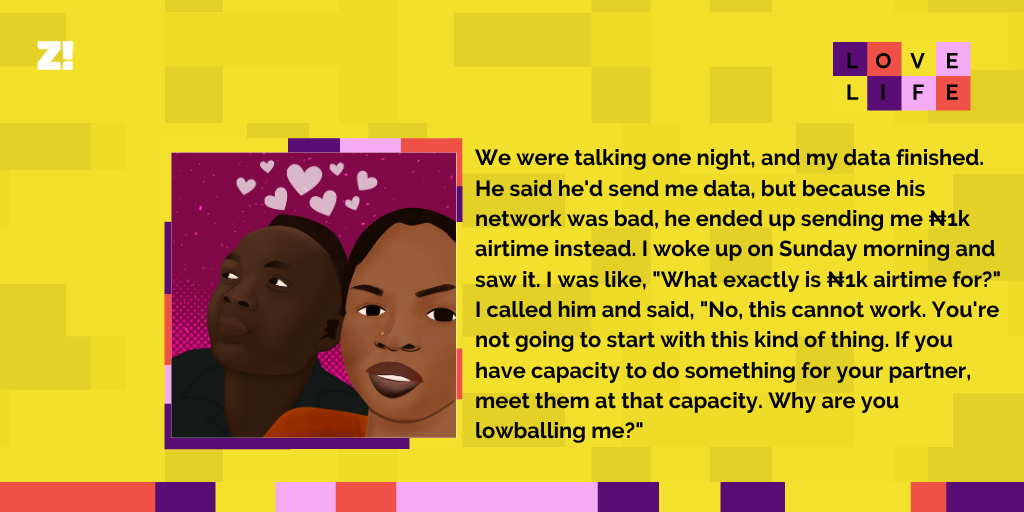
    Gbemi: Another major issue that rocked our boat was an airtime situation. We were talking one night, and my data finished. He said he’d send me data, but because his network was bad, he ended up sending me ₦1k airtime instead. I woke up on Sunday morning and saw it. I was like, “What exactly is ₦1k airtime for?”

    I called him and said, “No, this cannot work. You’re not going to start with this kind of thing. If you have capacity to do something for your partner, meet them at that capacity. Why are you lowballing me?” He later sent ₦5k, but I told him straight up: this is not it. If we’re going to be here and actually do a legit relationship, you can’t be playing in my face like this. It’s better for you not to offer than to offer something below expectations.

    Hmmm.

    Kenny: There’s a popular saying I learned growing up: “However you start is how you’ll end.” If you start with ₦10 million, that becomes the baseline. 

    In my mind, it was a small, thoughtful gesture since we were still in the early days. But she took it personally. I knew my babe was a high-class babe, and I knew I could handle the relationship financially. But I wanted to start from ground zero, to make sure she loved me for who I am, not for money.

    I’d been engaged, and when it didn’t work out, I told myself, “You have to get this right. Let a woman love you for who you are, not for what you give her.”

    Gbemi: Moving on, we also had issues about gender roles. Like I said earlier, I’m heavy on feminism, and he’s traditional. We’d have conversations about cooking, and he’d ask, “What’s your take on cooking?” I’d say, “I’m not big on cooking.” He’d be like, “So who will be cooking?” I’d say, “You. Don’t you eat?” All my responses were being taken out of context. He felt like I was too opinionated, stubborn, and that he couldn’t work with me.

    On my side, I thought he wanted to try to break my wings. I believe my partner should be my greatest cheerleader, encouraging me, supporting me, doing their best for me, and I’ll give them the same in return.

    But Kenny is a very kind person. After we’d give each other hell, we’d come back and say, “Is this how you want to continue? Is this how you’re going to be when we get married?” One thing he always said to me was: “This relationship is leading to marriage. Whatever thing you’re giving me hot for, we need to figure it out.” That was constant for us, and it really helped.

    I see. So how did you guys eventually work around these issues? 

    Gbemi: It was very important for us to treat the relationship as a contract. We update the terms of our agreement from time to time and set policies for each other.

    The terms include mutual respect: not screaming at each other when we have issues, keeping each other updated on our whereabouts, sexual satisfaction for both parties, trust that we’re building as we go, and acceptance of each other at every point in life.

    We pray together. We have terms against cheating, and anything involving living with the opposite gender is a no-no. We have access to each other’s phones and chats. My WhatsApp DP is his picture, and his DP is my picture. We make it clear. We stay transparent with each other.

    Kenny: It’s like having a contract with an organisation. It’s not just a relationship backed by love. Everybody’s eyes are open. The terms and conditions are stated here, and they must be obeyed.

    There’s a price for non-compliance. However, it depends on the gravity of what has been done. For instance, if we get into it and emotions are heightened, and I raise my voice, Kenny will say, “Baby, you’re raising your voice.” That’s my cue to calm down.

    The golden rules that must never be broken are: cheating and disrespect. Break those, and it affects the progress of our relationship.

    Curious, though. How do you navigate your different views on feminism and traditional gender roles?

    Gbemi: As much as Kenny is a traditional person, he’s kind. His kindness comes first and prevails in all situations. Some men are traditional and wicked — the wickedness prevails. But for Kenny, his kindness prevails. He’s able to empathise and meet me halfway, validate how I feel, and not just defend his gender.

    He’d always say, “As long as you don’t hate me, be a feminist.” I’d say, “There’s you, there’s your gender. You have to exist outside of your gender.” The fact that your gender is the perpetrator of the most vile things doesn’t mean you have to defend it just because that’s your gender. We’re able to agree on most of those issues.

    Also, Kenny is domesticated. I’m not big on doing domestic chores at home, and he fills that gap. He’ll just do it easily—no stories, no excuses. Sometimes I’ll even complain that something isn’t properly done, and he’ll say, “You won’t do this thing, but I’m doing it and you’re still complaining?”

    Because of these things about him, I can see that at his core, he’s empathetic, kind, gentle, and he listens. That’s what’s important. 

    Kenny: One thing I’d say is that we complement each other. We’re like toothpaste and toothbrush — we just fit. For example, she hates leaving dirty plates overnight, so she washes them before bed. But on the days she doesn’t, I do it first thing in the morning. I also warm food and make sure everything’s set before she wakes up. Little things like that keep us connected.

    Nice. It’s been a year and some months together. At what point did you realise you’d truly fallen in love?

    Kenny: For me, love is not a feeling. Love is commitment and understanding. That’s my definition. I’ve always loved her from day one. I was committed to understanding her.

    But the time I knew she really loved me was this January. I was extremely broke. One day, she came around even though I’d told her not to because I didn’t like her visiting when I was broke.

    Gbemi didn’t listen. Instead, she went to the market, bought soup and different food items with her own money, came home, cooked for me, cleaned everywhere, and took care of me. Then she gave me an extra ₦25,000 to hold on to that month. She messaged me saying, “I don’t like that you’re not able to share your pain with me.” 

    I was literally crying on the bus ride home. I thought, “I’ve met the bone of my bone.” That’s when I knew.

    Gbemi: For me, it was last year. Kenny was very supportive in helping me transition into tech.

    I saw how selfless he was about it, and I thought, “This is a very nice trait. I hope this is genuine.” I’ve accused him of not being genuine a number of times because what he’s offering isn’t something you commonly find in a typical Nigerian relationship without added drama. But he’s been quite consistent, and it’s made me realise I’m in love with him.

    Fair enough. Considering the shared history with your families, how involved are they in your relationship?

    Gbemi: That incident where Kenny called my siblings marked a turning point for us. We decided we’re never going to bring family in to sort out issues for us. That boundary had to be established. He’s more family-oriented than I am, so it’s easier for me to say, “Don’t involve my family in this.” Even when he’s talking to my mum and indulging her, I’m like, “Stop, stop. Bye-bye, mummy. We’ll talk to you later.”

    Both families are involved, but there’s a clear boundary. 

    Kenny: Everything she said. Gbemi’s really cool with my younger sister, who frequently visits my place. They’re really good together. Her mum also checks up on me and prays for me. Still, we understand the boundaries and try not to push them. 

    Neat. What’s the best thing about being with each other, and how has this relationship changed you?

    Gbemi: Kenny is ambitious and driven. His hunger for success rubs off on me a lot. He’s tech-oriented, smart, and intelligent. I tell him, “When we have kids, I want them to have your intelligence.”

    For somebody like me who struggles with focus, when I’m around Kenny and there’s something I have to do, he’s like, “Bring the laptop, let me show you how it’s done.” A few days ago, he was helping me with a front-end project. The way he was doing it made me feel like I was back in university, watching my 400-level boyfriend solve a complex math question. He drives me to want to be the best version of myself.

    Kenny: Gbemi has changed me in so many ways. I used to have some emotional instability, and she’s helped me with that. The relationship has also changed me in terms of financial prudence and listening. I used to be a very poor listener before, but now I’m much more patient. I can let her talk, and I’ll just be quiet because I know we’ll resolve it eventually.

    She likes to be protected and provided for, and that’s pushed me to do better financially. 

    On a scale of 1-10, how would you rate your relationship?

    Gbemi: 10 over 10. In a world full of chaos and mischief, it’s not easy to find your own person. It’s not easy to find somebody who gets you and is even willing to understand you. It’s not easy to have somebody who sees you for who you are and encourages you to be the best at whatever you do. Everybody else is trying to one-up the other person. But I’ve found my guy.  

    Kenny: I’d say 10, too. This is the longest relationship I’ve been in. I look forward to it becoming a century. She checks all my boxes. 

    What’s the future of this relationship?

    Kenny: Bright. We will definitely inform Zikoko about the actual marriage deal very soon. We have plans for certain things we want to achieve before I pop the big question.

    Gbemi: Marriage brings out different sides of you, so we’ll see. But what I’ll get in marriage is a man who loves me 100%, who cares about me, who provides, who protects, and who loves me completely. I’m looking forward to it.


    If you want to share your own Love Life story, fill out this form.
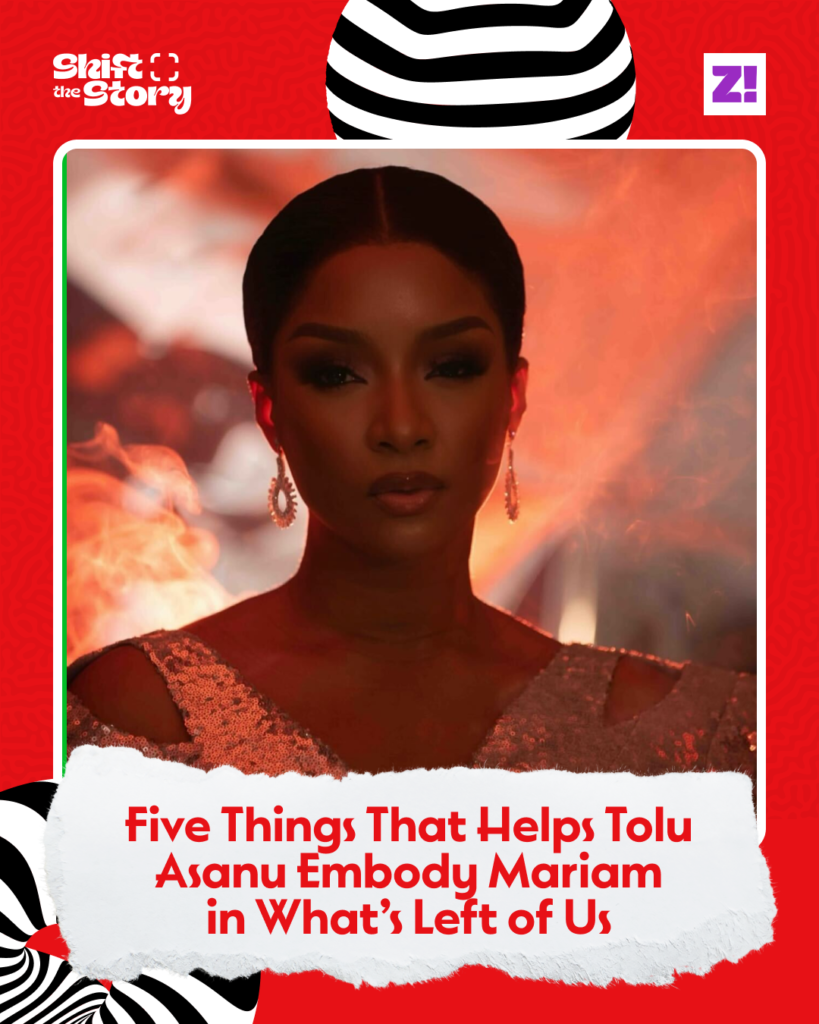
  • If you’ve watched the first episode of our Zikoko Life Series Production, What’s Left of Us, then you’ve already met a few of our favourites, Aliu and Mariam, in action. Well, maybe Aliyu isn’t quite a favourite. 

    However, if you haven’t seen it, what are you waiting for? Head over to our YouTube channel first, then come back to find out what inspired Tolu Asanu to take on the role of Mariam.

    We listened to Asanu talk about her acting career and what the journey has been like so far: auditioning, networking, and taking on roles that have done her good.  And, everything she felt for the characters in What’s Left of Us. 

    We’ve summed it up into five things that helped her embody the role of Mariam.

    1. Drive and Ambition

    Acting wasn’t always part of the plan for Tolu, so when she decided to pivot and change things, a lot of people were surprised at the unlikely direction. But for Tolu, the choice seemed non-negotiable. It was like acting was something she was made and born to do. She’d always had the talent and flair for it, being able to mimic people and take on roles she wasn’t familiar with. But like all things, there was no easy landing. Auditioning for roles and putting herself out there as much as she did wasn’t something she anticipated, but found necessary. 

    Luckily for her, she had legends like Joke Silva guiding and pushing her in the right direction. But one conversation, one successfully completed acting course and a role on The Johnson’s created opportunities and more. What’s Left of Us is just another essential layer of Tolu’s multilayered cake.

    “I usually watched actors with so much admiration and interest, and I was in the drama group in my church. I didn’t even know they did things like auditions; I just believed that if you worked hard, you’d get what you want. But it’s not necessarily the right orientation to have; you need to network. No one is an island in the industry.” –Tolu Asanu

    2. The Message in What’s Left of Us

    Her first thought after reading the script of What’s Left of Us was how powerful the final product could be, especially if everything went according to plan. For Tolu, the fact that the film seemed to be driving home a message was important to her. Especially how it might spoil the market for men. Part of it is also how northern women would respond to it. Seeing that it’s possible to break free from relationships that undermine them. 

    For Tolu, it’s important that women see that there’s more to life than sitting at home to cook, clean, and make yourself presentable for your husband. ‘How do you live if you keep doing the same thing over and over again?’. There are certain cultural and social norms she believes people are scared to challenge and question. For Tolu, What’s Left of Us is doing just that.

    “Me, that I’m talking to you now, there are certain topics that I get scared to speak about or roles that I worry about playing. I’ll think about what people will do and say if I say or do something. A lot of people can’t break free from cycles because they’re scared of what people will say.” –Tolu Asanu.

    Get More Zikoko Goodness in Your Mail

    Subscribe to our newsletters and never miss any of the action

    Also Read: Why Some Women Who Own Homes Don’t Want to Get Married


    3. Mariam’s Character

    Some of us might worry that Mariam’s doggedness and determination are too idealistic for the average Nigerian woman to emulate. But Tolu thinks otherwise. The starting point for her is loving yourself enough to do something, and contrary to popular opinion, Tolu believes the driving force for complacency is laziness and not fear. That’s one of the things she loved about Mariam, how she knew that she was the only one who could save herself. Her determination to leave and not beg Aliu when he sent her out of the house in the middle of the night. Mariam also didn’t hide under the guise of staying because of her children. 

    The fact that Mariam was doing something different and standing on business was important to Tolu. Drive and ambition are something both Tolu and Mariam seem to have in common. We’d call it the common ground and merging factor in how they become one. Mariam’s character made her want to do more than just perform.

    ‘A lot of women say they’re going back because of their children, and I don’t think all of them are telling the truth. I think they’re scared of what will happen if they leave. They need to know that if they take the bull by the horns and try to do something for themselves, they’ll be able to give their children better lives.’ –Tolu Asanu.

    4. The Opportunity to be Part of Something Big

    Everyone gets cold feet before doing something big or small, and Tolu is not exempt from that. She had doubts and feelings of apprehension and enthusiasm at the same time. But every time she read the story, Mariam moved Tolu in ways that made her want to take action. 

    What’s Left of Us felt like a story that was going to spark conversations and social and cultural content, and Tolu knew she needed to be bold enough to take the plunge. Even in the process of bringing the story to life, her focus was on making sure she delivered at full capacity. Even if it meant running one scene ten times. The picture for her was big, and the anticipated impact of the work was clear.

    ‘I’m happy I didn’t let all those thoughts take control of my head and affect my actions. I did what I had to do, and did it well, at least to the best of my knowledge. I even consider myself honoured to have been cast for the role.’ –Tolu Asanu

    5. The Team

    Beyond her stellar performance, Tolu owes the success of the film to the people she worked with. There was a lot of collaboration between her and her co-star, Caleb Richards, which not only made the delivery of her role easy but seamless. 

    The support she received from the directors, Olamide Adio, Victor Daniels and the showrunner, Blessing Uzzi, in moments of uncertainty. How solid, decisive, and intentional the pre-production team was. Working with a team that knew what they were doing also helped her know what she was doing. Everyone’s heart was in it, and hers wouldn’t be left out.

    ‘I really liked Blessing and the directors. They knew what they wanted each frame to look like. Everyone did their homework, and the entire team made input whenever and wherever it was necessary. I like productions like that, where everyone knows what they’re doing and pays attention to detail.’ -Tolu Asanu

    Click this link to see the result of Tolu’s driving forces and how they impact her character. 


    You’ll Also Love: I Was Almost Forced to Marry My Cousin at 11

    [ad]

  • Love Life is a Zikoko weekly series about love, relationships, situationships, entanglements and everything in between.


    Busayo (26) and Alabi (32) met in person for the first time at a mutual friend’s wedding in 2023, but nothing prepared them for how quickly things moved after. 

    On this week’s Love Life, they share how a casual connection turned into a full-blown relationship, what it’s like navigating marriage a year in, and why they’re convinced they found their person in each other.

    If you want to share your own Love Life story, fill out this form.


    What’s your earliest memory of each other?

    Busayo: My first real memory of Alabi was at a mutual friend’s wedding in January 2023. We’d exchanged a few texts prior, but that was the first time we met in person. Our friend had connected us in 2022, but it wasn’t anything serious then — just brief conversations and check-ins.

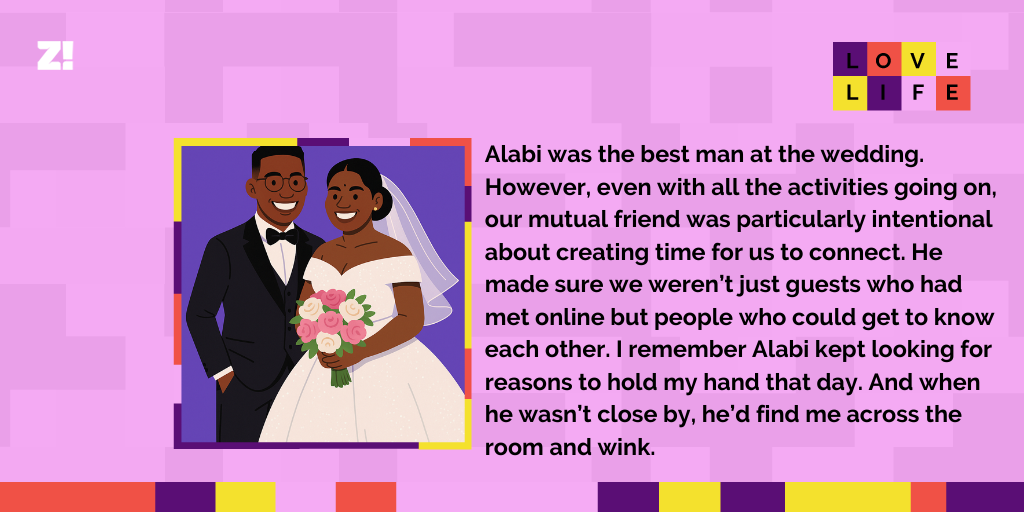
    Alabi was the best man at the wedding. However, even with all the activities going on, our mutual friend was particularly intentional about creating time for us to connect. He made sure we weren’t just guests who had met online but people who could get to know each other. I remember Alabi kept looking for reasons to hold my hand that day. And when he wasn’t close by, he’d find me across the room and wink. I won’t lie — it was sweet, and I felt very seen.

    Alabi: My memory starts from when our friend first connected us in 2022. I’d just finished university and was looking for internship placements. I was looking into the University of Ilorin Teaching Hospital and needed information about the environment. Our friend said he didn’t know much about the area, but he could link me to someone who had attended the school — that was Busayo. 

    He shared her number, and I reached out. She provided me with some information,  but I eventually passed up on the internship. Even though our chats didn’t lead anywhere serious, we occasionally stayed in touch.

    Months later, our friend was getting married and made me the best man. He kept talking about how I needed to settle down, and how he had the perfect person in mind for me. I realised it was Busayo when he sent her contact again. We laughed about it and agreed to meet at the wedding.

    Sweet. Were either of you single and searching at the time?

    Busayo: I was single, but I wasn’t searching. I wasn’t putting myself out there in any way.

    Alabi: I was searching very much. But it wasn’t just about dating — I was actively looking for a life partner.

    When I saw Busayo in person, I had a strong conviction that she was the one, and we would get married. I remember saying to her, “I’m going to marry you.”

    Busayo: The thing is, I also felt that conviction deep in my heart that we belonged together. However, I didn’t share this with him at the time.

    Get More Zikoko Goodness in Your Mail

    Subscribe to our newsletters and never miss any of the action

    I feel like I’ve missed something. Had Alabi shared how he felt about you before the wedding party?

    Alabi: Not really. However, we had several leading conversations that pointed towards my intentions.

    Busayo: Yes. There was also a lot of conversations around love, family and relationships. We were already asking each other about kids, relatives coming to live with us…questions people would only ask when they married or were about to. So even if it wasn’t said outrightly, it hung somewhere in the air.

    I see. Did he say anything when you met at the party? 

    Busayo: He did. We found a few minutes alone during the wedding party — nothing long, but just enough to have a moment. Then he said something like, “I really like you, and I’m serious about you.” However, I felt that the whole thing was happening too quickly, especially with the wedding energy and music in the background. It was a lot.

    Alabi: I felt like I needed us to have our own proper moment, outside of the noise and the pressure. So, I suggested a private hangout after the wedding to talk without distractions.

    Neat. When did this private hangout happen?

    Alabi: Two days after the wedding. I would describe it as one of the best moments of my life.

    Busayo and I got even deeper into our conversations about family, life, career and aspirations — things we’d briefly touched on over text. I thoroughly enjoyed every moment spent with her.

    Busayo: We were supposed to go somewhere nice, but because of all the expenses he had incurred from his best man duties, we agreed to meet at my place. We had a bet on who was the better cook, and decided to have him make vegetable soup. I got all the ingredients ready before he arrived, and after he did, he threw it down in the kitchen and didn’t disappoint at all. It was a nice time. 

    My younger sister was also around, and the way he connected with her made me smile. Later that day, when we had a quiet moment alone, we dove into another round of deep conversation about our values and dreams. In the middle of that, he asked me out again — this time in a more direct way. I told him I needed time to think about it, but he was persistent, and I ultimately said yes. We sealed it with a kiss.

    Curious. Why were you eager to get the ball rolling, Alabi?

    Alabi: I was searching, and at that point, I’d found what I wanted. I was drawn to her intelligence, her laser-like focus on her goals, and her family-oriented mindset.

    She’s pretty, too. She had everything I’d been praying to have in my wife, and I couldn’t let go. Everything seemed to click into place with her. 

    What were the early days of your relationship like?

    Busayo: They were pretty easy and peaceful days.

    Please, tell me more.

    Busayo: I didn’t have to do too much. I didn’t have to pretend to be someone I wasn’t. I could be myself around him and still be appreciated for that. It was beautiful. 

    It was also really easy to trust Alabi. He told me everything I needed to know without being asked and gave me access to his personal belongings. That was something I was just experiencing for the first time; no one had ever done that for me. He wasn’t judgmental and would always want to understand things from my perspective. It was clear that he wanted me in his life. 

    Even on days when I felt uneasy about the quickness of it all, he reassured me. 

    I remember telling my sister, “I think I’m going to marry him. My spirit just feels settled.” And she didn’t even question it — she could see I was happy.

    Alabi: I saw those early days as preparation for marriage. I already knew everything about Busayo — her background, her personality, her hobbies — so I was only preparing to pop the question and build a life together. 

    There were minor issues, but they were addressed promptly with intention and care.

    [ad]

    What kind of issues?

    Alabi: I don’t remember the specifics. I just know we had our fair share and found a resolution.

    Busayo: The only issue we had was communication. I was always ready to confront problems head-on on while Alabi needed more time. It was initially conflicting and difficult to navigate, but after some time, I realised he preferred taking his time. 

    I had to learn to be patient a lot, and I also had to be intentional about my approach and ensure I wasn’t presenting issues in an aggressive or infuriating manner. However, I should note Alabi was always open to apologising. 

    Alabi: The thing is, whenever we have issues, I prefer to reflect on what has happened and pick out the role I played, after which I immediately map out a plan to prevent such from happening again.

    Now, after I’ve done that, it doesn’t feel necessary to talk about it. She’s now made me understand the importance of addressing issues as soon as they happen. I’m learning to adjust.

    Busayo: I remember one of our issues happened during our wedding. We had agreed on our invitation list, and he went ahead and invited someone against our initial agreement. I felt bad about it, but around the same time I also did something to piss him off and he had to accommodate my excess. We realised we’d always offend each other, but we agreed to always seek a quick resolution before they escalate into a fight. 

    Speaking of getting married, when exactly did you know you’d fallen in love and wanted to commit forever?

    Alabi: I’ve always known that since I met her in person. The funny thing is, she met my mum before I officially introduced her, and even though my mum had no idea that we were already talking, she liked her naturally. That played a role in how easy it was for us to sync and the deep connection we shared from the outset.

    Busayo: The moment for me happened three months into our relationship. He invited me to meet his parents, and they asked me so many questions. The realisation that I liked this person a lot hit me as I answered the questions.  He also visited my parents the following month, and they grilled him with questions. At the end of it all, they also liked him. Our families syncing like that made it all so beautiful.

    Alabi: We got married on April 20, 2024.

    Curious, Busayo. Did you talk about your feelings with anyone else, considering you felt it all happened so fast?

    Busayo: I spoke with my brother and sister. My sister and I are super close, and she was there from the beginning. She agreed that our relationship was moving at a fast pace, but she could also see that I had never felt so strongly about anyone. Her only advice was to enjoy and make the best out of it without overthinking. My brother, on the other hand, wanted me to trust my instincts.

    And that you did. Has marriage been any different from dating? 

    Busayo: Oh yes. Despite our many conversations, there were things we didn’t know about ourselves, especially in the context of emotions until we got married. It’s been a mix of hard and easy navigating these differences, but we’re still here riding it through.

    It’s easy to get carried away sometimes and want to misbehave or not acknowledge your partner’s feelings, but I think that’s where prayer and gratitude come in. Every day I wake up grateful to have him in my life. Yes, we may not always agree, but we’re doing life together. I’ve trusted this man with my life, and I know he’ll always have my back. 

    It was also challenging to navigate marriage alongside my career. At some point, I had to change jobs, which came with a set of challenges, but I knew it was all for the better. In this short while, I think we’ve gone through every phase with the knowledge that things will get better, and we’re making sacrifices for the good life we want.

    Alabi: I agree with everything she’s said. Marriage hasn’t been drastically different from dating, but it has shown us sides of each other that we didn’t fully know. We’ve had to grow in patience and understanding. I’ve had to learn to be more emotionally available, and she’s had to adjust to my communication style. We’re still learning, but I think the best part is that we’re committed to figuring things out together—no matter how tough it gets.

    How would you say being with each other has changed you over the years?

    Busayo: My sense of commitment and trust has gotten significantly better. Before I got with him, I always had reservations about trusting people entirely due to past disappointments. I also tailored my expectations of people. But Alabi has shown me that vulnerability doesn’t always lead to hurt. I also expect more from people now, not in a bad way, but because I’ve seen what it looks like to be treated right.

    Alabi: I’d say being with each other has pushed us to be better in all ways — career, personal life and interactions with others, and it’s been beautiful because we consciously strive to make ourselves better.

    In particular, my communication style has significantly improved. I’m learning to open up more, rather than shutting down whenever there are issues. 

    Right. How would you rate your love life on a scale of 1-10?

    Alabi: I’ll give us a 10. We’ve had a fantastic and beautiful journey so far, but I hope and strive to be a better husband for her.

    Busayo: Can I say 100? Okay, maybe an 8 — there’s always room to grow, but I’m truly happy. I don’t want to think about anything that could be more beautiful than what we currently have.


    If you want to share your own Love Life story, fill out this form.


  • Love Life is a Zikoko weekly series about love, relationships, situationships, entanglements and everything in between.


    What’s your earliest memory of each other?

    Lauretta: It was around the last few months of 2023; I forget exactly when. I was looking for a job in finance and landed an interview after searching for a bit. When I got to the venue, I saw Joe, who had also come to interview for the same job.

    The interview was a very long process, so we interacted a lot.  He sounded really smart — like the kind of guy I could like. He wasn’t from a finance background, but he spoke like he was, which I found extremely attractive. And well, he’s also really fine — tall, dark and handsome.

    I copied his work for part of the written interview. But when I returned from my oral interview, he had gone in for his, and I didn’t get his number.

    Joe: That’s correct. We were at the interview in 2023, and she was this babe with the brightest smile in the room. I clocked the moment down to a T — I even remember her hairstyle and dress. We didn’t talk that much because a lot was going on, but the quality of our conversations piqued my interest. It was good banter and mentally stimulating. Unfortunately, she was gone by the end of the day before I could get her number.

    Ouch

    Lauretta: The good thing is that we both got the job. I resumed the office a few weeks later and ran into him again. I was like, “Youuuuu!”

    Joe: I’d have found that number even if we hadn’t met at the office. I’d have asked around from mutual friends we made during the job interview. But yeah, we reconnected that day, and I was happy to be in her company again.

    Sweet. You guys hit it off immediately, didn’t you?

    Joe: We definitely did.

    Lauretta: The friendship was instant. We spoke like we had known each other our whole lives.

    Curious. Did you make any other friends at the interview?

    Lauretta: We made the same friends that day, but Joe was the only person who felt anything like my type.  From the first day, I felt like I’d found my person for real.

    Joe: The connections I made that day were mostly platonic. I didn’t attach any special feelings to them. That said, I was attracted to Lauretta from day one.

    Get More Zikoko Goodness in Your Mail

    Subscribe to our newsletters and never miss any of the action

    Right. So what was it like navigating a new job and a new friendship?

    Lauretta: It felt really good. Our job is pretty hectic, and having someone I could talk to about anything was comforting. Joe and I worked together, taught each other things, and made silly jokes throughout the workday. He also bought me snacks, which made work easier.

    Joe: Those days were amazing. Like she mentioned, we had strong banter from day one, which made working in the same office pretty cool. I say we didn’t have a real friendship development phase… we just hit the ground running.

    I knew who to go to whenever I got frustrated. We understood each other on a deep level, and that made dealing with whatever external difficulties we faced at work much easier..

    Lauretta: It also helped that we were in the same department, so we sat close to each other most days. At some point, we became so close that our bosses pulled our seats apart, but that ultimately didn’t stop anything.

    At what point did feelings come into the picture?

    Lauretta: Pretty quickly, honestly. After I saw him at the interview, I told my sister I’d seen a guy I liked. So the initial interest made it easy for feelings to grow naturally once we started working together. Again, Joe is a really smart guy, and I liked that a lot.

    Before him, I hadn’t been in a proper relationship. I was just going on dates, living my best life, and trying to avoid men and their wahala. But I met Joe, and I wanted to be his. He didn’t want a relationship initially, but he eventually decided I was best for him.

    Joe: I hadn’t been in an official relationship either. I always prioritised my career and never explored anything serious with the people I dated. But the bond with Lauretta felt different. Stronger. I even had a phase where I tried to ghost her.

    Wait, what?

    Joe: It’s something I did in past situationships to exit quietly. But the ghosting barely lasted a weekend with Lauretta. I moved my seat away from her on a Friday and stopped talking to her. That weekend, I told a close friend I might end whatever was brewing between us. But on Monday morning, I folded before 11 a.m.

    Lauretta: I came to work that Friday to find out he had moved his seat far from mine. He didn’t talk to me at all. I sent messages, and he ignored them. It felt so strange not to talk to him. I had no idea what was happening, but I gave him space.

    I didn’t find out what had gone through his mind until weeks later, when he confessed his feelings.

    Joe: About three months in, I realised there was no point fighting it. While I’m still career-focused, she fuels that drive. We talk about work, and she offers insightful perspectives while being a source of emotional support.

    When did you make things official?

    Joe: A few weeks before her birthday. Very questionable timing, financially.

    Lauretta: It was one day in April 2024, when I wasn’t expecting it. I was at his house, and in the middle of getting some action, he asked me to be his girlfriend. I was shocked, but it was sweet and intimate.

    Curious. What was the situation at work at this point? Had anyone suspected you two had something going on?

    Joe: Not really. A few people knew, but the rest just speculated.

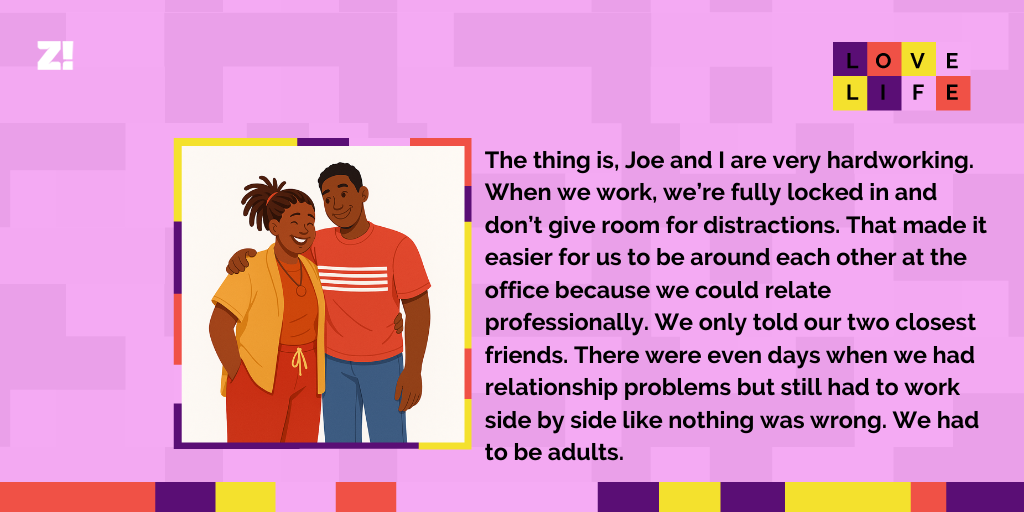
    Lauretta: The thing is, Joe and I are very hardworking. When we work, we’re fully locked in and don’t give room for distractions. That made it easier for us to be around each other at the office because we could relate professionally. We only told our two closest friends.

    There were even days when we had relationship problems but still had to work side by side like nothing was wrong. We had to be adults.

    [ad]

    What were the early days of dating like?

    Lauretta: They were really good. I finally had a boyfriend, and that felt nice. But our interactions didn’t change much — we were already acting like a couple. We just had the official tag now.

    Joe: I like describing those early days as “magic.” The honeymoon phase is underrated. “Baby, babe, Ife mi, olowo ori mi…” Yes, we already acted like we were in a relationship, but we became more intentional. We scheduled monthly dates and made relationship rules like not going to bed angry. They were sweet days.

    And when you moved past the honeymoon phase?

    Lauretta: I don’t think we’ve moved past it; the relationship has just evolved. We both struggle with communication. I talk a lot, and Joe doesn’t talk as much. It’s something we’re still working on. But we try to understand each other and are committed to growing through it.

    Joe: I don’t believe the honeymoon phase has to end. It only dies when people start taking things for granted. Yes, arguments last longer and linger more, but we’ve remained committed to choosing each other. I’ve also learnt that communication should be your best friend in any relationship.

    Why is communication still a struggle if you’re always around each other?

    Lauretta: We communicate differently. Sometimes we’re physically present but mentally elsewhere. I’d say things like, “Babe, we haven’t spoken,” and he’d respond, “Aren’t we beside each other?” I had to explain that I needed more from him.

    Joe is more of a listener, and I talk more. Now, we’re both trying to meet each other halfway.

    Joe: Communication is nuanced. I used to think it was simple: talk, listen, respond. But Lauretta sometimes communicates without saying anything. Her body language might contradict her words. It took time to learn how to interpret that. I’m still learning, honestly.

    Also, early on, we both got upset about not being informed about important things. Now, we’ve worked out what information we should always share with each other.

    Lauretta: The funny thing is, we communicate more now that we don’t work together anymore.

    What? Did someone get transferred?

    Lauretta: No, Joe left the company.

    Joe: I left this year for an opportunity I couldn’t pass up. Lauretta knew every step of the way. We had long conversations about how it might affect our relationship. But we’ve adjusted well.

    How did you handle the transition, Lauretta?

    Lauretta: I supported him 100%, even though I was losing my work bestie. But like he said, we’re one call or Uber away. 

    How did you deal with not seeing each other as much?

    Lauretta: Work was hectic, even when we worked together. We didn’t always have time to talk. But now that we’re apart, we prioritise time together. We go on dates, take walks, and send each other gifts. It’s like we’ve found a new rhythm.

    Joe: It’s harder not seeing her daily. If anything, it makes me miss her more.

    Right. Have you guys had a major fight yet?

    Joe: Yes — last Christmas. We broke up for a day.

    You guys keep shocking me. What happened?

    Joe: We had planned to spend Christmas together and had an elaborate day mapped out. But that didn’t happen because of what came up.

    Lauretta: We had promised to be 100% open with each other because we value honesty. But something was going on that I didn’t know how to tell him, and it involved another guy. He found out a few days before Christmas and broke up with me. I tried to explain, but my coconut-head boyfriend didn’t want to hear it. He’s very principled.

    Eventually, we met again — not necessarily to get back together, just to clear the air and not part as enemies. But as God would have it, we ended up right where we belonged: in each other’s arms.

    Curious. How did he find out about it?

    Lauretta: He asked for my phone. We already had each other’s passwords, but he’d never actually checked it. He read my chats with the other guy. Just to be clear — I didn’t cheat. But I should’ve been upfront with him earlier.

    Joe: I felt disrespected and annoyed. If we were serious about building something together, our words had to stand for something. We agreed on honesty, and this wasn’t that. I started wondering whether everything we’d talked about really held value. I know people aren’t perfect — I’m not either — but it made me question things.

    How did you resolve the issue and handle similar ones going forward?

    Joe: We went back to the basics: communication.

    Lauretta: We talked through everything. We both understood that the issue couldn’t be swept under the rug. Now, we talk through things immediately. We come clean, even when it’s uncomfortable. And being friends first really helps with that. We’ve also agreed that if it ever becomes too much to manage, we’ll be honest enough to end it with love and stay friends.

    Joe: It’s not like I haven’t made the same mistake. There was a conversation I had with someone I used to see. I didn’t think it was deep, so I didn’t mention it. But Lauretta found out a few days later. She wasn’t happy because we’d agreed to disclose any interactions with past partners. We moved past it by talking, just like we always do.

    Neat. What’s the best thing about being with each other?

    Lauretta: Joe’s so caring. I honestly worry less knowing I’m with him. He listens to everything I say, helps solve my issues, gives me investment advice, treats me like a princess, and the sex is amazing. Loving him just feels good.

    Joe: Beyond the fact that she’s drop-dead gorgeous with the sexiest body, Lauretta is kind, thoughtful, loving and incredibly smart. She fuels my drive. She truly cares about me, respects me and understands me like no one else. And like she said, we have bomb sex.

    I love it for you guys. On a scale of 1 to 10, how would you rate your love life?

    Lauretta: Definitely a 10. This man understands me, and I can’t imagine being with anyone else.
    Joe: It’s a 10 for me, too. We’re not perfect, but we’re intentional. We show up, learn, and grow, making this love feel sustainable and real.


    If you want to share your own Love Life story, fill out this form.
  • Love Life is a Zikoko weekly series about love, relationships, situationships, entanglements and everything in between.


    Trade on Yellow Card and win tickets to see Gladiator 2! Trade $10+ for a chance to win Filmhouse tickets or go big and trade $1,000+ to win Cube tickets. 

    Enjoy low fees, great rates, and top security. Join Yellow Card today!


    What’s your earliest memory of each other?

    Chidi: I met Oma during a class rep interview in January 2023. I was the department’s president, and I had to conduct the class rep election for first-year students. She was one of the aspirants. Her delivery during her interview was excellent. She made my seemingly difficult questions look easy, so I asked harder ones, but she still aced them.

    Oma: I’d just gained admission to university, and I contested for the class rep position in my department because I was interested in politics. I noticed him sitting inside the department’s secretariat while interviewing candidates. In my mind, I thought, “He seems calm, like someone determined but collected.” I also noticed his eyes—they were pretty, although I never told him this.

    Chidi: I later found out she’d authored some novels. I was like, “Author as how? Aren’t you in year one?” 

    In that moment, I thought, “I like this one. She’s the kind of lady I’d want to be with.” I even said a silent prayer to God about her. But then I heard her age, and I took a step back.

    How old was she?

    Chidi: She was 16 — a few days away from her 17th birthday, though I didn’t know that yet.

    I see. So what happened next?

    Chidi: She won the election. I wanted to help her get acquainted with the new role and offered to answer questions she might have, and she had many. We started talking more often; we’d always meet around the department, and she’d have a question or two for me.

    Oma: I had challenges with the role, and whenever I had a problem, I’d call or text him for advice. I remember one morning when I called him about a tutorial issue. He gave directions, and we ended up laughing together on the phone. That was when I realised I was starting to like him.

    The next time we spoke, he explained that during his first year, he had a senior colleague who helped him navigate those early days, and that’s what he was trying to do for me. After he said that, I reminded myself that he was only trying to be helpful, and I shouldn’t see his actions as anything more. From then on, we didn’t let our conversations get personal. It was strictly school-related. Even then, he started pulling away, and I noticed it. Although I didn’t do anything about it, it made me sad. I value my self-respect, and I was more than willing to return the energy if he wanted space. 

    Why did you take a step back, Chidi? 

    Chidi: I would say it was her age and personal boundaries. For one, I felt being a guardian would help her avoid mistakes I made during my early years.

    At the same time, I wasn’t a fan of interacting too much with junior students because I didn’t want a “see finish” situation. 

    Still, with her, it was different. She had my mumu button. Anytime she called, I was eager to see how I could help. A part of me also wanted her in my circle just because she seemed really smart. 

    Did you notice when she started withdrawing from you?

    Chidi: I didn’t. I just knew that we weren’t so close, and on my part, I knew I was deliberately keeping a distance. I wanted her to mix with other people in school and not be boxed around me since I was among the first connections she made. 

    Fair. So, how did the relationship evolve from mentor/mentee to something else?

    Oma: It was gradual. We had lengthy phone calls once every three or four months because he’d graduated and wasn’t around the school premises often. At this point, we’d started broaching other topics that weren’t about school, even though we’d still not gotten to talking about our personal lives.

    I’d see an interesting video or tweet and send it to him to get his thoughts. At this point, our dynamics had slowly shifted from mentor/mentee to friends. Also,  we started talking more frequently. I was pretty happy about the change. He’s such a smart person, and I wanted to have him in my circle for support. I also didn’t want him as a “senior colleague”, I wanted him as a friend.

    Chidi: Yes, we didn’t really talk when I was in my final year. Then I graduated, and we started talking a whole lot more. She would ask if she could call, and we would talk for hours, discussing everything from academics to her social activities in school and other pockets of gossip.

    But I think the big change for me came in May 2024. I bumped into her during my clearance, and her excitement was so evident that my friend teased me, saying, “This babe likes you. See the way she was looking at you.”

    That night, I called her, and we talked for hours. I was trying to figure out if she was still single—and she was.

    If you want to share your own Love Life story, fill out this form.
    I’m curious. What was your relationship status at the time, Chidi?

    Chidi: I’d been single most of my life, except for a six-month stint in secondary school. I had crushes here and there, but  those never became anything more because I realised we wanted different things. I was wary of being with the wrong person. 

    So, what happened after you found out she was single?

    Chidi: In May, I asked her if she liked me. She said she didn’t want to answer the question, and I felt she was offended. I also thought I had ruined our friendship. 

    Oma: I wasn’t sure if he liked me, so I didn’t answer the question. I’m not one to tell you I like you if I don’t know you feel the same way. Moreover, I wanted to be patient and let us continue as friends. I’d never been in a relationship before, but as a firm believer in best friends making the best partners, I wanted to focus on building a friendship with him.

    I knew that if I told him I liked him, it would change the dynamics of our friendship, and I didn’t want that. I’ve always fantasised about being with someone who loves me as deeply as I love them. We hadn’t gotten to that point at that moment. 

    Chidi: Anyway, we remained friends, asking questions to test our ideologies, and getting to know each other better. Then, in October, she tweeted that she was going to tell a guy that she liked him. My heart skipped because somehow, I knew it was me. After the tweet, I got a text from her saying, “Can we jump on a call tonight?”

    How did the call go?

    Oma: When I made that tweet, I was telling my friends how much I liked this guy and how it felt like I’d die from the crush. My friends encouraged me to “go for it!” I remember saying in my heart, “God, I like this person so much my chest is overflowing with it, and I cannot keep it anymore lest I run mad…so I must tell him. God, I must tell him.” 

    I called him that evening and tried to lighten the mood by asking him how he was. I was basically yapping. And then, out of the blue, I was like, “Fuck it. I like you. Do you like me too?” 

    He started telling me stories of how he had noticed me since the first day he saw me, and I was like, “Bruv!  That’s not what I want to know. DO YOU LIKE ME TOO?”

    I was eager to find out because my friends had told me that if he didn’t feel the same way, we could buy ice cream, eat and cry together, and I’d get over it. So, I wanted him to get to the point so I could know my fate. It was also my first time telling someone I liked them.  Like actually going after someone I wanted…so I was scared. 

    Anyway, he finally got to the point and said he liked me since the first time he saw me. I was like, “Sharp!”

    Chidi: She called and started talking about her friend. In my mind, I was like “Is this why we are here? Go straight to the point.”

    After she told me she liked me, I told her I’d always liked her, but I was waiting for her to graduate before telling her.

    Before then, we had a conversation about grooming, and that was when I learned not to think or assume for her.

    Tell me more about this conversation 

    Chidi: I shared this Zikoko’s story to hear her thoughts on. I’d always assumed that the five-year age gap  between us was a lot and could be perceived as a case of grooming. 

    However, Oma tells me, “It’s not actually five, but four years and three months.” She then explained the difference between age-gap relationships and grooming and shared more resources on what grooming is. During the conversation, I was in awe of her level of intellect and knew we would be together. 

    Oma: Most people feel that when there’s a certain age gap, the older partner has somehow manipulated the younger one into the relationship. I explained to Chidi that as long as both partners are adults with pure intentions toward each other and choose to be in a relationship, then it’s fine.

    When it comes to grooming, there’s often malicious or manipulative intent from the older partner towards the other, but that’s not our reality. Regardless of the age gap, we have pure intentions toward each other. Nobody is manipulating the other. I know what I want, and I know what I’m doing. People can have age gaps and still respect and love themselves in their relationships. I believe that’s what we have.

    How do you recognise these pure intentions, Oma?

    Oma: I’m spiritually sensitive. I sense energy and often see people’s true intentions in my dreams. This has been happening since I was little—I dream about something, and it comes to pass. There were people I could have dated, but spiritually, I never saw them in a good light, so I didn’t pursue those relationships. I firmly believe the spiritual governs the physical.

    With Chidi, before we even started dating, I remember writing in my diary, “I get the energy and feeling that he genuinely cares about me.” 

    My dreams about him were positive, and that’s how I know he has pure intentions toward me. As for myself, I know my intentions for him are equally genuine. 

    Beyond my dreams and intellect, I have older friends—women who are mothers and far more experienced. I talk to them often, and they’re honest with me, even when my feelings might cloud my judgment. They’ve helped me see things I might have overlooked. Between their guidance, my dreams, and the way I pay attention to even the smallest actions, I’m confident I’d know if this relationship wasn’t right or has an element of grooming.

    Chidi, you mentioned pulling away earlier due to Oma’s age. Did you think approaching her was grooming then?

    Chidi: I think older guys sometimes use their experience to lure and manipulate younger girls, and I hate it so much. The “catch them young” bullshit.

    At the time, I felt a 21-year-old guy dating a 16-year-old girl was different from a 28-year-old guy dating a 23-year-old lady. So, for me, time was the most important factor. I wasn’t going to have anything with someone under 18, and I preferred to wait until we were ready, and I think I can say we are now.

    Were you ever bothered by the age gap, Oma?

    Oma: I wasn’t. I told a close friend of mine, and she said, “The age gap is okay.” But even if my friend hadn’t supported it, I wouldn’t have cared. I’ve always believed that one can have an age-gap relationship with love, respect, and peace of mind, while a relationship with someone your age could be full of chaos.

    So, no, the age gap never really bothered me. What mattered most was that I felt heard, seen and cared for.

    Right. Talk to me about when things became official 

    Chidi: I asked her out in October. It was surreal to be with someone who ticked all my boxes finally—she’s kind, career-oriented and really intelligent. And to think that we agree on almost everything, I’d say that I won for real.

    Oma: I was excited and scared; I’d never dated anyone before. I’ve always been so focused on my life and goals, but I’m glad about how everything went.

    [ad]

    So, what has the last month been like?

    Oma: We’ve been taking things easy and slow. It’s important we stay patient with everything, including our relationship. We’ve been talking and laughing, and above all, we’ve been friends. The friendship makes our relationship easy and chill for me. I like it. Anytime I remind myself we’re friends, it calms my heart. 

    Chidi: I agree that things have been pretty chill. I’m learning how to communicate better and not assume for her. I love how patient and super supportive she is.

    Patience is something you both hammer on. What’s that about?

    Chidi: This is our first relationship as adults, and since we’re also invested in being friends, we don’t want to push things too fast and get overwhelmed. We don’t want a situation where we lose the relationship and friendship. So, we’ve decided to do everything at our own pace. The visits and “how far” we can go in the relationship whenever we meet. I think it has made us not lose ourselves now that we’re dating.

    Oma: We stay in different states. So, rather than rushing to see each other, we’re focusing on our goals. I’m focusing on my studies and career as a creative. We’re not putting a timeline on anything. We don’t have to rush the back-to-back dates, physical hangouts and such. It’s also a long-distance relationship, and I’m happy with how it’s going so far.

    Speaking of long distance. How do you both plan to make things work? 

    Chidi: For now, we text every day and call from time to time. Last week, we had our longest call ever—eight hours. 

    Oma: We’ll probably meet next year. But for now, as he mentioned, we communicate a lot via phone calls and texts. It has made the long distance easier for us. 

    What’s the best thing about being together, and what comes to mind when you think about the future of this relationship?

    Oma: I love his laughter. For some reason, I could sit down and listen to him laugh. It’s crazy. But aside from that, my favourite thing about being with Chidi is how he makes me feel heard and seen. 

    Our future looks promising. There’s no need to worry; it’s in God’s hands.

    Chidi: I love how we support each other’s goals. Oma has lofty goals—she’s a multi-disciplinary artist who writes, sings and films. She’s a published author at 18, and plans to get her masters and PhD in creative writing. I constantly remind her that I’m her number one fan, rooting for her to do all the amazing things she can think of.

    With her, the future excites me a lot. In my head, we are married, living the power couple life and bringing out the best in each other.

    Oma: I always think of things in the long term, and that’s why I haven’t dated anyone until now. I don’t have time to waste getting attached to someone I see no future with. I see things in the long term with him, and marriage would be chill.

    On a scale of 1-10, how would you rate your love life?

    Chidi: It’s a 10 because she ticks all my boxes. I love how she’s career-driven, her feminist views, and our similar views on almost every topic. I never wanted to end up with an opposition, and I’m glad she’s not one. 

    Oma: Even if we have opposing views, we’d respectfully share our views and respect each other’s thoughts.

    I’ll give us a 9.5. The missing 0.5 is because this still feels like new territory for me. I sometimes feel nervous because I’ve never done anything like this before. But I also know it gets better, and we’ll be good.

    READ THIS TOO: His Weight Loss Feels Like Betrayal

  • Love Life is a Zikoko weekly series about love, relationships, situationships, entanglements and everything in between.

    What’s your earliest memory of each other?

    Amara: She came to my department with a mutual friend in 2017. I thought she stood out because of how she dressed. I honestly can’t remember what she was wearing anymore, but it’s what I took away from that first introduction. In my head, I was like, “Oh wow, this person looks interesting”.

    The next time we met was at a study session in the BQ of a friend’s then-boyfriend. 

    Eseosa: The first time I noticed him was at the BQ. I wasn’t part of the study session because I was in a different department. But I was almost always with my friends during my free time, which was a lot because I didn’t really care about school. Anyway, my friend had a natural hair business and I helped her with it. That day, we had a few errands to run, and she needed to pick something from the BQ where they were having the study session.

    We didn’t stay long, but that was the first day I properly noticed him, even though we didn’t talk. 

    What did you notice about him, Eseosa?

    Eseosa: I mean, I thought, “Oh wow, this boy is fine,” and that was it.

    So what happened next?

    Eseosa: The years passed. At least three years, if I’m correct.

    Amara: Yes.

    Eseosa: At the time, I was still at university and was going through a lot. He and our mutual friend attended the same church. One day, our mutual friend came to me and said, “You’re following me to church.” I got to the church, and he was there. I was like, “This fine boy is here again.” I hadn’t developed a crush on him then; that didn’t happen until later. 

    Oh

    Eseosa: Thanks to my friend, I started attending their church, and we were always together. The church was small and cosy and served coffee and biscuits after service. People didn’t leave on time because the atmosphere was great for conversations, plus we had a friend who always drove us back. So, it was a thing where, after church, we all stayed back until everyone was ready to leave. And that was how we started talking.

    When was your first conversation?

    Eseosa: We’d been assigned as each other’s prayer partners. You and your partner had to spend the week praying and reporting how it went to our pastor. My faith was watery, but Amara is someone who likes to finish things. One Friday, he reached out to me and said, “Guy, we have to do this prayer thing,” and then he came to my hostel afterwards.

    Everywhere was crowded with people who came to see their lovers that night. While he was trying to find chairs for us, I sat on the floor. He eventually joined me and  we got into a conversation. 

    We yapped about different things and only remembered to pray afterwards. We became friendly after that night, and I developed a strong crush on him.

    Amara: That night, we spoke about everything: her faith, our praying habits, and our individual views on aspects of spiritual life. All of my discoveries about who she was at the fundamental level happened during that conversation.

    However, what struck me the most  was how she chose to sit on the floor. I have female friends, and I’ve come to realise that for most women, it takes a long time before they can become their most authentic selves around a guy, which is normal. I expected that to be the natural progression of whatever we had going on, so I was shocked when she sat on the floor. I still admire that about her to date. 

    Anyway, it was from the conversation that night that we became cordial. We spent the next year and a few months being cool toward each other. But we were still not “friends friends”.

    Hmmm. So, when did things progress to the next level?

    Amara: It was after I got out of a relationship in September 2020. 

    I’ve always avoided extended conversations with the opposite sex when I’m in a relationship; it’s a sort of boundary that I put in place to make sure I don’t leave room for cheating. I don’t expressly say it; I just do it. 

    I think she noticed that I’d relaxed my boundaries. I’d started talking to her and other women. I should be clear: I wasn’t looking for a new relationship. I was at a point where I’d let down my guard and started enjoying conversations with other women, without worrying about crossing any personal boundaries tied to an existing relationship.

    One day, a conversation came up and she wanted to find out who I was interested in, seeing that I’d become single. I was like, “ Yeah, I cannot tell you that.” For me, it was partly because I wasn’t ready to build anything. 

    But Eseosa knows how to pester you; she’s like a bug. Eventually, she said there was someone she also liked, but she would only share the details if I revealed who I liked. It was after that I told her she was the one. 

    I think she was in shock for a few minutes before revealing she liked me.

    Eseosa: His ex used to attend the same church as Amara and I; you could say we had a budding friendship. We were also in the same church unit, and it only made sense to befriend people you work with.

    Anyway, I noticed I wasn’t really seeing his ex anymore around COVID. I reached out to her, and she said she was fine, but she didn’t tell me they’d broken up. I also noticed that he casually mentioned that she was fine when I asked him about her, but I wasn’t fine with that answer, so I pressed on until he told me they’d broken up.

    I was bummed by the news because I actually liked them together, but it started to make sense why he’d become more lax. However, there were two other girls that I thought he had his eyes for. I thought if he was going to be interested in anyone, it would be with one of these people.

    Then, two  months later, the conversation about who we liked happened. I truly didn’t expect he would say my name because I assumed he thought of us as just friends. I didn’t think he wanted me in that way. 

    That’s why I wanted him to say a name first. So if he didn’t mention my name, I’d wiggle my way of telling him mine. Imagine telling him I like him and finding out he likes someone else.

    If you want to share your own Love Life story, fill out this form.

    Fair. What did you guys do with this “mutual likeness”?

    Eseosa: We sat on it for a bit. It was like, “Now that we are both aware, what do we do with this information?”

    Amara: We were supposed to wait between three to six months before dating.

    Why?

    Amara: Our pastor set a dating rule for young people in the church to achieve two goals: to ensure that people have properly processed their past relationships (before getting into a new one) and that the person you’re starting a new relationship with doesn’t feel like a rebound.

    A challenge I didn’t notice, however, was the willingness of the new person you want to date to wait for you. So, I communicated this with my pastor, who waived the rule because my ex had stopped attending church.

    Eseosa: I was ready for a relationship, and I’m not one to talk to one person exclusively. I was talking to him, enjoying the conversation, but there was another person I’d gone on two dates with.

    I like to know the script. If I say I like you and you say it back, what are we doing with it? I don’t just “go with the flow”. So when he told me about the rule and timeline, I said it was fine, but “don’t expect me to wait for you.”

    Amara: Once I was sure that we both knew what we wanted, I asked her to be my girlfriend. This happened in November 2020, two months after my previous relationship ended.

    Sweet. What were the early days like?

    Amara: They were amazing. I was discovering this person who is very true to herself and has a number of talents. She draws, and sings, and because of that, we got to do a lot of goofy things on video calls. Plus, she’s also the funny one in the relationship.

    Eseosa: It was like love in Tokyo.

    We had just come out of a pandemic and graduated from school, so we had a lot of time on our hands. We fell asleep together during phone calls and did all the mushy things you’d roll your eyes at on social media. But those days were also triggering, not in a bad way. 

    Please, explain.

    Eseosa: When we started dating, I was in a headspace where I was carrying some emotional baggage — personal troubles and childhood trauma. 

    These things had held me back in previous romantic relationships, but I was getting better and making progress. But then, do you know how people say you feel lighter when you shed bad stuff? They never mention the need to fill the vacuum you’ve created. Now, because you’ve been used to so much negativity, you want to replace it with positivity, but you don’t even know what that looks like. It’s a very weird space that triggered me a lot.

    I was in a relationship where everything was so easy. With Amara, all I had to do was communicate — but I wasn’t used to that. So, I started self-sabotaging. I was convinced I’d ruin the relationship because it felt too good to be true.  On some days, I’d say I didn’t want to talk, and he’d understood. 

    But at some point, he called and said, “We can’t keep doing this, what really is the problem?” I told him I was scared, and when he asked if I wanted us to end, I said “No”. Eventually, I had to learn to stop being scared.

    Again, the early days were great; I just never expected to be triggered by how good they were.

    Amara: I acknowledge that these things happened, but they weren’t significant enough for them to be the defining memories of our relationship’s early days. From my POV, there were a lot more positives than negatives.

    I should also add that one factor instrumental to the success of the first three years of our relationship was the counselling sessions with our pastor.

    Eseosa: It was pretty much marriage counselling.

    Wait, you attended marriage counselling while dating?

    Eseosa: Our church’s structure is that once a relationship has been steady for three to six months, you present yourself to the church authorities for counselling. Couples who attend talk about a range of topics and possible scenarios that can arise in the home. The idea was that if you’re dating, it’s because you’re both working towards marriage. And the church was right — four years later, we decided to get married.

    Amara: Anyway, she’d occasionally drag me to a meeting with our pastor and table a matter she felt we needed to address, especially if I had a problematic perspective about the issue. 

    Having a neutral third party whom we both respect offer advice and their perspective helped us see things from a different lens. It helped that we respected them, which made us consider their suggestions and figure out what works for us.

    Another thing that helped was a review system we painstakingly used to find out what we’d done wrong and what we could do better.

    Interesting. So, what was your first major fight about?

    Eseosa: I can never forget because I broke up with him right after.

    Ah.

    Eseosa: So, we were both in the same unit at church, and I was in charge of outfits. Basically, I decided how everyone appeared on Sundays. 

    Some people couldn’t get their stuff together and I only found out at rehearsals on  Saturday. While I was having a conversation with two people, someone barged in and was really rude to me. I didn’t know what warranted the rudeness, but I also had to excuse myself around that time to use the restroom.

    When I got back, Amara and other church members already had a roundtable discussion about how I handled the situation. My grouse with Amara was, we were both leaders in the group, and I felt he could have levelled with me without the entire roundtable discussion. That felt like a pile on. 

    I was angrier at the fact that I tried to communicate how the person had rudely approached me while he stood watch, and he tried to dismiss my feelings. He got defensive and couldn’t see from my point of view that I was the aggrieved person. The whole thing  dragged on, and he tried to resolve it, but I didn’t like how he went about it. I texted him that night saying, “Omo, don’t do this to your next girlfriend.” In my mind, I’d clocked out of the relationship.

    I’m curious, how did you take the break up, Amara?

    Amara: I didn’t know she broke up with me. I just read her text as a message and didn’t interpret it as deeply as she meant it.

    The thing with letting go is that I don’t remember much details, but I think that’s been our biggest fight so far. One thing that stood out from the event was that it was the one time I saw that my pastor’s ability to help me see things differently helped to keep our relationship going.

    How did this experience help you manage conflicts going forward?

    Amara: We now have a list of guiding rules that we bump up from time to time in light of new information, research or feedback.

    One that stands out is, “Don’t bring up your issues when I’m sharing how I feel about something you’ve done”. You help to validate my grouse with you first, and you can talk about yours later.

    Eseosa: The most important thing is what he mentioned. 

    Sometimes, we get defensive. We don’t get it right all the time, but we’re both aware of these guiding principles. Our first instinct as humans is to defend ourselves or justify what we’ve done, but these principles help us navigate the tide.

    Another rule is, we must always reach a resolution. No matter how small, we can’t move forward until we resolve it.

    [ad]

    You mentioned you’re getting married earlier. When did you know y’all were headed there, Eseosa?

    Eseosa: I’m a very impulsive person. 

    A lot of big decisions I’ve made were in the moment. Thankfully I’ve not made any horrible big decisions in the past couple of years. But the “I want to marry this person” decision was very logical.

    I was never marriage hungry; I was fine whether it happened or not. However, with Amara, the whole experience is positive.  He gives me room to grow, holds me accountable, calls me out on my bullshit, and he’s my safe space. 

    So, it was like, if I’m going to get married at this moment, this is the person.

    What about you, Amara?

    Amara: I’ll say the defining moment for me was when I asked myself, “What is out there that I don’t have?” And the more I examined our relationship, the more I realised that I had everything I was looking for.

    How would you say the relationship has changed you?

    Amara: I used to consider myself a very patient person but relationships require a different type of patience. 

    There are moments in our relationship when one of us is struggling because of something the other person is doing, and you know you just have to be patient. I’ll admit, those times have demanded more from me than I ever thought I could give.

    Eventually, it becomes like building a patience muscle. The more opportunities you get to be patient, the more you get better at it. I’m still learning to pause and delay my reactions to think of an outcome we’re both comfortable with.

    Eseosa: I’ve learnt to be kinder to myself. 

    I used to be conflict-avoidant, but I’m in a relationship with someone who’s confrontational. During the early days, I’d tell him he can’t demand a response when I’m clearly agitated; that action in itself makes me breathless, almost like I’ll have a panic attack. 

    So, there he was learning to be patient with me, and I, on the other hand, had to get comfortable with having hard conversations. I had to accept that these conversations were necessary because you’re trying to make the relationship work.

    I’ve also learnt to become comfortable about talking about my feelings. I’m very emotional but don’t like to talk about feelings because I’m used to being misunderstood. But I had to trust that if this person believes me when I say I love them, I’m obligated to share my feelings and emotions with them; that’s how they’ll feel like a part of my life.

    I’ve also become a lot more patient. Amara is patient. If I can’t understand it, I dismiss it. But I’ve had to come to the headspace of being more patient with people. Basically being kinder to myself so I can be kinder to others.

    How would you rate your love life?

    Amara: Honestly, 10. If anyone wants to rate it lower, they’ll have to convince me where the minus one is coming from.

    One of the perks of a relationship that has the ability to be everything you want it to be — your safe space, your baby, something you consider an asset — is that the relationship grows because both parties continue to grow and invest in themselves. That’s a 10/10 relationship for me.

    Esosa: I’ll also say 10. I like that we’ve continued to grow over the years, and we’ve gotten to a place of understanding conflict by recognising each other’s triggers, and helping each other to overcome those triggers.

    Read this next: I’m 11 Years Younger and Pregnant at 20

  • Love Life is a Zikoko weekly series about love, relationships, situationships, entanglements and everything in between.

    What’s your earliest memory of each other?

    Obinna: We met at a church event in July 2022. 

    I wasn’t supposed to be there. During a visit to my mum, she practically dragged me to help her out in her small family church. So I was setting up chairs when Emem came in with her family. She was with her sister, and they were joking about something. She had this vibe—confident, but still a bit shy. 

    Later, I found out she lived near my mum’s shop. We started chatting whenever I passed by the shop every other week or so, and eventually, it turned into longer conversations.

    Emem: I was waiting outside his mum’s shop on the day we really talked for the first time. I was bored, scrolling through my phone, and he just showed up. He was talking to our mums about some local council thing—I barely paid attention. But after a while, he started showing up more, and we’d talk casually. 

    About what?

    Emem: At first, I thought he was just being polite, you know, those older guys that are nice but never look your way. But he started asking about me—like what I wanted to do after school, what I was passionate about. He wasn’t pushy either, just…interested.

    Obinna: I remember Lagos was in that usual rainy season mess. I’d stop by whenever I was in the area, and we’d talk about the weather and how it’ll affect so many things—traffic, electricity, laundry. 

    By the end of the year, we were seeing each other more often.

    How did you feel about this, Emem?

    Emem: I was still 18, entering into my second year at uni. I wasn’t even thinking of him in that way when we started talking. But he wasn’t playing games. By the time I turned 19, it just felt right to be together, even though I knew some people wouldn’t get it.

    Tell me how you got together

    Obinna: We got into a routine. I started picking her up from school whenever I could. We’d go for lunch or just drive around town. Lagos traffic was a blessing in disguise—the long car rides gave us time to bond without interruptions. And I started inviting her over to my place just to hang out, watch movies or talk. Nothing serious at first, just enjoying each other’s company.

    Emem: He’d sometimes drive me and my sister home from school. Eventually, he started picking me up more often, especially on weekends. I wasn’t really going out much before that, but with him, I felt like I could experience more. 

    We didn’t want people getting the wrong idea, especially early on, so we kept it low-key. But as we got more comfortable, it became more open.

    What wrong idea did you think people would get?

    Obinna: The obvious one—people would assume I was taking advantage of her because of our age difference. Once people see a younger girl with an older guy, the first thing they think is, “He’s grooming her” or “She’s too young to know what she’s doing.” They don’t take the time to understand that it’s not like that with us. 

    Emem: My friends, especially. They’re quick to judge things like that, calling it sugar daddy vibes or whatever. But I know what I want. From the beginning, I knew I liked being with him. It’s always easy to label something “wrong” just because of that holier than thou attitude.

    Did you have your parents’ approval to go out with him so often?

    Emem: Not exactly. I knew they’d have their concerns about me dating an older guy, especially since I was still in school. So I just told them I was hanging out with a “friend,” which was true to some extent.

    Obinna: I wasn’t happy she had to sneak around for us to spend quality time together. But then, I know she’s still young. I get why she felt she had to protect what we had, just like me. It’s not like she was lying about her feelings; she genuinely likes spending time with me. 

    If anything, it made me want to be more supportive and prove that we could make this work, regardless of how others viewed it.

    How did you know for sure that you liked each other?

    Obinna: I’ve been with women my age, but it always felt like we were competing—like we were both bringing too much baggage. There was something about Emem that clicked on a deeper level; it felt easier. It wasn’t instant, but I liked that she wasn’t jaded yet, if I’m being honest. She was still figuring things out. She wasn’t trying to prove anything. 

    I knew I liked her when I found myself genuinely looking forward to our conversations, not just the physical stuff. There was a simplicity to being with her that I hadn’t felt in a while.

    Emem: I knew because I felt safe with him. I’ve never felt even a dot of bad vibes or like I’m putting myself in danger. Most guys my age just want to play games, and I was tired of that. He didn’t make me feel like I had to impress him or act older than I was. I don’t feel like just some young girl he’s using for fun. 

    We talk about my plans, my frustrations with school, and he’d give me advice that makes sense. I liked that he wasn’t rushing anything and let me set the pace. That’s how I knew it was real—he respected me.

    [ad]

    So you didn’t tell anyone at all about the relationship?

    Obinna: Not at first. Even my own friends—guys who have no business judging—would’ve had something to say about it. And I was right. 

    I didn’t want to deal with unnecessary comments before we even knew where the relationship was heading. Eventually, though, I told one of my cousins, and she was surprisingly cool with it. That gave me the confidence to slowly open up to others.

    Emem: I didn’t tell my friends at first. I just said I was talking to someone, but I didn’t give too many details. It was only a few weeks after we became official that I told my best friend. And she asked me, “What could you two possibly have in common?” But when I explained that I felt more comfortable with him than with any guy my age, she kind of backed off. 

    My family found out later when they noticed I was spending a lot more time with him. I was 20, and I think that’s why my mum, surprisingly, didn’t react badly. She was more concerned about whether I was happy than about the age gap.

    Did she know you’d been talking since you were 18?

    Emem: No. She still doesn’t.

    Okay. So how did the relationship progress after this?

    Obinna: Earlier this year, we stopped hiding. But the real turning point came when she got pregnant in May. That changed everything. Suddenly, what was just between us became everyone else’s business. It solidified things for me—I knew I wanted her in my life long-term.

    Emem: We got more serious when I occasionally started staying over at his place, helping him with stuff and spending weekends together. By the time I found out I was pregnant, I already felt secure in our relationship, but I was still scared. When I told him, he was calm about it, even more than I expected. 

    We talked about the future, and he made it clear he wanted to take care of me and the baby. That’s when I knew he wasn’t playing. He wants to marry me now, and honestly, I’m ready for it. People will always talk, but I’m happy with him.

    What’s been the reaction to the pregnancy and marriage talks?

    Obinna: My parents are still warming up to the idea, and a few relatives have made comments about me “rushing things”. Some even suggested that I was being irresponsible, like I purposely got her pregnant to trap her. But the truth is, I’m not marrying her just because she’s pregnant—I actually love her. Is that so bad? I wish we didn’t always have to prove our relationship is pure.

    Emem: My friends freaked out when they found out. I’m four months in now and some of them have stopped talking to me altogether. My mum actually discovered it before me. She was shocked at first, but she’s supportive now. She’s been telling me to focus on building my life with Obinna and ignore the noise. 

    The most hurtful reactions have been from strangers. People look at me like I’m some naive girl who doesn’t know what she’s doing, but they don’t understand us.

    And how are you balancing everything with school?

    Emem: It’s no joke. I’m in my third year, so classes have been intense, but Obinna is really supportive. He helps me study and reminds me to take breaks. When I feel overwhelmed, he encourages me to focus on my health first, which I appreciate. 

    I’m excited about being a mum. That keeps me motivated.

    Obinna: She’s currently on break, but when school was in session, you wouldn’t even know she was pregnant. We’d use everything from apps to planners to keep track of her assignments and doctor’s appointments. But we’ve agreed to defer her final year for our peace of mind.

    Emem: My elder sister has been really supportive as well. It’s just the two of us, and I’m so happy that we’re still so close.

    Neat. So what was your first major fight about?

    Obinna: We don’t really fight. The only one I can think of is two months ago when I’d put money together to take her away to celebrate our anniversary. But Emem wanted us to spend it all on the baby—clothes, a crib, stuff like that. I felt like she was getting ahead of herself since she was just over two months gone. We had an argument about it for days.

    Emem: I thought we should be preparing for the future, not just focusing on having fun. It was the first time I really questioned if we were on the same page, and I cried and cried. But we talked it out. We ended up going shopping for the cot but still having a nice dinner on our anniversary.

    It didn’t feel like a fight, though.

    Got it

    Obinna: That’s how I know I want to marry her. 

    In our culture, there’s a lot of stigma attached to having a child out of wedlock, and I don’t want that for Emem or our baby. It’s important to me that we do things the right way, even though everyone’s interpretation of that is different. I believe in being a family, and I want to give our child a sense of stability.

    Emem: My mum has been dropping hints about how important it is to her, so that’s in the back of our minds.

    So what’s the plan?

    Obinna: The plan is to propose soon, ideally before the baby arrives. I want to do it in a way that feels special, not rushed at all. I’ve been looking at rings. I want it to reflect her personality, something unique. Once I propose, we’ll start planning the wedding. 

    Emem: I’m excited about it. I’m secretly hoping it’ll be a cute proposal I can brag about to my friends! For the wedding, I don’t need anything extravagant, not in this economy. I just want us to have enough to create a home filled with love and support, and marrying him is a big part of that.

    Does it still feel like you’re setting the pace, Emem?

    Emem: Honestly, yes, it does. I’m excited about becoming a mum and marrying Obinna, and I sometimes feel like I’m the one driving the relationship forward. I’m the one who’s pregnant, and that changes a lot! I’m thinking about our future, how we’ll manage the baby, and making sure we’re both on the same page. 

    Obinna: I worry she feels overwhelmed with everything, and that’s the last thing I want.

    In what way?

    Obinna: I just wish she’d relax a little, knowing I’ll support her. It’s a learning curve for both of us, but I believe we’ll find our way as we go.

    Emem: I see Obinna stepping up all the time, and it gives me hope that we’re in this together, but I still catch myself thinking about things I want to make sure happen, like expanding my crochet business and creating a loving home for our child.

    On a scale of 1 to 10, how would you rate your Love Life?

    Obinna: 8. There are challenges, like dealing with the stresses of an unplanned pregnancy. But overall, I believe in what we have.

    Emem: I agree with 8. I know it might sound crazy given our age difference and the baby on the way, but I genuinely feel loved and supported by Obinna. I think once we’re married and start our life as a family, that score might just go up.

    Read this next: We Struggled After He Survived a Terrible Accident

    [ad]

  • Love Life is a Zikoko weekly series about love, relationships, situationships, entanglements and everything in between.

    What’s your earliest memory of each other?

    Peter: It was my first day at my first job post-NYSC in 2017. He started some months before me, but we were both fresh out of university. I’d heard horror stories about working in Lagos, so I was already bracing myself for the worst. 

    Ayo walked in that morning all self-assured. He ended up being assigned as my mentor during orientation, and I was struck by how easy it was to talk to him. It wasn’t just small talk; we had a real conversation about our hopes, fears and what we wanted out of life, on that first day.

    Ayo: My earliest memory of him is his laugh. It was the first thing that stood out to me—how he could be so nervous yet still find something to laugh about. We were in this awkward team-building exercise some days into the orientation, where everyone was supposed to share something unique about themselves. 

    Most people said the usual things, but Peter blurted out that he was obsessed with old-school cartoons. Everyone laughed; there was something about the way he made people feel at ease, like he was always trying to make the world a little less serious. I think that’s when I knew I wanted to be around him more.

    Did you tell each other how you felt right away?

    Peter: Oh, definitely not. It took a long time for us to get there. I didn’t even realise I liked him in that way at first. 

    We became friends. We’d go to work together, have lunch together, hang out on weekends. People would joke that we were like an old married couple, but I brushed it off as just that—a joke. 

    Ayo: No, it wasn’t immediate at all. I had my guard up for a long time because of past experiences. I’d been with a few guys before, and none of those ended well. 

    When I met Peter, our connection was deep from the start. But I didn’t want to mess it up by rushing things or assuming he felt the same way. I mean, I didn’t even know if he was queer or not. And in Nigeria, you have to be so careful. Even if someone is your best friend, you can never be too sure how they’ll react to you being gay. 

    Peter: Plus, I’d never been in a relationship before, so I didn’t even know what it felt like to like someone. It was only after a few years, when I started feeling a pang of jealousy whenever Ayo talked about dating someone else, that I began to understand my feelings.

    What was the specific turning point?

    Ayo: We had this one night when we just sat in my room talking about everything and nothing, and I felt like I had to say something. I could just sense that he felt the same way, but neither of us wanted to make the first move. It was almost like we were waiting for the other person to give a sign. 

    It just slipped out awkwardly. I told him I loved him. And it was such a relief when I did because he said it back. We just sat there, both a little stunned by the reality of what we’d admitted to each other.

    Peter: He’s forgetting to add that this was over two years after we met.

    What happened within the span of those years?

    Ayo: Again, we were really good friends—who happened to spend almost all our time together.

    Peter: We’d go for things like short film screenings and art exhibitions; things that none of our other friends particularly found fun. I think the bond solidified over us loving the same niche things, like manga and long walks. 

    I’d always wanted to be involved in running marathons. And I never would’ve if I didn’t have someone like him, who was just as interested, to motivate me.

    How did the relationship evolve after?

    Peter: Things became… complicated. 

    We didn’t just jump into a relationship. We were still figuring out what this meant for us for some time. It’s one thing to admit your feelings; it’s another thing entirely to navigate those feelings in a place like Nigeria. So, we kind of tiptoed around it for a while. We continued being friends, but with this new layer of understanding between us.

    Ayo: It was a weird transition. 

    We didn’t go on dates. We created our own version of dating—a lot of nights in, eating my mum’s dinner together in my small room, watching movies, just being in each other’s company. We’d eat together during lunch breaks too, and while it looked like two colleagues hanging out, there was this new, unspoken bond between us. 

    But there was also this tension, because we were constantly looking over our shoulders, worried someone might catch on.

    Sounds tedious

    Ayo: It wasn’t until a few months later that we had our first real date outside our homes. We went to this small, quiet restaurant where no one knew us. We sat in the corner, hardly touching, just talking. But for us, that felt like the most rebellious thing we could do—just sit there, in public, as a couple.

    But Ayo, you’ve been in relationships with other men. Was this how those went too?

    Ayo: They weren’t even real relationships, now that I think about it. They were more like flings, mostly physical. I was younger then, and I didn’t really understand what I wanted or needed from a partner. I just knew I was attracted to men. And to be honest, those relationships were toxic. 

    With Peter, it’s never been about sex—it’s about the way we understand each other.

    Peter: We didn’t even know we were both asexual until much later, which probably explains why his other relationships never worked. 

    Ayo: It’s about having someone who truly gets you, who makes you feel safe in a world that constantly tells you you’re wrong for being who you are. So yeah, while we’re always careful, it’s the first time I’ve felt like I’m in a relationship that isn’t defined by sex or secrecy but by love, respect, and this deep, almost spiritual connection.

    Do you have support systems?

    Peter: That’s tricky. Besides each other, it’s really limited. 

    We can’t talk to our families about it—they’re either too religious, too traditional, or just outright homophobic. Most of our friends don’t even know we’re together; they just think we’re really close friends who spend a lot of time together. There are a couple of people we’ve confided in, but it’s always a gamble. 

    Ayo: Yeah, it’s tough. We don’t have the luxury of a typical support system. There’s no one to run to when things get hard, no family dinners where we can just be ourselves. My past experiences have made me even more cautious. I’ve been outed before by someone I thought I could trust, and it was a nightmare. 

    That’s why we’re so careful now.

    You must have some friends close enough to know by now…

    Peter: We stick to small, private groups where we can share our experiences with other queer people, both in Nigeria and abroad. 

    There’s this added pressure to stay under the radar, especially with how dangerous society is these days. We avoid PDA, even the smallest things like holding hands or sitting too close together. It’s exhausting, but we’ve learnt to navigate it. We have our own little code words and signals for when we’re out in public. 

    Ayo: Actually, the isolation is the hardest part. 

    Most times, it feels like we’re the only two people in the world who understand what we’re going through. And sometimes, that pressure gets to us. We’ve had arguments about it—about how much we can or can’t say to certain people, about whether it’s worth the risk to confide in someone new.

    How do you navigate that constant fear?

    Peter: We just keep going. The same way we all navigate the fear of dollar crashing and ruining your business, or you or your family getting kidnapped, or random fuel scarcity, inflation—everything else that’s wrong with this country. 

    Ayo: We’ve thought about leaving Nigeria, moving somewhere we can just be ourselves without fear, but it’s not that simple. Leaving would mean starting over from scratch. There’s this weird sense of attachment to this place, even with all its flaws. It’s home, you know?

    Peter: That being said, I wish there were more queer resources available. It would make a world of difference to have access to counselling, safe spaces, or even just more understanding friends and family. But until that day comes, we’re our own support system, and we’ve learnt to be okay with that.

    But do you plan to just never tell your family about each other?

    Peter: Are you sure you’re a Nigerian with Nigerian parents? 

    If I’m being honest, the thought of telling my family terrifies me. They’re very religious—church every Sunday, prayer meetings during the week, that kind of thing. I know exactly how they’d react if I came out to them. It wouldn’t be just disappointment; it would be outright rejection. They’d probably try to “fix” me, take me to some pastor for deliverance or something like that. 

    And if that didn’t work, I’d be cut off. No contact, no support, nothing.

    Ayo: I’ve gone back and forth on this a lot. Then reality hits, and I remember who my family is. My parents aren’t even religious like that, but they have zero tolerance for anything outside the norm. I remember when one of my cousins was rumoured to be gay about a decade ago; they cut him off completely. And he wasn’t even gay.

    Wild

    Peter: It’s not just about me, either. I’m the firstborn, and I have younger siblings. If I come out, it would affect them too. My parents might see it as some sort of failure on their part and take it out on them. I can’t do that to them. So I’ve made peace with the fact that my family may never know. 

    Maybe one day, I might reconsider. But for now, it’s just not worth the risk.

    Ayo: I don’t think I ever will. My parents keep asking when I’ll settle down with a nice girl, start a family. I usually just laugh it off or change the subject.

    It’s a painful situation to be in, and it sucks that we even have to think like this. I wish things were different. I wish I could introduce Peter to my family, let them see how much he means to me. But I know that’s not the reality we live in. It’s not ideal, but it’s the only way we can maintain some semblance of peace in our lives.

     [ad]

    The friends who do know about this, how did they react?

    Peter: They’re exhausting, to be honest. Even the ones in the queer communities we’ve joined over time, you’d think they’d know better. The constant questions about who’s the masculine and who’s the feminine partner are probably the most frustrating. 

    Ayo and I are both masculine, and that doesn’t fit the stereotype. People look at us and assume one of us must play a certain role or that we’re not being “authentic” to their idea of what a queer relationship should look like.

    Ayo: A lot of it comes from ignorance. People don’t know what they don’t know, and we’re often faced with having to educate them, which can be draining. When people ask who’s the masculine and who’s the feminine partner, it feels like they’re not just questioning our roles in the relationship, but our entire legitimacy. 

    Or the ones who assume men are only gay because of the sex.

    Really?

    Ayo: Yes, and it’s hurtful.

    People have this ingrained idea that sex is a crucial part of men “become” gay, so when they find out it’s not part of ours, they call us liars or think we’re crazy. It just makes us more determined to live our truth and show our love is valid, no matter what anyone thinks.

    Does that mean you don’t have sex at all?

    Peter: Yes, that’s right.

    When we first got together, we both realised we were on the same page about it. For us, intimacy is more about emotional connection, trust and companionship. It doesn’t mean we don’t have a deep, intimate relationship—it just means that sex isn’t a part of it. We’ve never felt pressured to include it because it’s just not something either of us craves.

    Ayo: Our first kiss was so awkward, and I was terrified. We wondered if something was wrong or if we should be doing something different. But once we understood ourselves better, it was a huge relief. We love to hug and cuddle and just feel each other’s warmth. But that’s where it ends. 

    Can we unpack the part where people assume sex is the main reason why people are queer?

    Ayo: I don’t know if it’s just me, but I’ve noticed that people can’t fathom that a same-sex relationship can be about more than just sex. They see two men in a relationship, and immediately jump to conclusions that it can never be that deep.

    Peter: When we finally share that we’re both asexual, people are shocked. Even other queer people. We’ve had to deal with a lot of unprovoked questioning.

    Interesting. Any plans for the future?

    Peter: Moving in together seems like the most natural thing to do, especially after five years together. But for us, it’s complicated. Living together as two men who aren’t related would raise too many eyebrows, especially in the kind of neighbourhoods we can afford to live in. People are nosy, and they talk. 

    My family, for example, would want to know why I’m living with another man instead of getting married and starting a family. They’d probably show up unannounced, and that’s not a risk we can take. 

    Ayo: But we always spend more time at my place. 

    The plan is to move to Abuja together once my rent is due in February—away from everyone we both know. We’ve started looking for jobs there, so fingers crossed. Neither of us particularly wants kids; we’ll just grow old together living our private lives.

    Why don’t you want kids?

    Ayo: No big reason. It’s just too complicated for us to plan towards right now.

    What was your first major fight about?

    Peter: Some months after we decided to date, weeks before we’d even convinced ourselves to go on an outside date, Ayo invited a friend over to his place while I was there, without giving me a heads-up. 

    I felt uncomfortable because I’d never met this friend before and wasn’t sure how I would be perceived. I’m someone who values having a bit of notice before having new people come into my personal space, especially since we were still figuring out our relationship.

    Ayo: I honestly thought he was overreacting and being too reserved. It was like he didn’t trust me and judgement—and in my own father’s house again? But now, I know it was more about him needing to feel comfortable and secure in our shared spaces. 

    How did this turn into a fight?

    Peter: We ended up having a long conversation about it after the guy left, and it was very heated. We both felt hurt and misunderstood, and it took a while for us to really listen to each other’s perspectives.

    Ayo: I don’t know why but I felt judged for my choice of friends. I felt like he wasn’t giving me the flexibility to make decisions about my own space. 

    His reaction also felt too different from his usual way of laughing things off and taking nothing seriously. But after I calmed down and gave him small silent treatment, I realised he was just scared. He’d just come out to himself, whereas I’d known I was queer much longer than him.

    I still didn’t apologise sha.

    On a scale of 1 to 10, how would you rate your Love Life?

    Peter: 7. I can’t wait for us to move in together so the rating can go higher. 

    Ayo: Yes. Probably a 7.

    ANOTHER ONE: I Fell in Love With My Childhood Friend

  • Love Life is a Zikoko weekly series about love, relationships, situationships, entanglements and everything in between.

    What’s your earliest memory of each other?

    Muyiwa: I remember seeing her at a friend’s party in late 2022. She was wearing a bright yellow dress, standing out from everyone else. I didn’t approach her that night because I thought, “This babe is way out of my league.” 

    But we ran into each other again at a work event and I finally worked up the courage to talk to her.

    Banke: I don’t remember him from this friend’s party. When we met at the other event, I liked that he wasn’t trying too hard to impress anyone; he was just comfortable in his skin. That kind of quiet confidence is rare, especially in men around here who feel the need to overcompensate. 

    What made you like each other?

    Banke: I was tired of the typical Nigerian guys who think they have to show off their money or connections. Muyiwa didn’t even try to flirt with me when we first talked, which made me curious. I guess I liked the idea of a man who didn’t need to prove anything.

    But honestly, if you’d told me then that we’d end up together with a kid months later, I would’ve laughed it off.

    Muyiwa: What really drew me to her when we first spoke was her drive about her work.

    But it wasn’t just her ambition. When we started talking more, I saw this vulnerable, soft side she didn’t show to many people. It made me want to protect her, even though she didn’t need protecting. I liked that she could be this powerhouse at work but still have moments when she let her guard down with me, even early on when I thought we’d be just friends.

    So how did this friendship turn into a relationship?

    Muyiwa: We exchanged numbers, but we didn’t rush into anything. We’d text occasionally, mostly just small talk, nothing serious. It wasn’t until about three weeks later that things really kicked off. We ran into each other at another mutual friend’s birthday party. 

    Banke: We ended up talking for hours about life, work, family. That was when I felt like I really got to know him. What I liked about him after that was how he listened. I’ve met a lot of guys who pretend to be interested in what you’re saying, but you can tell their mind is somewhere else. 

    With Muyiwa, he was genuinely engaged. He asked thoughtful questions, remembered little details, and wasn’t intimidated by me.

    Muyiwa: What pushed us closer was this one conversation where she mentioned how exhausting it was being a woman in her field. She was dealing with a lot of pressure, trying to prove herself in a male-dominated industry. I remember telling her she didn’t have to be “on” all the time with me, that she could just be herself. 

    The way she looked at me for a while then smiled, I just knew I wanted her to be my girlfriend.

    Did you ask her immediately?

    Muyiwa: No, I waited till we spoke on the phone that night. We started dating not long after that because she had to think about it. But we were just going with the flow. Neither of us was thinking too far ahead. 

    Banke: Then, a few months in, I was pregnant. That changed everything. 

    So there was already sex involved in the flow?

    Banke: Yes, but we weren’t prepared for this. I wanted to keep the baby, but it didn’t stop me from freaking out. Marriage was the obvious next step, but something about rushing into it didn’t feel right to either of us. 

    I was at a point in my career where things were really taking off, and the timing just felt all wrong. But after the initial panic, Muyiwa was the one who calmed me down. He said we’d figure it out together, which gave me some peace of mind.

    Muyiwa: At that point, I had a really good job. I assumed I’d keep working, and we’d somehow juggle everything. But a few months after our daughter was born, I got laid off during a company downsizing. 

    Banke: I was still on maternity leave, and we were suddenly living off my savings and his severance pay. We had to make some quick decisions. The job market was rough, and with a newborn at home, we needed one of us to be with her full-time. 

    I went back to work, and Muyiwa kind of fell into the role of primary caregiver.

    Wait, a lot happened so fast. Why does it sound like these decisions came easy to you?

    Muyiwa: It was chaotic, and nothing about those decisions was easy. 

    When Banke told me she was pregnant, we weren’t even half a year into the relationship, and suddenly, we were talking about raising a child together. We didn’t have a solid plan; we were just trying to keep our heads above water. There were arguments—plenty of them. I was under so much pressure to step up and be the provider, but for whatever reason, finding another job in the middle of all that didn’t happen.

    Banke: I’d just gotten a promotion at work before I discovered the pregnancy, and suddenly, I was facing this huge life change. My friends, even my mum, advised an abortion. But when I talked to Muyiwa about it, he was clear about how he felt. He wanted to keep the baby, and honestly, his determination affected me. He had this sense of commitment that made me rethink my own stance.

    What made you so sure at the time, Muyiwa?

    Muyiwa: I grew up with traditional values, and part of me felt we had a responsibility to give our child a chance. I knew I had to support her in whatever decision she made, but I also wanted to make it clear that I was in this fully. I think deep down, we both felt a sense of duty and connection that made us lean towards keeping the baby.

    Banke: It wasn’t just about what Muyiwa wanted; the idea of going through with an abortion wasn’t something I took lightly. It felt like it would leave a permanent mark on me psychologically. I also worried about how it might affect my relationship with Muyiwa. I didn’t want us to have that kind of conflict or regret hanging over us.

    When did the idea of moving in together come in?

    Muyiwa: It started with the fact that she lived with housemates because her family is still back in Nigeria. 

    When she was around six months pregnant, the reality of managing everything—like doctor’s appointments, preparing for the baby, and just everyday life—started to hit us. She was still working, and we realised that juggling everything from two different places was becoming impractical. 

    One evening, after a particularly stressful day of trying to balance all the errands, we had a serious conversation about our situation. I brought up the idea of moving in together, mostly because it seemed like the most practical solution. 

    Banke: He really wanted us to support each other more directly. He wanted to be more involved in our baby’s life without the added stress of commuting or coordinating visits. 

    It wasn’t exactly a romantic decision. We didn’t really have the luxury of taking our time to make it a “big” decision with all the planning and excitement of a typical move-in. It was more about getting things done and setting up a home base where we could both be present for our daughter.

    Why does it sound like you were more focused on being parents than being a couple?

    Banke: Actually, that’s what it was like for some time. Our relationship still feels a lot more domestic than romantic today, but it’s become a healthy balance.

    I was initially hesitant because moving in together before marriage felt unconventional, and I was worried about how it would look to our families and friends. But as Muyiwa said, the timing and circumstances forced our hand. We needed to make it work for the sake of the baby and our own sanity. 

    Muyiwa: I also wanted her to move from her apartment she shared with housemates. We started looking for somewhere that was reasonably close to where she worked so she wouldn’t have to commute too far, and that had enough space for a growing family. It was a whirlwind of decisions—finding a place, moving, and setting up a nursery—all while managing work and the stress of impending parenthood. 

    I remember constantly thinking, “Is this really how we’re starting our family?” This was before I lost my job and things became a lot tougher.

    Tell me about that

    Banke: It was like the ground fell out from under us. I was trying to recover from childbirth, and now, we had to figure out how to keep our lives together with one income.

    Muyiwa: After I got laid off, I felt like a failure—especially after encouraging us to keep the baby, and then, move into a bigger apartment on a good side of town. I couldn’t even tell Banke right away because I was embarrassed. When I finally did, I could see the worry on her face, but she didn’t freak out. Instead, she just asked, “What do we do now?” 

    What did you do?

    Muyiwa: I was job-hunting for a while. In the meantime, I stayed home on baby duties so we could save on daycare and nannies.

    Banke: His mum was able to stay with us for the first month, but we were on our own after. So we kind of fell into the pattern of him staying home and handling chores. 

    Muyiwa: It wasn’t easy for me to accept that she’d be the one going back to work while I stayed home. In our society, that’s not what’s expected of a man, and I struggled with it. But we had to make a decision quickly because we had a baby to take care of. There wasn’t time to sit around feeling sorry for ourselves.

    I can imagine this affected your relationship even further?

    Banke: We argued a lot during that time. I was a little resentful—why did I have to have so much responsibility now, right when my career was taking off? And I know Muyiwa felt guilty about losing his job. There was this tension between us, like we were trying to hold on to some sense of normalcy, but everything was changing so fast. 

    Muyiwa: We didn’t sit down and calmly discuss our options; it was more like we were reacting to each crisis as it came. I think we just made the decisions we had to make to survive, even if it meant turning everything we knew about relationships on its head.

    Banke: And even now, it’s not always smooth sailing. There are days when I feel the weight of being the breadwinner, and days when Muyiwa struggles with not fitting into that traditional male role. We’re still figuring it out as we go, and it’s far from perfect.

    So you decided to stick to this dynamic longterm?

    Muyiwa: As our daughter grew, I realised that being at home allowed me to build a strong bond with her, which is something I couldn’t trade for anything. It’s not just about taking care of a baby; it’s about being present, involved, and providing a stable environment for her to grow up in.

    Banke’s career is doing so well. I’d never ask her to give that up so our daughter can have a present parent. I decided to take that up myself.

    Banke: When Muyiwa first took on the stay-at-home role, I felt relieved because it meant one less thing for me to worry about. I could focus on my job and provide for our family without having to juggle everything on my own. 

    Sounds like a “but” is coming…

    Banke: But there’s a part of me that feels guilty for being the primary breadwinner. I know it sounds strange, but I’ve had to confront my own insecurities about being the one who’s “bringing home the bacon”. There’s a lot of judgement about women who out-earn their partners. 

    Muyiwa: But I contribute. I still have freelance and side gigs, but the focus is no longer on chasing a full-time role.

    Banke: I also sometimes feel that his role as a stay-at-home dad is undervalued by others, and that affects how I see our situation. I worry about him feeling sidelined or less important when his role is crucial to our family’s well-being. It’s hard not to feel that there’s a stigma attached to it, both from society and within ourselves.

    [ad]

    What pushbacks have you experienced from society so far?

    Muyiwa: Oh, there have been quite a few. 

    One specific scenario that stands out is a family wedding we attended a few months back. I was there with Banke, and we were discussing our daughter’s milestones. My uncle, who’s always been a traditionalist, asked me directly, “So, what are you doing with yourself now? Still at home?” 

    It wasn’t just the question; it was the tone—almost like he was questioning my manhood. It was uncomfortable, and I felt this wave of embarrassment. I could see Banke getting angry, and she tried to deflect the conversation, but the damage was done. 

    Banke: During a meeting at work early this year, a colleague asked about my family. When I mentioned that Muyiwa was at home taking care of our daughter, their reaction was almost comical in its disbelief. They couldn’t understand why I was the one working while my partner stayed home. 

    The questions started rolling in—“Isn’t he trying to find a job?” or “How do you manage with him not working?” It felt like people were looking for a reason to justify our arrangement, as if it couldn’t possibly be a legitimate choice.

    Muyiwa: Then there’s the more subtle stuff, like when people make offhand comments about how “nice” it must be for me to not have to work. It’s this kind of dismissive attitude that implies my role is somehow less valuable because it doesn’t come with a paycheck. 

    I’ve also encountered some judgement from friends who’ve expressed surprise that I’m “okay” with being a stay-at-home dad. They often assume there’s something wrong or that I’m not ambitious, which couldn’t be further from the truth. It’s a strange kind of scrutiny that’s hard to explain.

    People don’t like “different”

    Banke: I think it’s also a thing where this generation only glorifies capitalism. Anything slightly domestic is always looked down on because, trust me, if I was the one as a woman staying home, they’d still say my husband is squashing my potential. 

    Muyiwa: Meanwhile, it’s kind of a privilege for us to be able to afford to prioritise our daughter this way.

    Actually

    Banke: There was this time I ran into an old friend from university. She knew about my career success but was shocked to hear that Muyiwa was at home. And she asked if everything was okay at home. The judgement is often veiled in concern.

    Muyiwa: There’s a lot of subtle but pervasive pressure to fit into a mould, and it’s exhausting to constantly navigate those expectations while trying to make the best decisions for our family. Because this actually works great for all three of us; we’re actually fine.

    What are the biggest challenges you’ve faced since settling into this dynamic?

    Banke: Beyond the constant need to justify our arrangement or prove that it’s working well, there’s the juggling act of managing my career, being present for our daughter as well, and supporting Muyiwa emotionally.

    Muyiwa: Another challenge is dealing with the impact on our relationship. 

    Banke: Oh yes. 

    Let’s talk about that

    Banke: There are days when I come home from work and feel like I’m expected to pick up where Muyiwa left off, even though I’m exhausted. It’s also tough to find a balance between being supportive and not falling into a role where I feel like I’m doing everything. 

    It’s a constant negotiation of who does what and ensuring that both of us feel valued and understood.

    Muyiwa: There’s also navigating our parents’ reactions and dealing with their constant questions about marriage, when we’re going to have our second kid…

    Exactly what my next question was. What’s the plan for these things now that things have seemingly settled?

    Muyiwa: We’ve discussed marriage as something we’d like to do eventually, not just for ourselves but also for our daughter’s sense of stability. However, we want to make sure that when we do get married, it’s because we’re ready and not just trying to meet societal expectations.

    Banke: We’ve seen too many couples rush into marriage for the wrong reasons, and we want to avoid that. We didn’t quite get the chance to be ready for that when our little girl came into the picture. We’re more focused on building a strong foundation for our family and making sure that when we do decide to marry, it’s not just because of her.

    So no expanding the family right now, I guess

    Banke: No, and we’ve been very careful with precautions! 

    We’ve talked about it, but we’re also trying to stabilise our situation and make sure we’re both in a good place before considering adding another member to our family. We want to be sure that we can give any future children the attention and resources they deserve, just like our daughter, without stretching ourselves too thin.

    Muyiwa: I mean, we’re still adjusting to our current dynamic; adding another child would be a big decision most likely for after marriage.

    What was your first major fight about?

    Muyiwa: We haven’t had any major fights.

    Banke: Neither of us has the personality for a blown-out fight. We’re much too level-headed.

    Muyiwa: But we’ve had our share of arguments, especially when we’re both exhausted after a long day. We have to remind ourselves that this is a work in progress, and we’re both learning how to make this work.

    Banke: Despite all that, I do appreciate what Muyiwa brings to our family. He’s been amazing with our daughter, and seeing the bond they share makes me realise that this arrangement is so beneficial.

    On a scale of 1 to 10, how would you rate your Love Life?

    Muyiwa: 4. Do I love her? Yes. Do I love where our intimacy is at right now? Not at all.

    Banke: I’d rate it around a 5. There are definitely aspects of our love life we’re struggling with, but there’s still a foundation of love, effort and mutual respect I find invaluable.

    ANOTHER ONE: We Strongly Believe in Different Religions 

  • Love Life is a Zikoko weekly series about love, relationships, situationships, entanglements and everything in between.

    What’s your earliest memory of each other?

    Nneka: We met at a lounge in 2022. I was out with some friends, trying to unwind after a long week. Daniel was there, taking photos for an event that was happening on the side. I noticed him because he was really into it — like he was capturing something more than just faces. There was this confidence about him, and well, I found him incredibly attractive. 

    I’m not usually one to approach someone, but I decided to make the first move that night. I asked him if he could take a picture of me and my friends, and we started talking from there.

    Daniel: I remember that night clearly. When she asked me to take her picture, I wanted to tell her I was working, but I could tell she was interested in more than just the photo. We started chatting, and she was upfront about what she wanted. 

    Her honesty caught me off guard, but in a good way. We exchanged numbers, and things took off from there. It was clear from the start that this would be more about mutual benefits than love, and we were both fine with that.

    What has kept this relationship going?

    Nneka: Honestly, it’s his looks. I won’t pretend that wasn’t the first thing that caught my eye. 

    After my divorce in 2021, I wasn’t looking for anything serious, just someone who could bring some excitement back into my life. And Daniel does that—he’s young, fit, and knows how to keep things interesting. What keeps me around is the fact that he fulfils my needs without any of the emotional baggage that comes with a traditional relationship. 

    Daniel: Being a photographer in Lagos isn’t easy, and I’ve always had to hustle to make ends meet. With Nneka, it’s straightforward— she takes care of me, and I make sure she’s happy. I respect her, and I do care about her, but I know what this relationship is, and I’m fine with that. I’ve got goals, and being with her moves me closer to achieving them.

    So what exactly happened after that first meeting?

    Nneka: I reached out to him the next day. We met up for lunch, and that’s when we really laid everything out on the table. He was open about his situation, telling me about his work and how tough things were. We both knew what we wanted and agreed to give it a try.

    Daniel: That lunch was when things got real. After that, we started seeing each other regularly. She’d help me out financially, and in return, I made sure she got the attention and company she wanted.

    Neat. How has that worked out?

    Daniel: Things moved quickly. We settled into a routine — dinners out, occasional weekend getaways and regular late-night meet-ups at her place. It was convenient and uncomplicated. 

    Nneka: Over time, I think we’ve started to care about each other more than I expected, but we both keep it in check.

    Daniel: We have a good thing going, and neither of us wants to complicate it. We don’t bother with labels or try to make it into something it’s not. It’s been almost three years now, and we’ve managed to keep things steady by staying honest about what this relationship is — and what it isn’t.

    How does the financial part work?

    Daniel: It’s not just about giving me cash or paying for our outings, even though that definitely happens too. 

    She helped me upgrade my photography gear, which was a big deal for me. When we first met, I was using a pretty basic setup, which was holding me back. Nneka saw potential in my work and didn’t hesitate to invest in better equipment. She bought me a new camera, lenses, and even helped me set up a small studio space. She also covered some of my living expenses, taking a lot of pressure off me. 

    Nneka: In return, I expect him to be available whenever I need him, whether it’s to accompany me to events or just spend time with me. He also has to keep himself in shape and make sure he always looks good.

    Daniel: But she’s so generous. She’s given me money to help my family out a couple of times before. She doesn’t just think about me—she knows I have responsibilities, and has been willing to support me in fulfilling them.

    Do you ever feel conflicted about being in a transactional relationship?

    Nneka: Not really. I was married for 27 years, and I spent eight of those years estranged from my ex-husband. I’ve dealt with all the complications that come with love and commitment. 

    With Daniel, there’s no pretending. There’s no pressure to be anything more than what we are to each other, and it’s been refreshing. It’s about fulfilling needs—mine are more physical, and his are more financial. It works for us.

    Daniel: I grew up in a tough environment; money has always been a big deal. I’ve dated younger women, but the stress of trying to build something real while struggling financially wasn’t worth it. I’ve been with other older women too, but they will stress you? With Nneka, I’m able to focus on my career, and that’s what matters to me right now. 

    Maybe someday, I’ll look for something more. But for now, this is what I need.

    Do your family or friends know about this?

    Daniel: Mostly no. But of course, my best friend knows. 

    We’ve known each other since secondary school, so he’s seen me go through a lot. When I first told him about it, he wasn’t too bothered. But he’s recently started questioning my choices.

    Nneka: Maybe he didn’t realise we’d be together for so long.

    Have you met this friend, Nneka?

    Nneka: No. I’m curious to hear about this myself.

    Daniel: One time, we were out drinking, and he just kept saying things like, “Man, you’re wasting your youth. What’s going to happen when she gets tired of you? Are you just going to hop from one sugar mummy to another?” He was worried that I’d get used to the easy money and never want to work hard again.

    I tried to explain that it wasn’t just about the money — Nneka is helping me build my future. He literally said I was letting myself be “kept,” like I was some sort of toy for an older woman’s amusement. We’ve made up since then sha.

    What about you, Nneka, do your people know?

    Nneka: I’ve been very selective about who I tell and how much I share, but some things inevitably come out.

    One of the more challenging conversations was with my eldest daughter, who lives abroad. She called me one evening and asked me why I was with someone so much younger—she’d heard from my lastborn who’s in a Nigerian boarding school. She was concerned that he’d just take advantage of me and steal my money. 

    Daniel: Meanwhile, she gives it freely.

    Right?

    Nneka: My close circle of friends have been even more critical. One of them is in a similar relationship. But another friend, in particular, is very traditional and can’t grasp why we’d be involved with younger men. At a recent dinner party, she made a comment about my “mid-life crisis” and implied that I was being foolish for dating someone who was clearly using me.

    Daniel: I’ve met this particular friend, and she’s always so nice to me. I don’t even get.

    Nneka: These conversations haven’t been easy, but I’ve tried to stay firm in my choice. I know people have their opinions, but this relationship works for me right now. It’s not about fitting into societal norms but about finding what suits my current needs and circumstances.

    Any chance this relationship could evolve into something more serious?

    Nneka: I doubt it. I’m not looking to get married again or start another family. I’ve done all that. We’ve been together for two years, and while we care for each other, I know he’s not in this for love. When the time comes to move on, we’ll do so without any hard feelings. I’m enjoying the present, and that’s enough for me.

    Daniel: Like I said, I have goals. I’m using this time to build my career and save up. Eventually, I’ll want to move on and focus on something more permanent. But right now, this relationship gives me the stability I need. When I’m ready, I’ll figure out the next step.

    How do you balance the power dynamic?

    Nneka: We’ve developed a mutual respect over time. I don’t try to control him, and he’s not greedy. He knows that as long as he keeps me happy, I’ll keep supporting him. We’ve both agreed to those terms.

    Daniel: It’s all about understanding the rules. I know what Nneka expects, and I deliver. In return, she makes sure I’m taken care of. It’s not a typical relationship, but it’s honest. I don’t feel powerless because I know my value in this dynamic. We communicate openly about our needs and boundaries, and that’s why it works.

    Is there an actual contract signed somewhere?

    Nneka: Nothing formal like that. It’s an unspoken agreement between us. I know that might sound risky, but we’ve managed to maintain a balance because we both have something to lose if things go south.

    He’s never tried to push for more than what we’ve agreed upon. He’s respectful of my space, my time, and my family. And honestly, I’m not naive — I’ve been around long enough to see when someone is trying to play me. Daniel hasn’t shown any signs of that. He’s been consistent, and that gives me confidence.

    Daniel: I know how good I have it. I wouldn’t risk losing this by overstepping. There’s no formal contract, but we’ve had enough conversations to know where we stand.

    I also know that if I tried to take advantage of her, it would backfire sha. She’s smart, experienced, and she has connections that could make my life difficult. So I stick to our arrangement because it’s beneficial for both of us.

    [ad]

    Have you ever felt emotional pressure within the relationship?

    Daniel: There have been times when I felt the weight of expectations. When you’re with someone older and wealthier, there’s always the unspoken pressure to be perfect and meet their needs. It’s not always easy. We’ve had our share of arguments and misunderstandings, but we’ve also grown stronger because of them.

    Nneka: There are moments when the financial dynamics come into play. Sometimes, it’s like I’m the one in control because I provide the money. But Daniel contributes emotionally, creatively, and by being there for me in ways money can’t buy.

    What are some common misconceptions about the glucose guardian-glucose issue situation?

    Nneka: That it’s all about sex and money? 

    Okay, I know ours sounds exactly like that, but that’s not the full picture. While the financial aspect is significant, there’s still genuine respect and care. Another misconception is that the younger person is always being exploited, but it’s more nuanced than that. Relationships, no matter their nature, are complex.

    Daniel: I’d add that people often think we have nothing in common, or that we’re fundamentally incompatible because of the age gap. But that’s not true. Nneka and I share many interests—art, travel, and even some business ventures. Also, people underestimate the support and growth that can come from it. She’s been instrumental in my career, offering guidance and opportunities I might never have had otherwise.

    I know you said “nothing serious”, but how else do you see your relationship evolving in the future?

    Nneka: I try not to think far ahead because life is unpredictable. But we’ve talked about some long-term plans, like travelling more and maybe even starting a small business together. Whatever happens, I know we have a deep bond that’ll carry us through—even if it’s not a romantic bond.

    Daniel: I agree.

    You also said something about arguments and misunderstandings. What was your first major fight about?

    Nneka: Things had been going smoothly up until maybe five months into the relationship. 

    We’d planned to spend the weekend at a resort, and I was looking forward to it because I needed a break from work and everything else. But he cancelled at the last minute on the day we were supposed to leave,  saying a “job” came up. He didn’t give me any details. I was furious because I had already made all the arrangements.

    Daniel: It was actually a last-minute opportunity to shoot an event for a high-profile client. I’d been waiting for them to get back to me for several months. It was a big deal for me, something that could open doors and help my business grow. I couldn’t explain well because I was already panicking over the impromptu logistics for the job.

    Did things escalate badly?

    Nneka: Yes. I accused him of being unreliable and not taking our relationship seriously. I remember saying something like, “If our arrangement was a real job, you wouldn’t just cancel last minute. Why should it be any different?” I was hurt because with my ex-husband, I always felt second to his work, and I wasn’t about to let that happen again.

    Daniel: I felt like Nneka didn’t understand my situation. I tried to explain this to her later on, but she wasn’t hearing it. She kept saying I should have told the client no, that I’d already made plans with her and I should’ve respected those plans. I remember accusing her of wanting me to be dependent on her so I wouldn’t have any other options. 

    How did the relationship move past that?

    Nneka: We didn’t speak for a few days, which was unusual because we were used to talking every day by then. 

    Eventually, I reached out, and we met up to talk things through. We agreed we needed to be clearer about our expectations and boundaries. He had to understand that, while I was willing to support him, I needed to be a priority too. 

    Daniel: When she reached out, I felt happy that she valued me. I wasn’t completely satisfied with the resolution. Sure, we talked things through, and I said all the right things. But deep down, I felt a bit cornered. The whole situation made me realise just how much power dynamics were at play in our relationship, and I had to be more serious. 

    I decided I didn’t want to rock the boat and risk losing everything I had gained by being with her. I told myself that as long as I could build my career and eventually stand on my own two feet, I’d be okay with making some compromises. 

    That’s why I said I know my value in this dynamic.

    Nneka: Since then, we’ve had other disagreements, but that first major fight set the tone for how we handle conflicts.

    On a scale of 1 to 10, how would you rate your Love Life?

    Daniel: It’s probably a 7. I enjoy our time together—sex, conversations, all-round enjoyment. We care about each other. We’re both getting something we want. But it also feels a lot like a situationship, so I don’t feel settled. 

    So yeah, a 7 feels about right.

    Nneka: Based on that, I’d say it’s around a 6. 

    He knows how to make me feel young and alive, which is something I’ve missed for a long time. But it’s not the deep, emotional connection I once had in my marriage.  It’s good, but it’s not perfect.

    READ THIS NEXT: I Met Him Through a Radio Show as a 40+ Single Mum