In April 2018, Nigeria’s former President, the late Muhammadu Buhari made a comment which has continued to live in infamy: “More than 60 per cent of the population is below 30, a lot of them haven’t been to school and they are claiming that Nigeria is an oil producing country, therefore, they should sit and do nothing, and get housing, healthcare, education free,” Buhari said, during a panel session with world leaders at the commonwealth Business Forum in London.
Feeling slighted, young Nigerians immediately criticised the ex-President on social media, using the hashtag #LazyNigerianYouths.
Although he was only three years into his eight-year presidency, that statement and the reactions that followed it would symbolise how young Nigerians viewed the man who had ruled over their parents and was now ruling over them.
On Sunday, July 13, the former President breathed his last at a London clinic after weeks of illness. Mixed reactions have trailed the news of his death as Nigerians across demographics recount what he was to them. These reactions have raised questions and inspired commentaries about Buhari’s legacy. From reflections about his achievements (or a lack of them) in security, to his policies, and politics, a lot has been said since news of his passing broke.
As a publication that caters to young audiences, we examined his administration’s relationship with young people and how they view him.
Buhari, the headmaster figure who became President
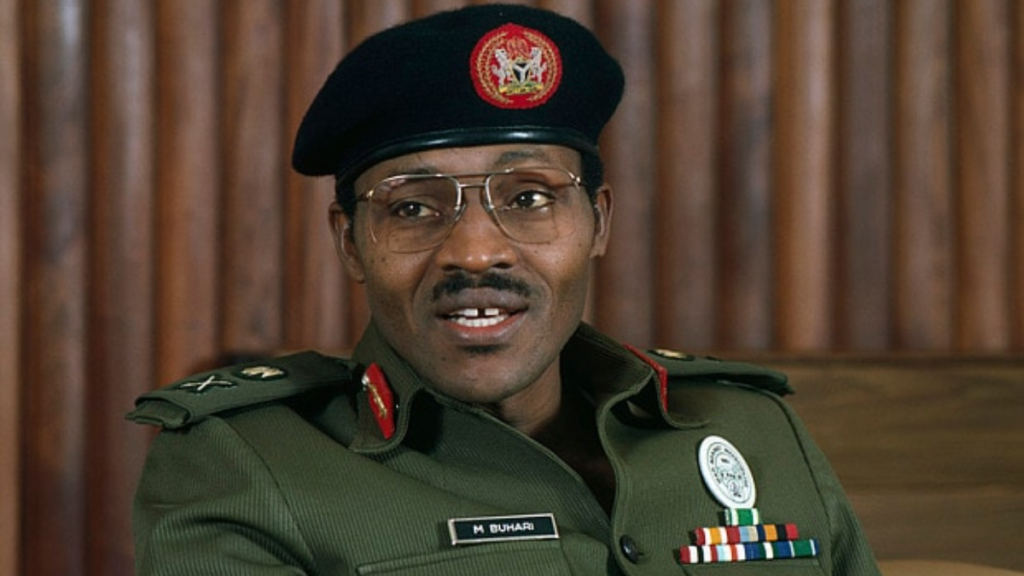
Although he was Nigeria’s military head of state from 1983 to 1985, many young people are more familiar with him as a democratic leader.
Sure, there might have been tales from older Nigerians about Buhari’s time in office, perhaps how he and his Deputy, Major General Babatunde Idiagbon, launched War Against Indiscipline (WAI). The five-phases program saw Nigerians “queue up to board a bus, even to enjoy basic amenities and government services,” the paramilitary set up to enforce WAI, or about the regime’s numerous decrees. All of these tales may have cemented him merely as a former headmaster figure to younger Nigerians. However, a year into his first tenure, the former President began exhibiting the headmaster traits everyone thought he’d left in his past.
[newsletter type=Z-daily]
In 2016, during a Q&A interview with a UK newspaper, The Telegraph, Buhari placed so much emphasis on the attitudinal problems of Nigerians that the paper likened his disposition to his WAI military days.
However, his statement, which suggested that asylum claims from his country were frivolous, mostly hurt young Nigerians.
“Some Nigerians’ claim that life is too difficult back home, but they have also made it difficult for Europeans and Americans to accept them because of the number of Nigerians in prisons all over the world, accused of drug trafficking or human trafficking,” Buhari told The Telegraph.
“I don’t think Nigerians have anybody to blame. They can remain at home, where their services are required to rebuild the country,” he continued.
As expected, young Nigerians took to social media to call him out on his scathing statement. This time, the hashtag was #IAmANigerianNotACriminal
The anti-protest President
Nigerian youths hold several grudges against the former President and remember him for many reasons, but none of those grudges and memories outweigh his #EndSARS legacy.
In October 2020, young Nigerians took to the streets to protest against years of police brutality by the now-defunct Special Anti-Robbery Squad (SARS) of the Nigerian Police.
Matching every day for nearly two weeks, Nigerian youths showed unity and courage in their struggle, until the night of October 2020, when the Nigerian government deployed the army to the location, who in turn, opened fire at unarmed peaceful protesters gathered at the Lekki tollgate.
For many, there was no coming back from the trauma they had witnessed. This event inspired a new wave of travel outside the country. Every October since then, young Nigerians have remembered this event; however, following Buhari’s recent passing, they have resumed their mourning and reawakened their grudge against the former President.
The not-so-democratic democrat
While he campaigned for office, Buhari acknowledged his military past, assuring Nigerians it was all behind him.
“I want to give you my full assurances that in this democratic dispensation, I will ensure that the Nigerian constitution is upheld. This includes respect for the media, respect for the right to free expression and freedom of speech,” he said, emphasising he was a ”former military ruler and now a converted democrat.”
Buhari’s words sounded noble, but they were untrue. His administration did not respect media freedom or freedom of speech. A major marker of this legacy remains the mysterious abduction of a social media critic of the government, Abubakar Idris, popularly known as Dadiyata, at his home in Kaduna State.
Another indication of Buhari’s anti-democratic legacy is the Twitter ban. In 2021, just as young Nigerians tried to recover from the traumatic Lekki tollgate shootings during the #ENDSARS protests, the President took away the platform where they freely expressed themselves.
The announcement of the Twitter ban made no sense, and young Nigerians, in their bold pattern, called it out — the platform had taken down the president’s hurtful and divisive tweet, and there was no reason to plunge an entire nation into dark times. Yet, the Buhari administration not only went ahead to effect the ban but maintained it for nearly a year before it was finally lifted in January 2022.
This ban affected the lives and businesses of many Nigerians, an offence which young Nigerians have refused to forgive the ex-President.
Before the 2021 Twitter ban, Buhari had also banned cryptocurrency. Without warning, the Central Bank of Nigeria (CBN) released a circular ordering banks to immediately stop conducting cryptocurrency exchanges in the country and shut down the accounts of individuals or organisations actively involved in them.
The big bank said it was instituting the ban because cryptocurrencies were being used for money laundering and terrorism. Like the reason for the Twitter ban, this, too, made no sense to young Nigerians.
The CBN sent a similar message regarding cryptocurrencies in 2017, except that one warned banks about the possible dangers of conducting crypto transactions as they weren’t recognised forms of legal tender, while the 2021 regulation directly prohibited them from doing so.
Some stakeholders speculated that the decision to move from a disclaimer to an outright ban might be related to the EndSARS protests, which saw young people move about $32.5 million worth of cryptocurrency (in donation funds) after the CBN ordered banks to freeze protesters’ accounts.
The ban could not stop young Nigerians from crypto transactions; instead, it drove them to use peer-to-peer (P2P) networks, which doubled the already existing risks associated with crypto transactions. Though the ban was lifted in 2024 by the Tinubu administration, young Nigerians have yet to let go of their anger with Buhari.
The unfriendly president
The Buhari administration was already unpopular among young Nigerians. Still, one policy towards the end of his administration played a role in cementing the status already created by the EndSARS killings — the Naira redesign.
In October 2022, the former CBN governor, Godwin Emefie, announced that the apex bank would be redesigning the ₦100, ₦200, ₦500, and ₦1,000 notes.
This would not have been an issue, except that the banks imposed an impossible deadline (January 31, 2023) for ending the use of the old notes. To make matters worse, the CBN issued a directive in January limiting the amount of cash people were allowed to withdraw— individuals were allowed ₦20,000 cash daily while corporations were allowed ₦500,000 per week.
Both moves, expressly approved by former President Buhari, were supposedly meant to protect the currency’s integrity, improve the country’s monetary policy, limit readily available cash for ransom payments and vote buying in the 2023 elections (still ahead at the time).
What followed these CBN directives were frustrated customers overflowing banking halls, markets filled with tired people, and an overall defeated populace, a crime for which young people have refused to forgive the former President and ex-CBN governor.
The record-breaking President
Under the former president, the Academic Staff Union of Universities (ASUU) experienced its longest strike since Nigeria transitioned to democratic rule in 1999.
Though the ASUU strike was rooted in the lack of implementation of a Federal Government agreement signed in 2009 before Buhari’s time, many felt that he did not do enough to pacify ASUU, as the union went on strike five times, which amounted to over 635 days.
Since news of the former President’s death broke on July 13, young people in Nigeria have taken to different social media platforms to express themselves in a way that some older Nigerians have termed distasteful.
However, young Nigerians within and outside the country have insisted that their relationship with the late Buhari was not cordial enough to accord the two-time leader the customary respect accorded to the dead.
[ad]