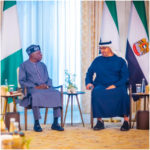
On Monday, July 15, Nigeria’s Minister of Information and National Orientation, Mohammed Idris, announced that the United Arab Emirates (UAE) had lifted its visa ban on Nigerians after diplomatic agreements with the Nigerian government.
According to the minister, Nigerian passport holders can now travel to the UAE without any hindrance.
“Today, an agreement has been reached on that, and effective from today, 15th July, Nigerian passport holders are able to obtain visas to go to the United Arab Emirates.”
Idris added that the ban lifted on Nigeria came with some conditions, which included obtaining a Document Verification Number (DVN) from a website he shared with the public.
The DVN costs a non-refundable ₦640k verification fee on the website, excluding VAT for each application. In addition, Nigerians seeking a UAE visa are required to provide proof of a bank balance of $10,000.
UAE denies affiliation with DVN website
On Wednesday, July 17, two days after Minister Mohammed’s announcement, the UAE government denied its affiliation with the DVN website and the $10,000 proof of funds.
Speaking to the press, Dubai’s General Directorate of Residency and Foreigners Affairs (GDRFAD) said:
“We are not aware of such requirements. Make your visa applications through the GDRFAD.”
Regarding whether Nigerians are required to make payments for document verification, the GDRFAD stressed that the visa application process only requires a personal photo and a passport with at least six months’ validity. A tourist visa costs approximately 200-300 dirhams (₦60k – ₦90k), depending on the length of stay.
In addition, visitors will need a travel ticket and valid medical insurance within the UAE.
Meanwhile, Eche Abu-Obe, spokesperson for Nigeria’s Ministry of Foreign Affairs, said the ministry’s office in the Middle East would provide further clarification.
[ad]
How are Nigerians reacting?
Nigerians who initially celebrated the news of the visa ban lift have since taken to social media, accusing the government of trying to fleece citizens.
This is a developing story.
Image: Canva AI
In 2014, Omolola Akintola left the US for Nigeria with a dream. She’d spent the last seven to eight years getting her degrees — a BSc in Economics, an MBA and an MSc in Marketing — and knew she didn’t want a long-term banking or consulting career.
“I wanted to do something different, something that didn’t already exist,” Lola tells me. “I wanted my own startup so I could solve a problem and impact Nigeria.”
She decided on greenhouse farming. Nigeria’s fine dining scene was on the rise and with it, the need for fresh produce. Lola predicted that it’d be difficult to keep up with importing produce like fresh strawberries and herbs, necessitating a need for all-year-round cultivation — the perfect market for a greenhouse farm.
But setting it up isn’t a small investment. The cost of a small 250 square meter-sized greenhouse averages ₦3m now, and Lola had big plans. Bigger than just one greenhouse.
“I knew what I wanted to do would involve a lot of money,” Lola says. “I planned to stay and work in the US for a few more years to raise capital for the farm and then return. But I fell in love with my partner and returned to Nigeria much earlier — let’s hope my dad doesn’t read this. Greenhouse farming was still the plan — specifically, a 10-year plan. I just needed to work for some years in Nigeria before that could happen.”
Soon after returning to Nigeria, Lola found a job at Access Bank, one of the country’s big four banks.
“I enjoyed my time at Access. I worked in the strategy department, and I felt useful. I loved the fast-paced, exciting environment. I was going to stay at the bank for years so I’d have saved enough for my greenhouse farm.”
However, Lola only spent a few months before she resigned to pursue another business idea.
A “breakfast for the skilled middle-class” business opportunity
Working at the Access Bank head office in Victoria Island opened Lola’s eyes to two things.
First, the 9-5 life for young professionals in Lagos is hard. She had to leave her home in VGC before 6 a.m. if she hoped to beat traffic and get to work by 8 a.m. Returning home wasn’t easier as long hours at work meant she often had to leave the office at 10 p.m.
Secondly, her new lifestyle meant she never had time to grab breakfast or prep food. This wasn’t a problem peculiar to her.
“My colleagues had the same problem. The higher-ups could afford to get in-house chefs or maids to bring them food. Married guys didn’t have to worry about food because they had someone else doing that labour for them. But the single men and women — mostly millennials — didn’t have time to cook their own food.”
Lola also noticed something interesting. The skilled middle-class wasn’t willing to rely only on roadside food.
“It was 2015 in Lagos, and people had disposable income. There was always a concert or show happening during the weekend, and people could afford to go. I had 9-5 friends in different industries too, and I knew that the average millennial Lagosian liked going to cafés on the Island to treat themselves to brunch on weekends. What if they didn’t have to wait for the weekend to treat themselves? What if they could have nice, fancy breakfasts delivered to them daily?”
“In business school, we discussed how businesses are gradually going online,” Lola says. “Buildings are disappearing, and people are exploring new ways of doing business. When I got the idea for a breakfast business, I knew I didn’t need to invest resources in a physical restaurant.”
It made economic sense to run her new idea as a subscription-based service, where customers could subscribe to a meal plan, pay and get their food delivered daily. This way, Lola didn’t have to worry about buying ingredients in bulk and hoping that the power supply was regular enough to store them.
She did a trial run with her sister and some friends first. “I’d close from work and prep the meals I wanted to send to them the next day. My menu included local and international (mostly American) cuisine. Most of what I did was self-taught and by reading recipe books. I already had a passion for cooking and wanted to attend culinary school to get professional skills, but that would’ve meant sponsoring myself and an additional two years of study. So, I decided to just start.
I’d wake up really early to cook and send the meals through my sister’s driver to save costs. Interest grew when other colleagues at work noticed my sister and friends having meals like tortilla wraps and quesadillas for breakfast.”
The referrals flew in, and Milk and Honey became a full-fledged business in 2015. Lola offered different meal plans, from the Bronze subscription plan (breakfast-only) at ₦7,500 weekly to the Platinum plan (including lunch) at ₦20k/weekly, with customised recipes designed to replicate the fine dining experience.
She did that for a few weeks before deciding she could no longer juggle it with her 9-5 at the bank.
“But I was wary about leaving because I had senior colleagues who loved me. Fortunately, I had to report to the NYSC orientation camp soon after, and I used the opportunity to resign. I couldn’t bring myself to do it face-to-face.”
Without the distractions from her 9-5, Lola could now give her full attention to building her business. And she did exactly that, but there was a lot to figure out.
“I was new in the country with a lot of theoretical knowledge. But I didn’t know how to get the right people to bring my vision to life. I was building a tech-enabled startup, so I needed to know where to find experienced website developers. Also, I knew the kind of packaging I wanted, but I needed someone who knew how and where to get materials to make it happen. My lawyer-sister helped with filling me in on legal registrations and regulations, but I needed someone who knew how to run a business specific to Nigeria — a partner.”
Olumide Akinsola became that person. Introduced through mutual friends, Olumide was the key to connecting Lola to everything she needed for her new startup.
“Olumide had a guy for everything,” Lola says. “We discussed the brand image, website and operations. It was like a meeting of the minds. He immediately saw the vision and ran with it. We created a system and knew it would work. We were creating the next big thing.”
Slow and steady [and expensive] growth
Naturally, running a business involves spending money. While Lola didn’t have to invest in a physical restaurant, she had to spend on chefs and kitchen assistants, branding, digital marketing and delivery bikes.
“I didn’t get external funding, and my parents’ support only extended to them allowing me to cook out of the home kitchen and using my dad’s car for delivery initially,” Lola explains. “I get it, though. My dad didn’t understand why I left my US degrees to come and cook.”
However, as Milk and Honey’s clientele expanded to over 300 subscribers, running the business out of her parents’ kitchen became impossible, so she had to rent a ₦1.1m/year kitchen space and office.
“I’d saved about $20k over 7-8 years working summer jobs in the US, and most of it went into keeping the business running between 2015 and 2018. It shouldn’t have cost that much, but like Temple Run, Nigeria kept bringing us new hurdles to jump over.”
Inflation and the adverse effects of government policies
In 2017, the Lagos State government announced a ban on commercial motorcycle (okada) and tricycle (keke) movements on major highways, bridges and roads. This wasn’t the first time the state would restrict bike activities — the last ban was in 2012 — but the new ban affected hundreds of routes, including Yaba, Surulere, Ikeja and the entire Lagos Island. These areas were the major hotspots for Milk and Honey’s activities.
Image: Tribune Online
“We initially bought two bikes for delivery,” Lola says. “But when the government impounds one, you have to go and beg, which affects delivery time. At one point, it was like we had to buy proper motorcycles that didn’t look like okada.
We did that, but we still ran into problems. When it became too much, we partnered with Gokada — the government allowed their bikes on the road. That cost us an extra ₦5k/day for each bike.”
With Nigeria’s age-long power supply problem and the need to keep generators running to preserve ingredients, Lola also had fuel price increases and scarcity to worry about. In 2016, fuel prices rose from ₦87 to ₦145 and maintained the same price between 2017 and 2018. However, frequent scarcity increased the price slightly at several points in the same period.
“It was just hard. I had to maintain relationships with several fuel station managers because no one knew when fuel would suddenly become scarce again.”
On top of all that, the naira kept falling against the dollar. By 2017, it had fallen to ₦300/dollar as against ₦197 to the dollar in the previous year. For an importation-heavy country like Nigeria, this led to a steep rise in the cost of packaging material Lola needed to keep her business going.
“We tried multiple things to keep our costs low. We started a recycling drive and encouraged our customers to return their plates for a discount, but it didn’t do much to minimise expenses,” Lola explains. “I also never paid myself a salary — even though I made sure my eight regular staff were never owed, but it was a lot of money. We had no choice but to increase the prices of some of our plans.”
Even as Milk and Honey was fighting for its life, the customers were fighting for theirs, too.
“People could no longer afford to pay ₦7,500 weekly (without delivery) for breakfast. It wasn’t like they were moving to different brands. There were just more important things they had to pay for or prioritise. When I started the business, I argued that people would always eat. Now it became clear that, yes, people would always eat. But what they ate was a different question. Bread and eggs could fill them just as much as a BLT sandwich.
For most of my bronze plan subscribers, the service was initially a small price to pay for luxury. But when the economy took a nosedive, it became a luxury they couldn’t afford. There just wasn’t as much disposable income to work with. We lost 70% of our bronze subscribers in 2017”.
Trying to stay ahead of the curve
In a quest to stay afloat and reinvent the wheel to continue serving her customers, Lola started offering health-based meal plans in 2017.
“I got a dietician, and we started offering nutrition consultations to create meal plans for people with dietary restrictions who wanted to stay healthy.”
Of course, this service was mostly used by the richer middle and upper-class who could afford to care about what they put in their mouths. The problem? This target audience was a tiny portion of Milk and Honey Gourmet’s initial customer base.
“I had to gradually abandon the idea that our service would be for the global millennial. I had to focus on older rich people, and this category isn’t necessarily online. I needed to re-invent Milk and Honey if we wanted to make enough to keep running. That would involve a new form of branding, marketing and the whole works.”
Making the difficult decision to exit the business
By 2018, it became clear that the economy was deteriorating faster than it was trying to improve, and everyone was struggling. Even Lola’s husband, who’d initially refused to leave Nigeria, had decided it was time to leave.
“At the end of the day, I didn’t really leave Milk and Honey. I left Nigeria,” Lola says. “I’d already calculated that the pivot to an older market was what we needed, and we could turn profitable in the next two to three years so I could take a step back and let the business run on its own.
But Nigeria just wasn’t working. Did I want to stay because of all the time and money I invested or because I thought Nigeria would get better? What if the upper class also have to make tough decisions and decide our services are an unnecessary luxury?”
Lola left Nigeria for the UK in December 2018 after giving her customers a month’s notice to shut down operations. She sold the remaining bikes and donated most of her cooking equipment.
“I rarely talk about Milk and Honey because giving it up was so sad. I’d invested everything into it; my finances and my mental and physical health, and for a while after it ended, I lost my confidence. I did everything by the books, and while that always resulted in success, I was suddenly introduced to the possibility of failure. That fear followed me into the other dreams I tried to pursue.”
As our conversation ended, I asked Lola what the experience has taught her about doing business in Nigeria and what other prospective business owners might benefit from knowing.
“Nigeria discards economic principles. I have a degree in marketing and knew all the fun things to do to make a business work, but one plus one was no longer equalling two. The government can announce a new policy, and you may think it’ll have a positive effect. But it doesn’t because they don’t follow through with all the other things that should make the policy work.
For instance, the government can announce it wants to tackle inflation by releasing funding. That should work, right? At the same time, the same government can decide to stop importation and allow only one person to produce an item. Or they sell forex cheaper to that person. It causes chaos. The word for the Nigerian economic market is just chaos. Some businesses are still making it work regardless, but it’s exhausting. All your permutations and projections can mean nothing at the end of the day.”
On what she thinks might help, Lola says, “So many businesses would do much better if the electricity and transportation problems were solved. If someone comes and solves just those two problems, I’d say they did a wonderful job.”
Ten years later, Lola isn’t the same person who stepped into the country with big dreams.
“I don’t think I’ll return to Nigeria. Many people are doing greenhouse farming now too, so no one needs me. I might consider returning for a vision that has to do with the girl child. If I’ll be helping save a million lives, then I can come back. Otherwise, I’m fine where I am.”
President Tinubu and the Nigerian Government made some interesting to questionable moves this week. We’ve compiled the high and lowlights across different sectors of government.
FG pays pensioners owed pension arrears
Some good news for pensioners of the Power and Transport Sectors of the Parastatals Pension Department. The federal government finalised payment of ₦1.02bn to 7,091 beneficiaries on Sunday, November 5.
“The payment represents 39 per cent of the accrued pension arrears owed pensioners in the said sectors for the period August 2015 to September 2023, as a result of the computation of the monthly pension of pensioners of Parastals Pension Department based on their career details, salary structure and applicable pension increments,” stated Olugbenga Ajayi, head of Corporate Communications Unit, Pension Transitional Arrangement Directorate.
Barely weeks after the senate approved Tinubu’s controversial 2023 supplementary budget, the president is making moves for the 2024 national budget. On Monday, November 6, sources within the presidency disclosed the president’s intention to present the budget in the third week of November, so fingers crossed.
The government has commenced the implementation of an automatic 40% deduction of internally generated revenues of federal universities across the country. The FG in October had announced that the deduction would take effect from November 2023.
With the commencement of this deduction, there could be an increase in tuition fees for the students.
Governor Sanwo-Olu “came through” for Lagosians as he slashed the fare on state-regulated buses like BRT and rail transport by 25%. The directive took effect on Tuesday, November 7, 2023, with no clear indication of how long it’ll last.
Governor Umo Eno denies padding supplementary budget
It appears President Tinubu’s supplementary budget isn’t the only one that’s raised eyebrows in recent times. On Tuesday, November 6, in Akwa Ibom, Governor Umo Eno shut down allegations that he padded the state’s supplementary budget.
Eno spoke up after Policy Alert, an NGO focused on promoting fiscal and ecological justice in the Niger Delta region, highlighted some controversial appropriations in the budget.
President Tinubu leads 9-man delegate to Saudi-Africa summit
The president is in Riyadh, the capital of Saudi Arabia, for the inaugural edition of the Saudi-Africa summit. Through the summit, President Tinubu hopes to attract more direct foreign investment and expand business partnerships for the country.
Minister of Foreign Affairs, Amb. Yusuf Tuggar; Minister of Education, Prof. Tahir Mamman; and the Coordinating Minister of the Economy and Minister of Finance, Mr Wale Edun are among the president’s official delegate.
On Wednesday, November 7, Minister of Power, Adebayo Adelabu, revealed that President Tinubu ordered a stop to the implementation of a hike in electricity tariff and insisted on subsidising the power consumed nationwide. The president insisted that before power companies can charge a cost-reflective tariff, there should be constant power supply.
At the moment, Nigerians pay ₦70 per kilowatt-hour, an increment would see the price shoot up to ₦140 per kilowatt-hour.
Joining President Tinubu’s administration this week are 20 federal commissioners for the National Population Census (NPC), three executive commissioners for the Nigerian Upstream Petroleum Regulatory Commission (NUPRC), an SSA on disability matters and an SSA on Citizenship and Leadership.
Uju Kennedy launches pink kekes to cushion female unemployment
On Wednesday, November 7, Minister for Women’s Affairs, Uju Kennedy, donated tricycles with pink interiors and sewing machines to women in Abuja. She announced the Pink Riders Transport Scheme, an initiative aimed to reduce unemployment and empower women across the country. According to her, the plan is to extend the scheme to other states in the country.
Nigerians have criticised Uju with many stating that there are better ways to empower women.
Burning Ram is going down tomorrow. You still have time to grab tickets to attend the biggest meat festival in Nigeria.
It’s hard to scroll through the internet these days without seeing something about Gangs of Lagos. From clips of Chioma Akpotha’s viral monologue to screenshots of the bloody fight sequences, everyone is gushing about Jade Osiberu’s ambitious action project. Everyone, that is, except the Nigerian government.
Source: Prime Video Naija
Lagos State Vs. Gangs of Lagos
Barely a week after the Prime Video original premiered, the Lagos State government put out a statement accusing Gangs of Lagos of being “derogatory to our culture” and an attempt to “desecrate the revered heritage of the people of Lagos”.
Source: Prime Video Naija
The Lagos State government that famously unlooked and aired everyone who was attacked during the February 25 and March 18th elections of 2023 had time to make a statement dragging a Nollywood film?
Not the first time
Source: Greoh Studios
This isn’t the first time the Nigerian government has dragged a Nollywood film. Ironically, the last film to experience something like this was 2019’s Sugar Rush, which was also co-written and produced by Jade Osiberu. The film, which starred Adesua Etomi-Wellington, Bisola Aiyeola and Bimbo Ademoye as sisters who must deal with the numerous owners of the $800,000 they stole, was removed from Nigerian cinemas by the National Film and Video Censors Board (NFVCB) because it portrayed the Economic and Financial Crimes Commission (EFCC) in a “bad light”.
However, thanks to the #BringSugarRushBack social media campaign, the Censors Board caved, and the film returned to the cinema before making its way to Netflix.
Why is the Nigerian government so pressed and bothered by Nollywood all of a sudden?
One word: “accountability”.
For the longest time, Nollywood has focused on basic Nigerian issues: looking for love, hustle culture, a sprinkle of backstabbing and juju here and there. But now, the focus is turning towards the corridors of power and how the people and their deals affect the average Nigerian.
Source: Kemi Adetiba
Kemi Adetiba’s King of Boys is a typical example of a story that shifted the veil between Nigerians and politics through film. In the first act, we get to see how politicians use mob leaders to do their dirty work then frown when they ask for a crumb of power for themselves, especially when the said leader is a woman like Eniola Salami.
King of Boy: The Return of the King delved even deeper into the drama behind the scenes of an election. The bodies, the kingmakers, the role religion plays and the family’s hoarding power for themselves; Kemi Adetiba went there. As realistic as the series was, the Nigerian government seemed unmoved.
To start off 2023, Netflix released Shanty Town, a limited series starring Ini Edo, Chidi Mokeme and Nse Ikpe-Etim. Shanty Town focused on a group of women navigating sex and organ trafficking, violence and intimidation in a fictional shanty town in Lagos.
Source: Netflix
While audiences praised Chidi Mokeme’s acting and debated Peter Okoye’s Femi Fernandez’s Igbo accent, we noticed slight similarities between the show’s antagonist, played by Richard Mofe Damijo, and a popular Nigerian presidential candidate.
Source: Twitter
Tell me you can see it too.
While the similarities between Shanty Town‘s antagonist and this political figure might be limited to their filas (Yoruba hats), Gangs of Lagos strikes an even deeper nerve with a political character hellbent on ruling Lagos state. The story is fictional, but the audience has done the math and found “x”.
Nollywood isn’t the first to tackle politics, and it won’t be the last
Like new Nollywood, Hollywood AKA the gold standard of filmmaking, hasn’t shied away from holding its government and political structures accountable over the years.
Martin Scorcesse’s 2006 film, The Departed, unearthed corruption within the American police force and ended up with a Best Picture Oscar at the 2007 Academy Awards. Similarly, Aaron Sorkin’s 2020 film, The Trial of the Chicago 7, was a masterclass in dragging the American police force, judiciary and the FBI for their role in the unfair 1969 trial of seven defendants charged with conspiracy against the government. Most recently, 2021’s Judas and the Black Messiah, directed by Shaka King, showed how the FBI murdered African-American activist, Fred Hampton, in his sleep.
These Hollywood films premiered, showed at cinemas and walked away with awards despite flipping a middle finger at the American government. Regardless of their exaggerated storylines, they offered nuanced insight into political issues that affect people, making them relevant works of art. So why must Nollywood face a different battle?
We need films like Gangs of Lagos
Whether or not we liked the plot, films like Gangs of Lagos are important.
Source: Prime Video Naija
Although it’s hard to believe people in Isale Eko fight like they’re part of Vin Diesel’s Fast and Furious crew, there’s no denying the existence of countless Obalolas, Gifts and Ifys — people who don’t get to live for themselves. They fight other people’s political battles, sometimes with no idea how their actions will impact their communities in the long run. These are the people we see snatching ballot boxes during elections.
Films like Gangs of Lagos humanise Nigerians who live on the margin, reminding us of the puppeteers who create unfavourable conditions for Nigerians and then take advantage of the victims. If we allow the Nigerian politicians and government to silence creatives who hold up a mirror to their actions, we may never hold them accountable for their actions in the future.
When we think about structure in the political context, our minds instantly veer to political parties and the grassroots network they possess.
However, Nigeria itself is founded on structures that enable it to function. For instance, Nigeria became an independent country in 1960, but only a few people are aware that Nigeria became a republic in 1963. What does it mean to be a republic, and what structure is the Nigerian government built on?
Nigeria as a federal republic
[FCT/ The Guardian Nigeria]
Officially, Nigeria is known as the Federal Republic of Nigeria. But what does this mean? The term “federal republic” consists of two words. “Federal” refers to a federation of states. Nigeria has 36 of those and its federal capital territory (FCT).
A republic is a system of government where people choose representatives through elections to represent them in the public interest. However, a republic isn’t necessarily the same as a democracy, despite their similarities. One key difference is that democracy is a government of the majority, meaning it can impose its will on the minority.
A republic, however, allows for inalienable rights for everyone regardless of whether they belong to the majority or minority. In Nigeria, these rights are protected by the Constitution of the Federal Republic of Nigeria, enacted on May 29, 1999 — the beginning of Nigeria’s Fourth Republic. Nigeria is both a republic and a democracy.
The Nigerian government operates on the doctrine of separation of powers. It has three arms. The executive arm is responsible for managing the country daily. The president leads the executive and is advised by the federal executive council (FEC). Mr President also chairs the FEC. But the president alone can’t be everywhere, which is where ministers come in. The president picks the ministerial cabinet that reports directly to the president and oversees anything from agriculture to sports.
There’s also the Nigerian Civil Service comprised of employees in government agencies other than the military and the police. The president holds the title of the Grand Commander of the Federal Republic of Nigeria (GCFR), and all military parastatals are under his command.
The president appoints the Inspector General (IG) of the Nigerian Police. Other commissions like the Nigerian Population Commission, Federal Civil Service Commission and the Nigerians in Diaspora Commission, among others, report to the president. These departments assist the executive in running the country.
The legislative
[The Nigerian Senate / Premium Times]
From the explanation so far, the president is very powerful. However, all power doesn’t belong to the President, fortunately. The legislative arm of government is the one in charge of making laws.
The Nigerian legislature is known as a bicameral legislature. That is, it’s divided into two separate chambers: the Senate (the upper chamber) and the House of Representatives (HOR) (the lower chamber). Together, they’re known as the National Assembly.
The National Assembly consists of 109 Senate members—three from each of the 36 states and one from the FCT. The HOR has 360 members, and they’re cut unevenly across federal constituencies. Lagos and Kano have the most, with 24 each, while the FCT has the least—two.
Their function includes scrutinising bills before the floors of the National Assembly. Before a bill can be made into law, the two houses must agree on it in their respective readings. The president also has to assent to it. However, the president can refuse to sign or override the bill. This is known as a veto. The National Assembly can overrule the veto in both chambers if they can get a two-thirds majority.
Beyond making laws, the legislative has special powers. The Senate, for instance, can impeach judges and officials in the executive. In the event of gross misconduct by the president, they can move a motion for impeachment. While this helps them check the president’s powers, the process, in reality, could be more rigorous and unlikely to happen.
The judiciary
[Supreme Court in session / Peoples Gazette]
If the function of the executive is to put laws into action and that of the legislative is to make laws, the judiciary’s work is to interpret them. The highest court of the land in Nigeria is the Supreme Court. It derives its powers from the Constitution and the Supreme Court Act. While there are other courts of jurisdiction like the appeal court, high courts and so on, decisions rendered by the Supreme Court are binding on everyone and final.
The Chief Justice of Nigeria (CJN) leads the Supreme Court. The president appoints them on the recommendation of the national judicial council and following confirmation by the Senate. Associate justices support the CJN, and there can be at most 21 justices. Currently, the Supreme Court has 13 members.
Altogether, these three arms are the structure upon which the Nigerian government is built. Ultimately, a functional democracy is one where these arms act as checks on each other while performing their primary responsibilities.
How much do you know about Nigeria? We’ll know at the end of this quiz.
Is it the educational system or the economy? Take the quiz:
— Fed Min of Info & Nat’l Orien (@FMINONigeria) June 4, 2021
There are concerns that the ban is an attempt to restrict freedom of speech and expression because this is not the first time the government has done this. Here are seven other times since Nigeria’s independence in 1960 where the government has made a mockery of free speech.
1. 1967 — Imprisonment
In 1967, Nigerian author Wole Soyinka was arrested and imprisoned for twenty-eight months for commenting about the state of the country shortly before the Biafran genocide.
2. 1984 — Decree Number 4
In 1984, Muhammad Buhari who was head of state at the time passed Decree Number 4, The Protection Against False Accusations Decree which criminalised publishing any statement or rumour that brought the government or any public officer to ridicule.
3. 1986 — Assassination
In October 1986, Nigerian Journalist and editor-in-chief of the defunct Newswatch, Dele Giwa was assassinated by a letter bomb for exposing corrupt and illegal practices of the Nigerian government.
4. 2016 — Cyber Security Law
In September 2016, several investigative journalists and bloggers were arrested, detained and charged under Nigeria’s Cyber Security Law with some of them being accused of criminal defamation.
5. 2019 — Communications License Suspension
In June 2019, the National Broadcasting Commission suspended the license of Daar Communication Plc, a media and entertainment company owned by Raymond Dokpesi, a principal member of the opposition party, PDP. The company was accused of airing inciting broadcasts and media propaganda against the government. In the same month, State Security Services announced a crackdown on social media users for allegedly posting inciting materials threatening the stability of the country on the internet.
6. 2019 — Anti-Social Media Bill
In November 2019 the Nigerian senate proposed the Social Media Bill to restrict the use of social media in transmitting information. Though the bill has not been passed into law, it is another attempt to stifle free speech.
7. 2020 — #ENDSARS Protests
In October 2020, after thousands of Nigerian youths protested online and offline, calling for an end to police harassment and brutality, the Central Bank of Nigeria froze the accounts of individuals publicly linked to the #EndSARS protest. Travel documents of some of the protesters were seized and some were arrested and charged for criminal incitement.
Being a woman means different things to different people. I had a friendly chat with Dr Ebi Awosika, a senior technical assistant to the president in the office of the vice president on community engagement. It started out with me trying to understand what the hardest part about being a woman is to her and ended with her telling me about the sacrifices she had to make because of her love for community service.
Tell me something interesting about yourself
I am a physician.
Wait, you are a physician as in a doctor-doctor?
Haha. Yes. Quick background on me. I am a medical doctor, what Nigerians would call a consultant actually. Also, I specialise in internal and occupational medicine. I got my first degree at the University of Ibadan in 1991 before moving to South Africa with my husband to practice medicine. We migrated to the united states together where I ended up working as a national program director with the United States Department of Veteran Affairs for 13 years before taking an early retirement.
Ma’am, Did I hear you say you retired from making dollars?
Haha. It wasn’t quite like that. It has never been about the money for me. I have always been interested in community service, so when I got the chance, My husband and myself set up our own practice in the united states. Two practices actually, that deals with mental health. Oh, by the way, my husband is also a doctor but a psychiatrist.
Wow. I like how you casually just threw that in like it’s nothing… God when?
Haha. It’s all about the service for me. Everything I have done has led up to me serving the community. I have a masters in public health and also picked up an assistant professorship at the University of Minnesota. So, when the opportunity to work as a senior technical assistant to the president in the office of the vice president on community engagement, I felt this is where I am needed to create massive impact.
Omo, Your resume is very impressive. So, What happened to your practice in the United States?
Thank you. My practice is still there. Before I left, I played more of an administrative role. I saw patients but not as often. I will tell you though that it is incredibly challenging to run a business. Before taking the early retirement, I went part-time first and I had to juggle being in Minnesota where the practice is and Washinton DC where I worked part-time for the US government. When I went full-time private practice, I still took a job with the Canadian government but it was medicial consultancy. It took a lot but by the time I was needed in Nigeria to serve, I had a discussion with my family and with their blessings, here I am.
Dr Awosika being conferred as a fellow of the American College of Occupational and Environmental Health.
You left Canada for Nigeria? Mad oh.
I was invited to serve so yes.
What do you think stands out about you to other people?
I like to do things differently. As a strong believer in God, I like to imbibe the spirit of excellence. Whatever I find myself doing, I give it my all. It must be outstanding. This has helped separate me from others because there is always a special difference in whatever I do.
Tell me a little more about your faith.
I gave my life to Christ in 1991, when I was 22. Ever since then, I have been an active Christian. I am currently a minister in a church called Strong Tower Parish in Minnesota. There, I provide premarital counsel for people who are getting married. I also manage the media department in church, seeing as it forms a significant part of my life and that of my family.
You have done a lot in your lifetime. What would you consider the hardest part of your work?
Which of them?
Ohhh wow. Flex. The most recent one here in Nigeria.
I work with out-of-school children and it’s amazing how many children are out of school, especially the girl-child. Trying to empower women and youths and seeing how many more of them still need to be empowered. The challenge here is that even with all the work done, there is still more that needs to be done.
I personally don’t like to think of them as challenges because the person I work for, the vice president, sees these things as opportunities. Also, the issue of mobility, in terms of safety and accessibility.
Working for this administration, how do you personally deal with Nigerians who have lost faith in the government?
These people have a right to expectations and because of the many years of less than good or great leadership, we are not where we need to be as a nation. The expectations from the people were that this administration will bring automatic change but things take time.
I found that when I talk to people about what the administration is trying to do, they are really receptive. In the past, I have gone around the country doing radio interviews where I encourage Nigerians to call in and ask questions. It helps people to have an understanding of what is being done.
What is something you wish you knew earlier that could have made your life considerable better?
When I went to South Africa to practice medicine, I discovered something they do that I wish Nigerian medical school would adopt. When you train in Nigeria as a medical doctor, you can work for someone or assist them but you are not empowered with the skills to set up your own practice.
In South Africa, you are being trained to not just be a doctor but to go into the rural areas and function independently. For me, this was something I had to learn and I truly wish it was a part of our educational system.
What would you consider the hardest part about being a woman?
As a woman that is a professional, a minister, a business owner, a mother and a wife, the most challenging part has been juggling all the demands on my time, my emotions and energies. The desire to be a good mother and wife has to be balanced with the demands of my profession, career, ministry and business.
Sometimes the demands are mutually exclusive, leading to varying priorities. As a woman, it’s tempting to feel guilty when progressing in one’s career path. There is a feeling that doing that is taking time away from my family. Accepting that I am human and therefore prone to mistakes, and far from perfect. Acknowledging that it is ok to say “no” has been a lifeline.
Anything else you’d like to add?
Yes. I want every woman out there to know that whatever they are going through, they are bigger than their challenges and they have so much potential and power. Never get defeated by your struggles, keep fighting and God will see you through.