• It starts with a beat. A stupidly good one. Before you know it, you’re singing and rapping along, word for word. Then you hear the line — the one where he calls women out by their names, for sport.

    You pause. Then you don’t. Because the song slaps. But your brain is already spiralling: “Can I call myself a feminist and still vibe to this?”

    This is the dilemma many listeners with feminist views face when they come across misogynistic lyrics, tweets and statements from musicians like OdumoduBlvck. It’s a tension many feminists have to navigate daily if they want to keep vibing to rap music.

    Isn’t it worth a second thought when you read on his X feed, “Women should not be allowed to act like rabid dogs because they know they can’t be spanked.” Or that, “Not all beating is abuse. I agree that some parents abuse their kids. No one loves me more than my mother. No one. She beat me when I was little. I put aloe vera in my housemaid’s vagina. I dey mad?”

    I asked Salawa*, a feminist who also enjoys OdumoduBlvck’s music, what it means to constantly renegotiate the terms of her values with her taste in music. The answer, it turns out, is a complex one. 
    This is Salawa’s story as told to Tomide

    I first heard about OdumoduBlvck, the person, on my X timeline sometime in 2021 — the same year I discovered his music. His charisma was undeniable, and that’s what initially caught my attention. I tilted towards his music after I heard Alpha Ojini’s “Vigilante Bop,” which he’s featured on.

    My first reaction was, “What type of audacity is this? Why is he so lewd? Ewww.” But at the same time, I couldn’t help thinking, “Why is he so good?” I remember getting goosebumps when I heard his verse on that track. My brother introduced me to the song when he randomly played it in the kitchen one day, and I was instantly intrigued. I added the song to my library, and I have been actively listening to his music ever since.

    It seems like he’s innovating a new sound that’s hard to copy because of its uniqueness. I remember watching him perform at Show Dem Camp’s Palmwine Fest in 2022. His crude personality was obvious then, but it wasn’t an ick…yet. It felt more like an accessory to his showmanship. Everything fit quite nicely, including the Igbo cap — until I started seeing some of his opinions on Twitter.

    As a feminist, I hold certain values that don’t align with his kind of persona: that women deserve dignity and respect, that we are equal to men, and that stereotypes are harmful and untrue. 

    OdumoduBlvck once joked about putting a woman in her place by hitting her. I understand there was some context to it — he was referring to a woman who had beaten up a child. But in the now-deleted tweet, he said, “Women should not be allowed to act like rabid dogs because they know they can’t be spanked. There’s a difference between a good spanking and a good beating. No! Don’t punch her. That’s too much. A nice, ordinary Ahmed combo is a good resting device for those who are foolish.”

    There’s a dismissive tone to that tweet, but even worse is how it endorses violence, reducing all women to a single entity and stripping us of individuality, as if we are undeserving of regard or respect.


    Get More Zikoko Goodness in Your Mail

    Subscribe to our newsletters and never miss any of the action


    That said, I don’t think this behaviour is rooted in a deliberate desire to be wicked. I think it’s the result of a deeply ingrained social conditioning that’s been upheld for a very long time. That’s why I don’t listen to “Cast” by Shallipoppi and Odumodu. I’ve never sung along to that infamous line. I can never dance to it either. It just can’t happen. But again, when I’m with the people whose opinions I rate, there’s no scrutiny, we’re just having a good time.

    I carefully select his songs that I listen to. I regularly put “Commend” on repeat. As a matter of fact, I need to play it right now. I like it because he references consensual sex, one of my core principles. But also because it’s a damn good song.

    If you’re wondering whether I have tried to hide the fact that I listen to him: no, not really. Unfortunately, all my friends are hypocrites like me. I’ve never hidden the songs I listen to in real life. We play everything when we link: house parties or even at work, when it’s just us Black folks around. I’ve done that many times. My friends are mostly like me. There are only a few reasons we’ll refuse to play a good song. (Naira Marley, however, is a no-go)

    But on the internet, it’s a different story. I think that social media has become so polarising over time that it feels like a literal minefield. People are quick to brand anyone anything based on their preferences or opinions. The idea that a person can be multifaceted or multi-dimensional is not something the internet accepts. If you listen to Odumodu, you must be a misogynist. You don’t like Beyoncé, you must be a pick-me. (For the record, I love Beyoncé.)

    I’m not saying he’s a good artist or praising his music to show anybody that I’m gang. It’s just me doing the little that I can to practice what I stand for. If it gets worse, like allegations of assault or crime, I can easily stop playing the guy altogether. But for now, avoiding his disrespectful songs is the least I can do to practice my feminism.


    ALSO READ: 12 Nigerians On Separating the Art From the Artist

    Participate in our riddle callout for a chance to win ₦25k. This campaign is open only to Zikoko Daily newsletter subscribers and ends May 10, 2025!

    [ad][/ad]

  • In November, a group of young Nigerian women came together to create a WhatsApp group chat, which was supposed to be a “safe space” away from the “noise and banter” in the real world.

    However, this space was invaded by a man who entered the group chat posing to be a woman and then publicised the messages in the group. Many critics have said it was an attempt to cyberbully the women in it.

    One of the group’s founding members (who we’ll call Kali) tells Zikoko Citizen that the group was the safe space they hoped it would be before it was compromised. On some days, they shared book recommendations and discussed their hobbies, as seen in screenshots by Zikoko Citizen. On other days, they recounted painful sexual assault experiences, finding solace in the knowledge that they had found a community of women who understood their pain.

    None of these women suspected that a man was in their space until November 6, when cropped screenshots of messages from this group hit the internet,  specifically X. 

    An X user, @societyhatesjay, shared these screenshots and publicly admitted that he joined the group after posing as a woman. 

    In the past, Jay has expressed his desire to rape women. In some leaked Whatsapp screenshots, he said, “If I catch her, I’ll rape her”. After facing backlash, he said they were simply “dark humour” and “taken out of context”. 

    What happened after the screenshots were leaked?

    Kali tells Zikoko Citizen that the screenshots were taken out of context with the goal of making the girls victims of cyberbullying. In one of the cropped messages, the X user who shared the screenshots cropped them to suggest that the women in the group hated men and constantly discussed ways to kill them.

    Another screenshot suggests that a member of the group chat was planning to kill men and was going to use her brother as a “test lab.”

    However, Kali shared screenshots of the full conversation, which shows that the comment was a light-hearted response to a conversation about cooking — a group member  who earlier mentioned her love for “experimenting in the kitchen” had sent a follow-up message humorously implying she makes her little brother try out her cooking.

    Kali also said that Jay, who went by the name Tamara, tried to trigger certain conversations to “expose” feminists as men haters. According to her, some of those conversations evolved around heavy topics like abortion and rape.

    In one of the screenshots Kali shared with us, “Tamara” said, “I hope a gay man rapes him”. Kali believes that the message was intentionally sent to draw out similar comments from other group members which would then be cropped and shared on X to target them and feed into the running narrative against women who identify as feminists.

    In some of the screenshots that made rounds on social media, a group member made a comment insinuating that she would have been open to killing men if it wasn’t against the rules of “our father who hath in heaven”. 

    While Kali insists that most of the group chat messages were misconstrued, some messages’ content was too sensitive to excuse. Kali says that messages like the one above made it easier to question the group’s intention but clarifies that the group wasn’t supposed to promote violence or hatred towards men. 

    What’s happening to the girls?

    Kali tells Zikoko Citizen that most of the girls in the group have been living in fear since the cropped screenshots from the group chat were shared on November 6. It is now nearly one week since the screenshots went viral, so the conversations around them have died down, but these girls are still being body-shamed, slut-shamed and threatened with murder and rape.

    She also says that the personal information of some group members like birth certificates, phone numbers, and National Identity Number (NIN) have been spread across the internet and have been used by some people to trace one of the girls.

    “Some strange men showed up at one of the girls’ houses after her address was leaked online. The men insisted on seeing her, but the girl’s sister figured out that something was off about them. So she insisted that her sister wasn’t home,” Kali narrates, adding that the girl and her family are thankfully safe for now.

    Why is this situation a problem?

    We spoke to Emitomo (Nimisire) Oluwatobiloba, a feminist researcher and Sexual Reproductive Health and Rights (SRHR) consultant, to understand the severity of this situation. 

    She said, “This seems like a targeted attack against a few girls, but they are actually targeting all Nigerian feminists. We can all see that it’s not just cyberbullying or slut-shaming; it has become something more violent for these girls. This is gender-based violence”. 

    “As a society, we’ve been acting like online or technology-facilitated gender-based violence is an abstract thing but it is very real and just as violent as every other type of gender-based violence,” she said, stressing that it’s also taking the fight against patriarchy and misogyny back because “there are men who have made a brand out of disrespecting women and spreading misogynistic views. Young boys are looking up to these men, and it’s affecting us as a society.”. 

    A study by UN Women,  also confirms Nimisire’s stance on the issue. The 2019 study which was carried out in five Asian countries shows that  Online Gender-Based Violence (OGBV) has serious consequences both on the victims and on the society. Research results gotten from the Philippines for instance, show that survivors of OGBV often suffer emotional harm (83%), sexual assault (63%), and physical harm (45%). Results of the study also showed that online harassment in Pakistan has led to cases of femicide, suicide, physical violence, emotional stress, and job loss for women in the country. It also causes many women and girls to silence themselves in online spaces.

    What does the law say about cyberbullying and digital rights?

    To answer this question, Zikoko Citizen contacted a Nigerian lawyer, who said that  “while everyone has a basic right to free speech under Section 39(1) of Nigeria’s 1999 Constitution (as amended), it’s important to note that cyberbullying is a recognised crime in Nigeria.”

    The lawyer explains that the Nigerian Cyber Crimes Act updated in 2024,  makes it pretty clear that cyber bullying is a serious offence. 

    According to the Act, if a person is caught sending offensive or threatening messages (or anything meant to annoy, harm, or intimidate someone) online, they could be looking at a fine of up to ₦7 million or a 3-year prison sentence. For those who take it a step further by making people fear for their lives or safety, the penalties jump to a possible ₦25 million fine or 10 years in prison.

    The act also gives the court the power to issue restraining orders to protect victims from further harassment. 

    Cybercrime is still widespread despite these measures; the lawyer believes it’s because people are not really aware it is a crime with heavy consequences

    “I believe many people in Nigeria are not aware of these provisions, which may explain why cyberbullying has become widespread. Even many perpetrators do not likely know it’s a sanctionable crime in Nigeria. If they knew they could face legal consequences, maybe many of them would have a rethink or refrain from doing so”, she said.

    The lawyer also points out that while cyberbullying is prosecuted as a serious offence in countries like the US, Nigeria has only been able to record a few cases, mostly because the current laws specifically targeting cyberbullying are insufficient, and underdeveloped and make it challenging to prove such cases. 

    Any update from the authorities?’

    So far, it doesn’t seem that appropriate authorities are investigating the matter however Nigerian journalist and feminist, Kiki Mordi has shared that she’s working behind the scenes to push for legal action against him the X user @societyhatesjay who shared the cropped screenshots.

    https://twitter.com/kikimordi/status/1854662225241518131

    What can we do to control the spread of online gender-based violence and cyberbullying in Nigeria?

    According to IREX, A global development & education organisation, there’s a lot that we can do to stop the spread of online violence against women.

    1. Use your social media platforms to raise awareness about online gender-based violence. Let people know what is and why they should care. You can start by sharing this article. 
    2. Support the collection of data relating to OGBV and its impact on victims by gathering evidence (tweets, public statements, etc) and sharing it with women’s rights activists. 
    3. Raise awareness of the dangers of OGBV and call out injustice wherever you see it. 

    Editor’s note: This story has been updated.

  • Hear Me Out is a weekly limited series where Ifoghale and Ibukun share the unsolicited opinions some people are thinking, others are living but everyone should hear.


    This Hear Me Out was written by Aladeselu Margaret Ayomikun.

    Of all the things a girl could be in this world, I chose to be a 19-year-old feminist in Nigeria. I was 9 years old the first time I read Chimamanda Ngozi Adichie’s Purple Hibiscus. Even though I could only understand the book the best way a child can, I still remember feeling like I had discovered the eighth wonder of the world.

    “Being defiant can be a good thing sometimes.”These words stood out to me. Aunty Ifeoma was just a character in a book, but she gave me permission to embrace my “defiance”.

    It seemed almost impossible that somebody could give ordinary words so much power. And the more I flipped through the pages, the more I felt as if Chimamanda was writing my mother’s story. Then, it occurred to me that many women in Nigeria are just like Mama. In that very moment, I knew I had to know more about the author.

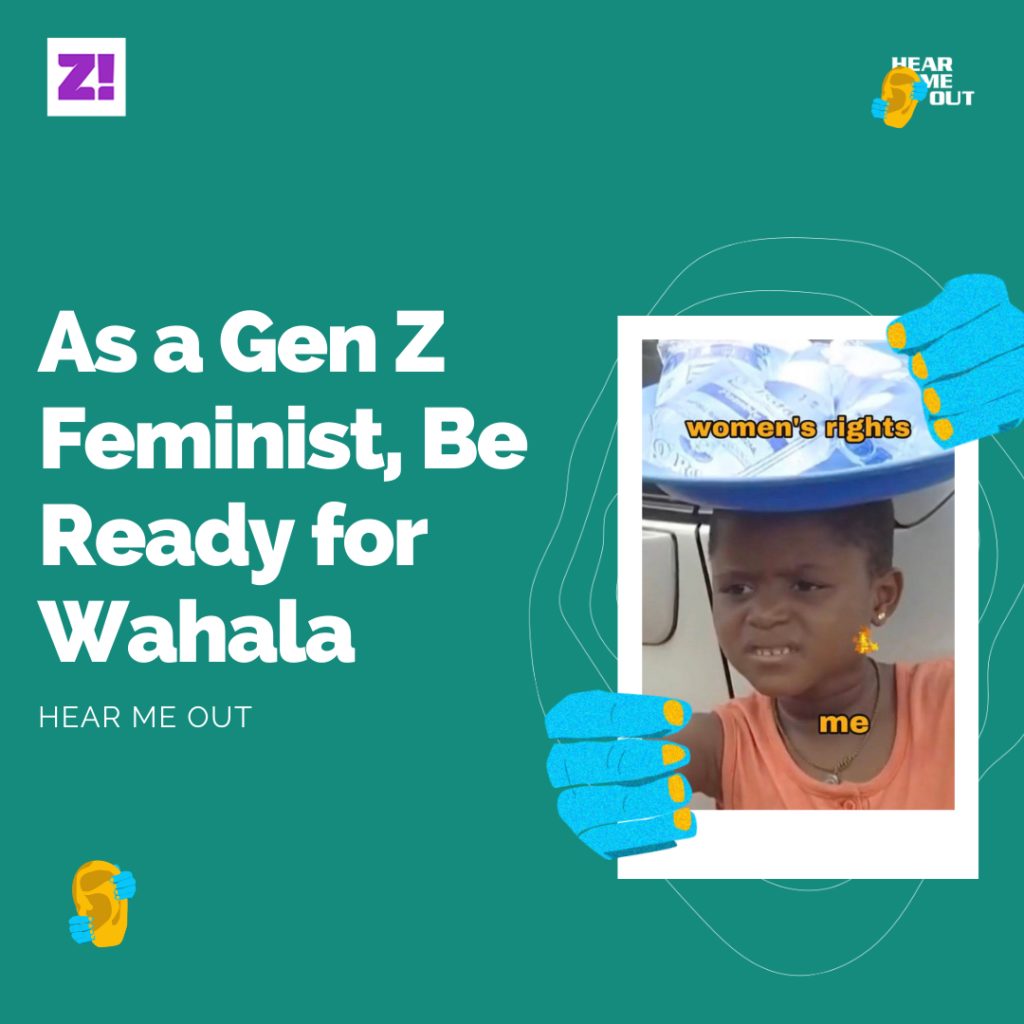
    As a Gen Z feminist, you must be ready to become the topic of every family meeting.

    I picked up my older sister’s phone and started my little quest for answers. It was during this process I discovered the word feminist, and when I knew what it meant, I knew I had found my identity.

    I had found my identity. 

    The world will always come up with new ways to objectify and sexualise women. I grew up wearing mini-skirts and thin-strap tops my mother bought for me at bend-down-select. I was called a slut for the first time when I was only 10. And as weird as it might sound, it was my own mother who called me that. According to her, people were starting to talk, my breasts were poking through the thin fabric of my favourite tops. One day, she looked at me with distaste and called me a slut.

    As a Gen Z feminist, you must be ready to become the topic of every family meeting. You should also prepare yourself for endless unsolicited opinions. I have come to realise my feminism terrifies a lot of people; it makes them angry. If I didn’t have such a coconut head, perhaps, I would’ve cared.

    I’ve always been vocal about my feminism. I would walk into a room and somehow, start talking about women’s rights. The world has a long history of despising “loud women.” The result of that is I’ve had to sit through painfully long hours of my parents giving me “the talk” about how no man will ever want a wife who won’t submit. 

    Several times, I’ve listened to my brother try to convince me that identifying as a feminist would make people hate me. He suggested I try other terms like “gender rights advocate.” I’ve seen my name become the butt of jokes about Nigerian feminists in my school. People have asked, “Oh, you’re a feminist?” I imagine they pity the person who would marry me. 

    And I can’t forget my religious friends who remind me that feminism is not part of God’s plan. As a matter of fact, I’ve been bullied in church because of my feminism. 

    On a “special Sunday”, youth pastors were walking in circles, selecting random people in the congregation to answer questions. One pastor called me out and asked, “What would you do if your husband wants you to cook, do his laundry, do the dishes and clean the house, every single day?” My answer was simple. “I would tell him I’m his wife, not a slave.”

    I was walking back to my seat when a young man requested to speak next. “Women like her are the problem of the church”. Even though these words were coming from a complete stranger, they still stung. There is a common idea that feminists are “strong” and have a “tough skin”, but we’re only human. 

    What’s it about my feminism that terrifies people? Why does it make people’s blood boil?

    I was publicly humiliated at school once. I was in the middle of a heated argument about how Nigerian culture needs to be reformed until it acknowledges that daughters deserve the same respect sons get without even trying. There was a look of disgust on the faces of the men I was arguing with because I was suggesting something as “sacred” as culture needed to be reformed.

    Not just that, the only woman who agreed with me expressed her view in low whispers. I was still trying to make people see the sense in what I was saying when I felt somebody yank my wig off my head. The loud echoes of laughter that followed right after broke my heart. I cried horribly for days because that was the smallest I’d ever felt in my entire life. I didn’t tell anybody about the new level of anxiety and self-doubt it unlocked inside me. 

    Memories like these leave me with questions I haven’t been able to answer to this very day. What’s it about my feminism that terrifies people? Why does it make people’s blood boil? Is it because I’m tired of seeing doors slammed in the faces of deserving women on the sole basis of gender? Is it because I believe women should not be denied their right to safe abortion? Or because I would never fit the “good African wife” narrative my mother has spent her entire life trying to fit? 

    Society claims to appreciate women, but in reality, they only appreciate women who deliberately dim their light just to allow men shine. As a woman, you’re expected to aspire to be a good wife and mother, to never prioritise anything over your matrimonial duties.

    On some days, you’re allowed to have an opinion, but it’s usually better to keep those opinions to yourself. You can speak up about gender-based violence, but when you do, prepare for the “maybe you shouldn’t have gone to that place, or worn that dress, or said that to him” speech that would follow right after.

    All my life, my mother shrunk herself just to stroke my father’s ego, and it’s never made much sense to me.

    You’re expected to dress the way women are “supposed” to dress — everything knee-length or baggy, minimal accessories and NO cleavage — any other type of dressing would be seen as defiance. You should also smile even when you have no reason to. I’ve watched many women shrink themselves to fit that little, demeaning image society has created.

    All my life, my mother shrunk herself just to stroke my father’s ego, and it’s never made much sense to me. Even though we all knew how hard she worked to raise our school fees, she would give the credit to my father because that’s what good wives do. Just like my siblings and I, my mother had a curfew because “good wives shouldn’t be outside past 8 p.m.” And if God forbid, she ever misses her curfew, he would punish her the way bad wives should be punished, by locking her outside her own home.

    It’s very easy for people to ignorantly assume feminists are angry and unhappy women who hate men, and I’m tired of this misconception. You could spend your whole life educating people about the true meaning of feminism, and they would still choose to listen to those little patriarchal voices in their heads. I’m not naive enough to think the world would change overnight because of me, but I’m never going to stop clamouring for that change.

    I was once the kind of feminist who only said the things men like to hear. Things like, “I’m a feminist but I still think a man should be the head of the family”. I was at a point where I relied heavily on people’s validation for every aspect of my life. Even my feminism was tainted by societal stereotypes because I didn’t want my views to offend anybody. I would tell myself I could be a feminist and still be a “Nigerian woman”, the one who would master the act of compromising to seem nicer to men. A small part of me didn’t want to contradict everything the Bible says a woman should be.

    But last year, I got selected for a women’s rights fellowship where I met 19 like-minded women. For the first time in my life, I had the opportunity to be in a room full of feminists, and they helped me realise that if I couldn’t be an unapologetic feminist, there was no point in being a feminist at all. I’m used to being hated now. As a matter of fact, it doesn’t bother me anymore because the kind of people who hate me for my feminism is exactly the kind I don’t want to be associated with. 

    I have a clear vision of how I want my feminism to impact the world. It starts with calling bullshit on all the misogynist nonsense society likes to preach. And on days when I feel like giving up, I remind myself of the different ways society robbed my mother of her voice and happiness. Like many Nigerian women, she deserved better. She still does.

    ALSO READ: 8 Nigerian Women Talk About Why They Became Feminists

  • Every Nigerian man knows feminists are bad vibes and should be avoided at all costs, but some feminists manage to gain their approval. Would you like to know how to feminist in a way that appeals to Nigerian men? Find out below.

    How to be a feminist that Nigerian men love

    1. Aspire to be “likeable”

    Put conscious effort into being liked. Tone down your voice in public spaces, garnish the truth and pander to men as much as possible. The point is to avoid offending the men around you. Audition for male validation every chance you get. Once men start agreeing with your brand of feminism, know you are doing great. 

    2. Always listen to “both sides”

    You must fake objectivity even when it is absolutely unnecessary. The men around you will see you as unbiased and logical. A good example is comparing misandry to misogyny. Call both of them “extreme,” because women must remain calm and unfettered in the face of systemic violence. Always remember to add “not all men” when other women are talking about all the things men are capable of.

    3. Uphold culture and tradition even when it doesn’t benefit you

    Do it just because you can, after all women are some of the strongest soldiers of the patriarchy. When women object to bride price or taking their husband’s surnames, remind them that they are doing too much. As wives, their business is to the kitchen, their husband and their kids. Everything else na over sabi. Na you talk am and men will stand by you. 

    4. Stand for equality while reminding other women that the man is the head of the house

    Always remind women of their place as the neck of the home even while preaching equality. You can start with, “Women are equal to men,” but quickly add that, “Men are natural leaders, with special leadership qualities vested upon them by virtue of their genitals and God”. Men love feminists who know this. 

    5. Remind everyone that you’re not like other girls whenever you can

    Remind everyone that you’re not like other girls, especially not these toxic feminists who hate men and are always bitter. It doesn’t matter that you have never read anything on the history of feminism, and how women fought on the streets, burnt property, held naked protests, went to prison, just so you can have the rights you have today. Those women must’ve been incredibly bitter and were doing too much. You are not like them and everybody needs to know. 

    6. Occasionally, tweet things like, “Women are not fighting against oppression; they just want to be the oppressor,” or, “Women are their worst enemies.”

    This should be a constant feature in your journey to be a feminist loved by Nigerian men. Women’s worst enemies aren’t the ones at the center of their harassment or violence, but their fellow women, of course. When a woman catches her husband cheating, her worst enemy is the other woman that lured her naive husband into adultery. 

    7. Shut down other women when they call out oppression by saying they’re playing victim

    You know, the same way Nigerians are always playing victim by spending all day calling out political and ethnic oppression instead of just working hard to improve things for themselves, yes, just that. Women too are imagining things because they have too much time on their hands. They should get their ass up and get to work.

    8. Be an equity feminist

    Tell everyone that cares to listen that the feminist fight should be for equity and not equality because, in your imagined world, equity can be achieved without addressing the root cause that is inequality. Conflate equality with sameness, because for some reason, in this special world of divine comprehension, they both mean the same thing.

    9. Shit on sex workers

    Do this as often as possible in order to signal that you are different. Compare them to actual criminals like fraudsters and money ritualists because sex is as harmful to the human population as killing and stealing. It does not matter that you as a woman are one kidnap or murder away from being stripped of your humanity, just do it.

    10. Be queerphobic

    Need I say more? You don’t have to do it the old fashioned way, you know. Be benevolent with it. Posture as that bisexual feminist who fancies threesomes and you will have a lot of cis men lined up and salivating. Drop queerphobic nuggets from time to time like, “Don’t make your sexuality your personality.” Remember to always end it with, “I’m not homophobic, I have gay friends.” Nigerian men will be falling over themselves to marry you. 

    Subscribe to our HER newsletter for more stories about African women and how they navigate life.

  • Are you a radical feminist or a nice feminist? Are you even a feminist at all?

    Let’s find out:

  • Feminism is a diverse movement that aims to liberate women and other oppressed groups. Each feminist’s path is different from the next. In this article, I asked eight Nigerian women why they became feminists, and here’s what they had to say: 

    Kay, 26

    I was a feminist even before I knew what the word meant. Growing up, I used to question societal norms because I wasn’t okay with “That’s how things are done” or “It’s a man’s world”. After I got married, I started having issues with my husband because I wanted him to treat me the way he would want to be treated. He couldn’t take what he gave me. He was the one that helped me realize that I am a feminist. We were fighting one day and he blurted out, “You are just a fucking feminist!” I had been hearing and seeing the word around but I didn’t know the meaning. 

    After that fight, I started reading feminist materials and I was so happy to find a word for everything I had been feeling. 

    Tomi, 24

    I have always been a feminist.I grew up in Northern Nigeria and I watched small girls get married off to grown men and I hated everything about it. I didn’t realize I was a feminist till 2018 when I read an article from Chimamanda. Since I have been carrying women’s issues on my head like gala. 

    Bisola, 22

    I was 15 and in secondary school when I found Chimamanda’s Purple Hibiscus in my school’s library. I loved the book so much that I turned to the back cover to read about the author. There, it was stated that she’s a feminist. I checked the meaning of the word and thought “Who doesn’t believe that men and women are equal? That means I am also a feminist!” From that day, I started identifying as one and made it a duty to advocate for women’s rights like Chimamanda.

    Amaka, 21

    I think it dawned on me that I am a feminist when we travelled home to my father’s family. Every single thing those people said was unfair to women and they called it tradition. My mum had a minor surgery just before we travelled so the brunt of the work fell on me as the first child. I would refuse to do the things I didn’t want to do. I hated that they would listen to my brother, who I am older than with three years before listening to me. I didn’t want to be pounding yam while men drank. I told my parents I didn’t want any of it. They call me an ogbanje because of how outspoken I am. I don’t care as long as I am choosing myself. 

    I started reading about women’s rights and I found the word feminism. Initially I didn’t want to call myself a  feminist because of the stigma attached to it. But I eventually did and became an ally to other marginalized groups. 

    Aisha, 31

    I have always been a feminist but I didn’t know the word for it until I became an adult. As a child, I found gender roles ridiculous and always campaigned for equality. I watched women shrink themselves and tolerate rubbish from their husbands and husbands’ brothers. ven as a child, I knew it was unfair. I swore it would never be my portion, not realizing the struggles I would face rebelling against that as an adult.

    Women are and do so much — the continuity of humanity literally depends on women, yet they’re given second-class treatment? How could that ever sit well with me? Or anyone? I had to be a feminist. Anything less is unimaginable. We die here.

    Uche, 25

    Identifying as a feminist was inevitable for me because I was a rebellious child. I always did C when everyone else was doing A, and it was always different from what was expected of me as a woman. I heard things like “As a woman you need to learn how to cook for your family” when I was only 6. Those expectations felt like confinement. I first saw the word feminism in university. It was the first day of orientation and a girl, who later became my best friend, was upset at a school policy that involved expelling students that got pregnant while in school. I couldn’t understand why she was angry. She explained to me what a woman decides to do with her body is her choice and what they are really punishing is the audacity of a single woman to be pregnant. It blew my mind. I started to think about the other ways the African society oppresses women. I became a feminist after that. I embraced my rebellion, and I found a community of feminists that didn’t make me look odd for not wanting to conform.

    Ivie, 24

    I became a feminist because the misogyny in my family was too much. Men are allowed to do what they want but when women want to do their own, it’s a disgrace to the family. First time I got my period, I had menstrual cramps. My uncle told me to stop acting like a baby because I was crying. Before my mum died, she would tell me that I’m supposed to be better than my brother at chores because I am a woman. It used to annoy me. I became a feminist in my first year of university. My feminism was birthed out of the frustration of Igbo women. Igbo culture suffocates women. If not for civilization, e for don be. I call myself a Christian Feminist. There is misogyny in the church but people try to justify it as the word of God. God can never treat you less because you are a woman. I know He loves us all equally.

    Tos, 19

    I have been misogynistic in the past. There was this girl I knew who was vocally feminist and I used to insult her for it. Now, I cringe when I think about it. My journey to feminism started when I joined Twitter. I would see tweets pointing out the injustices against women and it made sense to me. Now, I am a radical feminist and my views surprise many people, including other feminists.

    Subscribe to our HER newsletter for more stories about African women and how they navigate life.

  • The feminist coalition is a body run by a group of women with their main focus being fighting injustice. They do not organise. Rather, they’ve assisted, structured and dispersed funds for the #EndSARS protests. Here are some of the things they have done.

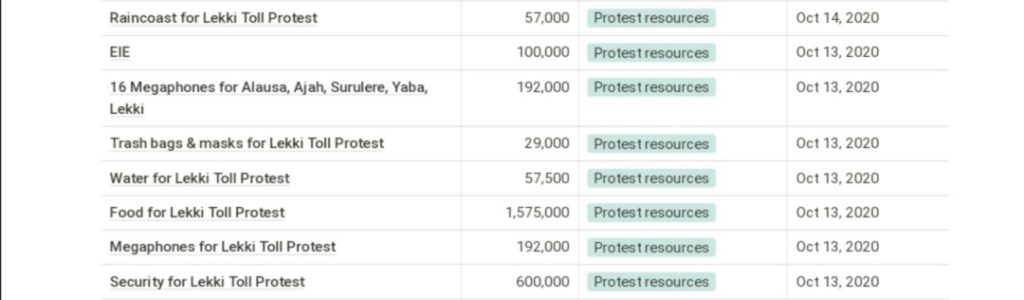
    1) Feeding

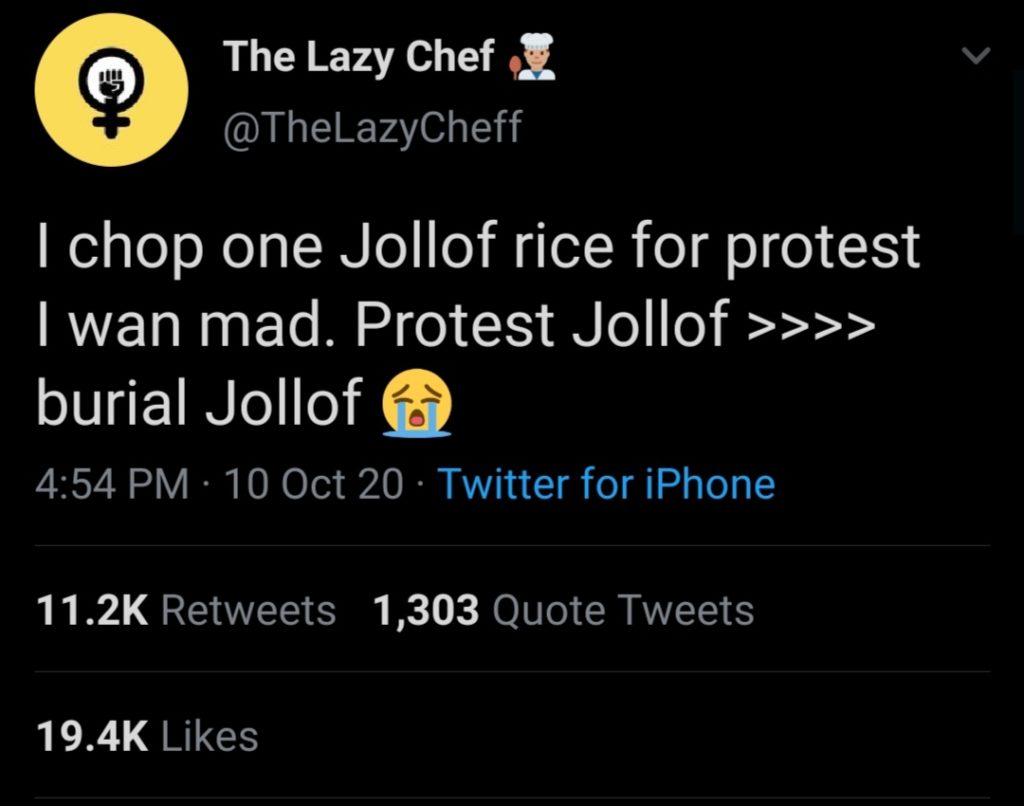
    Some of the money has been used to pay for the protesters feeding, and feeding all those people is not easy. That is why protest jollof > burial jollof.

    2) Medical Aid

    They have also paid for the medical bills of some of the injured protesters. Some of who were shot or seriously injured.

    3) Funeral Aid

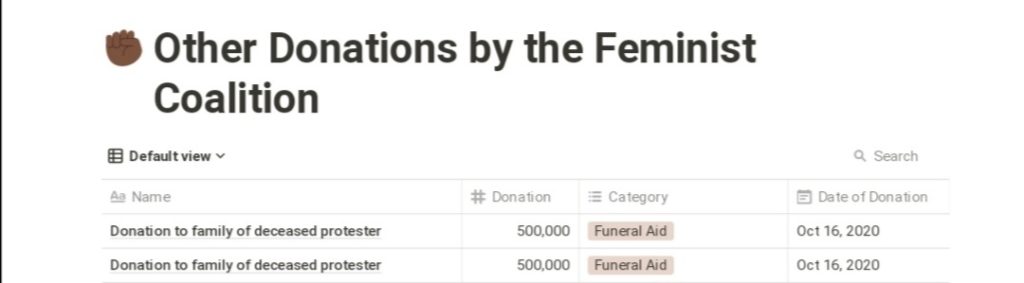
    They had given money to assist in the burial of deceased protesters

    4) Masks

    They arranged for masks in some locations to help prevent the spread of the Coronavirus. We all need to be properly masked up and kitted. No be Corona go kill us. 

    5) Legal Aid

    Some people while protesting were arrested by the police on false charges. The feminist coalition paid lawyers to represent them and get them released.

    6) Protest items

    Some other protest items like megaphones, banners, cardboards, etc. 

    7) Protests

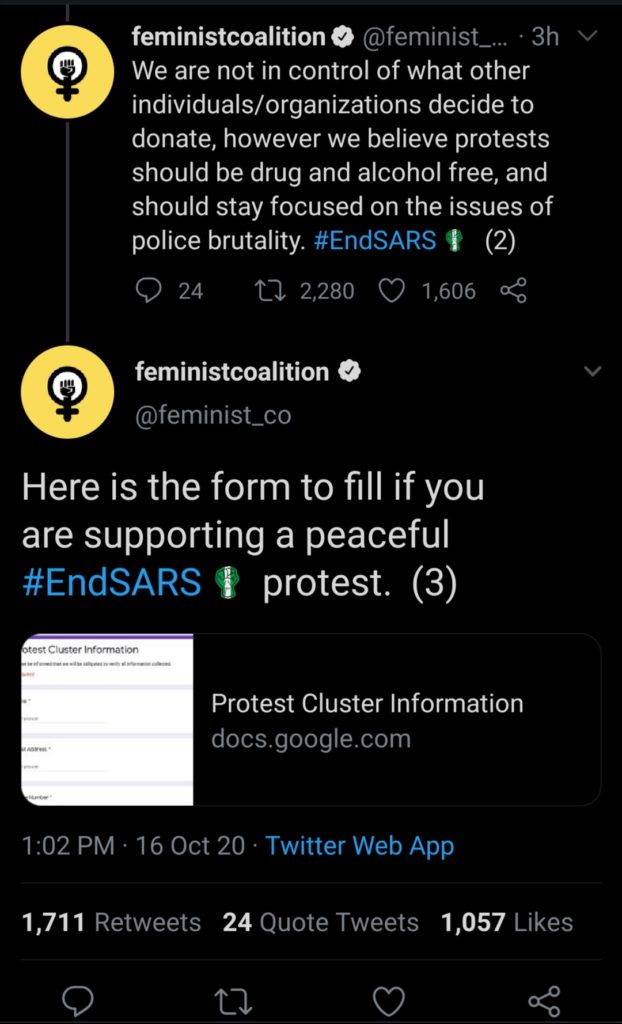
    The Feminist Coalition has given money to people organising protests in different states, and they have supported 25 states so far. If there is a protest you want to organise, you fill a form and they will attend to you.

    If you want a more comprehensive list of money spent and money gotten, please click here. For more about HER, click here

  • Today, I spoke to a lady who regrets not taking runs seriously.

    How did you get to this point?

    When I came to Abuja in 2018  for my NYSC, I stayed with my aunt.  Just before the end of my service year, I got a job with a slightly okay pay. I was excited about the possibilities until my aunt kicked me out of her house.

    Say what now?

    When I told her about the job, I literally watched the light leave her eyes. A few weeks later, she told me she was travelling and wanted to lock her house so I should prepare to leave. She actually told my mom before she told me. I was helpless. It hurt more because she’s actually related to me by blood and isn’t just a family friend.

    I’m sorry. What did you do next?

    Honestly, It threw me off because I thought I’d finally get a chance to start my life and do better things for myself. I started an immediate search for a place to stay. There was a guy who liked me; he was doing very well for himself, I told him about my situation and he offered me his place as an option.

    Was your mother okay with this?

    I didn’t tell her. I knew she wouldn’t want me living with a man so I lied that a friend offered me a space in his guest house. She bought the story and I started living with this friend. I stayed with him for 2 months.

    What was that like?

    I was being monitored and I wasn’t allowed to have friends over at all. He didn’t like the fact that I insisted on staying in the second bedroom in the house. He had expected me to stay in his room. Don’t get me wrong, I was grateful for a place to stay, but I didn’t appreciate the other things he did like randomly grabbing my breast or touching my butt or telling his friends that I was his girlfriend. This is someone that I wasn’t even considering as a dating prospect and I wouldn’t have looked his way at all but life comes at you fast.

    How did you become a sugar baby?

    After living with him for 2 months, he saw that I refused to have sex with him and that I wasn’t responding positively to his advances, so he switched up. When I told him I was getting my own place soon, he started acting out. One day, he told me his babe was coming from Lagos and asked when I was leaving.  I had to stay with a friend while trying to raise money for my house. By then, I had been meeting up with other people, trying to solicit help so I could get my own place. My first sugar daddy was a man I met when living at my aunt’s place. My aunt was also a sugar baby so she had a lot of rich men come to her house and this one picked interest in me and got my number.

    What was the relationship like?

    Initially, he started out being so helpful with no strings attached, he didn’t act like he was interested in me that way. I got gifts and money from him from time to time until one day he asked me to come to a hotel. That was when I knew what was up. I couldn’t bring myself to do anything with him but I knew that If I didn’t do something, the money and gifts would stop so I gave him a blow job. I hated myself afterwards. I continued seeing him even though he made his intentions clear that he wanted to make me his second wife but wanted to sleep with me first. I perfected the art of giving blowjobs so I wouldn’t have to sleep with him.

    So, you were a sugar baby without giving sugar?

    Yes. Something like that. I was totally repelled by him. I didn’t sleep with him because I was disgusted by him. I never stated this to his face but all these played a factor. However, he kept coming back. Even when I moved into my new place, I had to tell him that I wouldn’t sleep with him and the most I would do was a blowjob. I always felt disgusted after. 

    So, You didn’t take on more partners? 

    I actually did. I started seeing other men but I made it clear that I wasn’t going to have sex with them. My hesitation came from the fact that I am a feminist and I don’t like being objectified but I figured that everyone has their cross to bear and this is mine. Over the months though, I toughened up and told myself that I will treat being a sugar baby like a side hustle. I might not like it but I have to do it to survive. My job pays me next to nothing and sometimes my salary finishes in the first week but I somehow manage to pull through.

    You mentioned being a feminist

    Yes. I am. It makes doing this harder because I want to be more for myself. I don’t intend to keep doing this for long. I am only maintaining these relationships with hopes that if an opportunity comes up, I’d be remembered and considered and that would push me to the next level in my life. Also, I regret not taking runs seriously last year because I felt it made me a bad person. So even when I kept meeting big people, I wasn’t willing to play the game. Now, I understand that you have to weaponise what these men like about you to get what you want.

    Anything else you want to add?

    Yes. I have come to learn that life is “give and take”. Men don’t do anything out of charity, there’s always a motive. Understand their motives and use it to get what you want. Secondly, do not judge others for the decision that life forced them to make. We are all just trying to survive.  

    For more stories like this, click here.

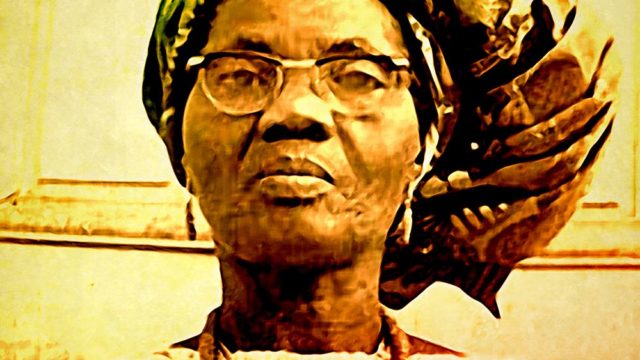
  • Google is paying homage to Funmilayo Ransome-Kuti today by celebrating her posthumous 119th birthday with a wonderful doodle by Nigerian-Italian artist, Diana Ejaita.

    Here’s what you need to know about such a great legend, who once pursued a king from his throne:

    Early Life:

    • She was born on October 25, 1900 in Abeokuta, Ogun State, Nigeria; and was christened as Francis Abigail Olufunmilayo.
    • She was the first female student in her secondary school, Abeokuta Grammar School, which she attended from 1914 to 1917.
    • She later went on to study at Wincham Hall School for Girls in Cheshire, England from 1919 to 1923.
    • Afterwards, when she returned from England, Madam Kuti stuck to her heritage by giving high preference to her Yoruba name–Funmilayo.

    Activism:

    • As a believer of equal rights for women, Funmilayo was instrumental in educating women; she organized literacy classes classes for women and established a nursery school in the 20s and 30s, respectively.
    • She created the Abeokuta Ladies’ Club (ALC) for educated women in 1942. She also started the social welfare for market women club to help educate working-class women.
    • Regarded as the Lioness of Lisabi, Funmilayo Ransome-Kuti led a protest in the 40’s against arbitrary taxation on the Egba people; this evetually led to Oba Ademola II’s abdication of his throne in 1949.
    • Funmilayo was a cultural ambassador, ensuring that she was always clad in traditional outfits every time.
    • She was part of the delegation, as the only woman, that laid a formal complaint in 1947 for the colonies. She also partook in the negotiations of Nigeria’s independence.
    • She was the first woman in Nigeria to drive a car and ride a motorcycle.
    • Funmilayo was also an Oloye of the Yoruba land, holding a chieftaincy title.

    Offsprings:

    • She was the mother of the late afrobeats legend, Fela Anikulapo-Kuti, and aunty to, Nobel Laureate, Wole Soyinka who also followed in her footsteps as social activists. Apparently, the apple didn’t fall far from the tree.
    • Her other sons, Beko Ransome-Kuti, Olikoye Ransome-Kuti  were also renowed professors and Mnisters of Health and Education in Nigeria before their deaths.
    • Her grandchildren Femi Kuti and Seun Kuti are also well recognized and highly respected worldwide for their role in the musical world in Nigeria and the world over.

    Even More…

    • Her father, Ebenezer Sobowale Thomas, was a son of a returned slave, from Sierra Leone, who discovered he was from Abeokuta and decided to return to his hometown after he became Anglican.
    • Funmilayo’s husband, Reverend Israel Oludotun Ransome-Kuti, was an activist as well, although not as fierce as she was. He was one of the founders of the Nigeria Union of Teachers and the Nigerian Union of Students, which are amongst the strongest organizations in the educational system in Nigeria.
    • She died in 1978 after being thrown from a second floor window during a military attack in Fela’s compound.
  • Gather round, boys and girls. Today, we’re talking about Feminism, feminists and stupid questions.

    Dave Chappelle Come to me
    After decades of maintaining (and enjoying) the status quo, it seems the world is finally acknowledging how society has been unfair to the female gender.

    Let’s take our society for instance.

    The average Nigerian girl is raised to be a mother and little else. As a child, she often has to prove she’s as deserving as her male counterparts to even get a shot at anything. As an adult, more often than not, she becomes her partner’s side-kick and spends her prime years tending to her family. All of her life, she is made to feel like an accessory to her male peers and treated as such.

    Feminism is seeking to change all that.

    wow the power of a feminist
    That’s why it’s one of the biggest social movements of the last few decades. Simply, it’s an ongoing campaign for women to be seen as equal. Feminists are asking for one simple thing; that women are given equal footing and opportunity, with no recourse to their gender.

    But as you would expect, people have reacted in different ways.

    There are those who insist that today’s women are just spoilt brats who are complaining about the same things their mothers handled happily. The people we want to talk about are those who are standing by the door – waiting for a nice, God-fearing feminist to explain what’s going on to them. They swear they would be feminists too, only if someone could just explain exactly how they’ve contributed to the status quo.

    But do Feminists really need to explain anything to you?

    feminist why?
    The simple answer is NO.

    Here’s why – To start with, you’re part of the problem

    If you’re a man who breathes air and eats food, you contribute to and benefit from the problem. How? You ask. Odds are, growing up, no one ever told you to leave your books to join mummy in the kitchen so you could be a good wife. You probably weren’t raised as if your role as a human is to bear children and raise a family. And if we’re being serious, no-one has ever accused you of using runs money to buy your new phone. If anyone should understand the system and how it benefits men; it’s you.

    Or you’re just too lazy to task your brain.

    Saying you need someone to explain feminism to you feels like plain mental laziness. It’s like saying you don’t understand why bad hygiene is a problem. So you’re going to continue soiling your trousers until the Minister of Health comes to explain hygiene to you. Simply, it’s not a valid excuse. Feminism isn’t exactly rocket science.

    But… there’s a BUT.

    Is it possible to understand where these guys are coming from? The ones with their hands spread out, waiting for an explanation. We can’t deny that there’s yet a long way to go, but in recent times, the campaign for women’s rights has been overtaken by a lot of… other things.

    Frankly, it’s all very confusing and exhausting.

    Terms like “Man-splaining” and patriarchy itself have become overused to the extent that they now only dilute the message. Also, while feminism tries to draw attention to gender inequality, some funny people are hiding under its canopy to spread misandry – an ingrained prejudice against men.

    What is this moral lesson in all of this?

    What all of this means is that Feminism, in its purest form, is getting lost in the sauce. And that serves no one well. The truth is that a world where men and women are treated equally, with equal access to opportunity and balance in responsibility, is better for everyone. Maybe that’s why we need to talk about it more. Maybe, just maybe, we need to explain to those who want to understand but don’t.