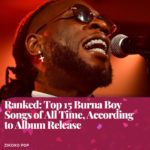
There’s so much music out there that it’s hard for even the most loyal fans to stay up with their favourite artists or what’s new and hot right now. That’s why we’ve created #BumpThis – a daily series that features the one song you need to listen to, every day. Don’t say we never did anything for you.
One of the more common responses to Burna Boy’s infamous response to the Coachella 2019 promotional material was the question of exactly what the singer meant by the term, “African Giant”.
“Another Day”, off his recently-released fourth studio album, does a better job of explaining than he has in interviews. The song, which features Ghanaian rapper, M.anifest expresses the social stagnancy and political wheeling-and-dealing that has defined Africa through the decades.
The song opens with an excerpt of Jide Olanrewaju’s “A History Of Nigeria” in which he describes how the British bought the area now known as Nigeria, for commercial purposes, at the beginning of the 20th century.
Burna Boy reinforces this theme of struggle by interpolating lyrics from two classic Nigerian protest songs; “E Be Like Say” by 2baba and Original Stereoman’s “E Dey Pain Me”. M.anifest’s laid-back verse is a perfect condiment; it offers a more recent, relatable perspective to the song’s theme.
The effect is two-fold; the sampled classics are a reminder that the problems they speak off are old. But this also points to a bigger issue; that songs about Africa’s social & political issues are rare – the exception, not the norm as you would expect given the influence that African pop stars wield among their listeners.
The beat, a reggae-inspired groove by Kel-P, now Burna’s go-to collaborator, is more celebratory than you’d expect. It makes ‘Another Day’ sound like a campaign for change rather than yet another sob story.
Burna Boy’s follow-up to his 2018 career-defining album “Outside” has arrived, four months after “Steel and Copper“, an intermediate release that placed his year in context. Just so you’re certain how significant his 7th body of work is, the album’s press release alludes to the belief that 7 is the number of perfection, “an auspicious sign from our gods that one is on the right life path.”
Burna would be justified in thinking so. In the last 18 months, the 28-year old who opened his debut album, “L.I.F.E” by implying that his path was predesigned has put together the run to support those claims. When, days before his album’s release, Burna performed on Jimmy Kimmel’s show — a high profile set that many compared to Majek Fashek’s 1992 appearance on the David Letterman show — it seemed like a logical next step, not the rare exotic showcase that African music is often presented as.
For the first time in a decade, fans are acknowledging that Afropop’s long-standing duopoly, Wizkid and Davido has a third entrant. The truth is that the duopoly no longer exists.
His response to the Coachella 2019 promotional fliers may have shot the ‘African Giant’ tag into infamy, but the multiple themes that dominate the album date further back to his earliest mixtape, “Burn Notice”.
Burna Boy’s Coachella set also set off an inevitable conversation on how much African music needs the US market. If he felt any pressure to address those concerns, there is no evidence here.
https://www.youtube.com/watch?v=BuMM9vv4Gt0
“African Giant” sounds like an assertion of Burna’s belief in himself, the era that birthed his multiple tastes of the Nigerian experience, the cultures he has come to cross-pollinate and the continent he speaks for.
Much of that is down to Burna’s own primary inspirations. Damini Ogulu has, in the last few months, given a contemporary twist to Fela’s militant afrobeat on three singles, “Ja Ara E“, “Anybody” and “Gbona“. The album’s title track follows the trend, but more so in theme than tone. “Tell them Africa don tire,” is an apt summation of the collective mood among the continent’s youth.
Like Fela, Burna presents himself as a messiah – “so here comes the African Giant,” – even if he knows it will take more to save us. It closes with a sample of an Igbo folk song with lyrics, “Obudu Obelugo jimjim” that translate into: “The country is shaking.” This theme of Africa’s struggle, liberty and pride is strong through the album.
“Wetin Man Go Do“, one of the album’s more sombre cuts, shrouds the perpetuity of the average Nigerian’s struggles for necessities in folksy guitars and Fela Kuti’s call-and-response delivery. “Dangote“, titled after Nigeria’s richest man, is a reminder that the paper chase never ends — something a large number of his listeners relate to in more survivalist terms. “Collateral Damage” sits on a jaunty beat that Burna uses to evoke a charged Fela Kuti and blatantly state several Nigerian truths. “My country problem pass Jesus” is a sharp comment in a society where religion has never delivered returns on the people’s devotion.
“Another Story”, one of the album’s best tracks, samples the opening words of Jide Olanrewaju’s acclaimed documentary “A History of Nigeria“. (The excerpt, which describes how the Royal Niger Company traded the area now known as Nigeria, has inspired a wave of interest so strong that many fans are now revisiting “Royal Niger Company” by rapper Jesse Jagz.) Buoyed by a stellar, descriptive verse by Ghanaian rapper, M.anifest, Burna interpolates other conscious songs: 2baba’s “E Be Like Say” and Original Stereoman’s street-pop hit, “E Dey Pain Me” to paint what is, in essence, an updated version of the same reality.
Burna Boy’s 2018 album was described as a ‘fine lesson in mixing genres without making mud’, “African Giant” sums up what it means to be a Nigerian born in the 1990s, raised on different continents in the digital 2000s, and representing Africa in a globalised 2019.
These multiple perspectives (on life, culture and music) come across in the variety of sounds he manages to compress into one cohesive body of work. He’s schooled in the electronically-produced bashment and garage sounds of the UK, but Burna’s as comfortable on the live instruments of Ghanaian highlife and Afrobeat.
It’s hard to remember the man who was first introduced to fanatics as a reggae hyphenate. On “African Giant”, Burna seems intent on further obscuring the lines between Afropop and the form of global pop music that has incorporated African melodies. If in doubt, listen to anything from Ed Sheeran’s “No. 6 Collaborations” EP to Beyonce’s “Lion King: The Gift”.
Compared to the high-octane, genre-bending scale of “Outside”, “African Giant” may, at first listen, sound like a deliberately simple take on Afro-fusion. The latter is more atmospheric than its predecessor, and will sound more accessible to first-time Burna Boy listeners. That’s because Burna’s influences are more coherent and smoothened. There is little of the purposeful watering-down that other contemporary afropop ambassadors believe to be necessary.
He is as confident painting vivid love scenes in pidgin alongside UK R&B sweetheart, Jorja Smith on “Gum Body” as he is trading boastful bars on a menacing beat with Zlatan Ibile on “Killin Dem“.
On “Omo“, Burna goes back in time to give us a taste of the melodies that made “Smooth Sailing” a cult favorite, then introduces “Secret”, a futuristic reggae/R&B hybrid featuring Serani and Jeremih that asks lovers for utmost discretion.
“This Side“, his collaboration with YG is an unusual gem that sits smack between Lagos and the West Coast that the US rapper wears on his sleeve.
Much of the album’s cohesion is courtesy of the featured artists – a motley crew ranging from a breakout Nigerian rapper to semi-retired world music icons. There are the men and women behind the scenes as well – Burna personally hailed the work of UMPG A&R, Sureeta Nayyar – and perhaps, most importantly, the producers. Hours before the album’s release, he also did a Twitter roll-call of the beatmakers who contributed – Nigerian producers, TMXO, GMK, Chopstix, BenJamz, Kel-P, Kleb Beatz as well as DJDS, Levi Lennox, Skrillex, Dre Skull and Supreme Young Stars.
Thematic albums work best when the soundscape is crafted by one or a few producers. Burna himself has done this before; 2013’s “L.I.F.E” was helmed by producer Leriq to great effect. Here, the list is longer. But much credit should go to Kel-P, who is credited on 10 songs and has found a sweet spot between Burna’s various inclinations.
Not all the collaborations stick. A Future & Burna Boy collab should be flames on paper, but when restricted to an afro-Carribean beat, the two don’t strike up synergy on “Show And Tell“.
More than anything, “African Giant” is a triumph of self. In the days preceding its release, the “Outsiders” as Burna’s fans are known, made references to the early days of his career; days when everyone supposedly knew he would be this big, even if Burna also doubled as his own biggest problem.
Perhaps there is something to be said here about fans and our entitlement to artists and their growth. Not many expected that the hyper-masculine singer who made an album wondering aloud about his place in the world could find himself enough to define a path for the next wave of Nigerian musicians.
In the years since he had his concert cancelled over a court case, Burna Boy has opened up layers within his art that provide context for his person. On “African Giant”, he is at many times sensual (“Pull Up”,”Gum Body”), celebratory (“Omo”, “Anybody”), ponderous (“African Giant”, “Wetin Man Go Do”), introspective (“Destiny”) and militant (“Spiritual”, “Different”).
The album hit its climax at two points. “Pull Up”, the album’s sixth single is followed by a supernal skit by Blaq Ryno that sounds more like panegyrics than a sketch. What follows is “Destiny”, an autobiographical song that could well be an update of “Where I Come From”.
“Feel good, I ain’t gonna lie… They can take everything I have, but they can’t touch my destiny“, he sings. He’s come a long way from the days spent “standing on the corridors, dodging feds and the coroners.”
For all of his troubles, it’s the first time Burna admitted he’s impressed at how his story’s unfolding. It’s a sharp shift from the fears of failure he expressed in the past, and provides fitting context for “Different“, the album’s most glorious moment.
Introduced with a brooding beat, Burna taps two heavyweights, Damian Marley and Angelique Kidjo for a song that is bound to make award nominations lists. “Different” is just that… different. In many ways, it also suggests Burna’s ascension into a class of greats. The PH-born singer reaches astonishing new heights trading monologues with Damian Marley on inequality and the confrontational prophets that these times require.
Four years ago, invoking Burna Boy in the same sentence as Damian Marley & Angelique Kidjo, or worse, as a socially-conscious freedom fighter would have been seen as hasty or disingenuous. Since he propelled himself to the forefront of conversations about Afropop’s global push, however, his belligerence has been translated into the form of hostile indifference it takes to absolve African music of the biases it encounters.
The other crescendo comes at the end of the album. On “Spiritual”, Burna Boy takes on a simple Nigerian pop beat to address that transition. “When you start, them go yinmu” is a line that reiterates the bad press he got in his first few years, but Burna suggests that he’s lined up for a more special purpose than tabloid gossip and click-bait.
As the closing voice on the album, Bose Ogulu’s monologue portrays “African Giant” as a potential watershed moment in Africa’s music and culture.
The black world erupted in pride when Burna Boy’s mother/manager, first said “…the message from Burna I believe would be that every black person should please remember that you were African before anything else” as she received his 2019 BET Best International Act nod on his behalf .
The “Afrobeats to the world” narrative is built on the belief that the world must accept African culture, first for commercial success, but mostly as some sort of validation. “African Giant” comes at a time when it’s never been better to be African. Numerous black artists are accepting their African roots, and re-establishing their ties to the motherland.
Although he is often depicted as Nigeria’s best chance of ‘crossing over’, particularly in the US, Burna Boy has defined a different path for himself on “African Giant”. It is a statement-of-intent; that global appeal can be achieved without sacrificing the influences and experiences that make Africans and our culture distinct.
In a world where movements of the oppressed clamour for validation to varying levels of success, Burna’s symbolic 7th body of work speaks to a continent’s place in the world – it is a thesis on why African pride should be our starting point.
In the past two years, Burna Boy has put out enough music in albums and singles, that his new fans have sufficient music to lose themselves in. For an artist in his seventh year, Burna has even more music than you know. You may only have noticed after he began dropping singles every three months from mid-2017, but the Port Harcourt-born singer is arguably Nigeria’s most prolific A-lister not named Olamide. As of the time of writing this, he’s dropped two mixtapes, three albums and a collaboration project.
Burna Boy’s fourth studio album is set for release on August 26, 2019. In the 18 months since 2016’s “Outside“, Burna’s stock has risen – as seen in the past one week with his spot on Beyoncé’s “The Lion King: The Gift” and his appearance on American talk show host, Jimmy Kimmel’s show. “African Giant” has been described as a late-night take on afro-fusion, the genre Burna has worn like a tattoo since his first days. Perhaps more importantly, it is supposed to be his most personal album yet, a tag I used to describe “Outside” as well.
For first time entrants into Burna Boy’s hazy, energetic kingdom, as well as the fans and fanatics he calls “Outsiders”, we made a list of Burna’s lesser-known gems – songs you’ve likely never heard on the radio and only true fans will know. In no order, these are Burna Boy’s 10 best deep cuts to help you get ready for the album.
Burna Boy – “Agbada”
Some would say Burna is at his best when he gets personal. I wouldn’t disagree. The afro-fusion artist has a chequered past. When he gets into the gritty details or references his street cred as he does in “Agbada”, it makes for a great listen. The beat might remind you of OJB’s early reggae-influenced production. What steals the show, however, is Burna’s incredibly-vivid boasts and gang-speak that makes this feel like a call to war.
Leriq – “Cotton Candy”feat. Burna Boy
If you listen closely to his more sensual tracks like Gwarn or Rock Your Body, you’ll hear it loud and clear. Burna Boy believes he’s a catch. When you’re a 28-year old with a messiah complex and boundless talent, it’s bound to be the case. On a beat by Leriq, who’s thought by many to be his most ideal collaborator, Burna explains why he’s as desirable as cotton candy. Pride has never sounded so good.
Burna Boy – “Chillin Chillin” feat A.I.
In 2017, Ghanaian artistes, DJ Vision and A.I. released “Grind“, a gritty tale of sacrifice and survival. Burna Boy heard a song that was right down his alley and in weeks, released an updated version titled “Chillin Chillin”. Despite the controversy that followed its release, Burna’s version is so different that it’s a whole new song in its own right.
Burna Boy – “Celebrate”
Shortly after “Like To Party” and “L.I.F.E” introduced his new sound, everyone wanted a taste of Burna Boy. Abuja-based producer, GospelBeatz was one of the producers he would strike a solid relationship with. Released in 2013, “Celebrate” was their first of few collaborations. The beat is fast-paced and filled with heavy drums, just as Burna likes it. Burna sings with the enthusiasm you’d associate with a freestyle, but whether it’s written or not, “Celebrate” is still a solid listen today in 2019.
Burna Boy – “Smoke” (feat. Onos)
At a point in the early 2010s, more people knew this song than Burna Boy. Burna’s rare blatant approval of marijuana made sure it would become a cult classic, but the best part is arguably how Burna manages to sound like he’s singing to a loyal wife. The emotion is so strong that when fellow PH singer, Onos decides to sing about love, Burna cuts him off by saying “some man dem try change the topic”, even though “marijuana has never ever done me wrong” Obviously, this one didn’t make it to the radio. I can’t imagine what would have happened if it did.
Burna Boy – “Freedom”
“Freedom” is seen by many as the song that broke Burna out in his home town in Port Harcourt. It is one of the singles off his “Burn Identity” mixtape and arguably his most personal song ever. From the very first word, Burna sings with heavy sentiment about the yet-undetailed events of his arrest and jail stint in the UK. The most striking part is arguably how he acknowledges the effect on his parents, making it a story that anyone who’s been in his shoes can relate to. A gem.
Burna Boy – “Touch Your Toes”
Of the songs on this list, this is the only one that made it to radio. New to the Lagos pop market, Burna was on the hunt for a sound that sat somewhere between his afro-fusion tastes and the popular fast-paced dance music of the moment. “Touch Your Toes” was one of many such attempts. Burna kicks off the song in the most stereotypical way possible. What’s best about this song is the conversational tone and rapid delivery that would come to define Burna Boy’s music in the years after.
Burna Boy – “Smooth Sailing”
The question of whether Burna Boy’s debut album, L.I.F.E is a classic is still up in the air. One song that most Outsiders seem to agree on, however, is “Smooth Sailing”, a cut from the album. On an album filled with quick dance tracks, the track is more mid-tempo and misty. Though he may not be known as a songbird, Burna’s raspy voice is entrancing when he gets in his bag as he does on this song. Although it starts off with thumping drums, Smooth Sailing gives you the same feeling as the title suggests; sipping ‘Guinness’ and a ‘spliff’ and living life to the fullest.
Chip – “Reaching” (feat. Burna Boy)
In 2016, UK rapper Chipmunk had grown tired of trying unsuccessfully to break into the US market. As he made his return home, Chipmunk tapped Burna Boy for “Reaching”, a song that sought to reference Chip’s popularity in the motherland. The real star of the song though is Burna. Seen by most as being stuck in limbo at the time, Burna used the song to hint at the elements that would propel his global campaign. The hook is as Afropop as they come, with lyrics sung in Yoruba about haters and competitors. But Burna pulls it off well on a UK rap joint because as we’ve come to realise, he’s the best mix of both worlds.
Burna Boy – “Where I’m From”
My favourite Burna Boy deep cut comes from his most recent album, “Outside”. Burna has been described as many things through the years – ‘self-indulgent’, ‘problematic’, ‘arrogant’. But very few have afforded him the courtesy of a fair reasoning or used the term, ‘misunderstood’. On this cut, Burna basically describes how the places he’s lived in (or where he’s from) have shaped the man he’s known as. The song is a vivid description of Port Harcourt’s street culture that gives you a peek into Burna’s mind. 10/10. Absolutely recommend.
Did you enjoy this? You should sign up for our weekly pop culture newsletter, Poppin’. You’ll get to know what we’re up to before anyone else + insider gist, reviews, freebies and more. If it sounds like your deal, sign up here.
There’s so much music out there that it’s hard for even the most loyal fans to stay up with their favourite artists or what’s new and hot right now. That’s why we’ve created #BumpThis – a daily series that features the one song you need to listen to, every day. Don’t say we never did anything for you.
There’s no mincing words about it. As the release of his fourth studio album draws nearer, Burna Boy’s has grown into the role of Afropop’s newest heavyweight. The increased global attention surrounding his music has also been buoyed by a sense of self-awareness that was conspicuously lacking in the past.
The new Burna frames his music as a vehicle for African identity and pride. If there are doubts about his many claims, Burna hopes to clear them this Friday on his symbolically-titled “African Giant”.
“Pull Up” is the final single before the album’s release later this week. Burna first hinted at a surprise release by engaging fans on social media. Despite being the most prolific of the big 3 musicians this year, Burna’s fans are stoked at any sign of a new release.
Quite like the very similar “On The Low”, “Pull Up” is one of Burna’s more sombre songs. The Kel-P beat, built with the drums and shakers of Ghanaian Highlife, feels like you’re on a group vacation, sipping cocktails on the banks of the Upper Volta.
“Pull Up” is sure to be yet another summer playlist staple. Burna’s lyrics are as direct as ever; even if this time, he’s simply asking a love interest to meet him in the middle. “Cause I love you for life, you no go understand, na small thing to bust a million for you“, he croons with self-assurance.
If “Pull Up” is a hint at the sounds we’ve been asked to expect on “African Giant”, then 2019 looks set to be another year of Burna. “African Giant, This is Year 2000 and Gbese“, Burna calls as the song winds down. Who are we to disagree?
The first few lines of Beyoncé’s hook on “Bigger“, the opener for her just-released “The Lion King: The Gift” tells you all you need to know about the album. “If you feel insignificant, you better think again,” she sings, “better wake up because you’re part of something way bigger, You’re part of something way bigger.”
The album, which she says is a love letter to Africa was inspired by the Lion King franchise.
And as promised, the album is a celebration of African music. Beyoncé tapped the who’s who of Africa’s biggest musical movement, Afrobeats.
The list of collaborators — Shatta Wale, Burna Boy, Wizkid, Yemi Alade, Mr Eazi, Tekno, Tiwa Savage, Busiswa, Moonchild Sanelly, Bankulli, P2J, NorthBoi, GuiltyBeatz and many more — would make any African proud. From the tidal wave of pride sweeping through social media, the album’s Nigerian pop and Ghanaian Highlife influences have struck a chord, especially among West Africans.
It’s only fitting that we celebrate the Nigerian essence on Beyoncé’s “The Lion King: The Gift”. These are the 5 best Nigerian moments on a body of work that may be Afrobeats’ first true global moment.
WIZKID ON “BROWN SKIN GIRL” with Beyoncé, Saint Jhn & Blue Ivy Carter.
When fans first saw Wizkid on the tracklist for this album, familiar fears were raised. Wizkid has always been known for his melodies than any form of poignant songwriting, especially on an album packaged as a slice of African Pride. However, our fears were allayed on listening to the track. The ease with which Wizkid slotted his vocals into the beat is the level of comfort Nigerians should aspire to in these Buhari times.
The song is a celebration of Melanin and darker skin tones. Wizkid is not credited as one of the songwriters, unsurprisingly. But this matters only a little; Starboy focuses on his strengths and ends up nearly bodying everyone on the song, before rounding it off by harmonising with Queen B. Did you read that right? Wizkid, Baba Bolu, the patron saint of Nigerian gbedu flexed voices with Beyoncé on the best song off her new album. Wake me up. This has to be a dream. Hate him or love him, but Wizkid may have just crafted, with help, of course, an evergreen anthem for African women. What a time to be alive.
BANKULLI’s VOCALS
You may remember Bankulli as the chubby man screaming “Burna Boy, Call Me” in that viral video of Kanye West convulsing to “Ye”. Older fans may remember him as one of the first members of the Mo’ Hits team and the man who introduced D’banj to Kanye West thus kicking off the G.O.O.D Music/Mo’ Hits relationship. Long story short: Bankulli is an OG’s OG. On “The Lion King: The Gift“, Bankulli contributed writing and vocals to three songs. He’s the man responsible for the subtle ode to fuji music on “Find Your Way Back“. His best contribution to the album is arguably the spiritual outro on “OTHERSIDE“.
Sung in Yoruba, “Sokale o Oluwa, wawonuokan mi lo” (“Descend from the heavens, Lord and take over my soul”) is a staple of Nigerian pentecostal church music that elevates just another Lion King song to a call to God. It’s safe to say that while the lineup is heavily Nigerian, Bankulli represented the culture in ways that no-one else did.
A NIGERIAN BEYONCÉ
It takes a lot to curate a culture you’re not actively invested in. Sure, Beyoncé’s romance with Nigerian culture, especially the goddesses Osun and Yemoja is well documented. But what she achieves on “The Lion King: The Gift” is immense. She fits seamlessly into traditional Afropop & Ghana Highlife production on most songs and morphs into a soulful westernized Tope Alabi on “OTHERSIDE”, so well that when Bankulli’s vocals come in, she’s family.
Beyoncé’s romance with Nigerian culture, especially the goddesses Osun and Yemoja is well documented.
The most Nigerian version of Beyoncé comes on “ALREADY” featuring Shatta Wale. From her enunciation to how she interpolates melodies, you can almost swear she’s been listening to Yemi Alade. Queen B has delivered her love letter to Nigeria, maybe it’s time to come show that love in person.
EVERY TIME WE HEARD AFROPOP BEATS AND MELODIES
For decades now, producers have been the unsung heroes of Afropop’s evolution and subsequent journey to global recognition. In the last few years, producers like Sarz and DJ Maphorisa have gotten global recognition, but these were more of sporadic cosigns than full recognition of their abilities. Beyoncé’s “The Gift” may as well be that moment. It may have taken longer than expected for Nigerian/UK producer, P2J to get his coins and roses, but with credits on multiple songs off the album, it’s fair to say the man has etched his name in history.
NorthBoi Oracle, who produced Starboy’s “Soco” is also credited as a producer on the album and that’s not counting the back-end creatives — Michael Uzowuru, Bankulli, and more — who built what is a cinematic African experience. Much has been said of Afrobeats’ journey to global acceptance. This album, which may become its biggest moment yet, is evidence of how much collaboration and years of work behind the scenes we’ll need to make it happen.
Who’s the only artist with his own full song on an album made, curated and executive produced by the biggest musician in the world? That’s right, our very own Damini Ogulu aka Burna Boy. Rankin’s ascent to the upper echelons of afrobeats and world music since the release of 2018’s “Outside” is one for the storybooks.
Many have guessed that Burna refused to have anybody else on his song, others claim no-one was a good fit; whatever the case is, you can see why Burna Boy is in a class of his own, literally. “JA ARA E” is another tribute to Fela’s Afrobeat, a very apt allusion in an album about African pride. The title, which means “Enlighten Yourself” is also consistent with Burna Boy’s Pan-African ideals. This song sounds like the soundtrack to the radicalisation of Simba and is already a fan favourite. With what we’ve heard so far, we simply can’t wait for Burna Boy’s “African Giant“.
Speaking of evolution, one artiste who is an unsung hero on this album is Zlatan. Artists enjoying a breakout year have the capacity to do anything from changing the popular sound to creating sub genres of their own. In the year since he released “My Body” w/ Olamide and caught the attention of Nigerian singer Davido, Zlatan has done both.
Zlatan’s friendship with Burna gave him his biggest hit yet, “Killin Dem” and stamped him in the eyes of a mainstream audience. In turn, Zlatan’s edge and energy have found a willing vessel in Burna, who dances the Zanku like he came up with it.
Fans have hailed Burna’s loyalty to his personal sound on the Beyonce album. And the best evidence of Zlatan’s influence yet is how his ad-libs spice up Burna Boy’s “JA ARA E”. Those shouts of Kuronbe and Eh Eh are dominating Nigerian airwaves for months now. They’ve made their way to a Beyonce album. Agege must be proud.
It’s a great time to be African.
Did you enjoy this? You should sign up for our weekly pop culture newsletter, Poppin’. You’ll get to know what we’re up to before anyone else + insider gist, reviews, freebies and more. If it sounds like your deal, sign up here.
After years of seemingly waddling on the edges of his breakthrough, Burna Boy’s celebrating his 28th birthday as one of, if not the biggest artist out of Nigeria in 2019.
The Port Harcourt-born singer/rapper had a stellar 2018 as we outlined here, and he’s maintained that energy in 2019.
This year, he’s strung together a run of hits and wins that seems endless. With his fourth studio album, “African Giant” scheduled to drop in the second half of this year, there’s no sign he’s letting up anytime soon.
As Burna turns 28, we celebrate his five biggest moments since his last birthday.
His Coachella Debut
Rocking a custom design by Kenneth Ize, Burna Boy made his Coachella debut in 2019. The announcement was almost overshadowed by his show of ‘big font energy’ – his way of asking for greater recognition among peers from around the world.
Burna’s set was also polarizing as we reviewed here . In retrospect, it was a welcome sign that stakeholders in the right rooms and audiences had become aware of this rebel’s talent.
Winning Artist of The Year at the SoundCity MVP Awards
Once upon a time, the Headies (or the HipHop World Awards as they were once known) were the biggest stamps of a Nigerian artist’s success over the year in review. After many reiterations, the Soundcity MVP awards have emerged as another worthy seal. The 2018 edition was particularly remarkable in that it cosigned an important change of the guard.
After years of Wizkid and Davido dominating best artist awards, Burna Boy was named the artist of the year at a ceremony that felt like an oft-postponed coronation than anything else. The award was an early call that Burna had won 2018.
His mother’s warning to “expect more madness” as she received the award on his behalf was even more poignant. It was a perfect way to let us know that Burna wasn’t planning on relinquishing his new throne anytime soon.
“Killin’ Dem” w/ Zlatan Ibile
As 2018 drew to an end, it seemed pretty certain that “Ye” would be the song of the holidays. Despite taking its time to warm its way into our hearts and playlists, the song has reached anthemic proportions by the end of the year.
Then, out of the blue, Burna tapped Zlatan Ibile and the Zanku sound he’d made popular to create “Killin Dem”. The song ensured that Burna had the three biggest songs, “Ye”, “On The Low” and “Killin Dem”, as we entered the December concert season, and set a marker for his 2019. 6 months later and the songs still bangs like a fresh release.
Burna Live
Controversy typically follows the biggest artists like moths drawn to a flame. In Burna’s case, however, it has shown up at the most unfortunate moments. One of the sadder instances happened in 2017; after a fairly good year, Burna was scheduled to headline his own showcase, “The Burna Boy Concert”.
However, the show was suffocated by allegations that Burna had sent thugs to harass fellow PH singer, Mr 2kay. The police soon intervened and Burna appeared in court. After days of uncertainty, the show was cancelled. In retrospect, it would go on to mean next to nothing.
https://www.youtube.com/watch?v=eLTAR5fCkWc
Burna Boy pulled off an even better year next time around. As 2018 drew to a close, Burna announced “Burna Live”. This time, fate dealt him a better hand. He might have been four hours late to his own show but when the man climbed on stage, his people claimed him, in screams of “Burna”, “Rankin” and all the other nicknames he has come to be known by. An ascension five years in the making was complete.
Winning Best International Act at the 2019 BET Awards
Award shows have become notorious over time for going off-script. Popular examples include Kanye West’s outburst at the VMAs and Burna’s walk-out after being denied the award for the Next Rated Category at the 2012 Headies. Burna’s nomination for the 2019 BET Awards was expected. The events that followed his announcement as the winner of the “Best International Artiste” award were anything but.
“Every black person should please remember that You were Africans before you were anything else” -Mama Burna #BETAwards
Noticing that her son was missing from the hall, Burna’s momager. Bose Ogulu took the stage to receive the award on her son’s behalf. The final words of her brief speech – “Every black person should please remember that You were Africans before you were anything else” – have become a watchword on Malcolm X’s Internet.
It’s Burna’s day; but Mama Burna deserves all the roses too.
I’m one of those weird people who take pride in finding and following successful artists from my first listen. In the case of Burna Boy, it happened the day I heard “Freedom Freestyle” in 2011 – during one of those music-sharing sessions that replaced lectures while I was studying at the University of Ado-Ekiti.
Since then, it’s been easy, hard and impossible – in different phases – to make a case for Burna’s talent and his inevitable ascension to the upper echelon of African popular music.
After years of being an enfant terrible, 2018 will be remembered as the year Burna Boy got his act together and made that case for himself. And it has become apparent since that Burna himself knows this.
Barely days into the new year, Coachella released its list of performers for the 2019 edition. Of the dozens of performers, two Nigerians – Burna Boy and Mr Eazi made the cut. In fairness, it’s deserved recognition.
Apart from Africa’s pop princes, Davido and Wizkid, the two have covered the most international ground in the past year – Eazi with “Lagos To London” and Burna with “Outside”, “Ye” and a host of seminal collabs. But only one of the two saw it fit to ask for greater recognition.
The story is relatively well-known. Burna took to Instagram to ask that Coachella put his name in bigger fonts to reflect his standing as an African Giant in line with his “vision of the future of Africa and African Music”. Burna felt he was being sold short. Not many people agreed.
Coachella 2019 promo flyer – Burna Boy’s name is in the third line on the third row of names.
Burna’s reaction to the Coachella Flyer
As with everything that happens on Instagram Stories, time quickly ran out on that conversation. That is until last weekend.
Since 1999, Coachella, or the Coachella Valley Music & Arts Festival, as it’s officially known, has grown into one of the biggest music festivals in the world. Over two weekends, insane crowds come out to watch the world’s biggest musicians in the middle of the Colorado desert. An estimated 250,000 people came out for the 2017 edition.
If footage of his set on Sunday morning is anything to go by, barely 1% of those people came out to watch Burna perform.
After doing several visits to US radio stations to promote his set, including an interesting visit to Sway In The Morning, Burna arrived the Coachella stage with his crew, dripping in an interesting fit designed by Kenneth Ize that had him looking like he was going to fight Batman after the show.
The man of the hour (or 20 minutes, depending on how long his set was) kicked things off with his first hit of 2019; “Killin Dem”, a song that was made for dancing and boisterous partying.
On any day in Lagos, the Burna/Zlatan collab is enough to turn a funeral procession into a carnival. But on a sunny day in California, it’s just another song.
At times, the crowd seemed like a group of seat fillers at award shows; random people employed to give the illusion of a bigger audience. At others, they seemed genuinely disinterested; shuffling in the sun, a wave of a flag or a shirt the only sign that they noticed someone was on stage. This was definitely not big font energy.
There are obvious explanations; standing in the California sun is not one of the things fans look forward to, and as such, the biggest artistes get the night slots when fans can rave without a ball of fire hovering. There’s a reason Beychella happened at night.
To be fair, Burna did his best. He worked that Zanku in a way that Zlatan would be proud of and brought back one or two oldies. He did get the crowd moving to “Ye” and engaged whoever was listening by singing out some of the more politically-charged lyrics a capella. His performance of “Dangote” was impassioned. But it just wasn’t to be.
The real reason is a lot closer to home. African music is on the rise. But just how high it’s risen is open to discussion. Today, artists like Wizkid and Davido are familiar names in global music circles. In response to the renewed interest in African music, Spotify launched its Afro Hub, an entire block dedicated to content from and inspired by Africa. But these are symbolic victories, positive steps in the right direction, more than anything else.
Burna’s request for bigger fonts on the Coachella flyer implied belief that his music was big enough on a global level to stand font-to-font with the Billie Eilishes and Tame Impalas of the world. If quality is the parameter, I’m inclined to agree.
Burna Boy has joined in a league of artists who glide through genres and make inspired poignant music. That said, he is not nearly big enough to convince a bunch of inebriated American adolescents to stand in the sun on a Sunday morning. African music just isn’t there… yet.
There are levels to this shit. Coachella is synonymous with grand stage designs and elaborate sets – something that few African artistes not named Mr Eazi can afford or be bothered to put up.
It’s the same as having a Nigerian hit song in the US – it takes a level of organisation, resources and a level of deliberate thinking that we have not shown or achieved. Our music has gotten some interest in the last few years – but more in the sense of an exotic variety than a dominant force.
Davido may be proud to have the biggest Nigerian song in the US – but the silent subtext is that it has taken him two years and two US radio tours to get to No. 13 on the Billboard R&B/Hip-Hop Hot Airplay charts.
Nigerian music is in a place where it has a lot to prove. It’s the cool, trendy new guy at a university. He’s the hot new thing, eager to claim his place in this community.. It’s only a matter of time before he’s top of the food chain – but to preempt his progress and say, ask to be given a position in the Students’ Union would be suicide.
Today, being the biggest artiste in Nigeria doesn’t translate into much else. Maybe Coachella’s humbling of an African giant was the reminder Burna and everyone else needed. There’s much work to be done.
No matter how much the highs of a good year take the most avid fan, January inevitably brings with it one question; What next?
2018 was, in ways, a watershed moment in Nigerian music. A new king took the throne, a new queen sent out her statement of intent, and on the international stage, we won big.
The question will now be asked of the people who dominated the conversation in 2018, like Burna, and those who, like Peruzzi, have everything to prove.
These artists may still be reeling from the hangover of a very detty December but it’s never too early for new music.
Some of my faves have already announced they’ll be dropping new music this year. Others are, well, toying with our emotions.
But that never stopped anyone from expecting what we deserve. Definitely not me.
Davido – TBA
It seems like a century ago that Davido dropped that debut album.
Ice Prince was the superstar. Reminisce was finally breaking out. And Davido’s music seemed, to most casual fans, like a labour of love.
Now, he’s the big dog–record label chairman, international hitmaker and father of two daughters. He’s entering this year at the peak of his powers, with two of the best songwriters on his team and an expectant audience.
David’s mentions of the project have hardly gone past references to “My album…” but it’s almost certain OBO’s sophomore drops this year. The timing couldn’t be better. God safe us when it happens.
Maleek Berry – TBD
I can imagine a future where a white-haired former journalist explains to a room full of kids how a record producer reinvented himself as a pop star over the course of two brief, delicious EPs.
After learning the ropes as part of Wizkid and Wande Coal’s teams, Maleek is now a verified heavyweight on his own.
Now established on two continents, and already shaking the right hands in the US, Mr Berry’s debut is due, and he knows it.
Melodies abound for this man, and Maleek on his day can take you from Ikoyi to Rio in the same song.
That and his Afropop leanings have reflected on two stellar EPs–now it’s time for the coup de grace and the final chapter of a transition made in Gbedu Zion.
Santi – TBA
“Santino has this city in a headlock”–a tweet read after Santi, the mysterious, dreadlocked rager who makes anthems for a generation rocked a crowd of his peers to a sweat-soaked frenzy at a concert last December.
Over several years, Santi has built the cosigns, the records, the loyal cult following for the moments that are bound to come.
He may be little more than the face of the alternative music scene in Lagos now but almost everyone who’s a fan of the kid swears he’s the one.
After ending the year on a high with “Rapid Fire”, it’s a good thing that Santi began the year by announcing an album for January. We’ve been waiting for a while.
Wizkid – Made In Lagos
If you listen to the people who treat music as a lifeforce, the face of Afropop’s tour of the UK and the US is on his way back home.
Few pop stars can spend a decade topping charts while carrying a genre’s finest elements to new ears around the world.
But it would be unwise to count Wizkid out.
His fourth studio album has been touted as a return to the source – to Lagos and the overcrowded studios where it all began.
It may be where Wizkid finds the sauce to blow our minds again.
Burna Boy – TBA
Burna Boy’s 2018 was written in the stars–a beautiful story of overcoming one’s predilections that you could adapt into 30 languages.
But it’s over now. And no-one will know more than Burna that you’re only as good as the people’s last memory of you.
There’s word that last year’s “Outside” is the prelude to something else; a mixtape that took on bigger importance with an international record deal and a few collaborations.
Now Burna’s settled into big boy mode. Let’s see him swing for the stars.
Falz – TBA
Steady, consistent, calculated. Falz is a marketing course waiting to be studied. First introduced to us as a quirky, funny gimmick, Falz now comes up in conversations about new Felas and the best Nigerian rappers.
All of this while taking statues at award shows and offering poignant commentary.
He is in the big league now, which is why he must punch at even higher weights. Can Falz take Nigerian hip-hop to a new place? Can he take a very vacant throne even? What happens when he stops trying to be funny?
This could be the album that answers all those questions.
Tiwa Savage – TBA
The only woman in the game who can touch Tiwa lives in France.
Mummy Jam-Jam is proof that angels never die or get old.
Just when we thought we’d seen the best, Tiwa underwent a reinvention in 2018 helped undoubtedly by rumours of a fling with a certain Starboy.
Never mind that while all that was festering, she dropped one of the biggest songs of the year in “Ma Lo” and took a ride on the Duncan Mighty train with one of the better collaborations, “Lova Lova”.
The Tiwa who made R.E.D seems so far away now. Which is why this one has to drop that album so we can get to know her better.
Reminisce – TBA
Reminisce’s nickname literally translates to Chairman. Chairman in the sense of a gang leader who tries to usurp a king of boys, or an indigenous rapper who will hold his own in Queen’s English with the finest of the bunch.
Staying in the conversation in 2018 would have been enough for Reminisce, but the man’s role in one of 2018’s best movies reminded us of all the things we love about Baba Hafusa – grit, ambition and versatility.
2019 is the year where Alaga reminds us what he can do behind the mic.
Lady Donli – TBA
To some, she’s the female face of the Alte community. To others, she’s the unknown young singer who made a criminally brief festival on the intro to Mr Eazi’s 2018 album, “London To Lagos”.
Either way, Lady Donli is coming for your necks in a flowing dress, with cowries in her locks and the sensation of an old soul.
After a year spent in bars and arenas in Europe and North America, she’s back at home.
Her tweets suggest she’s in the studio, and with the experiences she’s gathered on the road for inspiration, we won’t be against Lady Donli striking gold on her debut.
Runtown – TBA
Runtown is like the uncle from Texas who we hardly hear from, until he calls on a Friday afternoon and the entire family gathers around the phone like loyal fans. Label battles have played their part in keeping him away for stints at a time but the singer says the worst is in the past now. If songs like “Oh Oh Oh (Lucie)” and “No Permission” are anything to go by, Runtown has finally found his aesthetic.
It may seem obvious that we’ll get the laid-back, dreamy Afropop he silenced doubters with in 2016, but that’s fine because it’s just what we want.
Teni – TBA
Love abounds for Teni. Unknown to most at the start of the year, she ended 2018 as the year’s biggest revelation, a viral sensation that is fiercely loved by her fans. Teni ticks all the boxes that should matter–she has the range, she writes like a ghetto poet and her talent for making songs is freakish–as evidenced in those Instagram videos where she makes demos out of unsuspecting friends.
She’s begun the year with a headstart–the absolutely uplifting “Uyo Meyo” and if we can rely on her record, another single should be in the offing.
Few Nigerian prodigies have ignored such raw desire for their music over time.
In Teni’s case, it would be almost criminal, because we know Makanaki can pull off something beautiful.
Tekno – TBA
As with most nascent spaces, Nigerian music has regularly churned out a new successor (or pretender to the throne) each year–one artist who changes the texture of the popular sound, puts out the year’s biggest single or just shows an astounding level of promise.
In 2017, that person was Tekno. Yet, despite heavy demand for a full body of work, Tekno chose to ride out on the strength of singles.
There is little doubt that the man knows his stuff–melody and an innate sense of rhythm drive his music and has also provided hits for peers like Davido.
Sadly, illness ultimately slowed down his pace as 2018 wound down.
With all the big dogs dropping this year, it might be time for Tekno to put his hat in the race and finally claim his place.
Described as an artist running out of second chances, Burna Boy was his own biggest problem going into 2018.
The self-destructive auteur had managed every step on the path to fulfilling his doubtless talent–the debut single, mixtape and album trio, nationwide hits, the international record deal even.
But every two steps forward had come with a display of the moonwalk–alarmingly deliberate moves, beautiful even, but with only one victim; Burna himself.
Damini Ogulu has always tethered on that line–the one habited by the gang members of hip-hop, Afropop’s internet fraudsters–where socially prominent individuals are often linked with criminal behaviour.
His stint in Port Harcourt’s underground scene came after he reportedly violated his parole by leaving the UK, following a rumoured 10-month jail term in that country.
However true those rumours are, his role in the kidnap and assault of fellow Port Harcourt artiste, 2kay served a reminder of who he could be.
After a year of dominating social conversations with the keyword “underrated”, amidst claims that he was in the studio with everyone from Madonna to Drake, something had to give.
You could be mistaken for expecting that Burna would adopt a more friendly, easily digestible image.
Burna has always insisted there is no method to his madness.
So it was somewhat surprising that the same artiste who in a 2017 interview, likened describing the spirit that leads him to “explain(ing) what the air is like” decided instead to let us into his puzzling world, as best he could.
It would give him the best year of his career, and maybe his life, yet.
On the 26th of January, while the year slithered to a deceptively slow start, Burna Boy released his third studio album, “Outside”.
The album immediately stood out for its ambitious genre-bending.
From tracks like “Giddem” to “Devil in California”, Outside made a cohesive case for Burna’s palate and in doing so, gave us some of his best music yet.
But an often overlooked side of that album is that Burna, known for cryptic remarks that hardly seem to make any sense in the moment, left himself–bare and unbridled–on wax
Like one of those hardbacks with one-word titles that Mother warned you against reading in your teens.
One of the album openers, PH City Vibration is an autobiographical ride through the city of his birth, Port Harcourt.
“And I was born inna the teaching hospital/The 2nd of July of 1991/I no dey stay too far from Liberation stadium”, he sings, before dropping a nod to “Rumuigbo where the high grade burn”, the busy neighbourhood with its night market where he is believed to have grown up.
Pop stars are often seen as products first, then multifaceted individuals second.
It is an approach that does Burna no justice. On the surface, he seems like a mindless brat.
Yet on “Outside”, he sings “Before me mama cry and her eyes start swell, cause her son end up like Vybz Kartel”, a reference to the Jamaican superstar whose ties to the street life nabbed him a life sentence in 2014.
It’s somewhat poignant that Burna chose the title “Outside” for his album and the tag “Outsiders” for his fans because, in a sense, he has always been one.
He may believe himself to be the chosen one, but his biggest contemporaries–Wizkid and Davido–have been blessed with fans who identify with them.
Wizkid is the underdog who climbed to the stars – an ultimate point of reference for the Nigerian dream.
Davido has been the direct opposite–born into wealth, yet determined to earn his name.
Burna sits in the middle. He is not poor by Nigerian standards–one doesn’t move to the UK and live there for years on sheer goodwill.
Neither is he an aspirational figure.
When we think about Burna, we don’t think about status and that has been, in some ways, a problem.
We often deny how invested we are in our favourite artists–from the forlorn writer to the sultry singer.
We project our ambitions unto those we can most relate to in the hopes that they can make their dreams, and ours, come true.
Up until now, Burna never left any room for that.
What he has always offered is a complex, brazen personality.
His attempts to let us in this year changed everything.
From leaving more crumbs of his gang affiliation scattered on loosies like “Agbada”. to making more mentions of his late friend, Gambo.
From explaining how he was shaped by a city ‘where nobody believes in us so we believe in ourselves’ to admitting, finally, his fear of not realising his own potential.
All these, one at a time, allowed us to make that emotional leap of faith nf give the man his due.
Away from the distractions of tabloid headlines and more markedly, his own tendencies, Burna gave us a run for the ages and his first controversy-free year.
International collaborations lined up in the right places.
The hits were never in short supply–he sat in the top 5% of Apple Music’s Top 100 tracks from its launch until the last day of the year.
More singles also came as the year wound down – “All My Life”, “Gbona” and “On The Low”.
Sold-out shows peaked with his ascension at the O2 Brixton and culminated with his first solo show since 2013, “Burna Live”.
On his most anticipated public appearance this year, Burna showed up over four hours late to his stage.
There is a graveyard of tweets in protest at his lateness, but when the man climbed on stage, his people claimed him, in loud screams, in shouts of “Burna”, “Rankin” and all the other nicknames he has come to be known by.
His time had come. The enfant terrible had become the golden child.
How else does one say this?–Burna won everything this year.
https://www.instagram.com/p/BsDBCUInSZf/
Detty Disembaa showed that no song from 2018 is nearly as anthemic as “Ye”.
There’s more. The relevance of collaborations like “African Star” with Sauti Sol, “Sunshine Riptide” with Fall Out Boy and “All My Life” with Major Lazer should not be understated.
His ascension to cultural icon status on two different continents, in the same year, is unmatched by his contemporaries in 2018.
There is no way to know if this time in the sun can be sustained.
There may be no method to Burna’s madness.
The man himself has said he doesn’t plan anything because plans end up never coming true. I’m inclined to agree.
But if he is the pre-ordained one, if he was truly Burna before he was born, then 2018 may end up being a mere footnote in his rise.
One thing is clear.
In a space saturated by many versions of the same skinny-jeans-clad, hit-seeking singers, with the same dreadlocks, as if to suggest they came off a production line, there is only one Burna.
The day was the 11th of August 1997, nine days after Fela’s death. Seun Kuti stood on the first-story balcony of his father’s home in Ikeja. Tens of thousands of people stood below. Most of them had walked through Lagos for Fela Kuti’s funeral. Now, they looked on as Seun offered a brief yet brave eulogy to the late bandleader.
“We will remember the true meaning of Fela: Forever Lives Africa”, he screamed out.
That acronym now reads “For Ever Lives Afrobeat” – as the theme of Felabration, an annual celebration of Africa’s most influential musician. The event’s purpose is as simple as the statement; Fela’s legacy, this music and his beloved people will live forever.
Fela would have turned 80 this year. In the years since, many names have come forward as potential successors, evidence that his legacy lives on.
But are they really? Which of these artists is the new Fela?
The Prince of Afropop
The first name that comes to mind is Wizkid, Africa’s pop prince and maker of watery party anthems.
In a way–considering his standing and the image he projects–the Fela comparisons were bound to come.
For one, Wizkid loves his marijuana, a drug that Fela described as a “gift from the gods of Africa”. Long before he decided to marry 27 of his dancers, Fela was known for his promiscuity. Wizkid’s 3 children and tussles over parental responsibility have brought that part to the fore as well.
If the comparisons have put them in the same sentence, Wizkid played his part to create an actual conversation by using the #Felaback hashtag.
He has “Jaiye-Jaiye”, a song with Fela’s first son, Femi Kuti, complete with a music video shot at Fela’s Afrika Shrine where he dresses like a Gucci-friendly version of the late icon.
But that’s where the attempts at similarity end. To start with, Starboy doesn’t look like he’s trying to get into trouble with anybody-he is more likely to talk about shoes than politics.
There’s also a lack of depth to Wizkid. His watery lyrics aside, he’s a sweet-faced poster boy for pop success in a way that opposes what Fela stood for; originality, pride in identity and a willingness to push the boundaries.
What we have is an easily digestible version of the real deal; a de-caffeinated Fela more interested in waist sizes than social commentary.
Damini Ogulu’s new national anthem, “Ye” revolves around a sample of Fela’s “Sorrow, Tears and Blood” that most people sing like a personal truth.
Burna ticks a lot of boxes, from Fela’s gang-like inner circle to walking around in his own perpetual cloud of smoke.
His devotion to Fela shows in his music. Burna is adept at making rousing songs of struggle with a sprinkling of Fela’s lyrics.
Like Fela who believed in corporal punishment, Burna has a reputation that suggests he is not one to shy away from using the power of the black man’s fist. And he has his own Afrika Shrine video too in “Run My Race“.
So what’s different? Perhaps, it’s Burna’s nonchalance. He may fill the Fela spec sheet quite well, but unlike Fela, there’s an impression that he’s not a deliberate product of his intentions.
Burna could sing Nigeria to revolution but he’s also as likely to inspire outrage for shutting down an interview of his grandfather because he was apparently bored.
On a bad day, he’s a loose cannon inspired by someone who had no regard for rules.
You get a sense that he wants to be as respected as Fela. But, for better or not, he’s confident he can become someone just as worthy by being himself.
Addendum: Since writing this piece, Burna Boy has delved deeper into Abami Eda’s influence on his sound and beliefs. For one, he has a massive diamond-encrusted necklace in the late singer’s image. The most substantial tributes to Fela have come on his fourth studio album, “African Giant” and the many events that led to that. He is Fela’s biggest and most prominent ambassador today.
Seun Kuti still wears Fela on his sleeve.
It’s almost perfect that the closest real thing to Fela is one of his own.
You can hear it in his aggressive Afrobeat, see it in his outspoken nature, and feel it in his belief in a united Africa.
Seun has Fela’s aura; an air that demands respect even if you’re uncertain of what to expect in return.
It is that impression that lures you to sit beside him and listen to whatever he has to say like the wives and children who shadowed Fela in interviews at his home.
Yet we never look at what Seun does as inspired in the same way that we look at Fela.
Seun, like all Kutis, suffers from the curse of having a unicorn for a father.
He has always been expected to follow in his father’s steps, like his brother Femi.
As such, his best efforts come across as one who is simply doing what he must.
Someone who might be surprised he’s making this conversation is Falz.
How does one compare a sweet-boy lawyer turned rapper – whose mainstream fame came with Instagram skits – to an unbridled, drug-using, anti-establishment bandleader with misogynist views?
The answer? The Internet.
This slightly-absurd story peaked when Falz put out “This is Nigeria“, a commentary on the Nigerian situation inspired by Childish Gambino’s “This is America”.
Lo and behold, the rapper, whose alter ego is named “Brother Taju”, was taking shots at everyone from politicians to yahoo boys.
Falz has found a sweet spot by making music that the average Nigerian finds personal, honest, or amusing at least.
Like Fela, he’s vocal about politics and the quality of people in power. After leaving crumbs of his singer’s inspiration, Falz released “Moral Instruction” in January 2019. It is an album so heavily influenced by the late icon that its could well be a cover album. The album was critically acclaimed for addressing “the lack of decorum that have become part of life in Nigeria”. However, the album faced backlash for selective morality, a problem that we deemed “problematic but not fatal“
But all that is only a feeble drop in a shallow puddle, next to the ocean that was Fela’s life.
At best, Falz’s image and approach is too clean for the grime of Fela’s impetuous life and legacy. At worst, he appears like an attempt to re-imagine a man who died in a class of his own, cooked up in the dark bowels of a strategy meeting.
What then does it take to be a new Fela? Or to be at least, worthy of the comparisons?
To start with, there’s an obvious flaw in how we see Fela. It should be obvious that most fans have grown familiar with a watered-down image where Fela is the benevolent daddy of all Nigerian musicians. But it was the same man who boasted of having death in his pouch.
To be the new Fela would mean to be free-spirited, like him, to the point of recklessness.
At the height of his career, Fela discarded every connection to foreign cultures, particularly those from Europe and the United States.
Despite being raised by an Anglican minister, he shunned Christianity and practised traditional faiths.
Before his performances at the Shrine, Fela would conduct elaborate ritualistic ceremonies with help from his personal magician, Professor Hindu.
To be Fela would mean to be idealistic to the point of self-sabotage.
Fela’s anti-colonial upbringing and his Black Panther teachings spurred a deep hatred for authority and repressive regimes.
As the military abandoned the barracks for government houses, Fela let them know what he thought of their autocracy with tongue lashings disguised as songs.
Some of them were like “Zombie“, a song so brutal that record shops refused to play them in public for fear of being beaten by soldiers.
For all his trouble, Fela had his home burnt down, his wives robbed and stabbed and his mother, the enigmatic Funmilayo Ransome-Kuti, thrown from a second-story window.
But till his last days, he never stopped.
To tick the boxes that make one worthy of being compared to Fela would mean abandoning material success for a greater purpose.
In this sense, Fela was closer to a religious leader than an artist.
His home, Kalakuta Republic was a fenced compound that was home to hundreds of free-spirited young people, many of whom had run away from home in search of answers and like minds.
Maybe that’s why there can’t be a new Fela, or why there shouldn’t be.
There are too many boxes to tick, some of them exemplary, others dangerous.
Fela was a rarity – and there will be many more that invoke his ideals. The road to carrying on his legacy may seem covered in Afrika Shrine videos and angry lyrics from “Teacher Don’t Teach Me Nonsense”, but any potential successor may find that the destination is beyond limits.
Some, like Burna will be close in most regards. Others, like W4 who showed us Fela’s fashion in contemporary terms, will pull off some elements with insane precision. But what they will not be is the complete package.
And that’s okay.
On their own, despite their individual shortcomings, they could be all the evidence we need that Fela still lives.
Did you enjoy this? You should sign up for our weekly pop culture newsletter, Poppin’. You’ll get to know what we’re up to before anyone else + insider gist, reviews, freebies and more. If it sounds like your deal, sign up here.