On the evening of January 2, 2024, a group of kidnappers attacked the Al-Kadiriyah family in their home at Bwari Area Council. In an effort to thwart the operation, the sisters’ father reportedly made a frantic call to his brother — the girls’ uncle — to alert the police. The police arrived at the scene before the kidnappers fled, but they couldn’t stop them. Unfortunately, the kidnappers took their first casualty that same evening. The uncle, who was with the police, was shot dead by the kidnappers.
With nothing in their way, the kidnappers took the girls and their dad. This event first broke on social media the morning after, when a family member announced what happened on her X account and prayed for their safe return.
On January 5, Mr Al-Kadiriyah returned home. The kidnappers let him go with one demand: a ₦60m ransom for the six girls. The deadline was Friday, January 12. Subsequently, a crowdfunding campaign kicked off on X with the hashtag #Najeebahandhersisters
Unfortunately, the full ransom couldn’t be realised before the deadline passed, and all efforts to negotiate with the kidnappers were unsuccessful.
What’s happening now?
On Saturday, the girls’ family member, Asiya Adamu, who has been at the forefront of the campaign to get them back home had heartbreaking news: Nabeeha had been murdered by her abductors. Nabeeha was buried later on Saturday.
The kidnappers have increased the ransom to ₦65m and have given the family a new deadline of Wednesday, January 17, 2024.
What is the police doing about this?
Before Nabeeha’s murder, it wasn’t entirely clear how much the police were involved in the plan to save the girls. The Force Public Relations Officer (FPRO), Olumuyiwa Adejobi, however, claimed the police have been working on the case and urged the family to reach out to him.
The PRO released another statement, promising that the force is still on top of the situation and “diligently coordinating efforts to address this and prevent any further occurrence.”
WE ARE COMMITTED TO TACKLING KIDNAPPING, RESCUING VICTIMS UNHURT… FPRO
As IGP Upscales Tactical Intelligence Teams
In the wake of the abduction of six young girls in the Bwari Area Council of the Federal Capital Territory, it is vital to state that the Police Force has… pic.twitter.com/BRqLW5OLOp
You can lend a voice to the efforts to bring the girls back safely. The hashtag to use is #Najeebahandhersisters. While at it, call on the FCT senator, Ireti Kingibe, and the FCT Minister, Nyesom Wike, to get involved. The crowdfunding campaign to raise the ₦65m ransom is still ongoing. Please, consider making a donation. Find the details below:
On July 3, 2023, Dr Sadiq Abdulrahman, the director of the Federal Capital Territory (FCT) Public Health Department, announced the diphtheria outbreak in some parts of Abuja. And there have been 8 suspected cases and the unfortunate death of a four-year-old child.
This diphtheria outbreak started earlier this year in January, with multiple cases being confirmed in Lagos, Yobe, Katsina, Osun, Cross River, and Kaduna. So far, at least 80 deaths have also been recorded.
To prevent the further spread of this disease across neighbouring states, the FCT Public Health Department is set to implement state border surveillance while advising residents to take their personal hygiene very seriously.
What exactly is Diphtheria?
The bacterial strainCorynebacterium diphtheriae, which releases toxins into the bloodstream, is what causes diphtheria, an infectious disease. This illness typically affects the mucous membranes of the nose and throat in infected people, resulting in difficulties swallowing and breathing.
Diphtheria’s fatality rate is up to 20%. As you progress through reading this article, you’ll learn more about its spread, preventive measures, and treatment.
Unfortunately, this disease is contagious and spreads by:
Respiratory droplets, i.e. if you’re sneezed or coughed on by an infected person
Secretions: being directly exposed to the saliva or mucus of an infected person
Contaminated personal items: people in the same household as an infected person are also at risk as personal items like towels or tissues may be contaminated.
A thick grey or white patch at the back of the throat.
Source: Vanguard News
It’s advised to see a doctor immediately after exposure to diphtheria, as it can lead to complications such as kidney failure, paralysis, nerve damage, heart damage (myocarditis), and death.
Is there any treatment for this disease?
Being a bacterial infection, it can be treated with antibiotics to eradicate and stop the spread of the disease. However, vaccines are one of the most effective ways of combating and preventing this illness.
The diphtheria vaccine is one of the childhood vaccinations, and it’s given at different stages: 2 months, 4 months, 6 months, 15 to 18 months, and 4 to 6 years of age. Booster shots are also given at around 11 to 12 years old to maintain immunity to this disease.
Also, an important prevention method is maintaining good personal and environmental hygiene.
What has the government done so far?
In response to this situation, the FCT Health and Human Services Secretariat has initiated the Diphtheria Incident Management System (IMS), which involves case finding by sample collection and community awareness programmes. Residents are also encouraged to visit any of the 400 vaccine outlets within the state. Rivers State is also calling for the statewide vaccination of children, and the State Emergency Response Team has been placed on red alert.
Also, the Nigeria Centre for Disease Control (NCDC) has deployed Rapid Response Teams (RRT) and the Diphtheria IMS to affected states. Physicians and scientists are also being trained, along with the supply of laboratory and sample collection tools nationwide.
Hopefully, this bacterial infection will be contained as soon as possible before it escalates into a nationwide epidemic.
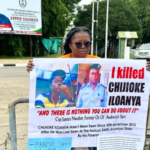
Ada is determined to see justice served for the disappearance of her brother, Chijioke Iloanya. Chijioke’s case was part of what fueled the 2020 #EndSARS protest after he went missing in 2012. The notorious Awkuzu SARS in Anambra, where Chijoke lived with his family, is said to be responsible, and there’s a face and name for who to hold accountable. Now, Ada is staging a solo protest at the National Assembly in Abuja, demanding justice for her brother and other victims of police brutality.
The Nigeria Police Force’s vision is “To make Nigeria safer and more secure…to create a safe and secure environment for everyone living in Nigeria.”
However, this vision has been nothing short of a nightmare for Ada and her family, who have been searching for elusive justice for the past 11 years. Ada narrated to Citizen everything that has led her up to this moment.
Walk us through why you’re staging this protest
My brother, Chijioke, was arrested by the Nigerian police on November 29, 2012. Then he was transferred to Awkuzu Special Anti-Robbery Squad (SARS) in Anambra state before my mum could bail him out.
When my parents tried to bail him out at Awkuzu SARS, they denied having him at first. My parents were about to leave the station when they saw my brother being led in, and my mum raised the alarm that he was the one they came to bail out. My parents were thrown out, and it would take several days before they were allowed into the station.
When they eventually got access, they met James Nwafor, the officer in charge of the SARS unit. When my mum asked for my brother, he told her that if it was those boys (including my brother) she was looking for, he’d already killed them and that there was nothing she could do about it.
My mum slumped when she heard it and was taken to the hospital. This started this journey for us, and we’ve been trying to get justice in different ways. In 2019, I wrote about it on Twitter. In 2020, I called out James Nwafor because I saw his handle on Twitter.
We went to the #EndSARS panel in 2020. The Anambra state government hasn’t made the panel’s recommendations and findings public. No whitepaper has been released either. Nothing has happened. James Nwafor is still a free man while we’re still in the pain of losing our brother and son. Other families have lost someone to James Nwafor, and others have been victims of police brutality.
It’s tough what you and your family have had to go through
I started this protest on July 3. It will go on for ten days, ending on July 13. The reason it’s happening now is because it’s going to three years since we wrote a petition and went to a panel for #EndSARS to demand justice over the death of my brother, Chijioke.
The panel made findings and recommendations, but we’ve not gotten that yet, up till now. I’m also doing this because I’m getting tired. I have a life outside of this. My life revolves around Chijioke, and I would like justice for him. It draws me back whenever someone sees me and asks if something has been done about my brother’s case. I have no good answer to that, and that has to change.
July is also Chijioke’s birth month, which makes this symbolic. His birthday is July 13, which I’ve chosen as the day to end the protest. Because I’ve fought for justice for my brother, other people who have been victims of police brutality have reached out to me as a point of contact. They tell me about family members they’ve lost, and I feel so bad I can do nothing for them. The least I can do is use my voice to speak on their behalf. So while I’m advocating for Chijioke, I’m also trying to get justice for them because we deserve it.
How’s it been so far?
I’ve been pushing, although it’s been getting harder and harder. Yesterday’s protest was harder than Monday’s because the sun was scorching hot, and I had to stand for long hours without a place to sit. When I get tired, I sit at the barricades, which still places me under the sun’s searing heat.
It rained in the morning today so I couldn’t start early. But I’m here now, protesting. I’ve noticed that people have been asking me to go to Ahmed Isah (Ordinary Ahmed of Brekete Family). But when I first tweeted about it, some people like Segalink tried to help, but nothing happened. So I’m conflicted. Do I reach out to him? Would it change anything or not? Also, it’s not just about me. What about other families? It’s a little convenient for me because I’m based in Abuja but what about them? Do they spend their money to come to Abuja to meet Ahmed when it’s easier to arrest James Nwafor immediately?
What would you like to see happen?
Start the investigation and prosecution of James Nwafor immediately. Let each state release its #EndSARS panel reports, whitepapers and recommendations to the public. It makes no sense for ordinary citizens to seek justice through one man who is probably overwhelmed with so much. Why should I rely on a regular Nigerian to help me when we have institutions that aren’t doing their jobs? It’s unfair. I’ve been here since having people look at me with pity, and I don’t want that. I just want justice.
I heard people are complaining, yet again, about the criminal rent prices in Lagos.
Even if you’re lucky to find a reasonably priced apartment, give it a year, and inflation will greet you in typical fashion.
But if you want to run away from Lagos because of rent prices, avoid a case of “from frying pan to fire” by crossing these places off your list.
“Abuja is no better”
— Debby, 35
I thought Lagos was bad till I moved to Abuja in early 2022. I only looked for apartments in what we’d call the “suburbs”, like Kubwa and Lugbe. Tell me why I was hearing ₦1.7m to ₦1.8m for two-bedroom apartments?
“They’ve moved Lagos craze to Ibadan”
— Torera, 28
Gone are the days when people move to Ibadan because they can’t afford Lagos. If you have a certain standard of living and want a decent one-bedroom mini flat in places like Bodija, just hold like ₦1m, minus agent fees.
“Port Harcourt is also pricey”
— Odi, 27
Renting here is also pricey, especially well-known residential estates or GRAs like Eliozu, Woji and the like. Two-bedroom apartments in these areas can cost as much as ₦900k – ₦1.2m per annum, but it’d most likely be a new building and really standard.
“The agents in Ado-Ekiti are in a weird competition”
— Ope, 33
I moved here in 2019 when you could still find standard three-bedroom apartments for between ₦200k to ₦250k. Now, you may need to budget around ₦400k if you want a new two-bedroom apartment with basic amenities, especially around areas close to the tertiary institutions. The prices may not be as bad as Lagos, but the business prospects in Ekiti are next to nothing, so it doesn’t make sense.
Then there are the agents who love to increase rent every year, as if they’re chasing them.
“The popular areas in Ilorin cost more”
— Adetola, 30
Rent is quite reasonable in Ilorin, except if you’re looking in places like Tanke or the GRA. GRA is the best area in Ilorin, and you can get a two-bedroom apartment for around ₦400k – ₦550k per annum. It’s not as much as what it’d cost in Lagos, but it can also be ridiculous, considering it’s much lesser in the inner towns.
“You won’t even see what you’re paying for in Abeokuta”
— Dara, 25
You can get a one-bedroom apartment at around ₦400k in Oke-Mosan — which is one of the nicer neighbourhoods in the city — but my problem is you won’t even see what you’re paying for. It’s either the road is bad, the landlord wakes up and decides to increase the rent or light becomes an issue.
Many people know Abuja as Nigeria’s capital city, but not everyone knows how this happened and why it happened.
Let’s take a trip down memory lane.
Why the change in capital?
Lagos has always been the commercial hub of Nigeria, especially due to its close proximity to the Atlantic Ocean. This was useful for slave masters in the slave trade era and later on, as a means to transport the nation’s resources for profit in the colonial era.
Coupled with fears of Lagos as a potential security risk due to the Nigerian Civil War, General Muritala Mohammed decided in 1975 to set up a panel to study whether or not Lagos could hold its dual position as a federal and state capital. The resolution was to move the Federal Capital Territory out of Lagos and into Abuja. This brings us to the next question.
Why was Abuja picked as the new capital?
The answer is simple — because of its position on the Nigerian map.
Located in the centre of the nation, Abuja was seen as a neutral point for the diverse religious and ethnic groups that made up Nigeria. It was also seen as an accessible location to all Nigerians, regardless of their origin.
How was Abuja built?
While preparing to build Abuja, Nigeria studied other major capitals for inspiration on how to plan the city. Examples of such cities were Brasilia, the capital of Brazil; Paris, the capital of France; Islamabad, the capital of Pakistan; and Washington D.C., the capital of United States of America.
A combination of five American firms made the blueprint for Nigeria’s capital: Planning Research Corporation, Wallace, McHarg, Roberts and Todd, and Archisystems. They were collectively known as the International Planning Associates (IPA).
Construction work started in the 1980s. At the end of that period, there was a functional water and telephone system to cater to one million people. Hospitals were built and a university was established in 1988. By the close of the decade, many people were flocking to what was being dubbed the Center of Unity.
On December 12, 1991, General Ibrahim Babangida made it official and crowned Abuja as the new capital of Nigeria.
But what happened to the native residents?
Abuja wasn’t just some deserted grassland before 1991. The area was inhabited by ethnic groups like the Gbagyi, Koro, Gade, and Gwandara. These groups had lived on the lands for over 4,000 years. The relocation of the capital from Lagos displaced these natives. Their primary means of livelihood — farming — were affected by the construction work.
There were over 800 villages in the location over which the Federal Capital Territory (FCT) was built according to Al Jazeera. The government created committees to oversee the relocation process and provide compensation for affected natives. When indigenes didn’t move as fast as expected, the government considered relocating them involuntarily and pushing them to the new capital’s fringes.
Should the move have happened?
While many Nigerians would agree that transportation and road networking is far more favourable in the FCT, Lagos generates by far more revenue. Lagos is also often considered to be the state with more great job opportunities. This is quite unlike Abuja. There, people often claim you need to have connections in government parastatals in order to get jobs.
Just hours to the planned November 26, 2022 resumption of operations on the Abuja-Kaduna railway corridor, the Federal Government announced a postponement. It’s not the first time the government has postponed a planned resumption since terrorists attacked the railway corridor in March.
But more than the government’s erratic announcements and postponements, Nigerians remain worried about the safety of the corridor.
You and your entire family should ride on it to and fro for one week and we will know it is now safe.
Even though all the hostages from the train attack are back home, the terrorists who kidnapped them haven’t been arrested. The only person the government has managed to arrest is a journalist who negotiated a ₦2 billion ransom for the terrorists in exchange for hostages.
There have been reports of illegal NIN enrollment offices across the country, and terrorists can use them to bypass identification safeguards. The heightened insecurity in Kaduna also doesn’t help, as terrorists killed 645 people in the state in the first half of 2022 alone.
When the Abuja-Kaduna railway corridor eventually reopens do you trust the Nigerian government to protect the lives of passengers?
The past week hasn’t been the best time to be an Abuja resident as five first-world countries raised alarm about possible terror attacks. The United States has gone as far as evacuating government staff back home and the United Kingdom, Australia, and Ireland have reduced consular services. It’s indeed a very critical period in Abuja.
To gain a sense of how life currently is in Nigeria’s capital city, Citizen spoke to four Abuja residents — Elizabeth, a 24-year-old who lives in Garki, Noa, a 34-year-old who lives in Karu, *Jane, a 25-year-old who lives in Gwarimpa and *Stephen, a 36-year-old who lives in Kubwa.
“I believe it’s a rumor because foreigners can’t be trusted, and they tend to say things to suit you when they mean something else. Our country could very well be blindsided on this terrorism thing.”
Jane — product manager
“I don’t think there’s going to be a terrorist attack, or at least not in the areas people think. When the terrorists want to attack and notify the government, it’s either one of two things — the terrorists won’t attack where people think or there’s no terrorist attack happening at all. Or maybe it’s not going to happen in Abuja, but somewhere else in Nigeria. This is because they know that when they notify the state, the state will tighten security and that’s literally a death trap.
“There would also be an issue in the sense of weapon sophistication because these guys can’t carry armored tanks like the army. So, even if they attack at all, it may be in remote areas like Buari, Kuali, or any of the remote towns.”
Has the terror alert affected lives personally?
Noa — businessman
“The terrorism alert hasn’t really affected me or my business because we’re going about our day as usual. The bars are open and even new ones are springing up on a daily basis. I know I saw one yesterday that was full to capacity. The joints are still there and people are eating roasted fish. We’re really not bothered about the terror alert.
Stephen — logistics and cab driver
“The security alert has really impacted negatively on the transportation sector. For instance, I was expecting to receive customers that used British Airways to arrive in Nigeria on Saturday and Sunday, but the flights were canceled. It hurt because I was expecting to make a lot of money. Even the Jabi Lake Mall has been closed due to the alert, and that’s an income source for me too.”
Jane
“On Sunday, my family members said we shouldn’t go to church but I bluntly refused and went anyway. We’ve been getting warnings not to go to specific places and police hotlines were sent for every area in Abuja, which has made my family extra cautious.”
Are people on edge with everything going on?
Elizabeth
“There are some people that are more cautious, there are some that haven’t reacted, and there are some that are very indifferent, like me. People have even been going to Halloween parties and posting themselves on social media. In my neighbourhood, there’s not much of a difference.”
Noa
“We all know our neighbors, and we know when new faces come into the area. It’s not just this terror alert. We’ve been vigilant since the whole issue of terrorism began. We once had a bomb blast at Nyaya, close to where I stay. Since then, we’ve been very vigilant about new faces in the area. We’re not really scared.”
Jane
“There’s a lot of fear in the air. There’s news going around that the last time the U.S. told its citizens to leave, there was a bomb attack immediately after they left. For the U.S. to tell its citizens again to leave, something is really about to happen. For me, I could easily pack my bags and leave Abuja because I have a family waiting for me in Lagos. But for most people here, this is their only home. They have no other choice but to stay here. People are trying to stay at home a bit more and be on the lookout.”
Has the government responded well?
Noa
“We see the Nigeria Police and the Army doing patrols on a daily basis, which is a good thing. Gathering intelligence is never easy, so I guess they’re good at what they do. As long as they’re not harassing us, and we’re law-abiding citizens, I guess we’re fine with them doing what they have to do to prevent this.
The street boys that hawk on the street or push wheelbarrows in the markets can be seen at night with axes and cutlasses guarding the neighbourhood. I can also say that it’s a form of preparation for the terrorists when they come.”
Jane
“I have mixed feelings about this. I feel a bit secure because back when I was at the Law School in Bwari, some terrorists sent us a letter. The government placed enough security personnel around the school and I felt safe. So, at least, I know that the government can actually respond well.
Now, as to why I don’t feel safe, how many military officers do we have? Can they really protect the whole of Abuja? But with the presence of Aso Rock, there’s some assurance of safety. Bombing Aso Rock is just like bombing the White House — there’s a very rare chance of that happening.”
Elizabeth
“I can’t say there’s been so much extra security presence that really struck me. But there can never be anything like enough security measures. If there’s a bomb, no matter how many soldiers in the army or policemen, it would still explode; unless they have bomb detectors, and they’re actively checking for bombs.”
What should the government be doing better?
Jane
“I feel they should do more to calm the level of hysteria around here. I think there should be an official document which tells us what to do in case there’s a terrorist attack and the full details of the situation. There should also be the appearance of military tanks and weapons in public places like mosques, schools, and churches if they have the manpower too. But, this will be hard for a government that doesn’t believe there’s anything like a terrorist attack in the first place.”
Stephen
“The fact that these malls are closed and flights are cancelled shows there’s a considerable amount of panic. Lai Mohammed should not tell us to just disregard it completely. He needs to tell us how we can cope with this. US and UK and all those oyibo countries can’t be wrong.”
Can Nigeria contain terrorism?
Nigeria hasn’t had it easy with terrorism in 2022 with a number of attacks recorded all over the country, including an attack on Kuje Prison in Abuja that freed many terrorists in July.
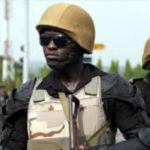
In response to the recent terrorism alerts, the Inspector-General of Police, Usman Baba, initiated a Counter Terrorism Incident Simulation exercise codenamed “Operation Darkin Gaggawa.”
[Image source: Sahara Reporters]
The Minister of Information, Lai Mohammed, dismissed the alerts and assured Nigerians the government is in charge. Only time will tell.
**Subjects’ names have been changed to protect their identities.
On October 23, 2022, the United States Embassy in Abuja warned American citizens of an “elevated risk” of terror attacks in Nigeria, especially in Abuja.
Just when we were catching some rest for the weekend and looking forward to salary week, the terror alert popped up to remind us that there’s no rest in this country.
What are the possible targets?
Possible targets for terrorists include:
Government buildings
Places of worship
Schools
Markets
Shopping malls
Hotels
Bars
Restaurants
Sports gatherings
Transport terminals
Law enforcement facilities
International organisations
How serious is this alert?
This isn’t the first time a foreign government has issued terror threat alert in Nigeria in 2022. In July, the US and United Kingdom alerted their citizens with separate warnings of an imminent rise in crime in Abuja. The advisories followed the prison escape of over 400 inmates, many of whom were convicted terrorists, from Kuje Prison.
How are security agencies reacting to this?
The Department of State Services (DSS) has called for calm over the U.S. advisory but asked Nigerians to remain vigilant. The agency said it was working with other security agencies to maintain peace and order across Nigeria. Given that the president himself is out of the country, it might be hard to find that reassuring.
What can you do?
The U.S. government wants its citizens to take some precautions in light of the feared attacks and that’s what we should all do:
Avoid crowds as much as possible. Terror attacks are often designed for maximum impact and crowds are easy targets.
Avoid all non-essential travel or movement.
Be aware of your surroundings and report any unusual faces or movements to the nearest authorities. Communal vigilance is essential in periods of high security threats.
Carry a form of identification at all times.
Review your personal security plans and keep your cell phone charged in case of emergency.
Ultimately, it’s important not to panic. This sounds like something the government would say but it makes sense — unwarranted panic can create even more trouble than any credible threat of danger.
I spent the first week of August 2022 exploring Abuja. I’ve lived here all my life but haven’t really explored the city because I have very strict Nigerian parents. I needed a break from house chores and some time to hang out with friends without thinking about getting back home early. So let’s just say, I found a way to get them off my case for a week. Here’s a breakdown of what my budget for two looked like if you’re planning to do the same.
Our starting budget for this trip was ₦200k for six days. Let’s see how well that worked out.
Accommodation
Criteria for picking a hotel
Proximity to central locations
I started with a Google search for hotels within town — preferably within the Municipal Area Council like Wuse, Maitama, Wuye and Utako. If you want to push it, Garki and Lifecamp should be your worst-case scenario.
Staying outside those areas adds to your transport fare because most of the spots to eat and have fun are located in those central areas. If you hear anything like Kubwa, Lugbe, Lokogoma or Karimo, don’t try it — well, except the accommodation you’re getting is free.
Now that you’ve gotten a sense of the areas to consider, the hotel rates are a completely different ball game. The closer you are to central areas, the more expensive the rates are. Our ₦200k budget covered only three nights in some hotels, so imagine the stress we went through trying to find a decent place that wouldn’t wreck my bank account.
“Decent” meant the beddings were extremely neat — even though I always bring mine — bathrooms had walk-in showers and standard rooms come with complimentary breakfast. And considering the insecurity, the hotel had to be in a largely residential area where there are usually a lot of security guards.
With those two main criteria, three options came up: the White Royalty Palace Hotel, Maitama; Imah Apartments, Wuse Zone 5; and Belmont Hotel, Wuye. White Royalty was ₦20k per night, Imah was going for ₦15k, while Belmont was ₦25k. At the start of my trip, the last two were fully booked. We checked them out on the third day of my trip, but I’ll share my experience at White Royalty first.
This hotel made the list because a friend recommended it as one of the more affordable places to try. We’d rate our experience there 6/10, and here’s why:
Pros:
Located in a central area, very accessible and serene.
Rooms are available for ₦20k a night, quite affordable in Abuja. However, I’d say, if you can, squeeze out ₦5k extra to get the ₦25k room which is much more spacious.
Bathrooms with walk-in showers and a water heater.
Con:
No full-sized mirrors in the rooms, which made it hard to see whether you were looking like a snack.
Mattresses were not as firm as hotel beds should be.
Beddings weren’t neat enough. I got a torn blanket in my room on my second night.
Cleaning service was a 2/5 for me.
No complimentary breakfast
Walls so thin, you’ll hear everything going on in the next room.
After spending three nights at White Royalty Palace Hotel, we decided to check out Imah Apartments. It was ₦15k per night, so I was very sceptical. But who doesn’t like cheap thrills?
First, the location was off the mark. Yes, it was in a central area, but the roads were too narrow for two cars to move freely at the same time, and the building needed renovation because it looked run down and old. The staff, however, were very polite and carried our bags up the three flights of stairs we had to climb.
Note that Imah Apartments isn’t a hotel. It’s a short-let apartment in a building, where people can rent out one of the four rooms for ₦15k per night, or ₦65k for all the rooms.
The rooms looked pretty decent, but they were tiny and the ones available had bathtubs instead of showers. I’m scared of slipping and falling in tubs, so it was a no for me. I may have overlooked those flaws if the whole place didn’t smell like burnt soup.
Pros:
Affordable.
Located in a central area.
Easy to locate and the staff were helpful with directions.
Cons:
Rooms are very small.
Not the cleanest space.
Not a place you can check into late at night because the reception closes at 10 p.m. But if you call ahead, they can wait for you to arrive. It also didn’t feel secure because there was no one at the reception most times.
No complimentary breakfast.
Reception hall
We ended up not staying at Imah apartments, and checked into Belmont Hotel, Wuye, the same day. The reviews on Google were encouraging, so we decided to check it out. I called to confirm if they had a standard room for ₦25k available because some reviewers mentioned that they were always booked. Luckily, they had one available when we called.
I was sold by the ambience at the reception. Everywhere smelt nice and looked extremely neat. The room didn’t disappoint either. My only issue would be the space, but ₦25k is their cheapest, so I wasn’t surprised.
Pros:
Affordable, and every room came with a complimentary breakfast.
Food was quite affordable for a hotel because we could get a plate of fried yam and egg sauce for ₦3k.
Staff was very nice and helpful with getting our bags in and out of the room.
Secure space with security cameras at almost every corner of the corridors and staircase
Extremely neat bathrooms.
Cons:
While the location is accessible and not too far from the central areas, Bolt fares from the hotel cost an average of ₦1k – ₦1.1k compared to the ₦600 – ₦800 you’d pay if you were staying in other areas.
Access road to the hotel was locked between 7 – 10 p.m. You’d have to walk down to the hotel if you came back really late.
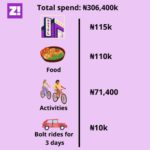
Between the three nights, we spent at White Royal Palace Hotel and the two at Belmont Hotel, we spent ₦115k.
Thought Pyramid, Wuse
Food
If you eat like a thief in the night, Abuja will finish your money. We spent ₦110K to feed two people for a week. But in this economy, that’s fair.
For the most part, we binged on Chicken Republic food because it was the most convenient and affordable to buy.
We basically ate one meal a day and binged on snacks from supermarkets around our hotel.
It’s obvious what we really did in Abuja was eat, but here are some of the fun activities we tried:
Trukadero bowling alley
Things are a lot pricier than they used to be and Value Added Tax (VAT) is another issue, but if you’re visiting Abuja for leisure, you need to be sure you can tick these boxes. My favourite activity was the paint and sip because there’s live music close by, with a Bluetooth speaker if you’d like to play your own music.
Paint and sip
Overall, I went over my ₦200k budget by ₦99k. I also didn’t bother tracking the money I spent on Bolt beyond the ₦10k cash I spent in about three days. But don’t stress, the fares range between ₦600 – ₦1100. So I’d say, ₦350k is an ideal budget for one week of fun in Abuja.
You already know Abuja is the place to go when Lagos traffic succeeds in beating you within an inch of your life.
So, what’s it like navigating Abuja and trying to live out your best Dora the explorer impression? Here’s a list of cool hangout spots to include on your “to-go” plans.
Keje Grill
— Wuse 2, Abuja
This spot offers almost everything; outdoor dining, cocktail bar and even karaoke. According to Conrad, it’s a great spot for when you’re feeling yourself and want to run into half of the people in your body count.
Cube Cafe
— Maitama, Abuja
Tech people should love it here. There’s this artsy, clean ambience that’ll have you feeling like the rich main character in a Hollywood movie.
You’ll enjoy Central Park more if you go with a group of friends as there are multiple activities to choose from — the go-kart rides and mini golf area are tourist favourites. Make sure to hold your money sha; rides typically cost around ₦7-8k.
Jabi Lake
— Jabi, Abuja
This may arguably be one of the best-known places in Abuja, and while most people probably go for the boat rides, Jabi Lake is actually a great location for slow Saturday morning walks.
Magic Land
— Wuye, Abuja
This amusement park used to be called Wonderland. It’s a children’s fun park, but no one will arrest you if you decide to go there to run away from adulting once in a while.
Trukadero by CityBowl
— Wuse 2, Abuja
If you’re looking to try out bowling, you should check out this spot. Entry itself is free, so if you just want to explore the space or hang around, you can absolutely do that.
Honey
— Chocolate Mall, Abuja
If you have money that you want to spend, Honey is that upscale place that’ll use fine dining to help you spend it. It’s a great ambience though, and word on the streets say your crush may agree to enter a relationship with you if you take them there.