For many girls raised in a society that shamelessly prioritises boys, entitlement was familiar long before they ever learnt the word. Young girls grew up watching adults defend the actions of boys with the familiar, tired phrase “boys will be boys.”
And when your brother had eaten most of the food meant for both of you, the adults would respond with, “he’s a growing boy”, as if you weren’t a growing girl who also needed to eat.
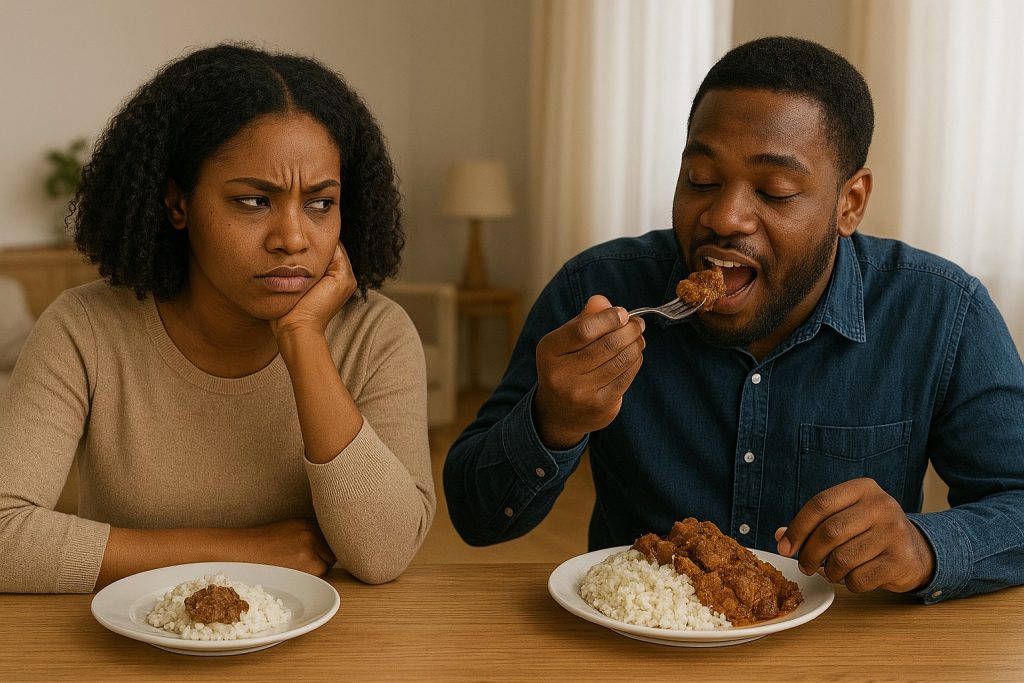
These excuses set dangerous precedents. Some boys become men with an inflated sense of entitlement around food, leaving the women in their lives to shoulder the consequences of their selfishness.
Over the years, women on Beyoncé’s internet have expressed frustration about this particular kind of inconsideration, and that frustration is valid. It’s high time we talk more openly about how harmful and exhausting it can be.
In this article, five Nigerian women share their experiences living with men who treat food like a personal right rather than a shared resource.
“I was always shocked at how my brother could eat and eat and not care about other people who might not have eaten”— Adeola*, 25
I’m the firstborn with four younger siblings, the last three being boys. There’s a pattern of selfishness among them. The oldest of the boys has grown to be more considerate over time, but only a few years ago, he was so difficult to live with.
For a period, it was just the two of us living with my dad. If my dad bought a big loaf of bread for breakfast, my brother would wake up in the middle of the night, fry three eggs, and eat more than half of the loaf. I would wake up in the morning and find out that half of the bread was gone, and that would leave me, the one who is thinking about how to make the bread last, to figure out how to manage it. I was always shocked at how my brother could eat and eat and not care about other people who might not have eaten. It’s the same situation with my other two brothers, sometimes worse. And whenever I complained, I was told I was overreacting or that I got angry easily. I had to prioritise my peace and leave. I learned that it’s easier to avoid wahala when I’m not in the house. I just wish we’d teach boys not to feel so entitled to things that are meant for everyone.
“I made sure to cook meals they didn’t like and also removed cuts of meat they liked” — Kaimah* 22
Growing up as the first daughter meant my siblings’ needs always came before mine. Whenever I cooked, I was expected to include their meals because it was considered mean if I didn’t. This meant that there were a lot of times when my brothers would go into the kitchen and take food without even asking if it was meant for them. They always believed that it was their right to do so.
The last straw was this one time after I’d finished slaving away in the kitchen, and I asked my brothers if they wanted to eat. They told me no, so imagine my surprise when I went to rest and came back to find them finishing the food I’d kept for myself. When I asked them why they did that, they told me that I could always cook another food for myself, and I swear, at that moment, it felt like someone had used a pot to hit me on the head. I was so pissed, and on that same day, I told my mum that I would not cook for my brothers anymore, and I stood by my words even when she did her best to defend their actions.
To let my brothers know that I was very serious about my decision, I made sure to cook meals they didn’t like and also removed cuts of meat they liked. I kept on doing this until they came to apologise, and ever since then, they’ve been more cautious about how they eat food.
“The entire thing contributed more to my unhealthy eating habits.” — Awele* 21
When a conversation like this comes up, I blame traditions for it because I remember being a child and watching my mother place four to five meat on my dad’s plate. In her words, “the head of the family eats more”, and indirectly, she instilled the thought in my younger brothers’ heads that when they grow up, they would get the chance to eat more than their future wives.
When I graduated from secondary school and returned from the boarding house, I started to notice a pattern in the way my mum dished out food for her two favourite sons, my immediate younger brother and my youngest brother. She would put a lot on their plates and leave the rest for my second brother and I to eat. See, the problem then was that she barely left enough for both of us, so by the time I was ready to eat, I would either meet little food or nothing at all. When I asked about my food, I would get a response like “You don’t eat, so why are you asking?” from my second brother. For someone who already had a bad relationship with food because of boarding school, the entire thing contributed more to my unhealthy eating habits.
Although I stopped complaining about it a long time ago, the situation is a bit better now, and that was because my mother finally noticed that I was not eating well. While there have been times when I cried over a brother’s selfish eating habits that directly affected me, my mum, in an effort to ensure that I don’t starve myself, includes me in the meal planning, picks out food that she knows I might like, and most importantly, she warns my brothers to stay away from whatever food she leaves for me.
You’ll Like: Ezra Olubi’s Tweets Weren’t Funny Then, and They’re Even Worse Now
“My daughter made me see that I needed to stand my ground.” — Hadiza* 51
My husband does not work. He never has. I am the sole breadwinner of the house, and while things can get financially difficult sometimes, I never minded it until the entitlement started. Whenever I bought foodstuffs for the house, he believed it was his right to do anything with them. He ate everything in sight, and he gave them out to neighbours even when he knew that I was managing.
One event that still plays in my head was the time I got admitted to the hospital for a while. The day before I ended up there, I had cooked enough food to last our family of three for a week, so I was deeply upset when my daughter informed me at the hospital that while she stayed the night with me, my husband ate most of it and gave the rest to the neighbours. The whole situation really hurt me, but I never confronted him about it, even though I should have.
In the end, my daughter made me see that I needed to stand my ground. One thing you should know about my daughter is that she does not take any sort of disrespect from her father, and she is not ashamed to call him out on his actions. Watching him slowly become scared of her pushed me to emulate her behaviour and also set boundaries. Ever since I started doing that, food has started lasting longer in the house.
“My father believed that it was the duty of a woman to cook and a man to eat.” — Adelayo* 47
As kids, we were raised to listen to our parents. It didn’t matter if they were right or wrong; you didn’t ask questions. You were just expected to respect everything they did, so whenever my father finished the food in the house without asking the rest of us if we had eaten, we couldn’t say anything.
My father believed that it was the duty of a woman to cook and a man to eat. Most days, we had to cope with the selfishness he showed when it came to eating food. Once, he told my brother not to cook when he made an attempt. He said the women (my mum, sisters, and I) should cook instead. It was something we didn’t like, but we had no choice but to accept it because we were all living under his roof.
For many years, I kept consoling myself with the fact that I didn’t have to live with him forever, but then, a day came when my mother finally had enough. To curb our father’s selfishness, she enforced a rule that the only time food should be available to our father was if the rest of us were as hungry as he was. Obviously, he didn’t like that rule, but thanks to our mum, we were able to eat our food without worry for a very long time.
Next Read: I Tried To Put Motherhood On Hold and Failed

Single? Married? Divorced? Dating? In a situationship? We’re surveying Nigerians about love, relationships, marriage, and everything in between, and we want to hear from YOU.
You only need to give us a few minutes of your time and participate in this quick survey. It’s 100% anonymous too!