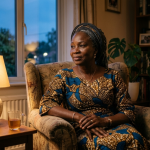
Sore* (22) grew up in a close-knit family, cherished and protected by everyone around him. But a family loss uncovered a long-buried truth that shattered everything he thought he knew about his childhood, the people he loved the most, and his place in the world. He opens up about how the truth reshaped his sense of identity and his journey toward acceptance.

This is Sore’s Story as told to Mofiyinfoluwa
I always thought I was the last-born in a family of four children — three girls and I, the only boy. I was much younger than my sisters, so it made sense that I was treated like the baby of the house. They felt more like aunties than siblings because of the age gap. Aunty Tope* was 17 years older, Aunty Ronke* was 14, and Aunty Bummi* was 13. But nothing ever struck me as odd.
People at school used to tease me about how old my parents were. My dad would have been 54 when I was born, and my mum, 41. Sometimes, I wished they’d had me earlier, but I never took it to heart. My sisters and parents spoiled me, and that was enough.
When I turned 10, all my sisters had moved out. One got married, the others were in university. They only came home during the holidays, then eventually settled into their own homes. Apart from relatives living with us to help around the house, I was the only child home.
I was raised in Akure, where my father moved the family a few years before retiring from the police force. He was a man of few words and wasn’t showy with his affection, but I never doubted how much he loved me. As a child, I’d sit on his lap while he told me stories in his calm voice. Those moments remain some of my warmest memories.
He passed away at 73 in 2023 after a long battle with his health. I was 19 and in my third year of university. ASUU was on strike, so I was at home to witness his final moments. A few weeks after his death, I went through some of his belongings. At the top of his wardrobe was a big iron box I’d never thought to touch, but I decided to open it that day.
The box contained old pictures and clothes, and while sorting through the items, I found a bundle of old letters and envelopes. One of the envelopes was dated around the year of my birth caught my attention. On the front, a note from one Mr E. read, “I’m so sorry for what happened. Please use this to take care of the baby and your family.”
I stared at it, trying to make sense of what “sorry for what happened” could mean. Curious and slightly uneasy, I took it to my mum. Her countenance changed immediately she saw the letter. She paused, then said it was probably related to a time the family had been scammed. She suggested the note came with money someone sent to support us through that difficult period. But something in her tone didn’t sit right. Her story felt thin, especially since I’d never heard it told before. Still, I didn’t see the need to press.
Two months later, during his burial, everything began to make sense.
Just before the ceremony kicked off, I overheard a conversation from inside while running errands. Our family friends were in the room, talking. One of them mentioned how surprised she was to see me listed as a son in the programme, when everyone knew I was actually the man’s grandson.
They said it didn’t feel right to keep calling me something I wasn’t.
I froze after I heard that, and it felt like time stopped for a moment. My mother, whom I just found out was my grandmother, called me from somewhere in the compound, but I couldn’t answer. I just stood there. The rest of the burial passed in a blur. My brain didn’t stop connecting the dots. With the note, age gaps and missing pregnancy photos, I didn’t need anyone to confirm it. The man I grew up calling my father was my grandfather. And if that was true, then one of my sisters was my mother.
Still, I needed answers. After the main events, I told my grandmother we needed to talk. She put it off till later. That evening, I sat her down and told her exactly what I had overheard. She didn’t answer my questions but asked where I’d heard it. Then she became defensive and started ranting about people spreading confusion.
What should have been a private conversation quickly turned into a family meeting. She called my sisters and made me repeat everything I had said. I stood before them, asking calmly for the truth. No one spoke. They just looked at me even as I screamed and begged them to tell me who my real mother was. They eventually revealed that Aunty Ronke, my middle sister, is my mother.
She was barely fourteen when her lesson teacher, a man in his 30s, impregnated her. My grandfather had him arrested, and even tried to make him take responsibility. But the man denied the pregnancy. He had no money or plan for his life, and eventually disappeared. The family had no choice but to raise me as their own. As far as they were concerned, it was the best way to protect everyone involved.
I’d always found the move from Lagos to Akure random, but I realised it could’ve been to hide what happened. My birth certificate listed my grandparents as my parents. There were no pregnancy photos, and everything about my documents and childhood memories had a consistent story. I learnt Aunty Ronke stayed with me for a while after I was born, but eventually, returned to school. She went on with her life, got married and had three other kids. Her husband never knew. Neither did his family. She was always kind to me, always checked in and sent money when she could. I visited her frequently before she moved abroad, but nothing in our dynamic hinted at something more. To me, she’d always treated me the same way my other sisters did.
After discovering the truth, I didn’t want stay in that house. I moved in with my uncle for a while. I felt stupid when I realised everyone had known. My aunts, uncles, and everyone older knew and just waited for me to discover the truth.
Aunty Ronke eventually reached out to apologise. She sent long messages and asked if I wanted to live with her. But I couldn’t understand how she expected us to move on and pretend like nothing happened. It hurt that she could return to her perfect family abroad, while I was stuck here trying to process the ruins of mine. I felt abandoned.
Everyone begged me to forgive, move on, and not cause problems. But no one cared about how I felt. I started to feel like I was a secret they wanted to erase. I even began to wonder if my grandparents raised me out of guilt because I reminded them of a mistake they couldn’t take back.
For months, I became obsessed with finding out who my father was. But no one — not even my grandma — would tell me. I eventually gave up. What would it change? The only thing that mattered was that whoever he was, he didn’t want me. He ruined lives and disappeared. That was all I needed to understand.
Even if I’d known Aunty Ronke was my mother from the beginning, it wouldn’t have changed the fact my biological father chose not to be part of my life. And as much as the people who raised me lied, they gave me the only version of family I had ever known — one where I felt loved, cared for and protected.
I’ve learned that holding on to anger or confusion will not change anything. I had a good childhood. My grandparents did everything they could to give me a stable, loving life. They’ll always be mum and dad to me, and that will never change.
I initially felt resentment toward Aunty Ronke, but over time, I stopped blaming her. At almost 15, she was a child too, and she didn’t have control over what the family chose to do. If I had grown up calling her my mum, her life might have looked different. I try not to hold that against her.
Have I forgiven them? I think so. I’m not even sure it’s my place to forgive. Aunty Ronke has never asked me to call her “mummy,” and I feel it’s for the best.
Read Next: I Lost 20kg to Feel Confident with Men, but I Still Struggle to Feel Loved