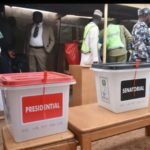
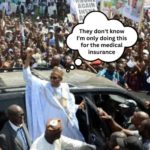
If you are ever sad and need something to cheer you up, watching what Bola Ahmed Tinubu, All Progressives Congress’ (APC) presidential candidate, does (or in this case, doesn’t do) will do the trick.
In addition to his long list of sins, we find that Tinubu has made it a habit to be absent from crucial events, the most recent example being the Arise Presidential Town Hall Meeting / Debate on November 6, 2022.
In this meeting, the candidates were meant to give voters some oral insight into what they would achieve should they become president. Yes, Atiku Abubakar of the Peoples’ Democratic Party (PDP) did not attend but his running mate Ifeanyi Okowa went in his stead.
BAT did not send anybody, not even his usual errand boy representative, Kashim Shettima, and was too busy turning up at Col. Sani Bello’s 80th birthday owambe.
[Image Source: @TinubuMediaS on Twitter]
As the social media pressure got werser over his absence, Tinubu’s campaign team felt that it was only fair to apologize to the public for his absence. But even that apology, well….
PRESS RELEASE: The APC Presidential Campaign Council (PCC) has explained why our Candidate, Asiwaju Bola Tinubu did not attend the Presidential Debate organised by ARISE TV on Sunday, November 6, 2022. pic.twitter.com/d1MGn7QlvV
To summarize the long grammar, here is what he basically said:
We couldn’t care less about any debates. Wetin concern us?
The reason why we can’t care for any debate is because we are too busy to think about the debate. If you want to know our plans, read the manifesto.
We are bosses that cherry-pick who we want to speak to, and when we want to speak to them. Selah.
What does Tinubu’s attendance sheet look like?
As I mentioned earlier, this isn’t the only time Tinubu didn’t feel like showing up. Let’s give some other examples:
The 2022 NBA conference
While his colleagues Peter Obi of the Labour Party (LP) presidential candidate, Atiku Abubakar of the PDP, Dumebi Kachikwu of the African Democratic Congress (ADC) candidate, and Adewole Adebayo of the Social Democratic Party (SDP) were present, Tinubu was absent from the conference and only represented by Shettima.
However, it seems as though Shettima had some dress code prepping on ‘fashion drips’ from BAT, as he came looking like a ‘cool kid’ wearing sneakers on a suit.
[Image Source: Vanguard Newspapers]
If you are waiting for an explanation of Tinubu’s absence, don’t hold your breath. He didn’t give any.
That could have been a very good time for Tinubu to showcase his economic plans for the country, as the conference was centered on sustainability for national prosperity.
Even Yele Sowore, presidential candidate for the African Action Congress (AAC), took a swipe at him, as he wondered why a whole “Chicago University Accounting Guru” decided not to show up for an ICAN event. Well, we are wondering too.
The LCCI conference
Yet again, Tinubu was too shy to share in detail his economic plans for the country, as he postponed his address for the Lagos State Chamber of Commerce and Industry (LCCI) on October 28, 2022.
Instead, he set up a ‘business summit’ with the moneybags of the private industry to share those plans with them instead. Why was this done? Did he feel he would have more control over an audience that wouldn’t give him tough questions? We may never know.
How do citizens feel?
If there is one word that sums up the public opinion of Tinubu’s absence, it’s pissed. Here’s what some Nigerians had to say about this:
1. We won’t be attending any debates. 2. We are too busy to even make time out for some of the debates. 3. We will only speak to those we wish to speak to, when and how we wish to speak. 5. Our way is the only way. Thank you
To add to all the commotion, some governors are trying to play smart and use civil servants to launder the money. We’re not making up stories and this is coming directly from the chairman of the Economic and Financial Crimes Commission (EFCC), Abdulrasheed Bawa.
What we know about this plot is that instead of paying into their workers’ bank accounts, as usual, the governors plan to pay them cash so it would be easier to dispose of stashed old notes. The gang of Money Heist would be so proud.
Who are the governors?
So far, Bawa is only giving us half gist and has refused to mention the names of these governors. But he mentioned that two of them are from the northern region and the third is from the southern region. Considering the fact EFCC can’t prosecute serving governors, we’ll probably never hear the names from him. But we know whose collar to hold whenever they announce they want to pay workers in cash.
But how do the actions of these governors affect citizens?
The exchange rate will get werser
With the rapid and uncontrolled influx of money by these unknown governors, consumption rates are increasing. But the unstable demand will negatively affect bank rates. So if you see ₦1000 to a dollar as the exchange rate before 2022 is over, you know who to blame.
Nigeria will start losing its daily ₦2k from foreign investors
The price instability caused by black money in the financial system will affect the economy’s credibility in the global community. Rational entrepreneurs will find it inconvenient to invest in the country because they’ll also consider the country’s risk before investing.
And if Nigeria isn’t making money, it’s very unlikely that you’d make money as well. You may as well fix your appointment for a salsa date with sapa.
With the high rate of inflation, there’ll certainly be a divide between the rich and poor. It’d be harder for those making money in naira to purchase goods as prices would steadily increase while those earning in dollars will keep getting richer. No hope for mechanics.
In the end, what these three governors and others like them should know is that EFCC is watching, and so are Nigerians.
The latest episode of the Wike Show is the appointment of the first batch of 100,000 special assistants on “Political Unit Affairs” in Rivers. According to Wike, their job description is to “work among their people and hear their views of his administration.” In other words, they should do amebo on what the Rivers streets are saying about Wike’s government. Of course, we can only guess the colour of wahala that’ll emerge if those comments are negative.
Some critics also think he’ll use these special assistants for vote buying, especially against whoever Wike doesn’t like.
But, is the only use of these 100,000 minions special assistants opinion monitoring? Because we have some creative ideas for how Wike can use them if he’s interested.
Backup singers for his live band
Wike could make these 100,000 special assistants the latest addition to his live band for diss tracks. The band has already made phenomenal hit songs, from “As e dey sweet us, e dey pain dem” to “Wike na bigi man.” They have great potential to top Asake and co on the music charts.
With the way Wike dishes out interesting scandals on the PDP chairman on a steady basis, we believe there must be a secret research team giving him all the dirt. If the team is ever in need of fresh hands, these new guys can definitely help.
Content strategists for his battle against Atiku
Since Atiku named the governor of Delta State, Ifeanyi Okowa, as his vice-presidential candidate, Wike has been a wrecking ball to all of his campaign efforts. From calling him out as a “fake founding father” and even calling his supporters “attack dogs,” Wike has targeted Atiku like a hunter would target his prey.
But it’s only human to run out of steam, even if you’re Wike. That’s why the governor needs these special assistants to back him up with fantastic Atiku comebacks every week. Two heads are better than one, so imagine what 100,001 heads can do.
On October 23, 2022, Governor Babajide Sanwo-Olu bragged on Twitter about the delivery of 62 brand-new fire trucks and support vehicles for the Lagos State Fire Department. The vehicles paraded the streets of Lagos like happy children would display their Christmas clothes to their friends and haters.
In order to empower the Lagos State Fire Department, we took delivery of 62 brand new fire apparatuses, consisting of fire trucks and support vehicles. pic.twitter.com/H3EbhWW5aw
But when a fire started burning a building under construction in the heart of Victoria Island in Lagos one week later, those trucks didn’t arrive fast enough to stop it. 30 minutes after the fire started, an eyewitness reported there were no firefighters on the scene to help.
I am shaking, look at people out for their daily bread burnt beyond recognition, 30mins and no FUCKING FIRE SERVICE !!! Argh 😭
If you were on Adeola Odeku Street between the hours of 10 am and 12 pm on November 1, 2022, a happy new month greeting would’ve been the last thing on your mind. The fire claimed the life of one man and injured nine other people.
Not to mention that in the official public report of the incident, the Lagos State Fire Service conveniently didn’t state the time the fire service arrived at the scene.
The incident sparked conversations about the operations of the fire service in the state and what rules guide them. How do the firefighters compare to operations of other countries and how can citizens help?
What’s missing from Nigeria’s fire service laws?
Rather than finding evidence of regulations, we found a whole lot of laws that the Lagos State Fire Service conveniently left out of the books. Here are a few of them:
The absence of proper safety equipment
Nowhere in the Lagos State Fire Service Law does it state that firefighters should wear the proper safety gear at all times. There’s not even a penalty, so even if a firefighter feels like wearing agbada and heels to quench fires, they’re more than free.
The absence of ETA reports
In the same document, there are no laws compelling firefighters to submit an estimated time of arrival report. So, if Lagos firefighters decide to use African time to show up to emergencies, no one is really checking them because they’re probably not documenting it.
What are the fire laws for other countries?
It shouldn’t come as a surprise to find out the United Kingdom and the United States of America have more efficient response times and rules on safety gear than Nigeria.
Also, response times to fire incidents in the US and UK have never been more than 7 minutes and 5 minutes respectively. We don’t even know that Nigeria has a response time target for firefighters.
What can you do when there’s a fire outbreak?
Putting out an out-of-control fire is a collaborative process and isn’t a job for firefighters alone. There are many ways for citizens to help in their own ways:
Know your building’s evacuation plan: Most buildings usually have a fire exit sign. Don’t just pass it by, memorise and use that exit when there’s a fire.
For buildings without precautions, always know all the available exits and use your two legs when there’s trouble.
Always try to know the location of fire extinguishers or buy one. E get why.
It’s important to call emergency numbers as quickly as possible because firefighters won’t know there’s a fire unless someone calls them. You can call 08033235891 for the Lagos State Fire Service or 112 for the Federal Fire Service.
The Health Facilities Monitoring and Accreditation Agency (HEFAMAA) shut down the centers because they didn’t follow the standards. Some other centers were closed for being unregistered, lacking qualified medical personnel, or conducting the illegal training of assistant nurses.
What’s going on with healthcare in Lagos?
Healthcare centers in Lagos have a history of bad maintenance and non-compliance with standards. In April 2022, the government shut down Medville Global Health Centre over the controversial death of a 28-year-old pregnant woman. The hospital had no blood bank and no ambulance for emergencies. In March 2022, the Lagos State University Teaching Hospital (LASUTH) suffered a water scarcity crisis that forced patients to use sachet water.
The government also shut down Vedic Lifecare Hospital in November 2021 for hiring unlicensed foreigners as doctors. And in July 2019, a toddler died in Ikorodu General Hospital because there were no doctors on duty. The list of terrible practices goes on and on and it’s sad to realize how much Nigerian hospitals don’t rate us.
Why’s primary healthcare so poor in Nigeria?
According to a survey by the Nigeria Health Watch and NOI Polls, there’s currently a shortage of doctors in Nigeria. It’s not a secret most of them are running off to first-world countries like the United States, the United Kingdom, and Canada. But even the ones staying have to deal with challenges bigger than their power, especially with equipment and their own welfare.
In May 2022, a former medical officer at Federal Medical Centre Kebbi, Chukwuka Okereke, also lamented the uneven distribution of the standard of care in Nigeria. In Lagos, most healthcare centres either don’t have enough personnel or equipment.
As citizens, it’s important to be vigilant about the healthcare centres where we seek medical care. Don’t go to a hospital unless you are sure it’s accredited by HEFAMAA. You can check out their website here.
And for healthcare operators running inadequate centres, breakfast is coming for you.
We all know Bola Ahmed Tinubu (BAT) loves to put on a show — doesn’t matter if he’s riding a gym bike in London or taking fire jpegs to prove he’s not sick.
Now, barely two weeks after he released his manifesto, the All Progressives Congress (APC) presidential candidate arranged a glossy town hall meeting with the moneybags of the private sector to press home his proposed economic policies. We’re talking about billionaires like Aliko Dangote, Jim Ovia, Tony Elumelu, Aigboje Aig-Imoukhuede, and Herbert Wigwe. If the Avengers were a Nigerian billionaire group, they all showed up for the BAT.
And since there’s nothing like a Lagos party, we recapped the most interesting things from Tinubu’s business summit.
[Image source: Channels Television]
Tinubu makes a lot of promises, as usual
As always, Tinubu made the usual promises concerning some of his plans for Nigerians including:
Double-digit GDP growth.
The resurrection of industrial policy.
Promotion of the agbado agricultural industry.
The evergreen promise of 24/7 power supply.
CBN giving affordable rates for credit.
Another evergreen promise of better roads and public facilities.
Enlisting more Nigerians into the armed forces.
Tinubu won’t stop talking about his master plan
Tinubu reminded everyone about his background as a former Lagos State governor and how he made the state what it is today with his masterplan. He said, “My team and I developed a blueprint, a masterplan, for Lagos. I can say that plan has been largely successful. We turned this state into a safer, more prosperous place where people can go about any legitimate vocation or venture regardless of their ethnicity, religion, region, or prior social station.”
Some lighthearted violence also got the spotlight at the business summit when Tinubu’s running mate, Kashim Shettima, took the mic. He targeted two of his party’s biggest opponents.
Remember him?
Atiku Abubakar
Shettima first went after the academic qualification of the Peoples Democratic Party (PDP) candidate, Atiku Abubakar. He mocked the former vice-president for getting a “wole wole (sanitary inspector)” certificate from the Kano School of Hygiene where he graduated with a diploma in 1967.
For his final shot at Atiku, Shettima said, “The ability to sell bottled water does not make one an expert on the economy. Atiku Abubakar is not Abraham Lincoln, he’s more of a Raila Odinga. Next year, we are going to permanently retire the political tourist back to Dubai.”
Shettima signed the peace accord with other presidential candidates in September, but he didn’t show up to the business summit to preach peace.
Peter Obi
The presidential candidate of the Labour Party (LP), Peter Obi, was also in Shettima’s firing line. Shettima rated his tenure as Anambra State governor a “mediocre performance” and cast doubts on his leadership skills.
“Leadership goes beyond glamourising poverty. We don’t glamourise poverty, we fight poverty. I won’t tell you that I have two pairs of shoes or I have a single watch. Leadership goes beyond dubious statistics or basking in a mediocre performance as the governor of Anambra State,” he said.
Sanwo-Olu won’t stop kissing Tinubu’s feet
The Lagos State governor, Babajide Sanwo-Olu, owes his position to Tinubu, so it’s not a surprise that he’s been all over his presidential campaign. In his tribute to Tinubu at the summit, the governor reminded everyone about his godfather’s achievements from ancient days.
Sanwo-Olu promised everyone that Tinubu will use his business acumen to help the private sector and everyone make more money. But we all know he’s just watching out for his own interests.
[Image source: Nigeria Info]
Everyone is shockedIyin Aboyeji is a BAT man
It was surprising for many Nigerians on Twitter to see the founder of Future Africa, Iyin Aboyeji, making a case for Tinubu’s tech policy at the summit, especially since he criticised the APC in 2021.
Here’s what some Nigerians had to say of his presentation:
I can understand Tinubu consulting leaders of the Nigerian tech ecosystem to get their input in order to inform his policy. But to have one of them present the policy seems out of place.
Iyin has already told you people that your "noise" doesn't matter. He's the productive one. He's the one who is putting your country on the map. He has no time for your "naive idealisms". He's the Nigerian "Tony Stark".
Tech-bro politics 101: He's a builder, you're a moaner.
The past week hasn’t been the best time to be an Abuja resident as five first-world countries raised alarm about possible terror attacks. The United States has gone as far as evacuating government staff back home and the United Kingdom, Australia, and Ireland have reduced consular services. It’s indeed a very critical period in Abuja.
To gain a sense of how life currently is in Nigeria’s capital city, Citizen spoke to four Abuja residents — Elizabeth, a 24-year-old who lives in Garki, Noa, a 34-year-old who lives in Karu, *Jane, a 25-year-old who lives in Gwarimpa and *Stephen, a 36-year-old who lives in Kubwa.
“I believe it’s a rumor because foreigners can’t be trusted, and they tend to say things to suit you when they mean something else. Our country could very well be blindsided on this terrorism thing.”
Jane — product manager
“I don’t think there’s going to be a terrorist attack, or at least not in the areas people think. When the terrorists want to attack and notify the government, it’s either one of two things — the terrorists won’t attack where people think or there’s no terrorist attack happening at all. Or maybe it’s not going to happen in Abuja, but somewhere else in Nigeria. This is because they know that when they notify the state, the state will tighten security and that’s literally a death trap.
“There would also be an issue in the sense of weapon sophistication because these guys can’t carry armored tanks like the army. So, even if they attack at all, it may be in remote areas like Buari, Kuali, or any of the remote towns.”
Has the terror alert affected lives personally?
Noa — businessman
“The terrorism alert hasn’t really affected me or my business because we’re going about our day as usual. The bars are open and even new ones are springing up on a daily basis. I know I saw one yesterday that was full to capacity. The joints are still there and people are eating roasted fish. We’re really not bothered about the terror alert.
Stephen — logistics and cab driver
“The security alert has really impacted negatively on the transportation sector. For instance, I was expecting to receive customers that used British Airways to arrive in Nigeria on Saturday and Sunday, but the flights were canceled. It hurt because I was expecting to make a lot of money. Even the Jabi Lake Mall has been closed due to the alert, and that’s an income source for me too.”
Jane
“On Sunday, my family members said we shouldn’t go to church but I bluntly refused and went anyway. We’ve been getting warnings not to go to specific places and police hotlines were sent for every area in Abuja, which has made my family extra cautious.”
Are people on edge with everything going on?
Elizabeth
“There are some people that are more cautious, there are some that haven’t reacted, and there are some that are very indifferent, like me. People have even been going to Halloween parties and posting themselves on social media. In my neighbourhood, there’s not much of a difference.”
Noa
“We all know our neighbors, and we know when new faces come into the area. It’s not just this terror alert. We’ve been vigilant since the whole issue of terrorism began. We once had a bomb blast at Nyaya, close to where I stay. Since then, we’ve been very vigilant about new faces in the area. We’re not really scared.”
Jane
“There’s a lot of fear in the air. There’s news going around that the last time the U.S. told its citizens to leave, there was a bomb attack immediately after they left. For the U.S. to tell its citizens again to leave, something is really about to happen. For me, I could easily pack my bags and leave Abuja because I have a family waiting for me in Lagos. But for most people here, this is their only home. They have no other choice but to stay here. People are trying to stay at home a bit more and be on the lookout.”
Has the government responded well?
Noa
“We see the Nigeria Police and the Army doing patrols on a daily basis, which is a good thing. Gathering intelligence is never easy, so I guess they’re good at what they do. As long as they’re not harassing us, and we’re law-abiding citizens, I guess we’re fine with them doing what they have to do to prevent this.
The street boys that hawk on the street or push wheelbarrows in the markets can be seen at night with axes and cutlasses guarding the neighbourhood. I can also say that it’s a form of preparation for the terrorists when they come.”
Jane
“I have mixed feelings about this. I feel a bit secure because back when I was at the Law School in Bwari, some terrorists sent us a letter. The government placed enough security personnel around the school and I felt safe. So, at least, I know that the government can actually respond well.
Now, as to why I don’t feel safe, how many military officers do we have? Can they really protect the whole of Abuja? But with the presence of Aso Rock, there’s some assurance of safety. Bombing Aso Rock is just like bombing the White House — there’s a very rare chance of that happening.”
Elizabeth
“I can’t say there’s been so much extra security presence that really struck me. But there can never be anything like enough security measures. If there’s a bomb, no matter how many soldiers in the army or policemen, it would still explode; unless they have bomb detectors, and they’re actively checking for bombs.”
What should the government be doing better?
Jane
“I feel they should do more to calm the level of hysteria around here. I think there should be an official document which tells us what to do in case there’s a terrorist attack and the full details of the situation. There should also be the appearance of military tanks and weapons in public places like mosques, schools, and churches if they have the manpower too. But, this will be hard for a government that doesn’t believe there’s anything like a terrorist attack in the first place.”
Stephen
“The fact that these malls are closed and flights are cancelled shows there’s a considerable amount of panic. Lai Mohammed should not tell us to just disregard it completely. He needs to tell us how we can cope with this. US and UK and all those oyibo countries can’t be wrong.”
Can Nigeria contain terrorism?
Nigeria hasn’t had it easy with terrorism in 2022 with a number of attacks recorded all over the country, including an attack on Kuje Prison in Abuja that freed many terrorists in July.
In response to the recent terrorism alerts, the Inspector-General of Police, Usman Baba, initiated a Counter Terrorism Incident Simulation exercise codenamed “Operation Darkin Gaggawa.”
[Image source: Sahara Reporters]
The Minister of Information, Lai Mohammed, dismissed the alerts and assured Nigerians the government is in charge. Only time will tell.
**Subjects’ names have been changed to protect their identities.
A musician and politician are similar in many ways. You need to stay relevant, remain popular, and keep dropping hot content for the public. We imagined the kind of music careers some notable Nigerian politicians would have and it’s hilarious.
Bola Tinubu
He’d be Jay Z, dropping evergreen one-liners that no one understands but he’d still have millions of fans anyway. We think he should just quit music altogether but what do we know?
Nyesom Wike
This man is Kanye West with a Nigerian passport. He wastes no time publicly calling out anybody that vexes him, or anyone he just doesn’t like. If you stress him, he’ll call you out and you’ll hate yourself. He always drops bangers though, and no one can do him anyhow.
Atiku Abubakar
He’s had the longest run as an upcoming artist, no contest. We admire his determination but at this point, he should just rest. Try your hand at something else, bro.
Peter Obi
He’s one of those artists that come out of nowhere and make a few hit songs from a little-known label. Then they clench the title of “Next Rated Artist” and make the already-blown artistes shit their pants. He’s the subject of a lot of diss tracks but that’s none of his business.
Muhammadu Buhari
He might as well be a ghost worker in the music industry because nobody sees him or hears anything from him. But when he decides to go on tour? He ignores his fanbase. But his die-hard stans keep making excuses for him.
Dino Melaye
He likes to think he’s an artist when he’s really just a hypeman. He’s the politics version of Toby Shang, no shade intended. He even has all the supercars to make himself look the part but, if it didn’t dey, then it didn’t dey.
Lai Mohammed
His entire discography is full of cap, and it makes you wonder what else he’s hiding. If fake-it-till-you-make-it were to be a person.
In Buhari’s Nigeria, young people are slowly giving up on the soft life dream. Not only is 33% of the working population unemployed, but even the ones who are employed are fighting sapa.
One of the biggest opps Nigerian youths are battling is inflation which rose to 20.77% in September 2022. It’s the highest inflation rate in 17 years and we fear Buhari just wants to break any record whether good or bad. But the biggest victims of the worrying inflation rate are young Nigerians and their dreams.
We had a conversation with two young Nigerians to understand how they’re surviving the inflation crisis.
“Data and fuel are my weekly money suckers” — Irene
Irene Akinyemi is a 23-year student and community builder. And, of course, data is necessary for her work – one thing that is hardly ever available or cheap in Nigeria.
Transportation, data and electricity costs are through the roof. The fuel of ₦5,000 which used to be enough for a week in the generator now lasts three days. ₦6,000 for 25GB used to last for a month — and sometimes spill over into the next one — but now finishes after three weeks, or even two.
What adjustments are you forced to make?
I’ve had to reduce the money spent on my necessities and cut down on unnecessary items that I used to buy. Also, before I make a purchase, I go over the things I need to buy to see if it’s really necessary or not.
What’s the biggest thing inflation has deprived you?
Inflation has reduced my fun money or the money that I spend on things that aren’t necessities. For instance, I don’t splurge on eating out as I used to.
A Stears Business report in 2017 estimated that Nigerians spent an average of 7% of the minimum wage of ₦30k on data monthly. But the Alliance for Affordable Internet (A4AI) reported that affordable data should cost no more than 2% of their monthly income. Inflation has grown worse in Nigeria since those reports five years ago, and our second subject is feeling the burn.
“I’m this close to shutting down my business” — Samuel
Samuel* is a chef who owns a restaurant on Lagos Island. He also doubles as a caterer for special occasions and events. But since he started his business, 2022 is the first time he’s regretting his career path.
How are you coping with inflation?
Things hadn’t been the smoothest since I started the restaurant in 2018, but at least one was trying. I could budget for ₦1.3 million as my rent, and buy foodstuff at Mile 12 around ₦300k and ₦400k every month. But with this inflation, it takes the grace of God to run a business.
In a week, I can spend up to ₦400k or even ₦450k per week on foodstuff, and my landlord increased next year’s rent to ₦2 million. I don’t even want to talk about overhead and payment of salaries. Three of my best employees left in August because of the ₦70k salary, but I can’t steal to pay these guys. My turnover since September has been ₦50k or less.
It’s becoming a huge issue for me to run this business and I’m this close to shutting everything down because of inflation. I might as well focus on getting referrals for special occasions.
What’s the biggest thing inflation has deprived you?
I’ve always wanted to be like Chef Stone and have my very own five-star restaurant, get global recognition, and even start my own catering school. But all of that may be on pause until we get a new era of government. Hopefully, things will pick up soon.
The Nigerian experience is physical, emotional, and sometimes international. No one knows it better than our features on #TheAbroadLife, a series where we detail and explore Nigerian experiences while living abroad.
Today’s subject on #AbroadLife is the main character in a tale of three countries. After deciding to study abroad nine years ago, he was finally able to in 2021. He talks about being the only black person in an English town, having a fun time living in Greece, and dealing with the language barrier in France.
Where are you right now?
I’m in Nantes, France.
How did you get there?
I got an Erasmus Mundi scholarship to study for my Master’s degree in Europe, and it’s taken me through three countries so far. It’s a joint Master’s degree programme and it’s administered by three universities in three different countries, with full tuition paid.
Wild. When did you decide to leave Nigeria?
In 2013. I got into a federal university in 2012 and was admitted to study Fishery and Aquaculture. I wanted medicine, but that’s what they offered me instead. So, I spent my first year trying to be serious and get good enough grades to help me cross into Pharmacy at the very least.
I didn’t know anything about scholarships at the time. The people who ran printing centres in school would come to class and tell us to apply for scholarships. But I always thought it was a scam just to collect the ₦1,000 registration fee.
The following year, I started seeing my friends get some of the popular scholarships at the time; MTN, NNPC, Agbami, etc. These people didn’t have grades as good as mine, but they still got scholarships worth around ₦100,000 to ₦200,000 every year.
That’s when it really hit me that scholarships were a thing. I made the decision that I would get a scholarship to study abroad for my Master’s degree. The first reason was that I wanted to become an expert in my field, and the second reason was that I knew I could do it. I started researching and documenting things in my final year.
When did you start applying for scholarships?
In 2019, during my NYSC in Akure. I applied for two scholarships in the Netherlands and the UK. I was actually hopeful because my grades were stellar, but I was served breakfast on both sides.
LMAO. What did you do next?
I got a job upon completion of my NYSC, and I started thinking about ditching my scholarship dream because I was making enough money from it. On the other hand, I had nothing to lose if I didn’t get a scholarship, so I decided to try again. The only difference was, my motivation wasn’t as high as it was before. Money can distract you from your dreams, to be honest.
The next year, during COVID, I applied for two more scholarships. One of them was the Commonwealth scholarship administered by the UK government, and it was the one I eventually got. I was selected to get funding to study in the UK, but sadly, it didn’t happen then.
Why?
Because of all the economic damage COVID caused, the UK government decided to cut funding for that year. So, I received an email saying I still had my scholarship, but I’d have to defer my scholarship till the next year. The following year, I reapplied for the other scholarship that rejected me. This time, I was successful. Now, I had two scholarships and could weigh my options.
The commonwealth scholarship offered me full funding to study in the UK for a year, after which I must return to Nigeria to develop it. But the other scholarship didn’t have that clause. Even better, it was for a joint Master’s programme to be administered by three schools in different countries: Scotland, Greece and France. This meant I’d get to see more of Europe. I chose the second scholarship and started the process of migrating.
What was the process like?
Even though it was my first time leaving Nigeria, I found the process pretty easy. I got a letter from the scholarship office stating that the scholarship would cover 100% of the tuition and a monthly stipend. I didn’t have to worry about providing proof of funds and other things like that. I was granted a visa within three weeks of applying, and I moved to the UK in September 2021.
Walk me through your journey across Europe
I arrived in London first. COVID was still on at the time, so I couldn’t move to Scotland immediately, and my classes were online. I had many friends in the UK already, so I stayed with one of them. I was there for about three months before I moved to a town called Oban in Scotland.
I expected the UK to be cold, and it was. I expected it to be beautiful; it also was. But my God, the apartments are tiny! My room was smaller than my room back in Nigeria, and I had to pay £450 every month in rent, my yearly rent back in Nigeria.
To make things worse, I had to share a kitchen with other people in the building. So all I really had to myself was a room and toilet. And the buildings weren’t so modern because they try to preserve their architectural history. To top it all up, I was the only black person in the town.
Wait, what?
It’s a really small town. If there were any other black person there, I’m very sure I’d have met them at some point. But I never saw any other black person throughout my stay.
It wasn’t weird at all though. The people were very welcoming, and I’d sometimes go to bars and get them to play afrobeats. They loved it. I had a good time, but I only spent three months there before I had to move to Greece for the next part of my programme.
What was Greece like?
Honestly, Greece is like Nigeria Pro Max. When I got there, I thought, “Did they bring me to Lagos by mistake?” People were blaring horns so loudly, and no one respected zebra crossings. It was giving Ojuelegba-level chaos.
One time, I tried to use a zebra crossing, thinking the cars would wait for me the way they would in the UK. Come and see swerving. I was the one dodging cars. At that point, I knew I’d found Nigeria’s twin. It’s a very interesting country and naturally beautiful too sha.
I lived in a city called Heraklion, and it has a beautiful landscape, beautiful beaches and many historic sites. Things were also cheaper in Greece than in the UK. Their economy was worse, which meant the stipend I was getting translated into a lot more cash for me. The buildings were not that pretty, and you could tell the country was battling sapa at the time.
Tell me about the people
The people in Greece are friendlier and more laid back than those in the UK. Back in London, everyone was about their hustle and didn’t really give a shit about you. But no one knows how to have fun as much as the Greeks.
About 70% of the people in Greece speak English, so I could get by very well in social circles without knowing any Greek. The families are bigger because they don’t migrate very often.
How long were you there for?
Six months, before having to move to Nantes in September.
Where?
Nantes, in France. It’s a student city, so I met more people from different parts of the world there. For the first time since London, I saw a lot of black people. It’s a lot like the UK actually. But the main difference is language. One annoying thing is how snobbish French people are about their language. It’s almost as if they have a long-standing beef with English speakers.
The first thing I learnt to say in French was, “I don’t know how to speak French”. The whole point was to get the person to speak English with me, but nine out of ten times, their countenance would change the minute I said it. French people aren’t as friendly as the Greeks, but they’re even less friendly if you don’t speak French. They’ll say they can’t speak English and air you, even when they actually can.
It’s so bad that even in the hospitals, the doctors only talk to you in French. The country is also very bureaucratic; there’s a lot of unnecessary paperwork you have to deal with, and they’re all in French. Emails from the authorities come in French, and when you call to ask for clarity, they’ll speak French. So, language is a real social barrier for me here. The lucky thing in all of this is that my classes are in English. If not, I’d be in trouble.
How are you dealing with it?
I’m currently learning French sha, so these people can stop airing me anyhow. I have French classes twice a week, and it’s helping. The good part is my coursework across the countries has been in English, so language isn’t affecting my studies in any way.
What do you love about France?
First of all, it’s very multicultural. In the other countries, the diversity came from the people in my own class. But we’ve been the same people moving together from place to place for the past year. In Nantes, there are people from all over the world. One time, I went to a church and saw so many black people, I thought I was back in Benin, Nigeria.
Another thing I love is the fact that it’s a welfarist state. The government cares about the people who don’t earn very much. My stipend is around €1,000 per month. But because I’m a student, I get up to 60% off my €450 rent, financed by the French government. The same goes for food and a bunch of other things I need to stay alive.
And what’s school been like so far?
Moving from school to school across different countries is very tough. Not only is the system of education different from Nigeria, but each country has a different system of their own. In the UK, we didn’t have proper exams; we wrote essays that would count towards the assessment grade. Most of my classes were online, and there’s only so much one can learn without being in a classroom. In Greece, I had proper exams and the classes were in-person. It was a better learning environment for me as I could interact directly with my classmates and ask questions in class. I’d say my semester in Greece has been the easiest so far.
France basically combines everything. Essays, exams, assignments, field trips, you name it. We do everything.
So, where will you go from here?
Back to Greece to finish my programme. It’s a two-year master’s programme. I did the first semester of my first year in the UK and the second one in Greece. The third one is what I’m currently doing, and the last will be in Greece. I can’t wait to leave the stress of this place and get back to my second Nigeria.
LMAO. Your love for that place is really something
Yes. It’s like Nigeria but with constant light.
Hey there! My name is Sheriff and I’m the writer of Abroad Life. If you’re a Nigerian and you live or have lived abroad, I would love to talk to you about what that experience feels like and feature you on Abroad Life. All you need to do is fill out this short form, and I’ll be in contact.