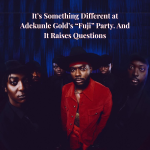
• Two years after Tequila Ever After, Adekunle Gold returns with his sixth album. Titled FUJI, it is his first release in full embrace of Fuji, a genre of Yoruba music birthed in the late 1960s, which he reveals is what he’s “meant to do.” It’s the first album he’s drawing attention to his royal heritage of the Kosoko kingdom.

    He digs into his family history. In homage to his forebearers, he returns to the palace and bows to pay respect to his king, the custodian of his ancestry. The throne accepts him like a true prince. Drummers with quick hands and tongues for chants and eulogy put him in a groove with their rhythms. All these are documented as part of the album rollout.

    Two minutes and twenty-four seconds short of a forty-minute listening time, this 15-track-long album opens impressively. It begins with a sample from Sakara musician Lefty Salami’s Oloye Eko album, which honours King Kosoko from the 1950s. The sample rings out: “Omo Oba ki jagun bi eru…T’Oba Oluwa lase”—meaning “a prince doesn’t fight wars like slaves…the will of God, the Supreme King, is final.” Then it fades into Adekunle Gold switching flows and singing of his transition from nothing to great. A peasant-prince now wines and dines with elites. A small fry now disturbs the deep blue sea. Hence, his new sobriquet “Big Fish” is also the title of the opening track.


    Subscribe to Zikoko Pop newsletter, The Feed, for the most important pop culture news


    He has wanted these moments all his life: magazine covers draped in gold, front row seats at international fashion shows. Although his politics have never been a public discourse, it tickles the ears to hear him sing specifically that he has never collected “Bourdillion (Tinubu’s) money.” He made his bones without a handout from any politician. His success did that for him. In realisation of that, and that success attracts success and so does influence, he emphatically rebukes, “I don’t wanna go, I don’t wanna go / I don’t wanna go back to poverty.” It’s money in Adekunle’s line of sight. And there’s no better way to keep cash flow than to innovate or creatively captivate what’s currently popular.

    Fuji has always influenced contemporary Nigerian music, dating back to LKT, and has had a particularly significant impact in the last four years. It’s the tail of 2025, and Adekunle Gold joins a growing roster of artists hybridising the culture and sound. Though his songwriting and sound gestures to a fusion of Afropop, Tungba, R&B and Amapiano, not Fuji in a purist’s approach or the neo-Fuji that’s common with the likes of LKT, Dekunle Fuji, Small Doctor, Olamide, Reminisce, Asake and Seyi Vibez. The look he presents, as seen on his curtain-call album art, is urban and gives no specific nod to Fuji. But a man can style himself as he likes, though on a closer look, it’s a vestige of his Mexican misadventure.

    “Don Corleone” is the second track, featuring shimming and repetitive ad-libs, as well as backup vocals from his wife, Simi. Like every non-Sicilian artist who has referenced Don Vito Corleone to project their strict and ruthless-when-necessary side in their music, Adekunle Gold likens himself to Mario Puzo’s classic The Godfather character. But don’t fret — AG Baby, as fondly called, still wants you to dance…though only if you’re a spender.


    READ NEXT: The 10 Greatest Fuji Music Albums of All Time


    With a tweak that encourages diligence and patience, “Bobo” continues his narrative that you’re noticed only if you’re rich, with features that carry emo-pop and street-pop sensibilities from Lojay and Shoday. “Coco Money” follows and plainly advises to stay out of his sight if money isn’t involved. 

    Now, love is in the air. “Believe”, the track that follows, is a serenade of a promising love, much like Bill Withers and Grover Washington Jr.’s “Just The Two of Us” (1980) — the song it samples. Here, he’s a young lover trying to keep his love youthful. Next, on “My Love Is The Same,” themes of family and sacrifice roll into a moment of fatherhood with his daughter, Adejare. He apologises for not being around to spend time together as much as he’d have loved to.

    The music switches back to prospective love in the 6lack-featured “Love Is An Action”, a title that reiterates the message of the sampled song, “What You Won’t Do For Love” (1978) by Bobby Caldwell.

    With the dots of American samples and Hollywood references on the album, followed by “Many People”, a Tungba-pop track that directly borrows from veteran Tungba-Gospel artist Yinka Ayefele’s song of the same title, the Fuji is yet to kick in. “Attack” with TkayMaidza, Cruel Santino, Mavo, the new generation lamba maestro, launches straight to a neon-light party where girls bring their friends to mingle. If anything, this song gives the youngsters more visibility than it reinvents Adekunle Gold.

    “Only God Can Save Me”, featuring Davido, finds rhythm in Amapiano and throws the two married singers into a confession and temptation with infidelity.

    Ten tracks in, it’s clear that the signalled Fuji is largely missing from the album’s sound, neither in the sample nor in the choice of featured artists. Instead, it vaguely hangs in his voice, tickling mostly the delivery of his choruses.

    Adekunle Gold says the album’s title carries a deeper meaning. “Fuji is bigger than music. It is Lagos, it’s street royalty, it’s our story, our hustle, our heritage turned global.” All these are valid, except for limiting Fuji to Lagos, but his album is nothing like the music and culture. It only pays tribute to the genre in name, not in approach, style, or sonic appeal. Presenting a certain thing and offering something entirely different is a spineless appropriation.

    This creates a fascinating cultural conundrum, especially now that African music genres move so fluidly around the world. If the name Fuji is used willfully, without an accurate context, won’t that enable listeners outside the culture to incorrectly assume the music is something else, rather than the existing, better-known Fuji genre?

    It’s noble that he’s shining a light on his inspirations. He even brought out Fuji music legends like Saheed Osupa, Taiye Currency, and Obesere at the Mainland Block Party, which he headlined in Lagos on October 5, 2025. But, interestingly, Fuji is only in his rollout, not in the music.

    Siriku “Barrister” Ayinde, the progenitor of Fuji music, blended Were, Sakara, Juju, Apala, Aro, Gudugudu and possibly  Highlife to create the sound. If this is the route Adekunle Gold is taking with Pop, R&B, Tungba and Amapiano, perhaps he should call it something different.


    Get More Zikoko Goodness in Your Mail

    Subscribe to our newsletters and never miss any of the action


    Anyway, the Afropop grooves on, but the eleventh track, “Lailo”, isn’t spectacular. It’s a reiteration of every saccharine lyric about love that you’ve heard from Adekunle since his magnum opus Afropop Vol. 1. On the soul-stirring “Simile”, which he wrote in 2019 after his father’s demise, he searches for an anchor to rest on, unwilling to be swept away by life’s fleeting tides. On this track, he brings back his band, 79th Element, and grabs assistance from Soweto Gospel Choir.

    In less than six minutes before he takes the final bow and drops the curtain on the album, “I’m Not Done”, with American pianist Robert Glasper touches on tenacity and longevity. “Obimo” ends the album. You can call it a bonus track.

    FUJI has been lauded by many as his best since Afropop Vol. 1, if not the top contender. But here’s an irony worth considering, as writer Ojo O observed in a recent Substack discussion: nothing on this Fuji-themed album is a strong option if brought next to Dammy Krane’s “Faleela”, or Seyi Vibez’s “Fuji Interlude”, or Falz’s “No Less.” Adekunle Gold did not refine the Juju-Tungba sound that came to him instinctively before grafting to a global sound. The result is a loss of musical grounding. He no longer has a centre to perform from with conviction, and his global experiments haven’t been as creatively rewarding as he often claims.

    Afropop Vol. 1 is a critical success because he took time to bring the listeners into his pop world-building. Ten singles in, and the audience was aware he was making a switch from the folksy sound.

    Post-Afropop, he began moving very fast, and the audience began to take the backseat. Adekunle Gold doesn’t give listeners enough time to love what he’s become before he splits himself into another thing.

    But maybe winning takes care of everything.

    Don’t get me wrong: six studio albums into a decade-long mainstream career is a serious discipline that deserves applause and more. And there’s no doubt that this is an enjoyable project that outranks many so far this year, in terms of quality and its flamboyant rollout. But FUJI, just like his last two albums, forces the audience to accept a new idea without proper preparation, and lacks the authenticity that allows them to bond with the artist and the body of work.

    However, this is the new Adekunle. He’s not a Fuji artist, just a man, or a prince if you’d like, who has loved Fuji since juvenile — and is interpreting it the best way he can.

    Score: 6.5

    Editor’s note (October 10, 2025): Editor’s note: A previous version of this story included phrasing similar to a Substack comment by Ojo O. The piece has been updated to include proper credit. We remain committed to maintaining accurate attributions in our documentation.


    ALSO READ: What Happens When the Most Avid Fuji Fans Come Out to Play?


    [ad][/ad]

  • Fireboy DML’s artistic evolution, assessed by his albums, began with being an ambitious, next-rated vocalist. Head in the sky, buzzing with goofy, complex, and cute love stories (“Laughter, Tears & Goosebumps”), he merges superstar confidence with a scientist’s frenzy (“APOLLO”). “Playboy”, his supposed trifecta, reassesses his views on matters of the heart and positions his new non-committal to them.

    All of Fireboy’s projects display up-close portraits. “adedamola”, his fourth and latest album is his most intimate. He bares his skin on the cover art like “Come feel me.” Although the cover art is overwhelmingly draped in gold and a bleak background, suggesting glitz and a dark, twisted fantasy, or a villainous state, it has his first name as the album title, a usual indicator of personal stories. But rather than a storytelling of personal moments in his life, the tracks explore his sexual and romantic nature. The music on “adedamola” blends styles — afropop, amapiano, house and soul — to exemplify these pieces of him.

    At the pitches of the stomping gangan (talking drum) and omele on soulful chords, Fireboy DML throws his hands in the wind, waving in gratitude to the supernatural yet cryptic way of God on iseoluwa (meaning “work of God”). 

    “Life has been good to me, I do not take this with levity,” he shares. You can almost imagine him giving his testimony before a congregation, swaying in trad wear and worship spirit. Put the lyrics on paper, lines like “2024, I pray to God, make I no fall o / Bí mo sé n lo, bí mo sé nbò, Olúwa só mí o” read like a watchword out of stickers made by religious faithful. Fireboy DML has iseoluwa, Asake has Suru, and Olamide has Morowore; the YBNL mafia has much to be thankful for this year.

    Fireboy DML is ready to ride into the sunset with the love of his life on call me, produced by Nxrth and Bassiqally. The self-proclaimed playboy finds love again. He’s learned to be more open; he won’t always be present because the money he looks fort is on the road, but he promises to always come back. On ecstacy, his songwriting is as sharp as the Bassiqally production. Seun Kuti’s saxophone softly rings through. By now, it’s clear that physical touch is his love language. We get it, bruh.

    It looks like Fireboy DML loses love as quickly as he finds it. Or perhaps he’s yet to heal from a previous relationship, yet already in a new one. He’s vindictive and clearer on hell and back. He rejects a forsaking lover’s plea and trashes the possibility of starting over again. He’s only into businesses that pay him and his peace of mind. The story continues on letting go with Lojay, the guy who brings a bevy of ladies in the yard to help you get over heartbreak. All in all, Fireboy warns an ex-lover not to disrupt his healing.

    Violin and saxophone hum underneath on back and forth, and the busy hands of omele and gángan roll in, giving a start to Fireboy’s new attempt at love. The afro-fusion comes alive to the serenading baritone of Lagbaja, who has been resting since his last outing and performance with Rema at the 2022 AMVCA. This song’s a top collaboration. The production shows taste. The cooks are surplus, and the broth is excellent. Eskeez, Nxrth, Bassiqally and ID Cabasa did something here. ID Cabasa continues his work relationship with Fireboy since Olufunmi Reimagined. Fireboy DML and the legends: young fire and old flame.

    Fireboy keeps burning for love. Setting aside contemplation, he throws himself to love on ready featuring Jon Batiste. He yearns to love and seeks the rewards of being loved in clear, confessional, passionate language. Nelson CJ calls it “detaching shame from vulnerability and desire” — a concept many have yet to learn and accept. Jon Bapiste is a featured background vocalist and producer alongside Blaisebeatz.  [ad][/ad]

    wande’s bop featuring SPINALL vibrates with bubblegum pop, a notable homage to Wande Coal, one of Fireboy DML’s favourite artists. This song sounds like a bit of Wande Coal’s Ashimapeyin and The Kick, which features SPINALL in its music video. If wande’s bop gets a video, Wande Coal should be the performing artist and model in it.

    As far as an Afropop homage goes , this is similar to Arya Starr’s Jazzy Song. The kids continue to honour the Black Diamond. The next song, change your life and obaa sima, continues to seek the prospect of love. It gets monotonous and bearable on need. The already-released yawa and everyday continue to sport uptempo vibes, bringing the album’s end to an abrupt piano decrescendo with jon’s interlude. It feels like drummers took their instruments away, but it’s a gentle end.

    The album plays out his romantic desires in approximately forty-one minutes. There are no complexities; it’s simple, and the themes give it déjà vu. It delivers some excitement missing from his music since “APOLLO”. Rather than a supernova, “adedamola” is stardust that rubs off on his talent and ability to keep his listeners engaged. He’s a reliable vocalist anytime. Fireboy DML remains one of the leading voices of his generation.

    “adedamola” is arguably his best work since “Laughter, Tears & Goosebumps” and his most enjoyable since “APOLLO”. It’s jolly-ride music, enjoyable. Repeated listens will eventually break into a few tracks — preferred titles are left to personal choices.

    “adedamola” has the quality to be among the last-standing albums of 2024 when it’s all said and done.

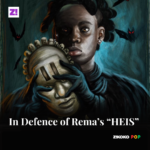
  • It’s been seven months since the O2 Arena filled with 20,000 music lovers for Rema’s Ravage Uprising concert. The consensus about that show is that the 24-year-old Benin-born singer is celebrating Benin heritage. Take his replica of the 1897 Benin sacking, like Queen Idia’s ivory mask, into account. The fact that the show happened nine miles from the British Museum displaying the stolen Queen Idia’s ivory mask and a note that Ravage Uprising was Rema’s only show in the coloniser’s UK in 2023, it’s not hard to agree with. 

    Critics have written adulations. Rema has thrown himself into the narrative. He’s tweeted about reshaping the Benin culture and a song titled BENIN BOYS with Shallipopi, another Benin boy. Rema adorned bats, a popular symbolism attached to Benin, into his jewellery collection and new album art. He’s claiming his birthplace with his full chest. However, the importance of symbolism might have been exaggerated. Bats don’t fly around the whole of Edo, and neither are they depicted in Benin guilds. Perhaps he should have spared a thought for leopards depicted in Benin guilds. 

    Rather than a connection to the centuries past, Rema’s inspired by Benin City’s urban life and culture (which has adopted bats into its identity). That narrative only teases listeners into the geographic-fluid afro-pop pits of his sophomore album, “HEIS”. He’s not playing it safe. This isn’t “Rave & Roses”. In comparison, his first album’s the rose, and this new one’s the rave. To appreciate “HEIS”, the search for homecoming aspirations and deeper music is seriously not advised. “HEIS” is pacy, head-back-leg breaking, and ridiculously amplified. It’s the complete form of what Ginger Me, Won Da Mo, Hov and the “RAVAGE” EP have shown. “HEIS” is the wildly experimental Rema.

    MARCH AM is a colloquial phrase for “doing the work and crushing it.” The corporate world will translate that to meeting KPIs. In Rema’s case, he’s a young overachiever. While one simmers in celebrating that, one observes his new linguistic approach, which is all over the album. He uses English, Pidgin English, Edo and Yorùbá in cruder tones. A marker of every man’s voice. American rapper Mick Jenkins said, “Deep conversations about language, which one [do] you speak?” Remaspeak is street-fluent and internet lingo rich.

    He rides the party into AZAMAN, originally an Edo slang term for someone who provides bank details for G-boys to pick funds. In this song, it translates to the popular Nigerian term for a “rich spender”. In a praise-singing mode, Rema hails Nigeria’s wealthiest men, including his state governor, Benin royal throne, and Don Jazzy. Rema sure knows how to pick his patrons. Interestingly, there’s no mention of his Jefe, DPrince, who discovered him.

    This praise-singing doesn’t sidestep Rema’s noteworthy consumption of X (Twitter) lingos. “No go hustle, dey talk for TL / Follow me run, you go tear ACL” is a banger boy material.

    Twitter might have been a bit of this album’s inspiration. From “No go hustle, dey Twitter dey zozo” on the opening track to “Monday morning, talking about me while I’m making money” on HEHEHE, the playful third track, that observation lurks. He clap-backs at his trolls and critics; this psychologically marks a reflexive response likely provoked by internet pressure and stan wars. It’s not crystal clear to him yet that the ascension to the Big 4 breeds contempt.

    On YAYO, he bites Asake’s style and comfortably holds the form. This is a jam; Mr. Sungba will be pleased. BENIN BOYS with Shallipopi follows in quick verse exchanges. The most notable thing about this song is the repetitive “See money, see am, see, see, see money o” chorus, subtle Edo music influence, and Shallipopi being the first Nigerian feature on any of Rema’s songs.

    Surprisingly, Bini’s heritage isn’t expressed on HEIS, the album track. The word is the Greek for “number one.” On it, Rema sings he’s THE guy. The chorus is rhetoric in Swahili, asking who’s the baddest. Who’s uplifting and hot and globetrotting? Who’s the shit and champion? Is it you? Rema’s confidence is stunning; he generates closing lines like “When I talk “Another banger,” you better believe am.”

    It’s not hard to miss P.Priime’s tag, which runs through six songs on this eleven-track album. This is evidence of their developing chemistry since their back-to-back collaboration on the “RAVAGE” EP. Rema’s go-to producer, London, takes the backseat on this album ride, credited on only three songs. According to metadata, this album’s also the first time Rema has deeply involved himself in the production of his music. Other co-producers are Altims, Daytrip, Producer X, Cubeatz, Deats, Klimperboy and Alex Lustig. [ad][/ad]

    Rema’s clearly synced with what’s vibrating in the ghettos and inner cities. Mara sound manifests in OZEBA, an Edo word for “entering trouble”. “Mara” is an informal term for madness. In music, it’s a homegrown sound that drives listeners wild. It’s high-speed and energetic. Picture a street carnival buzzing with DJ YK Mule’s mixes, dancers in ripped jeans, joggers, oversized round necks and sweaters, cross bags, sandals, designer slides, flipping white handkerchiefs in the air while thick Indian hemp joints burn on the other hands. OZEBA is trenches music brought to the global mainstream. The only thing missing is God Over Everything’s hypeman touch.

    From this song till the album ends, Rema retains the disruptive energy of Daddy Showkey—the new age composition of Olamide Baddo’s lamba. WAR MACHINE is an adrenaline pumper; it gives the thrills of street racing. Rema might have also been a new-age pop version of Obesere on EGUNGUN. He keeps on rocking on VILLAIN — repeating everything earlier said on the album, from accomplishments to soft-landing baddies, rocking designers and lavishing. His confidence leaps higher here; he desires babes built like the Afrobeats’ Queen Idia, Tiwa Savage.

    Decrescendo hits on the closing track, NOW I KNOW. The rave has come to an end, and others have left. His trauma and loneliness are all that’s left. This song’s a fine moment of clarity on the album, and one wishes it had more of it. 

    In 28 minutes, Rema sets a party for loud decibel suckers. It’s very experimental music, while someone like Ayra, his label mate, has a clear-sounding sophomore. Bold of him. It’s also a statement that Rema has a freer handle on his career. He notes on NOW I KNOW: “I dey move like Messi when he dey for Barcelo[na].” That’s one way of saying he’s unfuckwithable.

    While it’s true Rema’s music is becoming uncontrollably uncouth, his music has never been suburban. He’s only talented and cool enough for the butte and pako. He’s called the “Prince of Afrobeats”, which makes sense. But what Rema and the other top three, the kings of Afrobeats, have in common is the love for the Black app. Rema should grow thick skin!

    Closer listening reveals “HEIS” more native allegiance than a musical revolution orchestrated by the Mid-Western Nigeria’s tapestry. Another evidence of this is Shallipopi’s widely critiqued sophomore. What these two album releases heralded by the Benin/Edo fixation represent and share in common are apprehensive party music and cruise talks.

    Is a Benin renaissance happening? Is “HEIS” a special nod to Benin? Is the album by Rema’s hedonism, inspired by his critics or his desire to shift mainstream focus from Amapiano to Afropop? Maybe, maybe not.

    You have to agree, though, that Rema has given Benin as a whole more points than his Governor Obaseki.


    While We Talk About this Rema Hot Moment, These Are All the Times He Has Showed the World He’s Really HIM

  • ‘Summer’ is a warm season of recreational time and enjoyment. Agreed that it’s non-existent in Nigeria (the rainy season is what we have), but that hasn’t stopped Nigerians from weaving it into our popular culture like music.

    One can call that an effect of Afrobeats’ globalisation and as well tie it to foreign culture adoption like almost everything we import. Over the last decade, Nigerian artists have actively put out songs between June and September to also engage in summer raves. Some of these songs have crossed overseas, ruled airwaves, clubs and streets, and climbed the charts, and they still maintain relevance for newer summers. Here are 14 summer jams that reflect Nigeria in 2024.

    Summer Body — Olamide (feat. Davido)

    There’s no better summer song to kick off your summer than this one.

    Ye — Burna Boy

    On behalf of all Nigerians with aspirations to buy cars, and houses, turn up and enjoy existence, Ye is the national anthem you need right now.

    Chance (Na Ham) — Seyi Vibez 

    Since Seyi Vibez released this song, his music output has increased, and so have his feats and popularity. It’s your reminder to remind the gatekeepers that 2024 is the rise of new players.

    Essence — Wizkid (feat. Tems)

    Don’t waste time. If it’s love you have to chase or money to get, time is of the essence. Especially that money part.

    No Days Off — Teni Makanaki

    In this economic state that we’ve found ourselves in, sleep is the cousin of death and the younger sibling of poverty. If you like, sleep.

    The Money — Davido (featuring Olamide)

    “Life is all about the money eh” is a universal truth that hits close to home Nigeria, the poverty capital of the world. Do what you will with this gospel.

    Rush — Ayra Starr

    When every day’s work, it’s hard to lose sight of things. As money bags and soft living keep falling on you, remember to count your blessings.

    Squander — Falz (feat. Niniola)

    As you ball this summer, the opposite of this song title is what I advise. Or hasn’t Nigeria taught you to save for rainy days?

    UNAVAILABLE — Davido (feat. Musa Keys)

    Be honest: If you called yourself in this current depressing state of the nation, would you pick up your call or drop your location?

    Skintight — Mr Eazi (feat. Efya)

    At every turn on X these days, it’s marriage proposals. It seems romance is up and the last person to marry in 2024 is a fool. Need a wedding vow? Keep Mr Eazi’s Skintight close.

    Buga — Kizz Daniel (feat. Tekno)

    As you work hard and make more money, make time for leisure too, and feel free to feel pompous.

    Lonely At the Top — Asake

    This is for everyone: the liquidly rich, perceptibly monied folks and those hungry for better days. Don’t forget that you may get all the cash and still feel incomplete. But chase the money sha, at least you won’t be completely by yourself.

    Last Last — Burna Boy

    If you like, break your neck and legs in a hundred places to keep anyone, they’ll do whatever they like still. Even the “Emi lo kan” loyalists are not safe from Tinubu’s Nigeria.

    Fia — Davido

    Fia is Davido’s way of separating from a one-sided love. In a larger context, it’s a national protest song. Citizens love Nigeria but it doesn’t love us back. So, why continue to serve what isn’t serving us? That’s something to pick up here for OBO.

    High — Adekunle Gold (feat. Davido)

    You might as well get high and forget the bones to pick with the economy, for a bit.

    Happiness — Sarz (feat. Asake & Gunna)

    Life can be stressful, but you can always find your happiness in whatever you do.

    Well, It’s Summer and You Can Get Your Summer Body in these 11 Ways

  • The rise of female Nigerian music stars in the last few years isn’t only applaudable, it’s also sparked a conversation about a possible female takeover: Lady Donli put out one of the best albums of 2023. In 2024, Tiwa Savage released a first-of-its-kind, well-acclaimed soundtrack album and Ayra’s latest album, “The Year I Turned 21”, received even wider critical acclaim. 

    The girlies are up and creating their lanes. They bring newness to the game, and diversity in genre, vocal dexterity, delivery and lyrical content. We know seven on the come-up that should be on your radar.

    Yimeeka

    The combination of a music producer and recording artist in one person is an advantage that usually distinguishes a super-creative individual from an average one. Her musical ingenuity and production skills set her apart among the new wave of Nigerian female pop stars. Her debut EP, “Alter Ego” (2022), expresses relationships, and her latest self-titled EP, “Yimeeka,” explores personal moments. 

    Syntiat

    Syntiat is an impressive vocalist, producer and songwriter who graduated among the best of The Sarz Academy’s class of 2023. Get on her if you’re looking for music to play during heartbreak, as candles burn and you sip wine in a bathtub.

    Mahriisah

    Mahriisah’s pop style interplays with African rhythms, R&B, Highlife and reggae. Her music is perfect for glamming up to go flex outside or in a speedy car ride with your girlies.

    Amaeya

    Since Amaeya moved from Delta state to Lagos to push her music dreams in 2020, she has done backup work for A-listers like Tems, Ric Hassani, Tiwa Savage, Asake and Lojay. But she’s fully focused on her thing now. Amaeya’s stories of love, relationships and identity are bold pictures of the spoken and unspoken emotions of a careful romantic turned into music. Since her debut on “The Voice Nigeria” in 2021, she’s stayed true to her soul-drenched Afropop and r&b sound. Singles like On My Own, Delusion and Too Much will get any new listener started.

    Aema

    From Aema’s solo releases to her notable collaborative work with fellow singer, Kold AF, it’s easy to tell that her alternative soul music won’t be underground for long. When she’s not conquering her ego on No Place to Hide, Aema’s protecting her mental well-being, addressing relationship issues and women’s places in society on “ALT SOUL, Vol. 1” and “No Pity.”

    Clayrocksu

    In recent times, Nigerian Afrorock music has been referenced to the likes of Neo, Modim, The Isomers and Clayrocksu, among the very few women making music in that scene. Clayrocksu’s style blends rock, metal and alternative with Afropop, with relatable tales of Nigerian dreams and hustle, love and romance, optimism and higher calling. Her new EP “Hate It Here” is a mirror of all these and fun experimentation. One of the tracks, Nu Religion, mixes atilogwu with rock. What’s more daring than that?

    Reespect

    Reespect is a rapper who brings all her emotions to her songs. It doesn’t matter what kind of production she hops on; she’s going to spazz and bring out the soul in her bars. Her latest performance on Showoff Rap show (one of Africa’s biggest hip-hop platforms) is proof she’ll rap circles around the competition and still spit vulnerable lines if she feels like doing so. Put respect on her name.

    Nigerian Women Throw the Most Lit Parties, and the Proof Is Here

  • In the history of Nigerian music, teen stars have been few and far between. There was Wizkid, Davido, Korede Bello and a few less popular others. The year is 2024, and the number of teenagers springing up and running things is increasing almost daily. From music charts and playlists, notable stages and mainstream affiliations, we zoom in on the new youngins popping up in Afrobeats. Here are seven.

    Muyeez

    We got to know 16-year-old street-pop artist, Muyeez, when Seyi Vibez Incorporation was unveiled in April. Soon after, he featured Seyi Vibez on his first single, Instagram. In May, he released his self-titled EP, perhaps too soon after bagging his first hit.

    Qing Madi

    When considering the Afropop stars who’ll impact the industry in 2024, Qing Madi should be a sure mention. From peaking on Apple Music charts to featuring global stars like Chlöe, the 17-year-old singer-songwriter and dancer is one to watch out for.

    Ayo Maff

    Street-pop artist Ayo Maff began getting attention after dropping Jama Jama and 7 DAYS in 2023 and 2024. He isn’t just 17 and creative; he makes music that brands him as “an old soul in a young body.” His new single Dealer features Fireboy DML.

    Vasa 

    When I profiled 18-year-old Vasa in 2023, he’d just gone viral on TikTok with his single Treasure. He has since bagged a Bella Shmurda feature on the remix of his song 50-50 and is putting in work on his forthcoming project.  [ad][/ad]

    https://www.youtube.com/watch?v=iM8575IV0oY&pp=ygUEdmFzYQ%3D%3D

    Anni3

    Sensuality, toxicity and obsession are the major themes Anni3 (19) explores in her music. Port Harcourt remains the melting ground of music talents in the country, and she’s one of its latest exports with her mellow Afropop sound. Start with her single Toxic.

    Khaid 

    Thanks to the virality of Carry Me Go with Boy Spyce, 19-year-old Khaid is now enjoying mainstream attention and affiliation. His hit songs, Amala and Run Away (OMALICHA), boast big-name features like Zlatan, Rexxie and Gyakie.

    Uloko

    Uloko is a 19-year-old artist out of Benue state, and he just joined Apex Village, which houses artists like PsychoYP and Azanti. He went viral with Nsogbu in 2023 and came back with his “Problem Child” EP this year. If you’re looking for a mix of Afropop and electronic music, Uloko is that guy.

    READ: The Young Voices of the Trenches

  • Ayra Starr turned 21 in 2023. But like stars, her reflection is in retrospect. Hence, her second album, “The Year I Turned 21” (TYIT21), appears a year later, aligning perfectly with her birthday. In notice of this, her age-themed albums draw a specific parallel to the British music icon Adele. One can argue that Ayra Starr’s music and sonic concerns are different, but the universality of the experience of marking youth and independence is intact.

    Age 21 was also a year of many firsts for Ayra. She came into 2023 with Sability and ended the year with appearances on two American movie soundtrack albums (Creed 3 and SPIDER-MAN: ACROSS THE SPIDER-VERSE) and a posthumous album of the legendary Bob Marley. She went on her first world tour. She was named Amazon’s Breakthrough Artist of 2023. She climbed the O2 stage for the first time at Rema’s “Ravage Uprising” show. A title doesn’t get more specific. “The Year I Turned 21” is a more profound title than a chronological buildup on her “19 & Dangerous” debut.

    Now enjoying some career moments that surpass most of her predecessors’, conversations about Ayra’s music shift her to a trajectory that may transcend her into Afropop’s matriarch. Alongside Tems, she’s the anointed leader of the new uprising of female Afropop singers. These favourable speculations are fever pitches as her quick conferment majorly rests on the merits and success of her sophomore album.

    The music is saying…

    “I learned to be gangster, way from these dark times,” Ayra shares in Birds Sing of Money, opener of “TYIT21.” She spends the rest of the album owning that fearless identity, finding and defining what it means for her to be 21. How does she separate a fugazi from true love, independent versus dependent? Does she want to express freedom or curb enthusiasm, be a baby or face adulthood, keep her guard up or be a goofy youth, be a people-pleaser or live carefree, workaholism or chill and enjoy the fruits of labour?

    Ayra’s music blends styles — afrobeats, hip-hop, pop, R&B, ragga, dancehall, house, amapiano, indie folk — to probe her conflicting feelings. She plasters them all against the backdrop of her career, expanding celebrity and blooming 20s. Her lyrics can be saccharine, but don’t get to a conventional bore. 

    With numerous global achievements just four years into her music career, Ayra has built her universe so high that the chant on Birds Song of Money ceremoniously likens her to the stars that light up the night. Forty seconds into the song, whose also uneasy but organised violin, heavy hip-hop drums, breezy strings, chiming chords, and reggae undertones thump with a threatening assertiveness, yet it’s also calm and composed, one marvels at the pure sonic mastery. Fantastic production by London and Marvey Again.

    Her melodies are flexible, as is the boomeranging flow she spins on the P2J-produced Goodbye (Warm Up), featuring Asake. Ayra shows a toxic partner the door out, while Asake plays the heartbroken, self-righteous partner who lowkey won’t let go. His verse’s almost introspective that it convinces chronic gossip blog readers that it’s likely his response to his recently broken relationship. Ayra and Asake share chemistry, but this song’s strangely a mellow track hatched for the TikTok girlies and intimate parties like aprtment life where she previewed the song in April.

    The already-released Commas sports an upbeat composition, interestingly just a tone and pitch away from Tekno’s Peace of Mind. Exchange ataraxis for financial merit, and you have a testament to Ayra’s increasing multiple-stream incomes and quality mindset. Commas has joyful production and melodies, though those overshadow its simplistic message that charges listeners to fight dirty for their dreams if they have to. All there is to know about the commitment to excellence is in her lines: “Dreams come true, if na fight / Fight the fight, make you no go tire / Fire dey go.” Perhaps it’s why it took fifteen versions and three producers (Ragee, London and AOD) to get the officially released Commas, according to her revelation during a recent sit-down with Billboard.

    “Commitment to excellence” is a watchword she carries to her interviews these days. An evidence of that is her passage into the global music scene that fully unlocked after her appearance at the 66th Grammy Awards, where she was an inaugural nominee for the Best African Music Performance category. Put that moment into a lyrics generator, and Drake’s “Started from the bottom, now here we here” will pop up. She was excited to be there. So were the Western press and industry players warmed up to the new African music star girl. But frankly, her trajectory to own a seat among existing envelope-pushers like Tiwa Savage, Yemi Alade, and Simi has taken shape since her savvy, critically acclaimed 2022 “19 & Dangerous” debut album. It has a few national hits that pushed her over to international eyesight.

    In Woman Commando, featuring Anitta (Brazil) and Coco Jones (U.S.), Ayra brags about flexing her squad and carrying everyone along, sounding confident and pleased as the production reverberates Ragee’s bass-heavy house instrumental. It’s a straight jam.

    The album’s upbeat energy descends as Ayra segues into a lover’s mood. She flirts in Control, which interpolates Shakira’s Hips Don’t Lie, and she’s tipsy and ebullient on a potential one-night stand. She opens herself up to emotional attachment, but it soon gets tiring on the Lagos Love Story that sounds like a love song that’s trying too hard. It’s mechanical and an unnecessary segue into the lively Rhythm & Blues (produced by Sparrq). [ad][/ad]

    On 21, the album’s theme song, the weight of emotional distress, adulthood, self-reliance, boundaries and (it goes without saying) enjoying the fruits of her hard work weighs on her. It’s a niggle of new baggage, not a pity cry. When Ayra’s on an R&B production, her command of her emotions grip. It’s no surprise she’s convinced she writes better sad songs. This production by Fwdslxsh, KillSept and Mike Hector is a convincing ambience. Hopefully, an R&B album is in her future.

    It gets fragile on Last Heartbreak Song. Ayra throws away a one-sided love while American brittle-baritone vocalist Giveon chides himself for letting a real love slip away. This song dates back to the “19 & Dangerous” recording session with Loudaa, but is there a heartbreak song that retains the prospect of intimacy? It’s the Last Heartbeat Song.

    Still laid-back, Mystro takes on the next production. Bad Vibez featuring Seyi Vibez slides us back to Afropop. It’s bouncing over a plush R&B ballad to ward off negative energy, likely the internet moralists that police her short skirts and experimental fashion. It’s an exciting collaboration that elitist listeners would enjoy if they were open-minded to the magic of street-pop. To close out the song, she rhymes that she’s still eating off her last hit. It makes an arguable case for the boldest line in Afrobeats in recent times since Asake’s “I know I just blow, but I know my set.”

    The songs hop from youthful exuberance to love matters and mental well-being. As Ayra presents herself as a success model, she also grounds herself in her reality as a curious adolescent who knows she has time to learn from more mistakes and has her whole life ahead of her. 

    Orun is a cry to the heavens. It’s as evocative about personal longings and celebrity pressure as it’s declarative about forging ahead, past mistakes, and regrets. It’s a confessional, mezzo-forte track that draws hips into a slow whine. 

    Jazzy’s Song (cooked by PPriime) comes next, and it’s a turn-up song that unexpectedly samples Wande Coal’s You Bad and alludes to it as Don Jazzy’s likely favourite song rather than a tribute to her jolly label boss and influential music producer. Indeed, it’s a hit but feels out of place between two mid-tempo, emotionally charged tracks. This arrangement hardly lets listeners fully unpack and tie up emotions. It throws the listener in the middle of mood swings.

    She trusts Johnny Drill to soundtrack the following 1942. It’s a delicate cut that expresses Ayra’s and her brother Milar’s fear of losing everything they’ve worked hard for. Their duality picks up here: the despair of loss drowns them in a pool of liquor, but they still hold to their faith like an anchor.

    The closing track is a letter to her late dad, hoping she’s making him proud. Ayra’s mum’s voice starts the song by encouraging Ayra to live a full life. Her siblings also recount their ages and strides. One can hear the pain and pride in their voices, the kind that desperately hopes that their departed one sees what they’re making out of themselves. The song, produced by Remdolla, echoes out with a proud statement from Ayra’s mum that translates to the track’s title: The Kids Are Alright

    Conclusion

    The bonus song, Santa, thematically has no place on this album. It’s just an expansion and numbers strategy that’ll drive up streams and cement Ayra as the first female Nigerian artist to hit 20 million monthly listeners on Spotify. Get your money, girl!

    Looking outside in, being young and successful is one of the coolest things one can be, but it can also be an overwhelming position. Aside from squaring with life and the natural struggle to maintain success, being a female recording and performing artist means working multiple times harder and smarter than the other gender. If this is the evolution of the girl superstar who was once 19 and dangerous, it’s partially true. Most of her story thrives in gaiety, youthful innocence, vulnerability and self-affirmation.

    With 15 songs, “TYIT21” arrives as a lengthy, nuanced moment Ayra’s having with herself. Rather than a conceptual and narrative album, it’s a string of songs linked by recurring themes: heartbreak and love, happiness and melancholy, openness and boundaries, self-promise and tributes. This is the music you get when endeavouring to memento vivere because personal moments are fleeting, fond memories become distant, and emotions get unhealthily managed. This is the music that makes Ayra feel 21. It’s tough to say the same for the listeners, though.

    Compared with her coming-of-age “19 and Dangerous”, “The Year I Turned 21” is her most poignant and impressive work — an album of the year contender. Throughout the album, Ayra stays the dominant voice, in control. Its writing is sustainable, production is high-value, and there’s no Americanisation of the features. It’s just real and bad Afrobeats music. Although the arrangement could have been smoother, not moving tempo to tempo without consistently keeping the listener grounded.

    “TYIT21” would garner facile praise and embrace, considering its Zeitgeist hype, convincing rollout, major anticipation, and the currently uninspiring music year. But it’d need time to find its place as that crowning sophomore. This is subjectively a premature evaluation anyway.

    According to Polish poet Stanislaw Jerzy Lec, youth is the gift of nature; age is a work of art. Hopefully, Ayra Starr continues to stay alive to her feelings, with more virtuosos to craft them into songs at every juncture of her life.

    If You’re Trying to Get Into Arya’s Music, We Asked Chat GPT to Rank Some of Her Biggest Songs For You

  • Bump this:

    Once in a blue moon, Afropop artists take breaks from singing about love, sex, money and parties to give us Christmas songs. After scanning through the few we could find, we compiled a solid list of nine for your listening pleasure this festive season.

    Keresimesi — Skales feat. Wizkid

    Coming off the buzz of Mukulu, Skales released Keresimesi with Wizkid under Empire Mates Entertainment in November 2011. In his I’m-better-than-most-rappers bag, Skales flowed smoothly on Sarz’s production and dropped three verses, while Wizkid’s chorus emphasised on eating Christmas food till he could barely move.

    Jingle Bell — Tunde Ednut feat. Ice Prince, JJC, Davido & Lynxxx

    In the early 2010s, when most Nigerians juggled between free music sites for access to their favourite songs, Tunde Ednut was an upcoming musician. His most notable song, Jingle Bell, came out in November 2011. “Everywhere I go, it’s jingle, jingle bell, bell,” Ednut repeated throughout the song. On the verse spaces in between, Ice Prince, JJC, Davido and Lynxxx shine with enough Christmas rhymes, puns and punchlines to make anyone merry.

    Ovation Red Carol Theme Song

    Dele Momodu’s Ovation International made one of its greatest contributions to Afropop with the evergreen Christmas song that brought top artists together in 2011. The 2011 Ovation Red Carol theme song featured Wizkid, Sir Shina Peters, Yemi Alade, Waje, Ice Prince, Chidinma, Eva Alordiah, fuji music star, Malaika, and more, with late OJB Jezreel on production. It’s not every day we get an all-star lineup performing an eight-minute long Christmas jam.

    See Mary, See Jesus — DJ Kaywise feat. Olamide

    When the Shaku Shaku sound was still the toast of the mainstream, DJ Kaywise grabbed Olamide for a club banger that alluded to Mary the mother of Jesus and Jesus Himself. “See Mary, see Jesus,” as Olamide sang, is a figurative expression he likened to getting unexpected bank alerts. This is a great go-to for when surprise Christmas gifts begin to roll in. It was a jam in 2018; it’s still a jam now.

    Jolly Christmas — DOTTi the Deity

    On December 15, 2019, DOTTi put out Jolly Christmas, in which he wrote a letter to his babe to convince her to spend the holiday with him. From buying the same fabric to wear on Christmas Day to the general feeling of excitement, DOTTi brought all the nuance of the festive period to life on this song. Highly recommended.

    Christmas Sometin — Simi

    Christmas Sometin was Simi’s holiday gift to her fans in 2022. It’s a soft, jumpy dance record with moody guitar strings and logdrums wrapped with her infectious tiny voice. This song is the perfect background music for when you unwrap gifts or pour a glass of festive wine this Christmas. You can even hold your lover’s waist and dance to it.

    Merry Christmas, Darling — Timi Dakolo feat. Emeli Sandé

    In 2019, Timi Dakolo made an 11-track Christmas album. Its opening track, Merry Christmas, Darling, about long-distance lovers connecting to each other emotionally, features Scottish singer Emeli Sandé. Together, they made a beautiful and cozy record suitable for both family listening and romantic activities. If you’re seeing your partner this Christmas after a long time, here you go.

    Merry Christmas — Waje

    In a mix of English, Pidgin English and Yorùbá, Waje soulfully narrates the birth of Jesus, the celebrant of the day. In a perfect Nigeria, this song produced by TY Mix would’ve been an icon for the bubbling Christmas period. But regardless of the situation and time we find ourselves in, Merry Christmas remains a groove — the needed delulu of a perfect Christmas we all wish to have.

    Hope We See This Christmas — 234rnb

    234rnb is a community of new generation Nigerian R&B artists. In less than four minutes, members, RnB Princess, Givens and Emk the Genie put butterflies in our bellies with their dream-like lyrics about a love that’s gone but the memories still linger around. If you miss someone, this 2023 drop may make you call them. I hope the person picks up with the same energy.

    234rnb’s just released four-track EP titled Christmas < U will get you in a full Christmas mood.

  • Members of K-pop groups take on specific roles and positions besides singing. Just imagine Ayra Starr as the face and centre of this monster rookie band or Itohan of Nigerian Idol 2022 as the “golden maknae”.

    That’s why we created PURPLEWINE, a 4th-gen girl crush band made up of seven Nigerian Gen-Z stars. Let’s find out why each member would be in this Nigerian K-pop girl group, what the group would be known for, how well they’d do and how they’d eventually disband. 

    RELATED: K-pop Stans in Nigeria Can Relate to These Struggles

    The Unnie Line (older members)

    Sanchan: The Leader

    K-pop group leaders are either the oldest by age or years of training (RM in BTS, Red Velvet’s Irene).

    This 24-year-old brand influencer, popularly known as White Melanin, would be the oldest member, making her the default leader. The K-pop company would select Sanchan unnie to be a “visual” (AKA fine girl of the group) because of her modelling background as the face of many beauty brands. Her half-Japanese ethnicity would also be a factor, but the company would constantly deny it. Most likely the last member to be picked, they would train her for about a year to pass as a vocalist, dancer and maybe even rapper. None of that would matter though because what they want are her visuals and existing popularity to promote the group. She’ll always look out for the other members, but like BLACKPINK’s Jisoo, very few people will know she’s the leader as she’ll be completely overshadowed by the “centre” (AKA most popular member).

    Positions: leader, visual, sub-vocalist

    SANCHAN [@thewhitemelanin]. (2020, August 15). “Every single hairstyle gives me a different look 😌…anyways after this picture I took my wig off and kept [Photograph]. Instagram.

    Fave: The Vocalist

    The official vocalist position is usually given to the member with the best vocal range or technique (Aespa’s Ningning, EXO’s Baekhyun). That doesn’t mean the other members aren’t technically vocalists too.

    Fave (21) is understated but talented and passionate about music. She would’ve joined the company very early on, say ten years before PURPLEWINE’s debut. She would’ve known since she was a kid that she wanted to sing, auditioned to join the company and been the only one of thousands to be picked that year. She would then spend ten years as a trainee, learning to play every instrument (and dance every choreo) in the book while perfecting her vocals, only to be given one position and barely any parts in songs once they debut. Any part she does get would be the most difficult one. But she would kill it, so her stans would dedicate their lives to attacking the company for not giving her more.

    Position: main vocalist

    Fave [@faveszn]. (2022, April 15). “Stream Riddim 5 today!
    (real caption on twitter. 3 ha1va2 maya da1da 4na Instagram
    🤭) [Photograph]. Instagram.

    Ayra Starr: The Centre & Face

    The most popular one who’s also usually the one with the most skills. Sometimes, the centre is a different person from the face of the group (In ITZY, Ryujin is the centre and Yeji is the face, while BLACKPINK’s Jennie is both).

    It would be love at first sight between the company and the self-assured 19-year-old Ayra. She joined after Fave, but still very early on, as an IJGB, and has been crowned the company’s princess/secret weapon ever since. Considered an ace because of her singing, dancing and visual skills (they’ll probably train her to hold her own as a rapper too) and charisma, the company would start promoting her some months before the debut, as the face of the group. Then, once PURPLEWINE debuts, she would literally be at the centre of the group in everything — photo shoots, music videos, live performances — the person who sings first on all their songs, gets the most lines to sing, and generally be the Beyonce. There’s one in every group TBH.

    Positions: centre, face, lead vocalist, lead dancer

    Celestial being 👼🏾🤍⭐️ [@ayrastarr]. (2022, May 22). “Stanford gave me all the energy I needed 🤍👼🏾 [Photograph]. Instagram.

    RELATED: Korean Parents Are Nigerian Parents in Disguise, Here’s Why

    The Maknae Line (younger members)

    Diana Eneje: The Visual

    The official visual of any K-pop group is the most attractive member or the closest to local beauty standards (IVE’s Wonyoung, Jisoo of BLACKPINK).

    Also 19, Diana would’ve been scouted four years earlier, by one of many company reps who roam the streets, for a group they hadn’t formed yet at the time they noticed her. Since her looks more closely represent the Nigerian standard of beauty than Sanchan’s, they would want her to be the main visual of the group. She’d probably want to be a model or actress, but they’d convince her she was made for pop superstardom despite never actually hearing her sing. She would accept and spend the next four years training for it. The company would use her and Ayra to promote the group pre-debut so that by the time PURPLEWINE debuts, they would already be it-girls. However, it won’t take long for stans to accuse her of not having any talent. But hey, Posh Spice didn’t care, so why should she? 

    Positions: visual, face, sub vocalist

    Diana Eneje [@diana_eneje]. (2022, March 24). “Attention 📌 At Ease
    Dress : @kryptstore
    [Photograph]. Instagram.
    Actual evidence of Diana and Ayra promoting PURPLEWINE pre-debut. Photo Credit: BN TV

    Susan Pwajok: The Rapper

    The cool kid with the best rapping skills (BIGBANG’s G-Dragon, Soyeon of (G)I-DLE).

    There’s no evidence that Susan can actually rap. But the actress has major rapper vibes, and I honestly think she should consider it, just in case she’s looking for a side hustle. Anyway, that’s what the company would be thinking when they recruit her for this Nigerian K-pop girl group. After watching one of her many Instagram videos in which she’s being cool as usual, someone in the company would have a vision of her as a pop star and reach out to her. She’d then become a trainee for three to four years, during which time her swag would evolve into great rapping and dancing skills. She’ll end up being the most popular member some years after their debut because everyone loves a good rapper. Side note: Nigeria needs female rappers!

    Positions: lead rapper, lead dancer, sub vocalist

    Susan Laraba Ganchung Pwajok [@susanpwajok]. (2021, August 22). “main character in his dreams. [Photograph]. Instagram.

    Amarachi: The Dancer

    The most impressive dancer in terms of technique (LISA of BLACKPINK, Red Velvet’s Seulgi, TWICE’s Momo).

    Do you remember Amarachi Dance by Nigerian Willow Smith and winner of the first Airtel Nigeria’s Got Talent, Amarachi Uyanne? Well, Amarachi went viral in 2012 after winning and dropping the song (and another one featuring Phyno). She’s 17 now and has spent the last few years she was out of the spotlight swooped up by the company to train rigorously for a grand comeback as a member of PURPLEWINE. The company would be banking on people’s surprise at her return and transformation to promote the group even more. Not to mention that her obvious dancing talent would’ve been refined to its fullest power level through almost ten years of training, so she would get mad dance breaks during live performances. The devil works hard, but the head of this company works harder.

    Position: main dancer, sub vocalist, sub rapper

    Amarachi Dance [@amarachidance8]. (2022, May 2). “Today✨🙂 [Video]. Instagram.

    Itohan: The Maknae

    The youngest one (NewJeans’s Hyein, Mamamoo’s Hwasa)

    The company would snatch Itohan right after she’s made a name for herself as the Baby Dragon of the just concluded Nigerian Idol (2022). The 17-year-old would be the voice they’d been searching for to round up the group as the youngest member or “maknae”, with a huge fanbase hungry to support her harder after she failed to win the popular talent competition. They would expect her to unfurl, performing alongside the older, bolder members, so that when the band tragically goes on indefinite hiatus five years in, she would still be young — but experienced and famous — enough to have a long solo career ahead of her. Would they be conniving devils if they put all their eggs in the Ayra Starr “solo takeover” basket? I think not. She’ll sing all dem special bridges, and the stans will tag her “golden maknae” because of her big vocals, a la BTS’ Jungkook.

    Positions: main vocalist, maknae

    Itohan Agbator [@itohan_agbator]. (2022, May 20). “Short Storytime!!💃🏽💃🏽 A couple of days ago, I got a surprise gift from @shopmakiee_ 🥺. I was completely [Photograph]. Instagram.

    Introducing PURPLEWINE

    The ult 4th-gen group, PURPLEWINE’s badassery would catch everyone’s attention right away. Their visuals would be unmatched, and since there aren’t that many local female acts, they would be an instant hit, dropping fast and catchy songs with a mostly afro-trap, amapiano sound. Their choreos would be tight; they would invent new moves that would go viral, and put their spin on old popular ones as well. Like every K-pop music video, theirs would smell of Hollywood blockbuster-worthy budgets that would get them huge numbers on YouTube. That would be the beginning of the Nigerian K-pop girl group global invasion. You’re welcome, Don Jazzy.

    The Break-Up of an Iconic Girl Group

    Unfortunately, the company would mismanage their finances, everyone would vex over the preferential treatment of Ayra, and as soon as their five-year contract is up, only three out of seven would renew. Most would want to return to their actual careers; they’ve acquired the status of global pop icons, so they can now run the acting, modelling or influencer industries too. But don’t worry, OT7 forever! 

    There you have it. What do you think their fandom name should be? Tweet us or let us know in the comments section below.

    READ ALSO: These 10 K-Pop Bands Should Be on Your Next Playlist

  • These days, “Afrobeats to the world” has moved from a saying to an actual movement. Nigerian artists like Wizkid, Burna Boy, Fireboy DML and Tems are topping the charts and having fun with stars like Drake, Rihanna and Beyoncé. But while the world has taken notice of Afropop, it wasn’t always like this. Thinking back to when I fell back in love with Nigerian music thanks to Tay Iwar’s 2013 song The Box, I decided to talk to other Nigerians about the time they finally realised that Nigerian music is the shit. 

    “Listening to Davido’s Fall for the first time in an Atlanta club changed everything for me”

    — Koye

    As a second-generation Nigerian in the US, I never really connected with Nigerian music. My family raised me on the classics like Sunny Ade and Ebenezer Obey, but in trying to fit in with white kids, my taste shifted to rock and metal as I got older. In 2017, I eventually moved to Atlanta — a predominantly black city — and that’s how I got re-introduced to Nigerian music. 

    On a night out with some of my co-workers, I heard Davido’s Fall for the first time. To see everyone in the club, including non-Nigerians and non-blacks singing along to this Nigerian song changed everything. I still love rock and heavy metal, but that hasn’t stopped me from knowing all the words to Davido’s Fall and Jowo

    “I didn’t connect to female Nigerian artists until I saw the video for Kele Kele Love by Tiwa Savage”

    — Nicole 

    Before seeing the video for Tiwa Savage’s Kele Kele Love in 2010, I just didn’t feel like Nigerian women made music for girls like me. I love and respect all the women that were making music at the time, but seeing that video and hearing that song made me go, “Whoa! That’s a no-nonsense, sexy, bad bitch like me.” 

    She wasn’t afraid to be sexy and to sing about whatever she felt like — I loved that. She blazed the trail for all the new girls and that’s on period. 

    “I don’t think I remember life before Asa’s Awe

    — Lolu

    I know it’s cliché, but Asa’s Awe changed my life. Before I listened to Asa’s self-titled album, my idea of Nigerian music was songs I could dance to in the club and not songs I could listen to for great storytelling. And to be honest, it was fine that way. It wasn’t until I went on a road trip with my brother from Lagos to Ibadan and he played that album over and over again that it clicked for me. It wasn’t just the melodies or vocals for me; it was the deep, rich stories she told with every word and every sound. Now I listen to other artists like Bez, Lindsey Abudei and The Cavemen (even though I don’t get what they’re saying, I feel super connected to the music. 

    By the way, Awe is the reason I started writing short stories. So when I say that song changed my life, I mean it. 

    RECOMMENDED: Thriving and Killing It: 12 Times Nigerian Women in Music Made History

    “Cruel Santino, Amaarae and Shane Eagle made something magical with Rapid Fire

    — Hassan 

    I didn’t even know alté was a thing until my friend dragged me out for a show in 2018 and Cruel Santino and his crew came out to perform Rapid Fire. My memory of it is the feeling that came with seeing the whole place turn into a mosh pit of people jumping and screaming at the top of their lungs. For someone indifferent to Nigerian music at the time, just seeing all of this sent shivers down my spine. Every time I listen to Santino’s music now, it just takes me back to that moment.

    I wasn’t into Nigerian music before because of what I was hearing on the radio, but Cruel Santino introduced me to a new type of Nigerian sound. 

    “Niniola’s Maradona changed the game for me”

    — Uchenna

    I remember hearing Niniola’s Maradona for the first time and just knowing that this song was going to be the sound of the future. And lowkey, I was right. It was around the time I was falling in love with South African club sounds from artists like Bucie and Black Coffee, so it just worked perfectly. Niniola and Sarz took a huge risk with songs like that and now we have a lot of artists making songs like Maradona. It wasn’t like I didn’t like Nigerian music, I just didn’t care until I heard this bop in 2017. 

    “Temi Dollface’s pen game on Pata Pata made me pause, listen and go ’Who is she?”

    — Sammie 

    This chick came, dropped like two hit songs and disappeared. Why? When Pata Pata dropped in 2013, a lot of artists were doing the same thing, using the same producers and adopting the same formula. We didn’t have variety and then this girl came in singing, “Pour me a drink and I’ll tell you a lie. Baby what would you like to hear? That I’m in love with you and all the things you do. You know that wouldn’t be sincere.” 

    Ladies and gentlemen, that’s how you open a song. That is songwriting and the song that made me go, “Oh shit, Nigerian singers dey write o!” 

    ALSO READ: Do Nigeria’s Biggest Artists Really Need the Grammys?