• The Nigerian experience is physical, emotional, and sometimes international. No one knows it better than our features on #TheAbroadLife, a series where we detail and explore Nigerian experiences while living abroad. 


    Ken (49) left Nigeria almost twenty years ago. In that time, he has lived through multiple waves of anti-immigration sentiment in the West. He shares how having a tough skin helped him navigate racist environments, and why he is not considering a return to Nigeria.
    This model is not affiliated with the story in any way

    Where do you currently live, and when did you leave Nigeria?

    I live in England currently, but I have also lived in other parts of the United Kingdom (UK). I left Nigeria in 2006, 19 years ago.

    Was that your first time leaving Nigeria?

    No. I used to travel around. I had been to the UK a few times for holidays and visiting friends, but 2006 was when I moved here permanently.

    What inspired you to leave?

    I just wanted more for my life, that is the truth. I got my first degree in Nigeria, and I felt like I had gotten a certificate but not an education. I wanted more than just that paper. I wanted global exposure. The idea of being a global citizen was really appealing to me. 

    What was life like for you in Nigeria?

    It was okay. I made money, but it was not fulfilling. I worked in the banking sector, and I invested aggressively during my early days. So by the time I started thinking about moving abroad, I did not need my salary anymore. I was really comfortable, and my investments were yielding more than enough to take care of me.

    So I thought, “Oh, I think I need a lot more for myself.” That was what pushed me to leave. I applied for a master’s in the UK.

    I still remember when I got my visa. I got it in late October, and school had already resumed in September. I was almost too late to resume. After getting my visa, I had to get to the UK within 48 hours.

    Get More Zikoko Goodness in Your Mail

    Subscribe to our newsletters and never miss any of the action

    Wow. How did you make it?

    I basically just left everything. I said to my girlfriend, “Look, girl, I am leaving. You can have my whole house to yourself with everything in it.” I changed my money. I think it was two hundred naira to a pound back then. Then I got on a flight to the UK.

    What was the early experience like?

    I was really focused on school and work. My master’s took about two years to complete. During that time, I had internships with some companies to get “UK experience” because the companies here do not recognise whatever experience you are coming with from Nigeria.

    While I did not like starting from ground zero, I looked at it as coming in on a clean slate. So I just took on every opportunity to learn and relearn. I did not only do my master’s courses, but I also got some other certifications to make myself ready for the UK job market. About six months after I graduated, I got a job at EDF Energy.

    Would you say the move to the UK has been a good decision so far?

    Yes. It was a good move because of the professional exposure I have gotten. My move to the UK took me to a whole new level in terms of what I could achieve technically. I went to places I never imagined I would. Like getting to work underneath a nuclear reactor. I was doing stuff I never imagined I could. It was like my technical capabilities exploded. I was pushing myself beyond my normal boundaries because of the work I did, the people I met, and the opportunities I had.

    But it was tough. It was not a walk in the park. There were good times and bad times, but overall, I would say it was a good move.

    Sounds like you have had quite the career. What are you up to now?

    Like I said, technically, I have pushed myself beyond my boundaries and achieved a lot of great projects in those companies I worked for. So I felt it was time for me to pivot and start doing things for myself. Right now, I consult on a contract basis.

    We have talked about your professional life in the UK. But what about your personal life? What is your support system like?

    My support system is my family. That is my wife and three kids. Due to my continuous travelling, two of my kids were actually born in the United States (US) during the time we lived there.

    After my contracts in the US were completed, we moved back to the UK, and I have built a tight unit of friends who have the same mindset as me in terms of career plans and business, and also socially. So that is my support system.

    Your girlfriend joined you in the UK?

    No. I met my wife in the UK. My relationship with my girlfriend in Nigeria did not work out. We tried long-distance for a while, with me coming to Nigeria whenever I could, but it did not work out in the end.

    After that, I met my wife in the UK. She had also come from Nigeria to study. We met at an event at a mutual friend’s house, and we started a friendship that eventually turned into a relationship. She initially wanted to finish her studies and go back to Nigeria. But after her studies, we got engaged and then married here in the UK.

    She is more Nigeria-focused than I am, but I think along the way, she came to see the value of life in the UK. I think she is starting to see the UK as her home a lot more now, after all these years.

    You mentioned your children being born in the US while you lived there. Where else have you lived?

    Apart from the UK, I have stayed in the US, France, and Germany. Those are the countries I have lived in for work for long periods. I have been to many other countries for shorter periods, too.

    Do you have a favourite?

    I would say the US, Texas specifically. The environment just appeals to me. But my wife does not like it there because of the gun laws.

    While we are talking about different countries, let us talk about Nigeria. Have you been back since you left?

    Yes. I have business there from time to time, so that brings me back often.

    Is there a possibility of a permanent return?

    No, I do not think so. Not in the current state of things in the country. If I am going to retire permanently in Africa at some point, there are other countries on the continent I am considering. 

    There are other African countries that have much better situations economically, and in terms of security and safety, which is very important to me.

    I get contracts to offer my expertise in many different countries. Nigeria is one of those countries. So for me, it is just a place to do business. Whenever I am done with business, I leave.

    Does the current anti-immigration sentiment in the UK make you uncomfortable?

    The immigrant journey is never a straightforward one. I see all this anti-immigration talk in Western countries now, but I have seen it play out before. Back around the time I first moved here, there were all these really frustrating policies imposed on immigrants for no just reason. I passed through all that.

    Also, it was quite an expensive journey, and you find yourself having to depend on people and systems that make you compromise and endure certain things. You might be in a toxic workplace, and because you are an immigrant, you just have to endure it.

    There will be positions you are qualified for and should get, but you will not because they are designated for British passport holders only. I was in a tough spot because my work involved a lot of travel, and that was really difficult when I first came here.

    Documentation at the time limited my ability to travel. So there are a lot of limits to your opportunities as an immigrant, especially in the early periods. But you just have to get through those periods.

    That has to be a little frustrating, right?

    It is frustrating because I feel like they do not appreciate the value that immigration brings to their countries. And unfortunately, the Western media does not help because they feed them wrong narratives. Many people do not think critically and just swallow whatever propaganda they get fed, then run to the streets with it.

    The fact that they do not reason critically, and it leads to this anti-immigration rhetoric being pushed around, is what makes me uncomfortable. But the truth is that they cannot do without immigrants. It is like they do not want us around, but they also need us.

    There are so many occupations, roles, and parts of the economy that would collapse if they stopped immigration. They cannot do without it. So I would just say that immigrants coming to the West have to be prepared for what they are going to face. Do not allow yourself to be surprised by it.

    With some of the new laws and policies making life really difficult, do you think immigrants are getting a fair deal?

    What feels fair depends on each person and what they want and expect. You need to have a long-term strategy.

    As I said earlier, I was comfortable in Nigeria before I came to the UK. I was financially independent, but I still came to the UK because I was thinking long-term. I looked at where Nigeria was, where it was going, and I felt my investments would not be able to sustain the kind of lifestyle I wanted while still being in Nigeria. That was why I decided to pack my bags and come to the UK.

    So, talking about a fair deal, everyone has to think about what they are sacrificing and what the long-term benefit will be. You just have to think about whether or not the value you are getting is worth the pain you pass through as an immigrant.

    Whether you are getting a good deal depends on what you want from the system. It depends on what you want long-term.

    It could be tough, it could be hard, but if you have a long-term plan, you will be able to make the right decision for yourself and your family in the long term.

    Can you remember some of the culture shocks you experienced when you first moved to the UK?

    The first thing that shocked me was the structure of the UK itself. It is four countries: England, Scotland, Wales, and Northern Ireland. And each country has its own distinct culture, its own flag and currencies, even different languages.

    I struggled getting used to the different accents. My goodness, in Scotland, the accent is not a normal English accent. And they have their own language too: Doric. I had to learn it because it is what the local people speak, and if you want to get along with them, you have to know it.

    Let us talk about highlights and lowlights. What has been your worst experience as an immigrant?

    My worst experience was at a time when there was a lot of anti-immigration rhetoric. This was around 2011, the Conservative Party was in power, and they were really clamping down on immigration.

    It was a really bad time for me and my family. Every time you made the application to renew your paperwork, it would take almost forever. And that could affect your work placement. Luckily, my employers were quite understanding. But I have friends whose employers were not so understanding, so they had to stop work for a period of time. And you could not travel around while your visa was being renewed.

    So it was a bad time for me because for almost six months, I was not sure if I would still be a resident in the UK or not. And my finances were also affected because I lost many opportunities for work that involved travel.

    Added to that, the area I was working in was not a comfortable place for an immigrant. It was quite a toxic environment because of all the anti-immigration sentiment. I know some people would not stand what I did. They would have just left. But I realised that if you have tough skin, and you know what you are doing, you will pass through the tough time.

    You mentioned being in a toxic environment. Do you mean racism?

    Yes. In the UK, they are subtle about it, but it is there. You can feel it, you know when it is happening. And it is very difficult to deal with that in the workplace because your visa is tied to your having a job. So you just have to swallow it, shoulder it, and move on.

    My friends and I had this inside joke based on the movie, Twelve Years A Slave. So whenever something happened, we would encourage ourselves by saying, “Do not worry, just do your five years of slavery and get out.”

    That sounds grim. But it must have been good to have that support?

    Yes. One thing that really helped me through that dark time was the support of friends, especially from the Indian subcontinent. So that is my Indian and Pakistani friends.

    They are very resourceful, and they have a very strong community mindset. In that sense, they were actually more supportive than the Nigerian community in the UK. I found that Nigerians mostly did not know how to help, and those who did were asking for money. But my Indian and Pakistani friends just helped freely. They guided me through the whole visa process and never asked for a penny.

    That sounds great. What has been your best experience?

    I do not know where to really start. There have been so many great experiences. I really enjoyed my time working in the US. It felt like a really merit-based system there. If you work hard, you will be rewarded accordingly. That was my experience, so I loved it there.

    I also made some long-lasting friendships there. I am constantly having to fly over because people keep inviting me to events.

    I have become more financially independent in the UK to the point where I have dumped my nine to five and I am now doing my own thing. I have so much more time to enjoy new experiences.

    So I will say I am still building my best experiences here.

    That is amazing. Nineteen years is a long time. Can you sum up your journey?

    If you have a plan or dream, you can make it come true. That has been my journey. Almost everything I have made up my mind to do, I have done. Not everything I wanted has happened, not everything has worked out, but I have hit a lot of the milestones I laid out in my plans.

    Well, let us put a number to it then. How happy would you say you are on a scale of one to ten? And why?

    I will say for me, in the UK as an immigrant after all these years, I will give it a seven point five.

    It is not a higher number because of the weather. I hate the weather here. Let me put it this way: the rich people in the UK do not spend the winter and autumn here. Only poor people stay back. And the fact that I am speaking to you from the UK in the autumn shows I am still poor and I have some ways left to go in the things I want to achieve.


    Do you want to share your Abroad Life story? Please reach out to me here. For new episodes of Abroad Life, check in every Friday at 12 PM (WAT).


    Before you go, help us understand how you and other young people feel about the 2027 general elections by taking this 10-minute survey.


    Click here to see what other people are saying about this article on Instagram

    [ad]
  • The Japa class of 2023-2024 does not know what the Lord did for them because the 2025 aspirants are going through it. In what can only be described as village people machinations, the UK government has announced new immigration rules that will make relocating and staying in the European country harder than it already is.

    What’s going on?

    The real question is “what’s not going on?” On Monday, May 12, the UK government released an immigration white paper detailing its new laws and focus in that area. The 82-page document (yes, 82 whole pages) titled Restoring Control over the Immigration System contains anything but good news for hundreds of Nigerians looking to move to the European country anytime soon. We’ll break down some of the affected areas below:

    Graduate route visa

    From now on, postgraduate students in the UK will be required to leave the country 18 months after their studies, instead of two years, which had been the norm.

    If this first rule has you screaming “God abeg,” you’ll hate to know there’s more: The UK also wants to “explore introducing a levy on higher education provider income from international students,” and it doesn’t stop there. Universities that sponsor international students are also on the hot seat — they will now be expected to meet some compliance requirements, which include a 95% course enrolment and 90% course completion rate, a new rating system (Red-Amber-Green) for publicly accessible grading of universities on compliance level. Schools whose scores are below par will either have their sponsorship numbers reduced, be made to follow through with an intervention plan, or be stopped from sponsoring international students into the UK.

    Get More Zikoko Goodness in Your Mail

    Subscribe to our newsletters and never miss any of the action

    Permanent residency and citizenship

    The new immigration laws will make it much more difficult for foreigners to transition to permanent residency and gain citizenship. Instead of the usual five years, migrants will now be required to spend a minimum of ten years in the country to gain citizenship and permanent residency status.

    Social Care Visa

    If you or your relatives ever had plans to japa through the Social Care Visa, you might have to kiss that plan goodbye because the UK government will be shutting down that route. If you used this route and are currently inside the UK, you can enjoy a small win — the UK government will establish a transition period until 2028, which will “permit visa extensions and in-country switching for those already in the country with working rights.” It’s a small win, but don’t celebrate just yet because it will be kept under review.

    Skilled workers

    The reforms in this area are mostly tabled under the introduction of a Temporary Shortage List that will impose time-limited access to the Point-Based Immigration System. They will affect occupations with an RQF 3-5 (below degree level) and a couple of other things.

    Other areas which will undergo reforms include family migration, humanitarian response, and global talent.

    The UK government says it is putting all these reforms in place for the sole purpose of reducing Net Migration, which was at 906,000 and 728,000 in 2023 and 2024, respectively. The UK basically wants everybody to stay in their countries, and it couldn’t have made it any clearer than it did in the long document just issued. If you’ve ever mumbled “Nigeria must work” before, now is the time to scream it at the top of your voice because it really must.

    [ad]
  • Every week, Zikoko seeks to understand how people move the Naira in and out of their lives. Some stories will be struggle-ish, others will be bougie. All the time, it’ll be revealing.


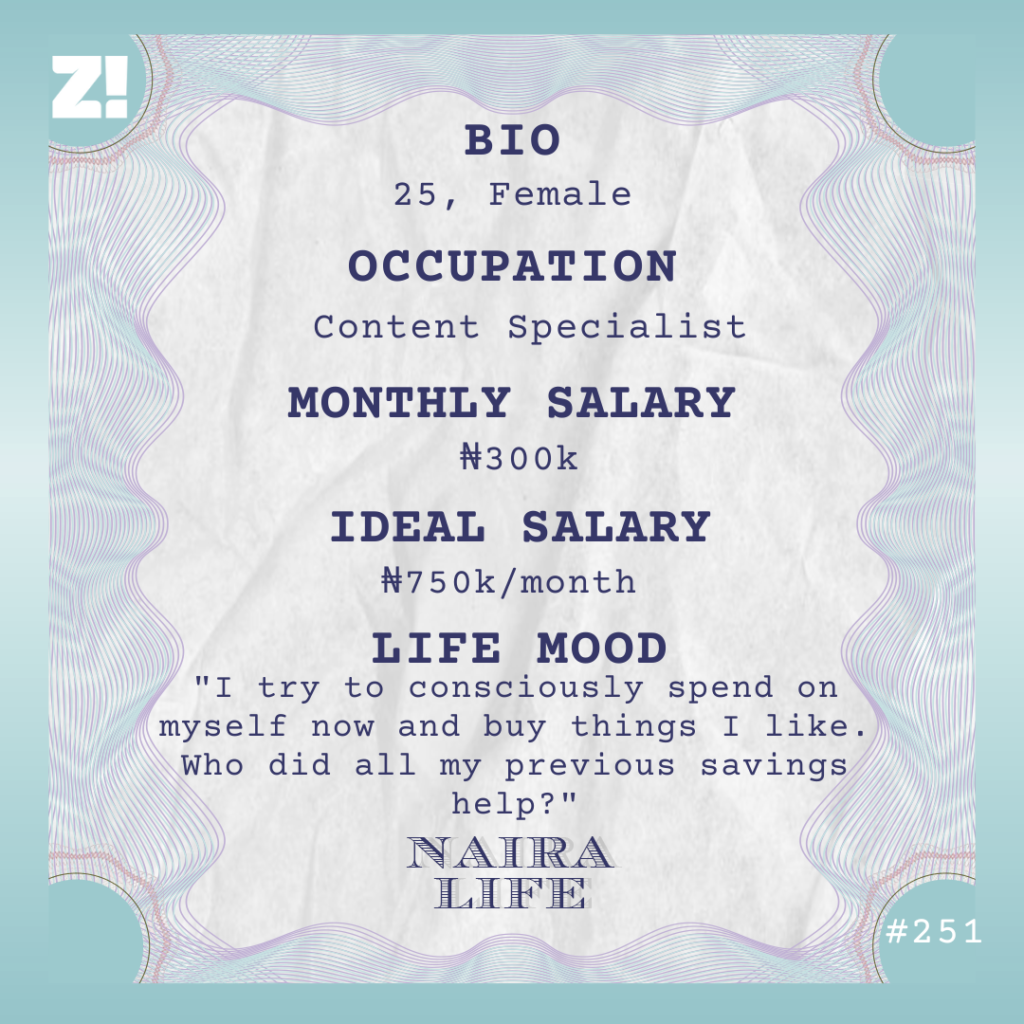
    NairaLife #251 Bio

    What’s your earliest memory of money?

    My family had an open approach to money; we all knew when there was money and when there wasn’t. My dad always said, “If you return from school and there’s no food to eat, go to the bedroom. There’s probably money on the table”. If there was no money there, I’d check other places he kept money. If I checked everywhere and there was no money, it meant we had no money. 

    There was no such thing as “stealing” your parents’ money because you knew if you took the money for no good reason, it’d affect you since there was no other source. It also helped manage expectations. I’m the firstborn, and when my siblings whined about wanting sweets, it was easy for me to go, “Can’t you see there’s no money in the drawer?”

    What did your parents do for money?

    My dad’s a pastor, and our finances had a lot of no-money and faith moments. My mum’s a lawyer, but she was also a jack of all trades. She sold chin-chin, beads, hats, clothes, and even ran her own practice at some point. Another time, she was legal counsel at a microfinance bank. 

    It was a two-income household, but we mostly lived on my mum’s income because my dad wasn’t the rich-pastor type. He was more of the pastor-struggling-to-make-ends-meet type, and my mum held the family’s finances down.

    Do you remember the first time you made your own money?

    I first made money in junior secondary school by drawing maps of Nigeria and selling them to my classmates. For some reason, I was good at drawing them, so whenever we were given class assignments, they’d pay me ₦20 to draw for them.

    It later progressed to drawing and labelling skeletons for biology class and selling them to my classmates for biscuits. Slowly, my customer base expanded to students from other classes. While I did this till senior secondary school, I didn’t have a standard price. My friends typically paid with snacks, and I’d charge others depending on how much I liked them.

    Here for the nepotism. What about after secondary school?

    In 2014, I got into university in Benin Republic to study law, but I didn’t do anything for money till my second year. 

    My parents moved to the US because my dad was transferred to a church there, and I realised I’d need to make money to support myself. This was because my dad was still getting paid in naira, which wasn’t much after the conversion to dollars. I knew they didn’t have much. So, when my parents sent my ₦15k – ₦20k monthly allowance, which was about CFA 30k – 34k, I’d lend it to people short-term for 10% – 20% interest.

    What were you surviving on while you loaned people money?

    My aunty usually sent me groceries, so I had minimal day-to-day spending needs. 

    The loan business worked until one guy refused to pay me back my money. He’d borrowed ₦30k and was supposed to pay me ₦35k after a month. I didn’t trust him from the beginning, so I had him sign a contract and use his laptop as collateral. 

    Month end came, and he didn’t pay. I told him I’d sell his laptop, but he thought I was joking. After the second-month grace elapsed and he still didn’t pay, I sold the laptop for ₦40k and told him I was keeping the ₦5k change. He couldn’t say anything because it was better than calling the Beninoise police, who didn’t even like Nigerians. He’d have slept in prison. That was the last time I gave out loans. I can do hard guy, but only so much. 

    I graduated in 2017 and relocated with my siblings to join my parents in the US. That’s when I got my first official job.

    Tell me how that happened 

    Since my dad’s visa only allowed my parents to work, I could only get a job that paid me in cash. Our senior pastor introduced me to a lawyer who needed a paralegal and agreed to pay in cash. The pay was $10/hour, and I worked six hours thrice a week.

    Someone else also offered me another job on the side. It was called medical coding, and my job was to change medical diagnoses to alphanumeric codes — like record keeping, but in codes. So, when he got the medical coding jobs, he’d outsource them to me and pay me around 30% of what he was actually getting paid. Payment was $1 per chart, but I was coding as many as 100 charts daily and 1000 charts weekly, and making $1k weekly. 

    I was 19, earning $1,200 a week from two jobs

    That’s not bad at all

    It was good money, and I hardly spent it. I was incredibly frugal and was only interested in saving. My sister was in high school, and I knew university would be expensive as an international student, so I was saving towards that. I was also saving towards a car and the medical coding exam to qualify as a professional because I expected we’d get the green card soon. 

    So after I got paid, I’d remove my tithe, set aside $100 for pizzas and McDonald’s — which was essentially my fuel for the long work days — and save the rest. The other bills that took my money were the few times my parents needed help with rent or groceries and my brother, who would randomly ask me to pay for sneakers, food and just random things. 

    Not spending enough of my money on myself is one of my biggest regrets today. I thought I’d finally start enjoying my money after I took the medical coding exam. The next step would have been an income boost since I’d be able to get the jobs myself. None of it happened because we had to leave the US in 2019.

    What happened?

    My dad was on an L-1 visa, which is mostly for executives. There’s a separate visa category for pastors, but my dad didn’t come in through that because it’s very difficult to get a green card with that visa category. So, his official job title was something like a financial advisor for the church, so he could apply for a green card after two years. 

    Unfortunately, Donald Trump started fighting against immigrants. My sister was just finishing her first year of uni, and my brother had just graduated from high school. I was studying really hard for the exams myself, and we were all hopeful. But we got denied and had to return to Nigeria.

    I’m so sorry 

    Thanks. I couldn’t do any medical coding jobs in Nigeria because it was sensitive information you couldn’t even move houses with. I also couldn’t do the paralegal job anymore. So, I had to start from scratch. I converted my $2k savings into naira, and I don’t remember how much it was now, but it was quite a lot. 

    I eventually lost the money sef. I naively put about ₦300k in a ponzi scheme that promised 40% interest after six months. I didn’t get anything, of course. Then I used about ₦750k to buy some plots of land somewhere I’ve never seen before. Honestly, I just bought it so it’d be like I owned something.

    Then someone who knew my dad introduced me to a real estate company for a job. They didn’t have an opening, but they just wanted to help out, so they put me in customer service. When I met the HR, she asked about my salary expectations. I just laughed and told her to tell me what the role paid. She was still insisting, asking what I earned before. When I said, “$1k/week”, she sat up in her chair in shock. 

    LMAO

    She finally said the role paid ₦50k and explained they couldn’t pay more because I hadn’t done NYSC. I wasn’t expecting much before, so I took it. I was in customer service, but I did everything. If the lawyers weren’t around, I’d draft contracts. If the accountant were unavailable, I’d print receipts. I also did admin work, visited sites, and took videos. 

    I registered for NYSC in 2020 and was at the orientation camp when COVID hit, and we had to go home. I did the rest of my service year with the same company, even though they didn’t pay me for the three months I was home because of the lockdown. They also tried to reduce my salary to ₦20k because I had NYSC’s monthly ₦33k stipend, but I reported them to the person who brought me there, and they fixed up.

    I started looking for a job as I approached the end of my service year in 2021, but I didn’t know what I could do. The only job I was really good at — medical coding — didn’t exist in Nigeria. I also wasn’t planning on going to law school, so I couldn’t practise. Then, a friend told me about a social media management position in an EdTech company. I’d been posting videos on my personal social media for the longest time, and I thought I could try social media management. So, I applied for the role. Honestly, I don’t know how they hired me because I’m not sure what I did in that interview. But they did, and I got my first social media job.

    How much did it pay?

    ₦100k/month. It was remote, and I also got side gigs once in a while from a lawyer in the US who needed me to speak to Nigerian clients and get documents. That paid $10 per hour worked, and I worked two to three hours per week, so that was an extra ₦10k/month. 

    I lived with my parents, had no expenses and even started saving again. I saved ₦20k monthly with my colleagues through an ajo contribution arrangement and another ₦10k on a savings app. I was in a relationship and thought I’d get married that year, so I was saving because everyone says you need to have money to do a wedding. But I later decided I was too young to get married, so I used my savings to buy my dad a new iPhone 11. It cost about ₦350k.

    In December 2021, I had a severe mental breakdown and decided I couldn’t do the job anymore. My team lead and I were the only people in the marketing team. I was hired for social media, but I was drafting copy to drive “leads” and meet “OKRs”. I had no idea what I was doing. 

    So, I left and told my parents I wanted to pursue a postgraduate degree. Really, I just wanted to leave the job, but I needed to give them a plausible reason for quitting, so I chose academic advancement.

    Did you have any source of income while in school?

    I survived on the generosity of my parents and boyfriend for the entire year I spent in school. I lost the paralegal side gig because school wasn’t in the same state I lived in, and most of the errands I did for the lawyer were back home. 

    After graduation in November 2022, I landed two social media management jobs, one for a startup and the other for a homeware store. They paid ₦100k and ₦150k/month respectively, bringing my total income to ₦250k/month. 

    I also started planning for my wedding. So, some of my salary went into getting my clothes and jewellery. I think that cost about ₦300k. We also had to pay rent for our new place, which cost ₦700k, but my husband mostly handled that. The wedding itself was in February 2023 and was paid for by our parents. They wanted 500 guests, so they might as well pay for it. My husband and I just showed up.

    Were you still working both jobs?

    It’s funny you ask because I kinda lost both jobs at the same time in September. To be fair, I quit the ₦100k job because handling both full-time was too stressful, and it felt like I was no longer doing anything impactful there. The second job is a lot funnier. When I started, there was a whole content creation team, but then they sacked everyone one by one and left me to be the videographer, photographer, editor and social media manager all in one. Then a few weeks after I quit the other job, they sacked me and hired another team because they wanted “quality”. 

    Thankfully, I applied and got my current job as a content specialist with a startup in October. This one pays ₦300k/month, better than my two previous jobs combined. However, it feels like I’m still struggling. If I earned this kind of money two years ago, I’d have felt incredibly happy. But with how the economy is, and the fact that my husband had to drop a job recently and is down to a ₦180k/month income, it doesn’t feel like much.

    What are your expenses like?

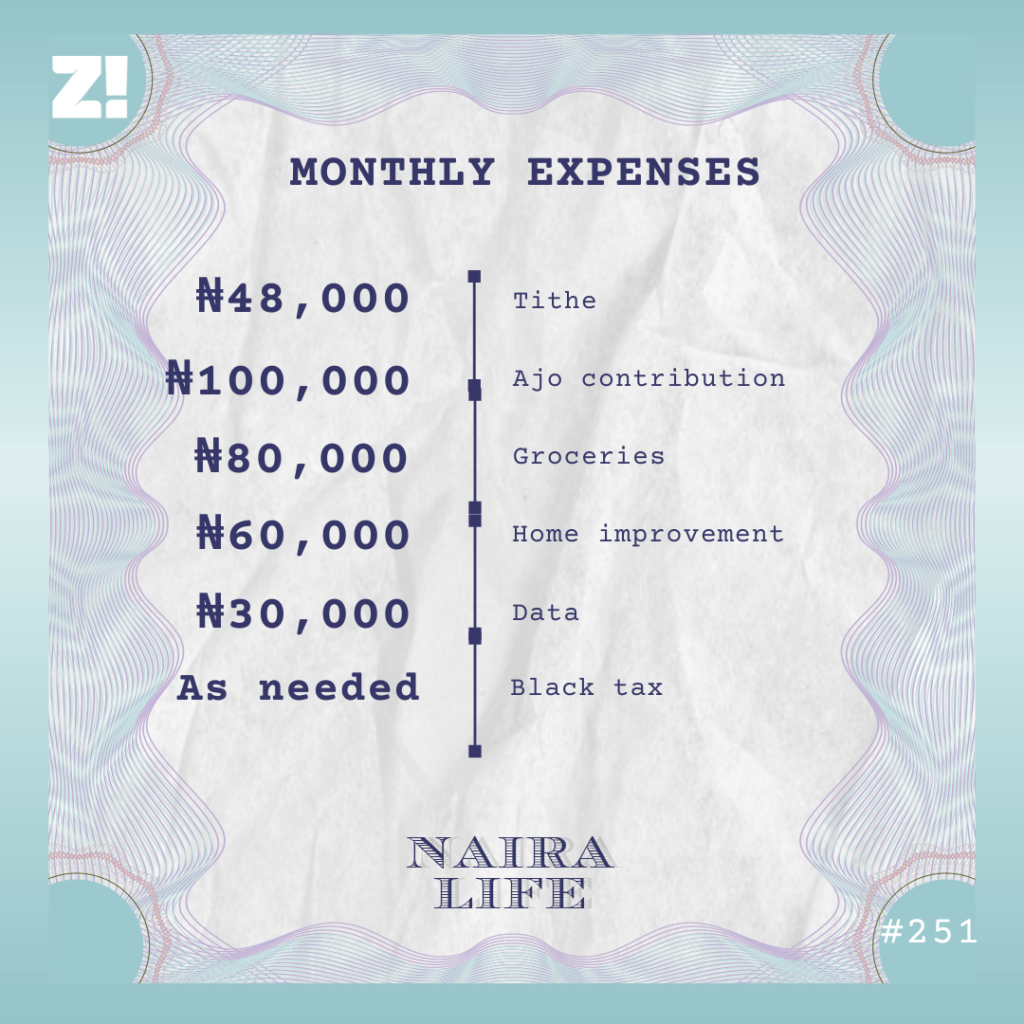
    My husband and I operate a joint money system, so our expenses are made together based on our joint ₦480k monthly income. To break it down:

    Nairalife #251 Expenses

    The ajo contribution is towards the rent when it expires. Black tax isn’t regular because our parents don’t really disturb us, we just send money randomly. My brother, on the other hand, calls regularly to ask for one thing or the other

    Your income has gone from a sharp drop to a gradual increase. How has this impacted your perspective on money?

    When you start a career with that much money, you don’t really think of it going away. I always thought it was just going to get better. It’s why I hardly spent on myself. I thought I was sacrificing my right now for a better tomorrow. But it didn’t turn out like that. Honestly, it was so depressing.

    Now, I try to consciously spend on myself and buy things I like. Because who did all that saving help? I don’t have anything to show for all my hard work. On top of that, I had to start my career again, pretending like I hadn’t made good money before. It is what it is. I just have to keep moving forward and keep finding better opportunities.

    Is there something you wish you could be better at financially?

    Balancing side gigs. I’ve realised that I’m not very good with splitting my focus, but that’s what most people are doing to augment their incomes. On the other hand, maybe I just need to get my money up by finding a job that pays really well. Business isn’t an option, because I’m not good at it. I just need to find better opportunities; I can’t do anything else for money. 

    What’s an ideal figure you think you should be earning?

    ₦750k/month. I want my one-month salary to comfortably pay my rent without thinking about what’s happening next, or how to plan to make it happen.

    Is there anything you want right now but can’t afford?

    Definitely a car. I’m a soft babe, and jumping buses make my life miserable. If I take public transport two days in a row, I’ll fall ill. When I first started considering it last year, it was around ₦1.8m for a simple Corolla. Obviously, ₦1.8m can’t buy anything now, so let me just focus on getting my money up.

    What’s one thing you bought recently that’s improved the quality of your life?

    We got an inverter as a wedding gift and paid ₦20k for installations a few months after we got married, and it’s made our lives easier. We hardly spend on fuel.

    How would you rate your financial happiness on a scale of 1-10?

    2. I’m not happy. I think about all the things I want to do, but I can’t afford them. If I wasn’t thinking about them, it’d probably be a 6. My day-to-day life is pretty good, and I have the essentials. But there’s still a lot I need to make my life easier. If I want to leave the country now, ₦300k salary can’t do that, so I don’t even think about it.


    If you’re interested in talking about your Naira Life story, this is a good place to start.

    Find all the past Naira Life stories here.

    [ad][/ad]

  • The Nigerian experience is physical, emotional, and sometimes international. No one knows it better than our features on #TheAbroadLife, a series where we detail and explore Nigerian experiences while living abroad.

    Today, we are doing things a little bit differently. Instead of discussing the Japa experience for Nigerians in other countries, we will touch more deeply on why some Nigerians moved back home from abroad and why anyone in the diaspora might consider returning to Nigeria. 

    Just think of it like the usual “Japa” move,

    The inspiration for this article came from a viral tweet that one of my editors spotted and tagged me on. 

    A marriage therapist, Shamseddin Giwa, shared the story of his previous life abroad and how he and his wife could barely make a sustainable income. This forced the couple to return to Nigeria.

    Many Nigerians received the story with lots of scepticism and speculation that they left due to “illegal migration.” It was unbelievable for many people. How could anyone make such a decision with Nigeria’s economy crumbling day and night?

    On this table, amidst the ongoing debates on social media, illegal migration isn’t always the sole reason for anyone to return to their homeland, Nigeria. There are myriad reasons behind such decisions. To gain a better sense of this decision, six Nigerians who previously lived abroad but have now chosen to reside in Nigeria share their motivations for relocating.

    “I had issues with European culture and racism”

    Bayo*, an entrepreneur, didn’t experience the stress of European culture and racism while seeking a Master’s degree as a student in Italy. His once cordial relationship with white people changed after graduation due to his lifestyle upgrade through internships. 

    “After I started to make money from my internships and look nice, I started experiencing racism. My neighbours harassed me and, at one point, even involved the police in minor incidents. For the average Nigerian, every day as an immigrant is stressful,” he shares.

    Bayo moved back to Nigeria in 2020, and he has never regretted his choice. He has made “five times the income” he made in Italy, has gained more job opportunities, and describes his lifestyle as “feeling like a king in my own country.”

    “My mother’s ill health drove me back to Nigeria”

    Even though Dele and Dante relocated to Nigeria from the UK in 2011 and 2018, respectively, they have one thing in common about their relocation stories—their mothers. Dante’s mom fell ill, and Dele’s mom passed on.

    But the one difference they have, however, is their feelings about relocation. Dante, a software engineer, hates that he moved, while Dele, a business development expert, has never regretted it because he is doing “way better financially” than the friends he left behind.

    “I would still have been in the UK if not for my mother’s health. Life there was cool, and there were no worries. I miss the job opportunities and friends I’ve left behind,” Dante shares. 

    Dele is also of the opinion that Japa is only for “economic survival” and that most Nigerians only travel to “gain exposure and enhance their skillset”, not to reside there permanently.

    “I came back to Nigeria because of the conflict in Sudan”

    In April 2023, John* was among the many Nigerian students in Sudan who had to be immediately evacuated due to the conflict in the nation’s capital, Khartoum, and the Darfur region. 

    But even though he is grateful for life, John hates that his education has come to an unprecedented halt since he arrived. “I’m doing nothing at home and haven’t finished my studies yet. And I’m currently finding it difficult to get admission as a transfer student,” he complains.

    “My dreams of becoming a diplomat can be fulfilled here in Nigeria”

    For many Nigerians, they see the Abroad Life as a means of fulfilling their dreams. But not for a recent graduate, Osione. Moving to Nigeria after living in the UK, Switzerland, and Australia is one step towards her long-term goal of becoming a UN Ambassador or diplomat.

    She sees this move as important because of “the connection one needs to have with his or her home country” before becoming a diplomat.

    Does she regret relocating? Not in any way. She is determined to stay.

    According to Osione, “Nigeria can be a hard country to live in and find job opportunities in, but nothing will deter me from my long-term goal of an international diplomacy career. If I want to achieve this, I have to stay.”

    “I left Ireland because of COVID”

    Peter* was halfway through the final year of his undergraduate degree in Ireland when the pandemic struck. As a result, he had to leave Ireland in March 2020 and only go back to school a few months later to finish his degree.

    After graduating in 2021, he never returned to Ireland, and he doesn’t see the need to.

    “I didn’t plan to work or live there,” Peter shares. “I have more family in Nigeria, and I am more comfortable here with my enterprises and accounting career. In Nigeria, if you find the opportunity to be who you want, it’s not as difficult to live here, unlike living an immigrant life abroad.”

  • You say you’re ready to japa, but do you even know the type of immigration plan suited for you? Well, Citizen is here to give you the answer.

    P.S: You can gain more insight by reading this article on UK student visas.


  • In January, I packed two bags, hired a cab for ₦110k and moved to Cotonou with a friend. We’d had a couple of rough months and needed a break from Lagos.
    Lagos wasn’t a city interested in my needs. I needed electricity, it gave me an anorexic power grid. I asked for an apartment close to work, and I lost my rented apartment to new house owners. Lagos was like a lover who ghosted once you started to want things. I needed better. Enter Cotonou.

    ​​
    I would’ve gone anywhere – as long as I had electricity and the air was cleaner. But I chose Cotonou because it was four hours away by bus and I could finally use my dusty passport. 

    Cotonou offered me three things in the first week we moved: 24/7 electricity, a clean city, thanks to cleaners who wiped the city at 2 a.m., and an apartment by the beach for the same price you’d get a boxy mini flat in the heart of Lagos mainland. 

    At a party, weeks later, when I explained this to a new friend who asked why I was in her city, she contemplated my analysis for a few seconds, then said, “Nigerians used to come to Benin Republic for trade or school… now they just come.”

    It was my turn to contemplate. She wasn’t wrong. Nigerians at Dantokpa market, the biggest market in West Africa, may have settled in Cotonou for trade, but I’d learnt about a growing community of Nigerians with mostly flexible jobs, who, like me, had just come. What were their reasons? How did they decide?

    Jite, a friend of mine, is one of these Nigerians. She’d spent her 20s in Awka and Nnewi, and loved their “small-townness”. Cotonou reminded her of those places. Friendly, quiet, with a passion to do very little.

    “That jet feeling you get in busy cities doesn’t exist. If you go buy something and they don’t have change, you better just stay and wait. If the woman selling fruits has three people buying something, she’d attend to each person one after the other, not at the same time. Everyone is fine with that.” 

    During a five-minute stroll the evening I arrived, she told me to tone down my “Lagosness”. We’d been tearing through the street as though we were being chased, and she’d realised she was starting to pant. We laughed about it.

    In her late 30s, Jite’s priority was peace of mind. Since 2020, before the move to Cotonou, Jite had been considering moving out of Nigeria. She, however, knew she didn’t want to move to a “white people country”.

    EndSARS, the protest against police brutality was the trigger. “Something broke in me,” she said. She’d been a managing editor at a publication in Lagos for three years, and she quit. Six months later, she was in Cotonou for a friend’s birthday party, where she fell in love with the city. When she did make the move, she settled in quickly. 

    Networks

    To enjoy a city, you need to understand how it works, and Jite had lived in Cotonou long enough to build a network. She had a guy and hack for everything. A guy for changing money into her Mobile Money (MoMo) account, which she used for transactions in shops on the streets; she knew what fruit seller spoke Yoruba, the fastest way to get to Lagos and back, how much internet data would last the month (25k, 75gb unlimited, the data cap lasts two weeks at best). 

    In my first week, Jite pointed out places and people I should know to have a good time: Her group of friends with whom she met once a month and checked out new places with, KaleBasse for the sensual, soft, Kizomba classes (we never went), the restaurant by the beach with tasty Bissap and a grilled Barracuda that melted in your mouth. She reminded me not to dress like a hippie when we prepped for a night at the hotel rooftop where a Nigerian singer named Gracia hosted live sets. “If you are black, you need to look wealthy in certain places to avoid disrespect.”

    Loneliness is a byproduct of relocation, and people find moving to new cities or countries difficult because of the distance it creates between loved ones. When I asked Jite how she stays connected to her friends and family in Lagos, she told me she saw them more now than when she was in Lagos. 

    Since Jite started as a comms manager in a hybrid company in February 2022,  she has visited Lagos once a month; she only has to be at the office once a month, so she takes a boat ride from Porto-Novo to CMS. The trip is two and a half hours. On these trips, she visits her mum and friends. 

    On our first night at the hotel rooftop, Jite introduced me to Ade, and the first thing I noted was that he spoke French to the waiter when he ordered a Mojito. For a second, I wondered if I could trust Cotonou bartenders with a glass of Moji baby, but I gestured for a Beninoise instead. As we drank and listened to Gracia belt Adele songs, he told me he’d lived in Cotonou for three years and knows the best spots. I’d meet Ade at various times in the following weeks. Twice at Jite’s for an evening of enjoying her meals and once at Erevan, the biggest supermarket in Cotonou. On one of those meets, we planned to visit one of his favourite spots: La Pirogue.

    27-year-old Ade didn’t find settling into a new place with no friends as simple as Jite. Born in Shomolu to a strict dad who didn’t allow him to spend the night at anyone’s house – friend or family — he was shocked by his decision to move to a new city. He’d visited Cotonou for a short trip, a four-day work retreat in September 2021, and on his first night, he fell for the city.

    “The time was 11 p.m. and everywhere was alive. I got to learn about the culture. For example, how it’s completely normal to have kids before getting married.”

    Ade wasn’t averse to big decisions. He dropped out of the University of Ilorin in 2016 because he hated his course, taught himself to create websites with a friend’s laptop, and started an unsuccessful coaching business. Moving to Cotonou would be the fourth biggest decision in his life. 

    When I asked why he came, his reason was that he felt alive in Cotonou.

    “I remember the moment I decided to move. I returned for another work retreat in December and found myself extending my trip. It was supposed to be for a weekend, but I stayed for two weeks. One night at a Sodabi joint, I immediately texted my mum, ‘I’m moving here.’ She freaked out. Had I considered the language, people, all the barriers? I hadn’t, but I didn’t tell her this. In fact, I had just paid rent for my apartment in Lagos.”

    Where to live in Cotonou was easy to figure out. His boss ran their office in his home, and there was space for Ade. But the next three months tested him.

    Building new communities

    The idea of moving to a new city comes with the daydream of choices unaffected by previous folly. Everything is fresh, exes are not one Friday night-out away from tearing open new wounds and the prospect of getting to know yourself some more is electrifying.

    You meet new people, find new spots. There are decisions to be made about everything from your hair salon down to your biscuits. 

    In reality, all of this was work, hard mental work that Ade, who hadn’t stayed longer than two weeks in a different country, was unprepared for.

    “My first week was great. I was excited, checking out everywhere, taking pictures of everything. Second week was also great. I was working with my colleagues face-to-face as opposed to using virtual conferencing tools. From the third week, I started struggling.

    “I realised I had to make new habits. If I felt low or had to talk, who would I go to? Living at work also didn’t help me. Even when I was done with work, it felt like I was still at work — the office was four doors away from mine.”

    The skill that proved most useful to Ade was his ability to just get into things. Just like he decided to move after a shot of hard liquor, once he knew he had to learn French, he spent time outside till it made sense; he wanted to try new food, so he did.

    “I’d jump on a bike and tell him to move. He’d be like, “Quel quartier?” I’d say just go. If I saw a place with a lot of light, I stopped.

    “Paying attention to how places made me feel also helped. I found Luxury Lounge, the beach restaurant that helps me when I’m feeling overwhelmed. I also made friends to help me with my struggles here. They have context about how the people here are like and can give me contextual advice when I need help.”

    In three years, Ade now had a network of Nigerian friends he met at places like Jite’s rooftop, friends from work and an aunt he found had also moved to Cotonou. These people, finding new places to visit and work keep him grounded. It took Ade about a year to settle fully into Cotonou. 


    When Life Gives You A Beninoise Passport 

    27-year-old Eli was born in Cotonou and moved to Nigeria when his dad’s trading business started to fail. We were eating bowls of ice cream from Ci Gusta, the best ice cream spot in Cotonou when he told me about his parents, a dad who moved to Cotonou in the mid-80s to expand his business and a mum who moved with his dad to build a family. Eli’s voice was soft and measured, unlike mine which was loud, competing with the music playing above us. 

    Eli’s dad left his import-export business in Abia, a state in South Eastern Nigeria when the Benin Republic opened its ports in the mid-80s. This is the story Eli was told to explain his Beninoise passport. His dad imported fabric from Gabon to Benin Republic, then exported them from Benin to the Netherlands. His business grew, and he built a house. He switched to importing clothes, towels, and fabric from Europe and selling them in Benin. When Eli was two, they moved to Lagos, and a year later, his dad was back in Abia State to continue his business. 

    “It was too late to be ‘Nigerian’. I was already in love with Cotonou,” Eli told me. He was back at the Cotonou house every school break, and once done with secondary school, he decided it was time to return. Eli had a plan. 

    “I told my mum we should come back, and she agreed. She also missed the calmness of Benin, and we still had a house. She moved back with me.”

    Eli loved the city and the opportunities his passport affords him. “It’s very easy to get admission into universities here. Once you have 5 C’s in your O’Levels, you pay for a form, fill it, and you’re in. The quality of education is good, but the discipline is poor. No one will tell you to attend classes or punish you for not attending. So the bright students are very bright and the dull students are very dull. It’s entirely up to the students to succeed.

    “I was a serious student. I studied Economics, and now I want to do a Masters in Social Work. I’m trying to transition because I want to travel. I’d like to do social work in a clinical setting, vulnerable people – giving care to people who need it. I’m working in a clinic now so I can do that.”

    Johnny Just Come

    Most Nigerians I met in Cotonou are fond of Jite, and that’s because she’d either convinced them to move down or they tasted her cooking. Jite hosts a once-in-a-while hang-out on the rooftop of her house. I’m eating yam and palm oil sauce on this rooftop when I meet Runor, who’d been in Cotonou for three months and was house hunting. He told me he came for the quiet.

    Runor preferred not to think about Lagos, where he ran his generator daily because his apartment belonged to the section of his estate with low current electricity, and he had to pump the entire compound’s water daily because no one else would do it.

    From him, I found out how much it cost to get a place. “The way these people build their houses can be very funny.” We watched a video of an apartment where the restrooms are outside and there’s no roof from the living room’s door to it. “What if it rains?” He bends his mouth in disapproval, but his forehead isn’t creased. It’s almost like he’s been enjoying the hunt. Runor knew he was very picky, and also knew that was a privilege he could only have in this city.


    “I found a 2-bed with a small bathroom for CFA 85k. I found a two-bedroom place with a balcony. It costs CFA 20k per month. CFA 1.4m a year. One agent sent me a 3-bedroom flat for the same ₦120k. They showed me a one-bedroom with the toilet and kitchen in the same space, so I don’t ask for a one-bedroom again.”

    At the time, CFA 1k was changing for ₦850 at Ajali, Dantokpa market area.

    Runor was waiting to settle down to really experience the city, and with the options he found weekly, he’d be ready soon. 


    There are many reasons to enjoy Cotonou during a two-day work retreat, a month or three years. Everywhere is 20 minutes away, there’s 24-hour electricity, and close to the airport is an Amazonian statue I never visit because what if it falls on me?

     For me, it’s my apartment.

    My apartment is a two-storey white building which houses tenants I don’t hear or see. Security is a man in his late forties with whom I practise my bonjour, bonsoir, a demain. Francis is also the cleaner, gardener, and upholsterer of things.

    He tries to teach me basic French, and I fail most times.

    “Bonsoir madame, ça va?”
    “Bonsoir…”
    “No no. You say “ça va bien, merci. Et tu?”

    I repeat, and I’m rewarded with a smile, then disinterest. I cannot bear to fail him.

    Two months of this, and I still stutter between je vais bien and ça va bien, et tu and et toi. I’ve been religious with Duolingo, but tongue-tied in actual conversation. I know what it means to be happy — contente — but have no idea what conversation would lead to me saying I was happy, and if anyone would be kind enough to place one word after the other so I could follow. Very unlike the Duolingo owl, I chicken out.

    In the middle of March, a week after Nigeria’s gubernatorial elections, we have a soiree on Sunday evening. There’s poetry, clinking glasses filled with zobo wine, a charcuterie board by Lara, my landlady; and art installations to mull over. Runor tells me he’s found a place. My struggles feel a globe away, even though I could get to them in four hours by road and two and half by boat. 

    I contemplate the people in the room, some here to fill or assuage something, each looking for a sense of balance or just a space to dream — a space that fosters dreams. I wonder how long it’d last, how long just until the stain of being Nigerian became a difficulty they had to contend with even here. We focus on the lull of the beach, Dwin the Stoic’s “God Knows Where”. Now is not the time for wondering; it’s for being contente.


    Do you have a story about Nigerian communities around the world? You can contribute to this series. Click here for our guidelines.

  • Do you move mad like Nigerian banks or have terrible mood swings like network providers?

  • Before you dream too much about your japa plans, you should know there’s such a thing as a visa interview, which determines if your japa dream will become a reality.

    In other words, you can do everything right, but your village people can still jam you at the interview. Not on our watch, though. Take note of these clever answers to all the most-asked questions.

    “Have you been to this country before?”

    Yes, I have, actually. In my dreams. That’s why I’m here to make my dreams a reality. Please, help me.

    “What will you do if you run out of money there?

    Nigeria has taught me how to hustle. I run out of money here, so it’s nothing new. I also like fasting. It’s my best hobby.

    “Do you have health insurance for this journey?”

    I don’t really used to fall sick like that. 

    “How long do you plan to stay?”

    As long as God is on the throne. Besides, only God knows my tomorrow.

    “Do you currently have relatives or friends in this country?”

    I can make friends easily. Don’t even worry.


    RELATED: If Your Friend Is Doing Any of These 10 Things, They’re Going to Japa Without Telling You


    “Can you show us your bank statement?”

    See, officer, I don’t want to offend you by showing you something that’ll spoil your mood. Let’s just be thanking God for life.

    “Why do you want to leave your country?”

    Shey you dey whine me ni? I love your sense of humour, officer.

    “What do you do for a living?”

    I wake up every day determined to leave this country. My japa dream is all I live for.

    “Who will take care of your properties in Nigeria while you’re away?”

    It’s someone who has properties that’ll be thinking that one. Just let me go, make money and come back first.

    What’s your opinion of this country?

    I know my destiny helpers are there. Just let me pass.


    NEXT READ: 8 Ways to Let Your Enemies Know You’ve Japa’d

  • The japa wave out of Nigeria is making doctors become as scarce as uninterrupted power supply. Many doctors have seen the benefits of working overseas and refuse to stay and fight sapa in Nigeria

    Even though we can’t blame anyone for wanting to earn their daily $2k, the japa wave of doctors is really causing a serious problem for Nigerians.

    How bad is Nigeria’s doctor problem?

    Let’s break it down in numbers. 

    An estimated 217 million people live in Nigeria and they’re all likely to need medical attention at some point. According to the President of the Nigerian Medical Association (NMA), Uche Rowland, Nigeria currently has 24,000 doctors available. This means there’s one doctor available to treat 9,083 patients. 

    But according to the World Health Organization, a country should have a ratio of one doctor to 600 people for their medical needs. Going by this recommendation, Nigeria needs at least 363,000 additional doctors in the country.

    Excluding witch doctors

    According to Rowland, there are some states in the southern region where there’s only one doctor available to treat 30,000 patients. The situation is even worse in some northern states where there’s only one doctor available to 45,000 patients.

    He said, “In some rural areas, patients have to travel more than 30 kilometres from their abodes to get medical attention where available thus making access to healthcare a rarity.”

    Nigerian doctors are rushing for the door

    Even though Nigeria needs more doctors practicing in the country, the ones we already have are looking for work everywhere else. A 2017 survey by NOI Polls revealed that about 88% of medical doctors in Nigeria were seeking work opportunities abroad at the time. 

    In January 2022, the Medical and Dental Consultants Association of Nigeria (MDCAN) said more than 100 of its members left Nigeria within 24 months. A 2022 UK immigration report also showed that 13,609 Nigerian healthcare workers got working visas in the past year, making the country second only to India with 42,966 healthcare workers.

    Who will make it stop?

    Nigeria faces an existential crisis with the japa wave of doctors. As the country grows in population, more healthcare professionals are needed. The government needs to act fast with favourable policies that’ll make practicing in the country attractive to doctors. 

    We know our leaders can jump on a plane and run abroad for their medical needs but regular Nigerians deserve access to care too.

  • It kinda feels like the migration gates have been thrown open, and folks are jumping on flights like it’s the last bus to Owerri Main Market on a rainy Friday.

    If you’re also planning (or just hoping) to leave the country, you should have these in mind.

    The passport office is a scam, and airport staff will tax you

    Timilehin, 19

    My passport expired while I was in secondary school, so I needed to get a new one for university abroad. I got to know from my mum that the passport office had this system where people were divided into two — priority list, and those they don’t give a fuck about.

    Luckily, my parents knew someone at the office, so we were bumped up. I know so many people who had to turn down admissions because they couldn’t get their passports. It’s crazy.

    Also, please don’t be seen carrying money up and down at the airport. I left in 2021 but was naive and held dollars openly while trying to check in, and all the customs guys were like, “Drop something for us nau.” Guy, I’m literally your child’s age mate.

    Be well informed ahead of your flight

    Lara, 25

    I left Nigeria in 2021, and this was around the time when COVID-19 was still serious-ish. I had gotten a negative test one week before my departure and assumed I was good to go.

    Imagine my shock when I got to the airport and learnt the negative test had to be done 48 hours before my flight. To cut the story short, immigration delayed me for a while, and I had to pay (almost double what I paid for my previous test) to get tested again, plus the tips I had to give the airport guys to help me make sure I didn’t miss my flight. I still had to quarantine when I arrived at my destination.

    Always ask questions while planning; don’t let the fear of village people make you keep everything to yourself, only to end up spending extra like I did.


    RELATED: How to Japa: Migrating From Nigeria


    Prepare to be delayed

    Wole, 24

    Especially if you’re carrying loads of foodstuff and luggage. I moved to the US in 2019 for my master’s degree. Trust Nigerian mothers, my mum loaded me with foodstuffs sufficient to open a mini Walmart in Texas.

    Although we correctly labelled everything and packed everything like our folks abroad had advised us to, these immigration guys delayed us by checking every single thing. Thankfully, my mum made sure I arrived the airport four hours before my flight. If not, I would have cried.

    If you’re carrying a lot, make sure to make ample time for any kind of delay.

    Corruption is very alive

    Chichi, 28

    I left the country in 2021, and listen, while I’m all for not pushing certain stereotypes, please still hold cash when dealing with immigration.

    I had done the whole passport application process myself online. I remember it was ₦17,500, and all I needed to do afterwards was go to a passport office for my interview and other biometrics. It was supposed to be really straightforward.

    Spoiler alert, it wasn’t. I had to pay an officer ₦12,000 extra to “release” the passport. That’s not all. On the day I was leaving, the immigration guys at the airport kept asking me to “bless them”. Be ready to drop something small, so you don’t get delayed unnecessarily.

    Start processing your passport six months ahead

    Imelda, 30

    In a sane world, getting your passport shouldn’t take more than two weeks after completing biometrics and other requirements. But when my mum had to visit me in New Jersey around 2021 to help with my newborn, we saw hell. We had foreseen a delay, so we started the process when I was seven months pregnant. It didn’t change anything.

    My mum and siblings kept going back and forth the passport office for about five months before the passport was ready. If it wasn’t an issue with finding her details on the system, it was some information suddenly becoming incorrect. We eventually overcame, and she got here when my baby was three months old.

    The passport situation may have improved now, but always start the process early.


    NEXT READ: Not Every Time UK, Nigerians Can Visit These Countries Visa-Free