How many health-related questions can you answer correctly? Test your knowledge by taking this quiz:
-
-
Women are very intentional about who they trust with their health and quite a number of women have talked about their different encounters with male and female gynaecologists. For this piece, we asked a few Nigerian women to share their experiences with male and female gynaecologists and here’s what they had to say:Kim, 26
I have visited both male and female gynaecologists and the experience was the same with both of them. I felt comfortable enough to trust them with my body. There was no fear or judgement; both of them were kind and patiently answered all my questions.
Both visits weren’t in Nigeria. I visited the first gynaecologist in Ghana because I was experiencing irregularities with my period. A female gynaecologist attended to me on that visit to the hospital. The second visit to the gynaecologist was in Nigeria and I was attended to by a man. I was met with the same patience and kindness by both of them.
Sarah, 20
I was 12yrs old when I first visited a gynaecologist. I had menorrhagia and my mum was scared. My male gynaecologist was really nice and welcoming. I have been attended to by another male gynaecologist and he was also very nice. He also made me feel very comfortable.
I still look forward to being attended to by a female gynaecologist.
Racheal, 25
Personally, I had mostly good experiences with female doctors than I did with male doctors and I always picked female doctors over male doctors. A few years ago, I had to do a surgical abortion at a teaching hospital and chose a female gynaecologist for the procedure. She was mean to me, she insulted me and was really rough with me. I cried all through the procedure. The male gynaecologist in the room held my hand and was consoling me throughout the procedure.
She was to insert an anal antibiotic pill in my anus after the procedure, and it wasn’t a small pill. She kept shoving it forcefully into my anus without lube and tearing me up till I started to bleed from my anus. The pain was so intense I cried a lot. She continued to insult me, saying when I was enjoying the sex I didn’t cry. When she couldn’t get the pill in, she just threw it away and stormed off. A nurse helped put the pill in more gently. I couldn’t sit well on my butt for 3 days after that experience.
I was 20yrs old at the time of the procedure and the procedure was a manual vacuum aspiration.
Nora, 23
When I was 17yrs old, I found out I had appendicitis and had to go for an appendectomy. I was advised to see a gynaecologist before going in for the procedure. I was met by a male gynaecologist before proceeding with the appendectomy procedure. The visit was very uncomfortable. It was my first time seeing a male gynaecologist and having to take all my clothes off for the medical examination. Midway into the medical examination, another male gynaecologist walked in. The second gynaecologist was a student.
I was still barely dressed and on the bed when the first gynaecologist started to teach the second gynaecologist. I was obviously very uncomfortable with what was going on, but he still continued. I was hoping he was going to read my body language, but that unfortunately didn’t happen. I eventually voiced out my discomfort to him, he didn’t apologise, he even wanted more time with me to continue teaching his student.
A few years after that, I was diagnosed with PCOS and had to visit a gynaecologist again. This time, I was attended to by a female gynaecologist. She was warm and very kind. It was a far better experience than my first visit.
Kike, 18
Two of my friends got diagnosed with ovarian cysts and womb cancer within a short period of time and that prompted me to visit the gynaecologist. When I got to the gynaecologist’s office, he immediately told me to take off my clothes and underwear, lie on the bed and spread my legs. This made me very uncomfortable and the manner in which he said it was always not helping. His tone sounded very commanding and brusque. I had to lie to him that I was on my period and I was going to come back another day for the medical examination. I have not been back to his office since that day.
Tosin, 25
When I was 16yrs old, I had to go in for a pelvic ultrasound and it was done by a male gynaecologist. He was patient with me, however, he dismissed the other symptoms I complained about and reduced them to stress. A few years later, I had to visit another gynaecologist and I was diagnosed with PCOS. It was another male gynaecologist. He immediately told me to lose some weight and prescribed oral contraceptive pills. His approach also felt very dismissive. I opted for a second opinion and went to see a female gynaecologist. She was more patient, she recommended a different treatment and she shared her experience treating other women with PCOS. I felt a lot more comfortable with her and I have been hesitant to visit male gynaecologists after seeing her.
-
A Week In The Life” is a weekly Zikoko series that explores the working-class struggles of Nigerians. It captures the very spirit of what it means to hustle in Nigeria and puts you in the shoes of the subject for a week.
The subject of today’s “A Week In The Life” is an emergency room doctor at the Lagos State Accident and Emergency Center. He talks to us about the stress that comes with his job, how witnessing road accidents has made him more cautious, and the procedure for contacting emergency services in Lagos.
MONDAY:
Because everyone is rushing to beat Lagos traffic, Mondays are one of the busiest days for me. And I’m not saying this because I’m also stuck in traffic.
I start my day at 6 a.m. on most days. My routine is the same: I wake up for morning prayers, have my bath and freshen up, then I dress up.
Work resumes at 8 a.m. so I leave my house at 7 a.m. Because I work in an emergency centre, the first thing I do when I get to work is change into scrubs — a protective garment worn by healthcare professionals involved in patient care.
After that, I go to the emergency room to take over from my colleagues on the night shift. My colleagues hand over by briefing me on the history of patients on admission and treatments done so far. Somewhere between all the paperwork and catching up, my day fully starts.
On Monday, we get a lot of road traffic accidents and a high number of assault cases. Unsuspecting workers who leave their houses early to beat the traffic are sometimes attacked by hoodlums. Also, private cars and bus drivers who drive too fast in the early morning get into accidents.
My job involves resuscitating these patients and stabilising them. That is, keeping them alive long enough until they can get to a General hospital or to a specialist.
My first patient today stood out to me because he was a victim of assault. He was rushed in with a fractured skull and he had lost a lot of blood. I noted to the ambulance driver that I could only stabilise the bleeding, and he had to take the patient to LASUTH for specialist care.
After that patient, the rest of my day was a blur: stabilise this patient, repeat, stabilise that patient, repeat. Over and over again.
TUESDAY:
We get a lot of emergency cases every day and our response time is of utmost importance. When a patient enters our gate, the security personnel rings an alarm system to alert every healthcare worker in the facility to start running to the ER. You leave whatever you’re doing and run.
It takes less than two minutes to get to a patient, then treatment commences.
Before any contact with the patient, we put on our PPEs, gloves, disposable aprons, face mask and shields. Then we move to what we call initial patient evaluation and resuscitation. This follows a stepwise pattern known as A — E:
A — airway and cervical spine — spinal cord — protection
B — breathing & ventilation
C — circulation
D — disability or neurological deficit observation
E — environmental checks. You check the surroundings to eliminate any other form of injury that might have happened due to the environment.
Different doctors handle different parts of the protocol.
A: There’s a doctor whose job is to ensure that the airway is not compromised and the patient can breathe well. In addition, they also protect the cervical spine which houses the spinal cord. Protecting the spine is important because the lifting of a patient for treatment, especially after an accident, can damage important nerves connected to the diaphragm. And this can affect the supply of oxygen to the brain and heart, which can lead to death.
There’s another doctor in charge of monitoring the patient’s breathing. They ensure the patient has no injuries that can affect breathing. Then circulation where the doctor replaces body fluid of patients who are in shock due to reasons like bleeding or infection.
Finally, we check for disability and monitor the patient’s surroundings to ensure that we don’t miss anything. While all this is ongoing, the patient’s vitals like pulse rate, heart rate and oxygen level are being measured by the nurses.
Once the health team is satisfied with the patient’s stability, we then refer them for specialist management. A nurse accompanies the patient in our ambulance and hands over the patient to the new team that’ll resume management.
The best part? We do all this for free so that patients don’t have to worry about money. In an emergency, people just need to dial 121 and our ambulance will pick them up. Then our facility handles the rest.
WEDNESDAY:
Today, I’m thinking of how quickly things in the ER move from 0-100. One second you’re in your call room chilling and the next you hear the alarm ringing. And you start to run.
It can be overwhelming and demanding because you’re always on your toes. I remember being nervous on my first day of work because of the number of patients and the pace of the job. But now? I can function in my sleep.
It’s been a year since I started this job and the experience has given me self confidence. Now, I don’t panic and I never freeze.
I’ve also changed a lot since I resumed the job. I now take extra caution when driving by wearing my seat belt before leaving my house or office. I don’t drive more than 60km/h. And if I see a car speeding, I allow them to go past me.
When everyone is horning on the road, I put on my double-pointer [hazard light] and stay on one side of the lane. I let everyone overtake me because I’m not rushing anywhere.
I also don’t cross the express. If the pedestrian bridge is 30 minutes away, I’ll trek towards it and climb. I’ll also not be caught dead on a bike.
Why? I’ve seen enough road traffic accidents to last a lifetime. I know better.
We have a saying in the emergency centre: “What are you running for? Even if you go slow, you’ll still get to where you’re going.”
THURSDAY:
In this job, there’s no “off” switch that you can just turn off. The lines between home and work get blurred, especially for patients who have spent some time in the facility with us. I find myself constantly thinking about my patients even when I’m off work.
I’m happy that the Lagos state government pays the patient’s fees so we can focus on saving lives. In my experience, the delay from payment and deposit affects a patient’s chances of survival. But this way, we commence treatment quickly.
I wish there were more centres like this around the country. I also wish the health system as a whole was something to be proud of. If things worked well and doctors had equipment, maybe jaapa would reduce. I love my job, but I know it’s a bubble so I’m still making plans to leave for greener pastures.
The experience has opened my eyes to many possibilities. When I get abroad, I know that I’d like to still continue as an emergency responder. The adrenaline and fulfilment from helping patients is second to none.
But away from daydreaming to the present. We have a lot of accident cases today. But I’m not worried —with our level of care and protocols, we’re fortunate to have a low mortality rate. For that, Glory be to God.
I can’t wait to close from work in the evening and crash on my bed. I’m on the night shift tomorrow, and I need all the rest I can get. Fridays are also one of the busiest days because of TGIF accidents. But until I have to think of Friday, my plan is simple: I must survive today’s madness.
Check back every Tuesday by 9 am for more “A Week In The Life ” goodness, and if you would like to be featured or you know anyone who fits the profile, fill this form.
[donation]
-
A Week In The Life” is a weekly Zikoko series that explores the working-class struggles of Nigerians. It captures the very spirit of what it means to hustle in Nigeria and puts you in the shoes of the subject for a week.
The subject of today’s “A Week In The Life” is a community health worker. Community health workers are trained to assist the healthcare team with tasks like vaccination and all-around preventive care. Our subject talks to us about some of the challenges of the vaccination program, why vaccines can’t be sold, and how to report the side effects of the vaccine.

MONDAY:
I wake up to the sound of my alarm telling me it’s time for the fajr prayer. It’s quarter to 6 a.m., and I drag myself, slowly, out of bed to say my prayer. I’m done after 30 minutes, and my clock reads 6:15 a.m. This means I have another 45 minutes to relax my eyes.
I’m up by 7 a.m., and now my day begins — I have my bath, brush my teeth and iron. I dislike ironing. It’s such a boring task. However, every morning, I’m plagued with the burden of ironing my shirts. Thankfully, my trousers don’t need ironing. After I’m done, I polish my shoes next.
After that, breakfast. I warm up leftover food from the previous day and manage to eat very little.
Then I dress up and check the mirror. “Not looking bad,” I say to myself as I dash out of the house.
The first thing the security man says to me when I get to the hospital is “Oga, you no wear nose mask today?”
On one hand, I can’t believe I forgot something so important. On the other hand, it’s understandable because fatigue has set in from wearing masks all the time. I make a mental note to get a mask when I settle in at work.
At 9:00 a.m. the vaccination exercise for the day kicks off. The crowd controller and person in charge of orientation address the crowd on what to expect from the exercise. After they’re done, we start attending to patients. Patients fall under two main groups — people who registered online and have a vaccination I.D. And patients who haven’t registered before and have to be manually registered.
My process typically goes: see if the patient has registered online. If yes, verify their details and proceed to administer the vaccine. If not, register them manually [this takes time], verify information and administer the vaccine. After injecting them, I counsel the patients on expected side effects and monitor them for about 10 – 15 minutes. While monitoring the patient, I also look at my adverse effects kit — which contains stimulants and steroids — in case of any untoward reaction.
I rinse and repeat this process until 4 p.m. when we’re done administering vaccines for the day.
At the end of each vaccination day, we hold accountability meetings where we reconcile the number of patients seen with the vials of vaccines used. We also take feedback and observations from the regulatory bodies on how to improve the whole process for the next day.
These meetings take nothing less than three hours to conclude.
Monday meetings are longer than usual, so I’m preparing my mind. I know that no matter what happens, I’ll leave the hospital by 7:30 p.m. I can’t wait to get home, complete my solats and jump into my favourite place in the world — my bed.
TUESDAY:
I have some “free” time during lunch break at work, so I spend today reminiscing about all the drama surrounding the vaccination exercise.
On the first day of the exercise, we prepared to receive 600 people in my LGA, and only 70 – 100 people showed up. This was hilarious because, in anticipation of a large crowd, the hospital brought in armed police escorts to prevent vaccine theft and to ensure the safety of health workers.
There was also the challenge of misinformation among health workers. It was difficult convincing some of my colleagues who had undergone the vaccination training to take the vaccines. After all we were taught, some of them simply did not trust the safety of the vaccine.
Lastly, there were people who wanted the vaccination card and not the vaccine itself. Their reason was that since the cards were computerised and had barcodes, it was for international purposes and this could help them get travel visas easily. This was funny to hear.
Lunch break is over by the time I snap out of my daydreams. When I get back to my duty post, there are patients waiting for me. The first patient is uncooperative and starts to shake before even seeing the injection. I spend a few minutes reassuring them that it’s a relatively painless process, but they don’t believe me. From their behaviour, I can tell that we’re going to be here for a very long time.
WEDNESDAY:
Today, I’m tired. I’m tired of one person vaccinating as many as fifty people because of the shortage of manpower. I’m fagged out by the long ass review meetings at the end of each day. More importantly, I’m stressed from constantly explaining to people that the main aim of the vaccine is to reduce the mortality rate from the Covid-19 virus and that until the second dose is administered, they should continue safety precautions like hand washing and wearing of nose masks.
I’m also tired of working long hours every day. I just want to be soft in peace.
But even in the tiredness, we move. That’s why I drag myself to have my bath and prepare for work.
At work, the NAFDAC team in charge of monitoring reactions to the vaccine is around. They’re educating people on the types — serious and non-serious — of reactions common with the vaccine. The non-serious drug reaction includes chills, mild fever, headache, pain at the injection site and weakness. The serious drug reaction reactions include anaphylactic shock, fainting, seizures, arm paralysis.
The NAFDAC team also spends some time educating people on steps to take to report any adverse reaction. This information has gingered some of my colleagues who have been sceptical about the vaccine. On our healthcare worker’s WhatsApp group, we all make plans to get our vaccines tomorrow.
THURSDAY:
I’m lowkey scared of needles but the question is, who isn’t? I’m excited to get vaccinated today, and I’ve prepared myself on what to expect.
9:30 a.m.: Took the vaccine. I kept on asking about the potency of the vaccine which made my colleagues laugh. In their words, “You’ve never worried about potency since you’ve been administering it on others, so why are you asking now?” We all laughed.
2:00 p.m.: Experienced chills and took two tablets of paracetamol to counter it. It’s not me that side effects will kill.
4:00 p.m.: Reported the chills side effects to the pharmacovigilance team of NAFDAC to help them in data collation.
7:30 p.m: Got home, prayed my solats, and did a video call with my girlfriend, the love of my life.
11:00 p.m.: Slept off in order to be properly recharged for another day on the capitalist treadmill.
FRIDAY:
I’ll be the first person to admit that the vaccination process is not perfect. There are holdups and limitations that slow down the process — system downtime, website crashes, etc. However, one thing I can vouch for is the vaccines are stored in a way that they can’t be resold by health workers.
The value chain of a vaccine is that it comes from the Oshodi central cold store to the local government’s cold store. Before vaccines leave the LGA’s cold store, it passes through a cold chain officer who distributes a realistic amount of vaccines sufficient for a team. At the end of the vaccination exercise, the empty vaccine vials are returned to this officer alongside the name and number of patients seen. After that, the cards bearing the patients names are collected and the barcodes are scanned to confirm the existence of these patients. Additionally, the number of syringes used and disposed of will be tallied against the number of vials used and patients administered.
Also, every LGA team has three supervisors who constantly monitor the vaccination activities for discrepancies. Because of how tightly controlled the process is, the highest that can happen is people paying others to help them jump a queue.
I start my day by giving a version of this speech to someone accusing health workers of selling vaccines to patients. After I’m done with my long explanation, I have a slight headache and I go to lie down.
I’m thinking about a future when I’ll move from the stress of fieldwork to a management role. I’m also thinking that the weekend is here, so I can finally rest. My plan this weekend is simple: sleep all through and be free from the world and all its stressors.
Check back every Tuesday by 9 am for more “A Week In The Life ” goodness, and if you would like to be featured or you know anyone who fits the profile, fill this form.
[donation]
-
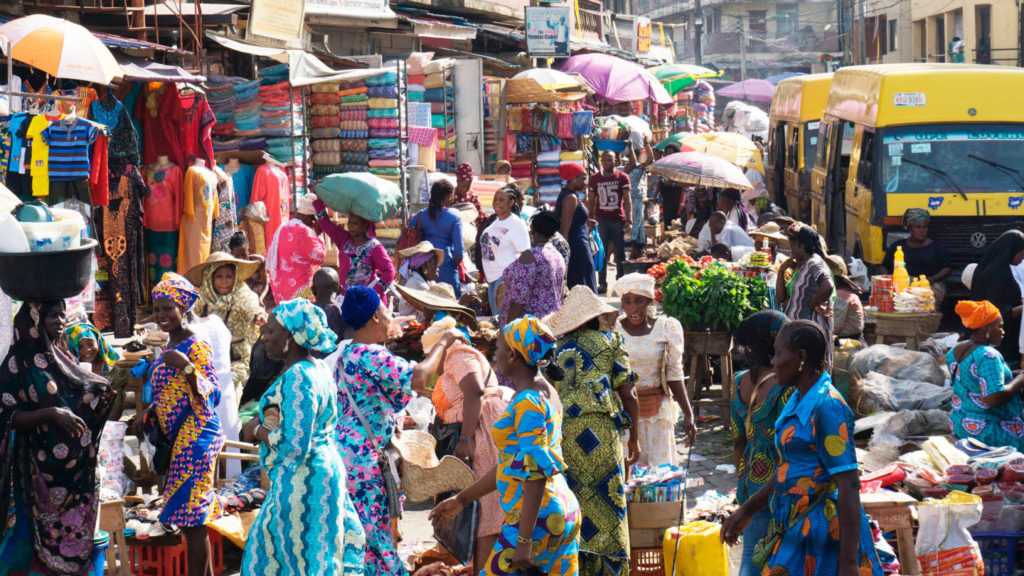
How would it feel to have access to free healthcare, especially as a woman in the informal sector? For this article, we spoke to 5 Nigerian women who shared with us the challenges they face with work in the informal sector, and the need for free healthcare to make things easier for them.
*Mrs. Olujimi.
I sell shoes in a very busy market. To make as many sales as I can, I have to be up as early as 6 or 7 AM. It is a fast life, and also very full of stress. I sit in the open space to call out to passers-by who might be potential buyers. I have to jostle with other competitors too.
This spot isn’t convenient for me. The weather isn’t always favourable, and when you add this to the daily stress of stocking the shoes, waking up early to go to my spot in the market, shouting to beckon customers, the effects on my health can be a lot. I believe that healthcare can go a long way to make a difference.
Ijeoma.
My name is Ijeoma. I sell fabric. Adire and George are the major ones I often stock. For me, I open my shop by 7:30 in the morning. The display of the fabric is what takes all the time. Because of the large sizes, it can take me up to two hours to display all the fabrics.
While displaying, I often force fabrics into the display space to allow for more room. As a result of this, I have a lot of problems with my right arm. The pain slows me down when it hits. It is annoying, stressful, and when it happens, I cannot work at my full capacity. Having access to affordable healthcare will make a difference for me.
Mama Habeeb.
Food is my own business here. Every morning, I cook rice, beans, and spaghetti. I fry plantains, prepare a stew with meat, fish, eggs, and ponmo, then, I head to the market to sell.
It’s hard work. Cooking, dishing, and trying to ensure I make a profit. And yes, there are health issues too. Especially with my hands — they do all the job, so they are bound to complain. But then, what choice do I have? I have to press on. You go to the hospital, they charge you for tests and drugs. And it’s not like I can choose to buy just any drugs without getting tested to know what is wrong with me. I need better healthcare, but when the money is not available for it, what will I do? Me I have left it to God.
Mrs. Linda.
My trade requires a lot of moving around. I leave the house around 5am to go buy the soup items I’ll sell that day. After buying, I return home to rest briefly and shower before I prepare for the day’s business at the market.
Falling sick is a major worry because of the stress. The last time I fell sick, I know how much I spent. I wanted to get well quickly, so my business would not suffer it. My children are young and they go to school, so I had nobody to stay in my market spot for me. Despite how sick I was, I had to come to the market so I could raise money for my own treatment. It wasn’t a very great experience.
Osas.
My day begins with me arranging shoes on the display rack. The quality and beauty of the shoes displayed are what attract potential buyers to stop by and check out the other things we have on the rack. Sometimes, we have to persuade them. Customers need convincing before they buy and you have to be ready to do it when the situation calls for it, which is everytime.
Hustling is what I do. It is what we all do. And even though we don’t plan for it, sickness is definitely going to happen. When it comes, either you have money to go to a hospital or you have to treat yourself. Ordinary drip that you’ll call a nurse to come and give you sharp-sharp, it can cost you N5,000 in the blink of an eye. How does one account for that?
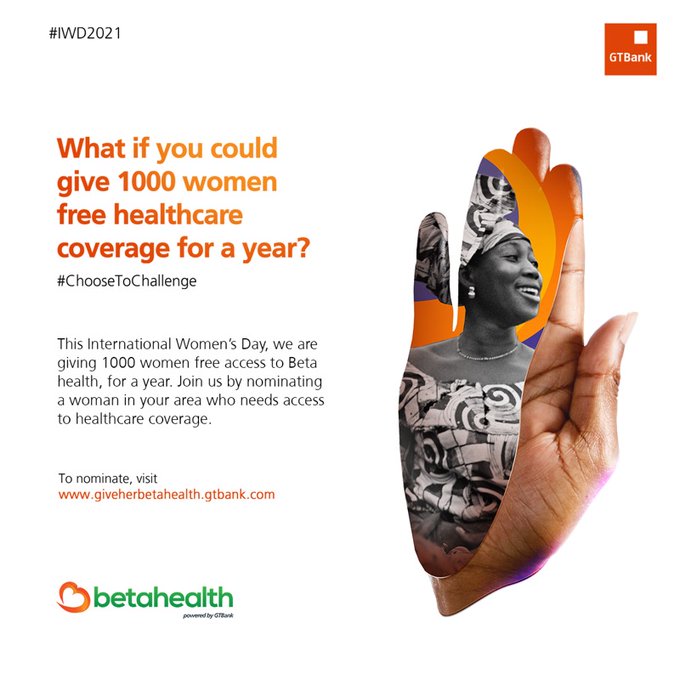
Did you know you can nominate a woman in your area to receive access to healthcare coverage?
To celebrate International Women’s Day 2021, GTBank is giving 1000 women in the informal sector free access to healthcare coverage. Here’s how you can be a part of this:
More details below.
*Names have been changed.
*Interviews have been edited and condensed for clarity.
-
It’s no news that the healthcare system in Nigeria is in shambles. Patients often complain of negligence, lack of resources or wrong and expensive treatment plans. In this article, I spoke to five Nigerian women about their experience receiving health care in Nigeria.
Dami, 19
When I was 16, I kept having these unbearable stomach aches, so I went to the hospital to get tests done. My mum went with me that day but when I went to get the results, I was alone.
The doctor said I had an ulcer and urinary tract infection. He kept complimenting me, which I thought was weird. He asked if I smoked or drank and the last time I had sex. I told him I wasn’t sexually active, he said he didn’t believe me and he could check if I was lying. He came closer and started touching me. He said we could go into the theatre and he’d insert something in my vagina to check if my hymen was still intact. I felt like throwing up. I can’t remember the excuse I gave, but I left without even collecting my drugs.
The next time I went back, I begged a friend to follow me. After that day, I went to register in a new hospital. They’re quite professional here, and I feel comfortable going to see my doctor.
Tife, 38
During NYSC, I had an infection but the lady I was with at the time didn’t so I went to see a doctor. He said I should come with my sex partner for him to be treated too. At this point, he had not run a test, so he didn’t know what kind of infection it was but he assumed it was sexually transmitted.
I told him I didn’t have a sexual partner. Of course, he felt I was lying. He did the test, and it was not an STI. He gave me the news, and he didn’t even feel the need to apologize for his assumptions.
Jumoke, 25
In 2015, I had an inflamed appendix. The doctor at my school prescribed antibiotics to prevent a rupture and stop the inflammation pending when I could finish my exams and get the surgery done.
The drugs worked but they made me constipated. After my exams, I went to see another doctor. I told him I needed to use the toilet.
The doctor said I was a surgeon’s nightmare because I was fat, and it would be difficult to navigate my organs. I told him I was okay and I just needed to poop but he wasn’t listening to me. I got another scan and they saw my appendix was back to normal. He still wanted to do the surgery, but he had insulted me so much that I told myself I’d rather die than get it done at his hospital.
Alex, 25
Some weeks ago, my neighbour took me to the hospital because I had been throwing up all night and my fingers were cramped, folding into my palm.
The health workers seemed to be more concerned with how I looked than giving me the care I needed. One nurse asked if I was a boy or a girl. Another asked why I was dressed like a boy. I brushed past the comments and repeated my complaints. As I explained that my fingers were refusing to move, one of the nurses came around the table and asked, “Why are your fingers not moving?” I said that’s why I came here. She said, “Move your hands. I said move it. Tell yourself you can move it. Pray, talk to God.” I let her try for a while but it hurt so I recoiled and told her I just needed fucking fluids. It was such a weird experience.
Rachael, 20
I went to the laboratory to get tested for infections. The lab attendant was male. He led me to a room where he asked me to lay down. Anyway, I felt really uncomfortable while he was taking the swab sample.
When he was done, he started asking if I had a boyfriend and if we used protection when we had sex. I wasn’t even sure how to respond. It was my first time getting tested so I had no idea what the standard procedure should have been. The thought of going in for tests terrifies me now.
Subscribe to our HER newsletter for more stories about African women and how they navigate life.
Subscribe here.
-
Yes, we’re still in a pandemic, and COVID-19 is lurking out there. Worse still, you CAN catch it. Wait fess, before you shout “God forbid!” take this quiz to find out just how safe you are.
Do you know about #ProjectSafeUp — an initiative developed by My World of Bags, in partnership with Mastercard Foundation? The project produces and distributes free personal protective equipment (PPE) to the general public and health workers in Oyo, Lagos, Osun, Ondo and Ekiti. You can follow them on Twitter, Instagram or visit www.myworldofbags.com for access to PPE.
-
As told to Mariam
Early last month, I saw a tweet on my timeline — Bimbo* had spent a long time in quarantine even though she didn’t have the virus. I have had the virus before so I was curious about her story. I messaged her and our conversation led to this article.
This year started in the wildest way. I work as a wireline field engineer in Port Harcourt. This means I get to travel a lot. My plan for the year was building my competency so I can be promoted at the office. I was scheduled for jobs that would enable me to reach my goal and I was looking forward to learning more about my job. Before we travel, we have routine checks that include running a polymerase chain reaction (PCR) test — performed to detect the presence of a virus. That was how I tested positive for coronavirus on the 3rd of January even though I wasn’t showing any symptoms.
I was shocked because I took COVID-19 precautions seriously. I always wear my masks. In the office, I wear it even when I am alone. Some of my colleagues joke that they have never seen my face without a mask since the pandemic started. I have a small bottle of hand sanitiser. I refill it very often. On public transport, I pay for two seats so nobody is in my space. I was interacting with everyone from at least 1m away. I was also sad that I had to stay back while my colleagues went on the job.
I was immediately moved to an isolation centre, which was the annexe of a hotel in Port Harcourt. Since I was unable to go to work and I wasn’t feeling sick, it was easy for me to get bored. At first, it wasn’t so bad. My office paid me an inconvenience allowance so I was a bit comfortable. I tried to get into a routine. I worked out in the mornings. I took virtual courses. I read my bible. I wrote competency exams for work. I also finished all of my work deliverables. That productivity level fizzled out fast. I started watching cartoons — I finished my favourite cartoons on Netflix while I was there. I watched a lot of shit on Youtube. I had a lot of information in my head so I started making videos of my opinions on different topics. I moved to games at some point and then I just started sleeping a lot.
It was like a holiday I did not need. Most of my work is done on the field so I couldn’t do a lot from the isolation centre. I was looking forward to leaving the facility and going back to work but on the 10th day, my second test came back positive. Wahala! At this point, there was nothing particularly interesting to do so I would find myself just staring out the window. It’s interesting how much you can notice when you look long enough every day. I also started taking drugs even though I still had no symptoms. My mum contacted her friend who was a nurse and she prescribed hydroxychloroquine, zinc and vitamin C. I had read somewhere that hydroxychloroquine doesn’t cure COVID-19 but I was desperate. My parents also sent me green tea, honey and ginger.
After another 10 days, I took another test and it came back positive again. This time, I asked to go home since I had no symptoms, there was no point staying there. By this time, I had spent 23 days in that centre. I live with my parents so when I moved back home, my mum would boil ginger, garlic, honey, onions and lime and I would inhale the steam. It was recommended by my dad’s cousin who is a doctor in America. I believed he knew what he was doing plus we were all worried. We did this for about seven days before I took another test.
Guess what? It was positive again. This was my third positive covid test after about a month of first getting diagnosed with it. My dad was quite suspicious because we had been following the instructions given to us by my dad’s cousin – the doctor, my mum’s friend – the nurse and the internet religiously. Also, I still wasn’t showing any symptoms whatsoever and neither of my parents was sick. So I decided to take another test at the government testing centre in Port Harcourt. It was negative and both tests were just a day apart. I sent the negative result to my office and they were sceptical about it because that’s where we had all been getting tested. In a bid to investigate further, I decided to visit a different private centre and take another test. Let’s call it Centre B. Centre A is where I had been getting positive results. Centre B’s result came back negative as expected. In all of this, I was annoyed that I was spending a lot of money and I wasn’t even sick! I spent 30k to print out my government result and the private tests cost me 50k. Luckily, my dad paid for them.
When I went back to Centre A with both negative results — from the government and Centre B, they had an explanation, something about antibodies but I believe that they were lying. I couldn’t chase the case any further because of how grave it would be to accuse a whole health centre of doctoring coronavirus results and I was the only one who had done an external test so far so I let it go. Moreover, I was relieved to not have COVID-19 after 40 days of isolation. Looking back, I feel like I could have utilized my free time better but I have no regrets. My goals are calling me and I have to answer. I may have lost some time but you never know what’s going to come out of that. What’s mine will always find me.
For more women-centred content, click here
-
“A Week In The Life” is a weekly Zikoko series that explores the working-class struggles of Nigerians. It captures the very spirit of what it means to hustle in Nigeria and puts you in the shoes of the subject for a week.
The subject of today’s “A Week In The Life” is a medical practitioner who has been taking care of a sick parent since last year August. He tells us about the frustrations of the healthcare system, the mind-blowing financial costs and the emotional tolls an illness exerts on a person.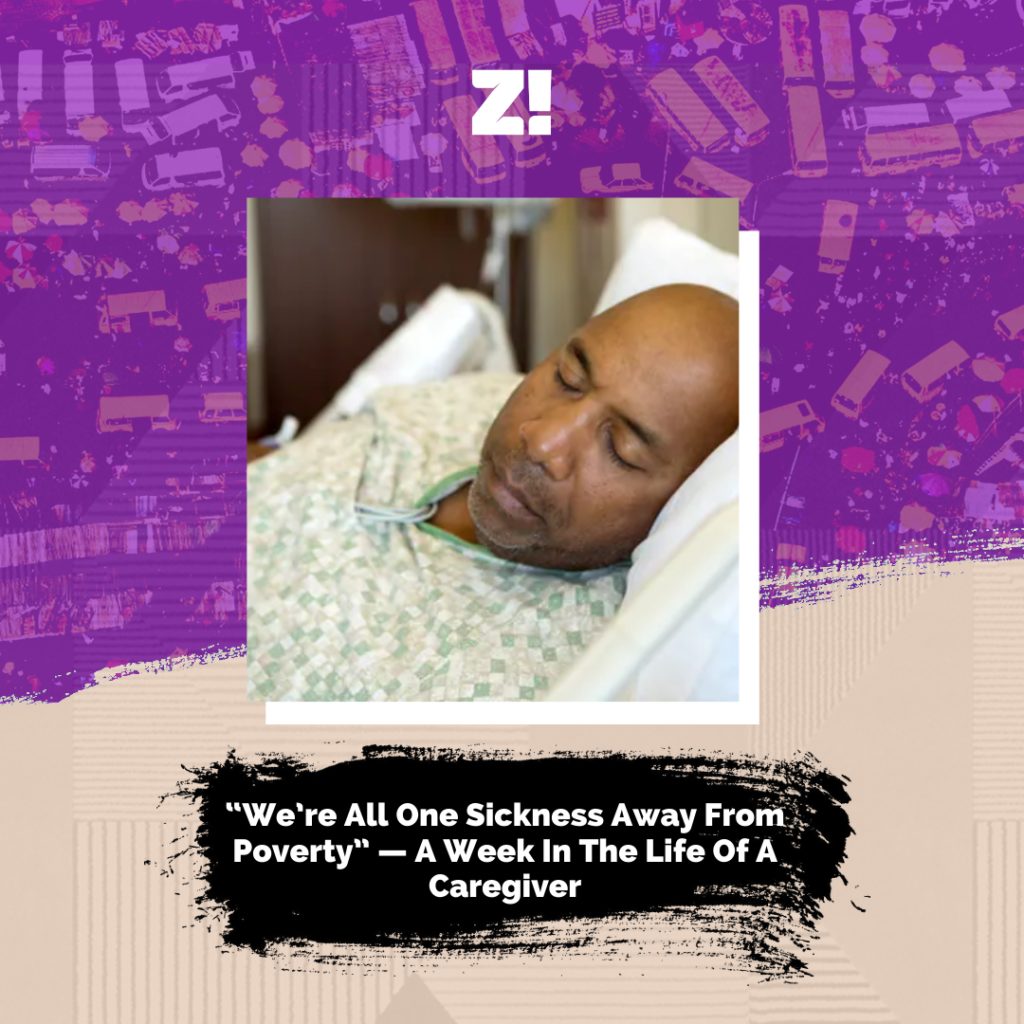
MONDAY:
My days are so similar that they’ve become a blur — it starts at 6 a.m. and ends at 9 p.m. From the minute I wake up and take my bath, I’m running errands: get X tests done here, buy Y drugs at another place, run to Z place to get blood. I’m always on the move because there’s usually a lot happening with a sick person. My first errand today is buying antibiotics outside the hospital for my dad. I start my waka by making a few calls to pharmacies to compare the prices of the medicine. After securing a decent price, I make arrangements for pickup and delivery.
It’s 4 p.m the next time I look at a clock. Between running around to pick up medicines and calling my mum for updates about my dad, I wonder where my day went. I also don’t remember if I’ve eaten today. But I don’t have time to ponder over this because I have to take over from my mum in the ward — we alternate the cleaning and feeding of my dad — while she goes home. Depending on my dad’s mood when I’m done feeding him, we either have a conversation or he asks to sleep. He’s in the mood for a conversation today, so I pass time with him while waiting for the doctors to start their evening rounds. I can’t wait to leave the ward, get food and sleep because the cycle begins again tomorrow.
TUESDAY:
When the doctor told me that my dad’s condition was multiple myeloma, I cried because I had no one to vent to. Multiple Myeloma is a cancer of plasma cells, and one of the symptoms is brittle bones. The damage to my dad was so bad that his hip removed from its joint. I’ll never forget the days leading up to his admission at the hospital. We were always home alone [Mumsi had to go to work]. One morning, I broke his hand while trying to move him from the bed to a chair. One minute I was trying to move him and the next, I heard a loud kpa sound. I was so scared because I had never seen so much shock and pain on my dad’s face before. For his sake, I had to compose myself and reassure him that it’d be okay. I called his physiotherapist immediately I left his room, shouting, “My daddy’s hand has broken. It has broken.” Even though the physiotherapist gave me first aid tips, my mind was still not at rest. I experienced flashbacks where I’d relive the memory of the bone breaking throughout that week. In the middle of a task, I’d hear the kpa breaking sound and become sad all over again. This memory is why I can’t complain about the hospital stress because I know whatever pain I’m going through, my dad is going through times ten of it.
It’s sad to say this but I’d been shielded from reality as a medical practitioner before this. Being on the other side has shown me what patients and their relatives pass through. My mum and I had to rent a hotel outside the hospital because the “living area” allocated for patients’ relatives is jam-packed because we’re in the middle of a pandemic, and the general building design is not old people friendly.
One time my dad needed blood and I kept following up with the blood bank for three days without show. It wasn’t until the fourth day when I went to the blood bank with a friend, who was a medical practitioner in the hospital, that they finally attended to my dad’s case. I was livid and people had to hold me from losing my shit. It’s crazy that I had to know someone to get blood. Since that day, I started wearing my scrubs to the blood bank and the ward since we’re all mad.
WEDNESDAY:
My dad got admitted at the hospital on a Thursday, and I remember thinking to myself: “The health care system is fucked.” My first introduction to the anyhowness of the system was when I had to carry my dad on a wheelchair to the last floor twice. Apparently, there was light but the elevator wasn’t working. I know I paid at least nine people ₦500 here and there to either help me lift my dad or fast track his settling in. That first week was also difficult because we didn’t have access to my dad except during visiting hours, and he required constant attention. In retrospect that first week wasn’t bad. At least compared to the weeks that followed. We still had peace, and he was still responding to chemotherapy. If only we had known that the coming weeks would show us pepper.
THURSDAY:
You’re one illness away from poverty doesn’t hit home until it happens to you. It can only be experienced, not explained. When my dad got admitted, I thought we’d just do chemotherapy then surgery and we’d be done in a month. LMAO.
After the surgery, it has been one complication after another — respiratory distress, swelling of the body, low PCV. And we’ve had to run tests to locate the problem. At one point, I was averaging about ₦60,000 per day on tests and drugs. Then we had to switch him to a class of antibiotics because of postoperative complications, which cost ₦10,000 for one. I died when the doctor said he was going to need 15 vials. This is minus surgical implants, diapers, money for surgery, dressing gauze, irrigation solution for wound dressing. It was that day that it clicked in my head why my customer told me I had spent over a million naira on drugs alone. Illnesses are not only financially draining, they also drain you emotionally. I’m constantly having to reassure my mum things will turn out fine. Today, one of my uncles was crying over the phone because he couldn’t send money to help us, and I also had to reassure him that it’d be fine. The curse of being an only child is having to be strong for everyone even when you’re clueless about how to get money for drugs.
Same today the nurse came to tell me that my dad exhausted his Clexane [a drug to prevent bedridden patients from developing a clot] and I couldn’t say anything because it’s a non-negotiable daily drug. At ₦2700 per vial, we’ve been buying the drug for him every day for almost seven weeks. I’m at my wit’s end, and I’m tired of this place. Even though it’s less than two months, it feels like I’ve been here for six months.
FRIDAY:
My mum is a superwoman abeg. Has she been scared? Yes. Has she been composed? Yes. Has she shown up? Double Yes. Her presence has made this ordeal a bit bearable. I don’t feel completely alone anytime I see her. It helps that she’s a positive soul with so much good vibes. Sometimes she’ll call me to say “Daddy finished eating his food, and he ate it all by himself.” Other times I’ll see her petting my dad to eat and my dad pretending not to like the attention and fuss — he knows he can’t try serenre with me because I don’t have time.
Yesterday my mum was looking stressed, so I told her to go home early to rest. Today, she came back looking refreshed. I feel bad anytime I remember how this whole ordeal made me selfish to her. As a result of the emotional stress from running around, I didn’t realise I was transferring aggression to my mum. It wasn’t until a friend pointed out my aggression to me that I saw I had been too caught up in how I was feeling to remember that my mum was feeling the same way too. I apologised to her, and I’ve become less selfish. I like how refreshed she looks so I’m going to tell her to take a few more days off. I really can’t afford for both my parents to break down at the same time. I can’t afford it.
God, I know I’ve questioned you during this period, but I pray my dad’s quality of life goes up and he gets better. We deserve this rest. I haven’t gone home in seven weeks, and I’m looking forward to sleeping on my bed. I miss my friends. I miss my old life. I just want things to go back to normal.
Check back every Tuesday by 9 am for more “A Week In The Life ” goodness, and if you would like to be featured or you know anyone who fits the profile, fill this form.
-
If you self-isolate from Covid-19 in itself is not enough. We are going up against the pettiest contagious virus known to mankind and it is simply not enough to stay in your houses. While you self isolate there’s a list of things that could still make you vulnerable to COVID-19 so do well to avoid them.
Don’t Smoke while you self-isolate from Covid-19
The World Health Organisation recommends that smokers should stay away from their smoking equipment this period. Why? Because you need your lungs in their healthiest shape and your immunity top notch. Smoking compromises on that. So while you self isolate, best to keep the lighters away.
Junk Food
Again on the immunity scores, now is the time to reach for the veggies and fruits as opposed to the junk you probably prefer. Your body needs all the nutrients you can feed it with. You need to stay healthy.
Unverified News Sources
For your own sanity, stay away from any source of incorrect news about COVID-19. How do you know which is false news? Crosscheck with sources like WHO, Worldometer, NCDC and Zikoko (Yes because we cross check with WHO too).
No strange foods while you self isolate please
Because while we are busy fighting an on going pandemic birthed by strange food choices we will very much appreciate it if you do not go on to birth a new one for us.
No visitors please
This is the time for every friend to stay home and enjoy the rent they paid. Just because we are all at home doesn’t mean it is time to start entertaining visitors. Everyone should really stay in their houses.
And don’t forget to wash your hands or use an alcohol based hand sanitizer as often as you can even as you self isolate. If you’re wondering what to do while indoors we got you covered.
Click here for some creative ways to keep busy this period.