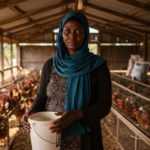
For seven years, *Ismatu, 40, ran a thriving poultry business in the North. She raised chickens in batches and made about ₦500k every eight weeks. When her family decided to relocate to the South in 2024, she moved with them and her life savings: ₦2 million.
She thought she could restart the business anywhere. But she didn’t expect a wildly different market or everything she built to fall apart so fast.
As told to Aisha Bello
I built a poultry business in the North that paid for my children’s school fees, fed my family, and funded two master’s degrees. Then, I relocated to the South with ₦2 million to start over and lost it all.
I started poultry farming in 2013 with about 20 broiler birds, mainly for family consumption. At the time, I worked as an operations officer at an environmental and waste agency, where I earned ₦120,000/month. But I soon realised that raising birds wasn’t just sustainable, but also profitable.
Back then, day-old chicks cost ₦20 to ₦30, and a bag of feed went for ₦800. After six to eight weeks of feeding, medication, and care, I’d spend about ₦700 per bird and resell them between ₦1,000 and ₦1,200. That margin gave me my first real taste of business.
Still, I couldn’t grow it the way I wanted. My husband constantly complained about the foul smell and mess from the birds.
Our marriage was already strained, and things escalated into physical violence. One day, he beat me so severely that I fainted and ended up in the hospital. That was the final straw. In 2018, I divorced him and moved in with my mum and three children.
I also lost my job around that time. I had been transferred to a new office, but I was emotionally drained and grieving my marriage. I couldn’t cope, so I resigned.
After a few months of healing, I finally had the freedom to build my life on my own terms.
I invested ₦200,000 to build a big pen behind my mother’s house. By then, chicks cost ₦500. Raising one bird to maturity cost me about ₦8,000 in total. Depending on size and demand, I sold them between ₦11,000 and ₦13,000 each.
The pen could hold up to 150 birds per batch, and I’d raise them for 6–8 weeks.
Losses were normal — bird flu, weak chicks — but I never lost my capital, even though up to 25 birds died every cycle. Sometimes, I even had overlapping batches, raising one set while selling another.
I understood the market because I had lived in the North almost all my life. We lived in a predominantly Christian area, so Sundays were always good sales days. But my real advantage was selling wholesale. I built relationships with retailers and market sellers who came directly to my pen every cycle. They knew when to call and buy in bulk.
The model worked perfectly. I made an average of ₦500,000 profit every 8 weeks, and up to ₦750,000 during festive periods. I repeated this cycle four times a year, and that was my rhythm for the next seven years.
With the income, I paid school fees, fed my children, and returned to school. I already had an HND, so I completed a top-up programme to earn a bachelor’s degree in human resources. After that, I went on to earn a master’s in public administration, a postgraduate diploma in management, and eventually a Master of Philosophy in Leadership as preparation for a PhD.
Along the line, I got a job as an administrative officer at a private school, earning ₦80,000/month. Between the salary and the business, we were fine. My ex-husband never paid child support, but I didn’t need him. I could afford our life on my own.
Then, in 2024, everything changed.
My mother retired from her job as a secondary school principal and wanted to move back to our hometown in the South. We decided to relocate together. “Your business can work anywhere,” they said. It sounded logical at the time.
I had approximately ₦2 million in savings from my business, and was optimistic about replicating my success.
A few months into settling down, I built a new poultry pen. It cost ₦600,000. I spent another ₦100,000 on feed cans, drinkers, and water. A day-old chick now costs ₦1,950, and I stocked 150 birds for about ₦300,000. After adding medication, feeding, and logistics, I had invested ₦1.2 million into the business.
I cared for the birds as usual. The death toll wasn’t alarming, but sales barely moved. I couldn’t find any bulk buyers. Everyone around here wanted to buy one chicken at a time, and at bargain prices.
Eventually, I sold off that batch, but it took time, and the profit barely came together. It’s hard to reinvest with retail buyers because you don’t get your money in one chunk.
Still, I tried again, this time with 100 birds. But the outcome was worse. After 8 weeks, many birds remained unsold, eating more feed and piling on losses.
I was already running out of capital.
Ismatu’s Abandoned Poultry Pen.
So, I paused the business and took a job as an admin officer at a private school, but they paid ₦36,000 and expected me to work as a kindergarten assistant. That couldn’t sustain me, so I quit.
I kept applying for admin roles, but what shocked me the most was how often I was told I was overqualified because of my degrees, and that they simply couldn’t afford to pay me what I was worth. I’ve been stuck in that loop ever since.
In October 2024, I decided to give poultry one last shot. December sales had always been my most profitable window in the North, and I hoped it would save the business.
With the last ₦400,000 I had, I bought 200 birds and went all in. By December, some had grown large enough to fetch ₦17,000 to ₦18,000 each. I hoped I could make at least ₦1 million and bounce back.
But that was the worst death toll I’d ever seen.
Nearly 50 of the biggest birds died. Sales were still stagnant. In the North, customers bought chickens into the New Year. Here, I didn’t even sell 100. What little money I recovered barely covered the cost of feed, and started eating into my capital.
I gave up.
I kept about 50 birds to prepare for my son’s graduation and haven’t returned to poultry since.
I’m currently living off support from my family. I’m still trying to get another admin job and keep my family afloat.
If I ever raise enough capital again, I’ll start another business, but not blindly. I’ll take my time to study the market here. If I ever return to poultry, it’ll be a smarter, better-informed comeback.
Zikoko’s first-ever money event is happening this August! Join us at the Naira Life Conference on August 8th — a one-day event, where successful business owners will share the honest, hard-earned strategies that helped them scale, stay afloat, and thrive in this economy. Get 30% off your ticket when you buy now. Don’t miss the early bird window!
Join 1,000+ Nigerians, finance experts and industry leaders at The Naira Life Conference by Zikoko for a day of real, raw conversations about money and financial freedom. Click here to buy a ticket and secure your spot at the money event of the year, where you’ll get the practical tools to 10x your income, network with the biggest players in your industry, and level up in your career and business.
Every time you look at a price tag and think, “Why is this thing so expensive?”, there’s usually a story behind it. One that includes juggling rising costs, unpredictable dollar rates, demanding customers, and the heartbreak of underpricing your own labour just to make a sale.
We asked four Nigerian business owners across different industries to show us exactly how they set their prices, what affects those prices, and how they make sure they’re not running at a loss. They give us a behind-the-scenes look at the balancing act of staying affordable, competitive, and profitable in an economy that makes no promises.
“I balance ingredient costs and customer expectations to keep my prices fair and my business running” — Zalim, Small Chops Vendor
I started my small chops business in 2021 and handle everything myself. I currently sell three sizes: small packs for ₦5,000, medium for ₦10,000, and large for ₦20,000.
Pricing isn’t straightforward because the cost of ingredients like flour, oil, chicken, and plantains changes with the seasons. Sometimes, I pay less, and sometimes much more. So, I don’t break down the cost of each item to figure out my profit. That would be impossible.
What I do is look at how much money I spend every month on ingredients, usually about ₦200,000, and then how much I make when I sell everything, which is around double that. From the money I make, I set aside 40% as my take-home and profit combined. Half of that 40% is my salary, and the other half is the profit I keep to grow the business. The rest goes right back into buying ingredients and running things.
Customers expect certain prices, so I don’t just increase mine whenever costs rise. I check what other vendors charge in my city at least twice yearly to ensure I’m not too high or too low. I’ve only raised my prices twice since I started. Before the last increase, inflation had pushed up flour and oil prices so much that I had to either reduce the size of the portions or raise my prices. I tried shrinking the portions first, but that didn’t work, so I finally raised the prices.
I also bought a barbecue stand to switch from fried to grilled chicken to save costs. That one-time investment helped me cut down on oil expenses.
So, while I can’t say the exact cost of one pack of small chops, this is how I keep the business running and still ensure I’m earning something fair for all the work I put in.
“I price based on all incurred costs, then add a fair profit that keeps my business afloat” — Halima, Adire Fabric Business Owner
First, I calculate exactly what it costs to get the fabric in my hands: transport, material price, paying the artisans, and packaging. Then I add the “hidden” costs: my monthly data for online sales, delivery fees, and ads on Instagram or TikTok.
Next, I decide on a profit margin. I don’t do crazy markups, but I also can’t just break even. Usually, I aim for 30% to 50% profit, depending on the fabric.
Adire fabrics are everywhere, so sometimes I lower my prices to stay competitive. But I never underprice just to match others who don’t include all their costs; I focus on my value as a business.
My prices also depend on my customers. If I’m selling to working-class women who want quality and fast delivery, they’ll pay a bit more. But for students, I try to offer smaller, affordable packages.
The biggest headache is the dollar rate. Today, a fabric costs ₦12,000; tomorrow, it will cost ₦20,000. Suppliers don’t care; they just increase prices, and we have to follow. Because of this, some prices aren’t fixed; customers have to ask for the latest price.
Delivery costs from suppliers also fluctuate with fuel prices. Sometimes, my delivery guy will call and say, “Aunty, it’s not the same price again.” Once, I even had to pick up my goods because he took my fuel money and didn’t deliver.
So I adjust prices when necessary to stay profitable without shortchanging customers.
For example, crepe fabric wholesale costs ₦12,000, and I sell it for ₦15,000, making about ₦3,000 profit per piece. I buy batik wholesale at ₦15,000 and sell it for ₦20,000, earning ₦5,000 profit per fabric. Cotton is pricier: wholesale costs ₦25,000, and I sell it for ₦30,000.
Delivery from my suppliers in Abeokuta to Oshodi costs about ₦3,000, plus another ₦4,000 to get it home. I usually don’t add delivery fees to my prices, but sometimes I include an extra ₦500 per item.
That’s why my prices aren’t fixed. I constantly review them based on what’s going on around me. But I always ensure I don’t run at a loss, customers feel it’s worth it, and the business keeps going.
Ultimately, pricing is a balancing act: covering costs, considering customers, and keeping my business afloat in a constantly changing market.
Join 1,000+ Nigerians, finance experts and industry leaders at The Naira Life Conference by Zikoko for a day of real, raw conversations about money and financial freedom. Click here to buy a ticket and secure your spot at the money event of the year, where you’ll get the practical tools to 10x your income, network with the biggest players in your industry, and level up in your career and business.
“With dollar rates spiking, I have to balance quality beads with prices my customers can still afford”— Deni, beaded jewellery business owner
I’m a fifth-year medical student running a bead jewellery business I started in 2022. It began simply; I wanted to make jewellery for myself. I taught myself through Pinterest and TikTok, ordered some beads and charms online, and just kept going.
Pricing is both straightforward and frustrating. When I use expensive or limited materials, it’s easy; I add my workmanship fee to the cost. But with smaller, cheaper beads, it gets tricky. Imagine counting out beads that cost ₦30 or ₦50 each, from the tiniest to the largest. It’s tedious. And the smaller the bead, the more effort it takes to work with.
I always try to use authentic materials. It breaks my heart when someone says, “Oh, this broke,” or “It faded.” But many customers don’t want to pay for quality, so I often give them two price options and let them choose.
Right now, I undercharge for my time because most of my customers are students. I want them to afford what I make. But someday, I want to reach an audience that sees the value in art. When that happens, I’ll split my products into affordable pieces and premium, collection-worthy ones.
Sourcing materials is one of my favourite parts. It feels like walking into a candy store. I want everything, but I leave with only what I can afford. I usually order online from AliExpress or Temu, or shop when I’m home in Lagos.
But the dollar rate has made it tough. First, Nigerian banks banned the use of naira cards for foreign online transactions, so I switched to a USD card. Then, the dollar spiked, and everything changed. I used to get a decent haul with ₦20k. Now I can’t do much with less than ₦50k or ₦60k. My workmanship took the hit for a while until I just stopped ordering online. I’ve only made two orders this year.
Sometimes I wonder if my pricing model is naïve. A proper businessperson might call me unserious. But I started this out of love. It was never about profit. What keeps me going is seeing people light up when they wear something I made.
Here’s an example of how I price:
A charm bracelet I sell for ₦4k costs me ₦2,500 in materials and ₦300 for packaging, so I earn about ₦1,200 for my time.
A more complex necklace might cost ₦2k for the pendant, ₦500 for the hook, and ₦4k for the beads and chain. I sell it for ₦8,500. It’s not fair compensation for the creativity and labour, but I want people to be able to afford it. And even then, some still say it’s too expensive.
I rarely profit from the beads themselves; it is just my workmanship. I price materials at precisely what I paid, including transport. At the end of the month, I take out 10%–30% of the profit, depending on sales and whether I did a pop-up. Some months, I don’t take anything at all.
That’s why I know I’ll eventually split my products between affordable designs for everyday wear and premium collections for those who understand the value.
But my biggest fear is pouring in time and effort, everyone saying, “Wow, so pretty,” but no one is actually buying.
Since I started, I’ve invested over ₦200k in capital. On a good month, if I sell 30+ pieces, I might make ₦50k.
The dream is to focus on custom, one-of-one pieces, exclusive collection drops, and, one day, a cosy walk-in store for my designer jewellery brand.
“My pricing starts with materials and time, but it changes depending on who’s buying and the story behind the art” — Ayo, Artist
Art is priceless, but when you’re trying to make a living off it, you must put numbers to it. For me, pricing is a mix of calculation and gut feeling. I always start by factoring in the basics: the cost of paint, canvas, and materials, and then I add a workmanship fee. That’s non-negotiable; it covers the time, effort, and energy I pour into each piece.
For mid-sized canvas, I charge a minimum of ₦70,000. That covers materials and workmanship and leaves me a small profit margin for the business. I start from ₦150,000 for larger paintings but can go higher depending on the client, the concept, or the time it takes to complete.
A single painting can take anywhere from a few days to a few weeks, so pricing also depends on how complex the work is and sometimes on who’s asking. If a buyer clearly understands the value of art or has the means, I price accordingly. I trust the right buyer will always see the value beyond just paint on canvas.
For exhibitions, it’s a different ball game. There’s more visibility, and the audience is typically collectors or buyers with deep pockets and a deeper appreciation for art.
I can price as high as ₦300,000 to ₦500,000 in those spaces, especially if the piece is part of a themed collection. I’ve learned that context and presentation matter; people value art more when they understand its story, which often justifies a higher price.
Subscribe to our newsletters and never miss any of the action
[ad]
After trying several businesses without much luck, *Laide (43) finally found success—until someone she trusted turned her world upside down. In this story, she shares how brutal competition, betrayal, and an unexpected twist pushed her to eventually choose kindness.
This is Laide’s story, as told to Mofiyinfoluwa.
I had tried my hand at different businesses over the years, but nothing ever worked quite like the provisions store I started in 2021.
It wasn’t even some grand plan. During COVID-19, while moving through a busy area near a nursing school, I noticed how hard it was for people to get basic items. The nearest market was far, and social distancing made things even harder. Life had to go on, but people were struggling. It seemed obvious to me that the community needed a shop. So, I took a high-interest bank loan, bought a container, stocked it with essentials and set up within the area.
The business boomed faster than I could have imagined. As restrictions eased, I became the go-to person for everything from provisions to toiletries. It helped that I was the only shop around selling at market prices. Within months, I expanded into foodstuffs like rice, beans, and oil. I was grateful for every day and without regrets. I even paid off my loan faster than I anticipated.
About a year into the business, in 2023, I started seeing a regular face I came to know as *Mary. She was a little younger and was very friendly. She often lingered after shopping to gist with my salesgirl and always dashed her change. I didn’t know much about her beyond the fact that she lived nearby and seemed harmless.
Then one day, Mary approached me for a favour. She said her sister was in an abusive marriage, and that she and her siblings were pooling money to set her up in business. She begged me to share my distributor’s contact information so they could help her start a provision store.
I was hesitant at first. In this kind of business, your distributor is your lifeline, and sharing that information felt like giving away too much. But Mary appealed to my emotions, reminding me what it meant to be a woman supporting another woman. In the end, I gave in. After all, her sister’s shop would be too far to pose any threat to me.
Shortly after that conversation, Mary disappeared. I grew concerned and even tried calling her a few times to ask about her sister, but she never answered. I didn’t think much of it again until three months later, when I arrived at my shop one morning and walked straight into one of the biggest shocks of my life.
Get More Zikoko Goodness in Your Mail
Subscribe to our newsletters and never miss any of the action

Right beside my container stood another container, fully stocked with the exact same goods I sold. And there was Mary, tapping her phone, and acting like I didn’t exist. My shock quickly turned into rage. I confronted her right there and asked her why she lied. Why did she betray my kindness? She refused to look up.
I ran to the caretaker. Our original agreement was that no one selling the same goods would be allowed on the land. He apologised and explained that Mary had tricked him too. She told him she was setting up an okrika business, but by the time the truth came out, it was too late —the landlord had already accepted her rent.
I was furious. But I told myself not to fight. I had built my business, and my customers would be loyal to me. After all, they knew me first. But I was wrong.
Slowly, my customers began to flock to Mary’s shop instead. I watched helplessly as the people who once crowded my stall walked right past to hers. Out of desperation, I even tried standing outside by the road, calling out to customers, but none of it really worked. On some days, I would sit from morning till night, and only two or three people would walk in. Restocking became a struggle, and my money kept running out.
At first, I blamed the economy like everyone else. But one afternoon, one of my old customers came in looking very upset. She had bought oil from Mary’s shop, realised it was substandard, and came to buy from me instead. After she left, Mary burst into my shop, screaming insults and causing a huge scene. In the middle of her ranting, she made a threat I’ll never forget — that very soon, I’d be completely out of business, and she didn’t mind if it meant harming my children.
That was when I knew this wasn’t an ordinary competition.
On a friend’s advice, I went to a church for prayers. Without even saying much, the pastor confirmed my suspicions that Mary had been using juju. She had even gone the extra mile by using items she bought from my shop to spiritually capture my customers. I was devastated. I had helped her with a clean heart, and she went so far to ruin me.
The pastor suggested I retaliate. He told me to collect a handful of sand from the front of her store, speak curses into it, and pour it back at the spot.
One evening, after she had closed, I made sure no one was watching, scooped the sand, and stood with it in my hand. But when it was time to curse her, something inside me refused. I couldn’t bring myself to wish evil on her, no matter how badly she had hurt me. Instead, I prayed over my own shop and poured the sand away.
Something terrible happened a few weeks later. One morning, we came to find Mary’s shop burned to the ground. Faulty wiring had caused an electrical fire that destroyed everything. Of course, people gossiped. Some laughed and said it was payback for what she did, while others looked at me suspiciously. But inside, I felt nothing but relief that my hands were clean. If I had done the sand prayer, I would have spent the rest of my life wondering if I had caused it.
[ad]
Still, seeing Mary standing there, crying in front of the remains, moved me. I had heard her husband was a useless drunk, and she was the breadwinner for her family. No matter what she did, I couldn’t help but pity he
For weeks, I couldn’t sleep properly. The image of her from that day kept haunting me. One afternoon, without telling anyone, I called her over. Quietly, I gave her a small loan to start again. I told her we didn’t have to be enemies. We didn’t even have to be friends, but we could coexist peacefully. She didn’t say much; she just cried and thanked me, probably because she was shocked.
Till today, Mary runs a small shed beside my store. She still sells provisions, but no longer stocks foodstuffs — maybe as her way of keeping peace with me. We aren’t close, but we greet each other. Sometimes, I help her children out. We even refer customers to each other once in a while.
My business eventually recovered. Slowly at first, but things have picked up now. Whatever happened, I am grateful every day that I chose to stay in my lane. In the end, staying true to myself was what helped us overcome.
In a lot of ways, 2024 was a hell of a year for Nigerians; from fuel scarcity and hikes in fuel prices to sky-high inflation, poor power supply, and crazy exchange rates, people living in Nigeria braved so much to survive.
Micro, Medium, and Small Enterprises (MSMEs) were no different. Like every other year, 2024 came with its ups and downs, but the lows were so severe that their impact was felt nationwide. From the Manufacturing Association of Nigeria (MAN) announcing that unsold products worth about ₦1.24 trillion were stuck in different warehouses across the country (just by the first half of the year) due to the inability of their owners to sell them, to the Bank Of Industry (BOI) stating that MSMEs in Nigeria need about $160 billion bailout funds, the country didn’t exactly prove itself as a good business environment.
As the year comes to an end today, Zikoko Citizen spoke to three young micro business owners to understand how the Nigerian economy affected their businesses in 2024 and what they look forward to in the coming year.
Chisom, 27– Fashion Designer, Abuja.
I don’t want to sound cliche, but doing business in Nigeria this year was hard. I consider this one of the most difficult times to be a young adult in Nigeria. The economy and everything is just so difficult. The cost of living is high, and the cost of doing business is even higher.
The crazy thing is that because customers struggled, they didn’t understand that business owners had it difficult as well. It’s even worse with my kind of business because some people feel like you just want to overcharge them or think you are overpriced.
You might just tell a customer the price for something this minute, then go to the market the next minute to buy that same thing, only to find out that the price is way higher than what you’ve already charged. Only a few people understand when you come back to them to say you’d need to increase the initial price you told them. I’ll give you an example– one time within the year, a bundle of lining was about ₦9000 to ₦1000. A few weeks after I bought some, I felt like the prices of sewing accessories might go up, so I went to the market to restock, but I was super shocked to find that it had increased to ₦35K and the sellers at the market were not even begging or haggling price. The energy they gave was like, “If you’re not buying, go.”
Navigating price increments and incorporating them into my business was not easy for me this year, and I don’t think it was easy for others, either. It came to a point where I needed to charge more to sustain my business. A lot of things came into play and I had to consider all those factors to be able to charge appropriately for my brand, so you have to accept the reality that not everybody who could afford me before will be able to afford me presently and just be fine with it.
People who appreciate the services you offer enough will keep patronising you, while those who can’t handle the price increase will go to another place that is cheaper and more affordable for them. It has nothing to do with the quality you offer; it’s just about what they can afford.
I don’t think there’s a specific thing that’ll make my business easier in 2025. I’m saying this because I don’t think it’s a matter of specifics– as it stands, everything and everyone is struggling. Even middle-income earners now are not fully able to afford our (fashion designers) services.
Every aspect of the economy is struggling right now. I can’t even say that access to loans, funding, or policies that’ll increase the ease of doing business will ease things for me in 2025 when every other aspect of the economy is suffering. It won’t really make sense because I can now have access to that funding or loan, and then find that my customers are still struggling, so everything just needs to be better in 2025 for other things to be better. I don’t know if that makes sense.
Sarah, 25. Jewellery Vendor– Warri
Living and doing business in Nigeria as a jewellery vendor in 2024 came with its own unique challenges and opportunities. The jewellery industry in Nigeria is already highly saturated due to its profitability, but 2024 was slightly stressful for a number of reasons.
This year, the cost of procurement and shipping became drastically high. Import prices, for instance, climbed by about 35%, and this affected the amount of goods I was able to purchase at a go.
Normally, doing business in Nigeria is quite difficult, so you have to be strategic, but this year required extra strategy to avoid running mad due to the way prices skyrocketed. The country’s economic environment was just unpredictable, with fluctuations in currency exchange rates, inflation, and government policies affecting the cost of doing business.
2024 has been a tough year for me and my brand, but I was able to scale through and make the best of it through careful planning, adaptability, and a deep understanding of the local market and culture. Coming up with the right strategy and mindset helped me achieve good results.
My initial plan for my brand was to sell super affordable jewellery, but with the increase in procurement and shipping, I just had to increase my own prices to avoid running at a loss. However increasing my price due to the whole exchange rate madness and other things actually brought in new customers, who are now my target audience. Because of that change, I strategised and moved from just selling regular earrings to luxury items like custom-made unique designs and venturing fully into niches like wedding rings and male jewellery accessories.
So yes, I lost a few clients because most of them were no longer able to afford me due to the increase in prices, but I also gained newer customers.
My business will be four years old next year, and this year, we recorded lots of sales than we’ve made in the past four years, not because the environment was encouraging but because I was strategic in adding new niches
When it comes to things that’ll make business easier for me in 2025, I’ll say the exchange rate first of all– I know it’s sort of decreasing right now, but I need the Nigerian government to look into it next year. If the exchange rate was actually good, people won’t be complaining, and businesses won’t be struggling.
A lot of the time when I’d reach out to my suppliers to calculate the prices of goods, I realised over and over again that the gap between the exchange rate in 2023 and this year was just too much.
Another thing I want the government to take a look at is this whole custom-clearing thing. To clear goods has now become another issue. The payment for clearing goods has become so heavy that many business owners now have to order bit by bit because ordering so much at once brings a lot of issues. The delay is also insane. These things just need to be better for businesses to thrive in 2025.
Ugonna, 29. Footwear Vendor– Lagos
Doing business in Nigeria was very challenging for me this year, and I tried to evade and minimize costs as much as possible.
The exchange rate didn’t make things easier either because it affected me like mad and this made me withdraw from importing by myself and buying from a friend that had a stronger capacity than I did. I’ll explain– When we order from shipping companies, the goods take about two months to get to Nigeria, but you can’t really monitor the exchange rate and take advantage because even though you had ordered two months away, you’ll still have to clear the containers at whatever price the exchange rate is at when you goods finally arrive. You also have to settle Alayes and Owo da boys.
I didn’t make as much profit as I set out to this year and I couldn’t take my business offline because the crazy costs of rent in prime locations were way more than I could afford.
What will make my business easier in 2025? Access to funding. This is particularly important to me because I need to diversify and look into other sectors because having more than one source of income will shoot me up the ladder. One of those sectors is entertainment/full-scale film production. I’m already working on this. My production company is set to release its first film by January, but there are so many ups and downs in the industry that make this type of venture unsustainable by a singular individual, so going into 2025, I need avenues to access more that’ll enable me to run my film production and footwear businesses properly and profitably.
Currently, MSMEs account for 40% of Nigeria’s Gross Domestic Product (GDP) and provide 90% of jobs in the country, making them the backbone of the economy, without which the country will experience more harsh times than it already is. Just like the young entrepreneurs who spoke to us, we hope that 2025 is a better year for MSMEs in Nigeria.
Image: Canva AI
In 2014, Omolola Akintola left the US for Nigeria with a dream. She’d spent the last seven to eight years getting her degrees — a BSc in Economics, an MBA and an MSc in Marketing — and knew she didn’t want a long-term banking or consulting career.
“I wanted to do something different, something that didn’t already exist,” Lola tells me. “I wanted my own startup so I could solve a problem and impact Nigeria.”
She decided on greenhouse farming. Nigeria’s fine dining scene was on the rise and with it, the need for fresh produce. Lola predicted that it’d be difficult to keep up with importing produce like fresh strawberries and herbs, necessitating a need for all-year-round cultivation — the perfect market for a greenhouse farm.
But setting it up isn’t a small investment. The cost of a small 250 square meter-sized greenhouse averages ₦3m now, and Lola had big plans. Bigger than just one greenhouse.
“I knew what I wanted to do would involve a lot of money,” Lola says. “I planned to stay and work in the US for a few more years to raise capital for the farm and then return. But I fell in love with my partner and returned to Nigeria much earlier — let’s hope my dad doesn’t read this. Greenhouse farming was still the plan — specifically, a 10-year plan. I just needed to work for some years in Nigeria before that could happen.”
Soon after returning to Nigeria, Lola found a job at Access Bank, one of the country’s big four banks.
“I enjoyed my time at Access. I worked in the strategy department, and I felt useful. I loved the fast-paced, exciting environment. I was going to stay at the bank for years so I’d have saved enough for my greenhouse farm.”
However, Lola only spent a few months before she resigned to pursue another business idea.
A “breakfast for the skilled middle-class” business opportunity
Working at the Access Bank head office in Victoria Island opened Lola’s eyes to two things.
First, the 9-5 life for young professionals in Lagos is hard. She had to leave her home in VGC before 6 a.m. if she hoped to beat traffic and get to work by 8 a.m. Returning home wasn’t easier as long hours at work meant she often had to leave the office at 10 p.m.
Secondly, her new lifestyle meant she never had time to grab breakfast or prep food. This wasn’t a problem peculiar to her.
“My colleagues had the same problem. The higher-ups could afford to get in-house chefs or maids to bring them food. Married guys didn’t have to worry about food because they had someone else doing that labour for them. But the single men and women — mostly millennials — didn’t have time to cook their own food.”
Lola also noticed something interesting. The skilled middle-class wasn’t willing to rely only on roadside food.
“It was 2015 in Lagos, and people had disposable income. There was always a concert or show happening during the weekend, and people could afford to go. I had 9-5 friends in different industries too, and I knew that the average millennial Lagosian liked going to cafés on the Island to treat themselves to brunch on weekends. What if they didn’t have to wait for the weekend to treat themselves? What if they could have nice, fancy breakfasts delivered to them daily?”
“In business school, we discussed how businesses are gradually going online,” Lola says. “Buildings are disappearing, and people are exploring new ways of doing business. When I got the idea for a breakfast business, I knew I didn’t need to invest resources in a physical restaurant.”
It made economic sense to run her new idea as a subscription-based service, where customers could subscribe to a meal plan, pay and get their food delivered daily. This way, Lola didn’t have to worry about buying ingredients in bulk and hoping that the power supply was regular enough to store them.
She did a trial run with her sister and some friends first. “I’d close from work and prep the meals I wanted to send to them the next day. My menu included local and international (mostly American) cuisine. Most of what I did was self-taught and by reading recipe books. I already had a passion for cooking and wanted to attend culinary school to get professional skills, but that would’ve meant sponsoring myself and an additional two years of study. So, I decided to just start.
I’d wake up really early to cook and send the meals through my sister’s driver to save costs. Interest grew when other colleagues at work noticed my sister and friends having meals like tortilla wraps and quesadillas for breakfast.”
The referrals flew in, and Milk and Honey became a full-fledged business in 2015. Lola offered different meal plans, from the Bronze subscription plan (breakfast-only) at ₦7,500 weekly to the Platinum plan (including lunch) at ₦20k/weekly, with customised recipes designed to replicate the fine dining experience.
She did that for a few weeks before deciding she could no longer juggle it with her 9-5 at the bank.
“But I was wary about leaving because I had senior colleagues who loved me. Fortunately, I had to report to the NYSC orientation camp soon after, and I used the opportunity to resign. I couldn’t bring myself to do it face-to-face.”
Without the distractions from her 9-5, Lola could now give her full attention to building her business. And she did exactly that, but there was a lot to figure out.
“I was new in the country with a lot of theoretical knowledge. But I didn’t know how to get the right people to bring my vision to life. I was building a tech-enabled startup, so I needed to know where to find experienced website developers. Also, I knew the kind of packaging I wanted, but I needed someone who knew how and where to get materials to make it happen. My lawyer-sister helped with filling me in on legal registrations and regulations, but I needed someone who knew how to run a business specific to Nigeria — a partner.”
Olumide Akinsola became that person. Introduced through mutual friends, Olumide was the key to connecting Lola to everything she needed for her new startup.
“Olumide had a guy for everything,” Lola says. “We discussed the brand image, website and operations. It was like a meeting of the minds. He immediately saw the vision and ran with it. We created a system and knew it would work. We were creating the next big thing.”
Slow and steady [and expensive] growth
Naturally, running a business involves spending money. While Lola didn’t have to invest in a physical restaurant, she had to spend on chefs and kitchen assistants, branding, digital marketing and delivery bikes.
“I didn’t get external funding, and my parents’ support only extended to them allowing me to cook out of the home kitchen and using my dad’s car for delivery initially,” Lola explains. “I get it, though. My dad didn’t understand why I left my US degrees to come and cook.”
However, as Milk and Honey’s clientele expanded to over 300 subscribers, running the business out of her parents’ kitchen became impossible, so she had to rent a ₦1.1m/year kitchen space and office.
“I’d saved about $20k over 7-8 years working summer jobs in the US, and most of it went into keeping the business running between 2015 and 2018. It shouldn’t have cost that much, but like Temple Run, Nigeria kept bringing us new hurdles to jump over.”
Inflation and the adverse effects of government policies
In 2017, the Lagos State government announced a ban on commercial motorcycle (okada) and tricycle (keke) movements on major highways, bridges and roads. This wasn’t the first time the state would restrict bike activities — the last ban was in 2012 — but the new ban affected hundreds of routes, including Yaba, Surulere, Ikeja and the entire Lagos Island. These areas were the major hotspots for Milk and Honey’s activities.
Image: Tribune Online
“We initially bought two bikes for delivery,” Lola says. “But when the government impounds one, you have to go and beg, which affects delivery time. At one point, it was like we had to buy proper motorcycles that didn’t look like okada.
We did that, but we still ran into problems. When it became too much, we partnered with Gokada — the government allowed their bikes on the road. That cost us an extra ₦5k/day for each bike.”
With Nigeria’s age-long power supply problem and the need to keep generators running to preserve ingredients, Lola also had fuel price increases and scarcity to worry about. In 2016, fuel prices rose from ₦87 to ₦145 and maintained the same price between 2017 and 2018. However, frequent scarcity increased the price slightly at several points in the same period.
“It was just hard. I had to maintain relationships with several fuel station managers because no one knew when fuel would suddenly become scarce again.”
On top of all that, the naira kept falling against the dollar. By 2017, it had fallen to ₦300/dollar as against ₦197 to the dollar in the previous year. For an importation-heavy country like Nigeria, this led to a steep rise in the cost of packaging material Lola needed to keep her business going.
“We tried multiple things to keep our costs low. We started a recycling drive and encouraged our customers to return their plates for a discount, but it didn’t do much to minimise expenses,” Lola explains. “I also never paid myself a salary — even though I made sure my eight regular staff were never owed, but it was a lot of money. We had no choice but to increase the prices of some of our plans.”
Even as Milk and Honey was fighting for its life, the customers were fighting for theirs, too.
“People could no longer afford to pay ₦7,500 weekly (without delivery) for breakfast. It wasn’t like they were moving to different brands. There were just more important things they had to pay for or prioritise. When I started the business, I argued that people would always eat. Now it became clear that, yes, people would always eat. But what they ate was a different question. Bread and eggs could fill them just as much as a BLT sandwich.
For most of my bronze plan subscribers, the service was initially a small price to pay for luxury. But when the economy took a nosedive, it became a luxury they couldn’t afford. There just wasn’t as much disposable income to work with. We lost 70% of our bronze subscribers in 2017”.
Trying to stay ahead of the curve
In a quest to stay afloat and reinvent the wheel to continue serving her customers, Lola started offering health-based meal plans in 2017.
“I got a dietician, and we started offering nutrition consultations to create meal plans for people with dietary restrictions who wanted to stay healthy.”
Of course, this service was mostly used by the richer middle and upper-class who could afford to care about what they put in their mouths. The problem? This target audience was a tiny portion of Milk and Honey Gourmet’s initial customer base.
“I had to gradually abandon the idea that our service would be for the global millennial. I had to focus on older rich people, and this category isn’t necessarily online. I needed to re-invent Milk and Honey if we wanted to make enough to keep running. That would involve a new form of branding, marketing and the whole works.”
Making the difficult decision to exit the business
By 2018, it became clear that the economy was deteriorating faster than it was trying to improve, and everyone was struggling. Even Lola’s husband, who’d initially refused to leave Nigeria, had decided it was time to leave.
“At the end of the day, I didn’t really leave Milk and Honey. I left Nigeria,” Lola says. “I’d already calculated that the pivot to an older market was what we needed, and we could turn profitable in the next two to three years so I could take a step back and let the business run on its own.
But Nigeria just wasn’t working. Did I want to stay because of all the time and money I invested or because I thought Nigeria would get better? What if the upper class also have to make tough decisions and decide our services are an unnecessary luxury?”
Lola left Nigeria for the UK in December 2018 after giving her customers a month’s notice to shut down operations. She sold the remaining bikes and donated most of her cooking equipment.
“I rarely talk about Milk and Honey because giving it up was so sad. I’d invested everything into it; my finances and my mental and physical health, and for a while after it ended, I lost my confidence. I did everything by the books, and while that always resulted in success, I was suddenly introduced to the possibility of failure. That fear followed me into the other dreams I tried to pursue.”
As our conversation ended, I asked Lola what the experience has taught her about doing business in Nigeria and what other prospective business owners might benefit from knowing.
“Nigeria discards economic principles. I have a degree in marketing and knew all the fun things to do to make a business work, but one plus one was no longer equalling two. The government can announce a new policy, and you may think it’ll have a positive effect. But it doesn’t because they don’t follow through with all the other things that should make the policy work.
For instance, the government can announce it wants to tackle inflation by releasing funding. That should work, right? At the same time, the same government can decide to stop importation and allow only one person to produce an item. Or they sell forex cheaper to that person. It causes chaos. The word for the Nigerian economic market is just chaos. Some businesses are still making it work regardless, but it’s exhausting. All your permutations and projections can mean nothing at the end of the day.”
On what she thinks might help, Lola says, “So many businesses would do much better if the electricity and transportation problems were solved. If someone comes and solves just those two problems, I’d say they did a wonderful job.”
Ten years later, Lola isn’t the same person who stepped into the country with big dreams.
“I don’t think I’ll return to Nigeria. Many people are doing greenhouse farming now too, so no one needs me. I might consider returning for a vision that has to do with the girl child. If I’ll be helping save a million lives, then I can come back. Otherwise, I’m fine where I am.”
When you think about the cost of running a business in Nigeria, the financials come to mind first. But there are grave mental costs too, and Olayinka Ahmed (co-owner and manager of Citi Lounge) only realised this weeks after starting his restaurant.
He talks about building the restaurant from scratch, why he believes everyone is out to defraud him and how much the business has changed him in little time. According to him, he’s “lost his humanity”.
Nothing prepares you for the reality of running a restaurant in Nigeria, especially if you have zero business experience like me.
I was a freelance influencer and had never held a 9-5 before setting up and co-managing Citi Lounge — a restaurant and lounge on the Lagos Mainland — in November 2023. I’ve been at it for about three weeks, and my learnings could fill a book.
The first thing you need to know when setting up a similar business in Lagos is that you’ll need a lot of money. Money influenced the idea of owning a lounge in the first place. My friends, Joshua, Chidi, and I were more versed in the digital marketing space, but we saw an opportunity to make money with the lounge and thought, “Why not?”
We kicked off our plans in September 2022. Once we decided we were going forward with the idea, land was the next thing to cross off the set-up list. This is where money comes in. We found a spot in Surulere and took out a 10-year guaranteed lease.
The government approvals and building construction came next. Lagos State takes these approvals seriously, so you can expect multiple supervisions from agencies like LASEPA, a million documentation, and several accreditations if you ever consider setting up a lounge. This cost between ₦100k – ₦200k. It is a tedious but necessary process.
We eventually got approval to start building in March 2023. Of course, we had to deal with the area boys who didn’t allow us to build — even after government approval — until we met with their leaders and settled them. That cost a couple of millions. After we paid, they gave us a timeline to complete building or risk settling them again. We met the timeline and kicked off operations in November.
When running a restaurant business, it’s important you get adequate technical support and training from a kitchen and operations consultant. Things like getting the restaurant to have a uniform taste and portion size and other processes don’t just happen by chance. We knew how it worked, but we still had a few glitches during the launch.
A week before the official launch, we decided to do a friends-only opening to get feedback and tweak our processes as necessary. We planned for 100 people, but the invitees must have thought it was a bigger event because 600 people turned up.
Our waiters were overwhelmed and were all over the place, so many people left without paying. Maybe the invite should’ve specified that it wasn’t a “free” launch, but I expected people to know to pay for their drinks as a way to support a new business. Out of eight bottles of Glenfiddich we sold that day, we could only account for three payments. Each bottle sold at ₦92k. In total, we lost at least ₦5 million in unpaid bills that day.
The official launch wasn’t much better. We had extra temporary waiters, but the turnout exceeded expectations. I didn’t know we were supposed to have runners — people who assist waiters with sending and delivering food orders to the kitchen so the waiters don’t leave the main area. Since the distance between the lounge and the kitchen is quite small, we figured one person could do it. Ideally, one person can do it, but it’s a challenge during peak periods when a waiter is also trying to attend to and get other customers’ orders to the kitchen. The biggest problem here is that people can easily slip out without paying, and that’s what happened to us.
Thankfully, we’re past that now. Did I mention the tax payments? It’s a whole new world, and you’ll definitely need an accountant.
In Lagos, you must pay 12.5% tax on every revenue you make: 5% consumption tax and 7.5% VAT. No one tells you this before starting. The crazy thing is I can’t directly charge this to customers. We’re in Surulere; If someone knows a bottle of beer costs ₦1k somewhere else, why would they pay ₦125 extra for the same thing? So, we have to pay that off from whatever we make, not counting product loss or theft.
Speaking of theft, never forget that everyone — especially your staff — is out to defraud you. I hired someone who had been begging for a job four months before we started. He’d come to the site and practically do work as a labourer, so he’d be part of those we’d employ when we started operations. He was also very religious, so I thought I was lucky to find a God-fearing, hardworking man.
One week into employment, we caught him stealing a massive chunk of raw meat. We’d just installed a CCTV system, and surprise surprise, he was seen hiding the meat in the bin so he’d come back for it. What’s funnier is that another staff saw the meat and kept it aside, but he went and took it again.
Immediately after watching the video, my manager called all the staff together to beg them not to steal. She begged for nearly two hours and was close to tears before she was done. She also called out the meat thief in everyone’s presence. You won’t believe that after that talk, we caught yet another staff hiding multiple pieces of asun under pasta. You can’t even blame it on hunger because we give them lunch, and even a lion didn’t need that much asun. It’s just sad.
Vendors aren’t left out, too. The other day, we ran out of beer and called our direct contact at the breweries. They didn’t have what we needed, so I decided to buy from a retailer nearby. The retailer’s price was only ₦100 more than what my wholesale contact charged, which shouldn’t be the case since wholesale is meant to be far cheaper.
Curious, I asked the retailer how much he sold empty bottles, and he charged ₦1k per crate. This was the same thing my wholesaler sold to us for ₦5,400. We’d bought 85 crates from him, meaning he’d overcharged us by a whopping ₦4,400 per crate. I’m sure if I’d negotiated with the retailer, he’d have sold it for less than ₦1k. I emailed the breweries to complain, but I know I won’t get my money back. The best they’ll do is sack the wholesaler.
I’m a different person than I was a few weeks ago. Now, I know why it’s important to talk to people in this industry. The wholesaler could cheat us because he knew we were new to the business. It won’t happen again; I now know to seek several opinions and check several prices before buying anything.
I’ve also lost a huge part of my humanity. I can’t stand to see people hurt or turn a deaf ear to pleas, but I’ve realised that people are out to ruin the business. Remember the meat thief? I was advised to sack and arrest him, but he showed remorse, and I decided to give him another chance. A few days later, he started acting up again, threatening to leave the business, and I had to have him escorted out. He responded by rolling on the floor and begging to stay. It broke me, but I knew he wasn’t actually remorseful.
Running this business has also made me more analytical. I used to believe in the universe making things work for me, but the business will pack up in days if I wait for the universe now. I have to be on the ground, keeping an eagle eye on everything. If it’s not food theft, it’s waiters claiming some customers didn’t pay so they can keep the money. I hardly have time for my family or other work interests now, and it’ll probably be like this for the next six months. I hope by then, we’ll have established a culture and strict processes to ensure the lounge runs at minimal loss without my daily input.
It hasn’t been all terrible, though. I recently started sharing some of these experiences on Twitter, and people have been really supportive. We’ve had people visit the lounge just because they saw my posts and wanted to show support. Patronage has been up by 500%, and it’s a significant testament to the fact that while there may be many terrible people, there are equally as many good people out there. It’s what keeps me going.
This quiz will not just tell you what you need but how you can get it.
Every week, Zikoko will share the hustle stories of Nigerians making it big in and out of the country. With each story, we’ll ask one crucial question in several ways: “How you do am?”
Sola Ajao’s hustle story taught us one thing: You can do what you love, and become a baller while at it. She took her love of cooking to Boston, US and has made a profitable business out of it.
If you also have a passion for the kitchen arts, this guide will take you step-by-step on how you can make money from it too.
Image source: Pexels
First off, what does it mean to be a chef?
You might know how to throw down a mean plate of noodles and egg, but that’s not all there is to being a chef. A chef is a professional cook who knows all there is to know about food preparation, cooking techniques, recipe creation and even kitchen management. You could say a chef is someone who knows their onions; pun very intended.
It’s a good pun. Admit it.
Is there a difference between a chef and a cook?
Yes. Anyone can pick up tricks from how their mum or Iya Basira down the street make Ewa Agoyin and become a cook. A cook follows established recipes to prepare meals.
Chefs are also cooks, but they most likely had to undergo some form of training to understand flavours and create recipes from scratch. They put in the work and, in some cases, have the qualifications to match.
Not this kind of “putting in the work”, sha.
What are the qualifications needed?
Many chefs and cooks start out self-taught, but if you want to make a legitimate business out of it like Sola did, you’ll need evidence of formal training like diplomas and certificates. You can get this from taking a course in a registered culinary school.
Don’t confuse a culinary school with a catering school, though. Those train people who are interested in the catering business, which involves learning how to cook for mass distribution. Think, owambes.
So, how do you become a professional chef in Nigeria?
There are several culinary school options to choose from. The duration of training varies depending on what you’re training for. For example, training to be a sous chef (the second-in-command in a kitchen) would probably take less time than training to be a head chef.
If you need help making a choice, take a look at some popular culinary schools in Nigeria.
This is probably the reason you’re reading this article in the first place, and honestly, we respect it.
As a chef, you can make money in a number of ways:
As a job: That’s the major point of getting the required certifications. Qualified chefs are well sought-after in high-end restaurants.
As a side hustle: You can also decide to offer catering services on the side for the million owambes that happen every Saturday in Nigeria. There’s also the option of offering personal chef services to individuals and corporations.
As a brand: Building a visible personal brand is a great way to make sure you stay in demand. If you’re on Instagram, you’ll know some companies now choose to take on celebrity chefs on Instagram as brand ambassadors. Secure the bag, boo.
Does “chef” refer to a male or female?
Can only a specific gender eat? No? Well, that answers the question. Anyone can be a chef. It’s not a gender-specific noun. Now, go forth and cook up a storm.