Every week, Zikoko seeks to understand how people move the Naira in and out of their lives. Some stories will be struggle-ish, others will be bougie. All the time, it’ll be revealing.
What’s your earliest memory of money?
It was realising money was important because of how my parents mismanaged their wealth.
When I was about six or seven years old, I constantly heard stories about how my dad came back from overseas with bags of cash. We were living in a choice area of Lagos. We even had two houses, and were building another one in a nearby state. Our neighbours took vacations abroad. We didn’t, but I knew we had money.
The first time I handled actual money was when it all fell apart.
Tell me about it
In 2006, when I was in Primary 4, my dad took a new wife and threw my mother, my siblings, and me out of the house.
I remember the event vividly: my sister was making custard, I was making toast, and we were watching cartoons. My uncles just showed up and told us to pack our things. They dropped us off at a beer parlour, and we sat there drinking Fanta like idiots, with our custard and toast packed inside Tupperware.
We (my mum and siblings) moved to another state to live with my grandmother. She had a small kiosk where she sold petty items like oils and groundnuts, and we helped her run it. I grew a habit of eating groundnuts by the handful because I loved them so much.
Selling things at that shop was the first time I handled money. It clicked that selling more meant extra money for snacks, or that grandma would give us money to buy fried meat for our rice.
Do you know what your parents did for money before everything crashed?
My dad had several ventures. Before moving back to Nigeria, he was a war veteran and engineer abroad, which was how he made a lot of money. When he returned, he started a massive industrial agricultural business: poultry, pig, and fish farming.
He was the main supplier of chicken to high-end restaurants and fast-food chains. He also worked with beverage companies supplying flavourings for their juices.
Growing up, I remember boxes of chemicals filling his office. His farm was industrialised and automated, with processing lines and defeathering machines. My mum, who had been doing well working in a bank before they married, left her job to become a housewife and manage my dad’s business. She handled client acquisition and relations.
When their marriage crashed, my mum’s source of livelihood crashed with it. My dad was not a financially prudent person. Left alone to run the business, he completely mismanaged it, and the multimillion-naira business failed within a couple of years.
That must have been tough. What happened after you moved in with your grandparents?
My mum got a job at a university and made decent money. While we didn’t starve, it was a stark contrast to the life we knew. My grandparents were also incredible, industrious people who helped raise us.
How did witnessing that rapid rise and fall affect your view of money?
It taught me a few distinct things. For one, money is fleeting. On the other hand, I believe I can always make money. This isn’t entirely positive because it makes me fearless about starting over. I saw my mum reinvent herself, and even my dad made a decent living again despite his poor habits. I feel like there’s never a permanent endpoint; you can always rebuild.
I think the whole thing also made me too generous. Because I know money comes and goes, and because I lived through having absolutely nothing, I give heavily. If a friend calls to say they have no food, I will send money, often more than I should.
I’m realising now that I’ve been falling into the same trap as my parents. My mum was overly generous, which left her with nothing of her own, and my dad was just a poor spender.
Speaking of your dad, did you ever mend fences with him?
My parents briefly reconciled after a few years, but he ruined things again and cost my mum the university job. That triggered about a decade of complete financial stagnancy for us. Things got much worse.
When he passed away in 2022, we didn’t have a relationship. He was not a good father or a good man. I’m almost 30 now, and I sometimes wonder if I could talk to him about money if he were alive. I basically had to raise myself financially, which made me hyper-independent, but it also means I have a lot of questions about navigating money and no one to ask.
Let’s get back to you. You mentioned raising yourself financially. When did you start earning your own money?
In 2016, just before my second shot at uni. For context, I’d been admitted to the first university in 2013, but I dropped out in 2015 due to financial problems.
My dad wouldn’t help with the fees, and my mum was struggling to find work. At that point, she’d moved us out of my grandparents’ to another state in the hopes of landing some business contracts. That didn’t work out, and we lived in a tiny, cramped one-bedroom apartment for years. I didn’t return to university until 2017.
Anyway, back to the money part.
I had started writing fiction and submitted a horror story to a competition. My entry won first place. The prize money totalled ₦76,000 and was paid via Western Union. At the time, we were deeply broke, so that was a massive amount of money for my family. I went to the bank near my house, and they gave me the money in a black nylon bag.
It felt surreal because, as a kid, I used to carry briefcases and heavy bags of cash with my dad’s driver to pay farm workers. At that low point in my life, ₦76k was huge. I handed it all over to my mum to pay off some family debts.
The Naira Life Conference is returning on August 22, 2026, in Lagos! Come learn from finance experts and industry leaders, and partake in unfiltered conversations about building wealth and diversifying your income stream in a country like Nigeria. Real stories, expert advice you can actually use, and a community ready to build wealth together. Secure your spot here.
Did writing become a consistent source of income?
Somewhat. I won two more writing competitions later that year. Around that time, I completed my A-levels (IJMB) and scored 16 points, the highest possible score. I was the only one in my centre to hit it, and it got me direct entry to the university in 2017.
While waiting for classes to resume, the proprietor of my A-level centre hired me to tutor students for ₦1,000 an hour, and I did four to six hours a week.
After he saw how good I was, he recommended me to a larger study centre in town, where I was paid ₦2,500 per hour and worked 6 hours a week. ₦18,000 a week was incredible money.
When school resumed, I had to pause tutoring and only pick it back up during holidays and semester breaks.
In addition to tutoring, I made extra money by editing people’s short stories and novels. The income from this was erratic. Sometimes I’d get ₦10,000 for a short story. The highest I ever made was ₦75,000 for editing a 380-page book.
Were you getting any allowance from home?
None at all. Things were incredibly tight for my mum. I paid for my own school fees and accommodation. Thankfully, it was a public university, so school fees were only ₦16k a year, and a standard hostel bed was ₦8k, or up to ₦30k for a two-person room.
I relied entirely on income from freelancing and getting my fiction published. I’d get published about four times a year. Some places paid ₦50k or ₦100k, but many indie journals paid only $15-$20, or 0.05 cents per word. Plus, it’s a numbers game; I’d submit 100 stories, and maybe two would get accepted.
I had to learn to manage whenever the freelance gigs dried up. I lived on potatoes because they were cheap. Back then, ₦15k could get a student a massive grocery haul: milk, cornflakes, butter, potatoes, tomatoes, onions, toiletries, and even some chocolate bars. When I was completely broke, my friends and mentors would step in to help me, and I did the same for them whenever I had cash.
In 2019, things stabilised slightly. I landed three concurrent internships with literary organisations. They only paid about ₦20k/month combined, but it kept me afloat until the internships ended after Covid hit in March 2020.
What was the lockdown like for you?
Peak suffering. It was the lowest point of my life. My mum, my siblings and I were stuck in that one-bedroom apartment, eating one meal a day. Our beds were on the floor, we had no wardrobes, and we fetched our water from a well.
But in September 2020, I got my first “big break”. An NGO put out an ad for a content creation and social media role. By then, I had four years of freelance writing and social media management under my belt. A prominent activist friend wrote me a recommendation letter. The NGO’s founder recognised my friend’s name, and during our first interview, she told me she loved my profile and hired me on the spot. My salary was ₦150k gross monthly, and ₦125k after deductions.
I was so happy, but mostly scared. It was my first proper corporate job, and I wasn’t sure what I was doing. I was just excited that I had money now and things could finally be better for my family. I didn’t tell them my real salary, though. I told them I was earning ₦70k. One of my mentors taught me early on never to let anyone know exactly how much you earn.
Right. What did this new salary mean for you?
I felt an intense sense of responsibility. My family had survived thick and thin together. In 2015, an uncle gifted my sister ₦99,000 to buy a Samsung S3 she really wanted, but she willingly handed the cash over to fund family needs instead. Going through that kind of hardship bonds you. I took it upon myself to pay for whatever I could.
So, I was practically giving away the entire ₦70k my family thought I was earning. Every month, I gave my two siblings ₦15k each, ₦20k to my mum and another ₦20k to support the house feeding and groceries.
I worked in that role for about a year before joining a media company in 2021. My role was still at the intersection of writing and content strategy. My salary bumped up to ₦200k/month. Again, I halved it and told my family I was earning ₦100k.
You were still in university at this point, right? How did you balance both?
It was brutal. My classes started at 7.30 a.m. and ran until 12.30 p.m. I’d rush back to the hostel, grab lunch for 30 minutes, and log into work from 1.30 p.m. until midnight or 1 a.m. I was often exhausted, but incredibly proud. I loved the work, even if I didn’t always love the concept of a job.
I worked at this company from 2022 to 2025, and during that time, I had several performance-based salary bumps. By the time I left, I was earning almost ₦700k.
Leaving was a massive risk. I left to join an international publication as an independent contractor. It started as a three-month trial period for a content strategist role at ₦1m/month. If I failed to perform within those three months, I’d be left with nothing. I couldn’t combine it with my full-time job, so I just had to take the leap.
Did the risk pay off?
It did. They retained me. After the trial period, I was signed on at $1,200 a month.
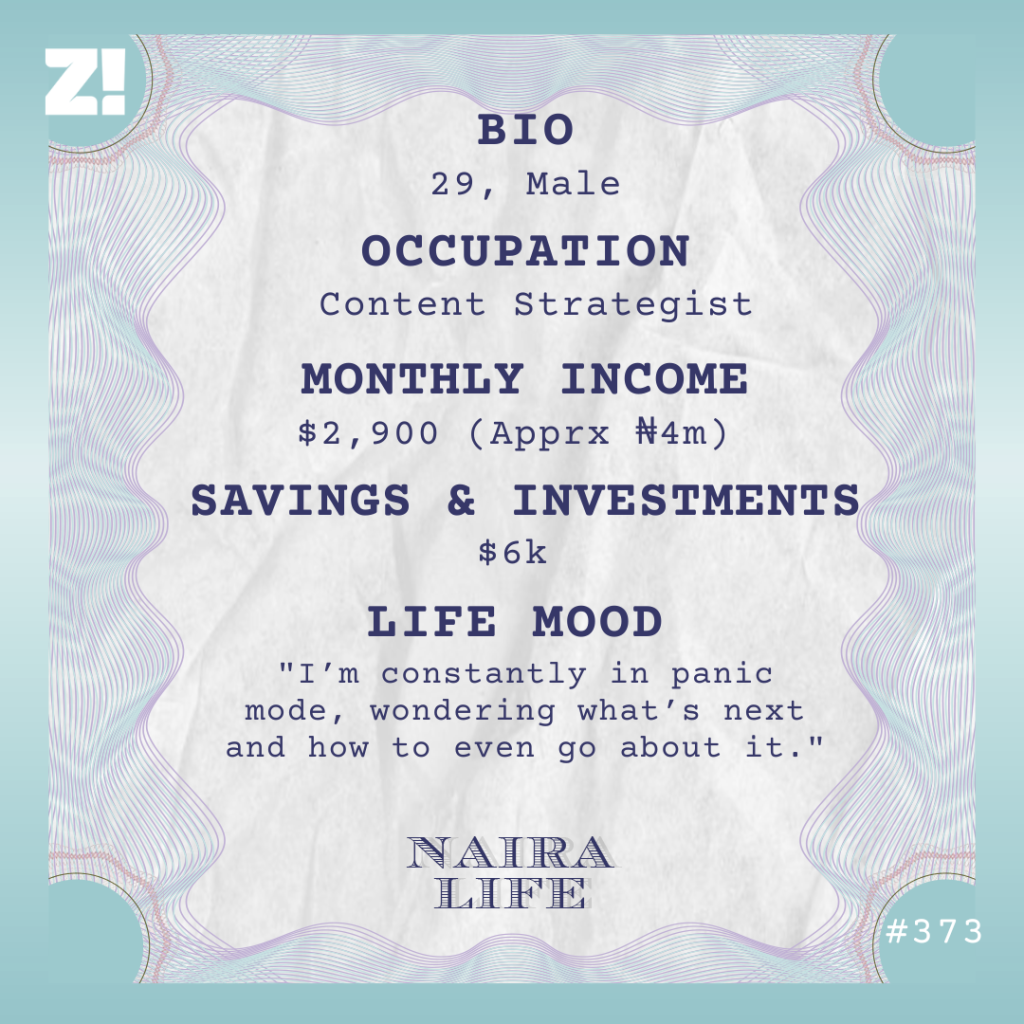
Since then, my growth has been incremental, and I keep exceeding expectations. In August 2025, I was bumped to $1,500. By October, it was $2,000. In January 2026, it was increased to $2,900 a month (roughly $3,000 with minor add-ons). Depending on the exchange rate, that’s about ₦4 million to ₦4.2 million a month.
That’s an astronomical leap from 2021. How has your lifestyle changed?
For a long time, I couldn’t save much because I was the sole breadwinner. In 2024, I went to postgraduate school, which cost ₦600k in fees alone. I also couldn’t cook much, so buying food cost me upwards of ₦5k to ₦10k every single day.
I still live with my family, and we don’t pay rent because a relative owns the building we live in. But I cover all utilities, light bills, and security fees. Last year, when I was making around $1,500 to $2,000, I managed to save about $700 to $800 a month, but lifestyle creep hit because I had to fix our living conditions.
The apartment was in a terrible state. I spent about ₦1 million repainting, installing fixtures, buying a proper work desk and chair, and upgrading my wardrobe so I could look presentable for corporate meetings and conferences. I don’t regret it, though. It was essential for my mental health.
I also recently spent ₦2.5 million on a solar and inverter system, which is hands-down the best investment I have ever made.
What do your typical monthly expenses look like now?
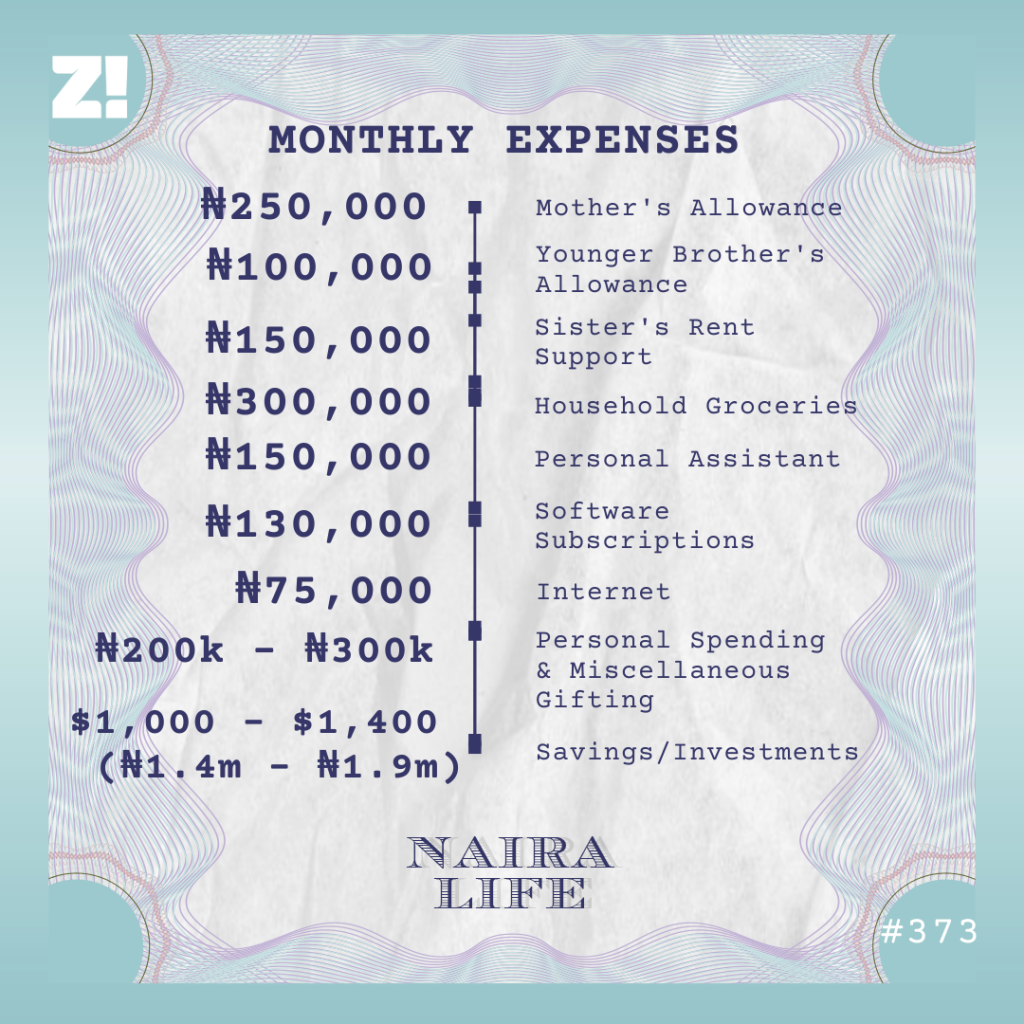
This year, I’m trying to be more intentional about savings and investments. The goal is to set aside at least half of my monthly income, but after random bills and family emergencies pop up, my actual net savings come down to about $1,000 a month.
What does your portfolio look like?
Right now, I have about $4,000 spread across federal bonds and stocks, and about $2,000 in my savings. The savings balance is lower than I’d like because of the solar project, but I’d rather have my money working in investments than sitting idle.
My ultimate long-term financial goal is to hit $2 Million. My dad was phenomenal at agriculture, and I want to eventually return to that industry and build a massive automated farm. My plan is to permanently quit corporate employment once my investment portfolio reaches $500,000 and launch that business.
The $500k goal seems far off, and I often beat myself up for not having more savings. But to give myself credit, I only started earning well about a year and a half ago, and my siblings only recently began to support themselves a bit. So, I’ve been learning how to be financially prudent, disciplined, and maybe a little selfish this year. I’m always too ready to give out money, and that needs to change. I’m taking financial courses and learning how to invest.
One thing I really want to do is work hard for a company that compensates accordingly. I know I work hard and do good work, but I’m discontent with where I am in the world. I’m earning more money than I ever have in my life, but I am disproportionately unsatisfied. I’m hungry, frustrated, and I always feel like I should be doing more.
Why do you think that is?
For one, I should be earning more. I’m acutely aware of the racial pay gap at my workplace. I’ve noticed that my white colleagues earn more, even though we do the same amount of work, or they do even less.
Also, I should be doing more. I’ve been questioning my career choices, wondering if I’m actually making any impact or changing lives. I want to do that, but it doesn’t feel that way right now. I want to make a real impact and also be financially comfortable — not necessarily super wealthy.
The impact thing is also hard because I constantly doubt my work. A little bit of doubt keeps you sharp, but it has also held me back from putting myself out there publicly.
I’ve worked with people who are incredibly vocal on LinkedIn, posting these high-flying, viral thought-leadership pieces. Then you meet them in real life and realise they are completely empty inside. I need to have more audacity.
Amen to that
Also, remember what I said earlier about not being afraid to start over? That’s changed since I started earning more. There’s a lot more to lose now, so I’m more fearful of my future. I fear I’ll be stuck in this line of work forever and not get to do meaningful work.
My friends and I recently started a social enterprise/startup, and part of me is constantly wondering whether I should save up $10k-$20k, then quit to take it on full-time. But then the fear creeps in. What if I fail and lose everything?
So, I’m constantly in panic mode, wondering what’s next and how to even go about it.
Regarding earning more, what’s an ideal amount you think you should be making now?
$7,500 – $10,000 monthly would be a sweet spot. I know people on my level earning more than that, but I’m willing to work my way up from there. I’m very sure that once I start earning that, I’d want to earn more. Still, I’m very grateful for where I am. When I was earning ₦25k, I couldn’t imagine earning ₦150k.
How would you describe your relationship with money?
It’s still unhealthy. I’m too flippant with it right now, and it’s a struggle to change that attitude. I think a lot of it stems from not having strong figures in my life who were good with money. My mum was overly generous, and my dad was just poor at managing money.
My vice is giving money away, which I’m consciously trying to change. I’m much better with money now than I was last year. It’s a gradual process.
Is there anything you want right now but can’t afford?
Initially, I thought it would be an MBA, but I’ve been doubting if that’s the next best step for me, given my line of work. I think a Master’s in my line would be better. Or, probably even better, a mentor who can show me the way.
How would you rate your financial happiness on a scale of 1-10?
5. I’m deeply happy that I multiplied my income, that my siblings are finding their footing, and that I can comfortably provide for my home.
The remaining 5 is completely missing because I am experiencing something like a midlife crisis. I feel this suffocating sensation, like someone is strangling my throat. Everyone on LinkedIn is pressuring you with one massive announcement or another. I know I am a hard worker who delivers exceptional results, but I want to push myself, and I’m unsure which direction to take.
What would make that score a 10?
Landing a job where I can see the immediate, tangible impact of my brain and hands on human lives, while being compensated accordingly.
Right now, I’m still at the beginner stage of my financial journey. I’ve mastered making active corporate income, but now I need to master passive wealth creation and long-term financial prudence. I just want to be certain of where I am going.
Once I reach that next stable level, I want to take a one-month trip to the Bahamas, where I don’t have to look at a laptop or worry about work. I’ve never taken a month-long vacation in my entire life. Knowing me, I’d probably get bored after a week because I get easily consumed by my work, but God, I think I’ve earned the right to try.
If you’re interested in talking about your Naira Life story, this is a good place to start.
Find all the past Naira Life stories here.