Every week, Zikoko seeks to understand how people move the Naira in and out of their lives. Some stories will be struggle-ish, others will be bougie. All the time, it’ll be revealing.
What’s your earliest memory of money?
It goes back to the late 90s/early 2000s, during my childhood days. Whenever we visited my maternal grandfather, he’d pull out ₦500 notes for my siblings and me. ₦500 was a fortune to a child, and we’d go wild buying biscuits and sweets. It was one of my first realisations of what money could do.
What was growing up like financially?
It was a rollercoaster. My parents were both bankers at Savannah Bank; they met and got married there. But around the time I was 6 or 7, the bank was liquidated, and they both lost their jobs. We went from “grace to grass.”
Phew. Just how bad did things get?
First off, we had to move from Bariga to some unknown place in Ikorodu to reduce expenses and survive. My siblings and I also moved from private schools to more affordable ones.
There’s a traditional Easter food called Frejon that we ate all the time. But after my parents lost their jobs, it became a once-a-year luxury. It got so bad that I’d follow my dad to pluck pawpaws, pineapples and pupuru tubers from people’s compounds just to have something to eat.
My parents eventually resorted to teaching. Despite the hardship, they were dutiful. They made sure all four of us kids focused on school without feeling like we had to look for money. It was only after secondary school that I started considering making money.
What did you do?
After graduating in 2011, I started offering home lessons for a neighbour’s kids three times a week for ₦4,000 a month. I did that for close to a year.
Then my parents separated, and I moved to join my mum in another part of Lagos. I noticed my mum was fending for herself without any support, so to reduce the burden on her, I got a teaching job at a local primary school. They paid me ₦4,500/month.
I worked there for four months, and the one thing I remember buying with my pay was a Nokia phone. I gave the rest of what I earned to my mum.
I did a few other teaching stints and some catering gigs in 2012, but my focus was JAMB, which I actually failed the first time. I finally got into university in 2014.
Did you try to make money at uni?
Oh yes. University was a mix of hustle and a massive miracle. My dad was carrying the financial weight alone because we lost my mum shortly before I gained admission. So, my pocket money wasn’t regular, and it was usually between ₦5k – ₦10k.
To survive, I did a few hustles. During a long strike in 2016, when I was in 200 level, I taught primary school students for ₦10k a month to save up for my ₦40k/year off-campus lodge. I also did some home tutoring around this period.
Then, in my third year, I got a scholarship from a telecoms company. They were paying me ₦200k every year as long as I kept my CGPA up. That money made my life soft, and I moved from a one-room lodge to a flat. I didn’t need to hustle as much from that point up until graduation because the money covered my needs. I just needed to focus on maintaining my grades.
Love it for you. When did you graduate from uni?
2019. But I missed something: I interned at a tech firm in Ikoyi for my six-month IT in 2018, earning a ₦25k/month stipend. That job introduced me to tech. I got to learn about programming languages like Java, and honestly, it was so hard I almost gave up. In fact, I didn’t return to it after school resumed.
However, after I graduated and did a stint in acting, I realised tech was the sure way to actually make money. So, during the 2020 lockdown, I sat down and used online resources to teach myself HTML, JavaScript and digital marketing.
Wait. Let’s not breeze over the stint in acting. How did that enter the picture?
I’ve always been a drama kid and was part of drama and music groups in church as a child. In 2019, I had the opportunity to train at a film academy for free, and I grabbed it. I acted in stage plays and a few films, and met renowned Nollywood stars. I even did comedy skits on Instagram.
I didn’t get paid for all of this, though. The compensation was mostly refreshments, which, sadly, is how the industry works. The exposure, on the other hand, was huge. It just wasn’t bringing in money.
I was living with my dad and surviving on what I made from tutorial lessons. Acting and filmmaking were passion projects. I had to follow the money, so I picked up my laptop and returned to programming.
The Naira Life Conference is returning in June 2026! Expect honest conversations and insightful sessions on building wealth, scaling businesses, as well as practical strategies to manage your money. Join the waitlist to be the first to know when tickets start selling.
Now we’re back to the tech chapter. Was it easier to learn this time around?
Somewhat. It helped that I was posted to a software company in Lagos for my NYSC. My role was “software developer,” and I basically learned on the job. They taught me languages like Angular, React, Typescript and a host of others. My salary was ₦50k/month, and I also got the ₦33k/month stipend from NYSC.
Right after NYSC in 2022, I landed a contract front-end developer role at a bank, earning ₦250k/month. In 2024, they made me a full-time staff member, and my salary jumped to about ₦557k.
That’s a big jump
It was. The increase even allowed me to move from a ₦250k/year self-contained to a ₦600k/year two-bedroom flat. However, in May 2024, mere months after my confirmation as a full-time staff member, I left the bank.
Oh. Why?
Convenience. I felt like a servant to the system, working from Monday to Friday. It wasn’t the kind of life I wanted to live. Also, I’d applied to a film academy to learn directing and film production, and there was no way I could do that while working at the bank. The whole 9-5 left just felt too restrictive. I wanted to live freely, so I resigned.
My training at the film academy lasted four months, and I paid about ₦250k for the course. I also got the opportunity to work as a production assistant for a major Netflix project.
How were you surviving during this period without an income?
After resigning, I focused on finding remote gigs. That was the only mode of work that would allow me to explore my other interests.
Thankfully, I found one almost immediately as a front-end developer at a fintech that paid ₦350k/month. In the mornings, I’d attend scrum meetings, then take my laptop to the film set and work from there.
I still work at the fintech, and my pay is now ₦420k/month. I’ve also worked for different companies since 2024, sometimes for only a few months and often juggling multiple roles at once. Even now, I earn the bulk of my income from short-term freelance gigs on Discord, LinkedIn, Indeed and wherever I see money. I’m also currently building my own startup.
Nice. Tell me about that
It’s a startup focused on pioneering STEAM (Science, Technology, Engineering, Arts, and Mathematics) solutions in Africa. Our first product is a marketplace that connects skilled service providers with recruiters and clients.
I got the idea for the startup in 2024 and got the business incorporated in 2025. We also recently entered into a service-level payment agreement with Paystack for payment processing on our platform. We plan to go live on the App Store and Play Store this month. So, a lot of resources will need to go into marketing and all that stuff.
What have been the financial implications of founding a startup?
I bootstrap everything. There was a time when I was juggling three jobs and using almost all my income to pay a UI/UX designer to build the web application. That cost me about ₦600k (including the necessary registrations with the CAC and NDPC).
Right now, I have close to 10 people on my team: two front-end developers, two back-end developers, two quality assurance people, and then UI/UX designers and marketers. Most of them are contract staff since it’s not a full-fledged company yet, and we haven’t made any money.
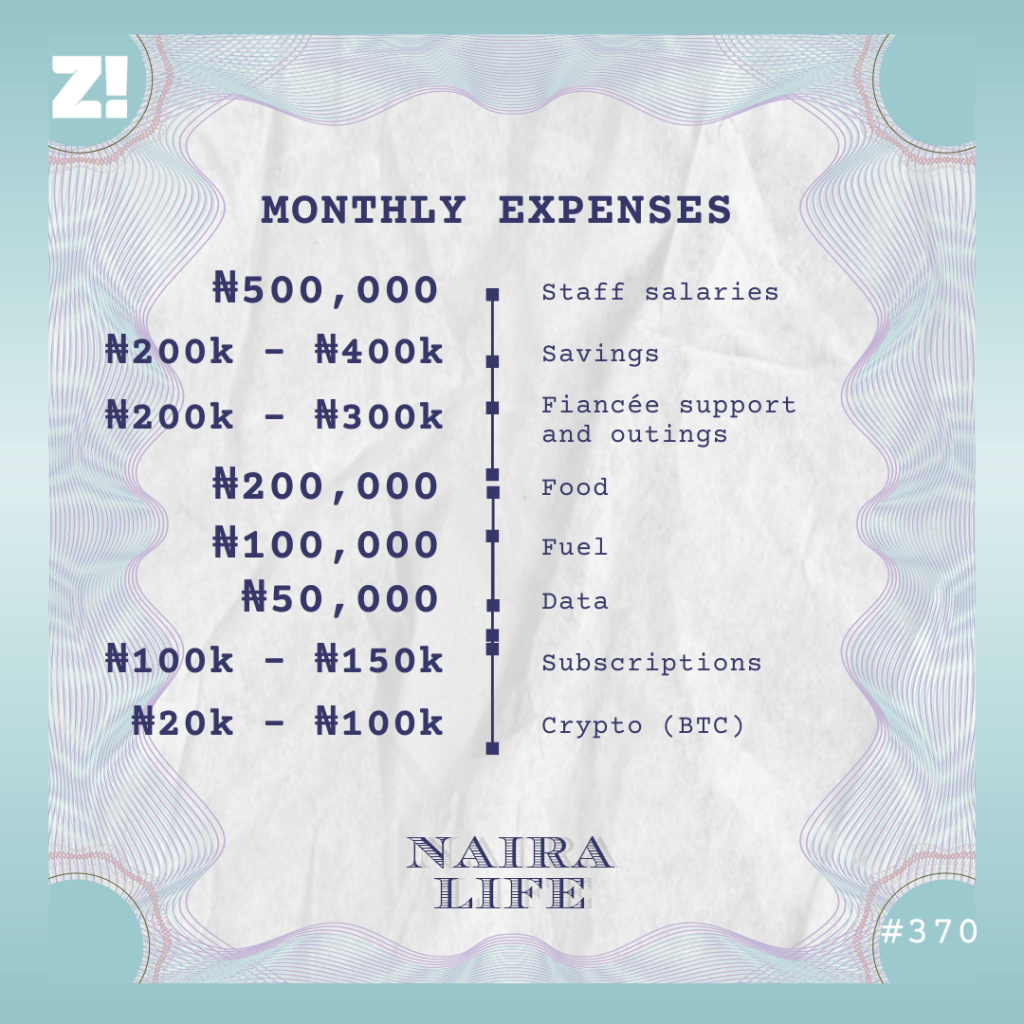
However, since October 2025, I’ve been paying at least ₦500k/month in staff salaries out of pocket. To afford this, I juggle my main remote job with the freelance gigs I mentioned earlier.
What does your average monthly income look like with those gigs?
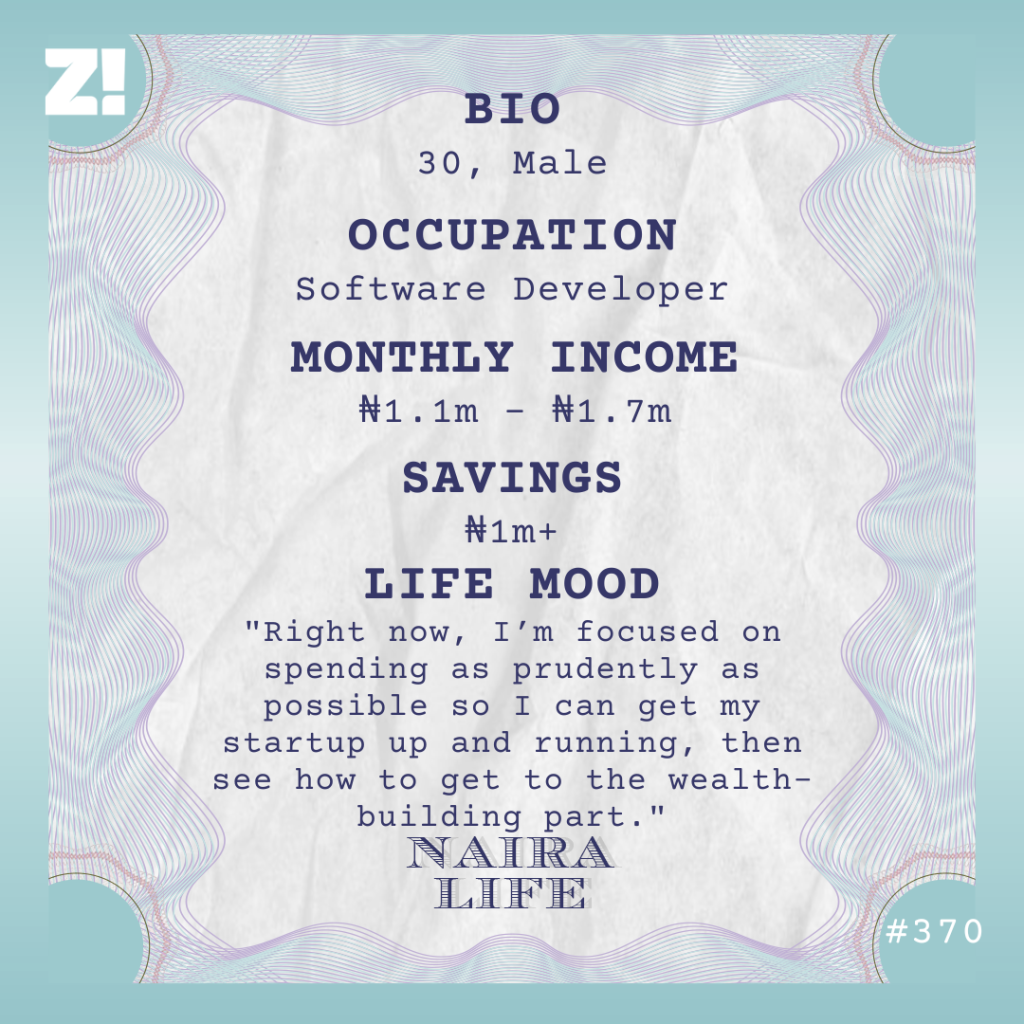
The freelance gigs pay in dollars, so it varies. Some months, I’m doing short-term contracts in the $1k-$2k range. On average, I bring in between ₦1.1m and ₦1.7m monthly, in addition to my ₦420k salary.
I still dabble in filmmaking, and I’m currently working on a couple of short films. I just don’t make an income from it yet. I plan to establish my own production company in the future, but that’s after the money from my startup starts pumping in.
Do you have a timeline in mind for this “pumping in”?
We’ll start earning revenue from the day we get our first user, since they need to pay an annual activation fee. Of course, it’ll probably take some time before user numbers enter millions and the big money starts to flow in.
But you know how they say, “you have to spend money to make money”? We plan to go really big on marketing and put ourselves out there. To make that happen, I plan to start searching for angel investors when we go live.
Zikoko is building an income report: a single, honest reference point for how Nigerians living in the country make money.
Please help us out by filling out this short, completely anonymous survey. It’ll only take a few minutes. Take the survey here.
Rooting for you. Let’s talk about your relationship with money
I believe money is a spirit. For someone to make money, they have to “feel it” first. If a poor person thinks that he’s wealthy, he’ll begin to attract wealthy people and ideas that, once implemented, can put him on the path to creating wealth.
Right now, I’m focused on spending as prudently as possible so I can get my startup up and running, then see how to get to the wealth-building part. Immediately I get paid from my gigs, I pay my staff salaries first, give my fiancée something, and then keep savings aside.
What’s your approach to savings?
I save between 10% and 20% in a savings app and another ₦20k to ₦50k in crypto. I’m using crypto as a fixed deposit. Every month, depending on the vibe, I buy a few coins and just leave them in my crypto wallet to appreciate over time.
Currently, I have about ₦1m in my savings app and $700 in crypto.
Let’s break down your typical monthly expenses
Is there an ideal amount you think you should be earning monthly?
I don’t have an ideal figure. I just want my startup to grow; there’s no cap on that one. I can make up to ₦100 billion in the near future. The goal is transcontinental impact; travelling across the world and taking our solutions everywhere.
Out of curiosity, do you intend to keep juggling multiple gigs once your startup goes live?
I’ll have to, at least for the next one to two years. I’m still bootstrapping, after all. So, the first few years will be to monitor the trend before focusing solely on the startup.
What’s something you want right now but can’t afford?
A car. I have a Ford Edge or Explorer in mind, and I’ll need about ₦15m – ₦20m for a Tokunbo.
How would you rate your financial happiness on a scale of 1-10?
5. I’m still juggling between survival and stability, and I haven’t even reached success yet. To hit a 10, it’ll mean I’m finally able to travel the world without ever having to check the ticket price. Until then, the hustle continues.
If you’re interested in talking about your Naira Life story, this is a good place to start.
Find all the past Naira Life stories here.