There’s a strange thing about how most universities are organised.
Everything is neatly separated.
Law students stay with law students. Engineers stay with engineers. Courses are arranged in credit units. Knowledge arrives through lectures, assignments, and exams. If you follow the structure carefully enough, you eventually graduate.
For decades, that structure has been the default design of higher education.
But the world outside the university rarely works like that.
Real problems don’t show up politely labelled by the department. A business issue might involve technology, psychology, law, and communication simultaneously. A public policy problem might mix economics, politics, culture, and ethics in ways that refuse to stay in one discipline.
Some universities have started quietly asking whether education should look more like the world students are actually preparing for.
At Veritas University in Abuja, that question seems to be shaping a number of small experiments across campus.
When Students Stop Waiting to Graduate Before Doing Real Things
One of the first things you notice about the campus is that a lot of activity happens outside formal classes.
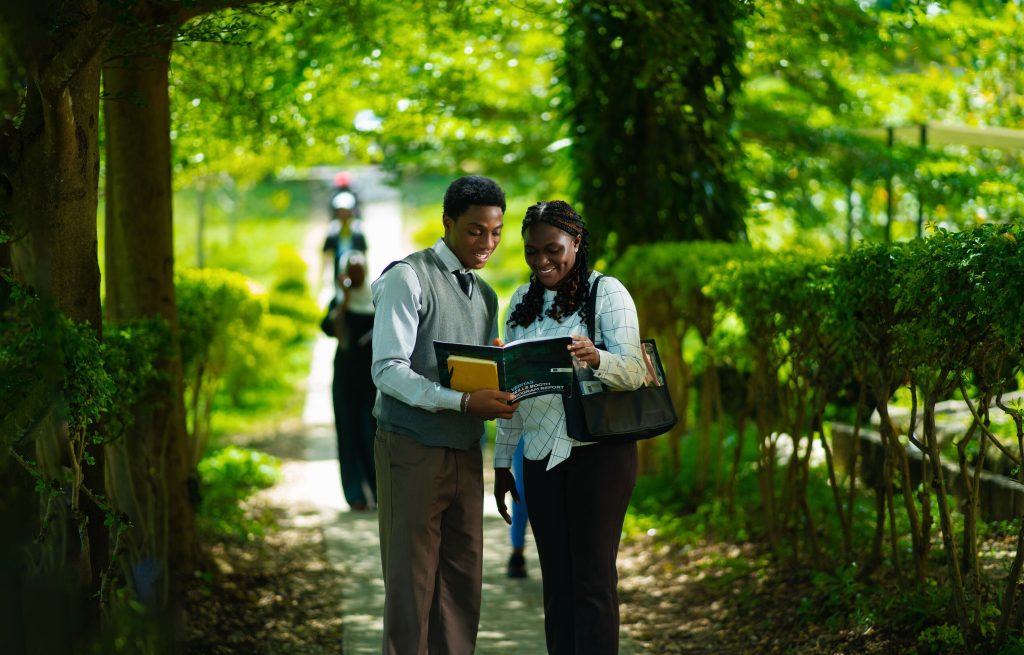
In one corner, students are arguing over public policy questions as part of a debate team that has gone on to win major competitions across Africa and beyond.
In another space, students experiment with media production, storytelling, and digital tools inside a growing creative hub. Some are learning photography, some fashion design, and others are exploring music production or visual storytelling.
Elsewhere, sports teams train with a seriousness that suggests competition beyond campus recreation.
None of these activities is new to universities. What feels different is how central they seem to be to the student experience.
They aren’t treated as hobbies that sit on the edge of academic life. They are becoming environments where students test ideas, build confidence, and develop skills that rarely appear on course outlines.
The Pattern That Starts to Appear
Over time, something interesting begins to show up.
Students who immerse themselves in these environments start producing outcomes that look unusually early for people still in university.
A school debate team begins collecting international trophies, including victories at the Pan-African Universities Debate Championship and strong performances on Commonwealth platforms.
One student earns recognition within Microsoft’s developer community while still early in his academic career.
Others begin working on media projects, community initiatives, or entrepreneurial ideas that stretch beyond the classroom.
None of these achievements is presented as part of a grand institutional theory. They simply appear as the visible results of students operating in environments that encourage experimentation.

When a Campus Starts Behaving Like a Community
Another thing you notice is the way different parts of the university interact.
Lecturers still teach classes. But many of them also supervise projects, mentor student initiatives, or guide teams working on ideas outside traditional coursework.
Alumni occasionally return to collaborate with student groups or offer practical feedback.
Industry professionals appear not only during ceremonial events but also in conversations about real projects.
The boundaries between “learning” and “doing” begin to blur.
The phrase “One Community,” which the university often uses, starts to make more sense when viewed through this lens. It isn’t only a cultural slogan. It describes how different parts of the university seem to interact with each other.
An Experiment Still Taking Shape
None of this suggests that the university has discovered a perfect model for education.
If anything, the campus feels like an experiment still in progress.
New initiatives appear each year. Some gain momentum; others quietly fade away. Students graduate, and new ones arrive with different ideas.
But the broader direction is becoming clearer.
Instead of treating university primarily as preparation for real life, the institution appears to be creating environments where students encounter real challenges earlier.
Whether that approach becomes more common across higher education remains to be seen.
For now, it simply raises an interesting question:
What if universities didn’t wait until graduation before letting students experience the world they’re preparing for?