• Every week, Zikoko seeks to understand how people move the Naira in and out of their lives. Some stories will be struggle-ish, others will be bougie. All the time, it’ll be revealing.

    The She Tank and BellaNaija are set to release a groundbreaking film as part of their 2024 Women’s Economic Power Campaign titled #HerMoneyHerPower. The film showcases real stories of women who have used their economic power to lift themselves and those around them, inspiring a younger generation to follow suit. Click here to find out more about the #HerMoneyHerPower campaign.
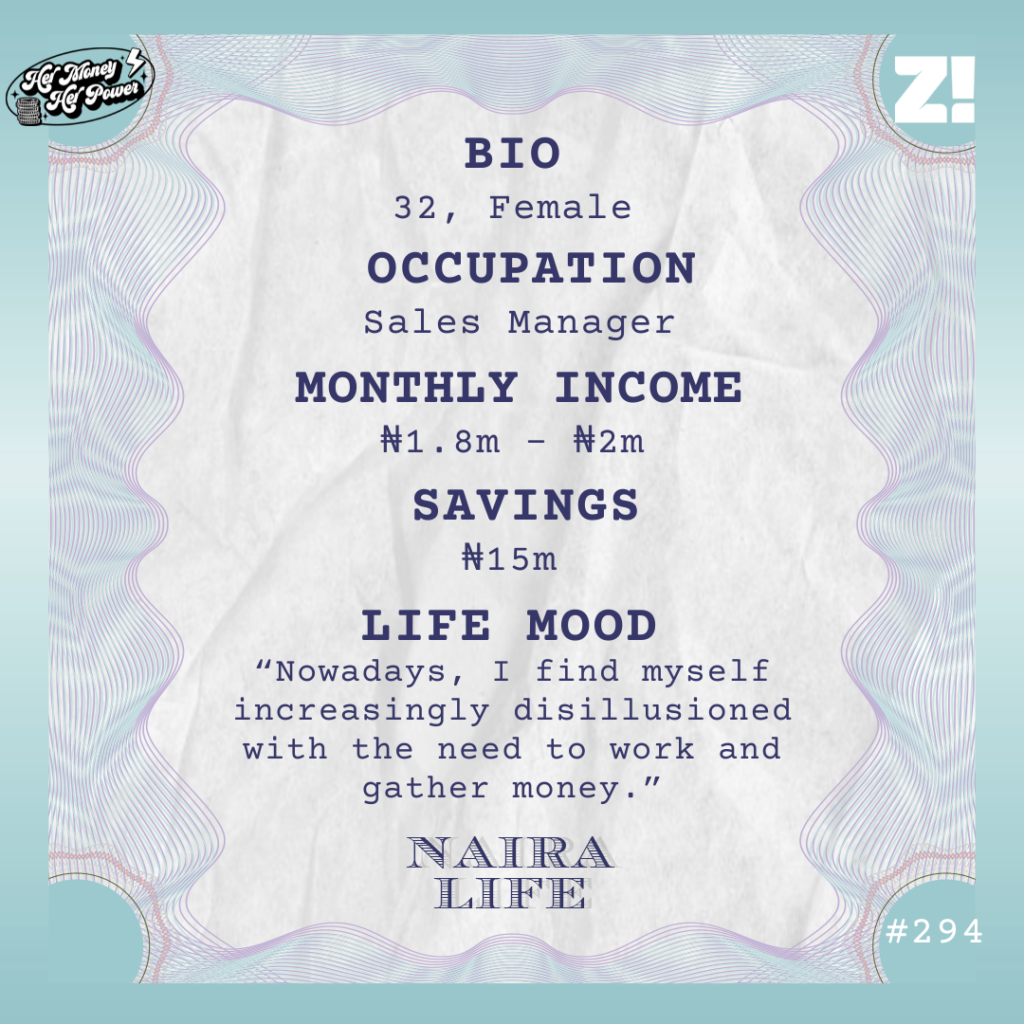

    NairaLife #294 bio

    Let’s start with your earliest memory of money. Do you remember that?

    I remember looking forward to every Eid celebration because my mum made me take food to our neighbours, who always gave me money in return. One neighbour always dropped at least ₦500. That was serious money to an 8-year-old. My siblings knew about his generosity, and we used to fight to deliver food to him. I often made at least ₦1k at the end of the day from these food runs.

    I saved my money to buy bangers in December, sneaking out of the house to light them with my siblings. Fun times.

    Your mum never asked to “keep the money for you”?

    She tried once, but my dad changed it for her. My mum was the frugal parent who always tried to manage money, but my dad was the jaiye jaiye type. The only arguments they had around us were on minor money matters. 

    My dad didn’t understand how he could be a major car dealer, and his wife would make a case for Nigerian cornflakes over a foreign brand to reduce costs. So when she tried to take the money my siblings and I made, he said, “Haba. Let these children be.”

    Thank God for daddy

    Haha, thank God. My dad tried his best to spoil us as much as my mum allowed. My mum was a stay-at-home mum, so she often “intercepted” any gift from my dad that she considered extravagant.

    For example, my dad gifted me an iPad after I passed JAMB in 2009. He thought it’d be great for uni, but my mum saw it as the weapon that’d push me into waywardness and a desire for expensive things. She seized that iPad and made me use a small Android phone instead. I was so angry. If I made my own money, would anyone stop me from getting nice things?

    Speaking of money, when was the first time you worked for it?

    2011. I started selling panty liners to my coursemates and hostel mates when I was in second year in uni. I got the idea from my cousin, who’d signed up to a business networking company that manufactured health and lifestyle products.

    As a member, she had access to the products and sold them in her university. She told me about it because she wanted me to sign up under her, but I didn’t have the strength to convince people to join anything. We just settled on her sending some of the products my way.

    I can’t remember every detail, but I made ₦800 in profit on every sale. The panty liners were a hit, and it was the first time I realised I knew how to convince people they needed something. 

    I sold the products for almost two years and made at least ₦30k in profit monthly. Add that to the ₦20k I got from home as a monthly allowance, and I was a pretty comfortable student. 

    Nice. What were your expenses like?

    The only thing I remember using the money for was an iPhone. I saved heavily through the year and bought the iPhone 5 in 2013. I think it had just come out and cost around ₦150k. Looking back now, spending all my money on one phone may have been foolish, but it was a reward for all my hard work.

    That same year, I did a three-month undergraduate internship at a production company. They only paid a ₦5k stipend, and I’d already zeroed my mind that I wouldn’t show up every day. ₦5k didn’t even cover my transportation for two weeks, not to talk for a month. But I changed my mind after my first two weeks at the company.

    Why?

    My supervisor was part of the sales team, and she intrigued me. She was so well-spoken and self-assured, it was like looking at a vision of what I wanted to be in the future. I decided there that I wanted to work in sales. 

    It’s dumb, but I somehow equated being confident with working in sales, and I wanted that. My supervisor also talked about meeting targets, but I figured selling wasn’t an issue for me. I mean, didn’t I sell out panty liners in school? Plus, she also got commissions for meeting targets, and the idea of extra money outside salary sounded good to me.

    I didn’t get into sales immediately after I finished uni, though. I taught for a while when NYSC posted me to a secondary school in 2015.

    Did you like teaching?

    Oddly, I did. I taught basic science, and I really vibed with my students. 

    The school paid me ₦10k monthly in addition to the ₦19,800 NYSC stipend. The job also came with free accommodation at the school’s sick bay, so I was pretty much chilling with my income. I also saved a bit. I finished the service year in 2016 with ₦120k in my savings. I didn’t have any plan for it; I just thought it was nice to keep money aside.

    What happened next?

    I toyed with the idea of staying back at the school to teach full-time. But they offered me ₦20k/month and the idea disappeared fast. I couldn’t imagine enduring five years of uni to come and be earning ₦20k. 

    I spoke to my brother about looking for a job and he connected me to a friend who worked at a management consulting firm. I applied, did the interviews and got employed as a business development executive. My starting salary was ₦85k, with the option of commissions if I brought in at least 12 new deals monthly. I usually averaged 6-8 monthly and even that was impressive. I was something like a superstar at work.

    After working there for a year, I was promoted to senior bizdev executive, and my salary increased to ₦120k. I’d been living with my parents since I returned home from NYSC, and after my promotion, I decided it was time for adult life. My mum kicked against it, but she calmed down after I pointed out that our house was far from my workplace. It wasn’t that far; I just wanted to leave.

    Tired of living at home, eh?

    Yes. I just wanted freedom. My mum had started to pocket-watch me, and it didn’t make sense to explain why I bought a new dress or listen to lectures about saving money whenever she saw me with a new shoe. I wasn’t spending frivolously; I just had to constantly update my wardrobe because my job involved meeting people, but my mum thought I was being wasteful. It was tiring.

    How did househunting go?

    Fortunately, it was pretty stress-free. I paid ₦10k to an agent my friend introduced me to, and we found the perfect apartment within two weeks. 

    It was a ₦400k/year apartment, but I lied to my parents that it was only ₦250k so they wouldn’t complain about it being too expensive. My dad gave me ₦300k, I made up the balance and moved in around 2018.

    Living alone wasn’t as easy as I thought. Suddenly I had to start caring when a light bulb stopped working and thinking about what I’d eat for the week. But I made it work. It just meant I had to budget seriously and cut down on some needs.

    For example, I learned to shop thrifted clothes rather than only purchasing overpriced boutique items. And I actually found gems in thrifted clothes o… unique pieces that no one would’ve guessed weren’t new after I washed and properly ironed them.

    I’m always up for thrift praise. Tell me more about how you handled budgeting 

    I created a simple spreadsheet where I tracked my proposed expenditure for a month versus what I actually spent that month. 

    I still use the same method to track expenses today, and it’s been very helpful. There’s no thinking like, “Ah, how did I spend money this month?” because it’s literally there in black and white. It’s also helped me become more intentional with saving.

    I’ve saved at least 40% of my income since I got another raise to ₦200k in 2019. Once I input the salary into the spreadsheet, it automatically calculates the 40%, and I send that amount to a separate account. Over the years, my savings have come in handy for emergencies and major projects. Like when my dad fell ill and passed in 2020, I used my savings to handle my share of the funeral expenses. 

    I’m sorry about your dad

    It’s fine. I often wish he’d stayed alive for at least another year; 2021 was my big break, and I’d have loved to spoil him a little. I landed a sales manager role at a fintech company and went from earning ₦200k to ₦750k from one job change. 

    That’s more than three times your previous salary. How did that feel?

    It felt like I was finally seeing the benefit of all my hard work. I was still going to be pursuing clients up and down like I did at my previous job, but the fintech job came with a 7% commission on every deal I landed in a specific category. 

    I’m still at the job, and my salary has increased over the years to ₦1.2m. With commissions, that’s often between ₦1.8m and ₦2m.

    That’s not bad at all

    It’s not. I know I’m more privileged than most, and I’m fortunate enough to afford to live below my means. My mum and siblings don’t bill me, so my primary responsibility is myself. But I’ve been battling a deep sense of tiredness and lack of motivation since late last year. 

    At first, I thought it was a desire to make more money, so I began applying for other jobs,  but when I got invited for interviews, I ghosted them. I’ve also gone on leave at work a couple of times, but I returned even more burnt out than when I left. I have a theory for why I feel this way.

    What’s that?

    I’ve worked nonstop since 2015, and it’s starting to catch up with me. Nowadays, I find myself increasingly disillusioned with the need to work and gather money. Like, is the point of my life to go from one meeting to the next trying to upsell people and pretend I’m passionate about one fintech product or the other? 

    To be honest, I’m considering quitting my job and taking an indefinite sabbatical to travel around Africa and see if I can drum up the passion to do anything again. Going on leave didn’t work because leave had an end date, and I found myself becoming increasingly anxious as the time to resume work grew closer. An indefinite sabbatical may be just what I need to get my head in the right place.

    Have you considered how you’d survive without a job?

    I think about that every day, and it’s the reason I haven’t dropped everything to sleep on a beach somewhere. 

    I have about ₦15m in savings right now—spread out across my mutual funds and dollar savings—but I know that’s nowhere close to sufficient to fund my travel dreams or keep me comfortably unemployed for long. My rent alone is ₦1.5m/year. It was ₦800k when I got it in 2022, but my Lagos landlord did what he knows best and increased it this year.

    I’ll need a safety net of at least ₦45m to plan an indefinite sabbatical without worrying about getting a job when I’m ready to work again. The way it’s looking now, I may only be able to achieve that by 2027, assuming I have no major expenses and manage to drastically reduce my living expenses or get an impressive pay rise. 2027 is still far away, but it’s the only hope I have right now. Let’s see if I can last that long.

    You mentioned living expenses. What does that look like in a typical month?
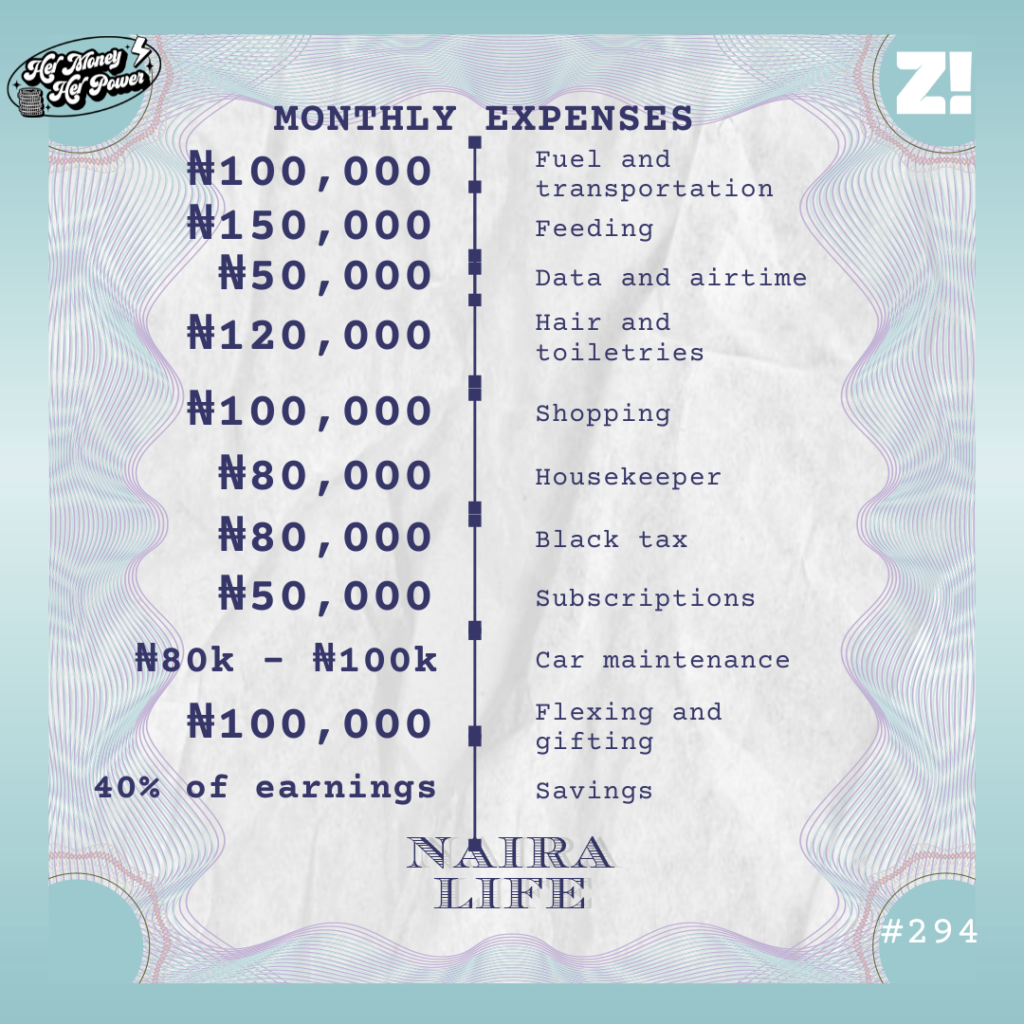
    Nairalife #294 monthly expenses

    My dad gifted me a Toyota Camry car in 2020, and that car behaves like an evil spirit. I’m constantly repairing one thing or the other. I can afford to sell it and buy another, but that’ll really eat into my savings and push my sabbatical plans even further. On the days I can’t manage the car, I just take cabs.

    How has your income growth over the years impacted your perspective on money?

    I used to consider money an all-important thing when I started my career, but now that I make more, I see that it’s essentially just a means to an end.

    Don’t get me wrong. I still like money and know how important it is — I wouldn’t be overthinking quitting if I didn’t — but it’s not a yardstick for happiness. It’s good to have money, but it’s not the most important thing. One can have millions of dollars and still not feel fulfilled. 

    Interesting. Do you think you’d return to sales if you eventually went on a sabbatical?

    I honestly don’t know. It’s been a while since I felt the rush of closing a deal that made me love my job. If that returns after my break, I might continue. If not, maybe I’ll just start dancing on TikTok. 

    Haha. What’s the last thing you bought that made you happy?

    A ₦500k wig I bought last week. I still randomly wear the wig around the house just to admire myself, haha. I can’t wait to install it.

    How would you rate your financial happiness on a scale of 1-10?

    7. I’m in a good place financially. But mentally? That’s most likely a 3.


    If you’re interested in talking about your Naira Life story, this is a good place to start.

    Find all the past Naira Life stories here.
    Subscribe to the newsletter here.

    [ad]
  • Every week, Zikoko seeks to understand how people move the Naira in and out of their lives. Some stories will be struggle-ish, others will be bougie. All the time, it’ll be revealing.


    Nairalife #292 bio

    Tell me about the first time you made money

    I was 13 years old and in SS 1. I had the bright idea of selling my sister’s time to senior boys in boarding school. She was in SS 3 then, and the finest girl in our school, and all the boys followed her like bees to honey. So, I monetised it.

    How did it even work?

    My sister and I are really close, but she’s quiet to a fault. I’m the stubborn, outspoken one. There was this boy in her class who liked her, but my sister was blissfully unaware. He came to me to help him talk to her, and I jokingly suggested he pay me ₦100 to arrange a time for them to talk during prep. 

    He paid, and I convinced my sister to talk to him. Then I did the same for another boy, then another. I got away with it five times before my sister stopped cooperating. 

    I still jokingly tell her we could’ve made serious money if she’d been more open-minded. Maybe she’d have agreed if I’d given her a cut of the money. But to be honest, it’s not like we needed the money.

    That means there was money at home, yeah?

    Oh, there was money. I come from a polygamous family; my dad had four wives and plenty of concubines, but he did right by everybody. My dad had filling stations, and all his women had their own houses. 

    My mum was the last wife and didn’t work — except for a lace store she kept for keeping sake — and my sister and I didn’t lack. I can also say we were spoiled. When I graduated from secondary school in 2010, my mum gave me a brand new Blackberry as a present. Blackberry phones were the iPhones of 2010. I was a big girl. 

    My mum doesn’t even know this, but I gave the phone to one foolish boy I liked at university. He broke my heart and refused to return my phone. 

    Breakfast … we’ve all been there. Talking about university, did you do anything for money while studying?

    I tried my hand at several small businesses, but I was a classic case of “money miss road.” I had too much money, and I’ll explain. 

    The minute I got into uni in 2011, I began receiving double allowance from both parents. They didn’t live together, so they sent me money separately, and I never mentioned that the other parent had already sent money. My mum sent ₦40k/month, and my dad sent ₦60k. Apart from the money, my mum regularly sent me foodstuff through other relatives. 

    Me, I was just spending like Mother Christmas. I had an off-campus apartment, and my friends loved to visit because I’d either cook or take them out. If I wasn’t buying my friends food, I was dashing them money. I once paid a friend’s ₦80k hostel fee because I was tired of looking at the money in my account. It was the same friend who suggested I try a business since I didn’t have anything to do with money.

    I’m screaming. So, what did you do?

    I decided to sell chiffon tops and jeans in 300 level. My sister introduced me to a friend who sold them wholesale. I think I bought each top between ₦1k – ₦2k, and a pair of jeans for around ₦2k. The first batch I bought cost ₦50k, and I added a profit of between ₦2k – ₦3k on each item and made good sales. But I didn’t see any money. Both capital and profit, I didn’t see. Everyone bought on credit and didn’t repay me.

    I think a major reason my friends were comfortable buying and not paying was that I already had a reputation for being Mother Christmas. Me too, I didn’t know how to pursue people for money, so I only asked a few times and left them. The business didn’t last three weeks.

    Next, I decided to sell makeup products. I used ₦30k to buy powders and brushes, but I ended up giving them out because marketing them was too stressful. Imagine someone asking whether the IMAN powder I was selling for ₦2500 was original. How will original IMAN be ₦2500? Nigerians should fear God. I sha left that one too.

    Then I tried to sell sneakers, but after I kept “collecting” my goods for personal use, I decided to hang up my entrepreneurial boots and call it a day. I survived on my allowance until I eventually left university in 2016.

    Let me guess. NYSC came after

    Yup. NYSC posted me to the north, but I wasn’t about to risk my life for ₦19800. So, I worked out redeployment through my dad’s friend to my home state. My PPA was a local government, and the only thing I did was to buy food for my supervisor. I did that twice before I gave myself brain and  decided I couldn’t use my one-year service to play errand girl, so I disappeared. I paid my supervisor ₦5k from my allawee monthly so I could leave to look for better opportunities.

    Did you find better opportunities?

    Not immediately. I wanted to get a job with one of the Big Four accounting firms, but omo, I saw shege with the assessment exams. When nothing came out of those, I took a gap year to just relax. I planned to rely on allawee and my mother’s food — an advantage of living at home. 

    But I almost didn’t survive that gap year sef — I was so broke. I didn’t realise just how little ₦19800 was until I had to live on it. I never went hungry o, but I was so limited. I couldn’t eat out with my friends or buy clothes and shoes. It was terrible. I couldn’t even whine my parents to give me money because they’d be like, “What are you using money for? Aren’t you at home?”

    I tried to find jobs halfway through the year, but the only one I found was a ₦50k accounting job, and the office was so far from my house. I’d have spent the whole salary on transportation. I didn’t take it.

    That period made me realise the importance of savings or a safety net before making foolish decisions like not wanting to work. Maybe if I’d saved when I was receiving so much money in school, I wouldn’t have felt like poverty was knocking on my door.

    Real. Did you have better luck with job search after NYSC?

    Not really. I wanted a job that paid nothing less than ₦120k. But I was broke, and beggars don’t have a choice. So, I settled for one at a small firm at ₦70k/month. This was in 2018.

    The salary wasn’t too bad, sha. My boss lived in my neighbourhood, so I hitched free rides with her daily. I wasn’t flexing as much as I did in uni, but I could afford to buy myself a nice bag after collecting my salary. I also tried to save at least ₦10k/month for my emergency savings.

    I worked at the job for almost two years before I got married and left in 2020. By the time I left, my salary had grown to ₦105k.

    Did marriage mean you had to stop working?

    Yes. My husband requested it before marriage, and he probably thinks I stopped because of him. Oga doesn’t know I was only happy to leave the workforce.

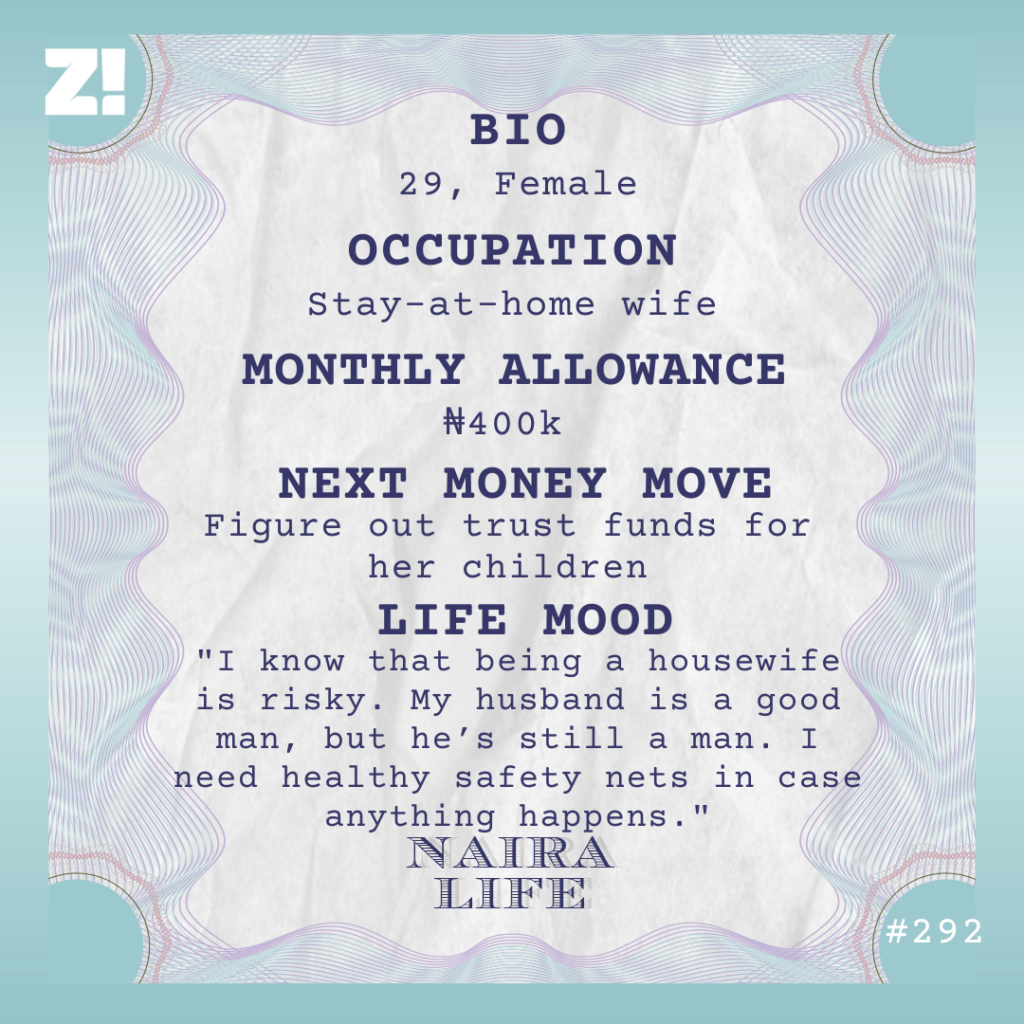
    A little backstory: My husband was widowed when I met him in 2019. His wife had passed away a few years before, leaving him with two children. He wanted someone who’d be there for him and the children. So, he was clear that he wanted a housewife.

    On the other hand, I was already looking for how to get paid to do nothing. I didn’t enjoy working and the idea of slaving all month for a salary that didn’t last two weeks. I was already checked out. But I didn’t tell my husband this sha. I made him believe he was asking too much of me. We came to a compromise — He’d pay me ₦300k/month as “salary” so I wouldn’t have to work.

    I have no choice but to stan

    Haha. That’s minus money for food at home and the children’s expenses. The salary is for me to spend as I like. My salary increased to ₦400k earlier this year after complaining about Tinubu’s economy and how inflation has made everything expensive. 

    However, the truth is, I hardly spend the salary. The ₦500k allowance I get for the home’s upkeep is enough to cover the necessities, and I still squeeze out a little to buy the random shoe or bag. I also whine my husband to give me extra money for aso-ebi and gold for family functions.

    My attitude to money has changed since I got married. I’m now very intentional about having different safety nets. I save and invest first before doing anything. I have about ₦2m in a secret savings account and two landed properties in my hometown. I also have a considerable gold collection I can sell in an emergency.

    Is there a reason for the sudden interest in safety nets?

    I know that being a housewife is risky. My husband is a good man, but he’s still a man. I’ve heard several stories about how men can suddenly start acting funny because their wives are 100% dependent on them. 

    Plus, he’s a Muslim. What happens if I wake up tomorrow and hear he wants to marry another wife? That might reduce my allowance. I also suspect he has a girlfriend, but I won’t bother myself with that. 

    I just need to make sure I have healthy safety nets in case anything happens. He doesn’t know about my properties, and I’m trying to convince him to build me a house as my next birthday gift. If anything goes south, I want a secure future for myself and our children.

    What needs to happen for you to know you’ve hit this goal?

    Hmm. I haven’t really thought deeply about this. I think the biggest indicator of a secure future is when I can afford to create a trust fund for my children’s school fees up until university. I’m not sure what that’ll cost yet, but this question has got me thinking about how I can do that. At least if anything happens, I should know I can keep my kids in school.

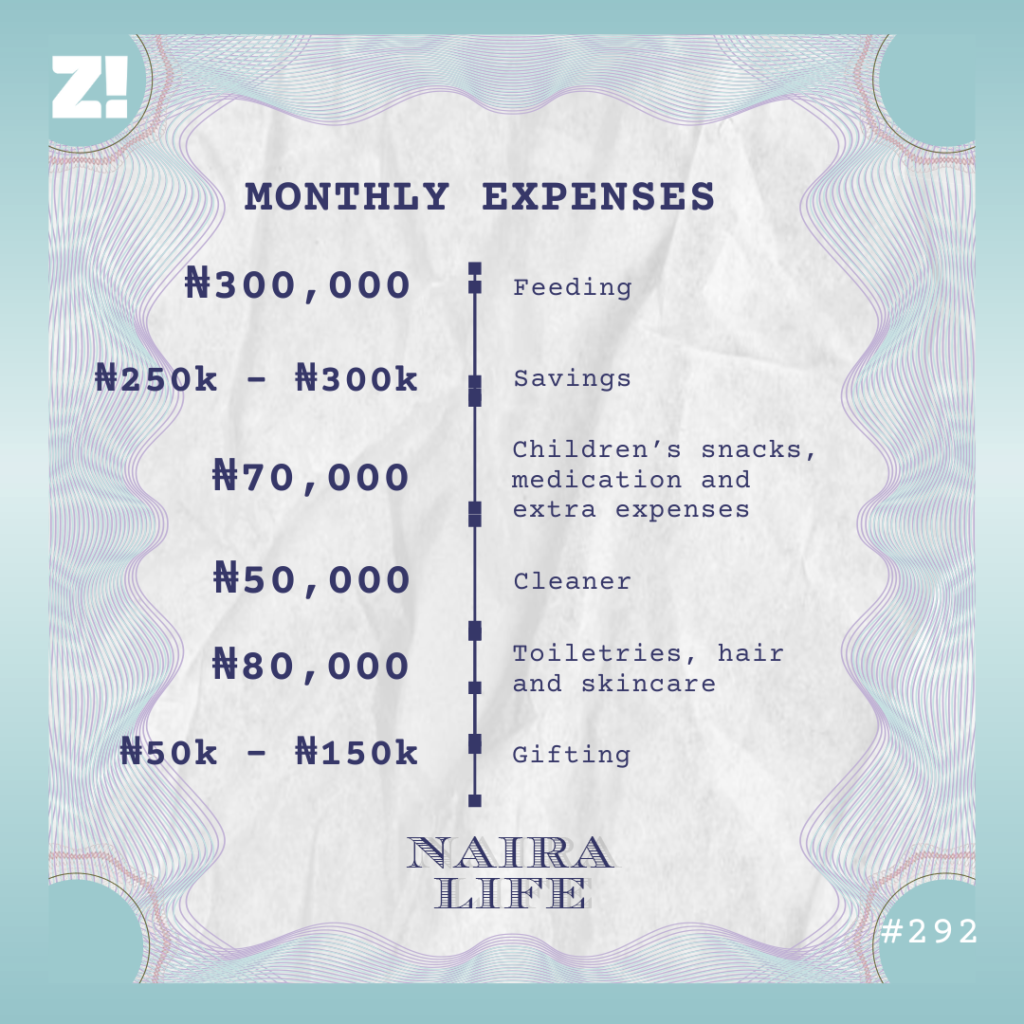
    Let’s go back to the monthly allowance and salary. How do you spend that in a typical month?

    Nairalife #292 monthly expenses

    My gifting budget is for the biweekly bulk cooking I do for charity. Sometimes, part of the money goes to settling people who come to me with needs. I send my mum a monthly ₦80k allowance, but that comes from my husband. It’s not part of my salary or home upkeep allowance. 

    Do you think you’d ever return to the workforce?

    What for? What am I looking for there? I intend to avoid having to work as much as I can. It’s not like I spend my days lazing around. I’ve had two more children since I got married, and taking care of four children isn’t beans at all. 

    A cleaner comes in twice a week, but I still feel like I’m constantly cleaning, cooking, and shouting at the children. I can’t add a job or business to the stress I already experience daily. That’s why I’d rather focus on having good investments and emergency savings to fall back on. 

    What’s an ideal investment portfolio for you?

    Real estate, gold, naira, and dollar savings. I’d like to own at least two houses and rent them out for extra income. If my husband builds me one, I’ll just have to focus on getting money to build the second one.

    I’m considering using one of my lands as a farm as I’m not building yet, but I’ll need to figure out how to get someone to run it so I don’t stress myself out. But then, I don’t trust Nigerians like that. I can employ someone to oversee the farm now, and they will use my money to enrich their own pockets. So, I may not do the farm thing. 

    I don’t have a cap on how much money I’ll have in naira and dollars that’ll be enough for me. I just want to have money.

    I get it. What’s the last thing you bought that significantly improved the quality of your life?

    This is funny, but I bought a child leash for my 1-year-old last month. We spent part of the summer holiday in my husband’s hometown, and I know my child likes jumping up and down. He literally watches for when you’re distracted so he can snatch his hand from your grip and rush into the road.

    I didn’t want him walking around, so I bought a child leash online for ₦50k and put it on him. It’s like a mini bag pack with a rope that I can snap on my wrist so he doesn’t go far. People kept looking at us weirdly, but I was so happy with my purchase. I wish I had known about child leashes for the other kids earlier.

    How would you rate your financial happiness on a scale of 1-10?

    7. I have all my needs met, and I don’t regret dumping my career. It’ll be a 10 when I have my houses.


    If you’re interested in talking about your Naira Life story, this is a good place to start.

    Find all the past Naira Life stories here.

    Subscribe to the newsletter here.

    [ad]

  • Every week, Zikoko seeks to understand how people move the Naira in and out of their lives. Some stories will be struggle-ish, others will be bougie. All the time, it’ll be revealing.


    Nairalife #286 bio

    When did you first become conscious of money?

    My parents separated when I was 7 years old. It didn’t become a financial problem until 2020, when I turned 15. Before this time, I went back and forth, living with both of them at different times. 

    I started living with my mum permanently in SS 1 and hardly got money from her. We didn’t have a great relationship and seldom talked to each other because she’d remarried, and I thought she focused more on her new family. So, I couldn’t tell her my school and personal needs. That wasn’t the case when I lived with my dad, and I realised I had to make money by myself.

    How did you do that?

    I began writing notes for my classmates for money. I attended a free public school, and most students didn’t take things like writing notes seriously. So, I charged them to do it. I wrote a full topic or two for ₦500 – ₦1k. If the topic was too small, I accepted snacks as payment. It was a win-win situation for me. The more I wrote, the more I read, so I liked it.

    I also washed clothes for two neighbours on weekends and made ₦5k/week from both of them. For the rest of secondary school, I fended for myself with both hustles. I also opened a student account and saved some of my earnings there.

    I’m curious. Why didn’t you ask your dad for help?

    Let me give you some context: My dad didn’t have a steady income source. He was a pastor and only got money when churches invited him to preach. It wasn’t an actual job. However, he always provided for me when I lived with him. During bad periods, he didn’t mind borrowing money to ensure I was comfortable. My mum worked as a caterer. When I moved in with her, she’d remarried and had other children. 

    It didn’t occur to me to ask my dad for money because I knew how difficult things were for him. Also, I think he expected my mum to sort out my needs because she basically forced me to come to live with her permanently. She arrived at my dad’s house one random Sunday and made me follow her. 

    But my mum barely provided for me. We had a huge fight once, and I accused her of focusing only on her new family. I told her to leave me alone and allow me to fend for myself. So, I guess that was a factor in why I had to be independent early.

    So, what did you do after secondary school?

    My mum enrolled me in a government-funded catering school in 2022. Tuition was free, but participants paid for materials and foodstuff for the practical projects. My mum gave me the money for each project — usually around ₦1k or ₦2k — for the first two to three weeks, then she suddenly stopped. 

    I kept washing clothes to earn money, so I had enough to get me through the six-month catering programme. I toyed with the idea of going to the university, but there were no funds. I also considered making money from catering, but I wasn’t sure how to start.

    So, I stuck with laundry, making around ₦5k/week. Then, one day in December, I followed a friend to the microfinance bank where he worked. I applied to work there as a joke. They told me to resume immediately.

    What role?

    Loan collector. Basic salary was ₦40k/month with a ₦5k monthly bonus for complete attendance at the office. There was also a ₦5k bonus for using my personal phone to work and incentives for every amount I retrieved from a debtor. In total, I made ₦50k – ₦60k/month. But the job came with many challenges.

    I’m listening 

    A big part of my job was calling debtors to remind them to repay the loans, and I had targets to meet. My colleagues often resorted to screaming at debtors, insulting them, and even intimidating them by sending false messages to their contact lists.

    At first, I found it difficult to rain insults, but I had to adapt when people refused to pay the money they owed. The only thing I didn’t do was send messages to their contact lists. I often missed my targets and was constantly threatened with losing my job. It was so stressful.

    On top of that, I started selling pastries at work. My goal was to make as much money as possible, save and then use my savings to return to school. So, three months into the job, I began making chin-chin and peanuts at home and taking them to the office the following day to sell to my colleagues. I figured I’d use the profit to sort out transportation and other minor expenses so I could save a bulk of my salary.

    Did it work out like you imagined?

    It did at first. I’d spend about ₦7k getting flour, sugar, and other ingredients to make a batch of pastries. I sold them at ₦100 each and made about ₦2k profit per batch. Then, after some weeks, more people started buying, and my profit grew to ₦4k. 

    I sold the pastries for only two months, though. The stress was too much; I’d return home by 11 p.m., make pastries, and wake up at 6 a.m. to prepare my siblings for school. The pressure from missing targets at work was also at an all-time high, and to make it worse, flour and sugar became wildly expensive. 

    A paint rubber size of flour shot up from ₦2k – ₦3k to ₦5k straight up. Sugar also went from ₦5k to ₦10k, and butter went from ₦1700 per row to ₦2,200. Every single day, the prices increased by an additional ₦100 or ₦200. I changed my pastry prices from ₦100 to ₦150 to try to meet up, but people complained, and I lost money. 

    I had to stop for my peace of mind. I even considered quitting my job too, but fortunately, I didn’t have to.

    Did anything change at work?

    Yes, and it’s still funny how it happened. Around June/July 2023, I went to work and was preparing to go round to collect payments when my boss stopped me and asked, “Can you do auditing?” 

    I replied, “Yes,” even though I didn’t know what she meant. It just sounded better than loan collection. The next thing she said was to ask me to resume at the auditing department the next day.

    When I got home, I did some research about auditing to understand what I’d agreed to. The next day, an existing audit staff member gave me a crash course about the department. That’s how I became an auditor at my job without a degree or any form of higher education.

    Does everyone in the auditing department have degrees? 

    Yes. Only people with BScs and HNDs work in auditing, and I’m still shocked I got the opportunity. My boss didn’t even ask to evaluate my CV or anything. I think it was just God’s grace.

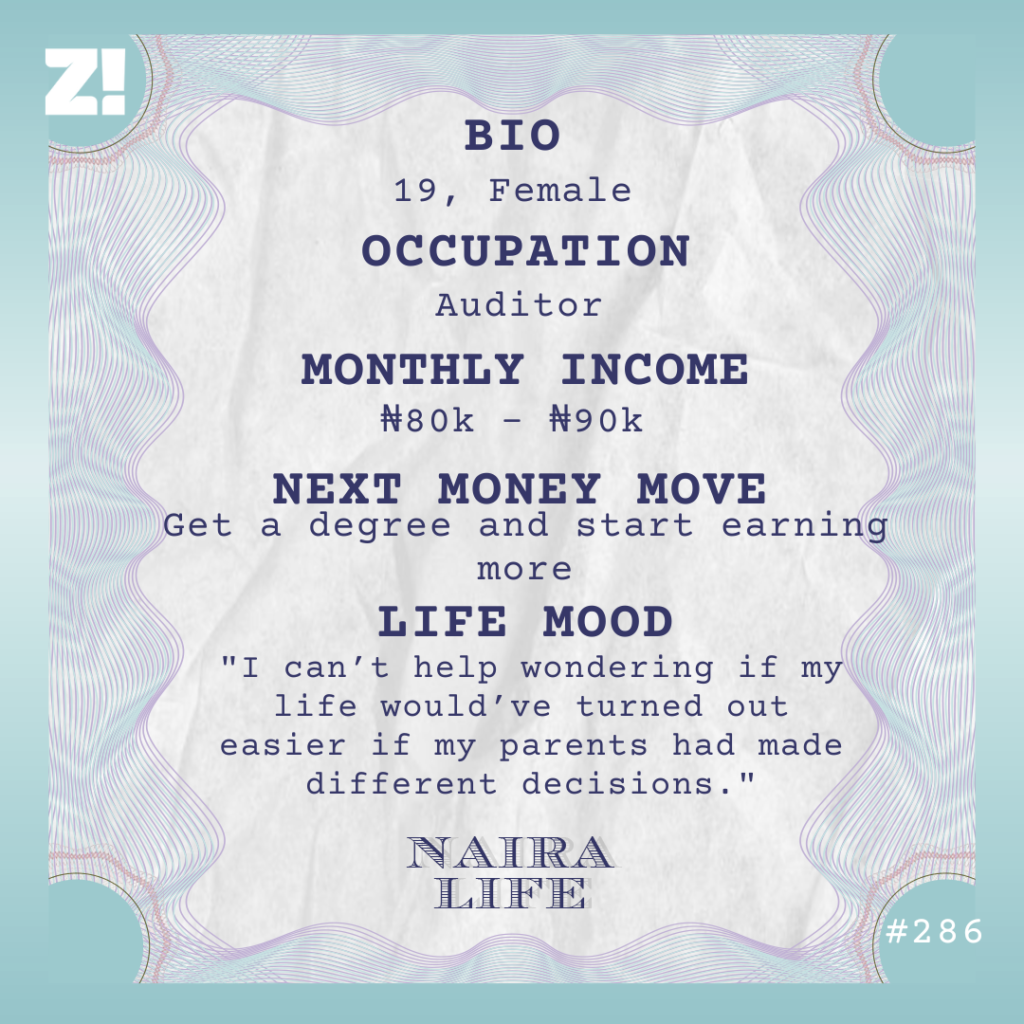
    My basic salary remained ₦40k, but my monthly incentives increased to ₦30k, bringing my salary to ₦70k/month. In March 2024, my basic salary was increased to ₦50k, bringing my total salary to ₦80k – ₦90k, depending on monthly bonuses and incentives. 

    There are no targets in my new role. My job description involves evaluating loan applications and reviewing customers’ information to confirm they sent the accurate requirements. It sounds simple, but it isn’t. Nigerians are funny people. They’ll comfortably send fake information just to get loans. 

    I’m screaming. What were some of the things you spent on?

    I mostly saved my salary for school. By July 2023, I’d saved about ₦300k, but I gave my mum ₦200k out of it to rent a house. It repaired our relationship.

    How so?

    I met my mum crying at home one day, and I found out that her husband had beaten her. It wasn’t the first time I’d noticed she had struggles in her marriage, and even though we barely talked, I’d told her to leave the marriage.

    When I met her crying that day, I brought up the topic of leaving again and offered to contribute money to help her find a new place. I think she didn’t expect that. A month later, we got a new apartment and moved in with my young siblings. After that, we had a serious discussion about our issues and made sure things were okay between us. We couldn’t afford to keep fighting when we now had only each other. I still have my dad, but our communication is quite rare.

    I’m glad you worked things out with your mum

    I am, too. We understand each other better now. My expenses have slightly increased because I contribute to the home’s expenses, but I try to save at least ₦30k monthly. My savings have grown again to about ₦380k, and I’m planning to use it to pursue admission.

    Have you made any attempts towards that?

    I’ve been trying since December 2023. I’m trying to work out a part-time program, but I’ve been stuck at the JAMB regularisation stage. I was admitted into a polytechnic and needed to register on the JAMB portal. However, the person who created the profile forgot to link my correct email address to the registration number before paying. 

    This means I only got a JAMB-generated email, which I have no access to and no way to complete the process. I’ve tried to change it, but it’s been an extremely long back-and-forth. I’ve spent ₦60k on the whole admission process, but it looks like I’ll have to abandon it and try again next year.

    I hope it’s resolved soon. You seem intent on getting into school

    To be honest, it’s the degree I’m pursuing. I’ve tried applying to other jobs, but they ask for a BSc or HND certificate. I need school to get better career opportunities.

    However, if I were to attend university to study what I’d like, it’d be law. I’m outspoken, and I’d like to help people who don’t have a voice. But studying law would mean quitting my job since I can’t take the course part-time. Where would I get the money from? 

    I’m pursuing mass communication now. Maybe if I graduate and there’s still time, I can study law. I also plan to take a short auditing course someday.

    How would you describe your relationship with money?

    I’m always on a budget. I’m extra careful about what I spend money on and how I spend it because any mistake means hanging on by a thread till salary enters again. I don’t think I’ve ever made a bad financial decision.

    What would you say has influenced your thinking around money?

    My family’s situation. I was pampered before my parents’ final separation. I had no business thinking about money. But when I started fending for myself after their separation, I realised that money isn’t easy to make, and I needed to be careful with how I spend it. Managing money became all I could focus on.

    Sometimes, I wake up and cry when I remember my financial situation. I’m not 20 yet, but I already have so much to shoulder. I’m going through life without a safety net, which means I have to create my own. So, I must consciously save and save because I don’t know what can hit me in the future. My mum doesn’t make much as a caterer, so I can’t depend on her. I’m always stressed about money, and I think I’m even at risk of developing high blood pressure.

    I can’t help wondering if my life would’ve turned out easier if my parents had made different decisions. My siblings will also go through this when they get to my age because their father is not around too. I just hope I can be financially there for them when the time comes. 

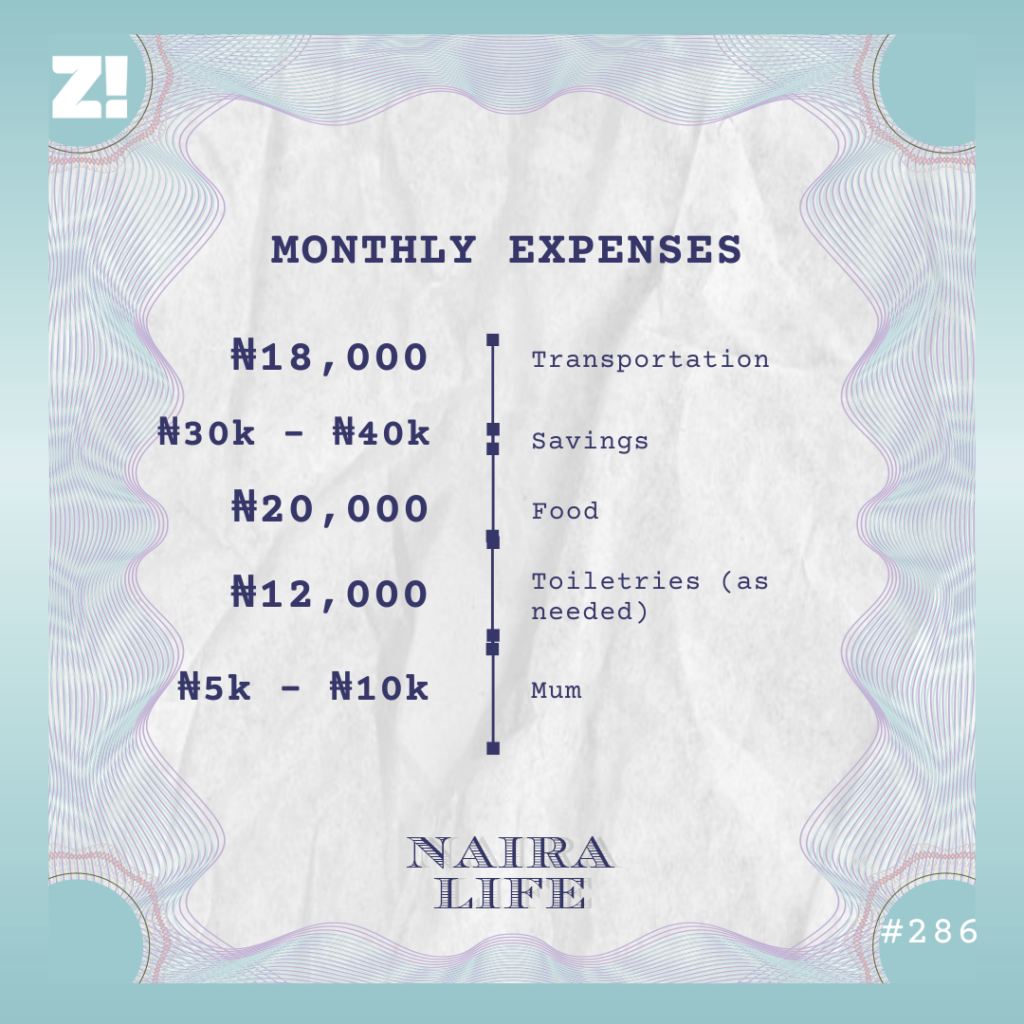
    Rooting for you. What do your typical monthly expenses look like?

    #Nairalife 286 monthly expenses

    I don’t spend on data or airtime because I get ₦500 airtime daily at my job, and I have enough left over at the end of the day to use for data and calls.

    Is there anything you want right but can’t afford?

    A new phone. My phone has been damaged for a while now, and I had to choose between fixing it and buying a new one. I settled on fixing it since I couldn’t afford a new one, which cost me ₦25k.

    How much do you need to earn to worry less about money?

    I feel like, the more you earn, the more your responsibility increases. But I think ₦200k/month would significantly reduce my stress levels.

    How would you rate your financial happiness on a scale of 1 – 10?

    4. I’m surviving despite the fact that I don’t have a certificate, but I don’t like having to think extra hard about how to avoid going broke while still providing for my family. It’s a lot.


    If you’re interested in talking about your Naira Life story, this is a good place to start.

    Find all the past Naira Life stories here.

    Subscribe to the newsletter here.

    [ad]
  • Every week, Zikoko seeks to understand how people move the Naira in and out of their lives. Some stories will be struggle-ish, others will be bougie. All the time, it’ll be revealing.


    “Do crypto with Quidax and win from a $60K QDX prize pool!” Bayo, a 28-year-old Lagosian tells Jide, his Ibadan friend seeking the most secure way to trade crypto in Nigeria after a major exchange he trades with announced its plans to leave the country. Find out more here.


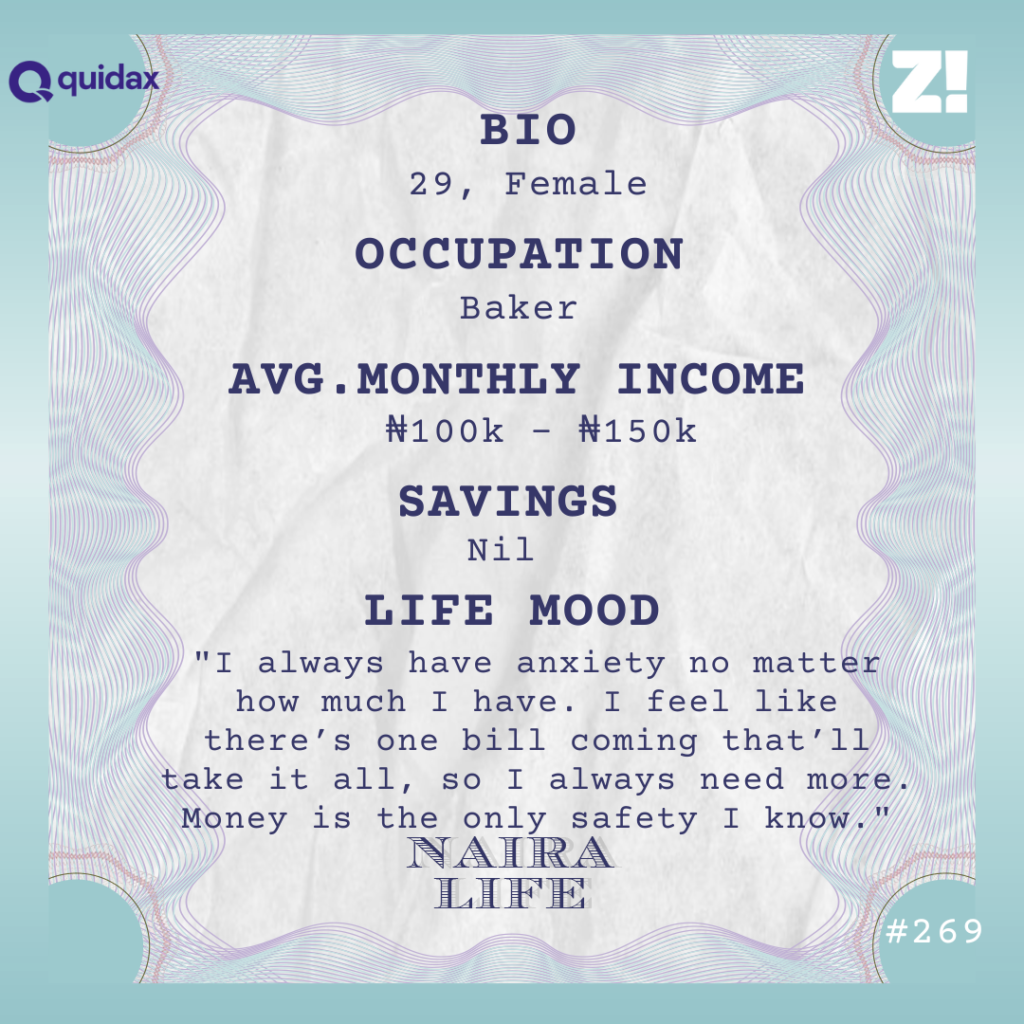
    Nairalife #269 bio

    When did you first clock the importance of money?

    When I was about 8 years old, I noticed the kids in my neighbourhood came out to play with their bicycles every evening. I felt out of place because I didn’t have one, and the kids didn’t let me play with them. I asked my mum to buy me one, and she said, “You’ve not even seen money to eat, you’re thinking about a bicycle”. 

    Me, I wanted to play and make friends, and I thought I could only do that when I had money to buy my own bicycle. 

    What was the financial situation at home like?

    My dad was a welder for offshore companies, but the early 2000s Warri Crisis forced some of these companies to leave the country. Then he didn’t get regular jobs anymore. 

    Plus, my dad wasn’t good with money. Whenever he got a temporary offshore job and got paid well, he’d spend it on electronic gadgets rather than follow my mum’s suggestion and invest in a business. I’d come home from school to find a new television when the old one was still working. Or he’d do some repairs on his car or buy a new freezer. So, my parents always fought about money.

    I’m the firstborn, so I noticed how his financial habits contributed to the tension at home.

    How did your family navigate the periods when he didn’t have a job?

    My mum used to be a stay-at-home mum until things got tough.  Then, she tried many things; from selling fabrics and hawking food to taking cleaning jobs, daycare and catering gigs. Her businesses hardly took off because my dad always came to borrow money, but at least she made sure we weren’t homeless and always brought food home whenever she went for catering gigs.

    Watching her try several things for money, coupled with my dad’s financial habits made me think a lot about money. There was a limit to what I could get because of money, and I just wanted to make my own.

    When did you first act on this need to make money?

    In SS 1. My mum used to cook for a neighbour occasionally. One day, she had a small get-together and came looking for my mum to cook for her. My mum wasn’t home, and this lady said I should follow her. She assumed I could cook since my mum was a good cook. I didn’t tell her I’d never cooked in my mother’s house. I followed her home and cooked fried rice. I went from never cooking at all to cooking fried rice at 13 years old.

    Please tell me it ended well

    Surprisingly, it did. My heart was in my mouth when she tasted it, but she said, “This is nice. Your mother taught you well.” She even said I’d cook for her the next time my mum wasn’t around. She paid me ₦3k, which I used to buy foodstuff and cook for my siblings before my mum returned. I was feeling like a small mummy. My mum was pleasantly surprised when I told her what happened.

    Did the cooking gigs become regular?

    Somewhat. My mum started passing down jobs to me during the weekends. All the money I made was for the house: I never really thought of it as mine. Besides, the only thing on my mind was finishing secondary school at 16 and doing what was expected of me: studying medicine so I could become a doctor and turn the family’s fortune around. 

    Nigerian millennials everywhere can relate

    Well, I failed two core subjects in WAEC in 2011 and couldn’t get university admission that year. Even worse, it had taken serious convincing for my dad to add to what my mum had scraped together for my WAEC fees. When I failed, he said I was useless and concluded I’d get married because he had washed his hands off my education.

    Since school wasn’t on the horizon, I got a teaching job at a nearby secondary school.

    How much did it pay?

    ₦4k/month. I did the job for a few months till some family members convinced my parents to let me write NECO and JAMB. I got into university in 2013. It wasn’t medicine sha. 

    But my dad refused to pay my fees, and my mum had to do a lot of running around to raise my fees. He later chipped in, but it was mostly my mum. It was clear from that moment that I’d have to take care of myself in school. They’d settled school fees. Everything else would be on me. 

    How did you manage this?

    I had a stint serving drinks at a bar three times a week for ₦4,500/month. But I stopped after a few months because the male customers kept touching me, and the bar owner was only interested in keeping his customers.

    Then, I worked as an attendant at a fuel station for ₦7k/month. Since I was still in school, I shared a shift with someone else and only worked half days. I hated the job because I had to stand for hours. I left after about three months.

    Also, I had a much older boyfriend —  I was 19, and he was in his 40s — who used to give me ₦10k – ₦15k every other week. He also paid for my hostel accommodation once. 

    My boyfriend kept saying he wanted to marry me. I didn’t mind because he had a two-bedroom apartment, a car, and seemed rich. At least, I’d be comfortable. Anyway, I saved up most of the money he  gave me and began selling beaded items in school.

    Did you make them yourself?

    Yes, I did. I’d make the beads and post them on Facebook. A bead set went for ₦2k – ₦2,500. My profit on each sale was about ₦1k.

    On the side, I was making ₦5k or ₦7k cooking for some Yahoo boys I’d befriended in my apartment building. They liked my food, so the money was regular. 

    While that was going on, the guys noticed I was well-spoken and started asking me to check for typos in the messages they wanted to send to “clients” to confirm there weren’t any typos. Sometimes, I’d edit; other times, I’d help them write the messages. Anytime they got paid, they’d give me between ₦30k – ₦50k as appreciation. The highest I ever got was ₦100k.

    Those were my major income sources between first year and second year of uni. I was making money — approximately ₦40k weekly — and even sending some home. Because of that, I stopped paying attention to school. I hardly attended classes because I couldn’t leave someone calling me to cook for one rubbish class. 

    That must’ve affected your grades

    It did. I had F parallel during the second semester of my 200 level. I had so many carryovers to write. But I was focused on making money. So, I started selling essential oils, too. I was also trying to raise money to start a hair business. The plan was to get hair from a distributor and resell them. It was lucrative at the time, so I saved everything I made so I could invest in it.

    Around this time, my relationship with the older guy had ended, and I met another one online. The new guy was in his 30s and lived in a different city. I think he was the first person who told me he loved me. I told him about my plan to start a hair business and he seemed proud that I was so hardworking. I had saved ₦300k+ by that time.

    A few weeks after I told him about my plan, he called and said he’d been in an accident. Then he ended the call. 

    An accident?

    I was confused too. He was unreachable for the next couple of hours, and I was worried. When he eventually called back, he said he was in the police station. Apparently, he’d hit a woman and her child with his car, and the police held him, asking for about ₦600k. He said his bank app wasn’t working and asked me to lend him the money, promising to pay back as soon as he was released.

    I didn’t stop to think. I just thought, “Well, he’s my boyfriend” and sent him my entire savings. He encouraged me to borrow the remaining ₦200k from people, and I did. After he got the money, I didn’t hear from him again.

    Damn

    I didn’t suspect anything at first. I thought he was still in danger. After three days, I borrowed more money to travel to his city to check on him. I met an empty house, and it was obvious someone had just packed out. I asked a neighbour, and they said they saw him leave a few days ago, and it looked like he was relocating. 

    At that point, my whole world shattered. I have no idea how I returned home that day. I was walking on the road, and tears were falling down my face. How could I have been so stupid?

    I’m so sorry

    I had lost everything I’d ever worked for and was about ₦300k in debt. I couldn’t tell anyone what happened. I stopped attending classes and didn’t even go out. I honestly wanted to die. 

    I started to “borrow from Peter to pay Paul” when my creditors started calling for their money. I’d take new loans to pay my old ones. I even used loan apps to fund a gambling habit I developed.


    RELATED: The #NairaLife of a Pharmacist Who Overcame a Loan App Addiction


    How did you start gambling?

    I picked it up from a neighbour. I desperately needed money and I asked him to teach me how to play but he refused because “babes no dey do this kind thing”. Instead, he suggested I give him money so he’d play for me. If he won anything with my money, he’d take a small percentage and give me the rest. I thought it was a good idea, so I agreed.

    I started giving him ₦500 – ₦1k here and there for him to place bets. I don’t even know if he was placing the bets or using my money to smoke weed. But every time he’d come and say the game “cut”, and I’d give him more money for another “sure game”. I don’t know if it was desperation, but I just believed I’d win big one day and clear all my debts.

    Did you win big?

    I didn’t win anything. I was still getting cooking gigs, but they didn’t come as frequently, and everything I made went into paying loans and feeding. At one point, I dropped out of school completely. I was keeping to myself a lot and my friends just thought I was going through heartbreak. They didn’t know about the loans. I didn’t want to ask for help because I felt like I needed to solve everything myself.

    I became homeless because I couldn’t pay rent. I started moving from one friend’s house to the other. They didn’t know I was homeless. I’d just be like, “I want to come and stay with you for one week,” and then I’d move to the next friend. I ended up staying with some of them for up to a month at a stretch. 

    It was crazy. I sank into a bad depression and was in limbo from 2015 to 2017. In 2017, I had to open up to my friends because the compounding loans were killing me. They pulled funds together, and I started to clear the loans. But then I saw an investment opportunity that promised to triple my money in two weeks.

    Hmmm

    See, I was at the mercy of people giving me ₦10k – ₦20k, and I didn’t want to rely on that. I wanted to make my own money, too. So, I took ₦100k that people had gathered for me and put it in the firm, expecting to make ₦300k. That ended terribly. I never saw one kobo.

    At that point, it felt like there was no end in sight to the series of bad financial decisions I was making.

    Thankfully, my friends helped me clear my debts completely in 2018. That’s also when my parents realised I’d dropped out of school.

    How?

    My mates were already going for NYSC, so they obviously had questions. I told them, and they were so disappointed. I couldn’t even go back home because I was ashamed. By this time, I’d rented another apartment with a friend’s help, so I just stayed back around school. 

    But I didn’t have a job or business. My mates had finished school and moved on with their lives, and I was still there. 

    I had nothing to my name and didn’t even know who I was. I sank into another depressive period that lasted until 2020. This time, it came with suicidal tendencies. I’d constantly overdose on drugs, and my neighbours would break down my door and rush me to the hospital.

    When I wasn’t trying to kill myself, I was just existing. I’d go for days without eating until my friends sent me money. The last time I attempted suicide in 2020, someone told me, “Maybe you should just die so everyone will rest”. 

    Ah

    I think, in the end, it was my friends’ encouragement that restored my will to live. They kept telling me things would get better, and I started to believe them. I was angry at this “things will get better” statement for a long time, though. I mean, I was a uni dropout in my 20s without a job, no relationship, and even my parents weren’t talking to me. Where was the “better”? But my friends didn’t let me give up.

    Towards the end of 2020, I decided to return to cooking. It was the constant in my life, and I thought, if I could go to culinary school, I’d even be able to make a career out of it.

    In early 2021, I got two steady clients. Between the two of them, I was sure of at least ₦100k/month. 

    Things were looking up

    A little. But then my mum became hypertensive and had a stroke, and I had to start chipping in money for drugs. She was no longer with my dad, so I was also supporting my siblings in school. For every ₦100k I made, more than half went to my siblings and mum. So, that didn’t help with planning for my life or even culinary school. 

    What are things like these days?

    Still pretty much the same. One of my siblings is waiting for NYSC and the other one is in final year at uni, and most of my money still goes back home. I really don’t think I’m living for myself. There’s always one need back home, and money is never enough. I have things bookmarked that I’d like to buy, but I can’t even think of buying them. I always think of home first.

    Do you still rely on cooking gigs?

    I learnt how to bake in 2022. Since culinary school wasn’t an option, I paid about ₦300k to learn to make cakes and small chops. 

    My plan was to set up a cute pastry shop, but I quickly realised it was capital intensive, so with the help of my friends again, I got a bigger ₦300k/year apartment with a big kitchen so I could bake in my kitchen and save on rent. It limits the number of cake orders I can get because some orders require storing products, which is a hassle without a freezer. The last time I priced a small freezer, it was ₦185k.

    In a good month, I can earn between ₦100k – ₦150k from baking and cooking gigs. Sometimes, I don’t earn anything and have to rely on the grace and kindness of my friends. My financial life is very up and down.

    You’ve mentioned your friends turning up for you a lot. Do you ever worry about relying on them too much?

    All the time. I struggle with asking for help until things are falling apart. Anytime I have to pick my phone to ask for something, I feel regret and shame. These are my agemates, but I have to depend on them again and again. 

    My friends probably don’t feel the same, but I feel like a nuisance. It’s not great being the broke friend. No matter how kind people are, nothing beats the peace that comes with having my own money. 

    Plus, there’s a way people treat the broke friend. For instance, when my friends do things that piss me off, I can’t react or call them out because what if they choose to be vindictive and ignore me when I need help? It’s like I have to give away little parts of my dignity because I need them. 

    I’m also like the last person they think about for events or get-togethers. Like, why send an invite when I probably don’t even have money to attend? It hurts seeing the people I care about doing fun things and realising I’m the only one not there. But I can’t even be angry because if they invite me, I can’t afford it. 

    How many times will I say, “Sorry, I can’t make it”?

    That’s relatable

    But my friends are really good to me o. If not for them, I probably wouldn’t be alive to talk to you. I met most of them on social media, and they’ve helped my life. I just feel foolish that I can’t reciprocate. I’m the friend who writes long notes on birthdays because I can’t buy a gift. They love the notes, but I want to buy them gifts. I feel inadequate.

    Sorry you feel that way. Let’s break down your monthly expenses

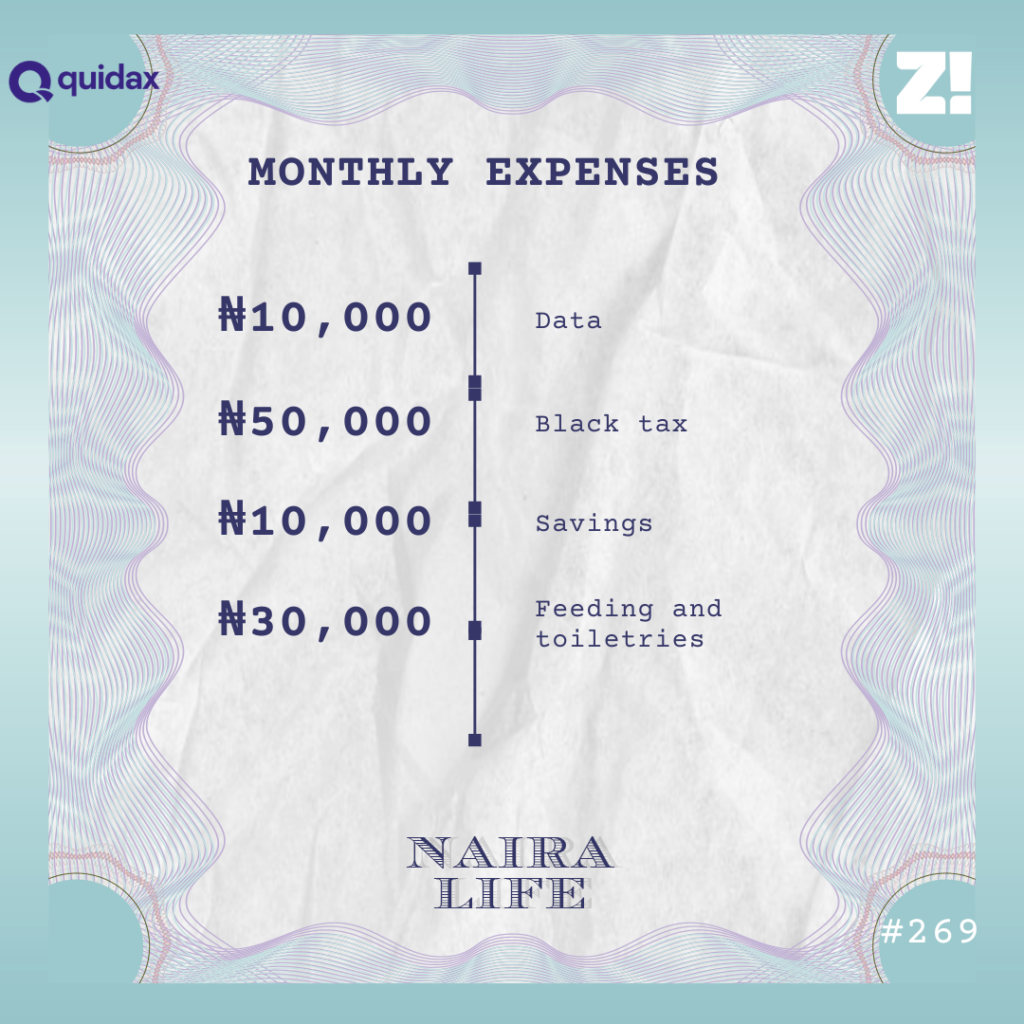
    In a month that I earn ₦100k, my expenses typically go like this:

    Nairalife #269 monthly expenses

    It involves a lot of manoeuvring to make it work. My toiletries are just sanitary pads and deodorant. That my savings figure is a delusional thing I like to do. I remove ₦10k and put it in a savings app, but then I collect it two days later when I need money. All my money goes into black tax and trying to survive. I honestly feel like I’m just existing. 

    How would you describe your relationship with money?

    I always have anxiety no matter how much I have. I feel like there’s one bill coming that’ll take it all, so I always need more. Money is the only safety I know. I don’t want to return to the point I was years ago — gambling and in debt. I want to have so much money to the point where I never have to worry about it again. 

    How have your experiences shaped how you think about money?

    Money gives you human dignity. Not having it can make you less than human. People can disagree and say, “But you can have a good quality of life without money”. It’s a lie. I’ve seen poverty, and I’ve seen how people treat me when they think I have money and when they know I’m completely broke.

    It may be unintentional, but there’s this condescension towards poor people. People are always ready to advise me, like I’m completely clueless. They say, “Oh, why can’t you start a business?”. My darling, it’s money I’ll use to start it. Or “Why not learn a tech skill?” Sweetheart, it’s still money I’ll use to buy a laptop and data. People think I don’t have money because I’m stupid. Like all my problems would disappear if I only listened to their advice. 

    That’s a lot to think about. Are you still pursuing culinary school?

    Oh yes. It’s still a dream. I want to become a chef so I can tell my mum I’ve taken her cooking gigs a step further. When this happens, I can confidently say I have a career. You can ask my friends what they do, and they quickly respond, “Software developer”. But I don’t have one straight answer. I have to start explaining how I bake, cook and write sometimes. That’s why I need this to happen.

    But culinary school would require me to leave my state, move to Lagos, and spend a couple millions on school fees. I don’t have that yet. I’d also like to return to school one day and get my degree, but that feels like a far-fetched dream.

    How would you rate your financial happiness on a scale of 1 – 10?

    1. I can’t afford a good life. I’m always scraping the bottom. I can’t even afford to lose ₦100 from my account. I’m always anxious, and it’s not a great way to live. I feel like I’m failing at life.


    If you’re interested in talking about your Naira Life story, this is a good place to start.

    Find all the past Naira Life stories here.

    Subscribe to the newsletter here.

    [ad]

  • Every week, Zikoko seeks to understand how people move the Naira in and out of their lives. Some stories will be struggle-ish, others will be bougie. All the time, it’ll be revealing.


    What’s your earliest memory of money?

    I remember older people “dashing” me money out of pity. I lost my dad when I was one and was an only child for the first 12 years of my life.

    On random Sundays,  my mum would take me to greet one wealthy church member or the other, and they’d hand me wads of cash. I used to go to primary school with ₦200, even though I didn’t spend more than ₦50 on food. The rest, I spent as I pleased.

    I don’t know what it meant for my mum and grandparents to provide for me, but I know I was quite comfortable.

    You grew up with your grandparents?

    Yes. After my dad passed, my mum moved back in with her parents. Then, she went back to school and married my stepfather after she got her Higher National Diploma. 

    My stepfather doesn’t live in the country but has a couple of businesses here, so my mum manages them.

    This is a good place to ask about the first thing you did for money

    While trying to get into university in 2013, ASUU went on a six-month strike. My secondary school’s principal encouraged me and some other new graduates to return to teach the junior classes. 

    So, I started teaching a special needs JSS 2 student maths, English and basic science lessons on weekdays and got paid ₦10k monthly.

    It was the first time I had money that wasn’t given to me. I spent most of it on clothes, and because I didn’t really know what to do with money, I also naively lent some to my mum’s sibling who lived with us at the time. Of course, I never got the money back.

    I was at the job for two months and left after the term ended. By the time the new term started, I had gotten into uni. I started classes in January 2014. 

    Did you do anything for money in uni?

    I didn’t. I’d say it was because I grew up without needing to be financially responsible for myself. Apart from the gifts I got when I was younger, my stepfather took on the responsibility when my mum married him, so I never worried about money.

    I only started working after graduating from uni in 2017. There were some delays with my clearance for NYSC, so I took up a client communications internship with a financial institution the following year.

    How did you get the job?

    I had been home for about four months doing nothing, so my stepdad spoke to my half-sister who worked there. Fortunately, they were taking interns, and I got in. It paid ₦60k/month (₦3k per each day you worked).

    Most of my salary went into paying for data to stream movies. I also tried to save, but after spending heavily on data and buying ₦1k chicken and chips daily, I realised ₦60k wasn’t plenty money. 

    I also gave a cousin ₦20k once to help pay her uni admission acceptance fee. Like me, she also lost her dad early, and we’d grown close. So, she and her siblings tend to look to me as an elder sibling, and I support them occasionally.

    I spent only five months at the company, though. 

    Why did you leave?

    I was supposed to go back to school for clearance. I lived and worked in Lagos, and school was in Port-Harcourt. But something happened, and I couldn’t go again. To think that I already resigned officially.

    Yikes. So, what did you do next?

    I stayed at home again for another three months. In January 2019,  I got another job as an audit intern. This time, the salary was ₦40k/month.

    How did this one come about?

    My stepdad came through again. His cousin owned the company and helped me get a foot in. This time, though, I spent all the ₦40k salary on transportation. We lived on the mainland, and the office was in Ikoyi. My stepdad even had to give me an additional ₦40k monthly for the two months I worked there so I could fend for myself.

    You worked there for only two months?

    I resigned when it was time to return to school and finally do my clearance and convocation.

    I eventually got called up for service in June 2019 and was posted to Jigawa. But I redeployed to Ogun where they first sent me to a village. Then I worked my way to a government office. However, I never actually worked there.

    How?

    They weren’t paying corps members stipends, and I wanted to return home. There was no point planting myself in Ogun when I didn’t see a future there, and there were better career opportunities for me in Lagos.

    From my ₦19,800 NYSC allowance, I paid a guy at my PPA ₦6k monthly and a lady at CDS ₦5k/month so I wouldn’t have to show up. I did have to go to Abeokuta once a month for clearance, and the cost of transportation was ₦5k. At the end of the month, I’d only have ₦3k left from my allowance.

    What were you doing in Lagos?

    My half-sister got me another internship with the same financial institution in August 2019. The payment structure was still ₦3k for every day I worked and ₦60k/month on average. But they started deducting 5% of my salary for tax, and I was left with ₦57k/month.

    This was how the internship worked: The company had different projects at different points in time. A regular team handled these, but but sometimes they had a lot of backlogs to clear. They hired interns for the number of months required to clear them. 

    When I came on, they needed interns for a year. So, I joined the reconciliation and resolutions team, and my job was data entry and extraction. I was there until March 2020, when the COVID lockdown sent us all home.

    What happened after?

    I was at home. I even tried my hand at a YouTube lifestyle channel, but I only did it for a bit and stopped. Now, I regret I didn’t use the opportunity to build skills in data science and analytics. I became interested in the field during the internship, and I still feel like I wasted time not acting on that interest. Maybe it’s because I didn’t have enough career information then. I’m on my younger cousins’ necks now to build skills so they don’t waste valuable time like I did.

    But what was money inflow like?

    Remember the internship was for a year? It was supposed to end in July, but we had to close work in March. However, they paid our salaries till July. I was also collecting NYSC’s allowance, which had increased to ₦33k. So, that’s what I used to cover my data expenses, food — I had moved in with a family to be closer to work — and sometimes send money to my cousins. 

    I also got random ₦10ks from my stepdad when I complained about needing money. I returned home in July and had no income till August —I received a payment from my late paternal grandfather’s property.

    What property was that?

    My grandfather had five flats. Each flat was given to one child as an inheritance. Since my dad was dead and I was his only child, the rent income from his flat was given to me. 

    I got ₦140k in the first year. It was supposed to be ₦400k, but my uncles said they removed some money as my contribution for my great-grandma’s 50th memorial party and some remodelling work at her grave. 

    It’s an annual payment, so I expected ₦400k the following year. But I got ₦300k. I believe they think I’m young and have no responsibilities, but I don’t fight it. I’m just glad to receive something.

    I get what you mean. Back to 2020 

    I wasn’t getting an allowance since I was home, so I managed that ₦140k from August till December, when I got a modelling gig. 

    How did you get into modelling?

    It was a one-off gig, really. I’d been interested in modelling since 2016 but decided to explore it with a friend who had a modelling agency in 2019. We tried to get me cast for a fashion week show, but I didn’t get in. 

    In December 2020, I auditioned for another fashion week. I got in and was paid ₦200k for the five-day event. 30% of the pay was my friend’s — technically my agency’s — cut, so I got ₦140k at the end. 

    Subsequently, I did a couple of free gigs where they’d pay for my transportation and snacks. I did another paid job in May 2021, though: a designer paid me ₦50k for a one-day show. After the agency took its 30% cut, I was left with ₦35k. 

    I stopped modelling entirely when I wanted to gain weight, but my agency kept pressuring me to lose even more weight. 

    We were given specifications, too. Your hips couldn’t be more than 33 inches, your bust 31 inches, and a waist between 24 and 26 inches. It was too stressful for me, and I wanted to look healthy. I’m 5’10, and I weighed 55kg. By BMI calculations, I was underweight. I just decided to let it go.

    Were you doing something else for work?

    Yes. The income from modelling wasn’t consistent, so I took up another brief internship with the financial institution in 2021. It was the same ₦3k daily arrangement, but I had completed NYSC and was qualified to apply to be a full-time staff member. A month into the internship, I applied to go full-time, but I failed the test.

    Oh, no

    It was really depressing. I felt like I’d lost an opportunity, and I disliked how they didn’t even rate interns and treated us anyhow. Soon, the work environment started affecting my mental health, and I resigned after three months. 

    Funny enough, two weeks after I left, I heard that some interns spoke with management to increase the daily pay. Instead of increasing it, they fired all the interns and got new ones.

    Mad o

    I’d always been interested in natural hair. So, after doing nothing for two months, I started an apprenticeship with a natural hair care salon. My stepdad paid ₦75k for the training, which lasted seven months. 

    I wasn’t paid during that period. Thankfully, my stepdad came through again and put me on an ₦80k monthly allowance.

    After the training ended, they offered me employment as a junior stylist. I did that for only a month.

    Why?

    They paid ₦40k/month, but I worked six days a week. The distance was also a factor. I was on the mainland, and the salon was in Ikoyi. So, I was always late, and they’d always complain about it. 

    Plus, I noticed some senior stylists only got paid ₦50k to ₦60k/month. The manager’s salary was ₦120k. It was obvious there wasn’t much hope for income growth. Granted, the customers were rich IJGBs and Ikoyi wives who tipped well, but it wasn’t sustainable. The entire salary was only enough for transportation, and I couldn’t rely on making an average of ₦1,500 daily in tips.

    Were you spending on anything besides transportation and food?

    Those were my major expenses. There were also the occasional expenses on clothes and other stuff. I just know I didn’t usually have money left to save.

    What was the next step after leaving the salon?

    I began applying for bank graduate trainee opportunities. I also got into a self-paced data science and analytics training with a data camp. It was free, and I had access to the courses for one year, but I couldn’t practise what I was learning because I didn’t have a laptop. It’s still there if I ever get the chance to go back to it.

    In September 2022, I got accepted into two banks, and I picked the one whose training school started earlier. Plus, the other bank had a clause where you had to work for two years or pay ₦2m if you wanted to leave before then. The bank I chose had a one-year compulsory stay clause and ₦1m in lieu of one year. It was a no-brainer.

    Training school covered a six-month period, which was later extended to eight months due to a couple of delays with the bank. I was paid ₦60k/month for the first four months before it was increased to ₦100k/month for the remaining months. 

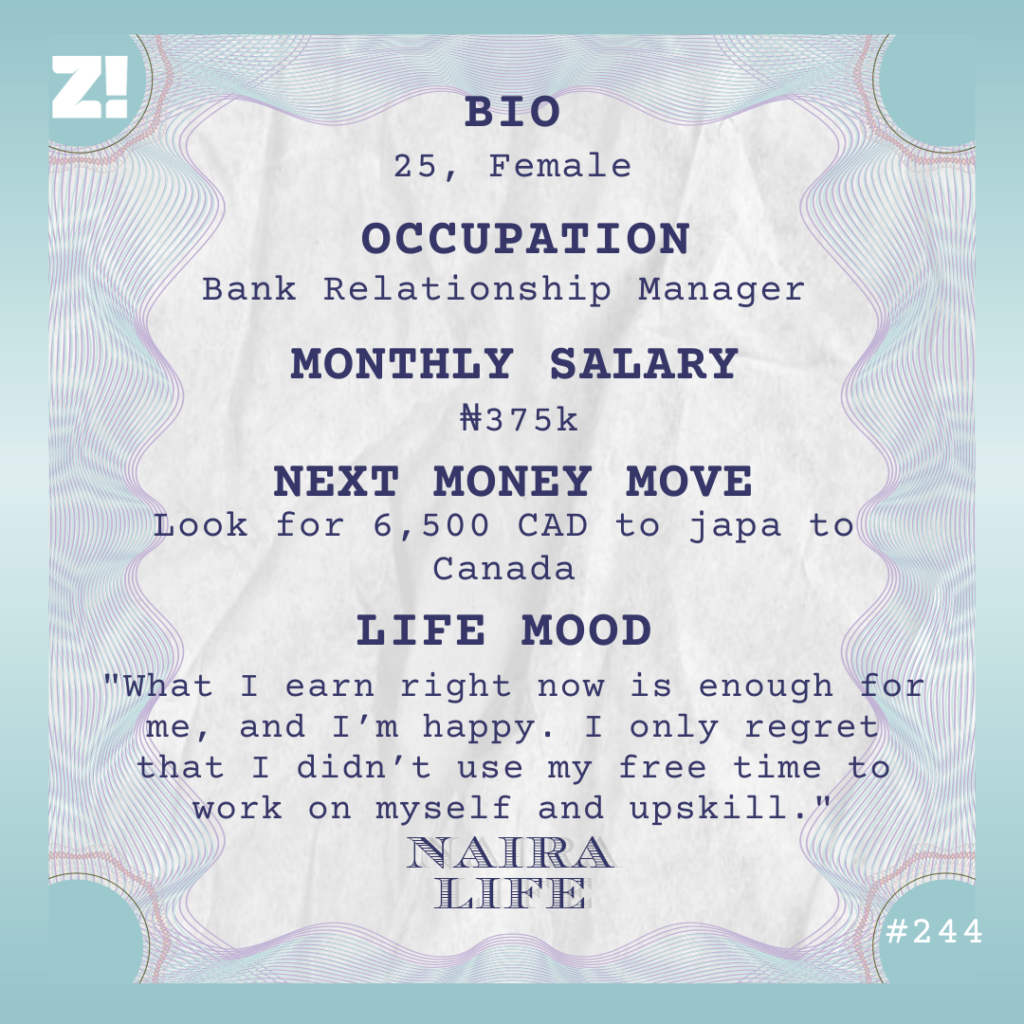
    I became a full-time staff member in May 2023, and my salary was updated to ₦307k. It was increased again in August due to the state of the economy, and now my salary is ₦375k.

    How do you feel about your finances right now?

    I’m finally making money that makes me happy. I don’t really have responsibilities, but I can comfortably get things I want without thinking too much about it. 

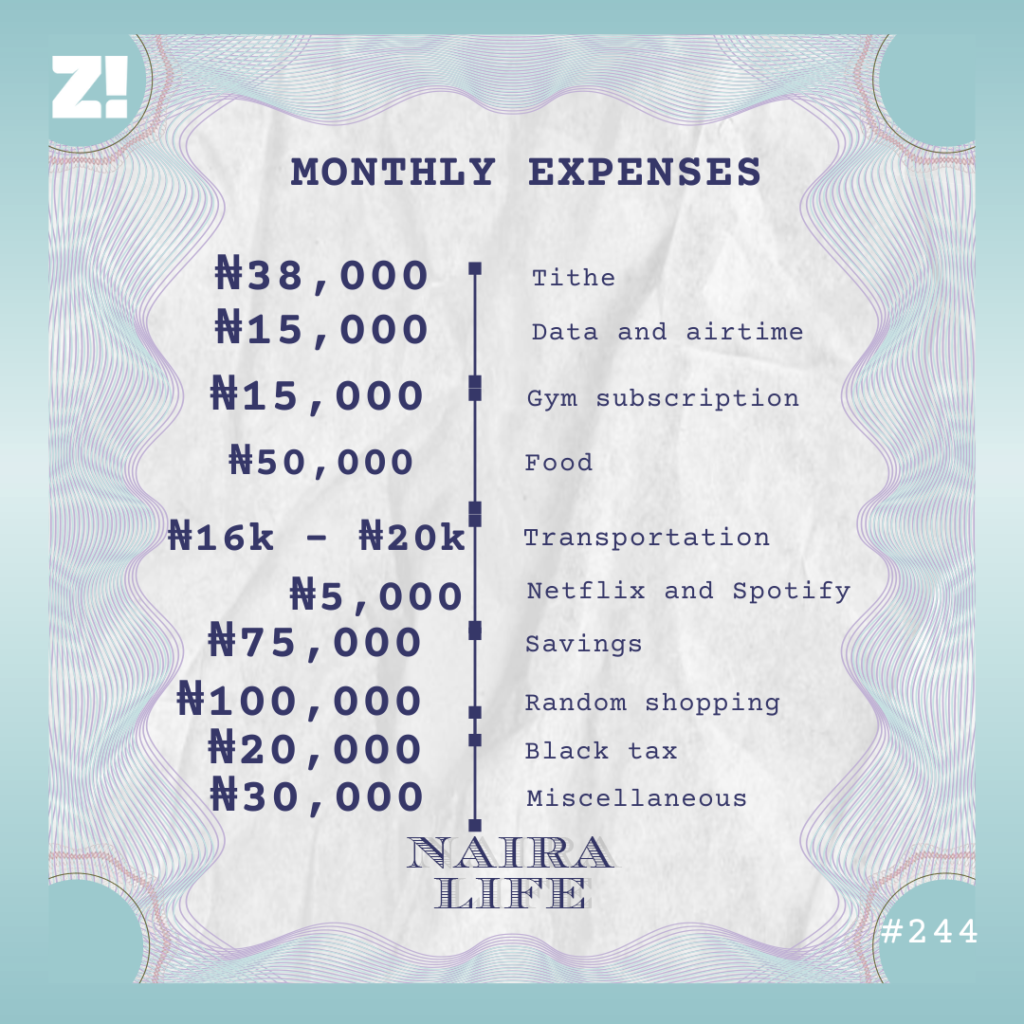
    What are some of those things in a good month?

    I just started saving the ₦75k because I feel like I’m in a position where I can save more. But I still spend more than I save, and I’m hoping to figure out how to manage my finances better soon. But unlike before, when I’d be broke before the end of the month, it’s better now. Of course, I’d still like to earn more so I can do more things.

    Can you tell me about some of those things?

    My boyfriend is currently working on his Canadian permanent residency, which involves money. I’ve lent him about ₦500k for the process. When he gets an invitation to apply (ITA), he’ll need to include me in the application, which will cost 1,500 CAD for each of us. 

    We may also need to get married, pay ₦107k for IELTS and get my degree evaluated by WES for $251. In summary, I’ll need about 6,500 CAD for my application and plane tickets. So, I need to make money.

    [ad][/ad]

    How much would you need to earn monthly for that to happen?

    Ideally, ₦800k or $1k. I currently work as a relationship manager at the bank, but I’m still interested in data analytics. I feel like tech is what will give me the opportunity to get jobs that’ll pay me in dollars. It’s still just a want, though. I’m not sure how to get there. But I’m happy with my current career progression.

    When was the last time you felt really broke?

    January. I was still in training school earning ₦60k/month. I typically get paid on the 24th, but they paid on the 9th in December. I thought that meant the 13th-month salary was coming. It turned out they only paid full-time staff a 13th-month salary. I was broke-broke all through January.

    What’s one thing you want right now but can’t afford?

    A MacBook. Last I checked, it was ₦860k.

    Is there anything you wish you could be better at financially?

    Saving and managing my money. I use a money planner, but I don’t use it daily. Meaning, I forget what I spent that day or dropped money somewhere I can’t remember. 

    How would you rate your financial happiness? The scale is 1-10

    6. I’ve grown up without much responsibility, and I’ve mostly only spent money on myself. What I earn right now is enough for me, and I’m happy. I only regret that I didn’t use my free time to work on myself and upskill. I see what people are doing around me, and although I envy them, I still struggle to put in the work.

    I still can’t believe there was a time I was receiving so many allowances from home, but I just spent it anyhow. I think I wasted a lot of opportunities.

    What do the next few years look like for you?

    I may take a professional accounting course since I plan to relocate. If I don’t stay in finance, it’ll be data. I just need to work on building opportunities for my future.


    If you’re interested in talking about your Naira Life story, this is a good place to start.

    Find all the past Naira Life stories here.

  • Every week, Zikoko seeks to understand how people move the Naira in and out of their lives. Some stories will be struggle-ish, others will be bougie. All the time, it’ll be revealing.


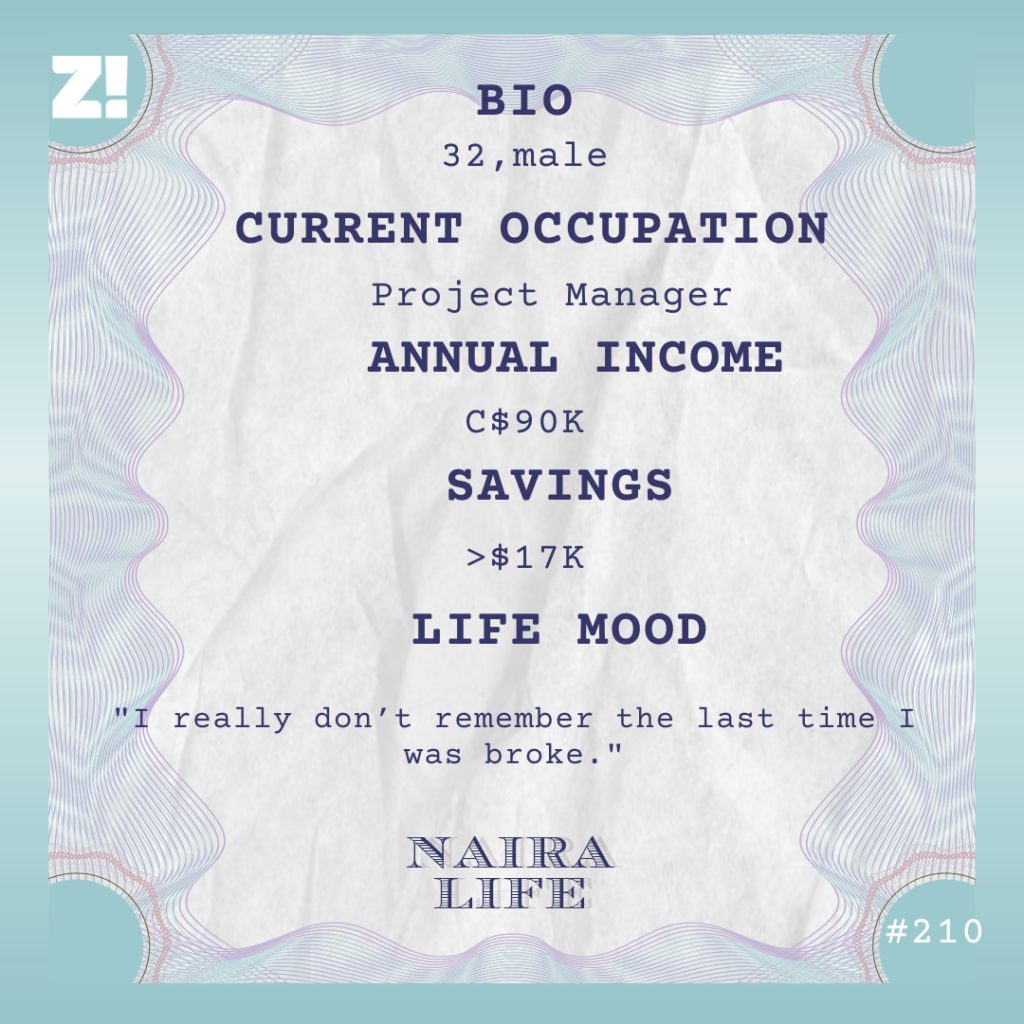
    The recurring theme in this #Nairalife is safety nets. The 32-year-old project manager in the story saved up ~₦21m in about five years. Now he lives in a country with free healthcare and earns $90k/year. He may have 101 problems right now, but being broke isn’t one.

    Here’s how he got there.

    What’s your oldest memory of money?

     When I was six or seven, my allowance was ₦20. Every morning, I found the money on the table without fail. One day, I found two ₦20 notes and took both to school without thinking much about where the second note came from.  

    When I got home, my mum asked me why I took more than I usually did, and I had no good answer. It was at that moment I realised that I didn’t confirm if the extra money was meant for me. I’ll never forget the punishment I served. But it was a lesson in contentment and accountability. This event taught me not to touch any money that doesn’t belong to me. 

    What was it like growing up?

    My dad was an insurance executive and my mum was a nurse. Both of them had thriving careers, so we were very comfortable. We were the typical working-class, upwardly mobile Nigerian family of the late-90s and early 2000s. My dad changed cars every three years because of where he worked. We had two drivers, and I was dropped off and picked up from school every day. I was pretty much a “get-inside” kid. 

    So when did you actively start thinking about money?

    When I was 15 or 16. I’m the last of my parent’s four kids, and there’s a 12-year age gap between me and my eldest brother. Somehow, my brother convinced my parents to pay me for house chores and I was getting ₦500 – ₦1000 for this. However, it wasn’t set in stone. This was the first time I earned money. 

    Things changed at home around the same time. 

    What do you mean?

    In 2007, my dad decided to run for political office. The people around him made him feel like he stood a chance, so he sunk his savings into his campaign. 

    He lost the election, and there was nothing to return to post-election. He’d resign from his job to focus on his campaign, even though his company’s board advised him not to. 

    Omo.

    My mum retired from work in 2003, so she didn’t have a regular stream of income either. Things became a little shaky. The drivers were the first to go, followed by small adjustments.

    What sort of adjustments?

    The plan was for me to go to university in the UK. But when this happened, the plan changed to a private university in Nigeria.

    In hindsight, things weren’t entirely rough – my parents had some financial structure we fell back on. We had houses, so we didn’t have to worry about rent. My parents also had some investments in stocks, which gave us some financial cushion. It was the first time I saw how safety nets worked. That event spurred my interest in keeping resources aside for rainy days.

    How did that manifest?

    When I got into university in 2007, my allowance was ₦15k. By the time I left in 2011, it’d increased to ₦20k. During my time in school, I made sure to save every month – ₦2k here, ₦3k there. It helped me build my savings muscle. 

    What happened after uni?

    NYSC. I served in the south-south and worked at an architecture firm as a site supervisor. The pay was ₦10k/month and the federal government also paid ₦19800, which brought my monthly total to ₦29,800. My boss also tipped me between ₦1k and ₦2k every weekend. 

    The cost of living in the state was low and I could live comfortably on ₦500 per day. There were barely any additional expenses. I lived on my salary at the firm and saved most of my government allowance for the whole year. At the end of my service year, I had about ₦180k in savings. 

    Sweet.

    I returned home, moved in with one of my siblings and started job hunting. Three months later, I got a job in a telecom serving firm. My salary was ₦60k. 

    However, the people that ran the place were unserious. Three months into the job, I hadn’t received an offer letter, which was a red flag for me. Fortunately, I found another job at a furniture company.

    How much did they offer you?

    ₦60k. When I told the people at the telecoms servicing firm I was leaving, they finally sent me a proper offer letter, bumping my salary to ₦130k. But my heart wasn’t in the job anymore, so I did the next best thing.

    You used their offer letter as leverage, didn’t you?

    I did and renegotiated my salary with the furniture company. We settled for ₦90k, and I resumed work in July 2013. The most interesting thing about the job was the high-network individuals I met. It was eye-opening. 

    Tell me more. 

    The furniture company helped HNIs set up their homes. I could be called into a meeting to give a presentation and the client would be this wealthy person I’d seen on TV. It was a thrill watching them listen carefully to what I had to say about our plans for their spaces. Like, they were genuinely interested and asked questions. For a 22-year-old, this was a massive confidence booster. 

    I guess I also started thinking of how to unlock an extra means of income. A few months into the job, I found it. 

    What did you find?

    I always cleaned up nicely and looked good. I usually wore trad outfits to work on Fridays, and people always asked me who made the outfits for me. Although I didn’t know how to sew clothes, I had relationships with the guys who did. 

    So, I started telling people that I could make attires for them if they wanted. Like that, I was in business. I’d take their measurements, and give them fabric samples to select from and a three-week timeline to deliver the clothes. 

    My 9-5 definitely helped pick things up. I was close to how the business ran, so I knew how sales were closed, and how to interact and manage people’s expectations. I took these lessons, scaled them down, and applied them to this fashion business I started. 

    What were the margins like?

    They were pretty good. A yard of fabric was about ₦500, and I needed between three and four yards for each order. That was ₦2k. Then I paid the tailors between ₦2k and ₦2500. 

    When it was ready, I sold the trad for ₦12k to ₦13k. Sometimes, as high as ₦15k. 

    Man. You were making at least ₦8k in profit from each order 

    Yes. On average, my profit ran into ₦40l – ₦60k every month. By this time, my salary had also increased to ₦100k. That was pretty good money for me.

    How good?

    I didn’t need to spend what I earned from my 9-5. I saved my salary for the next three years without touching it and ran my life with whatever I made from my business. 

    Fascinating

    In 2015, I was just turning 25 and was thinking about what to do next. My boss’s wife kind of gave me the clarity I needed. 

    She’d joined the business and was firing and hiring people at will. Then at one point, she queried me for taking two days off work. She claimed it wasn’t approved even though we had a conversation about it. The penalty was a salary deduction for that month.

    I wasn’t even bothered.

    Why not?

    While I was away from work, I got an order and made about ₦200k in profit. I made 2x my salary in one day. It was enlightening, and I realised that the 9-5 might be taking too much of my time.

    Ah. That point of no return. 

    I started looking for an exit, which came when I found another means of income — interior design. A friend referred me for my first job because of my experience at the furniture company. I made about ₦600k on that job alone. The following month, I got another project. Then the third one came. In a few months, I made about ₦1.3m doing what I did at my 9-5 for ₦100k. 

    I was like, mad o. 

    LMAO.

    By the end of 2016, I quit my job. But I didn’t go straight into starting a business. I needed a break to map out my next steps. So I returned to school for my Masters. I spent the next two years there. 

    Did you do anything for money during this time?

    Nah. I focused on school. It helped that I didn’t have to. My parents chipped in for my school fees, but I was in charge of my upkeep and accommodation. I had ₦3.5m in core savings and about ₦1m from my recent side gigs. I lived on this throughout my time in school.

    Safety nets, eh?

    Absolutely. I graduated in August 2018. A few days after my convocation, I got a call from someone I’d been referred to. They had a ₦375k project for me, and I got right to work. However, I didn’t use my usual guys for some reason. I went for cheaper labour, and it cost me. The guys messed up the job. Naturally, I wasn’t paid my ₦175k balance. 

    That wasn’t even the most painful part. 

    It wasn’t?

    A few months later, I found out the guy I did the job for was a nephew of the state governor. I couldn’t help but think that I lost a plug there. 

    I took the lessons and moved on.

    Sorry, man. But how easy was it to get jobs when you got out of school?

    My referral network made sure I had projects to do — ₦80k here, ₦100k there. Then a big one came in November 2018. The first person I designed for in 2015 was expanding their space and commissioned me for the interior design. Because of my background in architecture, they also made me a project manager. The scope of the project ran into ₦6m. I executed the project and got paid. 

    Baller. 

    My payments were spread over a few months, which worked because I wasn’t sure when the next job would come. That said, I was now certain that I could make the business work.

    What happened next?

    Growth. In 2019, I was busy from one project to another. I did some work for some good brands that paid well. I moved into a mini-flat in March and the rent was ₦500k. I bought a Nigerian-used car in April for ₦750k and spent ₦400k on early mechanic work. By the end of the year, I had saved about ₦6m. It was a good year. 

    Also, I got into a new talking stage with an ex-girlfriend in the same year. She lived in Canada and we hung out when she came home for Detty December in 2018. That kicked things off again and we wanted to give the relationship another shot. However, she didn’t want to do long distance. This put japa on the table for me. In December 2019, I wrote IELTS and officially began plans to join her in Canada.

    What did this mean for your business?

    On some level, I stopped consciously trying to grow it. I thought it’d be selfish to grow the brand, hire people and let them go in the end. I just kept to the level I was.

    Fair. What was your planned relocation route to Canada?

    It was originally going to be via Express Entry. But Covid happened, and they stopped the draw. My girlfriend and I decided that I’d come in on a visitor’s visa and apply for permanent residency when we got married. I was set to leave in December 2021, but a new wave of Covid hit. As a result, flights were grounded and borders were closed. I didn’t leave until May 2022. 

    The months must have dragged slowly

    Not really. In August 2021, I got a huge project and the cost came to about ₦53m. Since I’d planned to leave at the end of the year, I brought someone on board and agreed to a 60/40 split. My profit from the job was going to be ₦8m. 

    When I couldn’t leave in December, I focused on the job. However, the guys I was working for didn’t stick to their timelines. We were supposed to complete the project in January 2022, but it went on and on because they wouldn’t tidy up things on their end. Gradually, the relationship turned sour and they terminated the contract right after I left in May 2022. My business partner and I cut our losses and moved on. In the end, I made ₦6m from the project. 

    I’d started a new life in Canada anyway.

    True. How’s it been going?

    Pretty good. I got married in mid-2022, and my wife and I filed for Permanent Residency afterwards. 

    I became a permanent resident in January 2023. 

    Congratulations. What were the first few months in Canada like, financially?

    I came to Canada with about ₦21m saved up from my efforts in the past few years. This was about C$40K, and it helped me settle in. My wife took care of the rent and I picked up groceries and other miscellaneous. My average spend was C$1200 – C$1300/month. 

    Also, I still got some jobs in Nigeria. But since I wasn’t on the ground, I found someone to execute and I supervised them from here. At the end of each project, we split the profits. This brought in a few million naira.

    Once my permanent residency was approved in January 2023, it was time to transition back into construction and project management. I’d taken a course on project management the previous year. So I started job hunting. 

    How did that go?

    A few rejections here and there, but I got a job in February. 

    In construction?

    Yes. I’m not a project manager at a construction company. The pay is C$90k per annum. That’s C$7500/month.

    This is my first salary job since 2016. Mostly, it’s to provide some financial security while I settle in here. In a few years, I’m hoping to start up my own thing. Fingers crossed.

    Fingers crossed. What’s your current mindset about money?

    Since 2018, I’ve been saving at least 70% of my income because I felt Nigeria could happen anytime. Now I feel like I’ve saved fairly enough, and I’m confident about my safety nets. Also, the possibility of things going awfully wrong is low because of where I now live. The government of Canada has our back. In addition, there is my pay, which is a miracle considering I don’t have any Canadian work experience. 

    The bottom line is that I’m in a safe space and can afford to take a foot off the pedal. Money is for spending right now. At least until I start thinking about starting my own business here. It’s why I’m excited about our wedding ceremony in Nigeria later this year. 

    Exciting. Speaking of spending, what do your monthly expenses look like?

    What about your savings?

    It’s distributed across Canadian Dollars, US dollars and Naira.

    Canadian Dollars – ~ C$13K

    U.S Dollars – $4k

    Nigerian Naira – >₦2m

    Love it for you. Is there anything you want but can’t afford?

    To be fair, nothing at the moment. I’d have said a second passport but I’m already on the path to getting that. No rush. 

    God when. I have to ask, when was the last time you felt really broke?

    Not since my adult life started. I started building a secure chest as soon as I could. And as the years progressed, I delayed instant gratification of giving in to it would put me in a vulnerable financial situation. I really don’t remember the last time I was broke. 

    Energy. Is there a part of your finances you wish you could have been better at though?

    Maybe I should have started actively investing. Not just save money but get it to work. A primary goal in the next three years is to build an investment portfolio. 

    Let’s circle back in three years and see how that goes. 

    Haha. No worries. What’s your financial happiness on a scale of 0-10?

    It’s a 7 or an 8. I’m just happy about where I am, man. I’m planning my wedding, and I have the finances for it. I have some travel plans in the works and I can afford them. Most of all,  I have the safety net to cover my immediate needs. There’s definitely room for improvement, but am I doing badly? Nah.


    If you’re interested in talking about your Naira Life story, this is a good place to start.

    Find all the past Naira Life stories here.

  • Also: How much is a bottle of wine these days?

    Vol 2 | 31-10-2022

    Brought to you by

    Good morning, 🌞

    It’s the last day of October and today’s letter is all about safety nets.

    If you are anything like the subjects of the stories I’ll share today, then safety nets are not foreign to you.

    I think life hits different when you know you can experience many things without worrying about ending up broke.

    We approach the concept in various ways; saving, investing, and even buying NFTs…

    At the end of the day, we all just want the softest of lives, no?

    In this letter:

    • The Fearless #NairaLife of a Tax Collector
    • The Money of Love: Polyamorous in Ogun State on ₦400k/month
    • Money Meanings: What is a “Safety Net”?
    • Game: #HowMuchLast (Make sure you play o!)
    • Where The Money At?!

    #NairaLife: This Tax Collector Has Never Had to Make Money to Survive

    If the 34-year-old in this #NairaLife stopped working, she’d be very fine. But even with free ₦4.3m yearly and wealthy parents, she enjoys being independent while catching business owners who try to evade taxes.

    My favourite part of the story is where David asks her if she’s ever had to earn money to survive and she replied “Not yet. No.”

    Internal monologue: God, when exactly will it be my turn?

    Read the rest of her Naira Life

    Ordinary is Boring

    Let’s face it. Ordinary is boring, but you can go for the extraordinary with a juicy pension plan that rewards your hustle today so you can retire early and still ball hard. Start by moving your pension to Stanbic IBTC Pension Managers today.

    Visit Stanbic IBTC Pension

    The Money of Love: Polyamorous in Ogun with ₦400k/month

    Oh to be young and in love and be able to say: “I used to sleep with my debit card under my pillow, so if I had a bad dream, I’d wake up and buy something online.”

    Onome* is a 21-year-old polyamorous woman who spends recklessly on her partners because her love language is gift-giving. In this interview, she tells Zikoko how money moves in and out of her relationships, while on a ₦400k monthly income and an envious financial safety net.

    Read More Of This Story

    Some other great money articles you should read:

    At Luno, we believe cryptocurrency is for everyone. Tap into all the many possibilities.

    Visit Luno

    Money Meanings

    Game: #HowMuchLast

    #HowMuchLast is a game where we show you an item and you tell us (and the world) the highest amount you’d pay for it.

    Some weeks will be Okin biscuit, some others will be SUVs.

    This week, we’re keeping it simple, #HowMuchLast for a bottle of wine.

    What’s the most you’d pay? Tweet at us here.

    Where The Money At?!

    We can’t say we’re about the money and not actually help you find the money.

    So we’ve compiled a list of job opportunities for you. Make sure you share this with anyone who might need it because in this community, we look out for each other.

    Again, don’t mention. We gatchu.

    Share this newsletter

    All good things must come to an end. But not this good thing. We’ll be back next week.

    In the meantime, keep reading Zikoko’s articles and be sure to share the love.

    Till next week…

    Yours cashly,

    Dwin,

    The Other Mr Money

    Did someone awesome send this to you?

    Subscribe to this Newsletter

    \

    18, Nnobi Street, Surulere, Lagos,
    Nigeria