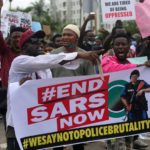
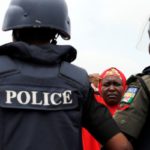
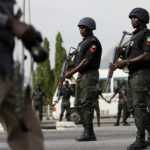
The Nigerian Police Force has a long history of abuse and extortion. Random searches, unwarranted detentions, and the targeting of young people for extortion led to the nationwide #EndSARS protests in 2020. Years later, little has changed and police reform remains an unfulfilled promise.
Ayo* was having a nice afternoon nap in his hostel when he was rudely awakened with a gun to his face. His day was about to get much worse in ways that have left him still holding a grudge against the Nigerian Police.
This is Ayo’s story as told to Franklyn
Anywhere they are hating on the Nigerian Police is my kind of space. I have plenty of reasons for how I feel about that organisation; too many unpleasant run-ins to count. But one I will never forget happened during my university days in Ilorin.
It was one of those lazy afternoons that make a midday nap really slap. The guys from the room next door had come over to mine to gist and play video games. Usually, I would have joined in the banter, but that nap was calling my name.
Since they were in my room, theirs was empty. I left them with my roommate and went to their room instead. From there, their noise became a soft hum that lulled me to sleep. I cannot say how long I was out, maybe an hour, before I sensed the door open.
I cracked my eyes just a little, and the first thing I saw was the sneakers. My gaze travelled up from the shoes to the worn jeans, and then I was staring down a dark tunnel with no light at the end. I was looking straight into the barrel of an AK-47.
If I had even thought for a moment that they were armed robbers, it vanished quickly. I knew that look too well—the black shirts, jeans, sneakers, sometimes a face cap. It was the Nigerian Police.
I found myself wondering, as I often do, why our thugs-in-uniform carry assault rifles like they are in a warzone. But that was not the time for such thoughts. The gun in my face had jolted me awake, and I sat up quickly.
“What is happening here?” I asked, rubbing my eyes.
“We are here for you people!” one of them barked.
***
Get More Zikoko Goodness in Your Mail
Subscribe to our newsletters and never miss any of the action
I lived in a private hostel off campus with a bunch of other guys. One of them, who had moved out a few months earlier, had a run-in with the police. They searched his phone and found something incriminating.
This was 2018, when Internet fraud was booming and the police were cashing out too, extorting guys through random searches and phone checks. Even those of us just minding our business were caught in the mess.
They arrested him and asked him to take them to his place. For reasons best known to him, he brought them to our hostel instead of wherever he was actually staying. That was how I ended up being woken up with a gun in my face.
***
The guys in my room must have heard the commotion and bolted. That was the standard reaction. In Ilorin, as a young man in 2018, you see the police, you run. If they had not caught me asleep, I would have run too.
My roommate was not fast enough.
They saw him leaving and called him back. He lied, saying he lived in a different room and was heading there. I do not know if they did not believe him or just felt lucky to have caught someone, since the others had escaped.
The officers held both of us and began searching our room. They tore it apart, flipping everything, throwing clothes off hangers. They did not find anything incriminating, but they did find our IDs, which exposed my roommate’s lie.
So much of that day is burned into my memory, but the worst part is a sound I still remember too clearly after all this time. The whole hostel heard the slap one of the officers landed on my roommate’s face. More slaps followed as they started to drag him away.
I am a big, tall guy, and I have noticed that it brings a sort of respect. People listen when I speak. I naturally fall into a big brother role with my friends. So I stepped in.
I told the officers he had done nothing wrong. They had not found anything on him. Lying about his room was not enough reason for this kind of treatment.
I said, “You are not taking him anywhere.”
Omo, it was like play. Before I knew it, they carried the two of us.
***
They dragged us downstairs to their vehicle. It was not even the usual Hilux pickup truck. They had come in a taxi. I still remember its distinct yellow and green paint job. I was still trying to figure out how we would all fit when one of them opened the boot.
They shoved my roommate in first. Then me. Like I said, I am a big guy, so the boot would not close with us inside. They kept trying to force it shut, but it was not working. Then one officer stepped up and slapped me across the face.
As I recoiled in pain, my body bent just enough for them to slam the boot shut, pinning me in the most uncomfortable position. Then they started driving.
I do not know how long we were in there. I tried to memorise the turns, listened to the sounds outside, anything to figure out where we were going.
When the car stopped and they let us out, I was not surprised that we were not at a police station. Nothing about this had felt official. We were at a really big tree, and from the way they immediately made themselves comfortable, I could tell it was their usual hangout spot.
It was then that the negotiations began.
***
They told us we had to go if we wanted to be set free. After some haggling, we settled on ₦15,000. Of course, we did not have the cash, so it was agreed that I would go and get it while my roommate stayed behind.
One of the officers flagged down a motorcycle for me. It took me to the nearest ATM, where I withdrew the money. I returned and gave the officers the money.
As we left, they shouted warnings after us. “If we come una side next time find anything for una hand, na serious trouble!”
I still think about the madness of that day. How I just wanted a nap, only to be woken up with a gun in my face, shoved into a car boot, slapped and extorted. I knew from the start they were not armed robbers, but looking back, I ask myself if there’s any real difference. Armed men woke me up, assaulted me and took my money.
As long as I am alive, the Nigerian Police will always have at least one hater. God will actually punish them on my behalf.
Share your story with us here if you’ve ever had a moment where Nigeria’s systems made life harder or unexpectedly easier. We want to hear about your personal experiences that reflect how politics or public systems affect daily life in Nigeria. We’d love to hear from you!
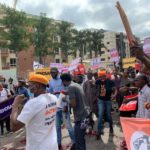
2020 was supposed to be the year Nigeria ended police brutality. But almost five years after the #EndSARS protests, young Nigerians are still being profiled and mistreated by the police, proving that the fight is far from over.
We asked four Nigerian men to recount the worst encounters they’ve had with Nigerian security agents, and their responses were sad and traumatic.
“They found hair in my bag, accused me of being a ritualist, and locked me up for five days”
Like 8 million other young Nigerians, Gbenro* (25) registered as a first-time voter in hopes of voting for his preferred candidate during the 2023 elections, but he ended up in jail before he could get the chance to exercise his civic rights.
“I was travelling from Lagos to Ogun state, where I registered for my Permanent Voters Card (PVC). Suddenly, we saw some policemen signalling to the driver to park. When he parked, the policemen said they wanted to search all the passengers, but they searched only the men in the car. I didn’t think much of it and just wanted to get it over with, so I cooperated with them and gave them my backpack. One of the officers took the bag from me and searched it. He found a nylon bag where I kept the hair from the haircut earlier in the day.”
“The officer had this weird look as he walked away for a few minutes to consult with his boss. They both returned and started questioning, asking me whose hair I was carrying. I told them that it was my hair from the barber appointment I had earlier in the day and that I had it with me because I always take my hair home to dispose of it myself. They said I was lying. Before I could defend myself, they started calling me a ritualist and swearing that they’d make an example out of me.”
“The next thing I knew, I was already locked up in a cell. They didn’t allow me to call my parents until it was late. The next day was supposed to be the election I travelled for. I had promised myself that I would vote for Peter Obi. I called my mom and told her I was locked up. She started crying because there was a curfew that was going to limit movement during the election, meaning that whether I liked it or not, I would stay in that cell for at least two nights. I stayed there for five days because they asked my mom to bring ₦250,000. I got out and found out that Tinubu won the election. I swore that I would never vote in this country again, and I’ve been trying to relocate since then.”
“They saw Google Play store reviews on my friend’s phone and called us Yahoo boys”
Micheal* (24) has had one too many experiences of police profiling, but the one that left him in the worst state of helplessness happened when he was just 17.
“A friend wanted a laptop, so he told me and some of my guys to follow him to Ilorin. It was supposed to be a quick trip, so instead of travelling in my friend’s car, we decided to take a cab to the park. We were already a few minutes away from Ilorin when some policemen stopped us. They asked their usual questions, but we knew they didn’t plan to let us go that easily after they asked us to pay our driver and ask him to leave. We were in the middle of nowhere, so we had no choice but to obey.
After the driver left, they asked for our phones and searched what we had on each of them. They took longer with my friend’s phone because he had a Samsung, which they didn’t think we were old enough to own.
They found nothing on our phones, so one of them, for whatever reason, decided to open the Google Play store on my friend’s phone. They somehow decided that the people leaving reviews from different parts of the world were our clients, and we were Yahoo boys. Imagine being held without your consent for such a stupid reason.
They asked us to pay ₦200,000, but we convinced them we only had ₦10,000. Then they drove us to Ogbomosho-Ilorin express road, which looked very creepy. We were in their truck with some other guys they picked up. I remember feeling like these people could decide to pull the trigger, and nobody would ever know. This experience started around noon, and the policemen didn’t leave us until 6 pm, and they still collected that ₦10,000 from us. I’ve been avoiding Ilorin since then.”
“They pointed a gun at my head.”
Not many teenagers spend their free time imagining they would ever be held at gunpoint, especially not a teenager like Nimi * (19), who just wanted to spend time with his big brother.
“I had just visited my older brother at his school, and I was returning home when some police operatives under the Special Anti-Robbery Squad (SARS) stopped the bus I was in. They told me and some of the other young men to come down and accused us of being Yahoo boys. Then they searched us, and even though they didn’t find anything to defend their claim, they pointed guns at our heads and forced us to call our parents.
I remember them telling my dad that I was a yahoo boy and they were going to shoot me. My dad negotiated with them, and they eventually agreed to let me go after he had paid some amount of money. I’m not sure how much he sent because he was too traumatized to talk about it. He ended up writing about it and publishing the story in a newspaper.”
“As someone with dreadlocks, I honestly hate to see the police checkpoints.”
Dreadlocks are fashion statements in many parts of the world, but in Nigeria, it’s the hairstyle that makes policemen single you out in a bus full of people – that’s exactly what happened to Ben* (23).
“It happened two years ago, just around the time I locked my hair for my dreads to set in. I boarded a bus in Aguda, and the moment I sighted a police checkpoint, I suspected they would stop me.
True to my suspicion, they flagged the bus and singled me out. I had a tote bag containing my laptop and other work essentials, so they saw it and demanded to search through it. I honestly don’t know what they were expecting to find, but after wasting my time close to five minutes, they finally let me go.
As someone with dreadlocks, I honestly hate to see the police checkpoints. They have this twisted idea that anyone who wears dreadlocks is either into cybercrime or walks around with drugs. Now, when I book a private cab, I always direct the drivers to go through routes where we stand zero to no chance of running into policemen.
What Can You Do If You’re a Victim of Police Brutality in Nigeria?
The Nigerian law is clear about many things, and police brutality is one of them. The police have no right to detain, assault, or extort you unlawfully. If you ever find yourself in a situation where officers abuse their power, here’s what you can do:
1. Know your rights: Sections 34 and 35 of the Nigerian constitution guarantee your right to dignity and personal liberty. Police officers cannot harass, unlawfully detain, or torture you. Additionally, the Administration of Criminal Justice Act (ACJA) 2015 states that arrests must be legal (and violence-free), and suspects must be charged to court within 24–48 hours.
2. Ask for legal representation: If arrested, immediately request a lawyer and avoid saying anything till your lawyer arrives. The Legal Aid Council of Nigeria offers free legal assistance if you can’t afford one. You can call them on this number – +234 7031915990
3. Report the officers: File a complaint with the Police Complaint Response Unit (CRU) via Call/SMS/WhatsApp: 08057000001, Twitter: @PoliceNG_CRU, Email: complaint@npf.gov.ng
5. Use social media for awareness: If safe, document everything—photos, videos, names, and badge numbers—and share it with the public. You can also tag activists or organizations that work with victims of police brutality.
News is boring, but we make it fun. Subscribe to The Big Daily to be the first to know the day’s biggest news.
[ad]
Police brutality in Nigeria never seems to take a break. Bolanle Raheem, a Lagos-based realtor, and lawyer, is the latest victim of the Nigerian Police Force (NPF). On December 25, 2022, an Assistant Superintendent of Police, Drambi Vandi, murdered Raheem during a routine traffic stop.
Here’s what we know so far about the victim, the murder, and what the government is doing about it.
Who was Bolanle Raheem?
Raheem was a property lawyer, an award-winning realtor, and a mother of one. She was also pregnant with a set of twins at the time of her death. She also owned a real estate company called Croston Homes.
What happened on Christmas Day?
According to Raheem’s husband, Gbenga, who was an eyewitness, the family started the day like millions of other Nigerians by attending a Christmas Day service at their church. The couple went to church in a car with Raheem’s nieces and nephews with them.
While returning from church, a team of police officers flagged them down to park the car at a checkpoint under the Ajah Bridge in Lagos. Gbenga said he was complying with the order when Vandi shot his wife at point-blank range. He first rushed her to a nearby hospital but the hospital staff couldn’t handle the case. By the time he transferred her to Grandville Hospital in Ajah, doctors confirmed her death on arrival.
How are Nigerians taking the incident?
The murder of Bolanle Raheem has caused outrage on social media, especially since she’s the second victim of a police shooting in Ajah in two weeks.
A lawyer, Bolanle Raheem, is reported to have been shot and murdered at close range on Christmas Day by a rogue policeman attached to Ajiwe Police Division, Ajah. This is barbaric.
It is a sad commentary that despite EndSARS, Nigerians are still being slaughtered by the police. pic.twitter.com/zEp69zu2Kf
On December 6, 2022, a stray bullet killed Gufaru Buraimoh, a 31-year-old man. This was during a police raid of illegal fuel marketers in the Sangotedo area of Lagos. The erring police officer was detained. However, he’s yet to be charged to court and the full report of the investigation is yet to be released.
According to the spokesperson of the Lagos State Police Command, Benjamin Hundeyin, ASP Vandi was arrested immediately with two other police officers who were at the checkpoint. However, the two unnamed officers have been released after interrogation and providing their witness statements.
This is a developing story that would be updated as it develops. But we hope swift justice would prevail and the case doesn’t fade away like many others before it.
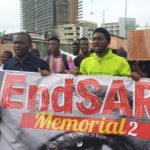
It seems as though peaceful protesters can never catch a break in Nigeria, as police brutality reared its ugly head again during the EndSARS memorial procession at the Lekki Toll Gate in Lagos State on October 20, 2022.
[Image source: PUNCH Newspapers]
Nigerian celebrities, Folarin Falana, aka Falz, and Adebowale Adedayo, aka, Mr Marcaroni, led the protest in honour of young Nigerians killed by security forces at the toll gate on October 20, 2020.
Police officers interrupted the procession to request that protesters remove a coffin, which was a symbolic reference to the 2020 victims. The protesters refused and the police started to shoot tear gas canisters.
[Image source: PUNCH Newspapers]
[Image source: Punch Newspapers]
A journalist who works for Arise TV, Oba Adeoye, was also allegedly harassed.
On October 20, 2022, Nigerians will commemorate the two-year anniversary of the EndSARS protests which ended in Nigerian security forces shooting and brutalising unarmed Nigerians.
As we remember them, we take a look at the timeline of events leading up to the tragic events of October 20, 2020.
A brief history of SARS
The Special Anti-Robbery Squad (SARS) was created in 1992 as a unit of the Nigeria Police Force (NPF) to combat a worrying trend of armed robbery and kidnapping. However, SARS eventually became the monster it set out to destroy as officers tortured, blackmailed, kidnapped and extrajudicially murdered Nigerians.
For 10 years, SARS operated in Lagos, but by 2002 it had spread to all the states in Nigeria. The rest of the country was about to see the shege Lagos people were seeing.
SARS gone rogue
SARS gained international notoriety in 2010 when Amnesty International rebuked Nigeria over its poor human rights record. The organisation singled out SARS for its unlawful killings and enforced disappearances of citizens, but that didn’t dissuade them.
In 2016, Amnesty International again released a strongly-worded report, condemning SARS for its “widespread torture and other cruel, inhuman or degrading treatment” of detainees. The organisation noted that officers subjected Nigerians to various methods of torture and ill- treatment in order to extract information and bogus confessions.
Still, SARS continued with impunity, and young Nigerians, fed up with the government’s inaction over the rogue agency, took their grievances online.
The seeds of EndSARS
It’s not clear exactly when the #EndSARS hashtag was first used, and by whom. Despite disputed claims over its origin, by 2017 the hashtag became frequent on Twitter.
By December 2017, there was an #EndSARS rally staged in Freedom Park, Lagos. Although it recorded a low turnout, the seeds that would inspire a global protest had already been sown.
Weak government and police response
In December 2017, then Inspector General of Police (IGP), Ibrahim Idris, ordered the “reorganisation of SARS” — a cosmetic response that was, in essence, the same thing as asking a rabid dog to stay quiet. By 2018, following public outcry, the acting president, Yemi Osinbajo, ordered the IGP to “review the operations of SARS”. In January 2019, a new IGP, Mohammed Adamu, ordered the “disbandment of SARS”.
Police reform in Nigeria typically followed this template for years — a press release here, photo op there, and empty promises all over the place.
The trigger
In June 2020, Amnesty International released yet another report faulting Nigerian authorities for failing to prosecute a single police officer in three years over the use of torture, despite laws being passed against it. The warning signs were there but the government ignored them as usual.
On October 3, 2020, a trending video that accused SARS officers of shooting a man and throwing him off a speeding vehicle in Ughelli, Delta State set off the chain of events that became the EndSARS protests.
It was at this point Nigerian youths had enough and took their complaints to the streets.
Timeline of the EndSARS protests
October 3, 2020
Protests began over footage of SARS officers shooting a young man in Delta state.
October 8, 2020
Youths converged at the Lagos State House of Assembly complex to protest against police brutality. They stayed over till the next day.
October 9, 2020
The Lagos State House of Assembly held an emergency session to address the grievances of the protesters. Young people also protested at the police headquarters in Abuja and protests started popping up in other states across Nigeria.
October 10, 2020
Protests continued with police using water cannons and teargas to disperse protesters in Abuja. In Ogbomosho, Oyo State, police officers fired gunshots to disperse a protest and killed Jimoh Isiaka.
October 11, 2020
The IGP, Mohammed Adamu, announced the dissolution of SARS but protesters welcomed it with doubts and continued the demonstrations. Three more protesters were shot dead in Ogbomosho.
October 12, 2020
The governor of Rivers State, Nyesom Wike, outlawed protests in his state. In Surulere, Lagos, stray bullets from the police killed a bystander but they blamed the protesters.
October 13, 2020
Delta State governor, Ifeanyi Okowa, announced the formation of a complaints committee to deal with the grievances of protesters. The IGP announced the setting up of a Special Weapons and Tactics (SWAT) unit to replace SARS but protesters didn’t welcome the idea.
The Lagos State government announced a ₦200 million fund for victims of police brutality, and the presidency said it would accept the five demands of EndSARS protesters.
October 14, 2020
In Lagos and Abuja, hoodlums and pro-SARS individuals attacked protesters and burnt vehicles.
October 15, 2020
The Minister of the Federal Capital Territory (FCT), Muhammad Bello, banned protests in the capital city.
October 16, 2020
An activist group, Anonymous, hacked the Twitter account of the Nigerian Broadcasting Corporation (NBC) to post a solidarity message for protesters. Candlelight vigils held across the country.
October 20, 2020
Governor Sanwo-Olu announced a state-wide curfew in Lagos but some protesters remained at the Lekki Toll Gate. As night approached, officers of the Nigerian Army arrived at the toll gate and opened fire on unarmed protesters who were singing the national anthem.
The defining image of that night is the Nigerian flag soiled with the blood of its slain youth.
On October 16, 2020, the National Economic Council recommended that the 36 states of the federation set up judicial panels of inquiry to investigate cases of police brutality by members of the disbanded Special Anti-Robbery Squad (SARS). Since then, state governments have established judicial panels to investigate cases of police brutality within their states.
1.ABIA STATE
On October 23, the Governor of Abia State, Okezie Ikpeazu, inaugurated a 17-man judicial panel of inquiry to investigate allegations of extrajudicial killings and brutality by security agents in the state. The chairman of the panel was Justice Sunday Imo, who was a retired Chief Judge of Abia State.
The Governor said that the panel should investigate killings of extrajudicial killings by the men and members of the Police Force and those of other security agencies, from 2015 to date; investigate all forms of police brutality, extortion and intimidation from 2015 to date; ascertain the immediate and remote causes of #EndSARS protest and other grievances associated with it.
The Governor mandated the panel to submit its report within 12 weeks. On July 6, the Abia State Judicial panel of inquiry submitted its 5-volume reports to the Governor of Abia State. The panel recommended over #511 million as compensation to victims of police brutality. Justice Imo declared that the panel received 86 petitions and 46 went through full hearing while the remaining were struck out.
2.ADAMAWA STATE
On October 20, Governor Ahmadu Umaru Fintiri Adamawa state approved the establishment of the eleven-member judicial panel to look into the alleged brutality by the Special Anti-Robbery Squad (SARS) in Adamawa State.
The Judicial Panel of Inquiry was headed by Justice Adamu Hobon (Rtd), and members of the panel constituted members of the judiciary, civil society organisations, security, youth and religious and student organisations.
The panel’s job was to receive and investigate complaints on police brutality or related extrajudicial killings, evaluate evidence and establish the nature of the abuses. The panel was also to establish whether there are people wrongly charged with crimes currently in custody, find out the reasons why they are in custody, find out whether they have been arraigned in court and establish how many have died in custody.
3.AKWA IBOM STATE
On October 20, the Akwa Ibom State Government set up a judicial panel to investigate complaints of police brutality, human rights violations and extrajudicial killings in Akwa Ibom state.
The panel was created after the State Executive Council meeting and was headed by Justice Ifiok Ukana (Rtd) and was made up of other youth representatives, student leaders, and other members from the Ministry of Justice, human rights commission and civil society organisations.
The panel received 143 petitions, and 28 were about extrajudicial killings and complete disappearance of suspects and death of persons in custody and 22 showed neglected litigations. 85 cases were on human rights cases and over 380 people testified at the panel. The panel submitted a report on 23rd July and its report was in four volumes.
3.ANAMBRA STATE
On October 16, 2020, the Anambra State Governor, Willie Obiano, set up a judicial panel of inquiry to investigate the allegations of human rights abuses by the Special Anti-Robbery Squad (SARS) in the state. The panel was headed by retired Justice V.N Umeh, and it was made up of 20 members. The panel was expected to submit its report within 30 days.
On February 13, 2021, five youth members of the judicial panel of inquiry resigned, claiming that the Anambra State Government had totally ignored the panel and the government had no regard for the victims of human rights violations, police brutality, extortion and extrajudicial killings in the state. The resigning members claimed that infamous SARS units like the Special Anti-Robbery Squad, Awkuzu and numerous other police outfits were still operating in the state.
The police officers of the Special Anti-Robbery Squad shunned the invitations of the Anambra State Judicial Panel, even though many petitioners complained of police brutality.
4.BAUCHI STATE
On October 28, 2020, the Bauchi State Governor, Bala Mohammed, inaugurated a 17-man panel of inquiry into alleged human rights violations by officers of the Special Anti-Robbery Squad of the Nigerian Police Force. At the inauguration, the governor stated that the panel was set up to address the violation of citizens’ rights in the state by receiving complaints and petitions from the public, identifying the culprits and proffering recommendations to the government.
The panel was headed by Justice Habibu Idris and the panel was mandated to submit its report within six months.
5.BAYELSA STATE
On October 21, 2020, the Governor of Bayelsa State, Duoye Diri, constituted a judicial panel of inquiry through a state radio broadcast. The Bayelsa State Government set up the panel in response to the demands of the #EndSARS protesters in the state.
The Bayelsa State panel of Inquiry was headed by Retired Justice Y.B. Ogola and the panel were given six months to complete its assignment.
The panel received 50 petitions and it recommended the prosecution of 11 police officers, the demotion of four police officers and the demotion of one police officer. The panel also awarded ₦21 billion as compensation to the victims of police brutality in the state. Eight cases were struck out at the panel and two were adjourned.
6.BENUE STATE
On October 21, 2020, the Benue State Government set up a judicial panel of inquiry to investigate cases of human rights violations, police brutality and extrajudicial killings in the state. The panel was headed by Justice Adam Onum, and the governor declared that the panel was to submit its report within six months.
The panel entertained many petitions including that of a 34-year old man, Terfa Gundu, who alleged that the police poured petrol on him.
The panel has not submitted its report to the Benue State Governor.
7.BORNO STATE
Borno state did not set up a judicial panel of inquiry in the state. Officials of the state claimed there were no cases of police brutality in the state.
8.CROSS RIVER STATE
On October 22, 2020, the Cross River State Government set up a judicial panel of inquiry to investigate the allegations of police brutality by members of the Special Anti-Robbery Squad. The panel was headed by Hon. Justice Michael Edem.
However, just a few days after the composition of the panel, members of the civil society in Cross River State complained about the composition of the panel, stating that the panel was not diverse enough. Many observers concluded that the panel was cherry-picked and the selection process was not transparent.
On November 11, 2020, the Cross River State panel adjourned due to “technicalities” about whether the panel had the power to investigate the police. The panel had received 39 petitions by the time it adjourned.
9.DELTA STATE
On October 19, 2020, the Delta State government formally inaugurated an eight-member panel of inquiry to investigate the allegations of police brutality and extra-judicial killings in the state. The panel was headed by Justice Celestina Ogisi (Rtd) and Omamuzo Erebe was the panel’s secretary.
On July 9, 2021, the Governor of Delta State, Sen. (Dr) Ifeanyi Okowa received the panel’s report. The Governor said that the Delta State Government will consider and implement the decisions of the panel, and that the state would do its best to support victims of police brutality and extra-judicial killings in the state.
The Delta State judicial panel of Inquiry received 86 petitions and it heard 49 cases while 37 were struck out. The panel recommended the payment of compensation to victims of police brutality in the state.
However, some human rights activists in Delta State claim that the Delta State government has not implemented the report and that there would be a procession to mark the one year anniversary of the #EndSARS protests if the government did not implement the report.
10.EBONYI STATE
On October 20, 2020, the Ebonyi State government set up an eight-member judicial panel of inquiry against police brutality, extra-judicial killings and human rights abuses in the state. The panel was headed by Justice Alloy Nwankwo.
The panel received 71 petitions and recommended the payment of ₦189 million to victims of extrajudicial killings in the state. The chairman of the panel also stated that security agencies involved in extrajudicial killings in the state were recommended for sanctions.
11.EDO STATE
On October 19, 2020, the Edo State government set up a 12-man judicial panel of inquiry to receive complaints from the public about police brutality in the state and to recommend measures for compensation of victims of police brutality in the state. The panel was given 90 days to complete its assignment and the chairperson of the panel was Hon. Justice Ada Ehigiamusoe.
After nine months, the Edo State Judicial Panel of Inquiry on Police Brutality submitted its report. The panel received 170 petitions, and it recommended the payment of compensation to the victims of police brutality in the state.
12.EKITI STATE
On October 19, 2020, the Ekiti State government set up a 10-member judicial panel to look into cases of police brutality and extrajudicial killings in the state. The panel was headed by Justice Cornelius Akintayo.
Three months after the panel was set up, the panel recommended over ₦1.5 million as compensation to six petitioners, including four policemen whose properties were violated during the #EndSARS protests.
In March 2021, the Ekiti State government presented ₦7.4 million to victims of police brutality in Ekiti State, following the recommendations of the Ekiti State Judicial Panel on Police Brutality.
The Ekiti State government formally received the report of the panel, and it promised to pay another ₦13.8 million to 28 victims of police brutality in the state. The Governor also promised to implement the recommendations of the Ekiti State panel Judicial Panel of Inquiry into allegations of human rights abuses by police officers in the state.
EndSARS protesters occupy Lagos State House of Assembly, Alausa, Ikeja, Lagos, Nigeria on Friday, October 9, 2020. The protesters are calling for the scrapping of police unit, known as Special Anti-Robbery Squad (SARS) over the squads incessant harassment and brutality of innocent Nigerians. (Photo by Adekunle Ajayi/NurPhoto via Getty Images)
13.ENUGU STATE
On October 27, 2020, the Governor of Enugu State, Ifeanyi Ugwuanyi, constituted a nine-member Administrative Panel of Inquiry to look into cases of police brutality in the state. The panel was headed by Justice Frederick Obieze and it was mandated to conclude and submit its report within sixty days.
In March 2021, the panel submitted its report to the Enugu State Governor, and the governor stated that the government would implement the recommendations of the panel.
14.GOMBE STATE
On 31 October 2020, the Gombe State Governor, Inuwa Yahaya, inaugurated an 11-member commission to investigate cases of police brutality by members of the disbanded Special Anti-Robbery Squad (SARS) in the state.
As of November 2020, the Commission claimed that it had not received any petition yet.
15.IMO STATE
On October 19, 2020, the Imo State Governor, Hope Uzodinma, set up a 17-member Judicial Commission to investigate and make recommendations on cases of human rights violations and extra-judicial killings by members of the Special Anti-Robbery Squad (SARS) in the state. The panel was headed by Justice Florence Duruoha-Igwe.
In June 2021, the Imo State government received the report of the panel of the Judicial Commission on Police Brutality and Related Matters and the commission recommended that ₦770 million should be paid as compensation to victims of police brutality in the state.
On receiving the report, the Governor stated that the report would effectively guide the state government in tackling issues related to police brutality.
16.JIGAWA STATE
Jigawa State did not set up a Judicial Panel of Inquiry into human rights abuses by members of the Special Anti-Robbery Squad (SARS) in the state.
17.KADUNA STATE
On October 19, 2020, the Kaduna State government inaugurated a judicial panel to investigate human rights violations and police brutality in the state. The panel was headed by Justice David Wyom.
The panel held its inaugural meeting in December, 2020, and it stated that it had received a total of 28 petitions from the public as at then.
In June 2021, nine months after its inauguration, the panel concluded its public hearing on police brutality in the state, stating that it entertained 69 petitions throughout the period it sat.
18.KANO STATE
Kano State did not set up a Judicial Panel of Inquiry into human rights abuses by members of the Special Anti-Robbery Squad (SARS) in the state.
19.KATSINA STATE
The Kaduna State Judicial Panel of Inquiry received 61 petitions related to police brutality, human rights abuses and extrajudicial killings by members of the disbanded Special Anti-Robbery Squad (SARS).
The panel was headed by Justice Abbas Bawale and it commenced hearings on November 23, 2020. Most of the petitions to the panel came from the Funtua zone of the state. Other petitions came from the Daura and Katsina zones of the state.
20.KEBBI STATE
Kebbi State did not set up a Judicial Panel of Inquiry into human rights abuses by members of the Special Anti-Robbery Squad (SARS) in the state.
21.KOGI STATE
The Kogi State Governor inaugurated a 10-member panel of enquiry consisting of personnel from the police, State Security Service, Nigeria Security and Civil Defence Corps (NSCDC), National Human Rights Commission (NHRC), Ministry of Justice and the Nigerian Bar Association (NBA). The Kogi State government codenamed the panel Human Rights Special Intervention Group (HRSIG).
The chairman of the panel was Ibrahim Alhassan. He claimed that the panel received six petitions and that one of the petitioners claimed that his cow was detained in a police station since 2016.
The Kogi State Human Rights Special Investigation Group has not released a report of its panel hearings.
22.KWARA STATE
On October 20, 2020, the Kwara State government set up a 10-man judicial panel to look into the complaints of police brutality in the state. The panel was set up to investigate complaints of human rights abuses and extra-judicial killings by the #EndSARS protesters.
Justice Tunde Garba was announced as the chairman of the panel and the panel included representatives of the civil society organisations, youths, human rights organisations, the state Ministry of Justice.
In February 2021, the Kwara State Government received a three-volume report of the panel and he promised to implement the recommendations of the committee.
23.LAGOS STATE
On October 19, 2020, the Lagos State Governor, Babajide Sanwo-Olu inaugurated a 8-man Judicial Panel of Inquiry to investigate the alleged cases of police brutality and extrajudicial killings in Lagos State. The panel was headed by Justice Doris Okuwobi and the two youth representatives on the panel were Rinu Oduala and Majekodunmi Temitope.
The panel was mandated to six months and its job was to determine the causes of police brutality in the state, investigate the cases of police brutality, recommend compensations for the victims of police brutality and recommend the prosecution of culpable SARS officers.
The Lagos Panel received 230 petitions and it awarded ₦262 million to 19 petitioners, including to one Charles Otoo, a petitioner who claimed that he was shot by police officers the Ojodu Police Division on the evening October 21, 2020.
At the Lagos Panel, the Nigerian Army admitted to firing live rounds at “hoodlums” around the Lekki toll-gate protest ground. The panel has promised to submit its report to the Lagos State Governor very soon.
24.NASARAWA STATE
On October 27, 2020, the Nasarawa State Judicial Panel of Inquiry commenced its judicial hearings. The panel was headed by Justice Badamasi Maina (Rtd) and he told members of the commission to approach the commission with their complaints on police brutality by SARS officers in the state.
On 29 April 2021, the Nasarawa Panel submitted its report and it recommended ₦480 million as compensation for victims of police brutality in the state.
25.NIGER STATE
On 23rd October 2020, Governor Abubakar Bello of Niger State inaugurated a 14-man judicial panel of inquiry to investigate cases of police brutality and other cases of extrajudicial killings by the disbanded Special Anti-Robbery Squad (SARS). The chairman of the panel was Ishaku Usman and the secretary of the panel was Abdulrahim Tariq.
As of January 2021, the panel had concluded its hearings and the panel received 18 petitions. The Niger State Judicial Panel of Inquiry has not submitted its report of the panel hearings.
26.OGUN STATE
On 17th October 2020, the Ogun State Governor, Dapo Abiodun, set up a Judicial Panel of Investigation to investigate cases of police brutality and extrajudicial killings in Ogun State. The Governor appointed Justice Solomon Olugbemi (rtd) as the Chairman of the Judicial Panel.
The Ogun State government also set up a Victims’ Support Fund of ₦50 million to enable payment of monetary compensation to deserving victims. The Governor also promised that a forensic laboratory will be set up to aid and support police investigations and crime scene management.
The Governor of Ogun State also announced the setting up of the Ogun State will be establishing a Forensic Laboratory to support police investigations and crime scene management.
On July 10, 2021, the Ogun State Judicial Panel of Investigation on Police Brutality and Extra-Judicial Killings submitted its report to the state governor, Dapo Abiodun. The Governor recommended over ₦218 million as compensation to 42 victims and families. The panel made recommendations for the investigation and prosecution of deterrent police officers.
27.ONDO STATE
On 19th October 2021, the Ondo State Governor approved the constitution of a Judicial Panel of Inquiry against the alleged illegal activities of the officers of the Nigeria Police Force in Ondo State. The Chairperson of the panel was Hon. Justice Salisu Adesola Sidiq (rtd), and the panel was given six months to complete its assignment.
The Ondo State Judicial Panel recommended ₦755 million for the compensation of the victims of police brutality and human rights violation by the police in Ondo State.
The panel received 77 petitions, out of which 14 were criminal matters and 63 were civil cases.
28.OSUN STATE
On October 23, 2020, the Osun State Governor inaugurated a judicial panel of inquiry to investigate the human rights abuses by disbanded members of the Special Anti-Robbery Squad (SARS). The panel was chaired by Akin Oladimeji, a retired judge of the state high court.
On August 5, 2021, the Osun State Governor received a report of the Judicial Panel, and he promised that the government will implement the recommendations of the panel.
For a long time, the report of the Osun State panel remained inconclusive. Seven out of the 13 members of the panel disowned a report of the panel allegedly submitted to the governor by other members of the panel.
29.OYO STATE
On November 10, 2020, the Oyo State Government inaugurated a Judicial Panel of Inquiry to investigate cases of extrajudicial killings and police brutality in Oyo State. The panel was headed by Justice Bolajoko Adeniyi and the panel had eleven members.
On July 14, 2021, the Oyo State Judicial Panel concluded its panel hearings. The panel received 163 petitions and the panel promised that it would submit its recommendations.
30.PLATEAU STATE
On 17 November 2020, Plateau State Governor Simon Bako set up the Plateau State Judicial Panel of Inquiry to look into police brutality and extrajudicial killings in the state.
The panel was headed by Justice Philomina Lot and the panel was given six months to complete the assignment.
31.RIVERS STATE
On November 24, 2020, the Rivers State Governor, Nyesom Wike, inaugurated a Judicial Panel of Inquiry to look into the cases of police brutality by operatives of the Special Anti-Robbery Squad (SARS) in Rivers State.
The panel was headed by Justice Chukwunenye I. Uriri (Rtd) and the panel’s job was to identify victims of police brutality in Rivers State and recommend punishments for perpetrators of police brutality in the state.
On 19 February 2021, the Rivers State Governor received the panel’s report and he said the state’s panel received 190 petitions. Governor Wolf said the state would produce a white paper and present it to the Inspector General of Police (IGP).
32.SOKOTO STATE
Sokoto State did not set up an #EndSARS Judicial Panel of Inquiry.
33.TARABA STATE
On October 22, 2020, the Taraba State Governor, Darius Ishaku, set up a 10-man Judicial Panel of Inquiry and Restitution for victims of police brutality and extrajudicial killings by members of the Special Anti-Robbery Squad (SARS) in the state.
The panel was headed by Justice Christopher Awubra and it said it had received 11 petitions by November 9, 2020.
On 17 May, 2021, the Taraba State Judicial Panel concluded its hearings but no compensation was awarded to any individual. The panek received 34 petitions throughout the times that it sat.
34.YOBE STATE
Yobe State did not set up an #EndSARS Judicial Panel of Inquiry.
35.ZAMFARA STATE
Zamfara State did not set up an #EndSARS Judicial Panel of Inquiry.
The 8-man Lagos Judicial Panel of Inquiry and Restitution to investigate cases of police brutality in Lagos is now sitting.
The panel is led by Justice Doris Okuwobi, a retired Judge of Lagos State. The youth representatives on the panel are Rinu Oduala and Majekodunmi Temitope.
As we move to end police brutality, by virtue of Section 5 of Tribunals of Inquiry Law, Laws of Lagos State, 2015, I inaugurated an 8-man Judicial Panel of Inquiry and Restitution which will receive and investigate complaints of police brutality in Lagos. pic.twitter.com/XRjDvw0Dha
The panel was constituted by the Governor of Lagos State, Babjide Sanwo-Olu on October 19th 2020, when he invoked Section 1 of the Tribunals of Inquiry Law of Lagos State which gives the Lagos State governor the power to constitute a tribunal when necessary, to inquire into the affairs of any public officer in Lagos State.
Section 5 of the Tribunals of Inquiry Law of Lagos State also gives the Tribunal the power to conduct investigations into the proceedings.
I’m at the Lagos Judicial Panel of Enquiry sitting. First observation, they’re late. #EndSARS
The panel will sit for six months, and it will draw conclusions from the statements of victims of police brutality in Lagos State, with the aim of determining and recommending compensation for victims and their dependents.
The tribunal is also mandated to interrogate SARS officers responsible for the abuse of victims and recommend their prosecution.
Orderly room trials of erring policemen resulting in dismissals, demotions and more severe punishment for human rights violations have begun.
We have also started engaging with protesters and all sides affected in all this.
The Lagos State Government also says it has established a ₦200 million fund for compensation to families and individuals who have been victimised by officers of the Special Anti-Robbery Squad (SARS).
Oath of secrecy
Earlier on in the day, there had been some controversy about an “oath of secrecy” that panel members had to swear to.
I don’t understand the need for oath of secrecy. @SavvyRinu And Majekodunmi are the representatives of the youth, we stand solidly with them. They should not sign any oath of secrecy. @jidesanwoolu should actually see that the panel is public and televised. #EndSARSpic.twitter.com/Oe7Tf7aBmb
However, it seems the air has been cleared as lawyer, Mochievous, stated that the concerns were raised on the issue and the panelists will not be signing the document.
This has been rejected after concerns were raised and a dialogue was had this morning. The panelists will not be signing this document. https://t.co/0WPsL90hAH
The Nigerian youths have been at the forefront of the #EndSARS protest. From all over the country, we have protesters enduring all sorts of harassment from the police force. From being poured hot water and tear gas to having bullets shot at them, they have seen it all. Today, I spoke to Nkeiru, a protester in Abuja to recount what the past few days of protest have been like.
Day 1 of the Abuja protest.
On Friday, 9th of October, we got ready to protest. We headed out to millennium park. I met people there ready to protest. I have a large following on twitter so a lot of people kept sending me DMs on where the location for the Abuja protest is. We walked from millennium park through Transcorp, NCC, hoping to get to the secretariat. When we got to Abia House, we got blocked by five police vans. Some police officers came down and started throwing canister of tear gas at us. Everyone started running.
I jumped the fence into Junkyard. Some people were running into Statement Hotel and Abia house. Some even ran as far back as Berger and Bannex. Everyone scattered and that ended day 1 of the protest.
Nkeiru at the Friday protest
Day 2 of the Abuja protest
On Saturday, 10th of October, we met at Berger roundabout. From there we marched to Banex and then all the way to Unity fountain. People really turn up for this march. When we got to the headquarters, we sat on the floor, demanding to see the IGP. We sat for over 4 hours waiting for him to come. Madam Aisha Yesufu was with us. The police asked us to leave that the IGP wasn’t around but we insisted that we would wait for him.
There was a ready supply of food, water and first aid in case of an emergency.
A policewoman came to talk to us repeatedly asking us to go home but we stood our ground. The police waited until it was dark, like around 6:30 pm – 7:00 pm next thing we knew, they started throwing canisters of tear gas at us. The 100 plus people who came for the protest started running for their lives. It was like a mini-stampede.
Our cars that were parked opposite the road were vandalised. They slashed the tyres, broke the windscreens and windows. The owners had to find a way to fix their tyres before going home. That was how the protest ended.
Nkeiru at the Saturday protest
Day 3 of the Abuja Protest
On Sunday, 11th of October, we met at Unity fountain to march to the police headquarters. When we got to Women Affairs, the police stopped us and started throwing tear gas and hot water at us. It got me thinking about all the fires that the Nigerian fire service did not put out because of lack of water and how easily they seem to have this “scarce” resources available now that youths are protesting for their rights.
A lot of people just sat down on the floor that if it’s just water, they should pour it on them. From pouring water on us, they started throwing teargas again. They caught some of my friends and beat them up.
We went back to Maitaima roundabout and regrouped again with a larger crowd. We went back the second time and they chased us back again with hot water. They chased us as far as Unity fountain from the Ministry of Women affairs.
This was when Davido joined us and he came with the longest convey I’ve ever seen in my life. Everyone followed Davido’s convey as it had over 200 cars. We were headed for the police quarters. When we got there, Davido spoke to them and they released everyone in their custody.
The police told Davido that they have called off the SARS unit and us protesting is against the law. Davido told them that if any of us encounters any SARS office, we will back and that was how everyone went home.
In 5 points, the Public Relations Officer of the Nigerian Police Force, Frank Mba, stated that SARS has been dissolved in the 36 state commands with immediate effect and that all men serving in the Unit will be redeployed to other Police Commands, Formations and Units.
He also stated that a new policing arrangement for tackling Armed-Robbery and other violent crimes will be unveiled soon, a Citizens and Strategic Stakeholders Forum will be launched, and an investigative team will be set up to deal with the reports of crimes committed against citizens.
Now, Let’s Break It Down:
1. Don’t Trust The IGP
First, it is important to shamelessly plug that this is not the first time SARS have been reformed (or acclaimed to have been reformed). So, what is the assurance that this “dissolution” will work?
The way it appears (since 2017), the Police Force Headquarters itself cannot properly control this officers. And this is why everytime the IGP makes an order about a new SARS reform, you hear that SARS officers are still terrorising citizens somewhere, at almost the same time.
They said they’ve disbanded SARS yet the police is still beating up protesters and arresting them even as we speak. Stop lying to us. #EndSARS
Secondly, what is that number 2? I mean the second point? It reads:
“All officers and men serving in the Unit will be redeployed to other Police Commands, Formations and Units”.
Is the IGP whyning us?
SARS officials will be redeployed to other units? So what will they be going there? Playing Ludo with citizens? Of course, they’ll continue what they used to do before! Robbing and extorting Nigerians.
What I would have thought the IGP would have ordered was that every State Police Command will be ordered to conduct an assessment of the SARS operatives im their command, grade each of them on past records/performances and deal with the “bad eggs”, after which the fairly responsible ones can be further retrained before being deployed to another unit.
You don’t just take a SARS officer and put him another unit. The man hasn’t changed. Omo, once a SARS always a SARS, I think.
3. Do The Police Feel Remorseful?
Remorse is an important thing, and it helps us determine if the Police are truly sorry for their actions over the years.
But in this new order, you can hardly find remorse in it. Is the Nigerian Police really ready to reform itself and stop terrorising Nigerians even more than the criminals they are supposed to protect? I really don’t think so.
In fact, there’s nothing in 5 point memorandum that makes me think so.
WHAT MANY PEOPLE WANT
To many Nigerians, this directive is just another false alarm. The Police have issues many (many) statements on SARS reforms, and this particular statement is no different.
Until we hear it from the President, see it in an official order from him, and until SARS officers leave the streets, we won't believe it, and we won't believe it will stick, and we won't stop.
What I think will truly show that the message of young Nigerians has clearly been passed across is a clear statement from everyone in the Muhammadu Buhari Administration admitting that yes, the Police have failed and that SARS will be banned while proper police reforms will happen within the next three to six months.
The President can decide to make a broadcast (which is better), and some sort of Executive order must be signed to show that SARS as a Police unit is ended.
Crowdsourced list of demands so far: – Executive Order from President – Timeline for SARS operatives to hand over ID cards, weapons + Proof of handover process – Release of all protesters – Publicly available audit of all civilian arrests by SARS #EndSarsNow#EndSarsProtests
But look, nobody has to strictly follow any of the processes above. We’re tired of audio reforms. SARS must end, and the Government must reform the Police. Seriously.
If there’s any information you think is important for us to cover ASAP, please let us know.
The Nigerian experience is physical, emotional, and sometimes international. No one knows it better than our features on #TheAbroadLife, a series where we detail and explore Nigerian experiences while living abroad.
Today’s subject on Abroad Life is a woman who left Nigeria seven years ago. She’s lived in Scotland and England so far. She talks about how leaving religion made all her friends cut her off, and how she’s grown past the idea of living in Nigeria.
First things first, how long have you been in the UK?
I came to the UK for college in 2013, but I was in Scotland for about a year. In 2014, I started undergrad in London. 2017 to 2018 was my master’s, I went back to Nigeria for a year to do NYSC. I got married in Nigeria, and I moved back this year. So that’s roughly seven years.
Did you initially move with your family?
All my siblings were in the UK by the time I moved.
How did you feel when you started living in Scotland?
In college in Scotland, you’d see girls with purple hair, tiny shorts, crop tops. Scotland is cold and I don’t know how they managed to pull that off. Before I moved to the UK, I had done a year of undergrad atin Niger Delta University (NDU). There, you couldn’t wear sleeveless clothes past the gate. The security man would embarrass you. Another weird thing in Scotland was professors and teachers telling us to call them by their name.
Culture shock?
Definitely. During orientation, I met a bunch of people, and we became friends in the first week. There was an Indian, a Pakistani, a Russian, some Columbians and some Scottish people in our squad. It was in bonding with these friends I realised that once you’re out of Nigeria, you need to watch the way you speak. There are some things you’ll randomly say in Nigeria that you can’t say here because they’re not “progressive.”
Did you have an incident?
Yes. One time in college, I was talking about God with a friend, and her friend was there. She was Muslim, I was Christian, and he didn’t believe in God. I remember saying something along the lines of “Well, I won’t discriminate against you if you don’t believe in God,” and the atheist guy got a very bewildered look on his face, like “What does that even mean?”
Haha. Did you say you “were” Christian?
Yes, but leaving religion wasn’t due to culture shock. I blended into British culture as much as I could. My religion was part of my social life. When I left Scotland for England, all my major friends for at least one year were church mates. It was a lot of fun. We used to go out to a lot of parties and clubs a lot. It was great. But I was already getting some progressive ideas.
Leaving religion was because of religion itself. I started dating my husband when I was religious. I used to be a Jehovah’s Witness. In 2018, one of our big conventions was coming up, and at that point I had already red flags with religion. I had questions. So I decided that I was going to listen and study this time during the convention and let the word dig into me and all of that. It was that extra listening that messed everything up. Everything just started sounding very very silly.
It was a three-day program and I was supposed to invite my husband to part of the third day, but I couldn’t because I was just there thinking “If he hears any of this, he’s going to think I’m crazy.”
That was the beginning of the end. I started researching and watching a bunch of videos and that was it. Apart from when I moved to Nigeria and had to make my mum happy and all of that, that convention was the last time I stepped into anything close to a Kingdom Hall.
How did that change your perception of life?
First off, I lost my social circle because everyone cut me off. After that, it was just an extra fear of death. Before, I used to believe in resurrection after death. But now I had to accept that it was just a final sleep.
Even till now?
Yes. But I channel those thoughts into loving more and appreciating life. Because I only have one, I might as well make the most of it. I stopped restricting myself to opinions and views I had in the past. I just owned it and then I reconnected with some old friends. Leaving religion was scary, isolating and free.
That’s cool. What’s it like living in England?
I live just outside London. It’s been weird because of Covid-19 and lockdown so everything is on hold. When we moved, we went to London a lot because London is 30 minutes from where we are if you use a train. We would go to the theatre, restaurants, or shows. We saw Dave Chapelle live. I slept.
Then we went into lockdown. During lockdown, I started baking and my husband started working from home. So we would be home 24/7. We would bake, eat, sleep, watch a movie, and record videos for our YouTube channel.
What kind of videos do you make?
We review Nollywood movies.
I’m also job hunting.
How’s that going?
Very stressful.
I started job hunting when I got here. Covid-19 was teasing, but it wasn’t that deep. I was applying for jobs at universities because that’s kind of the space where I want to be. When lockdown happened and the schools closed, the jobs went on hold too. There was really nothing to do so I put my job searching on hold. A couple of months ago, I started applying again, so many people have become unemployed as well so the job market is full.
Do you think it could be harder for you to find a job because you’re not British?
Not right now. Before I went back to Nigeria, I was job hunting and a lot of my problems were because I needed my visa to be sponsored. I almost got some jobs but because I did not have residence and they couldn’t sponsor my visa I lost the opportunities. But now they don’t need to sponsor my visa because I have a spouse visa.
Wait. Please explain that for Nigerians like me who don’t understand.
When you’re on a student visa, you can switch to a work visa if you get a job and the company is willing to sponsor your visa. They’re not paying money for it or anything. They’re just saying “This person is in the UK because they work for us.”
Not every company has a sponsorship license and getting one is not so easy. So they would rather just interview and hire a lot of home and EU people. But my husband is a resident here, so after we got married, I got a spouse visa which means I’m technically a resident as well.
Does it mean you can stay there forever?
Something like that. When my visa expires in about three years, I need to apply for an extension, and then after the extension, I need to apply for my resident visa. British people will always look for a way to eat your money for you to stay.
What are the chances that all of this will work out?
Very high. As long as you’ve gotten your first spouse visa, you’ll get the second one, except they have reason to believe that you and your spouse are not really married. It’s easy from there on. You’ll get your citizenship in about 5 years.
Nice, so you’ll be a British citizen soon. Does that excite you?
I don’t think about it a lot. I just want it for the passport. I want to travel. Visa applications are the worst. I feel I wasted my uni years studying instead of travelling. I had a friend who said she was feeling stressed so she went to Italy for a day. You can’t do that unless you have a visa, but having the red passport is a beautiful thing.
I can’t wait to start travelling. Tickets are actually very cheap. The last time I went to Paris, a round trip ticket was about £60. I want the freedom of the passport.
What would make you come and live in Nigeria again?
I’ll only come back and live in Nigeria if there was a war in England I can’t go anywhere else.
I don’t hate Nigeria or anything, but being there really stresses me out. When I moved back to Nigeria for a year, I didn’t feel like I really fit in anymore.
Why?
I was biting my tongue on a lot of stuff even the things that I decided to talk about would have my mother freaking out.
I like to consider myself as one of the most benign feminists ever, but in my area in Nigeria my views were considered too extreme. I would say something simple and the older ones would be losing their minds.
I did NYSC, but there are parts of it that were kind of a humiliating experience and that just killed the whole Nigerian experience for me. Imagine someone inspecting my NYSC uniform and telling me to turn around or someone giving me a blade to cut my NYSC uniform because they don’t like it.
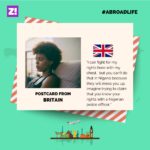
It sounds silly but those are things that put me off from coming back to live in Nigeria. I can fight for my rights here with my chest, but you can’t do that in Nigeria because they will mess you up. Imagine trying to claim that you know your rights with a Nigerian police officer. I think I’ve taken myself away from that culture and going back into it will be hard.
I also have learnt to dissociate myself from the idea that I have to be smart because someone might be trying to cheat me and I don’t want to have to learn that again.
What do you miss about being in Nigeria?
My friends and my family.
What’s the best thing about living in the UK?
Freedom. I feel more like myself if that makes sense.