
• Fawaz didn’t plan to become a site engineer. At 16, fresh out of secondary school, he took a holiday job in construction to make some money. That one holiday changed everything.

    Seven years later, after completing his civil engineering diploma at Yaba College of Technology (YabaTech) and spending every break working in construction, he now supervises full-scale projects in Lagos. In 2024, he worked on a ₦200 million one-storey residential building in Surulere, Lagos. 

    From unexpected government fines to skyrocketing material costs, here’s the real cost of bringing a house to life in Lagos, brick by brick.

    This is Fawaz’s story as told to Aisha Bello:

    I’m a junior site engineer in Lagos. This means I supervise the construction of buildings, ensuring everything — from the foundation to the finishing — is done right.

    Last year, I helped build a fully finished one-storey residential building in Soloki St, Surulere. The owner contracted the construction firm I work with to oversee everything. We took care of everything from sourcing materials to final fittings. But as with most projects, things didn’t go exactly as planned.

    Buying the Land & Paperwork – ₦120.5M

    The first step in building a house isn’t construction; it’s paperwork. The owner bought a plot of land for ₦120 million. Before any work started, a lawyer was brought in to verify documents like the Certificate of Occupancy (C of O), Deed of Assignment, and Family Receipt to confirm the land wasn’t being used as collateral for a bank loan. The lawyer’s service alone cost ₦500,000.

    Then, we did a soil test for ₦300,000 to determine the type of foundation the building needed. We drilled deep into the ground, collected soil samples, and tested them in a lab. Based on the results, we went with a raft foundation to prevent future structural issues. 

    The next step was to get an architect to design the house according to the owner’s vision, which cost ₦700,000. But a design isn’t enough; you also need a structural engineer to ensure the building won’t collapse under its own weight. That’s where the structural drawing came in, which cost ₦300,000.

    Once all the plans were ready, my boss, the owner of our construction company, took over. We charged ₦10 million to execute the project from start to finish. This fee covered expertise, project management, and the skilled labour we needed to make the architectural drawings a reality.

    Construction Pricing: Why We Charge Per Stage

    When people hear the cost of building a house, they assume it’s a fixed number from start to finish.

    But that’s not how we work. 

    While the contractor’s fee is paid upfront (in this case, ₦10 million), the actual money spent on materials and labour is determined stage by stage.

    Construction material prices change almost every day in Nigeria. If we estimated the total cost at the beginning and stuck to it, we’d either run into losses or get stuck midway when the prices of materials shot up. 

    So at every new stage, we confirm current prices and bill the client accordingly. That way, they’re only paying for materials at the actual market rate when they’re needed.

    Foundation – ₦10.5M

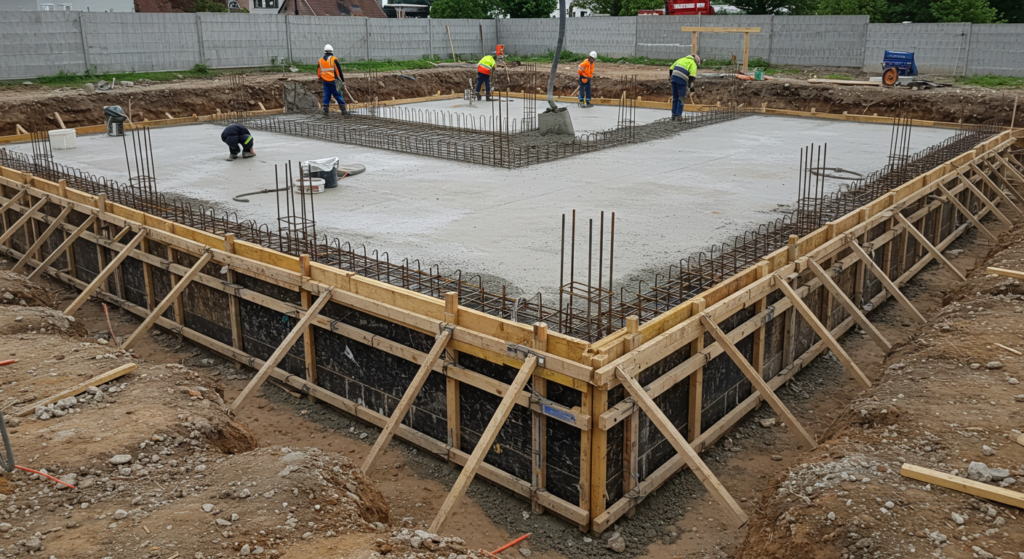
    This was one of the most expensive parts of the project. A building’s strength is in its foundation. You can’t afford to cut corners when laying a foundation; one mistake can collapse the entire building.  

    Here’s how we laid the foundation:

    Step 1: Excavation and Digging

    We paid ₦200,000 to dig out the ground for the foundation. This is hard labour: men with shovels and sometimes machines, depending on the land.

    Step 2: Laying the foundation 

    Once we finished digging, we started laying the foundation in the dug-out space called the trenches.

    How we laid the foundation:

    • Reinforcing the trenches: To strengthen the foundation, we placed 3.5 tons of imported iron rods ( ₦4 million) in the dug trenches. 
    • Setting up the framework: We used 100 Marine boards (₦2,800,000) to build moulds that held the concrete for the foundation. One marine board went for ₦28,000.
    • Mixing and pouring concrete: We combined 375 bags of cement (₦2.8 million), two trucks of granite ( ₦1 million) and two trucks of sharp sand (₦600,000) and spread the mix evenly. 
    • Installing the German floor: To improve stability, we layered another thick slab of concrete floor to reinforce the foundation.
    • Labour cost: We paid labourers ₦400,000 and ₦250,000 to cast the German floor and lay the foundation.
    • Total foundation cost: ₦8 million.

    It took 40 labourers to get this done. 
    Unexpected Delay – ₦2M Fine

    We started the project in September 2023 with a completion timeline of 7–9 months. However, three months in, construction was halted because the owner had lied about getting government approval to build a storey building in the area. The Lagos State Building Agency (LASBA) stopped our work, and it took three months to resolve the issue. We ultimately had to pay a ₦2 million penalty before work could resume in January 2024.

    Superstructure (Walls & Decking) – ₦7.5M+

    Once the foundation was solid, we started raising the structure. This process is done in stages:

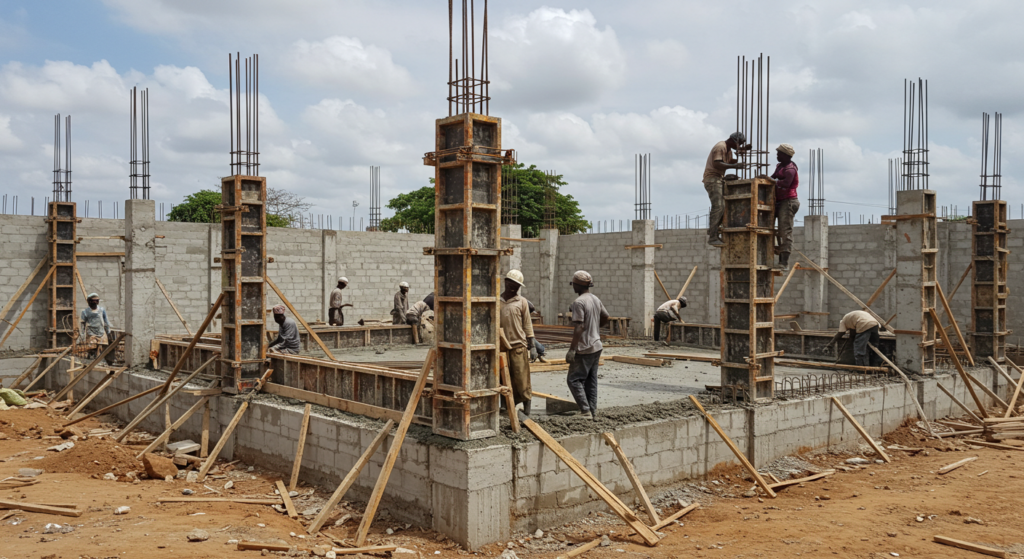
    1. Columns (Pillars) 

    Columns are the skeletal framework of the house — the vertical and horizontal supports that hold everything together. We paid: 

    • Iron bender (20 pillars): ₦100,000.
    • Carpenter: ₦100,000.
    • Labour for casting (20 pillars): ₦140,000.

    Whenever we cast a structure, we need iron for reinforcement, woodwork for formwork, and concrete to hold everything together.

    Once the structure was in place, we moved to the next big stage.
    2. Decking: The floor between two storeys

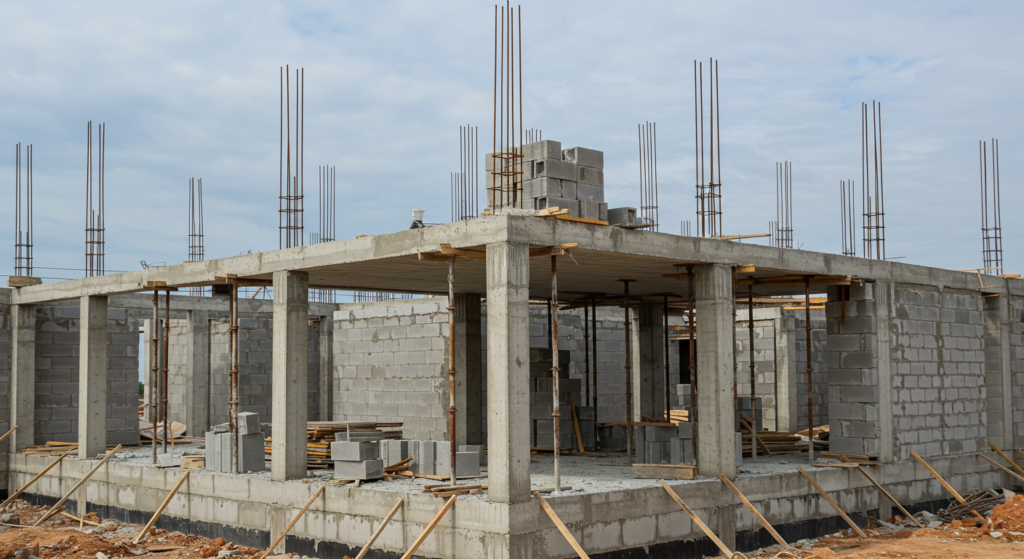
    If a building has more than one floor, you need a solid concrete slab between them. This is called the decking slab, and it’s a major part of construction costs.

    First, we had to mould hollow blocks, which are cheaper and reduce the amount of granite and sharp sand needed. This required 200 bags of cement and ₦200,000 paid to workers to mould the blocks.

    For the actual decking slab, we needed:

    • 130 bags of cement (₦7,500 per bag).
    • 2 extra tons of iron rods (₦1.9m per ton).
    • Workmanship for iron bending and carpentry: ₦250,000 each.
    3.  Another set of Columns (Pillars) 

    After the decking, we needed to raise another 20 columns to support the next level. Since fewer materials are needed as you go higher, this stage costs less than the foundation columns.

    • Iron bender (20 pillars): ₦50,000.
    • Carpenter: ₦85,000.
    • Labour for casting (20 pillars): ₦140,000.

    4. Roof Beam & Logging

    The roof beam is a reinforced concrete frame that keeps the building stable and distributes the roof’s weight evenly.

    • We cast the roof beam using leftover concrete from the decking.
    • Planks and iron rods were used to reinforce the edges.

    Next, we worked on roof logging, which is the wooden framework that supports the roofing sheets. This involved securing planks before adding a small slab for the water tank.

    At this stage, the house’s skeleton structure was complete. Now, it was time for the walls.

    5. Walls 

    For the walls, we needed about 3,000 blocks.

    • 9-inch blocks (2,300 pieces @ ₦730 each): ₦1.68M.
    • 6-inch blocks (700 pieces @ ₦630 each): ₦441,000.
    • Labour for lifting 3,000 blocks to the first floor: ₦75,000 (₦25 per block).
    • Labour for laying blocks: ₦280,000.
    • Extra materials (cement, sharp sand, granite): ₦1.5M.

    Get More Zikoko Goodness in Your Mail

    Subscribe to our newsletters and never miss any of the action

    Roofing – ₦15M

    Roofing is one of the most expensive aspects of building in Lagos, especially if you’re using the costly but durable aluminium sheets.

    • Aluminium roofing sheets: ₦8 million.
    • Woodwork & roofing labour: ₦7 million.

    Internal Work – ₦63M+

    Once the structure is complete, we move indoors for the finishing touches. This is where things really add up, and the house starts looking like a home.

    • Plumbing: ₦12 million (materials) + ₦2 million (workmanship).
    • Tiling: ₦9 million (materials) + ₦2.5 million (workmanship).
    • Electrical work: ₦7 million (materials) + ₦2 million (workmanship).
    • Aluminium work, rails and windows: ₦15.5 million (materials) + ₦3.5 million (workmanship).
    • Wall plastering: ₦1.4 million (sand) + ₦400,000 (labour) + 400 bags of cement.
    • Painting & Screeding: ₦5 million (materials) + ₦2 million (workmanship).
    • POP Ceiling: ₦10,200 per bag of POP cement × 180 bags + ₦450,000 (workmanship).
    Final Touches – ₦15M+

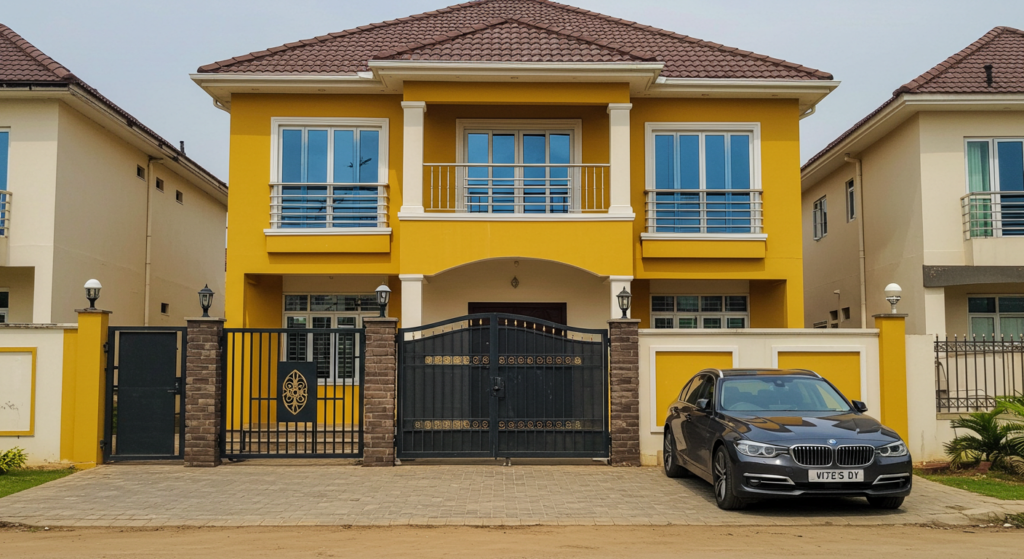
    This is the final stretch: fencing, gate, and finishing touches. Neighbouring buildings already provided two walls for the fence, so we only needed to fence the front and back.

    Fence & gate:

    i. 150 blocks + 300 bags of cement: ₦2.4 million.

    ii. Gate cost: ₦1.5 million.

    Iii. Labour (fencing, gate casting, flooring): ₦350,000.

    We cleaned the site, installed doors (₦12 million total), handled final electrical fittings, and completed the interior design (₦250,000).

    After all this, a painter touched up the dents and made the house move-in ready. Finally, we handed over the keys.

    Total Estimated Cost

    • Land: ₦120 million.
    • Construction & Labour: ₦121.14 million.
    • Total Cost: ₦241.14 million.

    Lessons from This Project

    One of the biggest lessons I learned is to double-check approvals to avoid delaying projects and having issues with the Lagos State Building Agency.

    Today, I’m supervising a shopping mall project in Yaba and another one-storey building in Lawanson, Surulere. My job challenges me to solve problems, lead a team, and bring buildings to life. I enjoy the process so much. 

    Someday, I hope to own my own construction firm and build homes people will live in for years.

    Join 1,000+ Nigerians, finance experts and industry leaders at The Naira Life Conference by Zikoko for a day of real, raw conversations about money and financial freedom. Click here to buy a ticket and secure your spot at the money event of the year, where you’ll get the practical tools to 10x your income, network with the biggest players in your industry, and level up in your career and business.


    Also Read: What It Really Costs to Move Out as a Young Person in Nigeria


    [ad]

  • A simple solution to the cubicles sorry houses they build in Nigeria these days would be bigger houses, but Lagos landlords would rather chew iron. So in this article, I shared some pro tips to make your bedroom look bigger. Even if you don’t live in a mansion, the least you can do is get your bedroom to fake it.

    Clear all your clutter

    Your room will keep looking like a cubicle if you handle it like a pig sty. Nothing in this article will help you if all your stuff’s scattered. At least, stuff them in your wardrobe and pretend.

    Get longer curtains, and place them higher

    Source: littlehouselovely.co.uk

    Curtains aren’t cheap. Heck, they’re the most expensive basic furnishing you’ll have to purchase. But they’re essential if you don’t want people to see your nakedness. The idea with curtains is to place them closer to the ceiling. People will focus on the height and see things much bigger than they actually are.

    RELATED: Home Is a Shapeshifting Concept

    Or ditch curtains entirely

    Our forefathers didn’t have them, and they were fine. And again, they’re expensive. The goal is to have fewer items in your room, and heavy curtains can make it appear choked up. If you can’t live without them, blinds are less bulky and more pleasing to the eye.

    Move your mirrors closer to natural light

    First,

    To make your space more like a home, get a full-length mirror. Squeeze ₦8k – ₦10k into your carpenter’s hand, and you should be fine. As long as you keep the frame as basic as possible.

    When you get the mirror, put it close to your window. The reflective light will make you think the space is bigger as the reflection of the view outside just opens up the room a lot more.

    RELATED: 5 Items That’ll Destroy Your Bank Account When Furnishing Your Home

    Keep your furniture closer to the ground

    Source: People Magazine

    A mattress on the floor has the potential to make your room look bigger because it leaves more space than a huge bedframe. You need to avoid high furniture in general because they take up more room.

    White all the way

    If you’re not down for white, nude is the next best thing. But whatever you pick, keep the colours light. Don’t go painting your entire room purple because you’ll wake up one day asking yourself why. The lighter the colour, the more light you get into the room, and remember what we said about light and the illusion of space?

    Match your wall with the furniture

    Like a man’s belt and shoes, you need the colours in your room to be coordinated. Once you’re out there buying a pink bed and painting your walls yellow, there’s nothing we can do for you again. 

    If you want more details on how much it costs to furnish your home, check out this article: “Basic Furnishing Cost Me ₦2m” — How Much Are Nigerians Spending on Their Homes?

  • Nothing beats the fantasy of living alone and on your own terms. But how prepared are you for the cost of actually owning a home? If you plan on moving out soon, this article is for you. 

    Here’s what 8 Nigerian millennials spent on furnishing their homes. Note: curtains are the worst.

    Location: Shangisha Magodo, Lagos

    Total cost: ₦2 million

    Before I moved into my apartment in 2019, I lived in my family house. I was 27 and my relationship had gotten to a point where I needed full privacy. Since it was just my cousins, siblings and me, we had to take care of everything we needed in the house. So I knew how expensive things could get to furnish a home. I knew exactly what I wanted.

    A two-bedroom apartment was my target. Aesthetics were very important to me too, and plants were at the top of the decor list. My babe and I love plants, so I was going for at least seven to ten in our apartment. By the time I had the basics like paintings, curtains and setting up furniture — including a standard workstation because my job was a hybrid set-up — I had spent ₦2 million.

    I can’t remember the cost of each item, but the most expensive things were within the ₦200k – ₦350k mark each. I’m still asking myself where I got the money from.

    Here’s a breakdown, excluding miscellaneous costs:

    — Femi*, 30

    Location: Jabi, Abuja

    Total cost: ₦100k

    I moved into my first Nigerian apartment in 2020. Before then, I’d lived in the UK for a year doing my master’s, and my apartment came with furniture and basic living room and kitchen items. Compared to moving to Abuja on my own, that was heaven.

    My style is minimalist and clean. But with the ₦250k salary I was earning, even the furniture I wanted was too expensive. The average price range was ₦145k for a single-seater, ₦365k for a two-seater and ₦385k for a three-seater sofa. Those prices were ridiculous to me. I was also sceptical about using roadside carpenters who were even charging like ₦200k plus for a regular bed. Why?

    RELATED: How Nigeria’s Housing Problem Is Affecting Nigerians

    So I moved into the apartment with no furniture. For the time being, I’ve made a makeshift bed that cost me ₦20k while I save up. The thing I’ve sorted out, for now, are the curtains. They cost me ₦80k plus installations for four windows. And it’s not that the material was expensive. The thicker and more costly materials were going for ₦120k – ₦150k. That will be for another time. 

    — Lydia*, 26

    Location: Avontrou, Benin Republic

    Total cost: ₦30k

    I go to school in Benin Republic. February last year, I decided to get an apartment mostly out of frustration from living in the hostels. I live in Avontrou and my place costs ₦30,500 weekly. That’s about the most reasonable price for a good quality apartment here. But there are student-friendly prices, around ₦10k – ₦15k weekly.

    As for furnishing, my parents gifted me all my furniture except a mattress which cost ₦30k — someone needs to explain why beds are so expensive. Then, I stole curtains from my dad’s office. I’m not interested in any more expenses until I’m done with school.

    — Michelle*, 21

    Location: Gbagada, Lagos

    Total cost: ₦180k

    I moved into my first apartment in 2019. I was earning about ₦125k monthly at the time, so my budget was obviously low. I needed a place that wasn’t expensive and too far from my office at Gbagada. When I finally got one, the rent was ₦350k per year. I also paid the ₦60k agency and agreement fees and ₦30k caution fee. 

    I had to renovate it to make it liveable, but I didn’t consider aesthetics at all. I didn’t have money for that. The major thing I did was install metal burglaries over the door and windows. That cost ₦100k. Then, I painted the house and changed the tiles in my bathroom for ₦80k. 

    RELATED: Home Is a Shapeshifting Concept

    The apartment was convenient until earlier this year (2022) when I decided I could get a much better place. My monthly earnings have increased to an average of ₦380k, but you can’t get a decent one-room apartment on the Island for ₦800k right now except if you go as far as Sangotedo.

    I’d love to have a nice aesthetic in my new home. But the cost of rent alone is scary. The logical option is to furnish in phases.

    — Jane*, 27

    Location: Anambra

    Total Cost: ₦40k 

    Before I moved into my one-bedroom flat in November 2020, I lived in a self-contained that cost ₦75k yearly. This was during my master’s degree program at a faculty under Nnamdi Azikiwe University in Agulo village, Anambra. After school, I decided to move to a more urban area, Awka. 

    I got a job as a public health worker, but the bulk of my money came from sewing and selling yoghurt. I was making about ₦100k by 2018. That’s how I raised enough to move to Awka. My new apartment costs ₦250k yearly, so when I moved in, furnishing was not at the top of my list because I’d spent the majority of my money on rent. 

    RELATED: Adulting: 5 Nigerians on Things They Find Expensive as Adults

    For now, my aesthetics are sapa-inspired. For the first four months, the sunlight woke me up every morning because I didn’t have curtains. The sellers were charging ₦80k each. I couldn’t afford it so I went for blinds, which still cost ₦40k each.

    I’m at the point where I have to hit my fan before it comes on, and I can’t afford to buy air conditioners because my finances have dwindled over the years. I stopped sewing too; slouching all day gave me back pain. I’m focused on getting a job that’ll pay me enough. When I get one, all the sapa-inspired aesthetics will end.

    — Bridget*, 30

    Location: Mombasa, Kenya

    Total Cost: ₦901k

    I moved out of my parents’ house in 2021, and I got an apartment in Port Harcourt. Compared to Lagos, prices were reasonable there. But curtains were bloody expensive. One cost ₦60k. Why, please? By the end of the year, I had to move to Mombasa, Kenya for school. 

    Things there were six times the cost I’d spent trying to furnish in Port Harcourt. So I focused on the most essential things. First, I got an orthopaedic bed that cost 29k shillings (approx. ₦162k). I carried my PS4 from Nigeria and got a TV for 77k shillings (approx. ₦430k). Then, I got four blinds for 18k shillings (approx. ₦110k). Finally, I got my air conditioner for 35,500 shillings (₦199k). Omo, I haven’t actually sat down to look at the cost of things. I’m sure there were more, but these were the most pricey.

    — Richard*, 21

    Location: Portsmouth, United Kingdom (UK)

    Total cost: ₦765k-₦1m

    When I moved to the UK in 2017, I opted for a shared apartment because the rent was expensive. And my share cost £350 (approx. ₦179k). The apartment came furnished with some janky couches, chairs and beds. But one time, my roommate sat on the couch and it broke. They were clearly not made for black boys.

    Buying something brand new in the UK was out of the question. I’m talking £400+ (₦204k+) for a single couch! We had to tell the landlord to get us another one instead. He brought a black leather couch that had coins and stuff from God knows where. So he definitely either gave us his own couch or bought it off Facebook Marketplace. 

    RELATED: These Ridiculous Rules Prove That Nigerian Landlords Are From Hell 

    My bed was also destroying my back after a year. So I had to tell the landlord to change that too. A new bed cost about £300 (approx. ₦153k). If I had to replace it on my own, I’d have just slept on the floor like my ancestors. 

    So in the UK, you don’t furnish except you want to be extra. Most of the cost goes into rent, which can be between £750 – £800 (approx. ₦383k – ₦408k), and utilities like electricity, heat and WI-FI. If I get something, it’s a thrift piece. Like my TV that cost £120 (approx. ₦61k). Other costs of living come in too. The other day, the microwave broke down. That was £40 (approx. ₦20k) gone to fix it. 

    RELATED: 18 Things That Are Too Real for Any Nigerian Who Has Ever Gone House Hunting

    Also, the UK is set up in a way that you always need to split the bill. The cost of living is high. Right now, I’m looking for a new place to live because my landlord wants to sell the house. I’m also getting married so I need my own space. That’s a nice £150 – £200 (approx. ₦77k – ₦102k) on kitchen utensils alone. Full furnishing would likely be £1,500 or £2,000 (approx. ₦765k-₦1m).

    — Ben*, 27

    Location: Gbagada, Lagos

    Total cost: ₦750k 

    I moved out of my mother’s house when I finished university in 2019. I was going for a minimalistic vibe because I really didn’t have the money to do anything grand. My modelling career was just kicking off. But I also didn’t want clutter in my space because it was a small one-bedroom apartment. 

    I didn’t have enough money to fully furnish until 2020. I got a bulk amount and took out ₦500k to re-do my home. First, I got furniture. I was going for something that wouldn’t encourage people to stay in my house for too long. So the chair didn’t have any arm or backrest. But it cost ₦50k because of the pink suede material. 

    RELATED: Read This if You Want To Hack House Hunting in Lagos

    I bought a fake plant that was way more expensive than a real plant at ₦25k. But a real one would’ve died; there was no need to spend money on it. The truth is, forming minimalist was way more expensive. Things like painting my living room satin white cost more than ₦50k. Way more expensive than painting my room (which is way bigger) purple. Painting and screeding the whole house cost 100k. 

    Oh, and my vanity mirror cost ₦40k to make, excluding the chair and table. I racked up ₦500k on my floating shelves, LED lights for Youtube and new cupboard doors. Then, curtains! I can’t remember how much they cost, but it was ridiculous — I was better off with window blinds. If we’re adding my inverter, it cost ₦250k.

    I actually can’t complain because if I’d gone to a regular store, I would’ve spent at least ₦500k on furniture alone. And that was two years ago. 

    — Dolapo*, 24

    ALSO READ: 7 People Talk About How Much It Costs To Live In Abuja