• We all grew up with the taste of Knorr in Sunday stew, jollof rice, and the meals that bring everyone to the table. It’s the flavour that feels like home, and it’s been part of our lives for as long as we can remember.

    On October 10th, 2025, Knorr brought that same spirit to life with Adekunle Gold and Victor Ehikhamenor at “Fuji Reignited”, a night that paid homage to Nigerian culture through food, music, and art at The Sphere in Lagos. 

    To celebrate Adekunle Gold’s new album Fuji, Knorr served meals inspired by his music and the culture that shaped it. 

    It was the perfect setup for what came next when Adekunle Gold took to the stage, performing songs from the new album, including Don Corleone, Coco Money, and Many Many People. He also took fans down memory lane with favourites like Ogaranya and Pick Up, filling the space with warmth, nostalgia, and joy. His performance captured the true spirit of the night, a celebration of sound, flavour, and culture.

    Speaking on the collaboration, Damilola Dania, Food Demand Creation Lead, Unilever Nigeria Plc, said, “Knorr has always been part of our everyday lives, from our kitchens to our celebrations. This collaboration with Adekunle Gold and Victor Ehikhamenor was about celebrating the things that make us who we are: our food, our art, our music, and our culture.”

    For Adekunle Gold, Fuji is a love letter to his roots. “Fuji is one of the Nigerian sounds I grew up on and fell in love with,” he shared. “Working with Knorr made this moment even more special because it feels personal. Growing up, I was always sent to buy Knorr Chicken cubes, and that memory stuck with me. So, when I say, “O dun bi Knorr chicken” in Don Corleone, it comes from a real place. This collaboration feels like coming full circle.”

    Victor Ehikhamenor added his artistic touch to the celebration, creating a special artwork inspired by Adekunle Gold’s Fuji album and Knorr’s deep Nigerian heritage. Unveiled in an intimate gallery space, the piece reminds everyone that our culture lives on through sound, art, and the meals we share every day.Fuji Reignited was more than a night of food, music and art; it was a reminder that Knorr has always been part of Nigeria’s story and will continue to be part of its future. Because Knorr is not just in our food; it’s in our homes, our stories, and our culture.

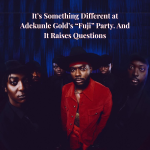
  • Two years after Tequila Ever After, Adekunle Gold returns with his sixth album. Titled FUJI, it is his first release in full embrace of Fuji, a genre of Yoruba music birthed in the late 1960s, which he reveals is what he’s “meant to do.” It’s the first album he’s drawing attention to his royal heritage of the Kosoko kingdom.

    He digs into his family history. In homage to his forebearers, he returns to the palace and bows to pay respect to his king, the custodian of his ancestry. The throne accepts him like a true prince. Drummers with quick hands and tongues for chants and eulogy put him in a groove with their rhythms. All these are documented as part of the album rollout.

    Two minutes and twenty-four seconds short of a forty-minute listening time, this 15-track-long album opens impressively. It begins with a sample from Sakara musician Lefty Salami’s Oloye Eko album, which honours King Kosoko from the 1950s. The sample rings out: “Omo Oba ki jagun bi eru…T’Oba Oluwa lase”—meaning “a prince doesn’t fight wars like slaves…the will of God, the Supreme King, is final.” Then it fades into Adekunle Gold switching flows and singing of his transition from nothing to great. A peasant-prince now wines and dines with elites. A small fry now disturbs the deep blue sea. Hence, his new sobriquet “Big Fish” is also the title of the opening track.


    Subscribe to Zikoko Pop newsletter, The Feed, for the most important pop culture news


    He has wanted these moments all his life: magazine covers draped in gold, front row seats at international fashion shows. Although his politics have never been a public discourse, it tickles the ears to hear him sing specifically that he has never collected “Bourdillion (Tinubu’s) money.” He made his bones without a handout from any politician. His success did that for him. In realisation of that, and that success attracts success and so does influence, he emphatically rebukes, “I don’t wanna go, I don’t wanna go / I don’t wanna go back to poverty.” It’s money in Adekunle’s line of sight. And there’s no better way to keep cash flow than to innovate or creatively captivate what’s currently popular.

    Fuji has always influenced contemporary Nigerian music, dating back to LKT, and has had a particularly significant impact in the last four years. It’s the tail of 2025, and Adekunle Gold joins a growing roster of artists hybridising the culture and sound. Though his songwriting and sound gestures to a fusion of Afropop, Tungba, R&B and Amapiano, not Fuji in a purist’s approach or the neo-Fuji that’s common with the likes of LKT, Dekunle Fuji, Small Doctor, Olamide, Reminisce, Asake and Seyi Vibez. The look he presents, as seen on his curtain-call album art, is urban and gives no specific nod to Fuji. But a man can style himself as he likes, though on a closer look, it’s a vestige of his Mexican misadventure.

    “Don Corleone” is the second track, featuring shimming and repetitive ad-libs, as well as backup vocals from his wife, Simi. Like every non-Sicilian artist who has referenced Don Vito Corleone to project their strict and ruthless-when-necessary side in their music, Adekunle Gold likens himself to Mario Puzo’s classic The Godfather character. But don’t fret — AG Baby, as fondly called, still wants you to dance…though only if you’re a spender.


    READ NEXT: The 10 Greatest Fuji Music Albums of All Time


    With a tweak that encourages diligence and patience, “Bobo” continues his narrative that you’re noticed only if you’re rich, with features that carry emo-pop and street-pop sensibilities from Lojay and Shoday. “Coco Money” follows and plainly advises to stay out of his sight if money isn’t involved. 

    Now, love is in the air. “Believe”, the track that follows, is a serenade of a promising love, much like Bill Withers and Grover Washington Jr.’s “Just The Two of Us” (1980) — the song it samples. Here, he’s a young lover trying to keep his love youthful. Next, on “My Love Is The Same,” themes of family and sacrifice roll into a moment of fatherhood with his daughter, Adejare. He apologises for not being around to spend time together as much as he’d have loved to.

    The music switches back to prospective love in the 6lack-featured “Love Is An Action”, a title that reiterates the message of the sampled song, “What You Won’t Do For Love” (1978) by Bobby Caldwell.

    With the dots of American samples and Hollywood references on the album, followed by “Many People”, a Tungba-pop track that directly borrows from veteran Tungba-Gospel artist Yinka Ayefele’s song of the same title, the Fuji is yet to kick in. “Attack” with TkayMaidza, Cruel Santino, Mavo, the new generation lamba maestro, launches straight to a neon-light party where girls bring their friends to mingle. If anything, this song gives the youngsters more visibility than it reinvents Adekunle Gold.

    “Only God Can Save Me”, featuring Davido, finds rhythm in Amapiano and throws the two married singers into a confession and temptation with infidelity.

    Ten tracks in, it’s clear that the signalled Fuji is largely missing from the album’s sound, neither in the sample nor in the choice of featured artists. Instead, it vaguely hangs in his voice, tickling mostly the delivery of his choruses.

    Adekunle Gold says the album’s title carries a deeper meaning. “Fuji is bigger than music. It is Lagos, it’s street royalty, it’s our story, our hustle, our heritage turned global.” All these are valid, except for limiting Fuji to Lagos, but his album is nothing like the music and culture. It only pays tribute to the genre in name, not in approach, style, or sonic appeal. Presenting a certain thing and offering something entirely different is a spineless appropriation.

    This creates a fascinating cultural conundrum, especially now that African music genres move so fluidly around the world. If the name Fuji is used willfully, without an accurate context, won’t that enable listeners outside the culture to incorrectly assume the music is something else, rather than the existing, better-known Fuji genre?

    It’s noble that he’s shining a light on his inspirations. He even brought out Fuji music legends like Saheed Osupa, Taiye Currency, and Obesere at the Mainland Block Party, which he headlined in Lagos on October 5, 2025. But, interestingly, Fuji is only in his rollout, not in the music.

    Siriku “Barrister” Ayinde, the progenitor of Fuji music, blended Were, Sakara, Juju, Apala, Aro, Gudugudu and possibly  Highlife to create the sound. If this is the route Adekunle Gold is taking with Pop, R&B, Tungba and Amapiano, perhaps he should call it something different.


    Get More Zikoko Goodness in Your Mail

    Subscribe to our newsletters and never miss any of the action


    Anyway, the Afropop grooves on, but the eleventh track, “Lailo”, isn’t spectacular. It’s a reiteration of every saccharine lyric about love that you’ve heard from Adekunle since his magnum opus Afropop Vol. 1. On the soul-stirring “Simile”, which he wrote in 2019 after his father’s demise, he searches for an anchor to rest on, unwilling to be swept away by life’s fleeting tides. On this track, he brings back his band, 79th Element, and grabs assistance from Soweto Gospel Choir.

    In less than six minutes before he takes the final bow and drops the curtain on the album, “I’m Not Done”, with American pianist Robert Glasper touches on tenacity and longevity. “Obimo” ends the album. You can call it a bonus track.

    FUJI has been lauded by many as his best since Afropop Vol. 1, if not the top contender. But here’s an irony worth considering, as writer Ojo O observed in a recent Substack discussion: nothing on this Fuji-themed album is a strong option if brought next to Dammy Krane’s “Faleela”, or Seyi Vibez’s “Fuji Interlude”, or Falz’s “No Less.” Adekunle Gold did not refine the Juju-Tungba sound that came to him instinctively before grafting to a global sound. The result is a loss of musical grounding. He no longer has a centre to perform from with conviction, and his global experiments haven’t been as creatively rewarding as he often claims.

    Afropop Vol. 1 is a critical success because he took time to bring the listeners into his pop world-building. Ten singles in, and the audience was aware he was making a switch from the folksy sound.

    Post-Afropop, he began moving very fast, and the audience began to take the backseat. Adekunle Gold doesn’t give listeners enough time to love what he’s become before he splits himself into another thing.

    But maybe winning takes care of everything.

    Don’t get me wrong: six studio albums into a decade-long mainstream career is a serious discipline that deserves applause and more. And there’s no doubt that this is an enjoyable project that outranks many so far this year, in terms of quality and its flamboyant rollout. But FUJI, just like his last two albums, forces the audience to accept a new idea without proper preparation, and lacks the authenticity that allows them to bond with the artist and the body of work.

    However, this is the new Adekunle. He’s not a Fuji artist, just a man, or a prince if you’d like, who has loved Fuji since juvenile — and is interpreting it the best way he can.

    Score: 6.5

    Editor’s note (October 10, 2025): Editor’s note: A previous version of this story included phrasing similar to a Substack comment by Ojo O. The piece has been updated to include proper credit. We remain committed to maintaining accurate attributions in our documentation.


    ALSO READ: What Happens When the Most Avid Fuji Fans Come Out to Play?


    [ad][/ad]

  • First of all, Asake is one of African music’s superstars, and indeed one of the biggest that we’ve ever seen. In three years of his ascent, he has released three albums, though the first two are more critically acclaimed than the third. Nonetheless, he has remained a king of street anthems, making fans dance like nobody’s watching.

    With his unique blend of Fuji, Afrobeats, and Street-Pop, Asake has taken the Nigerian music scene by storm. And with a discography full of jams, it’s hard to pick just a few faves. So, I took on the task of diving into Asake’s catalogue, ranking the 10 best of his songs and exploring what makes each one special. From the chart-toppers, fan favourites, and the often-overlooked, I’ve crowned his undeniable bangers.

    10.

    “Mr. Money”

    In August 2020, at the peak of the COVID-19 lockdown, an Amapiano jam hit the streets with the popular catchphrase, “Mr. Money, can I be your only honey?” This Magicsticks-produced song was everywhere, playing in clubs and parties, though Asake remained an obscure artist. It wasn’t until after his signing to YBNL that many realised that this guy had one of the biggest hits of 2020 when he was unknown. Its success birthed the remix with Zlatan Ibile and Peruzzi. This is his humble beginning in the mainstream.

    9.

    “Omo Ope” featuring Olamide

    Asake kept at his Amapiano experiment and even began fusing with Afrobeats and Fuji. By 2022, Asake and his music had gained more clout and traction. He got the attention of Olamide, who featured on “Omo Ope” and eventually signed Asake to his record label, YBNL. That was the dawn of greatness for Asake.

    8.

    “Mogbe”

    Relationship issues had Asake in a chokehold, and he had no choice but to voice out his emotions. He’s only available for love matters, but the problems with his insecure lover have pushed him to vices. Still, he found a strong voice that’s yielding to love, and he can’t let go. He ends the song by stating that his woman is a wonderful one. Indeed, romance over everything.

    7.

    “Nzaza”

    This song, “Nzaza,” is the eighth track on Mr. Money With the Vibes, Asake’s debut album. It’s an Igbo word that means “God, please, hear my prayers.” By extension, he admonishes himself to help his prayers work, after all, even the Bible says there’s no food for the lazy. He also praises himself as an important personality— more or less a declaration or his prayer to fulfil his destiny to be great. His songwriting is as pristine as the heart he opens up in the song to the heavens.

    6.

    “Terminator”

    This song arrested many music listeners straight from its preview on social media. “Terminator” refers to someone who goes back on an agreement or promise. In this case, it’s a babe he planned a link-up with. The song is riddled with sweet-nothings, sex talks and romantic yearnings. He even draws a comparison between his profound, persistent readiness for coitus, like a popular logistics company: “Mo wa gbe e de bi Gokada, I dey deliver steady.”

    5.

    “Fuji Vibe”

    In five minutes and twenty-two seconds, Asake gives an eclectic performance of pure Fuji delivered with the urgency of the current times. He sings of enjoyment and women with hypnotic auras. Interestingly, Asake had this song for a long time, but he updated it with his producer, Magicsticks and additional production from himself and The Compozers. The second half of the song switches into the thunderous and rhythmic sounds of percussion; it sounds like chaos, yet so sweet and safe. He comes fully into his Fuji act here.

    4.

    “MMS”

    Here, Asake, on his third album, Lungu Boy, eased off his Amapiano fusions and worked with another producer, P.Priime. “MMS,” meaning “Mr. Money Song,” is a laid-back and reflective record that suggests that God is omnipresent, nothing happens without God, and all that’s in this life is vanity. Wizkid, in the second verse, expands the theme and plunges into his mom’s demise and his grief. The song feels like a deep cut.

    3.

    “Lonely at the Top”

    This song is on Asake’s second album, Work of Art. Here, Asake has found success. He already had the biggest Nigerian debut album ever out. He has performed at the famous O2 Arena in the UK. He was at a top level he hadn’t been before. Hence, the reason why a great height sometimes is a scary territory, as he sings here.

    2.

    “Sungba”

    Before the “Sungba” remix with Burna Boy, the original song dominated playlists and DJ sets. “Sungba” is a raunchy jam about laying pipe. He remembers his old flings and calls on new players willing to join him in bed. It’s apparent here that this guy has mastered how to make resonating songs that become smash hits.

    1.

    “Remember”

    This song calls back on the love that feels like it may slip away. He recalls all the lovely moments spent together and pleads for a continued, stress-free romance. In this romantic chase, Asake wants his love interest and the listener, by extension, to remember who he is: an undisputed show stopper, an undefeated champ, a committed lover and a big spender on his women. He makes a maverick record of “Remember.” His lyricism, vim and passion are earnest.

    In Case You Missed It, We Reviewed Asake’s “Lungu Boy” Album. Read Here.

  • Every meeting place has a designated name. Where smokers and mostly closet drug-addled folks freely indulge in Southwest Nigeria is called Lungu. Another interpretation of Lungu is ghetto. It could also signify a corner, a personal space, a comfort zone, or a place of abode.

    This “razz Lungu” word has now found its way into pop culture and urban vocabulary and can be open to broader contexts. Your office space is your lungu. Your favourite hangout spot, your precious kitchen. This will be the Asake effect. “Lungu” is the adjective in his new album title. It modifies the noun Asake. It’s where the Nigerian singer finds a sense of belonging, his loyalty to his proletariat beginning, if not a specific nod to his Lagos Island origin. “Lungu Boy” is his third studio album, a speculated trilogy, just released after his modern classics, “Mr Money With the Vibes” (2022) and “Work of Art” (2023).

    Start opens the album. Forty seconds after the sample of Asa’s Eye Adaba, a morning reverie, Asake sets the album tone. He’s a party rider. He sings, “Mr. Money killing show / Anywhere I enter, it’s a big intro.” After the mellow post-Work-of-Art singles, Happiness and Only Me, nothing screams “We’re so back!” more than those opening lines. He pleads positivity, and disregards distractions. “Me I wan free mind, make I no yarn too much / Elevate my mind, make I not talk too much.” 

    Mr. Money Sound (MMS) comes in next. Reflection is written all over this. This therapeutic type of production requires acknowledging a higher power, going down memory lane, waxing philosophical about vanity, or getting deep into the pain points of desiderium, as Wizkid’s verse expresses. One hears this type of performance from Wiz and wonders, “This guy talks?” It builds an expectation that he likely has more to say on his forthcoming album than recycled smug brags, canal tales and frolicking gists of his lovers’ musings.

    The party finally picks up on Mood. It’s groovy, though not necessarily happy; it’s a mix of moods. Optimism is almost dimmed, and Asake contemplates with a resigned attitude. The fleeting emotions he sings about here is a universal phenomenon; it’s happening in every life. This song makes thoughts sober rather than turnt on a tipsy or drunk night. One may feel aligning chakras and white light on the forehead in more profound listening. The angelic “Oh, oh, oh, ohhh” between his verses shifts the song from a groove towards the realm of meditation. Asake repeats his first verse in the second but in broken Spanish. It’s hard to tell why he subjects us to español. Perhaps he’s learning a new language and testing his proficiency, or it’s the influence of Los Angeles living since his blow-up. Or maybe it’s an expansion move into Southern America, which makes sense considering the Bolero-styled bridge performed by French-Gabonese singer Anäis Cardot on the following track, My Heart. According to Asake, the song describes the kind of woman he wants. The song lyrics and love interest’s name, Marissa, further confirm his interest in the Latino experience, specifically a babe.

    Adding that up with his global breakthrough in the music space, Worldwide takes the follow-up spot. In a larger context, Asake wants to be more than a guy from Africa. The tempo almost dragged until he gets Active with US rapper Travis Scott on a funky urban-fuji inflected with log-drums and a sample of Jazzman Olofin and Adewale Ayuba’s Raise the Roof. They’re hyperactive, junking on adrenaline. This song’s the album’s zinger!

    Suru, the next song (meaning “Patience”), is admonishing, almost like Asake’s looking out for impatient people. The chorus bites Musiliu Ishola’s Ise Oluwa Ko Seni Toye. It features Stormzy, a UK rapper, to say that good comes to those who wait.

    Asake picked up a new hobby turned lifestyle this year. It’s skating. The outdoor sport that was once a rebellious underground subculture and became popular through the likes of Pharrell Williams (Skateboard P), Lil Wayne and Lupe Fiasco is very mainstream now. However, it’s a developing culture in Nigeria. Not to be classist, but a younger Asake who possibly made a fun ride from a motorcycle tyre and a stick would likely look at the version with a skateboard with yearning and envy. As regular as skateboarding may be, it’s a boujee sport for those with nothing to think about other than survival. This song is about the joy of finding fun (again) in adulthood. Also, it’s interesting that a Nigerian artist sings about a fun activity that isn’t a vice.

    Magicsticks, his go-to producer over the last two albums, finally sticks one production to us with Wave featuring Central Cee from the UK. It’s the twin to Active with Travis Scott, although it might as well be a Central Cee record. Far from peer pressure and insecurity cop-out, Mentally relates to nightlife spenders and hustle savviness impacted by street smart. He makes enough cash to disregard a lame. Uhh Yeahh comes up in the middle of a rave and possesses the party energy — Fuji, EDM and Jersey club music have become one spirit. This song gets the dancefloor going in the drench of sweat and deafening subwoofers. The beat is so hypnotic that Asake gets lost in the sauce. It’s a reminder that Sarz isn’t your mate. [ad][/ad]

    As a Nigerian, one word at the tip of one’s tongue from birth is I Swear. The slang means “I’m dead serious”, and it needs no serious conversation to slip in. Here, the listener moves to Asake’s message of self-importance and love for luxury. At this point, this album has become a slow burner. Three songs to the finish, totalled at 48 minutes, “Lungu Boy” feels longer than his previous 30-minute-long albums that play incredibly fast and beg for a repeat.

    Ligali is a term popularised by Fuji musician Pasuma Alabi over two decades ago. More than a reference to coitus stimulation, “ligali” encourages dancing and gyration. Asake continues to be influenced by Fuji music, a constant sonic element in his upbringing. Brazilian singer LUDMILLA joins Asake on Whine that melds Afrobeats groove and ragga-dancehall to advance Mr. Money’s quest into the Afro-Latin music market. He closes out with a live-performance version of Fuji Vibe, a long-time recorded song he played as an interlude during one of his shows. Its opening beat breaks share similarities to Olamide’s Wo, including their hyper-fast BPM. The thumps of gangan and omele drums, jazziness of modern drum set and trumpet, instrumental renditions of Adewale Ayuba’s Ijo Fuji, and Asake’s breakout single Mr Money, send the crowd into an àríyá (party) frenzy. Then it slowly descends into a Mara music vibe, carrying Gen-Z of the inner cities. This song will be as hard as any entry at the famous Oluyole West NG Carnival in Ibadan. Fuji Vibe will go down as one of the fans’ favourites.

    With P.Priime credited as producer on the first four songs (Start, MMS, Mood, My Heart) and three others (Suru, Skating, I Swear), it now goes without saying who the producer of the year is. Sarz, P.Priime’s sensei, did the production on Worldwide, Active, Mentally, Uhh Yeahh, Ligali. The three remaining production credits go to Haitian producer SAK-PASE on Whine, Magicsticks on Wave, alongside Asake and The Compozers on Fuji Vibe. The album’s production value is elite.

    Conclusion

    “Lungu Boy” is the repeat of stories he’s already told, laden on experimental Afropop, neo-fuji and urban-tungba. Rather than an autobiographical audio entry, this album is a party drilled in heavy, uptempo, ADHD-induced sounds, rigorous jolts, and dance moves. Although Asake remembers God and that he’s a vanity slave, there’s little reflection in the body of work, not what the title and portrait album art suggest. The music is hot on gaiety, ballers’ night out, house parties, counting cash and spending it on baddies with chop-life agendas. One wonders if these women are aware that he’s convinced that one drunk man is more intelligent than three women

    Asake’s performance seems more relaxed, but the music is still shindig and restless.

    Compared to his debut album “Mr. Money With the Vibes (MMWTV)”, “Lungu Boy” is a slow-burner, just as his second album “Work of Art”. The difference is the latest album misses the preciseness of his self-written debut, and lacks the focus of the sophomore, his best. Perhaps the exclusion of Olamide, his label boss, in its songwriting is glaring. Or maybe this is a pushed work that fulfills and ends his YBNL contractual obligations. “Lungu Boy” seems to miss its intended message. It gives little to the ghetto kids. Nothing more than weak songwriting, surface music and steeze.

    Considering the album hype and Asake’s reputation as a hit-making machine, the listeners’ conversation would be torn into an emphatic “Asake delivered” and a puzzled “What’s this?” Lungu Boy is an unsuccessful experiment, a 7/10 at best. It doesn’t feel like a convincing trifecta—at least not yet.

    This is a premature evaluation anyways.

    People will still dance to his music.


    Speaking of Experimental Albums, We Reviewed Rema’s “HEIS” too.

  • Fuji music is a Nigerian staple. Some Nigerian pop stars such as Olamide, Asake and Seyi Vibez make music that’s a hybrid of afrobeats, hip-hop and fuji, but the budding artistes don’t have to dilute Fuji with disco to become legends. You can focus on just Fuji music. This is the guide you need.

    Have a unique name

    You can’t go wrong with something strong and catchy as a stage name in Fuji music. Here’s an easy formula: use your nickname or merge it with your first name. E.g. Saheed Osupa, Taiye Currency Ayinde Barrister and Ayinde Kollington. I hope your name is not Wasiu or Ayinde sha, before people call you an impersonator.

    Mention it every minute

    You need to constantly drop your full government and nickname while singing. If you’re not doing that, you’re not ready for the world to know your name.

    Have street credibility

    If you haven’t served some time in the streets, your Fuji musician status is “learner.” The fastest and surest way is either to get four-year experience as a NURTW member or work as a freelance bus conductor. 

    Form your band

    Assemble the best drummers, backup vocalists, keyboardist and a hypeman with a baritone. Then get an official fabric seller who’ll constantly supply the band the best ankara and lace fabrics. Alternatively, the uniform can be polo shirts and facecaps with the band name printed on. Everyone should look flyer than Barrister and boys in 1989.

    Learn praise-singing

    Scam people into spraying you all their money with your high praises. If you can make people’s heads swell with your music, it’ll take you far and they’ll call you to the next ceremony in your hood. You better learn it so you can secure the Fuji bag.

    Do you know any proverbs?

    Whether you’re motivating, making social commentary or throwing words like stones, you must be clever with your figures of speech and best not miss.

    Have a photographic memory

    Imagine the embarrassment if you forget the name of the person who’s spraying you money halfway through your set? All it takes is one fuck up, and your whole reputation is out the window.

    Add your abroad experiences to the music

    How else do we know you’re spreading the gospel of fuji across the globe? You need to travel and then come back to give us your London Experience Vol. 1 – 5 or Amsterdam Tour part one and two, to certify your legend status.

    READ: The Zikoko Guide: Nigerian Music Industry 101

  • As afrobeats continues to expand, artists of our generation are reaching back to pull inspiration from older artists and genres that rocked the Nigerian music scene back in the day. From Abas Akande Obesere to King Wasiu Ayinde Marshal (KWAM 1), the influence of these iconic artists can be found in the songs we’re streaming today. 

    Here are six artists whose songs pull from the never-ending groove of fuji music: 

    Olamide – Anifowose 

    With over 10 albums to his name, Olamide is one of the most consistent hitmakers of his generation. On his 2013 album, Baddest Guy Ever Liveth, Nigeria’s number one baddo takes us on a trip down memory lane thanks to his lyricism and badass sample of KWAM 1’s fuji hit, Orin Abode Mecca Medley, which was released in the 1980s.  

    Naira Marley – Pxta and Opotoyi

    While Burna Boy has made a name for himself as the King of Fela samples, Naira Marley is another artist that deserves a crown of his own, this time, for sampling some of our favourite fuji bangers. Tapping another musical rebel, two of the Marlian leader’s hits from 2019 sample songs from fuji legend, Obesere. On Pxta, there’s a clear sample of Obesere’s 2002 song, Obutun. And on Opotoyi, Naira Marley dips his hand into the Obesere bag to pull out Papa Worldwide

    Teni – Askamaya 

    Teni cemented her position as one of the most exciting stars to watch out for when she dropped this song in 2018. We couldn’t escape Askamaya because it was everywhere. Becoming a popular street and club anthem, it samples Adewale Ayuba’s old school fuji hit, Omoge Cinderella

    Wurld – Contagious  

    The song might not contain a direct sample of a pre-existing fuji song, but there’s no denying that Wurld’s 2019 song, Contagious contains, wait for it, a contagious fuji sound. An interesting bridge between the fuji sound and Nigeria’s booming alte scene, this song is definitely one of our favourites on the list.

    DJ Tunez and Adekunle Gold – My Love 

    Right after the massive success that was Iskaba, DJ Tunez brought our favourite Zaddy (he wasn’t a zaddy at the time) onboard the song, My Love. Proving yet again to be one of afrobeats most in-demand lover boys, Adekunle Gold sings about happiness and love on a song that samples KWAM 1’s Can’t Just Stop Thinking about You.

    Odunsi the Engine – Fuji 5000

    This Odunsi single is what happens when you take fuji music, mix it with an energy drink, and dye its hair bright blonde. On paper, it sounds crazy, but something about it works. I guess we just like chaotic music. 

    This Sunday, 19th of December, FUJI: A: OPERA presents FUJI Vibrations.

    1 stage. 5 Fuji Stars.

    Venue: Muri Okunola Park Victoria Island.

    Time: 5pm

    Click this link to register. Registration is free.

  • See, Fuji House Of Commotion was everything! Refreshingly hilarious with great actors and the catchiest theme song, Amaka Igwe really made my childhood with this. In fact, it’s still one of the funniest Nigerians comedy TV shows to this day. These are some of the funniest episodes!

    The one where Ireti, Peace, Mama Moji and the children decided to move into ‘Aso Rock’ with Ireti and Chief.

    The one where ‘kitchen practical’ prepared ‘Osramo Branus Mangus’ for the house to eat.

    The one where Peaceful Peace jacked Ireti’s week with Chief.

    The one where Mama Moji and Peaceful Peace redefined the art of being shady.

    The one where Peace showed us how it feels to get ready for a night with bae and get stood up and the best way to handle it.

    The one where ASUU went on strike and Chief’s children came home and started their own strike too and locked their parents out of the house for four days.

    The one where Mama Moji, Ireti and Peace decided to spoil Chief for Valentine’s day. With absolutely no ulterior motives.

    One of the many episodes where Ireti had to fight for her week with Chief.

    These are just the episodes I remember o. I know there are a lot more, so share with us some of your favourite Fuji House Of Commotion episodes! Tweet us @zikokomag!