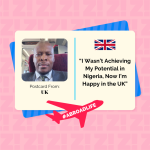
• The Nigerian experience is physical, emotional, and sometimes international. No one knows it better than our features on #TheAbroadLife, a series where we detail and explore Nigerian experiences while living abroad. 


    Collins (36) always believed in his potential. After he walked away from Igba Boy and put himself through University, he found that Nigeria stifled that potential, so he moved to the UK. In this story, he shares the differences between life in Nigeria and the UK, the culture shocks, and how childbirth and parenthood feel vastly different in the UK.

    Where do you currently live, and when did you leave Nigeria?

    I live in the United Kingdom now. I left Nigeria in 2022.

    What inspired you to leave?

    I just felt like I wasn’t reaching my full potential in Nigeria. I had an unconventional path, and I was determined to do better for myself. So when it started to feel like I couldn’t achieve the things I wanted back home, I decided to go where I could.

    You said you had an unconventional path. Could you explain?

    After secondary school, I didn’t go straight to university. I spent four years in the Igbo business apprenticeship system we call Igba Boy.

    I still remember the night I finished my last secondary school exam. My dad sat me down and told me I wouldn’t be going to university. He just couldn’t afford it. So in 2005, I went to serve a master at Balogun Market in Lagos. I was there until 2009.

    The usual agreement was to serve for seven years, after which your master would “settle” you with a fully stocked shop and some capital, about ₦2 million back then, which was a lot. But we had a falling out, so I left after four years.

    Get More Zikoko Goodness in Your Mail

    Subscribe to our newsletters and never miss any of the action

    What happened?

    I’d managed to save about ₦38,000, and he found out. He said the money was his because, in his words, “whatever belongs to the boy belongs to the master.” I didn’t agree. So we parted ways. That meant I wouldn’t get the full settlement, but I’d already made up my mind. My heart was never really in it. I wanted to go to school.

    In the end, he gave me ₦250,000. I added that to my savings and used it to put myself through school. I wrote the General Certificate of Education (GCE) and Unified Tertiary Matriculation Examination (UTME) exams and got into Obafemi Awolowo University (OAU).

    That’s impressive. When did you start feeling like you weren’t meeting your potential?

    Almost immediately after my National Youth Service Corps (NYSC) service year. I moved back to Lagos with some savings and stayed with a friend, but the money started running out fast. I was applying for jobs and getting nothing. It was frustrating. That wasn’t how I pictured my life.

    I started thinking, “What if people laugh at me?” Like, I left Igba Boy to go to school, and now I’m unemployed. If I’d stayed, I’d probably have my own shop by now, with boys under me.

    Eventually, I got a job at an insurance company in 2018. The starting salary was just ₦40,000. And from what I saw of the office politics, I knew I wouldn’t go far there.

    At that same time, a friend got a job abroad with one of the Big Four. That was my lightbulb moment. I thought, “I need to leave this country.” So I started saving and applying to schools abroad.

    How did that go?

    I actually got into a German university on a scholarship. But it didn’t work out.

    I did the first year remotely from Nigeria because of COVID-19 travel restrictions. By the second year, I was supposed to move to Germany, but even though the scholarship covered tuition, I had to fund my travel and show €10,000 as proof of funds. I didn’t have that kind of money, so I dropped out.

    Luckily, I’d met my wife-to-be around that time. We were both planning to japa, so we decided to work on it together.

    Did you get married in Nigeria?

    Yes, we did. We even had our first child there. After the wedding, we agreed she’d go to school while I worked. She got a partial tuition fee scholarship to a UK university, so we moved, and I found a job.

    What do you do now?

    Finance. When we got here, we had mentors who advised us. I told them I had experience in programme management and insurance, and they said, “Go into finance. That’s where the money is.”

    So that’s what I did. I’m working now and also doing my certifications. I’ve finished  Association of Accounting Technicians (AAT) Level 2 and Level 3 certifications, and I’m currently on Level 4, working towards becoming a Member of the Association of Accounting Technicians (MAAT). That’s a designation that you’re a qualified accounting technician in the UK. Afterwards, I’ll start my Associate Chartered Accountant (ACA) certification with the Institute of Chartered Accountants in England and Wales (ICAEW) to become chartered.

    Nice. Have you been back to Nigeria since you left?

    Nope.

    Any plans to return?

    Maybe for a visit. But definitely not to stay.

    So the UK is home now. What’s your support system like?

    We have Nigerian friends around, but I was intentional about not relying only on the Nigerian community. We’ve made friends from other countries, too. Honestly, I’ve been let down more by Nigerians here than by others.

    For example, I tried joining a group in my church, but it felt like we were always being asked to contribute money for one thing or the other. And it was just one guy pushing it. I got tired and left.

    Are there many Nigerians where you live?

    Oh yes. We live in one of the most diverse cities in the UK. There are lots of Nigerians and Indians, especially. So the Nigerian community here is big.

    But one thing we noticed early on is that there’s this culture where Nigerians who’ve been here longer expect some kind of special respect from new arrivals.

    So, you had a kid in Nigeria and another in the UK. How do those experiences compare?

    They’re worlds apart. In the UK, it’s not just about the mother and baby; they actually care about the man too.

    During antenatal visits, they ask the man, “How are you coping? How are you dealing with this? Do you need help? Do you need counselling?” They even gather all the men in one room to teach us how to support our wives. They ask about financial pressure and, if you’re struggling, they’ll tell you where to get free food like milk and eggs.

    They also check if your house is suitable for a newborn. They’ll come around to inspect things like mold on the walls, and if they find any, they’ll contact the council to fix it.

    Counsellors randomly call just to check in. At first, I found it invasive. But it really helps you prepare mentally. Having a child is a big deal. So it’s really great that there’s actual support to help men be in the right shape to then support their wives through it.

    The biggest difference is the structure. As long as you have paid the annual NHS surcharge, all healthcare services, including childbirth, are covered. Each family gets their own suite. I was surprised when I followed my wife to the hospital and there was a couch-bed for me too.

    They also offer after-birth support. They come to check on the mother and baby to make sure she’s not dealing with postpartum depression.

    In Nigeria, once you’ve paid your bill and been discharged, that’s it. Goodbye. Let the next person come in. It’s like a factory. Come in, push out your baby, move on.

    If I had to sum it up, I’d say Nigeria is still very far behind. So very far.

    The UK childbirth experience sounds better. But what about raising the child?

    That depends on what you’re looking at.

    My wife and I both work. Here, the man gets about four to six weeks paid leave, and the mother gets around nine months to care for the child.

    My mother-in-law came to help for six months, but she had to return before her visa expired. So we had to start taking the child to a nursery, which is very expensive. It’s not like Nigeria, where you can easily get help from your mum, sister, or a paid assistant.

    But my eldest, who’s in school, goes for free. And if there’s any health issue, you just take the child to the hospital for free. Children under seven don’t pay for NHS services.

    So yeah, it’s easier in some ways and harder in others.

    They say it takes a village to raise a child. Does being far from extended family in Nigeria bother you?

    Honestly, no. It does take a village, but I feel like we have that village here. It’s just made up of different people.

    If anything happens to your child or someone reports something, that’s when you realise there’s a whole community looking out for them.

    At school, teachers and counsellors don’t just talk about academics. They talk to the children about their welfare and home life. They reason with them like they’re adults.

    So yeah, the community here is different. In Nigeria, the support system is family-based. Here, there’s a different type of family that doesn’t share blood with you, but they’re invested in your child’s wellbeing.

    Recently, there’s been a lot of anti-migration talk in the West. Does that make you uncomfortable?

    Yes and no. My wife has actually been worried. You come here with plans to stay long enough to get Indefinite Leave to Remain (ILR), and then you start hearing far-right people saying they might scrap it. It’s scary to think they can just take something away that you’ve spent time and money chasing.

    But me, I’m not too bothered. When I first got here, a lot of people told me to go into care work. I refused. As a matter of principle, I will not come here and basically be a slave for white people after my ancestors were already brought here in chains. My ancestors didn’t wear shackles so I could come and wash infirm white people just to get ILR.

    People said I had an ego. But it’s not ego. I just believe labour is capital. I want to develop myself to the point where I have the skills to be a global citizen. So I’m focused on becoming a chartered accountant.

    Even if regular people don’t know it, the politicians do. They know they can’t survive without skilled migrants. If not, countries like China will leave them behind, and they’ll become irrelevant in the global economy.

    They need skilled migration. All this anti-immigrant talk is just politics.

    That may be true, but that kind of politics creates tension. Have you or your family experienced racism?

    No, but I think that’s because we live in a very diverse city. I’ve heard stories from people who live in mostly white areas.

    What were your biggest culture shocks when you moved?

    People actually obey the law. I mean the small things like traffic lights. On buses, there are seats for old people, people with disabilities, or those carrying children. If you sit there and you’re not supposed to, the driver will stop the bus and tell you to stand up. You either find another seat or you stand and hold the railing.

    Another shock was at work. In Nigeria, every superior is “oga” or “sir.” Here, you call your boss by their first name. You can correct their mistakes too. They actually expect and want you to. Try that in Nigeria and see what happens.

    They also don’t care much about religion. As a Christian, I feel like the odd one out. In Nigeria, if you say “Jesus is not real,” people will look at you like you’re mad. Here, it’s the opposite. If you say “Jesus is real,” that’s when people will look at you funny.

    I was also shocked by how open people are about their sexuality. I remember being in London and seeing two men kissing passionately in public.

    Also, they don’t believe it’s only the man’s job to provide. I was talking to a colleague about mortgages, and he said, “Your wife lives in the house too, so she should pay her share.” They split bills and chores. If the woman does the dishes and laundry, the man takes out the bins and vacuums.

    There’s this strong sense of responsibility. If you use something, you contribute. One time, I bought coffee for the office at Tesco. Next thing, people started dropping money on my desk. In Nigeria, they’d just watch you and label you the mugu who’ll keep giving them free coffee forever.

    Another thing I noticed is that white colleagues will gist with you in the office about things like sports, weather, and family life, but never politics or religion. And in public, they act like they don’t know you. They’ll see you and look away.

    I had to address it during a team meeting. I told them, “If I greet you in public and you ignore me, don’t bother talking to me in the office.” Since then, they greet me when they see me outside.

    Going to church was another surprise. We’re Catholic. In Nigeria, mass is at least two hours. Our first mass here lasted just 45 minutes. We were shocked.

    It sounds like a very different life compared to Nigeria. On a scale of one to ten, how happy are you in the UK—and why?

    It’s a ten.

    First, peace of mind. I remember calling emergency services for my child. Within minutes, an ambulance, two police cars, and a private car with a doctor showed up. Another time, my neighbour called about a fire, and four fire trucks came.

    Second, this is a country that works. I’m not even a citizen yet, but I’m allowed to vote. I know my local representative. I have the number for their office, and I can call if I’m not happy about anything. I once wrote to the council asking for a breakdown of how my taxes were being spent. Two days later, they sent me a full report.

    So yeah, I’m really happy here. It’s definitely a ten.


    Do you want to share your Abroad Life story? Please reach out to me here. For new episodes of Abroad Life, check in every Friday at 12 PM (WAT).


    Before you go, help us understand how you and other young people feel about the 2027 general elections by taking this 10-minute survey.


    Click here to see what other people are saying about this article on Instagram

    [ad]

  • We’ve heard the terrifying pregnancy and childbirth stories and seen the funniest things pregnancy hormones have made women do, but what about those who got the better end of the stick in the reproduction lottery? They’re people too.

    So, we asked seven of such Nigerian women to share how their pregnancy and childbirth experiences differed from what they expected.

    “I was horny all the time” — Lade, 35

    I have two kids, and my first pregnancy was the standard “preggy mama” starter pack. Nausea in the first trimester, crazy food cravings in the second, and a three-times-larger nose in the third trimester.

    But you see the second pregnancy? I was cruising all through. No nausea or strange cravings, and I was horny all the time. In fact, my husband was running away from me because he was convinced all the sex we were having could harm the baby. The horniness stopped after childbirth, and even after eight weeks I didn’t want. He became the one begging for sex up and down.

    “I had my baby within an hour” — Yemi, 29

    People used to tell me first-timers have it difficult in childbirth. Even my doctor told me we couldn’t take chances, and that we needed to be prepared for an extended delivery process. So, I expected the worst.

    But the day came, and I had my baby within an hour. I was far gone before I realised I was in active labour. I thought it was Braxton Hicks contractions — I’d had them some weeks before — so I delayed going to the hospital. When I got there with my mum, the nurses discovered I was close to 8 cm dilated. I was immediately wheeled into delivery, and an hour later, I was out with my baby.

    “I was a ball of energy” — Mimi*, 25

    It seems fitting that pregnant women should feel tired, right? I mean, we’re literally growing another human being inside of us. But me, I was a ball of energy all through. I never had the pregnancy waddle, and it’s not like I was this fit person before pregnancy. I even rearranged the whole house once because I was bursting with energy. My friends were always telling me to calm down. 

    My son is two now, and I’m beginning to understand why I was so energetic. The boy doesn’t know how to sit down in one place.


    Can you handle the hotness of Zikoko’s HERtitude? Click here to buy your ticket and find out


    “I didn’t know I was pregnant for the first six months” — Joke*, 29

    I always thought these “unaware pregnancies” was a scam until it happened to me. I was six months pregnant before I knew. And how did I know? I started to feel strange movements in my stomach at night, which I initially attributed to gas, but I decided to see the doctor when it became consistent. Voila! They saw a baby in my uterus.

    Nothing could’ve prepared me for it. I still had my periods consistently, and no nausea, sickness or any typical pregnancy symptom. I also didn’t have a bump till two weeks before I put to bed. I’m sure my neighbours lowkey think I stole a baby. 

    “Post-birth recovery was really smooth” — Debby*, 28

    A church member told me that the first poop after giving birth would be painful, so I dreaded it even slightly more than childbirth. I’d also heard many stories about post-birth difficulties.

    Thankfully, my post-birth recovery was really smooth. The poop was still painful, but it was more constipation-ish than the crazy pain I expected. I also had an easy breastfeeding experience, and holding my baby in my arms for the first time wiped away any pain I thought I had. Now, I know why many of our mothers went through this five or six times.

    “I didn’t have stretch marks” — Moyin, 27

    This probably sounds shallow, but stretch marks were one of my biggest concerns with pregnancy and childbirth. I know many people who developed stretch marks and even called it a “badge of honour”. I appreciate the sentiment, but I didn’t want them. For context, I do a bit of modelling, and I didn’t want lasting scars.

    I must’ve used everything in this world during pregnancy. Shea butter, coconut oil and every anti-stretch mark ointment I know. I also didn’t scratch my belly at all. It worked. I’m four months post-partum now, and zero stretch marks.

    “There was no weight gain or huge nose syndrome” — Hannah*, 30

    Weight gain and “huge nose syndrome” is like the hallmark of pregnancy, based on what I’ve seen and heard. But I was pleasantly surprised I didn’t experience either. I practically maintained the same shape throughout my pregnancy, minus the belly, of course, and you couldn’t tell I was pregnant by merely looking at my face. 

    It wasn’t a one-time thing; it was the same experience for my two pregnancies, and I’m grateful for that.


    *Some names have been changed for the sake of anonymity.


    NEXT READ: “It’s a Personal Hell” — 7 Nigerian Women on Trying and Failing to Conceive

    Don’t leave without getting your ticket to HERtitude 2023!
  • Creative Ways to Announce Your Pregnancy to Parents Who Aren’t Yet Expecting Grandkids From You

    Now you’ve fallen pregnant. Your parents aren’t yet ready to have grandkids from you, but the universe seems doesn’t care.

    So how do you break the news that a heritage from the Lord has taken up space in your womb? We gotcha.

    1. Play God’s Plan by Drake before telling them the news

    Sing the song over and over before telling them that God’s Plan for you is to have a baby in the next nine months. Find the inner musician in you and add the announcement to the lyrics of the song. Continue singing until your parents figure it out. 

    2. Tell them someone left a baby in your womb

    You’re actually not lying or being dramatic. Someone actually came over and left a baby in your womb and you weren’t given a return address. 

    3. Put the pregnancy test strip in their food

    This way, they’re going to consume the information with their food,  saving you the stress of having to use your words. Let your parents digest the information. 

    4. Tell them the Virgin Mary hired you as her intern

    Mary was in Heaven wondering what a Jesus version 2.0 would look like and decided to come down to earth to use you to do user research. It’s not like you went out of your way to get pregnant o; Mary is simply using you. 

    RELATED: 7 Things That Go Through Your Mind When You Have a Pregnancy Scare

    5. Tell them you swallowed a seed and it’s germinating inside your body

    It’s not like it’s a lie anyway. You were eating something; you didn’t know it was a fruit that has seeds and you accidentally swallowed the seed, now the seed is growing into a baby. When you swallowed that seed, you thought it’d come out in your poop, but unfortunately, it turned out to be a baby seed. 

    6. Start calling your parents “Grandpa” and ”Grandma”

    When they ask you why you’re calling them those titles, you’ll tell you you’re practising for a future that’s closer than they think. If they ask you how close, you tell them less than 1yr and 9months when their grandkids can speak. 

    7. If they’re Christians, randomly send them Psalm 127:3

    “Children are a gift from the Lord; they are a reward from him.” They should close their eyes and thank God for their wonderful gift. 

    8. Please, leave the country

    Buy a ticket or get a night bus going to Benin Republic, Cotonou or Ghana.If you’re rich enough, buy a ticket to Australia. Go as far away as possible. When you arrive in your new country, tell them you moved to create a better life for your child — the one in your tummy. 

    9. Start by asking them to join you as you sing Miracle Worker

    Dig into your choir mistress bag and sing all the songs you know about miracles. By the time you and your parents are done singing, they’ll know God has done a miracle that you want to keep. 

    10. Tell them you fulfilled one of their heart desires

    Which parent doesn’t want to be a grandparent? That your clocks may be working in opposite directions doesn’t mean their heart desire hasn’t still been fulfilled. They should even be thanking you for your service and love. Look at you being a very thoughtful child. 

    ALSO READ: 8 Nigerian Women On Their Funniest Pregnancy Moments


  • The subject of this week’s What She Said is Olajumoke Adebayo, a 26-year-old midwife. She talks about her passion for midwifery, helping pregnant women access better health care and why midwifery is so critical to childbirth. 

    What did you want to be growing up?

    I wanted to become a civil engineer. I had a friend who also wanted to be an engineer. Her dad had an engineering firm. I remember telling my mum that I would work with my friend’s dad after I graduated. She laughed and asked me who told me he would give me a job. I decided to study something else instead. 

    Oh?

    In secondary school, I chose science class — I decided to study medicine. However, the first year I wrote JAMB, I didn’t get in. I considered starting a business, but I tried JAMB again the next year and passed, getting in for nursing instead of medicine. I started university in 2011, but I wasn’t okay  with nursing. I went through the four years barely caring about the course. 

    In my fourth year, I heard about midwifery. I had a lecturer, Dr Flo Folami, who made it sound interesting. She told us she was a lactation consultant. I remember thinking, is this even a job? During lectures, she told us several women die during childbirth, and I was shocked.  I always thought childbirth was easy. I told her I wanted to teach people about it so women could stop dying during childbirth, but I didn’t have a midwife license. She said it was okay to do it regardless. That’s how I started a WordPress blog where I wrote articles about pregnancy. This was early 2014. I hid my identity because I felt if people knew I had never been pregnant and didn’t have a license, they would not  take my advice. I kept writing though. 

    How did this lead to midwifery?

    From writing, I started doing community projects. I worked with the Nigerian Child Initiative to sensitise Lagos slum communities on tetanus, water, sanitation and hygiene and pneumonia. I became a Carrington youth fellow and implemented a maternal and child health project at Ebute Ilaje community with my team. I also organised a quarterly meetup for young people to talk about sexual health issues, which was one of my favourite projects. 

    At school, I was excited whenever we were assigned midwifery postings. I remember the first mum I catered to. It was in 2017 — I was trying to get my license at the time. One of the requirements was to take care of a woman from the beginning of pregnancy till the end. I doted on her. I would reassure her whenever she expressed her fears about losing the baby — she had lost her first pregnancy. When it was time for her birth, we went to the family health centre. She had a lot of complications, and eventually, she lost the baby. I was so sad that day. I remember a car almost hit me on my way home. I couldn’t believe she lost it. I started avoiding her because I couldn’t talk to her — I felt like I gave her too much hope. 

    After a while, I was able to talk to her again. I understood why she had lost both pregnancies, so I advised her to avoid a vaginal birth for her next pregnancy and instead opt for a caesarean section. Today, she has a baby boy. This inspired me to do more. 

    What happened next? 

    I graduated in 2018. After school, I worked with a maternal health care start-up as a programmes officer. We trained mothers to teach the women in their community about pregnancy health. It was an exciting programme but I left. 

    Why?

    I was more interested in reproductive health, so I worked with other brands to help young people learn about sexual health. We would go to secondary schools to teach students, and it was fulfilling. By that time, I already had my license. In my NYSC year, I volunteered for an organisation that catered to pregnant women. There, I found out there was a shortage of midwives in Nigeria, so I decided to do something about it. 

    In October 2018, I started my organisation called Reprolife, which aims to improve the lives of young people by giving them access to sexual and reproductive health information. In 2019, I joined the International Confederation of Midwives. By this time, I had fully decided that my heart belonged to midwifery. 

    I started using my organisation to do outreaches to women in disadvantaged communities. I organised HIV tests, Hepatitis B tests and other necessary tests for these women. I learnt about preeclampsia in pregnancy, and how it could kill women. I became more intentional about creating lasting relationships with women so they always have access to me. Plus I am also a feminist, so I try to remind women that they have autonomy over their bodies. 

    I also realised that the midwifery we practice in Nigeria is more of obstetric care. At the end of the day, a lot of women go to traditional birth attendants who don’t know the requirements for a healthy birth. My theory is if we practised midwifery better in Nigeria, more women will come to us instead of traditional birth attendants. My goal is to get better at my job as a midwife. 

    Sounds like you really enjoy your job. What’s a day as a midwife like? 

    I go to work every day to see the pregnant women in my care. I teach them antenatal care. Sometimes, the job includes alleviating clients’ worries and telling them about their rights. I also talk to women about family planning. One time, a young girl walked into the hospital, she looked scared. We spoke and she said she wanted to do family planning, but I knew there was more. After we took a test, it turned out she was pregnant. I get cases like that often. Sometimes it’s married women who don’t want any more kids but their husbands don’t understand. Another thing I have noticed is that husbands and mothers-in-law are a huge barrier to pregnant women’s access to health care. 

    I particularly love community outreaches because the women do not miss the meetings. Whenever they do, they tell you what’s going on with them. It made me realise that they don’t go to hospitals in town because of the distance and cost it takes to get there. They use their traditional birth attendants because it is easier to access. For us, it’s even difficult to get there because the roads are bad and regular transportation doesn’t go there. 

    This is a lot. What keeps you going? 

    I think my purpose in life is to help women and make their lives easier. When women come to me and I can provide solutions to their problems, I am overjoyed. Like with the first woman I ever catered to — it meant so much to me that she listened to my recommendation and had a baby. That’s what keeps me going. 

    I’m curious. Do you want to have kids? 

    My job makes me more conscious of how I want my birthing process to look like. I know where I want it and what sound I want to listen to while I give birth. I feel more prepared than ever to handle it. Giving birth is not a walk in the park — whether cesarean section or vaginal birth. I’ve told myself that if I can’t handle the pain on my own, I’ll get an epidural. I’ll decide with my partner, and I expect them to support me, so I guess I am looking forward to it. 

    What’s your least favourite thing about being a midwife? 

    First of all, I don’t understand why there’s a pushback on midwifery in Nigeria. This is why I bring feminism to it. Studies show that midwives are crucial to successful births, but there’s no support — we aren’t even paid properly. Private hospitals don’t even let us practice midwifery, so the best options for us are primary healthcare centres and state hospitals. 

    What are your plans for the future? 

    I know I want to stick with midwifery. I would like to get a masters degree in midwifery or global health because I want to be able to influence policy making. I want to change how midwifery works in Nigeria, from the council to the government. Nigeria had a midwifery programme that was effective in reducing maternal and child deaths in rural areas. The program deployed midwives to rural areas, but it eventually died like everything else in this country. It was so good that it got into a list of the top 10 midwifery programmes in the world. I want to be able to influence how such decisions are made. 

    ICM, WHO and UNFPA recently launched the State of the World’s Midwifery 2021 report which highlights the life-saving, life-promoting impact of midwives in Nigeria and around the world. Learn more here

    For more stories like this, check out our #WhatSheSaid and for more women like content, click here

    Subscribe to our HER newsletter for more stories about African women and how they navigate life.


  • The subject of this week’s What She Said is a 32-year-old woman who is torn between her job and her family. She talks about how marriage and her first pregnancy affected her mind and body, and why she may have to leave work to have the number of kids she wants.

    Talk to me.

    Growing up was fun for me. I wasn’t told, “You can’t do this because you’re a girl.” I was the girl who was taught to wash cars and fix things in the house — sockets, DVD players, generator spark plug, you get the gist. I had an older brother, but my dad had me close by when he did these things and didn’t let me think it was for boys only.

    I was a fun-loving, confident girl, and my parents also trusted me. I was also allowed to do things I liked. I could go out, visit close friends. I just knew I had to be back home by 7 p.m. 

    By the time I got to university, I was still enjoying myself. I loved my own company, I was comfortable going out by myself and spending my money. My mum would say, “Once a month, take out a small sum and take yourself out.” And so I would. This time, my curfew was 10 p.m., but I could always call my parents to let them know if I’d be out longer.

    And then after school?

    I got a job, didn’t like it and left. Did a bit of banking, realised the banking life is not for me. Started my own thing, a bit of interior design and culinary services. Then I decided I’d like to have a 9 to 5, and I ended up in tech.

    And also marriage.

    Getting married was different. I got a rude awakening when I realised I had to be accountable to someone. I grew up the only girl in my family and my brother was five years older than I was. We didn’t click — we were almost never at the house at the same time. If I was at school, he was on holiday, If I was home, he was in school; we mostly saw each other during major holidays. And so I didn’t have an overbearing big brother breathing down my neck.

    With marriage, I realised I couldn’t just up and leave without telling my husband where I was going. I can’t just go and see a movie. I was accountable to someone, and If I was later than usual from work, that someone would be worried. I’d have to call and explain, “Oh I’ve been in traffic for two hours, so I’ll be late.” For someone that was used to running things my way, it was extra work mehn. It took a lot of getting used to.

    What helped?

    I got to a stage where I told my husband, “I love you, but you can’t tell me what to do,” and it was causing rubbish quarrels. After some time, I thought, “It’s not that bad.” I’m big on communication, so my husband and I decided to talk. “What’s the problem? Why is this a big deal? How can I help?” And it got better.

    And then pregnancy.

    Haha. Having a child was one of the most remarkable things to happen to me. No one prepares you for what it’s like — and it’s not just about the birthing process — it’s about becoming a mum, that big transition from being one person and suddenly you’re responsible for another human being. You have to figure out what this person is saying when it’s crying or rubbing its ears.

    It was another rude awakening. Nothing prepares you for the changes that happen to your body afterwards or the postpartum issues that come up. After my baby’s birth, I had issues keeping my concentration. I was always forgetting things — they call it mummy brain — and it stayed for a while. Till now, I still have flashes of that where I go, “Okay, what was I thinking a moment ago?” There was that feeling of losing my mind and also my self.

    I was a size 8 before I got pregnant. After pregnancy, my breast shape changed. They were not as perky as they used to be. My stomach wasn’t as firm as it used to be. My insecurities grew, and I thought I would never get myself back. I hated my body and my mind. I also dreaded going back to work — how would I fit into the workspace when I couldn’t even keep up with a conversation? 

    That’s heavy. I’m sorry. What happened when you did go back to work?

    The tech space is very fast-paced. You’re building new things, programmes — it’s a lot of brainwork. When I was on maternity leave, my biggest fear was I wasn’t going to fit into my work anymore, especially because I was losing my mind and couldn’t remember stuff. 

    My office has a lot of young people. I’ll be 33 this year, and I work with people in their early 20s who just want to live life and do amazing things, and I’d say getting married isn’t in their top ten things to do. Being pregnant was already a sandbag on my leg; something that was going to slow me down, then I was away from work for three months for maternity leave. I had a serious case of FOMO. I knew many new projects would have been completed by the time I got back.

    Before my leave, I had heard side comments that I was getting replaced, so I was already in a bad place. I wasn’t too excited about going back because I knew I was going to struggle. I wasn’t going to be able to stay for long hours, and I’d be treated like I had a disability. 

    Coming back to work as a new mum was difficult. I felt like I had to show I was still worth being retained as a staff. I was always waiting to be told, “Thank you for your services, we want to let you go.”

    I threw myself into work and tried to do things. It was like no days off for me. I was working from home and so I didn’t even have structures to help jig my mind back to form. My husband helped during this period. He kept telling me to remember it was a physiological thing as much as it was psychological, and I didn’t have to force it or put my brain under more pressure. 

    Did things get better at work?

    Yes. In retrospect, a lot of this was happening in my head. I don’t think anyone was feeling how I felt.

    Do you think you’ll try for another child?

    My husband is an only child, and I grew up as an only girl. While we were talking and planning out our lives, we understood we wanted to have three or four kids. After my first child, I just had cold feet. I wanted to take my time and get my body back to a state where I felt more comfortable with it. I didn’t want to lose my mind again. You know how they say no two pregnancies are the same? I asked myself what’s the guarantee it wouldn’t get worse?

    My husband and I agreed we would wait until our baby clocked two, then we’d start trying for another. But at the back of my head, I’ve been thinking, “Do I want to do this now? How would the guys at work take it?”

    The tech space can be unforgiving and treacherous. You have to come correct all the time and always prove yourself. I know for certain getting pregnant again would be seen as me not bringing my A-game. “This one has come again with pregnancy. She’s going to be away for another three months. Who is going to do her work?” I’d have those snide comments and side glances, and they wouldn’t understand. 

    I know I have to get pregnant because I want a family, but I am not looking forward to being pregnant while I still have this job. I’m at this point where it’s a constant battle. I don’t have all the time in the world. I can’t keep waiting forever, and while I used to bother about what people at work would feel about me, I could as well leave.

    Honestly, I don’t know what to do. I want to have a family and keep my job. I just feel like something has to give.

    For more stories like this, check out our #WhatSheSaid and for more women like content, click here

    Subscribe to our HER newsletter for more stories about African women and how they navigate life.

  • Having a child anywhere in the world is by no means easy. From the stress of carrying a baby for nine months to the stress of actually giving birth, it’s a lot for one person to handle. That’s why when the conversation around childbirth and spouse support for women (aka being there and actively helping) during pregnancy and childbirth came up on Twitter today, we decided to ask a few women about their own personal experiences. Here’s what they said:

    Aisha, 37

    This is not exactly a childbirth story, but we lost our baby at seven months. My husband was by my side all through. We were planning a move to a new state on account of his new job just about the time this happened. He abandoned the opportunity to stay with me. It was an excruciating thing to be in and even with him being there, I felt alone, but he was there for me.

    Tinu, 32

    My husband and I were separated just before I was due. I’d found out he was cheating (again). So I told myself I had to leave — can’t bring up my child in that environment. Childbirth itself wasn’t hard, I guess. I’m lucky because the stories I heard prepared me for the worst. Interesting enough, the moment he heard I had gone into labour, he showed up, although I didn’t actually see him till after.

    Mariam, 27

    The experience was bittersweet. Bitter because the pain was excruciating, if that’s putting it mildly. Sweet because the moment my baby’s head was out, it felt like I was on top of the moon. It was so surreal… I literally forgot all the pain. My husband was with me all through.

    Mekwe that you mekwe and enjoyed together. Now time to born you’ll now leave her alone? Ah.

    My husband didn’t eat throughout that day. First it was from seeing me in so much pain, food was the last thing on his mind, then over excitement after the baby came. It was the following morning I was asking him if he had eaten. I told him to leave the ward and not come back till he ate something bcos me wey born sef don dey chop already.

    My mother came to stay with me after we were discharged.All I had to do was just eat, sleep and feed my baby. My mum didn’t let me lift a finger. And my husband was so obsessed. If I wasn’t feeding her (my baby) and she wasn’t sleeping, he was with her.

    Nneka, 38

    I’m a single mother, not exactly by choice. I told my ex that I was pregnant and he ghosted. When it was this close to my labour date, my mum and sister moved in with me. I had been scared that I would be alone during the entire thing. I was a little proud and didn’t want to ask them to come, but when they showed up, I didn’t even argue. Which is lucky for me because I passed out just a few days before I was due and needed help getting to the hospital. They were with me all through. I don’t think I was ever alone in those first few days. I’m not sure if my ex knows or cares that I have his child. I tried to reach out a few years ago because my child was asking questions. He’s active on Twitter, and I assumed this was the best platform. I was ignored.

    Sope, 26

    I gave birth during the heat of Covid. I was in labour for hours. They told my husband to go back home because he couldn’t be in the ward with me and neither could he be in the hospital because of the Covid rules. He didn’t go home. He stayed in the car and kept parading the building, asking about me. Even after I gave birth and they said he should go home, the same thing.

    Akpevwe

    My own childbirth story is that I was dragging this man’s cloth from home asking him why he impregnated me. I can laugh about it now, but I was dead serious. My grouse with my husband wasn’t that he wasn’t there. It was that after giving birth, he expected everything to go back to normal. We didn’t have any help. It was just both of us. He expected that I would start cooking again, that my body would fall back in shape in no time and sex would commence very soon. He didn’t say this out loud, but I felt the resentment. Na so we resented each other because I didn’t do shit if it wasn’t for my baby or myself. The good thing is we eventually recognised our problems and talked about it. We couldn’t afford help, as that would have been the next best thing. We learnt to communicate and all.

    Ngozi, 22

    When my mum was having her last child, we didn’t know where our dad was. He came back after a few months and said to the new child, “Ahan, did you grow smaller?” He thought that was our younger sister.

    Titi

    After a very stressful, 38 weeks pregnancy, I opted for a CS delivery. Stressful because the first four months were hell. I lost weight, couldn’t hold down food or water and vomited till my stomach acid eroded my esophageal lining and blood followed. I was just one symptom away from hyperemesis gravidarum (a pregnancy complication that is characterized by severe nausea, vomiting, weight loss, and possibly dehydration).

    I spat whatever little water stayed down and carried a spittle cup around. I couldn’t go to work and had to resign. Then Covid came. The last five months were better, though I still vomited and spat every other day. I was admitted a day before the procedure. Last minute checks were done and everything we needed was bought. Surgery went great. My husband and my mum ran all the errands. My mum stayed with me for the 4 days I was there while my husband and his parents came every morning with food and other things, watched me sleep, then left in the evening. Doctors didn’t want more than 1 person staying over because of Covid.

    Let nobody say CS is easier than vaginal birth. They are identical twins of the same mother. I was in pain. Couldn’t bend, sit, laugh, cry. Stitches will just be pulling. I dreaded having to pee because it meant I had to walk 5 steps to the toilet. I was bent over and anytime I tried to straighten up, I cried. I couldn’t sleep either. Just tossed and turned every night. The last night before I was discharged, my pentazocine finished. The nurse said it was time to switch to oral painkillers. I cried and begged her till she went looking for pentazocine for me around 11pm. Breast milk didn’t come immediately. We had to wait for that one too for about 2 days. My mum followed us home after I was discharged and stayed for 41 days. My mother in law came every single morning and left in the evening. While I stayed in bed, they took care of baby and I only carried him when he needed to eat. I felt relieved after childbirth, considering the things I went through. My body and appetite came back (I cried so much in pregnancy because I thought I lost them forever). I’m thankful for my child because he is an answer to prayers. I’m still getting help by the way. After my mum left, my mother in law has fully taken over and if I sit down and actually think about it, I don’t think I’ve bathed my child myself up to 10 times. I can do it. I just don’t have to. For context, he is 4 months plus.


    Names have been changed to protect the identity of the women.