Love Life is a Zikoko weekly series about love, relationships, situationships, entanglements and everything in between.
Komi (31) and Layo (30) met at the University of Ibadan in January 2013.
On this week’s Love Life, they talk about getting pregnant in their third year together, being forced into marriage by their parents, losing their first baby, and building a life while navigating judgement and early parenthood.
If you want to share your own Love Life story, fill out this form.
What’s your earliest memory of each other?
Komi: I met Layo at the University of Ibadan in January 2013. I was heading to the park to board a taxi when I spotted my friend, Suliat, with a group of girls. I immediately noticed Layo; she was light-skinned, pretty, and had nice hips. So, I called Suliat over and asked for an intro but she didn’t take me seriously. She said Layo isn’t someone I could mess around with just for the sake of it.
I eventually approached Layo and asked for her number. She hesitated before she gave in. When I tried calling her later, it didn’t connect. I thought she’d given me a fake number. But I kept trying, and it eventually went through. That’s how our story started.
Layo: I remember that day clearly. We were returning home after a long class when we ran into Komi. I noticed him staring at me intensely and cracking jokes. In my head, I thought, “Who’s this clown?”
Then he asked for my number, and I said no at first. But he was really funny and down-to-earth, so I gave in. I told him I wasn’t interested in any relationship, just friendship. I’d just gotten out of one and wanted to focus on school.
Still, when we returned to the hostel, I asked Suliat about Komi, and she had only good things to say.
Komi, were you single at the time?
Komi: Before UI, I had done my A-levels at The Polytechnic, Ibadan, and I was really into girls back then.
There was one I had kind of an undefined thing with. She still came around after I got into U.I, but I’d moved on from that polytechnic phase. I only wanted to focus on U.I girls. Funny enough, I was actually seeing her off to the taxi park the day I first saw Layo. The babe eventually relocated to the US, which gave me a clean shot at chasing Layo.
Right. What happened next?
Layo: Komi asked me out on a date, but I turned him down at first. He pestered Suliat to talk to me until I agreed.
We took a walk to the Love Garden, a park inside U.I, and spent time getting to know each other. We both discovered our love for music, and that was our strongest connection.
Komi: That first date was very special because it showed me how much I wanted to spend time with Layo. We listened to music the whole time. Afterwards, I was restless and couldn’t stop thinking of her.
I had to ask myself if I wanted a friendship or something more.
When we met later that week, we took another walk. On the way back, I asked her to be my girlfriend. She broke into laughter and told me I was joking. But I was determined to show how serious I was, so I sat on the floor and said I wouldn’t stand up until she said yes.
Layo: I was so mortified. My mum worked at the university, and Komi’s display wasn’t far from her office. He pulled this in broad daylight.
But a part of me felt that if he could go through that level of embarrassment just to get me, he deserved a chance. The chemistry was there, and it was a shot worth taking.
What were the early days of the relationship like?
Komi: They were sweet days. I was 18 and a virgin. Because of my religious background, I intended to remain a virgin until marriage. Layo was the same. So we didn’t explore things physically. It was more about building a really strong friendship as lovers. We were obsessed with music, and we spent most of our time enjoying it. At some point, she also started making my meals when she found out I had an ulcer.
Layo: I fell in love with Komi because of how much he decentered the physical side of romantic love that other guys obsessed over. With him, it was all about building pure friendship. He didn’t obsess over my body, and that made me fall deeper.
My first boyfriend was more interested in the physical, but I couldn’t give him that. Just like Komi, I come from a strong religious background. My parents are pastors. So it felt good getting exactly what I needed from Komi: pure, genuine friendship.
Komi: During this period, I had a “ bad guy” reputation in school. I was the face of my faculty and was always around women, an “ashewo boy” so to speak. So seeing Layo, a nerdy girl from the faculty of basic medical science, choose me felt strange to people. They wondered why she was with me, but those same people didn’t know it was all a facade. Behind the scenes, I was someone else who found peace and comfort in Layo.
Layo: Everyone around me monitored Komi, almost like they wanted an “I told you so” moment. But Komi and I knew he was nothing like the guy who made sexual jokes or couldn’t draw the line. That was all for show.
I see. How did things progress romantically?
Layo: We got intimate in the third year of our relationship, and that was another level of getting to know each other.
Komi: I was Mr UI and had my own private room, so we made out a lot. We couldn’t get enough of each other physically. Toward the end of our third year together, we decided to have sex. We were both clueless, but we went with it anyway. After sex, there was bleeding, but we assumed that was normal, probably from her hymen. However, the bleeding didn’t stop.
Layo: My cervix tore, and I ended up at the school clinic the next day. I was so clueless that I had to call my aunt about the bleeding. I thought sex had triggered my period, but she said if it didn’t stop after a day, I should go to the hospital. The crazy part is she told us to try having sex again, and we did. That was when the bleeding became severe.
Komi: I was terrified because Layo is an only child. The school clinic couldn’t handle it, so they referred her to another hospital. At that point, we had to involve her parents. I went to see her, but I was too scared to go inside. I just stood at a distance watching her parents pace around while she went in for surgery. I eventually had to tell my parents, too.
Layo called me the next day after surgery, and I was so relieved. I rushed to the hospital without thinking about her parents, and her dad and godfather tried to rough me up. I apologised, and that was basically it.
Did you guys try to have sex again?
Layo: Not immediately. We took a break from physical intimacy for months, but not from each other.
Fast forward to December 2016, when Komi was turning 21, and we tried again. He was in a bad mood because his dad reneged on a promise to throw him a 21st birthday party. So I visited with gifts to cheer him up. We got intimate, but couldn’t even finish because someone interrupted us. But we were in for another long ride.
What happened?
Komi: We went on a break shortly after, and I started rethinking everything, including the relationship. I wanted to chase new dreams: Mr Nigeria, Big Brother Naija, MTV Base VJ Search. I loved Layo, but I also wanted to prioritise myself.
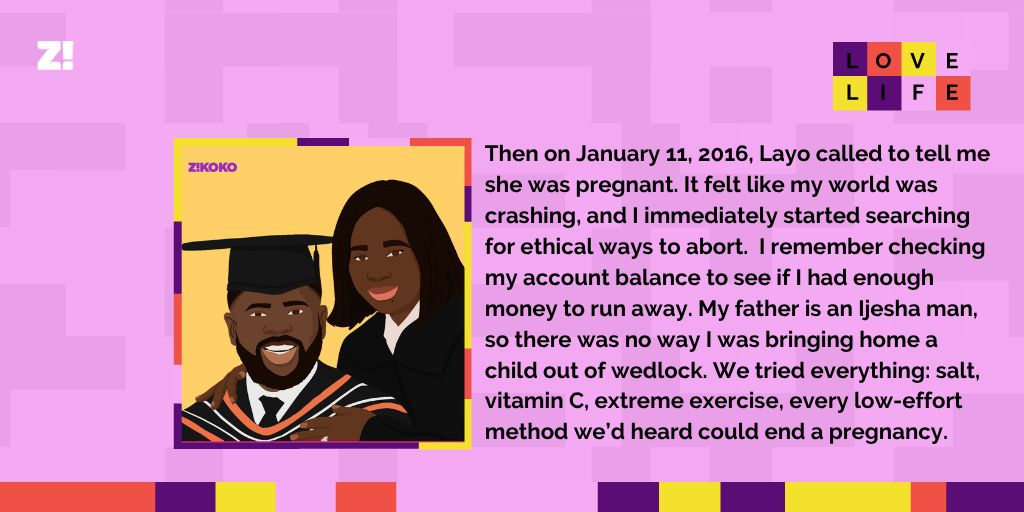
Then on January 11, 2016, Layo called to tell me she was pregnant. It felt like my world was crashing, and I immediately started searching for ethical ways to abort.
Layo: I remember checking my account balance to see if I had enough money to run away. My father is an Ijesha man, so there was no way I was bringing home a child out of wedlock.
We tried everything: salt, vitamin C, extreme exercise, every low-effort method we’d heard could end a pregnancy. Nothing worked. Komi suggested telling my dad, but I shut it down immediately. I asked if if hee had a death wish.
I dreamt that the pregnancy didn’t survive, so we returned to school and carried on like normal.
Around March, I was climbing the stairs to my hostel when I suddenly felt a gush of blood and water. I was excited because I thought everything we’d tried had finally worked. I went to an off-campus hospital for an evacuation, but the doctor told me the baby was perfectly healthy. They referred me back to the school clinic, and that was how my mum found out.
Komi: Both our mums were devastated. They didn’t know how to tell our fathers. I remember watching my mum cry. I’d done stupid things before, but this was the first time I’d pushed her to tears.
Layo: When my dad found out, he wanted an abortion immediately, but my mum told him it was too late. I’d already finished my first trimester. That really broke him.
What happened with your parents, Komi?
Komi: My parents came to my hostel the next day, and we all drove to Layo’s house. The night before, I’d sent my parents a long message saying I was running away because I’d failed them, but nobody addressed it. When we got to Layo’s house, the atmosphere was tense. I sat beside her but couldn’t even look at her. I felt completely overwhelmed, like I’d ruined her life.
As we sat there quietly, our parents talked. Out of nowhere, my dad suggested marriage. I objected immediately. I’d already applied for Mr Nigeria and listed myself as single because it was part of the criteria. I was training hard, building my body and planning my future. Marriage wasn’t part of the plan. My dad nearly punched me, and that was when I realised how angry he really was.
Then Layo held my hand and said, “Komi, don’t leave me alone in this.”
That changed something in me instantly. Until then, I’d been thinking about everything I was losing. But in that moment, I realised she was carrying the weight too. I stopped thinking, “I’ve ruined your life,” and started thinking, “We’re in this together.”
Right there in front of us, our parents started planning the wedding. And not a small one either. They wanted a full party.
Layo: I’m an only child. My mum didn’t want to be deprived of the joy she’d been waiting years for. Komi’s dad wanted a small, intimate wedding, but my parents refused.
We got married in May at Trenchard Hall in UI. There was aso-ebi and a whole party.
Oh wow! They meant business.
Komi: Layo and I returned to school after the wedding and continued attending classes like normal. Most people didn’t know we were married, but I confided in a few people, and the story spread everywhere. Suddenly, it was, “Mr UI impregnated someone.” Blogs picked it up. It became a full-blown campus scandal.
Layo: The rumours almost destroyed us. My bump wasn’t obvious yet, but I’d hear girls gossiping about me. People said I’d had several abortions before and finally used pregnancy to trap him. It was nasty.
There was also a strike around May when news broke that we were getting married. Still, the wedding hall was packed. People travelled from different states just to witness the drama. It genuinely felt like a public spectacle.
Through all this, how did you feel about each other?
Layo: We were still deeply in love. At that point, it felt like it was us against the world, and every other opinion was just noise.
Komi: Exactly. We protected each other fiercely and refused to let the outside noise break us.
That’s cute. What did life after the wedding look like?
Layo: Funny enough, we were still living in separate hostels because we were students. But everyone now knew our story. People became kinder to me, especially lecturers and staff who knew my mum.
I focused on my final-year project while Komi focused on graduating without carrying over courses.
Komi: It was surreal. Porters would see me and shout, “Bad guy!” but I ignored them. Through it all, Layo was incredibly caring. She stepped naturally into the role of a wife, bringing me food and looking after me. I also showed up for her. My mum took her to antenatal appointments. It was hard, but we had each other’s support.
We just didn’t know life still had more surprises waiting for us.
What do you mean?
Layo: Towards the end of my pregnancy, I noticed the baby suddenly stopped kicking. He’d been very active, so I knew something was wrong. I went to the school clinic, and they referred me to another hospital. The hospital told us they couldn’t find the baby’s heartbeat — we’d lost the baby.
Komi: Hearing my wife scream while delivering a dead baby broke me completely. It was one of the most traumatic moments of our lives.
Layo: I was also writing my final exams and wanted to defer, but my dad refused. He said I couldn’t lose a baby and lose a school year too. So after I was discharged from the hospital, I went straight back to studying for exams.
Komi: That period reminded me of a promise I’d made to her after we found out we were getting married. I told her nobody would ever look down on her and say pregnancy ruined her future. I promised I’d do everything possible to help her succeed. After she left the hospital, she stayed with my grandmother, a retired nurse who lived close to UI. It gave her space to recover and to properly prepare for exams.
My dad encouraged us to try for another baby because he worried we’d become emotionally scarred by everything that had happened. At first, I resisted. Layo was only 20 and still recovering physically. But two weeks later, she got pregnant again.
Before that second pregnancy, resentment had already started building in me. I’d been rejected from Big Brother Naija because I was married. It was the same year Miracle got in. I kept thinking about the life I could’ve had.
But the pregnancy forced us to refocus.
We’d finished school and were waiting for NYSC, so my parents prepared a room for us in their house, and Layo moved in.
Layo: That was when marriage started to feel real. Living together helped us reconnect emotionally and intentionally rebuild our relationship. Adjusting to life with his family wasn’t easy, but both families agreed it was best for us at the time. Komi took me to antenatal appointments, and we slowly settled into married life.
Then we discovered I was carrying twins.
Wait. What?
Komi: That was another major plot twist. I remember thinking, “God, why twins?” But we kept going.
I was unemployed and surviving on multiple side hustles. Then one day, while Layo was heavily pregnant, we had a stop-and-search encounter with the police. The hospital had instructed her to rest strictly, but the officers unnecessarily delayed us. That moment changed something in me. I realised we couldn’t build the kind of life we wanted in Nigeria forever. We needed to leave eventually.
Not long after, I got a job at First Bank at 22. That was the first time I earned enough to save towards getting us our own apartment. Two years after getting married, we finally moved into our own place.
I also kept pushing Layo academically because I wanted her to fulfil her potential. Eventually, I made sure she enrolled for her master’s at UI. She’d attend classes with the twins while breastfeeding. It was incredibly difficult, but I wanted her to reach every goal she dreamed of.
Neat. How did you know you still loved each other after everything you’d gone through?
Komi: There was actually a period where I questioned if it was still love. We got married young, and everyone still saw us as children. So whenever we had issues, there were always outside opinions. People would tell me, “This is how a man should behave,” or, “Why are you allowing this?” I started listening to those voices instead of listening to my wife.
It changed how I treated her. I started feeling like I wasn’t “being a man” enough. For almost two years, I became numb. I was just existing: paying bills, providing for the children, going through routines. We fought constantly. I didn’t feel joy. I felt trapped.
I’d imagined a completely different life for myself. I wanted entertainment, media, the spotlight. Instead, I was working a routine banking job I hated, married at 21 with kids. I kept looking at friends who were thriving in entertainment and thinking, “That could’ve been me.” I resented my life.
Then one day, I read an article that said the most important person in your marriage should be your spouse, not your parents or your children, because that’s the person you’re actually building a life with. It hit me hard. I realised I’d been letting everybody else into my marriage except the person I chose.
I remember telling my mum, “Going forward, I’m going to make decisions that may break your heart. If you tell me to go left and my wife says right, I’ll go right.” I had to return to first principles: I loved this girl. This was the person I started the journey with.
After that, I shut out the noise. If I was frustrated or confused, I discussed them with her rather than with outsiders. That changed everything.
Layo: That period was difficult, but patience saved us for me. If I’d listened to advice from my family, we probably wouldn’t still be together. I’m an only child. My parents hate seeing me upset, so if I’d complained to them about our problems, they would’ve told me to leave immediately. But I didn’t involve them. I kept our issues between us.
I’m also very intuitive, so I could tell his unhappiness wasn’t really about me. He felt like adulthood had interrupted his youth. He wanted to explore what he imagined for himself. Suddenly, he was married with responsibilities before he felt ready.
I understood that pain. That’s where my patience came from. I knew he needed time to process the life he thought he’d lost.
Women mature emotionally earlier, so while I also sacrificed things, I adjusted more quickly. For him, the resentment came from feeling like his freedom and future had been cut short. We had many conversations about it, and eventually he started asking himself, “How do I build a good life from where I am now?” That shift changed our marriage.
Komi: Another thing that affected me was external pressure about masculinity. But I stopped caring about expectations and focused on the life we were building. I started asking myself, “What kind of family do we want? What kind of people do we want to become?” That was when I truly fell back in love with her.
It took 10 years of being in the wilderness, but now I truly feel it’s all worth it. We’re both thriving in our careers. We’ve moved from Nigeria to the UK and now to Canada. I’ve bagged an MBA from a global top 25 university, and I’m currently a manager at one of Canada’s top financial services, a role that would have taken over a decade to achieve if I’d remained at First Bank.
As we approach our 10th anniversary, I can look at Layo and genuinely feel like I chose, not stayed, for reasons beyond circumstances or having children.
Fair enough. On a scale of 1 to 10, how would you rate your love life?
Layo: I’d say 9. Komi kept every promise he made to me. He made sure I didn’t lose myself or my dreams because of what happened. We grew up together, literally. We were kids when we met, and now we’re adults with children of our own. I wouldn’t change anything.
Komi: I’d give it a 9. We’ve been through hell and back together. But we came out stronger. We built something real from a very messy beginning.
*Names have been changed to protect the identity of the subjects.
If you want to share your own Love Life story, fill out this form.

The Naira Life Conference is returning on August 22, 2026, in Lagos! Come learn from finance experts and industry leaders, and partake in unfiltered conversations about building wealth and diversifying your income stream in a country like Nigeria. Real stories, expert advice you can actually use, and a community ready to build wealth together. Secure your spot here.