Remember the scene in I,Robot (2004) where Will Smith’s character looks the robot, Sonny, in the face and confidently says that robots are just an imitation of life and therefore can’t write a symphony?
Well, that’s technically no longer true. Meet Urban Chords, the AI music collective pirating Nigerian hit songs by turning them into soulful choir anthems.
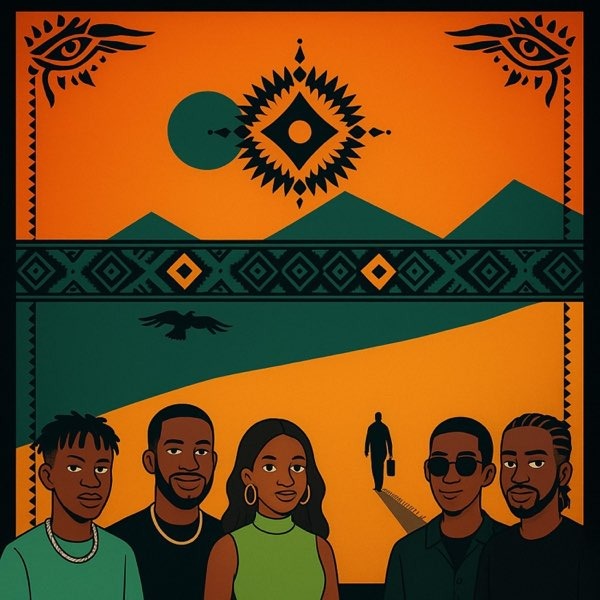
Their album, Choir Refix, was released in October 2025 and went largely under the radar. Many missed it, but now, a month later, it’s going viral, charting on the Nigerian Official Top 100 Albums list and racking up hundreds of thousands of streams.
Its streaming success and popularity have made listeners curious about what Urban Chords is, who’s behind its production and releases, and what the music law says about piracy and use of AI in music. In this breakdown, I answer those pressing questions and more.
What exactly is Urban Chords?
A quick Google search about Urban Chords will reveal it as a gospel music collective. Its Instagram bio brands it as “voices that praise different.”
On Boomplay, it describes itself as “a dynamic gospel collective bending soulful choir harmonies with contemporary sounds like drill, afro, R&B.”
Who’s behind Urban Chords?
Although Olamide Emmanuel Ajayi has been credited with being the mind behind the AI prompts, piracy and production, the names and faces behind the Urban Chords collective remain unconfirmed.
However, a closer examination of Choir Refix’s metadata on streaming sites reveals that the album was released under Lyripedia and Inner Circle Entertainment Limited. Lyripedia on Instagram says it’s home to Urban Chords and Emanvee (an artist-producer, self-dubbed vocal designer and likely the aforementioned Emmanuel Ajayi behind the AI prompts). Inner Circle Entertainment Limited is a new Nigerian music startup that has platformed artists like Fido, Mavo and Dxtiny.
Subscribe to Zikoko Pop newsletter, The Feed, for the most important pop culture news
What’s Choir Refix?
Choir Refix is an AI-generated album featuring pirated versions of eight Nigerian hit songs, performed in a choir style. It features the following tracks:
- Sarz’s “Getting Paid” with Asake, Wizkid and Skillibeng
- Asake’s “Lonely At the Top”
- Asake’s “BADMAN GANGSTA” featuring Tiakola
- Olamide’s “99” featuring Asake, Seyi Vibez, Young Jonn and Daecolm
- Libianca’s “People”
- Omah Lay’s “i’m a mess.”
- “Celebrate Me Now”, by a budding artist called Emanvee too — likely a R&B, choral-packed cover of Patoranking’s “Celebrate Me.”
There’s also a distinctive track titled “Afro Mix” which mixes several songs like Wizkid and Tem’s “Essence” with Burna Boy’s “Last Last”, Ayra Starr’s “Rush”, Davido’s “UNAVAILABLE” featuring Musa Keys, Joeboy’s “Sip (Alcohol)”, Fireboy DML’s “Peru”, etc.
According to Turntable Charts, the album is at number 43 on the Official Top 100 Albums chart, with 834,000 on-demand streams. Its cover of Omah Lay’s “i’m a mess” is the most-streamed on the album, surpassing 2 million streams on Spotify and over 500 thousand streams on Apple Music.
If you’re wondering what it sounds like, this album interprets the songs in an emotional, worship style. It sounds like a real choir, orchestrating under anointing. But the truth is, there’s no real choir in it. It’s a solo AI operator.
What’s Choir Refix trying to do?
At the moment, it’s still unclear if the goal of this project is spiritual, artistic or purely tech-driven innovation. But Urban Chords’ biography on Boomplay says, “From heartfelt to street-inspired worship, it [Urban Chords] delivers music that uplifts the spirit and bridges the gap between church and culture.”
READ NEXT: I Have 426K Instagram Followers. This Is How I Use ChatGPT to Make My Content
The public says…
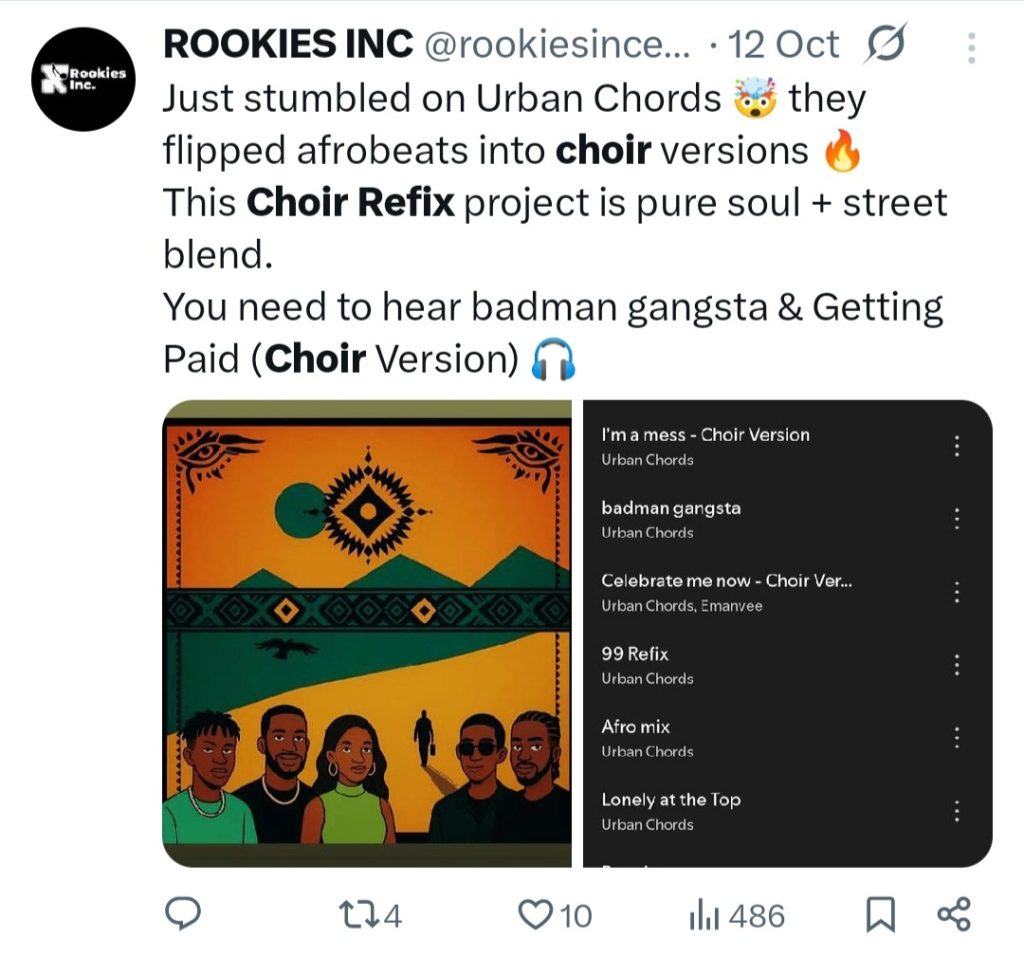
The reactions from Nigerians have ranged from impressed to disgusted.
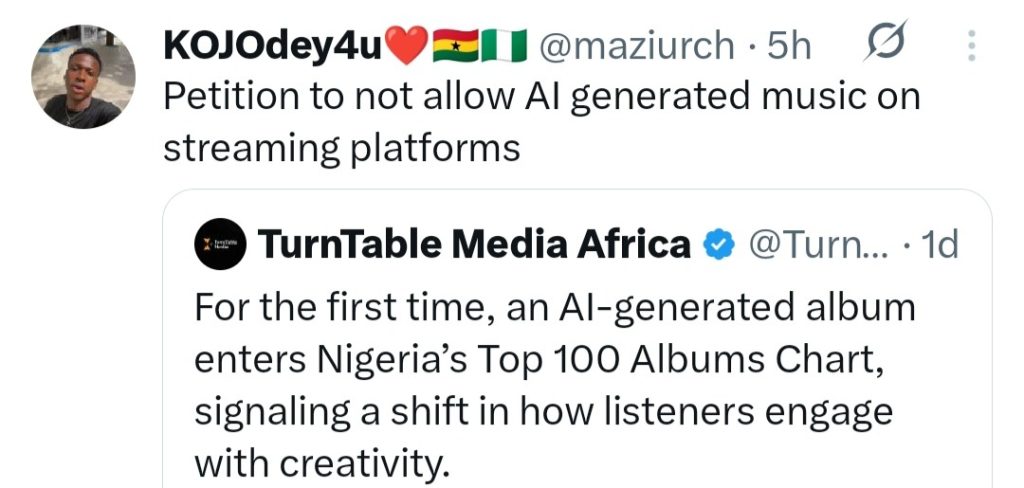
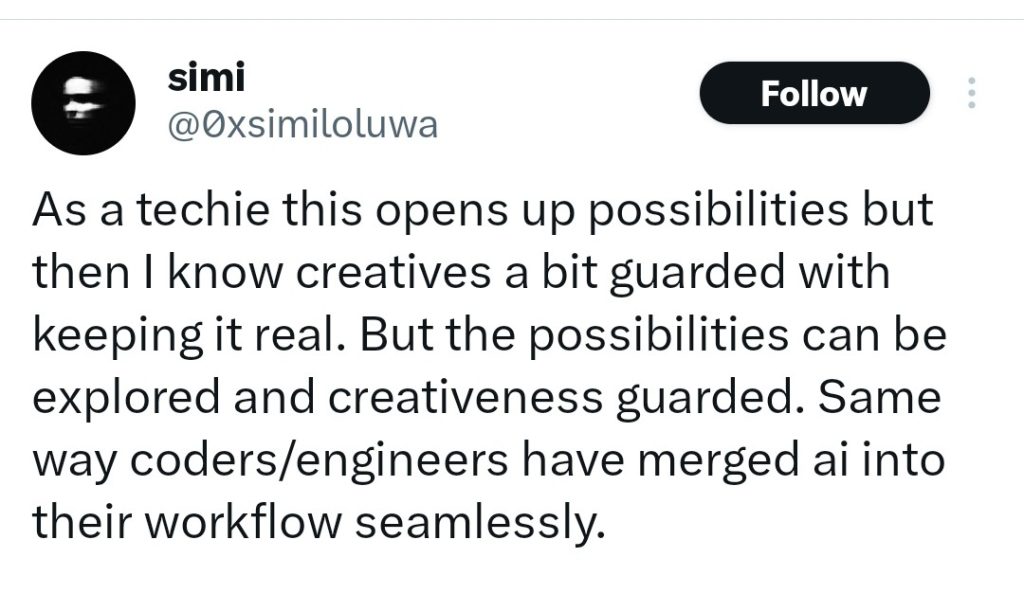
But Urban Chords isn’t done
The collective has a new gospel-themed album titled Grace Till December (AI-generated versions, of course), slated for release on December 24, a day before this year’s Christmas Day. The album will include an AI cover version of Gaise Baba and Lawrence Oyor’s gospel hit track, “No Turning Back.”
The legal implications
The trending success of Choir Refix and Urban Chords’ piracy has quickly exposed gaping holes in the nation’s legal framework. According to Lola Oyedele, an entertainment, intellectual property and data protection lawyer and DJ, the legal risks are substantial.
Here, Lola untangles some important legal questions around the use of AI in Nigerian music:
Is it legal to AI-cover or recreate other artists’ songs?
Lola Oyedele: Under Nigerian law, particularly the Copyright Act 2022 , it’s not legal to reproduce, adapt, or create derivative versions of another artist’s work without their consent.
AI-generated covers or recreations that mimic the voice, style, or lyrics of an artist fall under derivative works or adaptations, which are protected forms of expression under copyright law.
So, if an AI model recreates an existing artist’s performance or samples their song without authorisation, it would generally amount to copyright infringement unless it qualifies under a very narrow “fair dealing” exception (like research or education, which clearly wouldn’t apply fair dealing” exception (like research or education, which clearly wouldn’t apply here). Because the owners have put them on streaming platforms which shows they might be earning royalties on the pmpany that instructed, programmed, or released the AI-generated work.
Are there processes of rights clearance for reproductions like these?
Lola Oyedele: Yes, there are. Before releasing a song that includes another artist’s material whether sampled, remixed, or reinterpreted, the creator or producer must secure two main permissions:
- Master Use License from whoever owns the original sound recording (usually the label or rights holder, if any.
- Composition License (Mechanical Rights) from the songwriters, composers or music publishers.
If the AI system trained on or reused portions of the original recordings, the rights to both the composition and recording must be cleared. If it simply “mimics” the artist’s voice or style, we move into a grey area around personality rights or right of publicity, which Nigerian law doesn’t yet define clearly, but could still be challenged as unauthorised commercial exploitation of someone’s likeness.
I heard the “i’m a mess” cover from the album and the lyrics are the same as Omah Lay’s original recording. Although the melodies are not the same, there’s still a lot of portions of original songs used.
What happens if the featured artists or their label take issues?
Lola Oyedele: They would have strong grounds to act. Artists or their labels could pursue legal remedies for:
- Copyright infringement (unauthorized reproduction or sampling).
- Passing off or misrepresentation (suggesting a false collaboration or endorsement).
- Economic damages (lost revenue, reputational harm, or unfair commercial use).
The third is very important because that’s what is being done here the most — commercial use. If the album for example is monetised, streamed or sold, the affected artists or rights holders could seek an injunction to remove the content and demand compensation or royalties.
How do ownership and royalties work when it comes to AI-generated content?
Lola Oyedele: This is where things get murky. Nigerian copyright law currently recognises only human authors. So, for now, any AI-generated music does not have independent copyright protection.
Ownership would rest with:
The individual or company that created or deployed the AI system, and any human who contributed meaningfully to the creative process (e.g., by editing, arranging, or directing the AI output).
As for royalties, if AI-generated songs use copyrighted material, royalties remain due to the original rights holders of the sampled works. If it’s entirely AI-generated without human authorship or sampled content, it may technically lack copyright in Nigeria, meaning it could fall into the public domain, but this has not yet been tested in the Nigerian High Court, which is the court with jurisdiction for copyright issues.
Would this situation open up a new debate in the Nigerian music law?
Lola Oyedele: Absolutely and it already is. The rise of AI-generated music exposes gaps in Nigerian copyright regulation, especially around authorship of non-human works, voice and likeness rights for artists, use of copyrighted material in training AI datasets.
Nigeria’s Copyright Act 2022 was progressive in some areas, but it did not anticipate the AI revolution in music. This case could prompt legal scholars and the Nigerian Copyright Commission (NCC) to explore AI-specific guidelines, similar to what’s emerging in the EU , UK and the U.S.
We’re entering a moment where technology is outpacing legislation. As I have once stated in one of my Substack articles, AI will force Nigeria and the wider African creative sector to rethink what authorship, originality, and ownership mean in the digital age. AI can enrich African music, but it must do so within a framework that respects creators’ rights. If we don’t define those rules ourselves, we risk seeing African music used as raw material in systems that profit elsewhere while our artists lose control.
N.B: Inner Circle Entertainment Limited didn’t respond to our multiple requests for a comment.
ALSO READ: How Much Money Is There To Be Made Being Funny Online?
Everyone talks about love online, but what’s it really like offline? We’re collecting anonymous stories for Zikoko’s biggest relationship survey yet. Share your truth here.