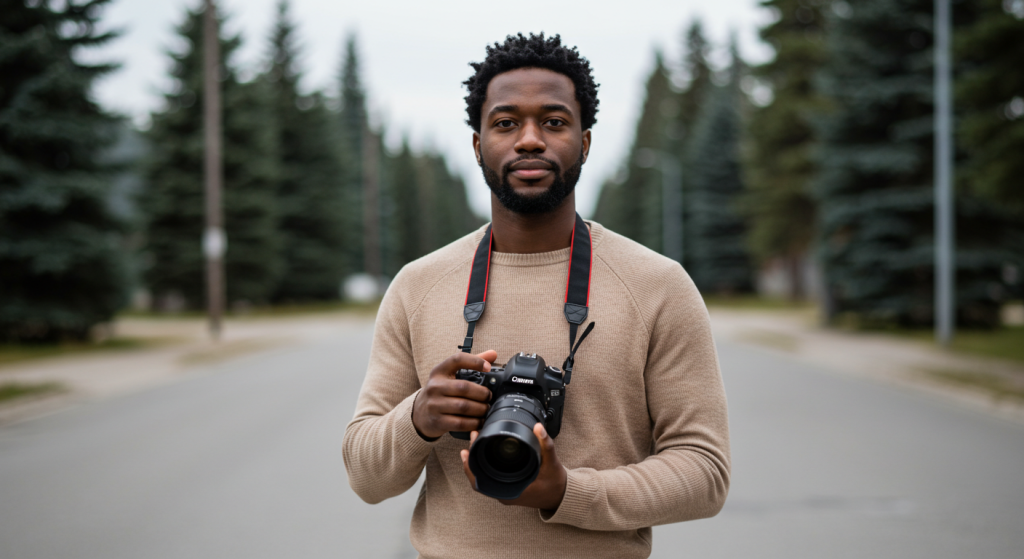
30-year-old Ayo’s childhood was “filled with art”. That said, he studied medical laboratory science at university because the creative path didn’t seem like a realistic career option. However, as someone who now makes a living from photography, he ultimately proved himself wrong.
Today, Ayo runs a Canada-based photography brand specialising in portraits, family moments, and weddings, with gigs ranging from 700 to 1,500 CAD. He spoke with Zikoko about how he turned his passion project into a business.
How did you get into photography?
I moved to Canada in 2021 to pursue a master’s degree in healthcare administration. My study permit allowed me to work up to 20 hours per week off campus during term time. If I managed to work at least 15 hours, I earned around 300–450 CAD weekly as a graduate research assistant.
I started photography to keep myself sane. Back in Nigeria, I was a traditional sketch artist and mobile photographer. Sketching takes a lot of time, so I couldn’t continue consistently in Canada. I turned to photography instead, taking random shots of landscapes and scenery with my phone just because it made me happy.
During the holidays after my first year, I decided to get into street photography. In the summer of 2022, I used my savings from my Research Assistant job— about 1000 CAD — to buy a Sony A73 camera and a 50mm lens for about 1,000 CAD. It was all the money I had, and I wasn’t expecting it to turn into a business. But the interest and demand were there, so I ran with it.
By my second year, I was already making money from photography.
What were the early days like?
Social media gave me the visibility I needed, and I started posting my work on Instagram.. Initially, I focused on street photography and took online courses to enhance my editing skills. I didn’t even charge for the first shoots; I just wanted to get better. But the more I put my work out, the more people noticed, and my name began to spread.
I bought the basics: batteries, lights, SD cards, a hard drive, a laptop, and editing software. In total, I spent a little over 2,000 CAD to get a more robust gear in the initial stages.
When did it move from being “just pictures” to something people wanted to pay you for?
It was about consistency and how seriously I took myself. I didn’t brand myself like I was “just starting out.” I put myself out there with conviction, and the quality of my work spoke for itself.
Do you remember the first time you got paid for a job?
It was a family shoot that I got through a referral in 2022. I charged 500 CAD. By the time I graduated in 2023, I was already known on campus as the “photography guy”. During my graduation, I shot about 10 other students and their families, each paying 300 CAD. That was when I realised this was bigger than a hobby.
How have you expanded since then?
I’ve gone from shooting free street content to focusing on families, weddings, graduations, and maternity shoots. At first, I did a bit of everything, but I’ve niched down to “happy moments.”
I’ve grown my Instagram following to over 5,000 people. I charge about 1,500 CAD for weddings and around 700 CAD for birthdays, professional portraits, family, kids, and maternity shoots. I’ve also added videography to my packages.
As the business grew, I reinvested in gear upgrades: a second camera, additional lighting equipment, tripods, camera bags, and even a drone.
Can you walk us through your monthly income — a busy month versus a quiet one?
The income isn’t fixed. On a good month, I make up to 6,000 CAD. In slower months, the number drops to 2,500 to 3,000 CAD.
The biggest factor is the number of clients I book and the type of shoots they need. Weddings, for example, pay more than portraits or birthdays, so the mix of jobs matters a lot. Although it fluctuates, it’s still a decent income overall, and it provides me with enough flexibility to balance it with my healthcare job.
Have you ever considered giving it up?
No. Photography keeps me sane. It makes me happy and helps me connect with people.
For someone who wants to turn photography into a business, what’s your money advice?
Photography is a huge investment. Be ready for your money to go straight back into gear and growth, especially at the beginning. My advice is: don’t rely on photography alone when you’re starting out. Have other sources of income.
The quality of your work, your consistency, and how you present yourself determine your success. It’s not easy, and you may or may not thrive immediately, but keep putting yourself out there. The payoff is worth it.
How does the business look for you now?
I’m still a one-man team. I’m in my second year of a three-year postgraduate work permit. In addition to photography, I work as a healthcare administrator, earning approximately 3,500 CAD per month. That salary can cover my bills, but photography is what fuels me.
One day, when the business grows enough, I may quit healthcare to do this full-time. For now, I balance both, but it’s the camera that genuinely makes me feel alive.