Every week, Zikoko spotlights the unfiltered stories of women navigating life, love, identity and everything in between.
What She Said will give women the mic to speak freely, honestly and openly, without shame, about sex, politics, family, survival, and everything else life throws our way.
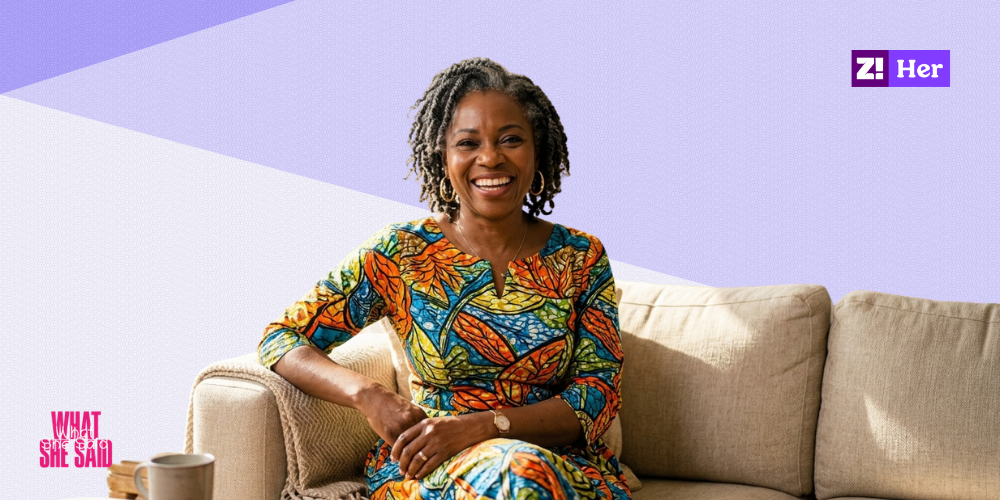
The subject of today’s #WhatSheSaid is Remi*, a 52-year-old businesswoman based in Lagos. She talks about 25 years of marriage, the emotional and financial abuse she quietly endured, the mother who told her she would be disowned if she left, and why she laughed when her ex-husband finally asked for a divorce.
Can you tell me a bit about yourself?
I’m Remi. I’m 52, and I live in Lagos. I deal in textiles, which is actually something of a family tradition; my mother was in the industry before me. It is the business I have built my independence around, and I am proud of it. Beyond work, I am a mother of three and someone who has learned, later than I would have liked, that choosing yourself is not selfish. It is necessary.
Before you got married, what did you imagine marriage would be like?
I only had my parents’ marriage to use as an example of what a perfect marriage looks like. So I imagined that my husband would be like my father, someone who worships the ground I walk on and loves me wholeheartedly, and that my marriage would be blissful and free of complications. My father genuinely adored my mother. That was all I knew of what a husband was supposed to be, so naturally, that was what I expected for myself.
How did you meet your ex-husband, and what made you think he was the one?
I met him through a friend. Let’s call her Stella*. At the time, she was dating his friend, and the day they introduced us, I kept staring at him because I had never seen someone as handsome and confident as him. When we started talking, I realised he was someone I could see myself having all my kids with.
What was that early period like before you got married?
It was exciting. He was charming and attentive, the way men are when they are trying to win you over, and I was completely taken. Looking back now, I can see things I missed or chose not to see, but in my time, when you are young and in love, and someone looks at you the way he looked at me then, you are not exactly looking for red flags. You are just happy. I was happy.
How long did you date before he proposed, and how did he ask?
We dated for about two years before he proposed. It was not an elaborate thing; he was not that kind of man, but he was sincere about it, and at the time, sincerity was enough for me. We were at home, just the two of us, and he told me he wanted me to be his wife. I said yes immediately because I genuinely wanted to. I loved him, and I could see my life with him clearly in that moment.
But even as I said yes, there was something sitting at the back of my mind. A few months before he proposed, I had met his eldest brother for the first time at a family gathering. I do not even remember what the occasion was now, but I remember that man’s face when he looked at me. He barely acknowledged me. At some point during that visit, he made a comment, not directly to me but loud enough that I could hear, something about his brother always making decisions without thinking them through. It was not hard to understand what he meant. I was the decision he was referring to. I smiled and said nothing because I did not want to cause problems, but I filed it away. When my husband proposed, I was happy, genuinely happy, but that interaction with his brother was already there, already casting a small shadow over everything.
What was the wedding like?
Quite dreadful, if I am being honest. By the time the wedding came around, I had had enough interactions with the eldest brother to know that the shadow I had felt at the proposal was not going anywhere. He was cold throughout the entire occasion. Not rude in a way that anyone would point to, but the kind of cold that you feel in your body when you are the only one it is directed at. He did not congratulate me. He barely spoke to me. At one point, I caught him watching me from across the room with an expression I can only describe as contempt, and when our eyes met, he simply looked away.
I told my husband how I felt, and he told me I was seeing things, that I was overthinking it, that his brother was just like that. But I knew what I had felt, and I knew what I had seen. I was scared, not in a dramatic way, but in the quiet way you are scared when you can see something difficult ahead of you and nobody around you will acknowledge it is there. I pushed the feeling down and got married anyway, because what else was I going to do? I loved him. I chose to believe it would be fine. It was not always fine.
Did that fear about his family materialise?
Yes. It was not just the eldest brother. Most of my husband’s siblings were awful to me because they felt I was trapping him. He was their only breadwinner at the time, so they resented me for it, as though my marrying him was some kind of scheme. Only the younger ones liked me. The older ones detested my guts. It created a tension in the marriage that never fully went away, because he was always navigating between being a husband and being loyal to siblings who did not particularly care for his wife.
How long were you married?
Twenty-five years.
What She Said: I Sold Everything I Owned For a Visa That Was Rejected Three Times
What were those twenty-five years like? Start from the beginning.
The early years were fifty-fifty. There were good days, genuinely good ones, but there were also moments that made me stop and ask myself if I had made the right decision. He had a way of saying things, cutting things, that would sit with me for days. He would berate me in front of people, family, friends; it did not matter who was watching. He would tell me I could not amount to anything. At the time, I was relying mostly on my parents’ money because I was not in the job market, and for some reason, he would call me useless for that, as though I had lied about who I was before we got married. He knew exactly what my situation was. He still used it against me at every opportunity.
The financial side was its own separate cruelty. There were times he would not give me money for food, but right in front of me, he would give his brother any amount he asked for without blinking. For a couple of years in that marriage, I had to rely on my parents to feed my children and me. He never denied our children their education, I will give him that, but he would constantly expect me to produce money from nowhere to carry the house, while simultaneously making me feel worthless for not having any.
I kept hoping the good days would become the majority, that we would find our rhythm and settle into something more stable. That never really happened. The difficult days were always there, just waiting.
I’m sorry. How did you eventually find financial independence within the marriage?
I tried a few things before I found my footing. Provisions first, then drinks, then I tried baking for a while. None of it quite clicked the way I needed it to. Eventually, I found my way into the textile industry, which is actually a family thing. My mother was in textiles before me, so in a way I was following a path that had already been laid. Once I found it, things started to shift for me in ways that went beyond just the money.
How did your husband treat you once you became financially independent?
He started seeing me as someone worth respecting. I was no longer someone he could rule over in the same way, and whatever control he had felt over me before started to loosen. There were still moments when he made me feel strange about having my own money because he no longer had the upper hand in the marriage, and that clearly unsettled him. But there was a certain level of respect I started to see that had not been there before. It is telling, really, that the thing that changed how he treated me was not a conversation, a realisation, or any kind of emotional growth on his part. It was money. The moment I had my own, I became worth respecting.
How important was having your own income to your sense of self?
It made me feel really good. I felt confident that I could spoil myself and my children without asking anyone for permission or waiting on anyone’s mood. I could get what I needed without calculating how much money I did not have. I did not have to beg him or my parents for anything, and that freedom changed how I moved through the world entirely. It is a beautiful feeling to know that you are not dependent on someone who does not treat you well for your basic survival.
When did you realise the marriage was something you could no longer live with?
When my daughter started making her displeasure with her father very obvious. She was not subtle about it, the way her brothers were. She genuinely hated him and wanted everyone to know, and watching her made something click for me. I realised that by staying, I had damaged my children in more ways than one. He never let them lack anything materially, that much is true, but he was still emotionally abusive to them. They were watching how he treated me and experiencing his moods and his coldness firsthand. My daughter’s anger was just the loudest version of it. Her brothers had their own version of it, too; they just kept it quieter. Seeing it so plainly on her face made it very hard for me to keep pretending things were fine.
For a long time, you stayed despite everything. What kept you there?
My children, mostly. And the whole “what would people say?” that my mother kept muttering in my ears every time I told her I could not stay in the marriage anymore. There was also the fact that I still loved him, to an extent. That is a complicated thing to explain, loving someone who treats you badly, but it is real, and it is one of the most disorienting feelings there is. You are not stupid for feeling it. You are not weak. It is just that love does not always go away simply because the person has stopped deserving it, and for a long time, that love, mixed with fear of losing my mother’s approval and genuine concern for what this would do to my children, kept me in that house long past the point when I should have left.
What did those conversations with your mother look like?
They usually started with me calling her, exhausted, trying to explain another thing he had done and how overwhelming everything was getting. And they would always, without fail, end with her saying, “he is still the father of your kids.” She has never experienced what it is to have an emotionally abusive husband, so like most women in our society, she trivialised my struggles. A lot. She did not mean harm. I think she genuinely believed she was giving me wisdom, but what she was actually doing was telling me that my pain was not enough of a reason to leave. The concept of my leaving him was so unacceptable to her that she told me she would disown me if I ever did. That threat sat with me for years.
That must have been very painful. What messages had you grown up hearing about divorce?
It was. I grew up learning that divorce is unacceptable and unheard of. That, unless your husband is physically laying his hands on you, there is no valid reason to leave. Just stay with him, even if he spends three hundred and sixty-five days a year making you feel like a failure. Just manage it. Pray about it. Find a way to make him happy. Nobody ever asked whether he was making you happy. That was not part of the conversation.
Why were you worried about what people would say if you left?
I was mostly worried about what my parents would say. My mother had made her position very clear, and my father, though gentler about it, had always taken an “as long as you are happy” stance that I knew would be tested the moment I told him I was choosing divorce. Honestly, I did not really care about other people beyond my immediate family. It was the people closest to me whose reactions I could not stop thinking about.
Do you think you would have left earlier if you had had financial security from the beginning?
Even if I had the money, I would not have left earlier, because my mother would have made good on her threat and disowned me. The financial piece was important, but it was not the only thing holding me. The fear of losing my family’s approval, particularly my mother’s, was its own kind of trap.
How did the conversation about divorce actually happen?
He left the country about three years ago. He said it was to set roots there, but I had a feeling from early on that he just wanted to leave without making it a dramatic event. So when he eventually called and told me he wanted a divorce, I was honestly just blank about it. There was no explosion of feeling, no moment of crisis. I told him to send the necessary papers, and I would sign. That was the whole conversation.
What was going through your mind in that moment?
Honestly? Relief. When I tell you I laughed, I mean I genuinely laughed. It had been such a long time coming that there was nothing left to feel except the strange lightness of it finally being said out loud by him. I did not have to be the one to say it. He said it. And all I had to do was agree.
How did your family react?
When I told my parents that he was the one who had initiated it, they expressed surprise and then more or less called it a day. My dad was calm about the whole thing, and I think it is because he never really liked him like that. He had always taken the gentle path with me, never pushing back strongly, just going with “as long as you are happy,” but over the years, you could sense that his opinion of my husband was not particularly high. My sister asked if it was the right idea because of the children, but our children are grown, all 3 in their 20s and barely interact with their father, so I honestly did not know what point she thought she was making.
If you’d like to be my next subject on #WhatSheSaid, fill this form.
Did you feel judged by your community or extended family?
No one judged me. They all knew what kind of husband he could be. I think that says a lot about how visible his behaviour had been over the years, even to people on the outside.
How did you talk to your children about the divorce?
I told them casually, and they barely blinked. They just said okay. There was no drama, no tears, no long conversation about what it meant. They already knew. They had been living in that house too.
How aware were they of what was happening in the marriage?
Very aware. He was not only unkind to me, but he was also unkind to them. He had his good moments, and I want to be fair about that, but my children mostly remember him for his bad days. They had their own relationship with his moods and his emotional distance, completely separate from whatever was happening between us as husband and wife.
Looking back, do you think staying together would have been better for them?
No. What was the point of having a father in their lives if he only gave them trauma to carry? I think it would have actually been better for them if I had left him much earlier. They would have been more self-actualised. They would have grown up watching their mother choose herself, which is a lesson I gave them far too late.
How has your life changed since the divorce?
It has been wonderful. Honestly, when he left the country, I was already living like a divorced woman in many ways. The weight of wondering whether someone at home was eating, whether his mood that evening was going to determine the atmosphere of the entire house, all of that was already gone. After the papers, I just kept going further in that direction. I started going out more, spending time on myself, pouring into who I am. No husband constantly chipping away at my self-esteem. I am prioritising myself in ways that feel completely natural now, as though I was always supposed to be living like this.
Do you ever regret it?
No.
Have your views on love or marriage changed?
I still think love is beautiful and that people just have to find their right partners. I understand that marriage did me dirty, but it is not everyone it would do dirty. Case in point, my parents. Their marriage is everything I imagined mine would be when I was young. I just did not end up with someone like my father.
Would you get married again?
Absolutely not. I am okay like this. I love being single.
If you could speak to the version of yourself who was scared to leave, what would you tell her?
It is fine to be scared, but she should not be, because it is not even as big a deal as she thinks. She is going to be okay. She is going to be more than okay.
What is one thing society gets completely wrong about divorced women?
That it is shameful. We have always tied a woman’s entire worth to being a wife and a mother, and the moment she exits a marriage, people act as though she has failed at the most important thing she was supposed to do. I think it is silly because more women should be allowed to divorce and still have their communities backing them. Leaving a bad marriage is not a failure. Staying in one for the sake of appearances is not a strength. We have had it backwards for a very long time.
What is one lesson you hope younger women take from your experience?
That it is fine to leave if your husband is not acting like the love of your life should act. You do not need him to be hitting you. You do not need a dramatic, obvious, provable reason. Feeling consistently unseen, disrespected and diminished is reason enough. Your life is too long and too valuable to spend it managing someone else’s ego.

The Naira Life Conference is returning on August 22, 2026, in Lagos! Come learn from finance experts and industry leaders and join unfiltered conversations about building wealth and diversifying your income stream in a country like Nigeria. Real stories, expert advice you can actually use, and a community ready to build wealth together. Secure your spot here.