Every week, Zikoko spotlights the unfiltered stories of women navigating life, love, identity and everything in between.
What She Said will give women the mic to speak freely, honestly and openly, without shame about sex, politics, family, survival, and everything else life throws our way.
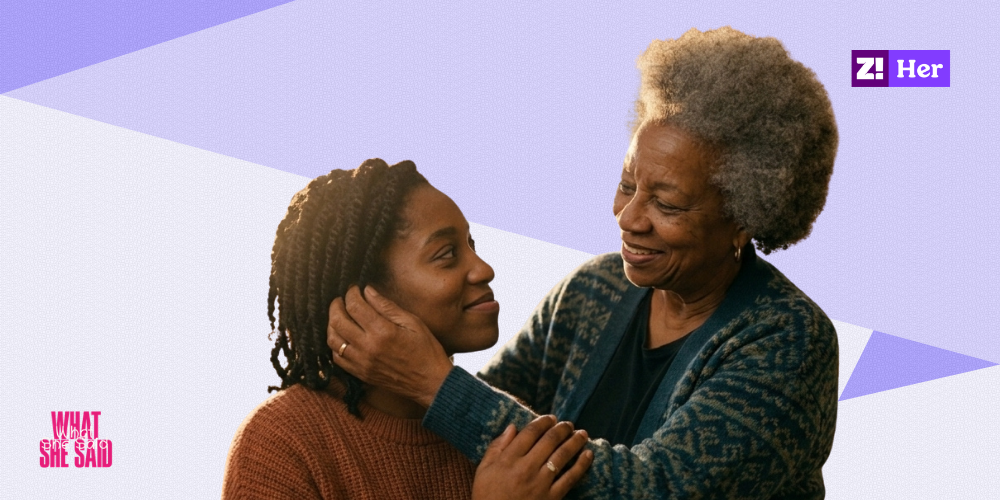
The subject of today’s #WhatSheSaid is Lade*, a 27-year-old PR professional based in Lagos. She talks about growing up with a mother who sabotaged her at every turn, the friend’s mother who stepped in and changed everything, and why cutting off the woman who gave birth to her is the best decision she has ever made.
Can you tell me about yourself?
My name is Lade*, and I’m 27. I work in PR, and I’m a Junior Account Manager at a firm on the Island. I like my job, I’m good at it, and I have plans for where I want to take it. I just got back from South Africa, where I did my master’s in Communications and Media Studies, and I graduated top of my class while already working, so I came back ready. That’s who I am now.
Take me back. What was growing up like for you?
It was not a happy home. I’m an only child. My parents were there in the physical sense, but there was no real support, financially or emotionally. From as early as I can remember, I was mostly on my own. My father left us when I was younger than 10. My mother was even worse. She may have stayed, but she was not someone I could rely on for anything. She wasn’t showing up for me, wasn’t providing, wasn’t present in the ways that matter. Especially when I got into uni. I did not get 1 Kobo from her. I just knew very early that whatever I was going to have in this life, I was going to have to get it myself.
What did getting it yourself look like as a student?
I was running a small business from school, selling clothes, accessories, beauty supplies, and lashes. I also eventually started hairstyling and nails. Just whatever I could do to make sure I had what I needed, because waiting on my parents for money was not a reliable strategy. My mother would say she didn’t have anything when I called. My father was the same. I had one uncle who would help when he could, but even that was not consistent, just whenever he had. So I learned to be resourceful very early out of necessity, not by choice.
Was there a specific moment that clearly showed why you couldn’t rely on your parents?
Yes. I got an athletics scholarship to a university abroad. I had worked for it, I earned it, and I was so proud of myself. My mother contacted the institution without telling me and had my name withdrawn. She told them I wouldn’t be coming. I found out when I called to confirm my acceptance, and they told me the spot had been released.
Her reason, when I confronted her, was that she didn’t want me to go that far. That was it. That was the whole explanation.
How did you even process something like that?
I don’t think I fully processed it for a long time. When something like that happens, you go through so many things at once. Disbelief, grief, anger. And then underneath all of that is this quiet, devastating realisation that the person who is supposed to want the best for you actively doesn’t. That she looked at an opportunity that could have changed my life and decided her discomfort was more important.
I had to pick myself up and keep going because what else was I going to do? But that moment never left me.
Did the pattern continue through university?
It never stopped. There was significant money that came for me through a relative that she collected and never gave me. I found out years later. There were calls that only ever came when she wanted to disturb me, to dump something heavy on me, to guilt-trip me. I used to dread seeing her name on my screen. I would watch my roommates light up when their mothers called, and I would feel this thing in my chest that I didn’t even have a word for. Jealousy maybe. Grief. Both.
I stopped going home except once in a while, and even those visits cost me. I wouldn’t sleep. I would come back to school carrying more than I left with.
Did things change?
After NYSC, I got a customer care role at a company in Lekki. Entry level, just trying to stack experience and save up before my master’s. That’s where I met Tolu. We worked together, at the same level, just two people trying to figure things out. We started having lunch together, spending time outside work, and eventually, I was spending a lot of time at her family’s place.
There was something about that house. The energy was just different. That’s the only way I can describe it. I would walk in, and something in me would just settle. It was warm and calm, and nobody was on edge. I didn’t realise how tense I always was until I was somewhere that I wasn’t, especially when I started bonding with her mother.
What She Said: I Would Have Said Yes to an Open Relationship, But She Never Asked
That must have felt amazing after years of feeling unsafe in spaces where you should feel the safest. When did you first properly connect with Tolu’s mother?
It was over food, actually. Mrs Adeyemi* makes fufu from scratch on weekends. Tolu thinks it’s too much stress and wants nothing to do with it. But me, fufu is my favourite, I grew up eating it, and I miss it when I don’t have it. So one Saturday I’m there, and Mrs Adeyemi is in the kitchen, and my eyes must have said everything because she just started laughing and told me to come and sit down.
We spent that whole afternoon in the kitchen together. Just talking. About food first, then about books, because she noticed what I was always carrying around. Tolu is not a reader; she doesn’t have that patience. But her mother and I would exchange books, argue about characters, and recommend things to each other. It just grew from there naturally.
What did she give you that was different?
She asked me about my life like she actually wanted to know. My plans, what I was working towards, what I was worried about. Not in the interrogating Nigerian parent way, but in the way of someone who was genuinely curious about you as a person. I wasn’t used to that from a mother figure, and it took me a while to stop waiting for the catch.
She also just saw things without me having to say them. I never sat her down and explained my home situation in detail. She just watched and understood and made space accordingly.
That’s beautiful. Were you still in contact with your mum?
Not really. We were never in contact. She just called once in a while to berate me, but I had not spoken to my mother in over a year when a cousin saw me at a birthday gathering Mrs Adeyemi threw. Put everything together and reported back. My mother called me immediately, not to ask any questions, just to accuse. She said I was embarrassing the family by going to beg from strangers. She said Mrs Adeyemi was using me, doing it for show, filling my head with ideas. When that didn’t land, she went further.
How far did she go?
She got Mrs Adeyemi’s number somehow and called her directly. I don’t know the full details of that conversation, but I know it was ugly. She accused her of trying to steal her daughter, of interfering in family business, and she threatened her. Then she started calling aunties and uncles, turning it into a whole family matter, telling everyone that I had abandoned my mother for a stranger and that I was being manipulated.
She showed up at my office in Lekki one day. I wasn’t even there; I found out from a colleague that she had come and caused a scene in the lobby. I do not even know how she found out where I work. She dropped voice notes in family group chats. It was relentless.
What did Mrs Adeyemi do when all of this was happening?
She didn’t move. When I came to her completely mortified and apologising for something I hadn’t even done, she sat me down and told me that nothing my mother said changed what she knew about me. She didn’t badmouth my mother, not once. She just made it clear that her door was not closing.
And when it became obvious that I couldn’t comfortably go back to my own home, or rather family, after everything, she shocked me with her next steps. She didn’t really say anything, just had the housekeeper clear out a room and told me this was my home for as long as I needed.
If you’d like to be my next subject on #WhatSheSaid, fill this form.
What did that feel like?
I cried for a very long time because I was grateful, but I was also grieving. I was 24, 25 at this point, and I was receiving something for the first time that I should have had my whole life. You don’t realise how heavy you’ve been carrying something until someone lifts it. That’s the only way I can describe it.
I’m happy for you. How did life change after that?
Mrs Adeyemi funded my Master’s in Communications and Media Studies in Johannesburg, South Africa. She sat me down and told me she had been watching me, and she wanted to invest in where I was going. She didn’t frame it as charity; she framed it as belief. She told me she expected to watch me do something with it.
I graduated top of my class. By my second year, I was already working remotely for a PR firm in Lagos that had taken me on. I came back to Nigeria with a degree, a job already running and a plan. I think about the scholarship my mother pulled me out of, and I think about this, and I feel things I don’t have words for.
Did you ever decide to cut contact with your mother?
Of course. The office incident was the final thing. I had spent years managing her, absorbing the chaos, trying to maintain something because she was still my mother, and I had been taught that meant everything. But standing in my office and hearing that she had come there screaming in the reception, at my place of work, was so heartbreaking and humiliating that something just permanently closed in me.
I didn’t say anything to her. I just stopped. I stopped picking up, stopped responding to her emergencies, told the security at my office to never let her in, moved out of my house so she couldn’t reach me and because I was truly welcomed by the Adeyemis. I just stopped engaging. That was how we cut things off.
How has the extended family responded?
Every angle you can imagine. She carried you. Blood is blood. How can you be living like this and leave her suffering? How can you be going abroad and not taking her with you? You will regret this. She’s still your mother, no matter what she did.
I used to cry when these conversations happened. Now they just make me tired. Because none of the people saying these things were there. They didn’t see what I saw, they didn’t live what I lived. And most of them didn’t show up either, so the audacity is ridiculous.
How do you feel now?
Free. It was one of the most difficult decisions I have ever made because no matter what she did, she is still my mother, and there is grief in that that doesn’t just disappear. But I have never felt lighter. I have never felt more like myself.
I now have a mother who chose me. I have a home I can walk into and breathe. I have a career I’m building on my own terms with someone in my corner who believes in where I’m going. I have peace. And I spent so long not knowing what that felt like that I don’t take a single day of it for granted.
What do you want other young women in similar situations to take from your story?
That blood does not automatically mean love. And the absence of love from a parent is not a reflection of your worth; it is a reflection of their limitations. You did not deserve it. I did not deserve it.
And if someone shows up for you, let them. Don’t talk yourself out of being loved because it’s coming from somewhere unexpected. Mrs Adeyemi did not have to choose me. She chose me anyway. And I chose myself when I stopped waiting for my mother to become someone she was never going to be.

The Naira Life Conference is returning on August 22, 2026, in Lagos! Come learn from finance experts and industry leaders, and partake in unfiltered conversations about building wealth and diversifying your income stream in a country like Nigeria. Real stories, expert advice you can actually use, and a community ready to build wealth together. Secure your spot here.