For the average Nigerian, getting from point A to B involves four transport options; walking, motorcycle rides, tricycles and buses. Of the four, most people tend to use motorcycles when they’re in a hurry or over short distances. You can see how this is a recipe for problems; most regular commercial bike riders treat their bikes like weapons of mass destruction. Luckily they aren’t the only options available. Keep your eyes open for these important bits and you can tell the difference between a safe ride and one that’ll end in the giant gutter near your street.
Is There Even Any Safety Gear In Sight?
The most important of these is the helmet, although if you asked a random bike rider, the more stylish option is a face cap. Most see helmets as an inconvenience, so all you need to get on a ride is to come as you are. Obviously, it doesn’t always end well.
Does The Motorcycle Look Like Something From Mad Max?
Simply put: is the motorcycle in good condition? Walking through any random Nigerian city, you’ll definitely see bikes with pieces of metal or wire held together by tape, or looking like an exhaust pipe for a second engine. That’s not talking about those ones with no working dials on their dashboards. You don’t need to take that kind of risk with your life.
null
Is There Any Respect For Traffic Rules?
Most bike riders swear they’re revolutionaries and the rules don’t apply to them. Bet you had no idea that motorcycles are supposed to stick to the right side of the road. Now think about how many times you’ve been on one fighting for space with a PathFinder on the left side of Third Mainland. God safe us, but first, let’s save ourselves.
Trained Or Nah?
Would you trust your life to a 14-year old driver whose only experience is video games and driving around in his estate? So why do you do the same with motorcycle riders? We hardly think about it but training can be everything, and trust me, you’ll recognise training when you see it,
The Rider’s Knowledge
Ask a random commercial bike rider if he knows the direction to your destination and odds are he’ll say yes before you even mention the place. Sad thing is, very few of them really do. Before you board a bike, you want to be sure that the rider knows the direction or, in the worst case scenario, he has some help i.e maps.
In a city like Lagos, or any other Nigerian city for that matter, getting on the right motorcycle can make all the difference. That’s why Gokada has made sure to equip their riders with the very best motorcycles, technical support and weeks of training.
Don’t want to end up praying for your life while going 240 on Lekki-Epe? Download the Gokada app now and ride through your city in the safest possible way, with trained drivers who will get you to your destination in one, unscratched piece.
The only thing better than a success story is a success story in the making. That’s the feeling I got when I spent some time with Team Neptune, made up of the nine Nigerian teenagers who won InterswitchSPAK’s inaugural “Innovation Challenge.”
InterswitchSPAK 1.0 Innovation challenge is just one segment of InterswitchSPAK’s National Science competition, organised by Interswitch Foundation.
A while ago, they were just nine students; now, they are nine students creating a solution that could change Nigeria’s health system forever. I know what you’re thinking; how did they get there? Let me take you on a journey that begins with — like everything in school — a written test.
Students from all over the country competed in InterswitchSPAK National qualifying examination.
Finalists were grouped into nine groups of nine students each. The groups were named after some of the known planetary bodies.
Their task was not a simple one. They were asked to find a solution to any notable socio-economic issues in health care, public transportation and education, taking advantage of technology. Each team had some help from staff of Interswitch who volunteered as mentors.
Team Neptune, made up of nine SS2 students, tutored by Interswitch’s Princess Edo-Osagie, Inalegwu Alogwu and Abiodun Adebisi, won the challenge.
Their innovative solution permits anyone who’s registered on the NHIS to consult doctors via the internet, or USSD (for those without internet access). Like the superheroes that they are, the students also dreamed up a system that allows the patients, after consulting ‘internet doctors’, to get drugs from partner pharmacies using the doctor’s prescription.
Sweet, right?
According to the judges, Team Neptune ticked all the right boxes.
The two major criteria in choosing the winners were ideas and presentation.
The jury considered the use of technology, what opportunities were explored, whether the idea was possible and how much change it would bring.
For the presentation, the jury considered the delivery, creativity and demonstration of teamwork.
Team Neptune worked for it and they got it. They won the founder’s prize. Since then, they’ve been lowkey working, with help from Interswitch.
Interswitch is keen on making Team Neptune’s solution a reality. Here’s what they did; the students were brought into the company and tutored for weeks by no other than the Interswitch head of innovation, Eghosa Ojo.
In those few weeks, they’ve built their health solution into a business, while also learning invaluable teamwork, strategy and planning skills.
According to Israel, who is Team Neptune’s de-facto CEO, the entire experience was great. He said, “I think the most important thing we’ve learned here is how to work as a team, how to combine ideas and approaches to create something strong and valuable. We’ve also had the privilege of being tutored by someone who has years of experience and is very patient and willing to pass on knowledge”
Team Neptune has now presented their business to the senior management team at Interswitch, and we can’t wait to see how far this goes.
Keep your fingers crossed. If anyone tells you how your health insurance package now lets you consult a doctor via the internet and buy prescribed drugs, you know who made it happen. Nine Nigerian teenagers will have made that happen and we have Interswitch to thank for it.
The new English Premier League season is here. Your favourite team probably looks nothing like it did last season. All 20 teams in the league have done business to varying levels. While clubs like Manchester City have only made a few tweaks, Chelsea fans must be wondering how their boy scouts would reach the heights set by the Drogba and Hazard generations. That’s not even counting the new managers, like Lampard & Steve Bruce who have a big point to prove.
As usual, the heavyweights will likely be at the top when the season ends, but if you know the EPL, you know that any team has the potential to cause an upset.
It’s not always easy to keep up, but whatever you do, make sure you’re always keeping track of these four Premier League teams:
Everton
Last time out, Everton stuttered under the new manager, Marco Silva before showing a few flashes of brilliance towards the end of the season. Many thought the Toffees board would show Silva the door during the break, but they’ve kept their trust in him and supported the ministry by nabbing two of the world’s most promising youngsters: Alex Iwobi and Moise Kean. I wouldn’t bet against them forcing their way into the top 6 this season.
Chelsea
For more than a decade, Chelsea has been at the top of the EPL, and they’ve pulled it off mostly by signing who they want, thanks to their billionaire owner, Roman Abramovic.
This season, however, they are facing a ban on buying new players. Losing their best player, Eden Hazard now means they have to look inwards; they’ve already promoted many young prospects in Mason Mount, Tammy Abraham & Reece James.
Club legend Frank Lampard is also in charge of affairs. While their team looks considerably weaker on paper, don’t bet against them just yet. As they showed against Liverpool in the Super Cup, the boys in blue aren’t ready to give up their ‘big boy’ status just yet.
Aston Villa
The Villains, as they are also called, are Premier League regulars, although, in the last few seasons, they’ve struggled to leave their mark and cement their place. After a tough season in the Championship, Aston Villa is back at the upper echelons. This time, they look like the real deal. They’ve made some good signings and built a team around the gifted Jack Grealish, a player many have tipped to be a future England captain. You don’t want to bet against these guys.
Leicester
You can’t school a Leicester fan on success or failure. They’ve tasted both, most notably winning the EPL against all odds four seasons ago. Since then, things haven’t been great – they lost their club owner in a helicopter accident and their best player, Riyad Mahrez to Manchester City’s petrodollars. But if there’s ever a time to start rebuilding, it’s now. For me, Leicester has one of the best managers, Brendan Rodgers. And while he may not have the team he had years ago at Liverpool, he has a fine balance of experience and gifted young players. The Scot is eager to prove his worth and whether he does or not, Leicester will play some exciting football this season.
As much as we love the EPL, even the most loyal fans struggle to keep up with the teams they support. Match times are irregular AF, and as you know, man proposes, but PHCN, NNPC and the weather can have different plans.
That’s what GOtv had on their minds when they came up with the new GOtv app. With it, you can keep up with these teams on the go, and even set reminders so you don’t miss anything. It really doesn’t get better than this.
My mother brought me to Lagos in 2006. I had just turned 10. It was my first time in Lagos, so I was very happy. We were going to visit some family members for a while; that’s what my mother told me. We packed a lot of clothes and left for Lagos on a Friday morning. My younger brother and my dad stayed back in Benin. On my first day in Lagos, we went to Lagos Market, past through the busy markets and the crowded bus stations. I couldn’t stop looking around; at the tall buildings, the old ugly buildings — it was all so different. I developed neck pain that day, but I was insatiable; I wanted to see everything.
We used to go to the Island very often. I didn’t know it was because my mother was a maid for the woman she called our “Aunty”. I knew something was funny because we didn’t chat like we usually did with family at home. She often called my mother or me out of the blue or at odd hours to help with something and that was the end. After about two months, we returned to Benin.
I didn’t think about being an adult when I was younger. I don’t think children can understand what it means to be an adult; how do you want to explain all the things that adults go through to them? All I did as a child was go to school, do housework and play. That trip to Lagos was the first time I was in a place where I had to gauge everything carefully. It was my first adult experience. The next time I went to Lagos after I finished JSS 3, I went to start work. My parents had been talking about getting work; they felt that I had to start earning my keep.
The truth is, I’m not from a wealthy family. My father drives a bus and my mother does anything she can find as long as it brings money.
I initially thought they would ask me to learn a skill like sewing or hairdressing. But when they started talking about going to Lagos, I asked, “What’s happening here?” In response, my mother advised to be a good child. She said I had to face my work and be honest with other people. I thought it was good-natured mother-to-child advice until she told me that I was going to live with one of our big aunties as a househelp.
I didn’t have to think twice before I ran away from home two days. I ran to our pastor’s house and asked him to beg them. With time, I calmed down. They convinced me that we needed the money, so I came to Lagos a second time. The only plan I had was to do exactly what my mother did back then. I thought that if I made enough money, I could just leave after a few months.
I’m still with the same family that I moved in with. I think the day that I collected my first salary of 20,000 naira was the first day I saw myself as an adult. I didn’t spend the money; I gave it to my madam and she helped me send it home to my mother. The other thing that made me mature was loneliness. My madam used to come back from work at around 9 pm. Her children were outside the country for school, so it was just us helpers in the house. In my first year working there, I was almost raped. It was the boy they brought to man the compound gate. It was on one of those nights when my madam and her husband went to church for vigils. I was afraid to tell anybody. And if I had told my mother, she would ask me to come back. I didn’t want to. About two years ago, I got the courage to tell my madam and oga about the almost-rape incident. They had already sent the boy away before this time. In fact, he was sent away not long after he forced himself on me. They were very angry that I did not tell them when it happened. I thought, “Something wey don happen since.” But I understand sha.
The family has been so nice to me from day one. Most people don’t know I work for them, even in the estate. They have two boys and a girl. They’re all older than me. People often assume I’m their niece.
Many things have changed, and I’m not as close to my family. We always talk on the phone, and I travel home twice a year for one week. Benin has become a different place for me. It’s almost a different life. I don’t know how to explain it. Somewhere along the line, I started to make the most of what I had in Lagos.
Since I moved to Lagos, I’ve learned to make hair and fashion design. I’ve also gone to good schools. Currently, I’m getting ready for exams in UNILAG. After this, na final year. Them no dey tell person. My people are okay at home. Things are better and the money from here still helps. I don’t get a salary for housework. My madam has a shop along Ogudu Road. I manage the place. We sell drinks in wholesale, so she pays me from there.
My oga is late now. He passed last year – you know these sicknesses that old people always have. So it’s just me and my madam now. She’s very old, but she’s still stubborn, and I’m the only one that can take care of her. It doesn’t affect school that much, except during exams. She always wants to talk about something. Her children are all abroad; she used to travel there before but not anymore.
Just take every day as it comes.
That’s my big lesson from growing up. See that time I was crying about coming to Lagos? What plan did I have for myself? I just wanted to stay with my family. I’ve been lucky sha. Some girls have come to this same Lagos and the story has been something else entirely. When I tell people who are close to me that I never cooked for the house, they don’t believe. But that’s life. I’m just taking it as it comes. I’m not thinking about what will happen when my madam dies. When we get there, we’ll see what happens.
The headlines have been short, scary and painfully familiar, spelling out different variations of the same message: “Xenophobic Attacks In South Africa.”
The story: the alleged shooting of a cab driver in Pretoria erupted into a wave of mob violence against African nationals in South Africa this week. Xenophobia is today’s trending topic of discussion, although the unfurling of the now-too-familiar #SayNoToXenophobia hashtag is the only reminder you need that we’re simply rehashing a very old problem.
In 2008, 60 people were killed and over 50,000 forced from their homes in violence against African nationals, according to Human Rights Watch. In 2015, similar attacks forced many foreign governments to repatriate their citizens from South Africa.
The recent violence is motivated by decades-old rhetoric that blames immigrants, particularly those from other African countries, of ‘stealing’ jobs and bringing crime into local communities. The sentiment was echoed by South African truck drivers who, on Monday, embarked on a wildcat strike protesting against their foreign colleagues. In videos circulating on social media, mobs can be seen shouting “Go Home” in the streets.
A closer look, however, suggests a disturbing connection between socio-economic conditions and the outbreak of these xenophobic attacks. The South African economy has been unstable for four years and counting. It shrank badly in the first quarter of 2019, amidst fears of an impending recession. There are other sources of discontent. The South African government still faces crises of representation and legitimacy, months after ex-president Jacob Zuma was ousted. Unemployment is worryingly high; more than 10 million people are unemployed, or 38.5% of people who could be working.
In the last few years, populist regimes and movements have emerged in almost every corner of the world. From Brexit to the Trump White House, it would seem the nationalist bug has now bitten South Africa. If there’s anything we’ve learned from Trump, it is that populism needs enemies. And when things go wrong, it often looks to offer up ‘minorities’ as the problem. It doesn’t help that immigrant population in South Africa has doubled in the last decade.
Add that to years of systemic oppression, apartheid and unfair land ownership laws and you can see how decades of discontent and anger are directed at an easy target – immigrants. Despite subsequent reports that the Pretoria shooter was not Nigerian, many have been killed, beaten, forcefully removed and had their businesses destroyed. It is an easier solution than the years of economic development, institutional restructuring and education that South Africa’s indigenous population, and Africans in general, should be asking for.
Received sickening and depressing news of continued burning and looting of Nigerian shops and premises in #SouthAfrica by mindless criminals with ineffective police protection. Enough is enough. We will take definitive measures. @NigeriaGov @DigiCommsNG @GovernmentZA@DIRCO_ZA
While the hashtag #WeHaveNoPresident silently indicts Nigeria’s notoriously lethargic President Buhari, Nigerians are outspoken about the attacks. Nigeria’s Foreign Affairs minister, Geoffrey Onyeama condemned the attack in strong language – so did the former minister, Oby Ezekwesili among other commentators and public personalities.
Social media has become the second battleground of sorts. Nigerian rapper, Ycee alluded to old tweets by AKA, which in turn led to a slew of ill-advised comments by the SA rapper that forced Burna Boy out of his social media hiatus with strongly-worded warnings to the former, MI and South Africa. Burna’s tweets have now been deleted.
The misplaced anger of South Africa’s xenophobia has also exposed problems in other African countries, most notably here at home in Nigeria. While the giants fought on social media, a spate of reprisal attacks began in suburbs of Lagos, Ibadan, Uyo and later, Abuja. They gradually descended into outright robbery, particularly in Lagos where two large malls were looted. “What does this have to do with South Africa?” is the burning question. First, nothing. Second, the answer has been staring us in the face for years.
Years of multidimensional poverty are festering like an open wound. The World Poverty Clock reports that Nigeria’s 87 million extremely poor people are the most of any country in the world. Over half the population of young people aged 15 to 35 are without work. The government is facing corruption allegations of its own. Amidst all of this, there is pervading sentiment that some classes & groups have managed to corner the good of the land for themselves. Sounds familiar?
These moments hold up a mirror to us as Africans. Two things have been made clear. As we learned yesterday, any cue to blame or antagonise a group in these times is an invitation to misplace anger and unleash violence. It doesn’t matter if it’s South Africa or Nigeria – oppressed, marginalised people react in the same way, whether there is a xenophobic agenda or not. It’s why many have warned that the looting in Lagos is a precursor to a violent class struggle that could follow the same script as the attacks in South Africa.
What happened in Lagos yesterday is an indication of what’s to come, it has nothing to do with Xenophobia or South Africans but a glimpse of what the middle class should expect from poor Nigerians who are waiting for a reason & an excuse to strike.
A few conspiracy theories have been thrown in the air: Why is this happening while Africa tries to get its act together? Why is this coming barely weeks after all 54 countries agreed to trade freely across the continent? Why did Burna Boy destroy his chance of winning a Grammy? Who has been hacking Babes Wodumo’s social media accounts? Is every Nigerian musician a cultist?
Whatever the angle, our biggest learning is that African countries have a huge job on their hands. Some say it’s a ticking time bomb. It is why it’s important to reiterate now more than ever that no country is the other’s problems.
The present path only threatens to drive us further apart, with the world watching. Reprisal attacks have begun in Zambia. Nigeria has just recalled her High Commissioner to South Africa and joined several African countries in shunning the World Economic Forum event holding in Johannesburg. Free Trade & Internal security were thought to be high on the agenda.
South Africa and Nigeria
What do the two have in common?
CORRUPTION + FAILURE OF LEADERSHIP + YOUTH BULGE + HIGH UNEMPLOYMENT + HIGH CRIMINALITY
In SA we have Xenophobia; in Nigeria, it is the underclass turning against the middle/upper classes
SA President Cyril Ramaphosa has spoken against the attacks. The Police have made over 60 arrests since Tuesday. But some of the silences are too loud. More South African leaders and monarchs need to condemn the violence in clear terms, and call their followers and constituents to order. These are small, necessary strides. Long-term solutions will be required to prevent a re-occurrence.
Africa’s governments need to get the message – the people need economic freedom. We also need to know our history, so that friends are not presented as enemies. For now, there’s little we can do but use our voices to #SayNoToXenophobia.
Did you enjoy this? You should sign up for our weekly pop culture newsletter, Poppin’. You’ll get to know what we’re up to before anyone else + insider gist, reviews, freebies and more. If it sounds like your deal, sign up here.
Even before she coined the phrase that defined summer 2019 from Twitter Nigeria to pool parties in Atlanta, Megan Thee Stallion was bound to enjoy a hot summer. The deliciously care-free music video for her massive hit, “Hot Girl Summer” is now out, directed by exciting Nigerian-born filmmaker, Munachi Osegbu.
The video opens with a confused social media star wondering about her choice of clothing to the party of the summer. Her problem is solved when she arrives at the party, where her host, Thee Stallion is getting all turnt up with a star-studded entourage that parties through the day and night.
https://www.instagram.com/p/BLZ-LHqjG-k/
23-year-old photographer and director, Munachi Osegbu grew in the US, obsessed with magazines, music videos and as she told Hunger, “2000’s Dolce & Gabbana ads by Steven Meisel,” Osegbu’s work blends urban and afro-futurist art. It would explain why he’s been an ideal fit to translate Meghan’s ‘feminist’ anthems into high-energy music videos.
Osegbu and Thee Stallion are regular collaborators; the two also worked together on “Realer” and “Big Ole Freak”. The 23-year-old filmmaker boasts a diverse catalogue with clients like NICOPANDA, Converse, Refinery 29, Epic Records and more.
Did you enjoy this? You should sign up for our weekly pop culture newsletter, Poppin’. You’ll get to know what we’re up to before anyone else + insider gist, reviews, freebies and more. If it sounds like your deal, sign up here.
Thanks to Kunle Afolayan, you can now sit back, crack a bottle of whatever activates your third eye and geek out on one of the greatest catalogues by a Nigerian filmmaker.
Kunle Afolayan is one of Nigeria’s most critically-acclaimed directors in recent times. He’s made such commercially successful movies as The Figurine and The CEO and more. So it’s great news that his newest feature film, Mokalik is now available to watch on Netflix.
Mokalik is a brief look at the career of a middle-class 11-year-old boy, Ponmile who spends his day as a car mechanic’s apprentice to understand life on the other side. This inexplicable scenario is fertile ground for him to develop a crush on a sweet-singing girl-next-door played by Simi. The singer is part of a diverse cast that also includes actors like Tooni Afolayan, Tobi Bakre, Ebun Oloyede and Femi Adebayo.
Regarding his choice of first-time actors like Tobi Bakre and Simi, Afolayan said, “‘Tobi is a natural talent and I have always seen that in him, so I decided to cast him for the role.”
“Simi’s part was not originally in my head until the writer, Tunde Babalola wrote her character into the film. I had always imagined a Simi in that role and she was able to pull it off.”
Mokalik is just one of six movies by Afolayan now available on Netflix. The others are The Figurine, The Bridge, October 1, Phone Swap and The CEO. That catalogue is a diverse range that spans historical drama, urban fiction and mystery.
That’s one more thing you want to do this weekend.
They say when you love a person, you’ll do just about anything to be with them. Some super-fans take this statement so literally, they’ll do just about anything to be with their faves.
I hate to have my point made with such insanity, but the perfect example happened this weekend. Some overzealous fans opened the grave of Ivorien singer, DJ Arafat hours after he was buried. Their excuse? They needed TO CONFIRM IT WAS REALLY HIM WHO WAS BURIED. Wtf guys! What the actual fuck? Who do you think they buried? 2Pac? Salomon Kalou?
Fortunately, as far as I know, Nigerian fans haven’t gone as far as exhuming bodies to confirm a celebrity’s identity. But trust Nigerians to package our fanaticism in style and years of persistent stalking.
Here are some instances where Nigerian fans took things a little too far:
When Tacha Got That Tattoo Of The DMW Logo
Long before Tacha became Port Harcourt’s anti-logic ‘first daughter’ on Big Brother Naija, she was @symplytacha, an Instagram slay queen who thought it was a good idea to get a tattoo of Davido’s daughter, Imade, just beneath her breasts. Whether the decision was to draw attention to the child or her cleavage, only Tacha knows.
I just can’t wait for Imade to grow up and meet Tacha (showing off her tattoo) at an event, thus creating the most awkward situation since they asked Eedris Abdulkareem to stand up at a Nigerian event because of 50 Cent.
Omowunmi Akinnifesi’s Stalker
Most beauty queens tend to deal with stalkers at some point or the other. But get this: Omowunmi Akinnifesi, the former Nigerian beauty queen who won MBGN in 2011, was stalked by the same guy for SIX YEARS. Online and offline. That’s enough time to get a degree and the two years experience that most graduates often need to get their first job. The whole episode began with a phone call and the regular ‘we need to be together’ rhetoric.
Despite her best efforts, it graduated to dozens of phone calls daily and later, unexplained visits to her workplace and church. According to Nigerian laws, stalking is a crime. Stalkers can get desperate and extremely dangerous (which is all we learned from “Obsessed”, one movie like that which had Beyonce in it). So Akinnifesi went public in 2012 and got a lasting solution to it. We don’t want to guess what that was.
That Time A Female Fan Tried To Rock Johnny Drille’s World By Force
Johnny Drille is Nigerian music’s poster kid for wholesome living and happy thoughts, which partly explains why he has a large share of female fans. While some are content watching him sing, others just want to have his babies, whether he likes it or not.
The story goes that, early in his career, Johnny was at a hotel when a fan knocked the door claiming to be room service, only to throw herself in his domain like a damsel in distress. Except this time, she wanted some good loving. In case you missed the memo, such behaviour has a name in the law; assault. The funny thing about this though; I can almost swear any random Nigerian singer would see this as an opportunity, the kind that only ends in Whatsapp chats, pregnancy tests and Instablog9ja.
This Nigerian Fan Who Scarred Herself For Life Because, Wizkid
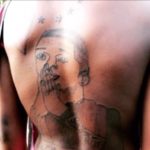
When you love an artist whose fans are literally a small army, you may feel like you need to be extra to show your loyalty. We’re going to assume that’s why Diane, a young Wizkid superfan decided to get a ‘tattoo’ of the artist on her back.
The main problem here is that Diane probably didn’t think this through because the tattoo, which covers her entire back, looks like she slept off around a drunk eight-year-old with a tattoo gun. Diane has a lot of explaining to do to too many people: employers, her kids, Wizkid and God, to mention a few.
When Nigerian Football Fans Sent 1000 Death Threats To Kaita
Nigerians don’t play, not even when we’re playing football. Sani Kaita had to find this out the hard way after he showed up at the 2010 FIFA World Cup as a rugby player and spent his time hacking opponents down, until he got sent off in Nigeria 1-2 defeat to Greece.
Sani Kaita had started out as a bright product of the Nigerian youth team, but we don’t live in the past on this side. Nigerian fans were so pissed that in two days, Kaita received over 1000 death threats. He never played for the national team again.
(EXTRA) All the times Naira Marley’s fans have shown him love:
In case you missed it, the Marlians are a different breed. For one, they are fans of Naira Marley, a problematic singer and living question mark. Marlians show love for their fave in ways that would scare any other person into retirement.
They’ve blocked him in hordes in traffic and at public events. Female fans routinely tag him on social media posts where they dance in their birthday suits without prompt. And there’s that Soapy dance. To be a Marlian is to make a great sacrifice.
Did you enjoy this? You should sign up for our weekly pop culture newsletter, Poppin’. You’ll get to know what we’re up to before anyone else + insider gist, reviews, freebies and more. If it sounds like your deal, sign up here.
We want to know how young people become adults. The question we ask is “What’s your coming of age story?” Every Thursday, we’ll bring you the story one young Nigerian’s journey to adulthood and how it shaped them.
Sometime last year, my family began to take down photos of my father around the house. He often disappeared for long spells. Each time, when he returned, he was in tatters and broke. This time was different; it was the longest he’d gone. We knew he would return, but we decided there would be no room for him when he did.
My older sister and I wanted to create a normal life while drugs could still relieve the pain of our 56-year-old mother who suffered from diabetes. We craved normalcy, even if it felt a little too late.
When I was born 25 years ago, my parents were traders from Eastern Nigeria who were finding their feet in Lagos. My father had come from Owerri to apprentice with an older uncle and set up his cassette store after a few years. They had my sister immediately. I was their way of celebrating their first decent apartment, a room and parlour in Ebute-Metta.
Life wasn’t eventful while growing up. The exciting things that happened were my mother’s not-so-frequent bouts of illness, mostly because someone always got to stay home with he — usually my sister. But she always got well after a few days, especially when her people sent herbs from home. So we’d settle back into routine; I was assistant daddy, I’d finish from school and go to the shop. My father would tell me stories about his childhood while I helped around. My sister would go to my mother’s stall in the market and we’d meet at home at night.
It was a good way to live if you’re the kind of person who believes in the dignity of labour. Not if you’re ambitious. Definitely not if you dreamed of seeing out your final days in a big house in your village. That was the reason my father gave when we first noticed things were going south with him. And I believed him. On some days, I’d go to his shop and he’d be nowhere to be found. So I’d wait until he returned, reeking of cigarettes and cheap alcohol. He’d instruct me to not tell my mother, but she noticed when he began to return with bloodshot eyes and empty pockets. Then he began to buy big bottles of Regal gin and take long swigs as he wished, home or at work, day or night.
Looking back, we shouldn’t have just watched it happen. When my mother got tired and confronted him for the first time, he hit her across the face. I can still remember the sound and the swelling. I was in SS1 at the time and now had a key to the shop. He stormed out and didn’t return for days. When he did, he was hungry, drunk and a complete mess. My mother rushed out to carry him. She was crying. She cleaned him up, gave him food, painkillers and put him to bed. My sister and I were shocked. It was our father, but we were upset that she seemed to have so quickly forgotten about a fresh wound.
That’s how it began. First, he stopped going to the shop. Then he’d disappear for days at a time, and later weeks, only to show up at my mother’s stall at the market. Sometimes, we’d meet him at home when we got back from church. By the time my sister left secondary school in 2008, our relationship had broken down. My mother’s ugu and condiments kept a roof over our head. We still lived in the same house in Ebute-Metta. Our landlord was nice enough to let us pay our rent every six months as long as we paid on time. My father was a complete no-show, even when my mother had her first crisis in 2011.
They say she was always falling sick as a child. In those days, things like that were chalked down to ‘ogbanje’ so she had several ritual incisions down her back and arm to keep her alive. Still, she kept falling sick. As she grew older, her health forced her to live safe, so she ate well and had no vices, except, of course, my father. Things gradually worsened when she moved with him to Lagos. The pressure of being a sole provider didn’t help either.
Neither myself nor my sister ever gave university much thought. I can’t remember discussing it with my parents. Who would send us? Our alcoholic father? A mother who’s been bedridden for years?
When I left secondary school, I continued to run the CD shop which also became a game centre. Since then, I’ve learned to do some electrical jobs: fixing television sets, irons, minor wiring, installing DSTV. Most of the money goes into getting drugs for my mother.
My sister has had to grow up too. After secondary school, she took up my mother’s stall. But she was never going to stay there for long. She’s hardworking but also very pretty. It’s the kind of youthful beauty that rich people like to spend on. When we were younger, people often gave her money; my father scolded her for it, but we all knew it wasn’t her fault. She has ‘friends’ who ‘helped’ her open a small food place in Jibowu. She sells Igbo food to drivers working in the transport companies. I think she makes new ‘friends’ there too. That’s none of my business. She often comes home, tired and angry. She’s 28 now. I know she’s thinking about her life too.
We don’t know how long my mother has left, but we’ve spent every day preparing since we took the photos down. She doesn’t leave the house anymore, except to attend church or go to the hospital. The day my father came back home, she was asleep. My sister had gotten some area boys to look out for him, in case she ever showed up. Because we’d lived there for so long, they knew the story. He returned with a friend, who looked like he’d been in a drug den all his life. The boys didn’t let him into the compound. When he began to make a scene, the boys carried him away. All I heard was his screaming, and later, stories of what happened. He never came back.
Sometimes, I catch myself waiting for my mother to go so I can start living. I know my sister does too. She talks about it. “Who go marry me when I don be like old cargo,” she says. I want to tell her that marriage isn’t a great idea; the only one we know broke everybody involved. I feel like I’ve settled for a lot of things because of my parents. I don’t have a girlfriend. I can’t afford the girls that I like.
If there’s anything that I’ve learned from my parents and adulthood, it’s that the people in your life are crucial as the decisions you make. That’s why I move at a steady pace; I don’t want to be like my father. I want to go for a technical program and learn electrical work properly. For now, my life revolves around what’s left of my mother’s. It’s this uncertainty that leads my day-to-day life. What will happen when she passes? I don’t know. For now, we do what we can and hope for the best.
Is Burna Boy the biggest Nigerian artiste in the world at the moment? I’ll leave you to figure that out. All I know is that in the last few years, U.S interest in Nigerian music has gradually risen. Today, news of Nigerian pop-stars collaborating with their colleagues in the abroad is normal. Same as the sight of celebrities dancing to hits by Wizkid, Yemi Alade or Davido.
Nowadays, Burna Boy is at the forefront of that push. It’s been a long time coming. Burna Boy has been a cult favourite for years. And his new album explores a range of topics; love, spirituality, slavery, misrule and pride, that few African pop musicians address in their music. Coupled with his newfound acceptance in the US, it’s one of the reasons why many are saying he will find the crossover success that many of his peers have craved for years.
Burna sat with The Fader to discuss the new album and in typical Burna fashion, he dropped some incredible nuggets. We picked the best quotes from the African Giant himself.
“I care about crossing over but in the opposite way. I want to come here and cross you over to where I am, because where I am is your actual home, the beginning” – On the topic of crossing over and whether he cares about finding success in the US.
“It felt great. It’s almost like a mission accomplished in a way because it goes back to what I’ve been saying. We’re all connected and that kind of proves it” – How Burna felt when he saw Jamaican singer, Koffee’s cover of “Ye”.
“The whole song is a brief history lesson about Nigeria and Ghana, when M.anifest comes in. (It was necessary to include it because) Nigeria is misunderstood by insiders. I can guarantee you that at least 90% of people my age have no clue about the real origins of Nigeria. There’s so much truth that we need to know in order to be respected. Because right now the only thing that can save the youth is knowledge and financial independence.” – On the critically acclaimed track, “Another Story” and why the song is so heavy on African history.
“I ended the album with my mum’s quote because I felt like there was no better way to close the album because that’s the whole message in one little speech. It was perfect the way she did it.” – Why the album ends with his mother’s now-iconic speech, delivered as she took the Best International Act award on his behalf at the 2019 BET Awards.
“It’s the message. Look at the language we’re talking about now, it’s nothing but broken English. We were all in Africa, we all had our tribes and the English came so we all had to break (their language) down in a way that we can understand it. The Nigerian would have their own pidgin, the Ghanaian, their own pidgin, the Sierra Leonean will have their own creole. It’s all the same thing. The Jamaican Patois. It’s just different accents. For me, I think that’s one thing that also proves it; that we’re all the same” – Burna’s explanation for how pidgin English in different countries has similar words, lexis and structure.