• Picture me as a content creator doing a storytime TikTok (sorry, boomers) because that’s the energy I’m coming with. The Nigeria Labour Congress (NLC) is dragging the Federal Government (FG) for filth, and I have all the details. Stay with me.

    What’s going on?

    The real question is, what’s not going on because there’s been a ton of drama in the past couple of days, and it all started with an announcement made on Monday, January 20.

    On Monday evening, the Nigeria Communications Commission (NCC) released a statement on its Twitter account saying it is giving telecommunication operators in the country permission to increase the tariff on phone calls, SMS, and data subscriptions by 50%. The implication of this announcement is that phone calls will move from ₦11 per minute to ₦16.50 per minute, SMS from ₦4 to ₦6, and 1GB data bundle from ₦287.50 to ₦431.25.

    Protests and lawsuit threats

    The ink from NCC’s pen had barely dried on their paper when they were hit by draggings from different corners. The first was from the National Association of Telecoms Subscribers (NATCOMS), which announced on Tuesday, January 21, that it’d be dragging the NCC by its hair to court for trying to add to the already heavy burdens that Nigerians carry.

    The second lawsuit threat came on the same Tuesday, from the Socio-Economic Rights and Accountability Project (SERAP). The legal advocacy group is no stranger to calling the Nigerian government’s BS, regardless of the administration. Regarding this tariff hike, SERAP says that the government’s decision to increase the tariff violates the rights of Nigerian citizens to affordable communication as contained in international human rights standards.

    The next dragging came from the National Association of Nigerian Students (NANS) on Wednesday, January 22. “This decision is not only abnormal but also highly inconsiderate and unjustifiable, especially in the current socio-economic climate,” the student association said in a statement.

    NANS said that while it understood that telecommunication companies were facing operational challenges, it does not believe the burden should be passed on to Nigerians, especially students, because they already have way too much on their plate as it is.

    Unlike SERAP and NATCOMS, the student association not only dragged the NCC but also bundled the Ministry of Communications and Digital Economy along with it, saying it would embark on a nationwide protest if the ministry and the NCC did not reverse the tariff hike in 72 hours.

    The Nigerian Labour Congress (NLC) was not as gracious with their time though. On the same Wednesday, January 22, the NLC released a statement saying the tariff hike was highly unfair to Nigerian workers, giving the government a 48-hour deadline to reverse the hike, but unlike the other groups and associations before it, the NLC did not threaten a protest or lawsuit, it threatened an industrial boycott which it wants Nigerians to get on board with.

    But why did the NCC hike the tariff by 50%?

    Everyone is (rightly) pissed off at the tariff hike, but the gag is that telecom operators in Nigeria actually asked the government for a whopping 100% increment. This would have seen phone calls climb from ₦11 per minute to ₦22, SMS climb from  ₦4 to ₦8, and 1GB data subscription from ₦287.50 to ₦575.

    Telcos explained that the telecommunication industry was at risk of crumbling if an increase was not effected; they also threatened to suspend their services in some parts of the country if their demand was not met. After stalling and stalling, the NCC met them halfway and increased the tariff by 50% instead of 100%. We previously wrote an article explaining this in detail.

    Why does the NLC want you to boycott telecom companies?

    Explaining the position of the union on Arise TV on Friday, January 24, NLC President Joseph Ajaero argued that the government increased the tariff prices for its own gain. “When you increase tariffs by 50 per cent, aside from the taxes the government may collect, it’s seen as a way to boost government revenue. This has been the same approach even in the power sector,” he said.

    He pointed out that while he understood the need for telcos to seek an increase in tariff due to operational struggles, he still thinks the government did not act in favour of ordinary Nigerians by making the 50% increment as he believes the NLC as a regulator, has the duty of striking a balance between the corporate interest of telcos and the welfare of Nigerians.

    “The government needs to strike a balance. For someone earning N70,000, paying over N10,000 on this tariff increase alone is significant. How will they afford transportation, housing, and other basic needs? It’s not realistic because, in reality, there’s no housing that costs N10,000, and transportation costs are equally high,” the labour President said.

    Explaining further, Ajaero said that the government could actually reduce the operational costs weighing down on telcos (as well as other industries) and save Nigerians the stress of extra expenses by producing essential items in the country rather than importing everything.

    “For instance, even for metering, we’re importing cables. These are items we could produce domestically, but instead, we rely on imports and then blame rising costs on currency value and importation expenses,” he said, explaining that it made no sense to import these things and then push the extra costs of importation on Nigerians.

    “Where did we go wrong that ordinary Nigerians must always bear the brunt? We need to rethink these policies and ensure that people aren’t left struggling to survive while corporations thrive,” he asked.

    So what now?

    Except for the Nigerian people, I have no dog in this fight. However, the NLC President made a fair argument in pointing out that certain things should be manufactured within the country to save Nigerians unnecessary headaches, sort of like how the entire country has always pushed for the establishment of functioning refineries that’ll supply petroleum products directly to Nigerians rather than going the importation route and incurring extra costs.

    What can we do?

    Your next point of action will be highly dependent on which side of the divide you stand on. You can do nothing if you believe the 50% tariff hike is fair. If you think it’s unfair, you can do either of the following to make your opinion known:

    1. Pressure your lawmakers: If citizens pressure their lawmakers about issues affecting them, they can summon the parties involved to explain what’s happening and possibly change the issue (again, only when pressured). You can find the lawmaker representing your constituency in the national House of Assembly here.
    2. Stage a protest: This is usually a no-brainer in situations like this. In this particular case, you can either start your own protest, join the one proposed by NAN or join NLC’s boycott.
    3. Use social media: Social media has quickly become a powerful tool for change globally, and it’s no different in Nigeria. One of the most effective ways to start a social media campaign is by consistently talking about an issue and using hashtags to do it. Strong movements such as the #EndSars originated through the use of hashtags.

    4. Start a digital campaign: Starting an online petition is also another way to  effect change that you want to see. Platforms like this are a great start and are pretty straightforward to use.

  • Photo credit: JC Communicationz

    Unless, of course, you live under a rock, haven’t touched your devices today, or are completely drowning in the news of Trump’s endless Presidential orders, you must have heard by now that the Nigerian Communications Commission (NCC) has made an announcement saying it’ll okay an increase in tariff rates charged by telecommunication companies in the country.

    You might have also heard that there are plans to sue the federal government over the increment. We tracked the entire story so you don’t have to.

    How it started

    Since 2024, the Association of Licensed Telecom Operators Of Nigeria (ALTON) and the Association of Telecommunication Companies Of Nigeria (ATCON)  have begged the Nigerian government to allow it to increase the prices of their services. To plead their case, the two associations pointed out that the telecom industry was the only industry that had not experienced any price increment since 2013 (12 years) and that a price review was not only long overdue but was compulsory to avoid the collapse of the industry.

    ALTON and ATCON’s request was made in the first quarter of 2024 but it was not granted–the Nigerian Communications Commission (NCC) told them it would conduct a cost-based study to decide if it would approve their request but as the year drew to a close in December, the telco operators showed they were not backing down by announcing they might suspend their services in some parts of the country if their demands are not met.

    A brief back-and-forth

    The telco operators asked for a 100% increase but the NCC said it was not going to approve that because it would weigh down on Nigerians who are already seeing immense shege due to the crazy inflation rates, hike in fuel prices, and other issues in the country but the companies weren’t having it because they too were suffering from the same issues.

    On Wednesday, January 15, The Minister of Communications, Innovation and Digital Economy, Bosun Tijani, said again that while the government was considering the request from the telcos, there was no way it would approve a ten per cent increase but would instead keep it within the 30 to 60% range. This time, the Association of Telephone, Cable TV, and Internet Subscribers of Nigeria (ATCIS-Nigeria) said it wasn’t going to happen on their watch.

    Increment announced

    On Monday, January 20, the NCC announced it had decided to increase the tariff by 50%. The announcement came in the form of a statement signed by NCC’s Director of Public Affairs, Reuben Muoka, and we read it so you don’t have to.

    In the statement, the NCC basically says that it landed on this decision after “taking into account ongoing industry reforms that will positively influence sustainability.” The commission also reminded Nigerians that tariff rates had not been increased since 2013, even though the cost of providing the services has since skyrocketed and that the increment is compulsory in order for the telecommunication operators to operate in a way that’ll benefit the customers.

    The NCC did not state a specific date when the tariff hike is expected to start, but it instructed telecommunication companies in the country to first “educate and inform the public about the new rates.” This means that your telecom service provider will let you know before they implement the new rates.

    ATCON threatens to sue FG

    Barely 24 hours after the NCC announced the 50% tariff hike, another group, the National Association of Telecoms Subscribers (NATCOMS) also announced it was going to drag the commission to court for the hike.

    Explaining their decision to sue, the association’s president, Deolu Ogunbanjo, told Channels TV that the move was totally unfair to Nigerians. “… It is so much for subscribers to bear. Already, we are grappling with a lot of things that are surrounding the business climate here—fuel cost, electricity cost, and all that—you are now looking at telcos asking for 100%, and  NCC now is granting them 50%. It is a no-no,” he said.

    Ogunbanjo also explained that NATCOMS is understanding of the need for a price increment and that it had propose a 5 to 10% increment to the NCC but was shocked to see that the commission had ignored subscribers and approved 50% increase instead.

    Does ATCON have a chance at winning?

    We actually can’t determine whether or not the association will win its case mostly because the NCC is empowered by section 108 of the Nigerian Communications Act (NCA) 2003 to approve tariff charges by telecommunication operators in the country.

    We will keep an eye out and tell you first when we hear anything.


    News is boring, but we make it fun. Subscribe to The Big Daily to be the first to know the day’s biggest news. 

  • Photo credit: Premium Times

    Lawmakers in Nigeria’s House of Representatives might be standing on business this year because they appear to be showing that already– reports have it that they’re looking to curb public smoking of tobacco in the country by introducing stricter punishments and jail terms.

    Three lawmakers, Usman Zannah, Aliyu Garu, and Mansur Soro, who are currently sponsoring a piece of legislation titled ‘A Bill for an Act to Amen the National Tobacco in Public Places and for Related Matters,’ are spearheading this move.

    What does this mean?

    Nigeria currently has a law named The National Tobacco Smoking (Control) Act 2015, which already prohibits public tobacco smoking in the country but lawmakers want it to be amended to contain stronger penalties for people who default against it.

    The current law, for instance, provides that any individual guilty of smoking in public would be sentenced to six months in prison; under the proposed amendment, such an individual would either be made to pay a fine of not less than ₦10,000 (and not above ₦50,000), or one-year imprisonment (instead of six months), or be made to suffer both consequences.

    While the National Tobacco Smoking (Control) Act 2015 currently penalises public entities who allow smoking with a fine of not less than ₦200,000, the amended version will increase the punishment by either making them pay a fine not exceeding  ₦1 million, a prison term not more than two years, or both.

    The new amendment also seeks to increase the punishment for people who advertise or sell tobacco, among others.

    Why is this important?

    You might be rolling your eyes at this amendment, but the lawmakers are actually on to something here. How? Tobacco use is currently responsible for  28,000 deaths annually in Nigeria and eight million deaths (per year) globally, and here’s the kicker– it’s also responsible for the death of an estimated 1.3 million people who do not smoke but are victims of second-hand smoking.

    If you still haven’t made the connection, the stricter punishments against public smoking of tobacco are especially important because any form of exposure to tobacco can lead to death. The  World Health Organisation notes that second-hand smoking can lead to “serious cardiovascular and respiratory diseases, including coronary heart disease and lung cancer.”

    It’s such a menace that the WHO wants a ban on tobacco smoking in Nigeria as a whole rather than the existing ban on only its public use. Also, in 2019, the Center for the Study of the Economies of Africa (CSEA) revealed that Nigeria spent ₦526.4 billion in treating diseases caused by tobacco smoking.

    Commonly contained in things like cigarettes, Shisha,  and other products, tobacco has remained a major health concern across the globe. Its smoke contains thousands of cancer-causing chemicals such as Acetaldehyde, Arsenic, Benzene, and Cadmium.

    Authorities around the world have tried to curb its use with things like popular “smokers are liable to die young” (which is a legislative requirement for cigarette companies)  imprinted on cigarette boxes and other anti-smoking rules. In 2003, WHO member states (to which Nigeria belongs) adopted the Framework Convention on Tobacco Control (WHO FCTC) to curb this menace. Legislatures like the National Tobacco Smoking (Control) Act 2015 are part of the country’s attempt at abiding by the framework. But like almost every law in Nigeria, implementation has remained a problem. Maybe it’ll be different this time around?


    News is boring, but we make it fun. Subscribe to The Big Daily to be the first to know the biggest news of the day.

  • The Nigerian experience is physical, emotional, and sometimes international. No one knows it better than our features on #TheAbroadLife, a series where we detail and explore Nigerian experiences while living abroad. 


    Chika (24) had a pretty sweet life and solid friends in Nigeria, so when his parents told him they had processed his visa to the UK, he rebelled against it, but later, he came around. In this Abroad Life episode, Chika talks about leaving for the UK a day after his NYSC and finding his footing in the country.

    Where do you currently live, and when did you leave Nigeria?

    I live in England, and I left Nigeria in October 2023, a day after my National Youth Service Corpe (NYSC) Passing Out Parade (POP)

    How did you leave?

    I left on a student visa; I’m here for my master’s.

    Is there a reason you chose that route and the part of England you stay in?

    There’s no particular reason. When I arrived, I stayed in London for a bit with my sister, but she got a job in this city, so I had to move with her. It wasn’t easy to manoeuvre school, but I did it because I had no choice. I had just arrived, and I had no job or money to get my own place.

    I’m also not the kind of person to burden anyone, so I had to just stay with my sister and find my way to school. But I didn’t go every time I had lectures. Sometimes I did it the Nigerian way and asked someone to sign my attendance for me.

    Was there a reason you moved immediately after your NYSC?

     Trust me, it wasn’t planned. I guess it was just God’s plan.

    You must have been working towards it at some point. How did that happen?

    My parents instigated it, and I was against it. I didn’t want to travel, so I rebelled against the idea. I was enjoying my time with my boys, doing drive-throughs and stuff. 

     Nigeria was really fun for me, and I was doing just fine.  There were already signs I was going to be retained at the company I worked at so I saw no reason to travel.

    That said, I accepted my parent’s plans later on.  I felt like it was going to work if God wanted it to, so I gave it a shot.  People thought it was something I had been planning for a very long time, but the whole thing took about three months or so.

    Can you walk me through the process?

    My parents and my uncle had already started working on the process before I was in the loop.

    I usually dropped my important documents like my NECO, WAEC, and testimonials with my dad. My uncle also works in my secondary school, so it was pretty easy to start the admission process without me. It was when they needed other documents (my transcript certificate) that they involved me. Like I said, I initially rebelled, but I ultimately gave them everything they needed. After that, all he told me was I needed to go for my interview, biometrics, and all that. Everything happened so fast. That’s how I knew God actually wanted it to happen, so I just gave in as much as I could.

    Did your parents process the whole thing themselves because they already knew you wouldn’t want to leave?

    Not really. I think my parents have always sought an easy way for their kids because they sort of foresaw the way Nigeria would turn out.

    That’s really nice and thoughtful. So, did they pick your course of study?

    My dad and I had tons of conversations about masters prior to this, so he already knew my choice.

    That makes a lot of sense. So, how has life been since you got to the UK?

    I can’t say it’s good. I can’t say it’s bad.

    Oh, okay. Please tell me more.

    It’s mostly because I was only able to make a friend about eight months after I moved here.

    Ah, your first friend? 

    Yeah. He’s Nigerian, and I connected with him through TikTok. But before then, I had already bumped into him twice on my way to work.

    That’s very interesting. I’m curious about why it took you that long to make your first friend

    All I do is go to school, come back home, shop for groceries, come back home, go to work, come back home, or go on a stroll and come back home.

    So, have you tried expanding your community?

    Not really. I feel like another reason why I’ve found it hard doing that is because making new friends online is okay for me, but I’m not really so keen on making new friends physically because I feel like the devil I know is even better than the one I don’t. 

    Once, I tried making friends with someone I met on the bus. We live ten minutes away from each other, but after we met like twice and I walked her home, we haven’t seen each other again. I mostly just talk to my friends online and make TikToks. That’s my life here, but I’m willing to expand.

    Would you consider living in England lonely compared to the life you had in Nigeria? 

    It’s not like it’s lonely. I’m normally a very social person, but I haven’t really been able to be that person here because of the things I’ve had to do. Also, I don’t just make friends with just anybody. I like creating strong and proper connections. And I actually have friends in the UK, only that they live so far away. My social life will definitely change once I’m done with my master’s.

    How so, though?

    First, I’m going to move out of my sister’s house. When I stay on my own, my friends can come over, and I can go over to my friends. I can also explore other lifestyles, going into fashion content and modelling and stuff. I want to get serious with things I used to do in Nigeria that I just had to put on hold because of my master’s.

    Let’s talk a bit more about you living with your sister. What is it like?

    It’s just like living with family, which has always been normal and fun. It’s just like leaving home for home.

    Would you say that living with your sibling limited your social freedom in a way?

    Not really. In fact, I can actually say it was me who limited myself because they know I’m an adult who can decide things for myself. It’s not like they can stop me from going out if I want to. The least they can do is tell me to be careful and stay safe.

    You said earlier that you didn’t want to leave Nigeria because you had fun with your boys. What was so special about that life?

    It was the bond and the fact that we all shared the same life and interests. They were people I could relate to. We like the same things. I love cars, and they do, too. It’s so easy that we never planned our outings; they just happened.

    One can’t have everything, but I had the things that I could. Having real and sincere friends is one of the best things in this life. Friendship is not something that is just so easy to get and I had mine for six years and over.

    So, what is the most interesting part about living in the UK for you?

    One of the good things about living in the UK is that your eyes will be opened to things that you didn’t know before. Another thing is that it exposes you to things that can actually help you make a more profitable life for yourself. I also like creating content on TikTok, and the UK makes that easier.

    Have you witnessed any culture shocks since moving to the UK?

    Quite a lot. There are many sexy cars here that aren’t in Nigeria. I’m sorry, the first time I’m talking about is a car, but I can’t help it.

    The laws are also a culture shock, but they make sense because they keep us safe. In Nigeria, many people are scared of walking in the night because of the risks, but you can literally walk in the UK at 1 a.m., or 2 a.m. without fear. I think it depends on the city, though, but it’s generally safe.

    The weather is another shocker, too. UK weather is bi-polar. I always say that I can’t be friends or even date someone who is as bipolar as the weather here.

    Speaking of dating. I mean, if you took it this long to find a friend, I’m wondering if anything has happened to your dating life since you moved to the UK. 

    I’ve not been in any relationship since I’ve been in the UK. My previous relationship became tough months before I left Nigeria, so we broke up. I think it’s also one of the reasons why I gave the UK a chance. I just wanted to get a breath of fresh air because I was mentally and emotionally messed up. It really affected me.

    Do you mind telling me why it affected you enough to influence your move?

    I had an emotional and mental breakdown. Everything around me revolved around her. She was a part of me already. My family knew already, too; we dated for about three years and were on our way to the fourth.

    On a scale of one to 10, how happy would you say you are with your life in the UK?

    I’m not sure, but I’ll say 8.5. It’s good, but things could be better. I had a breakdown a few months ago because of school stress. It’s not fully great, but it’s still really good.


    Do you want to share your Abroad Life story? Please reach out to me here. For new episodes of Abroad Life, check in every Friday at 12 PM (WAT). 

    [ad]

  • Photo credit: JC Communicationz

    We are not sure if this is to be categorised as a high or low-quality problem, but some Nigerians might be in for the mother of all modern inconvenience– a telecommunication shutdown. 

    On December 31, just as Nigerians said goodbye to  2024, the Association of Licensed Telecommunications Operators of Nigeria (ALTON) said that they might suspend their services in some regions of the country if the Nigerian Communications Commission (NCC) does not okay their demand for a tariff increase.

    In a statement signed by ALTON Chairman Gbenga Adebayo, the association said that Nigeria’s telecom industry is hanging by a thread and would need to increase the current tariff as a matter of survival as they currently suffer high energy costs, rising inflation, high cost of operation, unstable exchange rates, and other issues.

    The ALTON chairman emphasised that telecom operators need to, as a matter of survival, raise the tariff to reflect the unfortunate impact of the Nigerian economy on their businesses but have been able to do so due to the NCC’s refusal and have experienced stagnancy as a result.

    Although they were not specific on time and location, ALTON said it’d be cutting telecommunication services in certain regions of the country and at certain times. In the words of its chairman: “If nothing is done, we might begin to see in the new year grim consequences unfolding, such as Service Shedding; operators may not be able to provide services in some areas and at some times of the day leaving millions disconnected…”

    How will a telecommunications shutdown affect you?

    Actually, the question should be, “How will it not affect you?” because a telecommunications shutdown is on the same level (if not worse) as an electricity blackout. If telcos go ahead with their plan to suspend their services in some regions of the country, this means that people in those regions will literally be catapulted back to the Stone Age, as they will only be able to use their devices at certain times of the day. Imagine using your phone only when the rationing allows you to.

    On a larger scale, a suspension of telecom services would be potentially catastrophic for Nigeria, as essential sectors like healthcare, education, security, and commerce would be mad  stranded without those services.

    What does a tariff increase mean for you?

    Telecom operators have explained how the current tariff weighs heavily on their operations, and Nigerians will definitely be singing the same song if the NCC agrees to a tariff increment.

    Currently, the tariff stands at ₦11.00 per minute for voice calls,  ₦4.00 for Short Message Services (SMS), and  ₦1,000 for one GB data bundle. If the tariff increases, customers will be charged  ₦15.40 per minute for voice calls,  ₦5.60 for SMS, and  ₦1,400 for one GB data bundle.

    So, in addition to paying more for almost everything, Nigerians will have to dig into their pockets for extra cash to afford services as essential as telecom services.

    What is the solution to this problem?

    The obvious solution here might seem to be for telecom operators and the NCC to come to an agreement, but according to all that ALTON has said, the only acceptable agreement in their books is a tariff increase, which unfortunately brings us back to the issue of being forced to pay more.

    The only real solution is the not-so-obvious one—an economic turnaround. Nigeria is currently experiencing what has been termed its worst economic crisis on record, and its impact has been felt on just about everything in the country.

    From an increase in the cost of air and road travel to an increase in food prices and more, people in the country have barely caught a break, and neither has its industries. In 2023, following the impact of fuel subsidy removal and bold monetary policies, several companies like  Bolt Food, Procter & Gamble, GlaxoSmithKline (which had operated in the country since 1972), and Jumia Food all left the country for similar reasons. 

    Also, in 2023 alone, about 767 manufacturing companies in Nigeria had to shut down their operations due to the same old culprit– the economic crisis. Now, telecom operators are asking for a tariff review, citing the same issues.

    From all angles, there hardly seems to be a solution or an end in sight to the current telecom threat. As it stands, the NCC might have to finally agree to the tariff hike and Nigerians might have to pay extra for telecom services.

  • In a lot of ways, 2024 was a hell of a year for Nigerians; from fuel scarcity and hikes in fuel prices to sky-high inflation, poor power supply, and crazy exchange rates, people living in Nigeria braved so much to survive.

    Micro, Medium, and Small Enterprises (MSMEs) were no different. Like every other year, 2024 came with its ups and downs, but the lows were so severe that their impact was felt nationwide. From the Manufacturing Association of Nigeria (MAN) announcing that unsold products worth about ₦1.24 trillion were stuck in different warehouses across the country (just by the first half of the year) due to the inability of their owners to sell them, to the Bank Of Industry (BOI) stating that MSMEs in Nigeria need about $160 billion bailout funds, the country didn’t exactly prove itself as a good business environment.

    As the year comes to an end today, Zikoko Citizen spoke to three young micro business owners to understand how the Nigerian economy affected their businesses in 2024 and what they look forward to in the coming year.

    Chisom, 27– Fashion Designer, Abuja.

    I don’t want to sound cliche, but doing business in Nigeria this year was hard. I consider this one of the most difficult times to be a young adult in Nigeria. The economy and everything is just so difficult. The cost of living is high, and the cost of doing business is even higher.

    The crazy thing is that because customers struggled, they didn’t understand that business owners had it difficult as well. It’s even worse with my kind of business because some people feel like you just want to overcharge them or think you are overpriced.

    You might just tell a customer the price for something this minute, then go to the market the next minute to buy that same thing, only to find out that the price is way higher than what you’ve already charged. Only a few people understand when you come back to them to say you’d need to increase the initial price you told them. I’ll give you an example– one time within the year, a bundle of lining was about ₦9000 to  ₦1000.  A few weeks after I bought some, I felt like the prices of sewing accessories might go up, so I went to the market to restock, but I was super shocked to find that it had increased to  ₦35K and the sellers at the market were not even begging or haggling price. The energy they gave was like, “If you’re not buying, go.”

    Navigating price increments and incorporating them into my business was not easy for me this year, and I don’t think it was easy for others, either. It came to a point where I needed to charge more to sustain my business. A lot of things came into play and I  had to consider all those factors to be able to charge appropriately for my brand, so you have to accept the reality that not everybody who could afford me before will be able to afford me presently and just be fine with it.

    People who appreciate the services you offer enough will keep patronising you, while those who can’t handle the price increase will go to another place that is cheaper and more affordable for them. It has nothing to do with the quality you offer; it’s just about what they can afford.

    I don’t think there’s a specific thing that’ll make my business easier in 2025. I’m saying this because I don’t think it’s a matter of specifics– as it stands, everything and everyone is struggling. Even middle-income earners now are not fully able to afford our (fashion designers) services.

    Every aspect of the economy is struggling right now. I can’t even say that access to loans, funding, or policies that’ll increase the ease of doing business will ease things for me in 2025 when every other aspect of the economy is suffering. It won’t really make sense because I can now have access to that funding or loan, and then find that my customers are still struggling, so everything just needs to be better in 2025 for other things to be better. I don’t know if that makes sense.

    Sarah, 25. Jewellery Vendor– Warri

    Living and doing business in Nigeria as a jewellery vendor in 2024 came with its own unique challenges and opportunities. The jewellery industry in Nigeria is already highly saturated due to its profitability, but 2024 was slightly stressful for a number of reasons.

    This year, the cost of procurement and shipping became drastically high. Import prices, for instance, climbed by about 35%, and this affected the amount of goods I was able to purchase at a go.

    Normally, doing business in Nigeria is quite difficult, so you have to be strategic, but this year required extra strategy to avoid running mad due to the way prices skyrocketed. The country’s economic environment was just unpredictable, with fluctuations in currency exchange rates, inflation, and government policies affecting the cost of doing business.

    2024 has been a tough year for me and my brand, but I was able to scale through and make the best of it through careful planning, adaptability, and a deep understanding of the local market and culture. Coming up with the right strategy and mindset helped me achieve good results.

    My initial plan for my brand was to sell super affordable jewellery, but with the increase in procurement and shipping, I just had to increase my own prices to avoid running at a loss. However increasing my price due to the whole exchange rate madness and other things actually brought in new customers, who are now my target audience. Because of that change, I strategised and moved from just selling regular earrings to luxury items like custom-made unique designs and venturing fully into niches like wedding rings and male jewellery accessories. 

    So yes, I lost a few clients because most of them were no longer able to afford me due to the increase in prices, but I also gained newer customers.

    My business will be four years old next year, and this year, we recorded lots of sales than we’ve made in the past four years, not because the environment was encouraging but because I was strategic in adding new niches

    When it comes to things that’ll make business easier for me in 2025, I’ll say the exchange rate first of all– I know it’s sort of decreasing right now, but I need the Nigerian government to look into it next year. If the exchange rate was actually good, people won’t be complaining, and businesses won’t be struggling. 

    A lot of the time when I’d reach out to my suppliers to calculate the prices of goods, I realised over and over again that the gap between the exchange rate in 2023 and this year was just too much. 

    Another thing I want the government to take a look at is this whole custom-clearing thing. To clear goods has now become another issue. The payment for clearing goods has become so heavy that many business owners now have to order bit by bit because ordering so much at once brings a lot of issues. The delay is also insane. These things just need to be better for businesses to thrive in 2025.

    Ugonna, 29. Footwear Vendor– Lagos

    Doing business in Nigeria was very challenging for me this year, and I tried to evade and minimize costs as much as possible.

    The exchange rate didn’t make things easier either because it affected me like mad and this made me withdraw from importing by myself and buying from a friend that had a stronger capacity than I did. I’ll explain– When we order from shipping companies, the goods take about two months to get to Nigeria, but you can’t really monitor the exchange rate and take advantage because even though you had ordered two months away, you’ll still have to clear the containers at whatever price the exchange rate is at when you goods finally arrive. You also have to settle Alayes and Owo da boys. 

    I didn’t make as much profit as I set out to this year and I couldn’t take my business offline because the crazy costs of rent in prime locations were way more than I could afford.

    What will make my business easier in 2025? Access to funding. This is particularly important to me because I need to diversify and look into other sectors because having more than one source of income will shoot me up the ladder. One of those sectors is entertainment/full-scale film production. I’m already working on this. My production company is set to release its first film by January, but there are so many ups and downs in the industry that make this type of venture unsustainable by a singular individual, so going into 2025, I need avenues to access more that’ll enable me to run my film production and footwear businesses properly and profitably.


    Currently, MSMEs account for 40% of Nigeria’s Gross Domestic Product (GDP) and provide 90% of jobs in the country, making them the backbone of the economy, without which the country will experience more harsh times than it already is. Just like the young entrepreneurs who spoke to us, we hope that 2025 is a better year for MSMEs in Nigeria.

  • 2024 was such an eventful year for Nigerians, and we do not mean this in a positive way; the year stressed Nigerian citizens in many ways. From the constant disgrace of the Naira to the sky-high inflation rates, the unending fuel queues, the painfully high cost of living, and more, Nigerians saw shege that was heavily televised.

    Politicians in the country were no better either; in different ways, they added to the frustrations of Nigerians either by idly watching as citizens suffer due to harmful policies, helping implement those policies themselves, supporting them, or generally incompetent at their jobs. As the year slowly comes to an end, we thought to remind you (and the politicians) of their bad characters within the year by giving them awards that represent all they did in 2024.

    Godswill Akpabio- Best in Agbaya behaviour

    Godswill Akpabio is Nigeria’s Senate President, but this year, he did and said things that were in no way appropriate for the leader of the Nigerian Senate. On July 31, for instance, while Nigerians prepared for the Hunger Protests, Akpabio was in the news for mocking the protest plans of many Nigerians.

    While he attended a Niger Delta Development Commission (NDDC) event, the Managing Director of the NDDC, Samuel Ogbukwu, made a solidarity statement saying the Niger Delta region was in support of the present administration and wasn’t pushing for a regime change to which Apkabio responded. “…You said we are not interested in regime change; let us own this government. Those who want to protest can protest, but let us be here eating.” 

    The Senate President was famous in 2024 for insulting the sensibilities of ordinary Nigerians, and there are other instances of this, but that was not the only thing he was guilty of this year. He also had a thing for showing his loyalty and support to the Tinubu administration to the detriment of the reputation of his office as the leader of the Senate, an arm of government which is supposed to keep the executive in check.

    In May 2024, in the thick of suffering for Nigerians, Apkabio thought Tinubu’s intention to phase out the country’s national anthem for the old anthem, “Nigeria we hail thee”, was a fantastic idea, and he didn’t just show this by skipping an essential step like a public hearing and ensuring that the bill was hastily passed in a matter of days, he also thought it’d be fun to voice his thoughts on the bill even if they didn’t make sense to anyone. 

    On June 18, a few weeks after the bill passed, Akpabio implied that the national anthem change was the best thing since sliced bread because, according to him, insecurity, one of Nigeria’s biggest problems, wouldn’t exist if the anthem hadn’t been removed. In his words: “If we kept the anthem, we probably would not have banditry today in Nigeria because if you took your neighbour as your brother, you would not want to kill your brother…”

    Akpabio probably saw the criticisms that followed this development as haters hating because, in December, he topped off his pro-Tinubu theatrics with an even more distasteful drama. On Wednesday, December 18, when Tinubu walked into the Senate chamber to present the controversial 2025 budget, Akpabio, like a true Agbaya, started singing, “On your mandate, we shall stand!” (and other senators joined in) even before the President had a chance to begin his presentation.

    This behaviour is wrong on all fronts, and Nigerians called him out for it, but the thing with the winner of the Agbaya prize is that he does not seem to care that his behaviour is unbecoming his position. Just like an Agbaya wouldn’t. We couldn’t think of a more fitting winner for this award.

    Remi Tinubu– Best in “Innovative Solutions”

    Like the previous politician, this award-winner was mighty proud of her decisions, but there is something quite unique about her. No, it’s not her position as the wife of Nigeria’s President; her one big thing is that she wasn’t in the news for merely supporting her husband’s ideas and performance (or of others in his government); she backed up her support by coming up with innovations of her own.

    Like most things, food was costly for Nigerians in 2024, but Remi Tinubu did not think this crisis would be solved by finding solutions to insecurity, inflation, climate change, or any other cause of the problem; she felt that food would suddenly become affordable if all Nigerians started cultivating a garden in their backyard, so she came up with the “Every Home a Garden” farming Initiative in July to “boost food production” in the country.

    In September, ahead of the country’s Independence Day, Remi Tinubu came up with yet another brilliant innovation— a unity fabric.

    The Unity Fabric is a special project, which envisions the end to national issues caused by tribal differences through the help of a fabric (Unity Fabric) which would be worn by all.

    Haters will say that these brilliant innovations did not yield any results, but what did they say about haters hating again?

    Abdulmalik Sarkindaji– 1st Runner Up, Innovative Solutions category

    The position of the most innovative Nigerian politician of 2024 was hotly contested, but the speaker of the Niger State House of Assembly, Abdulmalik Sarkindaji, held his own and came out second only to Remi Tinubu, all thanks to a bright idea he came up with in the first half of the year.

    On May 10, Sarkindaji announced that he was going to marry off 100 orphan girls who lost their parents due to attacks in the Mariga Local Government Area (LGA) of Niger State. Sarkindaji probably took a look at obvious solutions like scholarship programs and scoffed because he believed in his genius idea. Even when he came under fire for his plan, he stuck to it and was able to marry all 100 of the girls off in separate ceremonies on Friday, May 24.

    Yahaya Bello– Best in audacity

    This year, Yahaya Bello proved that you can get away with just about anything in Nigeria with the right amount of audacity.

    Bello’s journey to this award first started in April 2024 when the Economic and Financial Crimes Commission (EFCC) said he used $720,000 of state funds (during his time as governor) to pay the school fees of his children in advance to the American International School in Abuja. The EFCC shortly attempted to arrest Bello on April 17 over corruption charges it brought up against him, but the former governor evaded the arrest and was declared wanted. Bello continued to play in Nigerians’ faces until November when he submitted himself to the EFCC. If another politician won the audacity category, it’d insult what Bello pulled off this year.

    Adebayo Adelabu– Best in incompetence

    This is by far the most hotly contested award category because by default, both President Tinubu and everyone in his administrations were eligible for this award but the Minister of Power, Adebayo Adelabu, worked extremely hard to emerge the winner of this category.

    This year under Adelabu, Nigerians, on top of having an epileptic power supply were thrown into complete darkness as a result of the collapse of the national grid.

    In 2024, the national grid fell so much that Nigerians stopped being surprised when it happened. In a particular week in October, for instance, the grid collapsed three times, and by December, it had collapsed 12 times in total.

    The award for this category should naturally go to Tinubu, but that would be stating the obvious, so for this reason, because Adelabu’s failures are the only ones as loud as Tinubu’s, he gets to go home with the award for most incompetent Nigerian politician of the year.

    Tinubu– Grandpatron award

    President Bola Ahmed Tinubu gets this position not only because he is the leader of all the politicians in the country but simply because there is nobody badder. Tinubu’s doings are so loud that his policies from the previous year are still showing an immeasurable amount of shege to Nigerians.

    While Nigerians battled with the unending consequences of the removal of fuel subsidies, the devaluation of the Naira, and many others, the grand patron taxed them more while continuing to promise things that he never did.

    Under President Tinubu, the exchange rate skyrocketed, several factories closed down, the manufacturing sector went into life support, and Nigerians suffered hunger more than ever. This translated to what has been described over and over by the international media and experts as the worst economic crisis on record witnessed by Nigeria.

    In response to this hardship, Tinubu has been adorned with nicknames like T Pain, so we cannot think of a more deserving winner than him.

    Going into 2025, we hope for better representation and leadership from Nigerian politicians, and we’ll be on the alert to report their bad and hopefully good behaviours to you. 

  • The year 2024 was such a wild year, and in many ways, many Nigerians feel like they’re absolutely different people than they were at the start of the year. No, we are not Spotify, but we’ve made you a list of the craziness that shaped your year in case you forgot.

    Band A, Band B, freezer drama

    The thing about this particular event was that it happened so close to April Fool’s Day, it almost seemed like a dumb prank because many Nigerians were on different social media platforms saying “ain’t no way” in different forms immediately after the news dropped.

    On April 3, the Nigerian Electricity Regulatory Commission (NERC) announced it was going to increase the electricity tariff on Band A feeders by 230.8%. The implication of their announcement was that Band A customers would be billed ₦225 per kilowatt hour (kWh) instead of the ₦68 per kWh they were being charged.

    NERC said they were introducing the increase to reduce the burden of the electricity subsidy the government was paying.  According to them, FG was going to spend an estimated 3.13 trillion on subsidising electricity in 2024, but with the increment of tariff price for Band A customers (who enjoy up to 20 hours of electricity), the government’s payment would be reduced by 63.58%, making the amount they’d pay to be ₦1.14 trillion.

    Nigerians were so livid about this because the economy was already showing everyone pepper due to the removal of fuel subsidies. As if this wasn’t painful enough, less than 24 hours after the announcement, the Minister of Power, Adebayo Adelabu told Nigerians to start turning off their freezers once in a while if they want Nigeria’s power issue to get better.

    Fuel scarcity

    Nigeria experienced fuel scarcity at different points of the year, but in April 2024, the fuel queues in different parts of the country became too long. People complained about this on the streets and on social media platforms, but that was all they could do because the NNPCL was busy arguing with the Independent Petroleum Marketers of Nigeria (PETROAN) over whose fault it was that there was no fuel. The scarcity lasted way into May, but you know what they say about Nigerians and the survival spirit.

    Mass marriage of orphan girls

    Nigerians were still being crushed under the weight of the fuel scarcity when a lawmaker dropped his own shocker. On May 10, Speaker of the Niger State Assembly, Abdulmalik Sarkindaji, decided that marrying off 100 girls orphaned by banditry attacks in the Mariga Local Government Area of Niger State was a genius idea that would help alleviate the poverty the girls were suffering.

    Sarkindaji’s Plan was met with criticism from different quarters; one of the most promising pushback was from the former Ministry of Women Affairs, Uju Kennedy Ohanenye, but Nigerians barely got the opportunity to dance in celebration before she grabbed an invisible mic and yelled sike! In our faces— after some back and forth, Uju backtracked, saying, “I did not intend to stop the marriage but to ensure the girls are of marriageable age and were not being forced into it.” On Friday, May 24, two weeks later, all 100 of the girls were married off in separate ceremonies.

    Minimum wage gbas-gbos

    No thanks to the five-year Minimum Wage Act (of 2019), Nigerian workers were paid ₦30,000 minimum wage, but the Nigerian Labour Congress (NLC) could hardly do much about it. Following the expiration of the Act in April 2024, the NLC said it was time for a review because the ₦30,000 was barely going anywhere for workers.

    NLC demanded 615,000 from the Federal Government (FG), but FG said they didn’t have it, and both parties entered a boxing match that lasted from April to July when they finally settled on ₦70,000 which has now been passed into law as the country’s official minimum wage.

    National anthem change

    In May, Nigerians realised that surprises might be one of President Tinubu’s love (or torture) languages because his last surprise announcement (fuel subsidy removal) was still showing Nigerians shege but just in time for the commemoration of his one year in office, the President pulled out another shiny surprise from his pocket— a new national anthem.

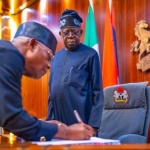
    The bill legalising the anthem change was an even bigger shocker because it literally came out of nowhere. For context, this bill was passed in one week—the House of Representatives debated it on Thursday, May 23, and passed it on the same day. Then, it was handed over to the Senate, which passed it on Tuesday, May 27, while President Tinubu signed it into law the following day, Wednesday.

    Dangote rants

    Before now, Billionaire businessman Aliko Dangote was on that laidback mysterious aesthetic but after the astronomical levels of shege Nigeria showed him in 2024, he has now left that aesthetic for Beyonce.

    Dangote had plenty of back and forth with oil institutions and officials this year, but it all mostly began with him coming out to raise the alarm about alleged plots to sabotage his new refinery. Dangote said that the  Nigerian National Petroleum Company Limited (NNPC) and the International Oil Companies (IOCs) refused to sell him the crude oil needed to start production at his refinery, so he had to go all the way to the United States (US) to buy some. 

    As if that wasn’t enough stress for him, the CEO of Nigerian Midstream and Downstream Petroleum Regulatory Authority (NMDPRA), Farouk Ahmed alleged that Dangote’s oil was substandard and that the imported ones were better than it. Alhaji was stressed but had to pick up a mic to debunk the claim. He also had another spat with the NNPC over the petrol pricing as well as other side frustrations surrounding his refinery. It’s just been a hell of a year for Alhaji, and we all sort of went through it with him.

    National asoebi

    Albert Einstein shakes when Nigeria’s First Lady enters the conversation because only she can rival his genius. This year. Remi Tinubu spiced up our lives with her bright innovations; after starting her own garden and telling Nigerians to do the same (“to boost food production”), she launched an Asoebi for the country.

    The asoebi  (or national unity fabric if you’re fancy) was launched ahead of Nigeria’s independence day in order to help Nigerian citizens “break down tribal barriers to identify as a people of one nation.”

    She didn’t just launch with an empty hand, either. The unity fabric was rolled out with a Fabric Designs Competition with a ₦25m prize money. We stan an innovative queen.

    Hunger protests

    2024 has been an especially hard year for Nigerians. What was even more frustrating was that the government seemed not to be listening. In August, Nigerians trooped out to make their voices heard through the #EndBadGovernance or hunger protests.

    But the 10-day protests, shadowed by subtle threats even before they started, did not end well as protesters were met with brutal force by the Nigerian Police. Later, on November 28, Amnesty International released a report revealing that at least 24 protesters were killed as a result of this force. Amnesty International said that “in all cases, the victims were shot by the police, firing live ammunition at close range often at the head or torso, suggesting that officers were shooting to kill.

    Cabinet reshuffle

    On Wednesday, October 23, President Bola Tinubu shook the internet when he surprised everyone and announced his cabinet reshuffle. The reshuffle involved the sacking of five ministers from his record-high 45-member cabinet, hiring of seven new ministers, and reassignment of ten others to new positions.

    This move got Nigerians talking, with some saying not enough ministers were sacked and others saying the President should have included his own name in the list of sacked people.

    Arrest of minors

    Another thing the government did this year was show Nigerians it wasn’t above manhandling kids as much as it did adults. On Friday, November 1, the Inspector General of Police arraigned about 72 minors at a Federal High Court in Abuja on ten-count charges over their participation in the #EndBadGovernance protests of August. The minors, who had been detained for three months, were accused of treason and trying to destabilise Nigeria, among other things. But after many Nigerians and Civil Rights Organisations (CSOs) condemned the government and pointed out that it was against several laws to detain minors in the way that they did, President Tinubu ordered that they be released, and a committee set up to look into the arrest and detention of the minors.

  • Photo credit: Nairametrics

    Wake up, kids! A new update just dropped–Nigeria is about to get a mining school and it’s expected to have some ripple effects on the country

    On Tuesday, December 10, the Nigerian Senate passed a bill to establish a Federal University of Mining and Geo-Sciense in Jos, Plateau State.

    The bill is looking to upgrade the already existing Nigerian Institute of Mining and Geo-Sciense (NIMG), Jos, into a federal university, and it was sponsored by Diket Plang, an APC Senator representing Plateau Central.

    Are mining schools a thing?

    This idea is not new, neither is it original to the Nigerian Senate. In fact, Nigeria is actually pretty late to the party. Mining schools exist in different countries in the world, with ever-changing curricula that reflect technological advancement of times.

    Mining schools typically offer programs ranging from mining engineering to geosciences and more. Recently, mining schools like McGill University, Canada, offer courses in robotic mining, and University of Queensland, Australia has also introduced artificial intelligence and virtual reality to its programs.

    Will this school affect your life?

    The proposed university will impact you in many ways, whether you’re interested in enrolling for a program or not. How? It’ll help diversify Nigeria’s economy and ultimately get rid of the things currently making life difficult in Nigeria, like sky-high inflation, unstable exchange rate, and general high cost of living.

    How?

    Nigeria currently runs a mono-product economy (this means that it relies on one product for money). The product it depends on is oil, and it’s currently responsible for more than 95% of the country’s export earnings, 70% of government revenue, and 90% of new investments.

    Because the country makes all its money from this singular source, the economy is always shaken by changes in global oil prices (and it’s been shaking a lot lately). Bad oil prices lead to harsh consequences like inflation and criminally high exchange rates, which trickle down to every aspect of Nigerians’ daily lives. They also affect the amount that the government is able to spare for development and other things.

    Even though it refuses to act like it, Nigeria is rich in over 40 mineral resources like Lithium (used in electric cars and batteries), iron ore, gold, limestone, and zinc, all currently valued at about $750 billion. Yet, these resources hardly generate revenue for the country; in 2023, the mining sector only managed to contribute a meagre 0.77% to Nigeria’s Gross Domestic Product (GDP).

    By reviving its mining sector, Nigeria can turn around its constant economic issues and make the lives of its citizens better however a couple of problems like lack of geological data, weak human capital (no skilled, educated, or experienced workforce in the sector), and lack of enforceable regulations, have been identified as roadblocks preventing the mining industry from reaching its full potential.

    The establishment of a well funded, functional mining university will solve some of those problems by producing a skilled workforce, driving mineral exploration and exploitation, improving mining practices, and driving research. It’s not the magic wand that will fix all of Nigeria’s problems but it’s a start.

    The bill to establish the University has not become law yet but it’s almost there. Following its passage at the Senate on Tuesday, it will now be transmitted to the House of Representatives for alignment, and then to the President for an assent. Is this something you’re rooting for?

  • Photo credit: Premium Times

    Nigerian politicians are probably the only people in the world who apply for a job and then blatantly refuse to show up for an interview after their potential employer asks them to. For the longest time, this behaviour has bothered Nigerians but there’s a possibility it’ll stop soon.

    Reports have it that lawmakers in the House of Representatives are preparing to empower the Independent National Electoral Commission (INEC) to conduct compulsory debates for candidates vying for the posts of President and Governor. This move was made possible by a private member bill sponsored by House of Reps member, Ikeagwuonu Ugochinyere. 

    What are the specifics of the bill? 

    The bill is proposing to change the Electoral Act to add a new section (24) saying that:

    1. INEC must ensure that a Presidential and Gubernatorial Debate is conducted for people seeking to be elected into the offices of President and Governor on a date it picks.
    2. Anybody looking to be the President of Nigeria must participate in the Presidential Debates, during which they are required to present a detailed analysis of their manifesto and plans for Nigeria as its potential President.
    3. Anybody looking to be the Governor of a Nigerian State must participate in the Gubernatorial Debates, during which they must present a detailed analysis of their manifesto and plans for the State as its potential governor.

    Timeline of Nigerian Presidents who refused to appear in debates

    Refusal of candidates to participate in debates has been a thing in Nigeria for so long that it has become almost normalised. It’s kind of bizarre too because all the Presidents of Nigeria since its return to democratic rule in 1999 have been candidates who refused to show up to election debates.

    1999—Obasanjo won his election into office even though he refused to debate Olu Falae, his major rival.

    2003—Obasanjo still won his reelection bid after he turned down a debate against his major opponent, Muhammadu Buhari.

    2007—Umar Musa Yar’Adua refused to debate against Muhammadu Buhari and won the election by a landslide.

    2011—Goodluck Jonathan won the Presidential election after failing to show up to the debate

    2015— Buhari who had attended debates for his past Presidential campaigns, did not attend the 2015 debate and went on to win the election.

    2019—Buhari refused to attend the Presidential debate but, after a bit of pressure, participated in a political town hall program known as The Conversation. However, that hardly counts as a debate as the audience was mostly made up of his and Atiku’s (his main opponent at the time) supporters.

    Governorship candidates also do the same thing and go on to win their election bids. In the just concluded Edo State governorship elections, for instance, APC candidate, Monday Okpebholo did not attend the debate, yet he went on to win the elections. If this bill becomes law, however, no candidate will refuse to appear in debates again because it will become a requirement rather than an option. Once this becomes a necessity.

    Why does this bill matter?

    You can draw a straight line from Nigeria’s poor leadership problem to the refusal of candidates to participate in debates. Political economist and Professor, Pat Utomi thinks so too. 

    Speaking to journalists before the 2023 general election, Utomi gave an example of South Korea’s situation.

    “The fortunes of South Korea were turned around because the electoral commission was so despondent about the quality of their politics that they decided that the thing that should matter the most for elections are debates between candidates,” he said, explaining it was incorporated into conventions in the country’s politics.

    “Once debates came to define (the) elections, moneybags and all kinds of criminals and charlatans ran away and their electoral process became one of a sustained, enormously developed country,” Utomi continued.

    Will this bill be successfully passed?

    I’ll hold your hands when I say that the chances of this bill going on to become law aren’t a 100 per cent, partly because it still has to pass through five more stages, and mostly because the bill has been around before and was not successful.

    In July 2014, a similar bill seeking to make Presidential Debates compulsory did not get past the fourth stage (reference to a committee) because the committees rejected it. They took the decision because they felt election debates “should remain outside the purview of the law.”

    What can you do to help the bill become law?

    1. Track the bill’s progress as it moves through different stages by monitoring official channels for media updates.
    2. Talk to other people about it. You know that saying about “power in numbers.” 
    3. Participate in Public Hearings: The National Assembly usually organises public hearings for bills under consideration, and Citizens are allowed to attend to express their opinions.
    4. Reach out to your representatives: you can contact the lawmaker representing your constituency via email or phone to let them know you support the bill. Here is the list of all Senators and House of Rep members with contact details attached.
    5. Launch or sign digital campaigns through platforms like this.
    6. Advocate for the bill on social media platforms by using hashtags.