• On Thursday, November 13, Ezra Olubi, co-founder and Chief Technology Officer of Paystack, was accused of sexual misconduct involving a subordinate. Here is what we have gathered so far.

    Who is Ezra Olubi?

    Ezra Olubi is famous for co-founding Paystack, one of Nigeria’s foremost online payment platforms. The establishment of Paystack made it easy for merchants to accept payments via customers’ credit and debit cards, making it a top-used platform for several businesses. If you’ve ever made online payments in Nigeria, chances are you’ve used Paystack.

    The platform’s impact and reputation were so significant that Ezra was awarded the national honour of Officer of the Order of the Niger (OON) in October 2022.

    Outed  for alleged sexual misconduct

    Whatever opinions people held of Ezra Olubi crumbled on November 13, after old, disturbing tweets of his resurfaced.

    It began on Wednesday, November 12, following several posts and a Twitter Space by a former romantic partner, where she accused him of power abuse and sexual misconduct. 

    The discovery of horrendous tweets

    Although Olubi wasn’t directly mentioned on the Twitter Space and posts put out by his ex,  they led to scrutiny of his X account and the discovery of horrendous decade-old tweets that he made between 2008 and 2013.

    Each Tweet is worse than the last

    Since the evening of November 13, X users have unearthed several disturbing old tweets from Olubi, including references to workplace harassment and explicit comments about minors and animals.

    One tweet from Olubi said:


    Another tweet of his read:

    Deactivation and suspension

    Not long after the tweets started making the rounds, Olubi deactivated his X account.

    On Friday, November 14, Paystack announced it had suspended Olubi for alleged sexual misconduct involving a subordinate.

    In a statement to TechCabal, the online payment platform said:

    “Paystack is aware of the allegations involving our Co-founder, Ezra Olubi. We take matters of this nature extremely seriously. As of Thursday evening,

    November 13, 2025, Ezra has been suspended from all duties and responsibilities pending a formal investigation.”

    The company added that its board “is in the process of appointing an independent third-party investigator to ensure the investigation is conducted fairly, thoroughly, and with full confidentiality.”

    Calls for Accountability

    As an investigation into Olubi’s alleged sexual misconduct opens and more Nigerians discover his problematic posts, the conversations around his conduct continue to grow. One thing is clear: Nigerians disapprove of the behaviours and ideas portrayed in Ezra Olubi’s old tweets. All attention turns to the ongoing investigation as Nigerians await its outcome.

    This is a developing story.

  • If you’ve enjoyed the previous editions of our Nigeria’s Current Affairs quiz (editions 12, 34, 5, and 6), you’ll love this edition even more. From major political moments to key decisions shaping Nigeria today, this 15-question quiz will challenge how well you really know the country’s political landscape.

    Who is the current governor of Delta State?

  • Like many infrastructure projects, road construction is often seen as a pathway to economic growth and improved quality of life. But for Kilankwa 1, a community on the outskirts of Nigeria’s Federal Capital Territory (FCT), Abuja, this promise has turned into tragedy.

    In 2021, Wadata Group began construction of a 3-kilometre road, sparking joy and hope among residents. That joy was short-lived. The company did a shoddy job, leaving behind not just an inconvenience but also a trail of suffering. In this investigation, Chigozie Victor journeyed to Kilankwa 1 to uncover the truth behind the abandoned project, funded with public money, and to reveal the human costs of poorly executed projects.

    Photo image of Hajara Muhammed. Photo credit: Chigozie Victor|Zikoko Citizen

    Hajara Muhammed felt her world spin and shatter the day her 17-year-old son, Nasiru Yusuf, died; it felt like a fever dream, yet it had happened.

    It was just like any other day. Nasiru had returned from school from neighbouring Kilankwa 2. He had joined her on the farm and left afterwards for his job outside as a security guard. He was supposed to return home to her again, except he didn’t.

    While he rode his motorcycle to work, he tried to dodge an approaching car from the opposite side of a junction, but he couldn’t. The pull of the road was stronger than he could resist, so he unsuccessfully tried to dodge the car, but it hit him, and he fell headfirst to the ground.

    A dazed Hajara rushed to the scene of the accident, where she and her older son, Abdurrahman, took Nasiru to a hospital in nearby Gwagwaada.

    Nasiru died before he could receive any treatment.

    As Nasiru’s body went cold, so did Hajara’s. The only difference is she’s still alive… Barely.

    “…He was still in school. Just in SS1 (Senior Secondary School), He used to sing. He wanted to be a musician,” Hajara said, wringing her hands.

    “I truly miss him. He was a musician and earned a little money from it, which we used to buy food. We ate and drank from what he provided. Sometimes he would go to occasions, and once he started singing there, they would give him food, and he would bring some back for us,” she said, explaining that her little family fed well because of him, even though he was only a teenager.

    The many costs of road abandonment in Nigeria

    Photo image of Nasiru Yusuf displayed in the palace of Kilankwa’s Chief. Photo credit: Chigozie Victor|Zikoko Citizen

    like Hajara, many people across Nigeria have lost loved ones to the menace that is road abandonment.

    In 2023, for instance, RCDIJ investigations shared the equally devastating story of Ugwu Obinna, whose little sister was crushed to death due to a road crash resulting from potholes in the abandoned old Enugu-Onitsha road.

    Similarly, a 2023 Investigation by CrossRiver revealed how families lost loved ones, incurred financial losses and many more as a result of an abandoned road project in the Yala-Ogoja area of the state.

    These are not one-off experiences. A 2017 study published in the Journal of Economics and Sustainable Development sheds more light on the prevalence of road abandonment as well as its human costs. Findings from collated data revealed that loss of lives (at 88.5%) accounted for the leading costs of road abandonment. Others include loss of properties (at 91.5%) and erosion at 93.5%

    According to the WHO, 1.3 million people die globally every year in road crashes, with Nigeria accounting for an estimated 41,693 deaths—about 2.82% of the global toll—placing the country 54th worldwide in road accident rankings. The WHO highlights structural factors such as road abandonment as causative factors.

    Despite the human and economic factors associated with road abandonment, the practice has remained prevalent over the years. As recently as 2024, the Chartered Institute of Project Managers of Nigeria (CIPMN) estimated that over ₦17 trillion-worth of projects—including many road projects—have been abandoned nationwide

    Studies have linked this terrible practice in Nigeria to factors such as lack of continuity in government, poor planning, financing, budget delays, policy inconsistencies, corruption, and capital mismanagement.

    This reporter visited the Kilankwa 1 community in the Kwali Area Council of Abuja to investigate a road abandonment project and its human costs. Like Hajara, many more in this community have suffered great losses caused by the road; from a father who is still haunted by the image of his son’s intestines bursting out of his lifeless body, to others who had near-death experiences. 

    Several community members alleged that Wadata Group Limited abandoned the 3KM road project halfway. However, when the reporter reached out to Wadata Group Limited, it told its own story, insisting that the project was done to government specifications .

    The loss of a lifetime

    Photo image of Abdurahman Yusuf standing by his brother’s grave. Photo credit: Chigozie Victor|Zikoko Citizen

    Nasiru’s older brother, Abdurrahman, misses him dearly too, and he is deeply concerned about his mother’s well-being following his death.

    “My mother always asks about him. Even the day before yesterday, when we went to the farm together, she kept on crying, saying we would have finished at the farm faster and gone home. She said his absence on the farm was disturbing her, so I consoled her, telling her to leave everything in God’s hands,” he recalled.

    “He was buried there,” Abdurrahman said, pointing towards a bush path. 

    As he walked to Nasiru’s grave, Abdurrahman recounted how his late brother would not eat unless he were sure Abdurrahman had something to eat too; how joyful he was and how he spread it throu⥜gh his music, and how loving and kind he was.

    “He had no problem at all; he was such a happy boy. He was so happy,” Abdurahman continued, explaining how they would gist among themselves, bantering over school and politics, and how all of that has drastically changed because their home is now devoid of joy.

    Beyond his own grief, Abdulrahman feels helpless about his mother’s. A huge part of her had died with Nasiru, and he did not know how to bring her back to life. He had watched helplessly as grief weakened her, snuffing life out of her small food business. Though she farms now and takes up side hustles, she still struggles financially, and he is eaten up by the discomfort of being unable to provide for her in the way that he wants to.

    “Sometimes, she will say ‘I don’t see him, I don’t see him,’ but I will say, ‘he’s dead, you can no longer see him,” Abdurrahman said.

    Hundreds of Millions of Naira Down the Drain?

    Photo image showing a cross section of the Kilankwa road. Photo credit:Chigozie Victor|Zikoko Citizen

    Kilankwa Road used to be an endless stretch of unpaved earth. Four years ago, when residents of the community learnt it was to be constructed, they were full of excitement. Their long-held prayer for a tarred road to drive the economy of the community was finally being heard. But the joy would not last. 

    Many residents of the farming community continue to tell tales of hardship, especially during rainy periods when the road turns into a death trap, becoming a nightmare and casting a bleak shadow on the area.

    Data from BudgIT’s govspend showed that a sum of ₦332,924,114.69 (Three hundred and thirty-two million, nine hundred and twenty-four thousand, one hundred and fourteen naira, sixty-nine kobo) was disbursed to Wadata Group Limited for the construction of the road. 

    On one of the days this reporter visited Kilankwa, it would be hard to convince a ‘newcomer’ that the road had gulped hundreds of millions of Naira in public funds to construct just a few years back 

    As the motorcycle I boarded drove past the community signboard, a stretch of untarred road lay steeply ahead. Its surface had large patches of cracks, and the gravel had worn away from years of neglect.

    The motorcycle shook from the effect of the gravel, as small pieces of the stones occasionally skidded off, even as the motorcyclist tried to dodge the potholes.

    The contractor only constructed the connecting bridge and graded the road before a truckload of gravel was poured onto its surface. Residents of Kilankwa 1 insist it was abandoned halfway.

    “They (contractor) took their things and left,” Haruna Musa, a resident of the community, said.

    “We expected to see them come back to complete and transform it to a normal tarred road, but they never did,” Haruna said, explaining that the gravel caused the road to pull people in a way that made them lose control of their vehicles.

    The road that keeps taking

    Photo image of Musa Salihu. Photo credit: Chigozie Victor|Zikoko Citizen

    Nasiru Yusuf was not the only one who had died as a result of fatal injuries sustained on the road. Abu Salihu was only 15 years old when his life was cut short in a ghastly accident caused by the state of the road. Though both boys were not peers in age, they lie side by side now in two graves a few walks away from the centre of the community.

    Abu’s father, Musa Salihu narrated it briefly: One morning, after Abu had finished preparing for school, he walked about outside and was hit by a car which had come to pick up farm produce from the community. 

    When asked to consider that Abu’s death may have been caused by recklessness on the part of the driver, Musa refused it, insisting that the badly constructed road caused.

    He explained that the driver of the car struggled to resist the pull of the gravel on the road, leading to the crash, which killed his son.

    “The road drags people, and carries their hands against their will,” Musa said.

    “I haven’t forgiven them (contractors),” he continued, recalling all over again how some people had come to his farm that morning to fetch him and how he saw his son’s body at the scene of the accident, his intestines splattered on the ground. 

    “I still grieve. I haven’t gotten over it. Even today, I still cried,”  Salihu said.

    More victims

    Photo image of Jibrin Shuaibu. Photo Credit: Chigozie Victor|Zikoko Citizen 

    Jibrin Shuaibu knew the roads all too well. He had seen the gravel pull people to the ground, leaving them bloodied and scarred. Each time, he counted himself lucky and prayed he would never get caught in its grip. 

    For a while, he didn’t. But one Saturday morning in 2024, Jibrin headed out to the market on a commercial motorcycle. As the motorcyclist navigated the unpredictable road, he spotted a car approaching from the opposite direction. Its tyres skidded as the driver fought to steady it against the gravel’s pull. 

    Not wanting to stake their lives on the probability of the other driver’s success, the motorcyclist swerved sharply to the left, but the loose stones pulled him down; the motorcycle slid out of his control. Jibrin and the motorcyclist fell violently to the ground, leaving them badly injured.

    Jibrin does not remember much of what had happened in the instant following the crash, but he remembers feeling like the bone in his leg had shattered. He was taken to the Specialist Hospital in nearby Gwagwalada. When it was clear he was not getting any better, he was taken to Birnin Kebbi, Kebbi State, where his leg healed.

    In the weeks that followed, Jibrin not only suffered a hit to his health and finances, he also had to watch helplessly as his family suffered.

    “That time, there was food scarcity in my home because all the money I had was being put towards my recovery. I had some land I purchased before, but I sold it and gathered the money for treatment. My children were starving; there was nothing to eat. Some people were helping me financially, chipping in where they could because of the situation I found myself in,” he remembered.

    Though Jibrin’s incident happened a year ago, he continues to suffer both physically and financially. While he is able to relieve the physical pain by taking medication from time to time, he cannot do much about his finances. 

    Once combining interstate driving with farming, he now drives sparingly within Abuja, “I used to go to Kogi, Nasarawa, Minna, and Jos, or anywhere my movement carries me. But since this incident happened, I can’t go interstate any longer. I just go to Zuba, Suleja, and Abaji.”

    “I farm (to make up for finances). It doesn’t really affect me there because I can be threading softly. Also, when I have some money, I pay some people to go and do the heavy lifting for me,” Jibrin said, his eyes fixed to the ground.

    “We didn’t abandon the road”

    After two visits to the Wadata Group’s office and several check-ins, , the chairman, Alhaji Umaru Wakili, told this reporter that, contrary to the community’s claims, his company did not abandon the construction of the 3KM road.

    “We were contracted to do surface dressing, and we have completed the scope of the job. There’s surface dressing and there’s asphalt. That road is surface dressing, not asphalt done with concrete. 

    “Anywhere there’s surface dressing, you see stones on the road,” Wakili explained, emphasising that surface dressing is usually done to make bare roads usable, not necessarily smooth.

    Wakili went further to explain that his company was asked to construct a bridge to waylay the water which caused recurring flooding in the community and made the road hard to use especially during the rainy season.

    “Jobs are given in phases. After this surface, we were supposed to be awarded the one for asphalt, but unfortunately, it didn’t come that way.”

    “That road was a constituency project. I don’t know why, but sometimes, the government takes time to award the completion of roads like this,” he said, emphasising again that his company rehabilitated the road as they were contracted to do, and did not abandon it.

    But is Wakili right?…

    The road was constructed in 2021. At the time, Senator Philip Tanimu Aduda represented the Federal Capital Territory (FCT) and, in extension, Kilankwa 1. 

    Though he is no longer in office, the project was still traced to his office via a Facebook post he made recounting his achievements as FCT Senator.

    To understand how such projects are funded, this reporter spoke with a representative from BudgIT’s Tracka platform.

    Tracka’s Communications Officer, Ademide Ademola,  said:

    “Constituency projects are initiated by legislators of respective constituencies across Nigeria. Legislators gather projects across their constituencies either by holding Town Hall meetings or taking the recommendations from written requests of their constituents.”

    When asked how constituency projects are funded, Ademola explained that legislators nominate select projects for their constituencies in preparation for a budget year.

    “After the projects are proposed by the legislators, deliberations are held, and after the deliberation phase, select projects are included in the national budget of said year, and passed.”

    “The project is then funded through the Office of the Accountant General of the Federation. Before they are given out by contracting agencies, the open bidding process is initiated and often announced in national newspapers as mandated by Nigeria’s procurement procedures.”

    The Bureau of Public Procurement (BPP), Nigeria’s regulatory authority established by the Procurement Act 2007, is responsible for the monitoring and oversight of public procurement, development of the legal framework and professional capacity for public procurement (among similar duties). It is also the agency which compiles the Procurement Procedures Manual, a policy book containing rules and regulations guiding procurement in the country.

    The latest edition of the manual states  that procuring entities must publish open up contract bidding to the general public by advertising bidding invitations “on the notice board of the procuring entity, any official websites of the procuring entity; at least two national newspapers, and in the procurement journal not more than four weeks for contracts within the thresholds of the Parastatals and Ministerial Tender’s Boards and not more than six weeks for contracts above the threshold of the Ministerial Tenders Board before the deadline for submission of the bids for the goods, works and services.”

    The procuring entity in this case is the Lower Benue River Basin Development Authority (RBDA), a federal parastatal under the Federal Ministry of Water Resources

    The bidding was published on publicprocurement.ng, however, there was no trace of the advertisement in any national daily or the procurement journal of May 2021.

    Meanwhile, a look at the scope of work of the project published on the platform listed the project as Construction of 3KM Road and Drainages. It did not specifically mention Surface Dressing, as stated by Wadata Group.

    To further investigate Umar Wakili’s claims on the scope of work awarded to his company, the reporter revisited the payment details provided by BudgIT’s govspend platform. This time, it’s noted that five of the eight payments the company received from Lower Benue RBDA had Surface Dressing in their descriptions. The rest were titled  Construction of 3KM Road and Drainages Kilankwa, Kwali FCT Senatorial District.

    According to this, Wakili’s claims about the scope given to him do not exactly check out. 

    Wakili’s company was also contracted to construct drainages in addition to the road. However, this was not seen in the community. Instead, a culvert was constructed. 

    Michael Olufemi, an expert in civil engineering, said that the contractors did not fulfil that part of the project, as culverts and drainages are two distinct things.

    “Culverts are different from drainages. A culvert is the box-like one that water passes under, while drainage is the one that water flows into.”

    “Drainage is better known as a gutter in local language,” said Olufemi, poking holes into the amount spent on the road. Olufemi mentioned that the amount of money seen on govspend.ng  (₦332,924,114.69) could not have been earmarked for surface dressing alone, as it was sufficient to cover both phases of road construction— surface dressing and asphalt.

    “As of 2021, that money should have done more than surface dressing. I will put asphalt on that road with that amount (at the time).”

    “Things were cheaper at the time, unlike now. Now, things are almost five times the price they used to be,” Olufemi said, expressing surprise that a constituency project was concluded at the surface dressing level.

    Experts weigh in 

    Though the Chairman of Wadata Group Limited dismissed the accidents and deaths recorded in the community since the construction of the road, our findings offered a glimpse into the danger residents of the community have been contending with 

    Studies have shown that several authorities declare surface dressing as a safe form of road construction. Durham County Council, for instance, describes it as the major type of surfacing  “ideal for all roads.”

    Surfacedressing.com  lists provisions for skid-resistant surface and waterproofing of road (to prevent water ingress, reduce cracks and prevent potholes), as some of its benefits.

    No source seemed to flag surface dressing as remotely dangerous; they did, however, state that it is unsafe to fast traffic immediately after it is laid, recommending that temporary signs be put in place, asking road users to drive at low speed. When asked if the constructors installed such signs or educated them about speed limits, the community members could not confirm this.

    While speaking on the possible cause of the numerous road accidents in Kilankwa 1, Engineer Michael Olufemi affirmed that speeding immediately after the road is constructed could indeed lead to accidents.

    “When this gravel is still new, and you are speeding, you can lose control. In fact, even a trailer can miss control because when you want to match brakes, the gravel will speed you up because there is no frictional contact to the ground; it is the gravel that is helping you to move,” he said, explaining that speeding when the road gravel is yet to settle into the Bitumen could be the cause of the accidents.

    “They (the contractors) could have introduced bumps in the community to reduce their speed limit, seeing as it’s a community that is not familiar with this,” he said.

    But when Olufemi was told that the accidents still happened as recently as July 2025, and shown photos and videos of the road, his stance immediately changed.

    “They (the Kilankwa community) are right,” he said, referring to their description of the road as having a pull, forcing their hands and making things as little as braking and turning difficult to the point of road clashes.

    Idachaba Adejo, a Civil Engineer with many years of experience, agreed with Olufemi. He mentioned that “surface dressing has never been a source of accident to anybody. I’m even surprised to hear a community saying they are having accidents because of surface dressing,” he said, going into a detailed explanation of the processes involved in surface dressing.

    “It is an aspect of road dressing done to give way for a larger one in the future..”

    “…The chippings (gravel) to be used are fine chippings: If they used bolder materials, then it’s a serious concern because they are supposed to use fine chippings,” he said.

    Upon hearing that some of the gravel skids off the road, Adejo speculated that the size used was not the recommended size.

    His conviction became stronger when he saw photos of the gravel and heard the community’s description of the road as having a pull.

    “I can confidently tell you that the chipping they used for that construction is not the normal chippings you use for surface dressing. Surface dressing chippings are so fine (little) that they will be buried inside the bitumen, which was sprayed and bonded, so that they form a layer on their own and are buried,” he said.

    Trapped in silence 

    Besides the wrong size of chippings used in constructing the road, a good part of the road is now riddled with potholes, a situation which Engineer Emmanuel Olufemi attributed to the lack of a proper drainage system.

    Speaking on the road’s condition, Olufemi emphasised that a new one must be constructed for the community as a matter of urgency.

    “This road is already gone,” he said.

    But is a new road possible in the nearest future? It does not appear so, at least,  not according to the explanation given by Tracka’s Communication Officer, Ademide Ademola.

    Explaining how constituency projects are nominated, Ademola stated that sometimes, it is challenging for legislators to successfully clinch funds for all phases of a road project that they consider important.

    “Sometimes, they have to wait for another budget cycle to come because that’s when the project can be accommodated in the budget.”

    Asked if this means the community would not get the help they need anytime soon, Ademola clarified that they can.

    “Of course, they can get help. The 2025 budget has been passed, and I don’t know if the project was included or not. If it wasn’t, they can keep writing their local representatives to bring attention to the road,” she said.

    But can the Kilankwa 1 community afford to wait it out?


    ***This report was facilitated by the Wole Soyinka Centre for Investigative Journalism (WSCIJ) under its Report Women! Female Reporters Leadership Programme (FRLP) Fellowship, with support from the Bill & Melinda Gates Foundation.

    [ad]

  • If you’ve enjoyed the previous editions of our Nigeria’s Current Affairs quiz (editions 12, 34, and 5), you’ll love this edition even more. From major political moments to key decisions shaping Nigeria today, this 15-question quiz will challenge how well you really know the country’s political landscape.

    Ready to flex your muscles again?

    What is the name of the Nigerian female basketball team?

    [ad]
  • On Monday, August 11, Comfort Emmanson, an Ibom Air passenger, was remanded in the Kirikiri correctional facility and placed on a lifetime no-fly ban over an incident between her and the airline’s staff member.

    Since news of this broke out, Nigerians on various social media platforms have compared the outcome of Emmanson’s case to that of popular Fuji musician Wasiu Ayinde Marshal (popularly known as KWAM 1), who was in a similar situation some days ago.

    This article breaks down what happened in both cases and how the authorities reacted. We also examine the legality of Emmason’s detention and the no-fly ban.

     KWAM 1’s situation

    On Wednesday, August 6, videos circulated on social media showing  KWAM 1 in what appeared to be a scuffle with the staff of Valujet Airline over his attempt to board a flight with a liquid suspected to be alcohol, which is prohibited according to  Nigeria’s Civil Aviation Security Programme and ICAO Annex 17.

    Shortly after, the Federal Airports Authority of Nigeria (FAAN) released a statement saying KWAM 1 had indeed breached aviation regulations.

    According to FAAN spokesperson, Obiageli Orah, KWAM 1 attempted to bring an alcohol-filled flask aboard the flight but was told by a flight attendant to comply with aviation rules, which banned liquids above 100ml. 

    The Fuji singer reportedly refused and proceeded to pour the liquid on the officer, who later confirmed it to be alcohol.

    The singer was also seen in viral videos blocking the aeroplane from takeoff with his body while the pilot on duty attempted to proceed.

    [newsletter type=z-daily]

    Outcome of  KWAM 1’s situation

    On Wednesday, August 6, the Nigeria Civil Aviation Authority (NCAA) suspended the two pilots involved in the incident for breach of safety protocols.

    Following public outrage over KWAM 1’s actions, as seen in the viral videos, he was placed on a six-month no-fly ban on Wednesday. However, the next day, Thursday, August  7, it was reversed to an indefinite ban, which will be decided pending the conclusion of an investigation.

    In a statement released on Wednesday through his spokesperson, Kunle Rasheed, KWAM 1 dismissed the allegations, claiming they were exaggerated.

    But on  Friday, August 9,  he released another statement through his spokesperson, apologising for the incident, which he described as “unfortunate,” maintaining that the liquid was not alcohol.

    “Unknown to many, I suffer from chronic dehydration, and my doctor strongly advised that I remain constantly hydrated. This is why I always carry a water flask with me. And contrary to the negative narrative circulated in some quarters, the flask I carried on that particular day contained only water, not alcohol, as wrongly alleged,” he said in part.

    Following his apology, the Chairman/CEO of the Nigerians in Diaspora Commission (NiDCOM), Abike Dabiri-Erewa, posted the singer’s apology on her official X account, calling for his forgiveness.

    The post drew criticism from many Nigerians, who questioned why a government official was making a case for the singer.

    Comfort Emmanson’s situation

    KWAM 1’s case was still under discussion when another viral video surfaced on social media on Monday, August 11. The video shows a similar incident between an Ibom Air passenger identified as Comfort Emmanson.

    In an initial video, Emmanson was seen in a physical altercation with a female airline staff member who appeared ruffled. 

    In another video, Emmanson was seen physically resisting other airline staff attempting to take her away. Her blouse, which was torn in the process, indecently exposed her body.

    Outcome of Comfort Emmanson’s situation

    Shortly after the video made rounds on social media, the Special Adviser on Media and Communications to the Minister of Aviation and Aerospace Development, Tunde Moshood, released a statement saying Emmanson had been charged to court and remanded in the Kirikiri correctional facility.

    The same day, the spokesperson of the Airline Operators of Nigeria  (AON), Obiora Okonkwo, released a statement announcing that it had placed a lifetime no-fly ban on Emmanson.

    “The incident, which Ibom Air described, from the initial refusal by the passenger to comply with safety instructions regarding mobile phone usage, which led to the brutal physical assault on Ibom Air crew members and the attempted use of a fire extinguisher as a weapon.”

    “She is hereby banned from flying with any AON member, either domestically or internationally, for life,” the statement read in part.

    Selective Justice?

    Following the announcement of Emmanson’s detention and lifetime ban, Nigerians on social media pointed out the disparities in how authorities handled her case and how they handled that of KWAM 1

    Another video suggests Comfort Emmanson may have been treated poorly

    Following the announcement of Emmanson’s lifetime no-fly ban and detention, more videos surfaced online, showing the Ibom Air passenger may have been treated badly by the airline staff. In one of the videos, the female hostess in the earlier video could be seen blocking the aircraft’s entrance, preventing Emmanson from exiting, while Emmanson asked to be let out. 

    Eyewitnesses back Emmanson

    As Nigerians called out Nigerian authorities for their treatment of Comfort Emmanson, more evidence which absolved the female passenger of some blame began to surface.

    Emmanson’s detention is illegal

    Since the escalation of Emmanson’s detention and no-fly ban, Nigerians have debated the legality of the measures taken against her.

    Speaking on the issue, Senior Advocate of Nigeria (SAN) Dr. Monday Ubani clarified that her detention goes against her right to a fair hearing under Section 36(1) of the 1999 Constitution.

    ‎“The AON’s unilateral action, without affording the passenger an opportunity to be heard, breaches the principle of audi alteram partem,” Ubani said, pointing out that the no-fly ban also violated her flights to movement within and outside Nigeria.

    “The AON’s unilateral action to impose a lifetime industry-wide ban, without affording the passenger the opportunity to be heard, violates the principle of audi alteram partem.”

    “While an individual airline may refuse carriage to a passenger for safety reasons under its contractual rights, an industry-wide lifetime ban by a trade association like AON amounts to a de facto travel ban. This type of sanction has nationwide and international implications.

    The life-time ban constitutes a restriction on a constitutional right without a court order,” he continued.

    Human rights lawyer, Professor Chidi Odinkalu, has also called out the illegalities spotted in the issue.

    In a post on his official X page, Odinkalu shared a photo of Emmanson’s remand order, pointing out that the date used is illegal.

    Not the first time

    While Nigerians continue to highlight the disparity in how KWAM 1 and Emmanson’s situation is handled in hopes that it will be rectified, there is a probability that it won’t, as this is not the first time Nigerian authorities have acted selectively in delivering justice.

    In January 2025, for instance, Raheem Okoya, son of billionaire businessman Chief Razaq Okoya, was seen in a viral video engaging in Naira abuse at an event. However, he was not detained or imprisoned like others who had committed the crime before him. Instead, he was let off after he tendered a public apology, just as popular musician and close associate of Bola Tinubu Kwam 1, has done.

    Similarly, in May 2025, Chief Government Ekpemupolo, popularly known as Tompolo, was seen abusing the Naira in a viral video. Nigerians called on the Economic and Financial Crimes Commission(EFCC) to punish Tompolo like it had done to other culprits, but this never happened.

    What can you do to change the story?

    While it is true that Nigerian authorities are selective in their duties, citizens can also compel them to do the right thing. In Kwam 1 and Emmanson’s case, you can do either of the following:

    • Talk about it on social media and pressure the government to release Comfort Emmanson from the Kirikiri correctional facility.
    • Use social media to pressure the government to do due diligence with Kwam 1 and follow through with it 
    • Create online petitions calling on the appropriate authorities to release Emmanson, properly investigate the matter, penalise all parties fairly and accordingly. You can create an online campaign here.

    Click here to see what other people are saying about this article on Instagram


    Ever had a moment where Nigeria’s systems made life harder or unexpectedly easier? We want to hear about your personal experiences that reflect how politics or public systems affect daily life in Nigeria. Share your story with us here—we’d love to hear from you!

    [ad]
    
  • In April 2018, Nigeria’s former President, the late Muhammadu Buhari made a comment which has continued to live in infamy: “More than 60 per cent of the population is below 30, a lot of them haven’t been to school and they are claiming that Nigeria is an oil producing country, therefore, they should sit and do nothing, and get housing, healthcare, education free,” Buhari said, during a panel session with world leaders at the commonwealth Business Forum in London.

    Feeling slighted, young Nigerians immediately criticised the ex-President on social media, using the hashtag #LazyNigerianYouths. 

    Although he was only three years into his eight-year presidency, that statement and the reactions that followed it would symbolise how young Nigerians viewed the man who had ruled over their parents and was now ruling over them.

    On Sunday, July 13, the former President breathed his last at a London clinic after weeks of illness. Mixed reactions have trailed the news of his death as Nigerians across demographics recount what he was to them. These reactions have raised questions and inspired commentaries about Buhari’s legacy. From reflections about his achievements (or a lack of them) in security, to his policies, and politics, a lot has been said since news of his passing broke.

    As a publication that caters to young audiences, we examined his administration’s relationship with young people and how they view him.

    Buhari, the headmaster figure who became President

    Although he was Nigeria’s military head of state from 1983 to 1985, many young people are more familiar with him as a democratic leader.

    Sure, there might have been tales from older Nigerians about Buhari’s time in office, perhaps how he and his Deputy, Major General Babatunde Idiagbon, launched War Against Indiscipline (WAI). The five-phases program saw Nigerians “queue up to board a bus, even to enjoy basic amenities and government services,”  the paramilitary set up to enforce WAI, or about the regime’s numerous decrees. All of these tales may have cemented him merely as a former headmaster figure to younger Nigerians. However, a year into his first tenure, the former President began exhibiting the headmaster traits everyone thought he’d left in his past.

     [newsletter type=Z-daily]
    

    In  2016, during a Q&A interview with a UK newspaper, The Telegraph, Buhari placed so much emphasis on the attitudinal problems of Nigerians that the paper likened his disposition to his WAI military days.

    However, his statement, which suggested that asylum claims from his country were frivolous, mostly hurt young Nigerians. 

    “Some Nigerians’ claim that life is too difficult back home, but they have also made it difficult for Europeans and Americans to accept them because of the number of Nigerians in prisons all over the world, accused of drug trafficking or human trafficking,” Buhari told The Telegraph.

    “I don’t think Nigerians have anybody to blame. They can remain at home, where their services are required to rebuild the country,” he continued.

    As expected, young Nigerians took to social media to call him out on his scathing statement. This time, the hashtag was #IAmANigerianNotACriminal

    The anti-protest President 

    Nigerian youths hold several grudges against the former President and remember him for many reasons, but none of those grudges and memories outweigh his #EndSARS legacy.

    In October 2020, young Nigerians took to the streets to protest against years of police brutality by the now-defunct Special Anti-Robbery Squad (SARS) of the Nigerian Police. 

    Matching every day for nearly two weeks, Nigerian youths showed unity and courage in their struggle, until the night of October 2020, when the Nigerian government deployed the army to the location, who in turn,  opened fire at unarmed peaceful protesters gathered at the Lekki tollgate.

    For many, there was no coming back from the trauma they had witnessed. This event inspired a new wave of travel outside the country. Every October since then, young Nigerians have remembered this event; however, following Buhari’s recent passing, they have resumed their mourning and reawakened their grudge against the former President.

    The not-so-democratic democrat

    While he campaigned for office, Buhari acknowledged his military past, assuring Nigerians it was all behind him.

    “I want to give you my full assurances that in this democratic dispensation, I will ensure that the Nigerian constitution is upheld. This includes respect for the media, respect for the right to free expression and freedom of speech,” he said, emphasising he was a ”former military ruler and now a converted democrat.”

    Buhari’s words sounded noble, but they were untrue. His administration did not respect media freedom or freedom of speech. A major marker of this legacy remains the mysterious abduction of a social media critic of the government, Abubakar Idris, popularly known as Dadiyata, at his home in Kaduna State.

    Another indication of Buhari’s anti-democratic legacy is the Twitter ban. In 2021, just as young Nigerians tried to recover from the traumatic Lekki tollgate shootings during the #ENDSARS protests, the President took away the platform where they freely expressed themselves. 

    The announcement of the Twitter ban made no sense, and young Nigerians, in their bold pattern, called it out — the platform had taken down the president’s hurtful and divisive tweet, and there was no reason to plunge an entire nation into dark times. Yet, the Buhari administration not only went ahead to effect the ban but maintained it for nearly a year before it was finally lifted in January 2022.

    This ban affected the lives and businesses of many Nigerians, an offence which young Nigerians have refused to forgive the ex-President.

    Before the 2021 Twitter ban, Buhari had also banned cryptocurrency. Without warning, the Central Bank of Nigeria (CBN) released a circular ordering banks to immediately stop conducting cryptocurrency exchanges in the country and shut down the accounts of individuals or organisations actively involved in them.

    The big bank said it was instituting the ban because cryptocurrencies were being used for money laundering and terrorism. Like the reason for the Twitter ban, this, too, made no sense to young Nigerians.

    The CBN sent a similar message regarding cryptocurrencies in 2017, except that one warned banks about the possible dangers of conducting crypto transactions as they weren’t recognised forms of legal tender, while the 2021 regulation directly prohibited them from doing so.

    Some stakeholders speculated that the decision to move from a disclaimer to an outright ban might be related to the EndSARS protests, which saw young people move about $32.5 million worth of cryptocurrency (in donation funds) after the CBN ordered banks to freeze protesters’ accounts.

    The ban could not stop young Nigerians from crypto transactions; instead, it drove them to use peer-to-peer (P2P) networks, which doubled the already existing risks associated with crypto transactions. Though the ban was lifted in 2024 by the Tinubu administration, young Nigerians have yet to let go of their anger with Buhari.

    The unfriendly president

    The Buhari administration was already unpopular among young Nigerians. Still, one policy towards the end of his administration played a role in cementing the status already created by the EndSARS killings — the Naira redesign.

    In October 2022, the former CBN governor, Godwin Emefie, announced that the apex bank would be redesigning the  ₦‎100, ₦‎200, ₦‎500, and ₦‎1,000 notes.

    This would not have been an issue, except that the banks imposed an impossible deadline (January 31, 2023) for ending the use of the old notes. To make matters worse, the CBN issued a directive in January limiting the amount of cash people were allowed to withdraw— individuals were allowed  ₦‎20,000 cash daily while corporations were allowed  ₦‎500,000 per week.

    Both moves, expressly approved by former President Buhari, were supposedly meant to protect the currency’s integrity, improve the country’s monetary policy, limit readily available cash for ransom payments and vote buying in the 2023 elections (still ahead at the time).

    What followed these CBN directives were frustrated customers overflowing banking halls, markets filled with tired people, and an overall defeated populace, a crime for which young people have refused to forgive the former President and ex-CBN governor.

    The record-breaking President

    Under the former president, the Academic Staff Union of Universities (ASUU) experienced its longest strike since Nigeria transitioned to democratic rule in 1999.

    Though the ASUU strike was rooted in the lack of implementation of a Federal Government agreement signed in 2009 before Buhari’s time, many felt that he did not do enough to pacify ASUU, as the union went on strike five times, which amounted to over 635 days.

    Since news of the former President’s death broke on July 13, young people in Nigeria have taken to different social media platforms to express themselves in a way that some older Nigerians have termed distasteful.

    However, young Nigerians within and outside the country have insisted that their relationship with the late Buhari was not cordial enough to accord the two-time leader the customary respect accorded to the dead.

     [ad]
    

  • Nigeria’s former President, Muhammadu Buhari has died today, Sunday, July 13, in London, at the age of 82.

    News of the former President’s death was broken by his spokesperson, Garba Shehu, in a post made on X, formerly known as Twitter.

    “The family of the former president has announced the passing of the former president, Muhammadu Buhari, GCFR, this afternoon in a clinic in London. May Allah accept him in Aljannatul Firdaus, Amin,” Shehu said.

    Before his death, the former President had battled with illness for some weeks in London, where he received treatment.

    Muhammadu Buhari was a significant and persistent figure in Nigeria’s history. Born in 1942 in Daura, Katsina State, he joined the army at the age of 19 and rose through the ranks, ultimately emerging as Nigeria’s Head of State following the December 1983 coup.

    Get More Zikoko Goodness in Your Mail

    Subscribe to our newsletters and never miss any of the action

    After his regime was ended by a coup in August 1985, Buhari settled into the background, emerging years after Nigeria’s transition to democracy, to launch a long campaign to be its President.

    He first ran under the All Nigeria Peoples Party (ANPP) in 2003 and 2007, and then under the Congress for Progressive Change (CPC) in 2011. However, in 2013, Buhari’s luck changed; after five parties— the Action Congress of Nigeria (ACN), Congress for Progressive Change (CPC), the All Nigeria People’s Party (ANPP), and the All Progressive Grand Alliance (APGA)— merged to form the All Progressives Congress (APC),  he contested the 2015 election as its candidate and went on to win, unseating former President Goodluck Jonathan and the People’s Democratic Party, which had been in power for 16 years prior.

    Though he campaigned on the “change” slogan, Buhari’s two-term presidency was hardly any different from the PDP’s 16 years.

    [ad]

    Marred by insecurity, particularly in the country’s North, human rights violations, and economic hardship, Buhari’s rule came to a slow end in 2023 when he handed over to fellow party member Bola Ahmed Tinubu.

    Dead in London, where he frequently received medical care during his time as President, Buhari’s remains will be flown back to Nigeria, where he will be given a customary state funeral.

    This is a developing story.

  • If you’ve enjoyed the previous editions of our Nigeria’s Current Affairs quiz (editions 12, 3, and 4), you’ll love this edition even more. From major political moments to key decisions shaping Nigeria today, this 15-question quiz will challenge how well you really know the country’s political landscape.

    Ready to flex your muscles again?

    [quiz id=351835]

    [ad]

  • On Friday, June 13, suspected herders launched a late-night attack on the Yelewata and Daudu communities in the Guma Local Government Area (LGA) of Benue State. The attack reportedly left about 200 people dead and displaced over 6,000 more. 

    Speaking to Vanguard, Matthew Mnyan, a community leader from Yelewata,  described how the attackers overpowered local police and youth efforts. According to him, the assailants struck from two fronts — the eastern and western parts of Yelawata — making it difficult to hold them back. 

    “They killed our people, poured petrol on the stalls in the market and burnt them,” he explained. “In those stalls, we had people who moved from places like Branch Udei and people displaced from nearby villages, who slept in them because of the proximity of the Police and soldiers there. And we learnt no soldier came out to defend the people.”

    [newsletter type=z-daily]

    Maurice Orwough, Chairman of Guma LGA, also confirmed the attack, stating that many had been killed, though he did not provide specific details.

    This was not an isolated incident. Before the Friday attack, there was also the June 1 attack in Naka, which claimed several lives; the attack on May 9 across four LGAs (Guma, Logo, Ukum, and Kwande), the April 17 attack in Ugondo, Tyuluv, and Gbagir communities that reportedly claimed over 56 lives. These are just a few examples from a long, tragic list. 

    As outrage continues to mount over these relentless, gruesome Benue attacks, one question has remained constant: What is driving the ongoing violence in Benue State?

    The history behind the never-ending Benue attacks

    The killings in Benue State did not start this year or last year.  They actually go back decades. In fact, some historians trace the conflict as far back as the colonial era. 

    At one time, farmers and herders had a cordial, even symbiotic, relationship. They exchanged resources and coexisted peacefully. But that balance was disrupted with the introduction of colonial policies, particularly around land ownership

    The most significant shift came with new laws that enabled colonial Europeans to privatise and claim large portions of land. As a result, indigenous communities were left with less land to farm or graze, fuelling tensions over increasingly scarce resources — a conflict that continues to this day. 

    Climate change

    Beyond the scarcity of resources, climate change has further worsened the situation. Large expanses of land in northern Nigeria have dried up due to the effects of desertification, further reducing available grazing land. As a result, more herders have been forced to migrate south in search of greener pastures, often into farming communities in the Middle Belt, where Benue is located.“Climate change is a new challenge that we didn’t experience 20 or 30 years ago; it’s really impacting us,” said Ibrahim Galma, Secretary of the Miyetti Allah Cattle Breeders Association (MACBAN),  in a 2024 interview with the United Nations High Commissioner for Refugees (UNHCR).

    This movement has sparked tensions on both sides. Farmers accuse herders’ cattle of destroying their crops, while herders complain that cultivated farmland now blocks traditional grazing routes. The result has been a seemingly endless cycle of conflict.  

    In 2017, the Benue State government attempted to curb the violence by signing the Anti-Open Grazing Law, which bans open grazing and promotes ranching instead. But the law has been met with resistance from herders, who argue it unfairly targets them.

    Former President Muhammadu Buhari also promoted ranching as a long-term solution.. In 2019, his administration introduced the National Livestock Transformation Plan (NLTP), which aimed to encourage herders to adopt ranching. Though he secured a €400,000 (₦188.5 million) grant to pilot the scheme in select states, the plan ultimately struggled to take off. Its failure has been attributed to  “deficient political leadership, popular misperceptions about its purpose, budgetary constraints aggravated by the COVID-19 pandemic, a lack of personnel with the expertise to carry it out and widespread insecurity.”

    Easy access to small arms and weapons

    The availability of small arms and weapons has made the conflict between farmers and herders even more deadly. In the past, disputes over land or resources were often resolved through dialogue, mediation, or other traditional means. But with easier access to weapons, these disagreements now frequently escalate into violent clashes and retaliatory attacks that leave many dead, wounded and displaced. 

    Attah Jesse Attah-Olottah, Risk Operations and Intelligence Coordinator at Beacon Security and Intelligence Limited (BSIL), told Zikoko Citizen why these weapons are so easy to come by.

    “The proliferation of small arms and weapons is twofold — the internal and external avenues,” he said.  

    Internally, Attah-Olottah explained that the weapons find their way into the hands of farmers and herders through different non-state actors operating across the country. These include “the quiet militancy in the South-South, the Indigenous People Of Biafra (IPOB) and its militia network in the Southeast, as well as  rural bandits and ideological terrorists up North.”

    On the external front,  Nigeria’s weak border security has made arms smuggling even easier. Atta-Olottahn pointed to Nigeria’s neighbours — Cameroon, Chad, and Niger Republic — as major sources of illicit weapons, given their security issues.

    “Nigeria is situated in what is described as an ‘arch of violence’ or ‘arch of instability’,” he said. ”Every country around Nigeria is experiencing some level of instability,” he added, emphasising that this position, coupled with weak border security, encourages arms smuggling.

    What are the solutions to the violence?

    While some interventions have been introduced — such as Benue’s  Anti-Open Grazing Law and Buhari’s National Livestock Transformation Plan (NLTP) — Attah-Olottah believes these efforts have fallen short. According to him, the government has failed in its responsibility to protect all Nigerians, not just one group. 

    “Where laws are not really being put in place to find lasting solutions that would support all parties of the conflict, it further exacerbates tensions and causes great levels of division between both parties,” he said, explaining that the government needs to do more to find lasting solutions to the problem.

    But while Nigerians wait for these solutions, Attah-Olottah believes that the government can do more to protect the lives and property of citizens in at-risk communities.

    “The Nigerian custom, for example, has an aerial asset, which it uses for its operation. The Nigerian immigration can collaborate with customs to utilise its aerial assets, which by the way is very underutilised in terms of border control and monitoring the fringes of the Nigerian border to stop and detect the movement of illegal persons and influx of weapons in the country,” he said.

    He also outlined broader security measures like better detection, deterrence, early warning systems and early response strategies to prevent and manage attacks, among other solutions.

    In addition to all these, Attah-Olottah also thinks the government’s failure to identify perpetrators of specific attacks has seen it fail in its duty to ensure that justice is served to victims.

    “We need proper systems that allow for the identification of actors and for justice,” he said.

    He emphasised that justice isn’t just about having laws on paper; it requires a functioning, trustworthy judicial system. “What we currently have in the Nigerian judiciary has made many citizens lose faith in the justice system,” he added, explaining that the system often allows perpetrators of violence to “manoeuvre around the laws and find freedom,” even after they’ve been arrested and charged in court.

    [ad]
  • President Bola Tinubu had just turned 40 when his political career started in 1992, an era when Nigeria’s democracy was far from stable. Now, at 73, after what many would describe as a controversial journey, Tinubu is the President of Nigeria under democratic rule.

    Today, Nigeria commemorates Democracy Day, and while it’s normal to ask how democracy is faring under different Presidents, that question is particularly interesting during Tinubu’s time as president because of his history.

    Tinubu’s ties with Nigeria’s democratic struggles

    Tinubu started his political career in 1992, when he joined the Social Democratic Party (SDP) and was elected into the Senate in December of the same year, as the Senator representing Lagos West district. Barely six months after Tinubu’s election, the events that would shape Nigeria’s democratic journey were set in motion, and he would somehow find himself in the mix.

    On June 12, 1993, a charismatic businessman, Moshood Kashimawo Olawale (MKO) Abiola, contested for the position of President under the SDP. Early results from the National Electoral Commission (NEC) indicated that Abiola had overwhelmingly won, but the military leader, General Ibrahim Babangida, annulled the election, preventing the announcement of the final results that would have seen Abiola declared president.

    The surprise move threw Nigeria into chaos. Pro democracy protests erupted in the country, reportedly leading to the death of more than 100 demonstrators. With tensions as high as ever, Babangida resigned in August 1993 and appointed Ernest Shonekan to head an Interim National Government pending another election, but this barely lasted because in November of the same year, General Sani Abacha orchestrated a coup and seized power.

    Bola Tinubu, Dele Momodu, and Mani Onumonu pose for a picture in London during NADECO days. Credit: Dele Momodu

    Shortly after this, a pro-democracy movement called the National Democratic Coalition (NADECO) was formed to get the government in power to acknowledge Abiola’s victory at the June 12 polls; Bola Tinubu was a member of this group.

    Naturally, Abacha did not like what NADECO stood for, so he went after its members, including the young Tinubu. Fearing for his life, Tinubu fled Nigeria and returned in 1998 after Abacha’s death.

    As Nigeria transitioned back to democratic rule in 1999, Tinubu made the crossover too, winning the election to become the governor of Lagos State till the end of his two-term tenure in 2007.

    But even after his time as governor of Lagos State, Tinubu remained influential in the country’s politics. In 2013, Tinubu, among other stakeholders, felt that Nigeria’s democracy was not thriving under the People’s Democratic Party (PDP), which had been in power since 1999. So, like in 1994, Tinubu again became part of a group that sought to influence Nigeria’s democracy, except this time, it was a political party.

    Bola Tinubu (right) pictured with former President Muhammadu Buhari and other party leaders, after the merger that formed the APC in 2013. Credit: Voice Of America

    And so, the Action Congress of Nigeria (ACN), Congress for Progressive Change (CPC), the All Nigeria People’s Party (ANPP), and the All Progressive Grand Alliance (APGA) merged to form the All Progressives Congress (APC), which won the 2015 Presidential election and has remained Nigeria’s ruling party to date.

    Tinubu believed APC would make Nigeria’s democracy healthier, or at least, that was what he told everyone who cared to listen. In May 2015, for instance, while former President Muhammadu Buhari was being sworn into office, Tinubu told Nigerians in the most elaborate words possible that they were about to experience democracy like no other.

    “May 29, 2015, shall be recorded in our history as the moment when democracy finally was allowed to participate in Democracy Day,” he said.

    “The reason for this is the legion of average Nigerians who voted to make this happen. Should any of you wish to see a true hero of democracy, don’t fret. Just look in the nearest mirror. The celebrations prior to this were false showings; they were the commemoration of wrong.”

    “Let it be said that on this day, the nation consecrates itself to the ideal that governance is the sacred instrument of the people and never again shall it be the exclusive recreation of a select few. No longer shall Democracy Day be a shallow ritual. Henceforth, it is a living truth,” he said.

    A decade later, and a few elections later, Bola Tinubu is now the President of Nigeria. It’s only right to ask: is the country’s Democracy Day still a “shallow ritual” or “a living truth?”

    [newsletter type= z-daily]

    Is Nigeria’s democracy healthy under Tinubu?

    The answer to this question is highly dependent on who you ask. People like the President’s son, Seyi Tinubu, and the Senate President, Godswill Akpabio, will likely tell you the President is the best thing that has ever happened to the country’s democracy, but you might want to pause for a moment, examine some crucial events under Tinubu, before you take their word for it.

    The not-so-seperated powers

    President Bola Tinubu pictured Senate President, Godswill Akpabio. Credit:Channels Television

    One way many countries around the world maintain their democracy is through a practice called the Separation of Powers and Checks and Balances. This principle ensures that power is not controlled by one arm of government. It does this by allowing all three arms of the government — the legislature, judiciary, and executive — to exercise their powers without any arm overshadowing or seizing the power of the other.

    Nigeria practices this principle, and ordinarily, this would mean that the legislative arm of government (made up of lawmakers in the Senate and House of Representatives) should be helping the executive (made up of Presidents, governors, and the like) stay in line. However, under Tinubu, the legislature has almost been absorbed into the executive branch. This near absorption has resulted in a number of things, which will be listed below:

    The hurried approval of the national anthem bill

    2024. President Bola Tinubu sings the new national anthem after its passage. Credit: Ben Curtis/AP

    In October 2024, Nigerians woke up to a new national anthem. This was mainly because of the express approval given to the bill—both the House of Representatives and the Senate approved the bill within one week, hardly giving Nigerians a say in the matter. “The lack of public engagement also doesn’t show a legislature able to provide necessary checks on the executive,” Political analyst Afolabi Adekaiyaoja said to Financial Times, pointing out the lack of accountability.

    The hurried approval of a $2.2 billion loan

    Nigerians had barely recovered from the shock of the anthem change when the National Assembly approved a $2.2 billion loan request from Tinubu, a record 48 hours after he made it, drawing criticisms from stakeholders.

    “It’s quite unfortunate that the lawmakers give blanket approval to the president’s demands. They have become more than rubber stamps by ensuring they side with the president at all costs,” The Executive Director of the Civil Society Legislative Advocacy Centre, Auwal Rafsanjani, said, pointing out that the interest of Nigerians must come first.

    The ratification of the state of emergency in Rivers State

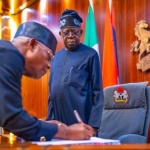
    2025. Tinubu looks on as the newly appointed Rivers’ military administrator takes the oath of office. Credit: National Record

    The biggest attack on Nigeria’s democracy under the Tinubu administration might just be the current state of emergency rule in Rivers State.

    On March 18, 2025, President Tinubu declared a six-month-long state of emergency in Rivers State, suspending its governor, Sim Fubara, Deputy governor, Ngozi Odu, and the entire Rivers assembly. He appointed Vice Admiral Ibot-ette Ibas (rtd) as the state’s military administrator, pending the end of the six-month period.

    Tinubu said he made the declaration to solve the political unrest in the state (which coincidentally had his ally, Nyesom Wike, in the mix). He cited Section 305 of the 1999 Constitution, which allows a president to declare a state of emergency in cases of national danger, disaster, or threats to public order and safety. This much is true, except that what happened in Rivers at the time did not constitute a condition warranting such a heavy declaration.

    According to the Nigerian constitution, a President is only allowed to declare a state of emergency in cases of war, major security threats, breakdown of public order and safety, natural disasters, the inability of the government to function properly, or a direct request from a governor — none of these things were true for Rivers State. Even if they were, the President is still not empowered by the Constitution to suspend a democratically elected governor (and elected officials), yet he did. This action, according to the Nigerian Bar Association (NBA), was an “unconstitutional usurpation of power and a fundamental breach of Nigeria’s federal structure.”

    While this happened, Nigerians looked to the National Assembly to steer Tinubu’s hands towards due democratic processes, but the lawmakers approved it two days later.

    The clampdown on press freedom

    2024. Activists protest the detention of investigative journalist Daniel Ojukwu. Credit: Punch Newspapers

    In 2023, while he campaigned for the position of President, Bola Tinubu promised to respect press freedom if elected, but that has not been the case. Tinubu’s two years in office have been marked with a clampdown on the very people he swore to protect.

    In 2024, the Committee to Protect Journalists (CPJ) revealed that about 56 journalists in Nigeria were attacked while they covered the #EndBadGovernance protests.

    A separate 2024 report from the International Press Centre (IPC) revealed that over 65 journalists and two media houses were attacked in 40 different incidents between January and September of 2024 alone. The report showed that government forces were responsible for the majority of the attacks. The nature of the attacks recorded by the IPC ranged from physical assault, confiscation of equipment, vandalism, and abductions.

    One of the victims of these attacks was Segun Olatunji, who was abducted on March 15, 2024, blindfolded and flown to Abuja aboard a military aircraft because he published a story connecting Tinubu’s Chief of Staff, Femi Gbajabiamila, to a $30 billion loot.

    The military first denied abducting the journalist, but bowed to pressure and released him 14 days later.

    “I was not interrogated until three days after my arrest and detention by the DIA in Abuja in an underground cell, bound with hand and leg cuffs, which were not loosened until the right part of my body was becoming numb. Up till now, I still feel the numbness on my right hand and leg,” Olatunji wrote, weeks after his release.

    Olatunji, who was still an editor of online news outlet FirstNews at the time, resigned weeks later due to safety concerns. The news outlet apologised to Gbajabiamila, but Olatunji told Foundation for Investigative Journalism (FIJ) in a May 30 interview that he stands by the story he wrote.

    Other journalists who suffered similar attacks include FIJ reporter, Daniel Ojukwu who abducted in May 2024, by the Intelligence Response Team (IRT) of the Inspector General of Police (IGP), Premium Times reporter, Yakubu Mohammed whom policemen hit with their weapons until he sustained a head injury, and many more journalists.

    A general clampdown on freedom of speech

    2025. The Take It Back Movement calls for the repeal of the Cyber Crime Act. Credit: Crossriver Watch

    Journalists are not the only group that has undergone human rights abuses under the Tinubu administration; Nigerians in different capacities have had their rights to free speech eroded by Nigerian authorities, and these abuses have been carried out mainly through a particular section of the Cybercrime Act— section 24.

    Though the Cybercrime Act was first signed into law by former President Goodluck Jonathan in 2015, Tinubu amended it in 2024 with particular emphasis on section 24, which criminalises messages (or other types of content) sent via a computer system that are a threat to life, are “Pornographic: or  he knows to be false, for the purpose of causing a breakdown of law and order.”

    Though some argue that the latest amendment has eliminated certain ambiguities and made the Act less dangerous, others disagree. The “Act is ambiguous with no clear definition, which makes it easy for it to be weaponised to target journalists and dissenting voices in the country,” Nigerian lawyer, Ayisat Abiona, told African Arguments in 2024.

    Nigerian citizens whose rights have been eroded through this Act include a nurse, Olamide Thomas, who was tracked down and arrested in December 2024 after she made a video cursing President Tinubu, his children, the Inspector-General of Police, Kayode Egbetokun, and Force Public Relations Officer Muyiwa Adejobi. She had made the video back in October after she, among other #EndSARS commemorators, was teargassed by the Police.

    A TikToker, Olumide Ogunsanwo, popularly known as Sea King, was arrested for similar reasons. Sea King made a video cursing President Tinubu,  Lagos Governor Babajide Sanwo-Olu, Inspector General of Police (IGP) Kayode Egbetokun, and the Police force itself.

    Other Nigerians have also been punished for different reasons using this same Act.

    The one-party system allegations

    2025. Bola Tinubu poses for a picture with three PDP Kebbi senators defecting to the APC. Credit: ICIR

    Over the past months, there has been an undeniable wave of mass defections across opposition parties—the People’s Democratic Party (PDP) and politicians from the New Nigeria People’s Party (NNPP), Labour Party, have been moving to the ruling All Progressives Congress (APC).

    The loudest yet has been the defection of the Delta State Governor, Sheriff Oborevwori, his predecessor and former PDP Vice Presidential candidate, Ifeanyi Okowa, from the PDP to the APC.

    On the day he officially defected, Oborevwori made a jaw-dropping revelation: “All our members in the Delta State House of Assembly have agreed to defect. The state exco, council chairmen, councillors, LG chairmen, and others are all moving to the APC,” he said.

    While Nigerians still reflected on the implications of this defection, the governor of Akwa Ibom State, Umo Eno, announced in May that he would be defecting from the PDP to the APC. In what may have been an attempt to carry out a similar defection as his Delta State counterpart, Eno made it compulsory for his cabinet members to join him.

    “I am told that some of you are saying that you will not come, you are free, absolutely free not to join me, but you won’t be in my state executive council.

    “So, you better just be prepared to resign the day I announce that I’m moving because you are an appointee and your loyalty is to me. You can’t be in my cabinet and play anti-party, it’s not a threat, it is what it is. I won’t beg you to come, you should normally not even expect it,” he told his appointees.

    Eno officially defected on June 6, and so far, only one cabinet member has resigned. It remains to be seen what the rest have decided.

    While defections are quite normal in politics, especially in Nigeria, many stakeholders have found these ones to be particularly disturbing and fear they could plunge the country into a one-party system, ultimately killing the country’s democracy.

    Although concrete proof of the true motivation behind the mass defections has not been provided, politicians, activists, and academics say the defectors are driven by bribery, coercion, and outright threats. In a statement released on April 27, an 18-person group made up of activists and academics shared their fears for Nigeria’s democracy.

    “Nigeria risks returning to a culture of impunity, where the absence of opposition breeds arrogance and unaccountable governance,” the group’s statement read in part.

    On May 22, Tinubu was quoted as saying, “There’s nothing wrong with a one-party system.” In the same breath, he said that the APC is not pushing for a one party system because “a one-party system is not suitable for democracy.” 

    The APC also dismissed fears of a one-party system, but a recent statement from the President’s former aide tells a different story.

    After he resigned on June 8, Aliyu Audu, the former Senior Special Assistant to President Bola Tinubu on Public Affairs, released a statement criticising Tinubu’s approach to opposition and dissenting voices.

    “If we now begin to silence or crush opposition simply because we have the upper hand, then we are no different from the very system we once criticised under Obasanjo in 2003,” he said.

    While the allegations of a deliberate push for a one-party system technically remain debatable, other events under the Tinubu administration point towards a weakened democracy.

    [ad]