• Every week, Zikoko seeks to understand how people move the Naira in and out of their lives. Some stories will be struggle-ish, others will be bougie. All the time, it’ll be revealing.


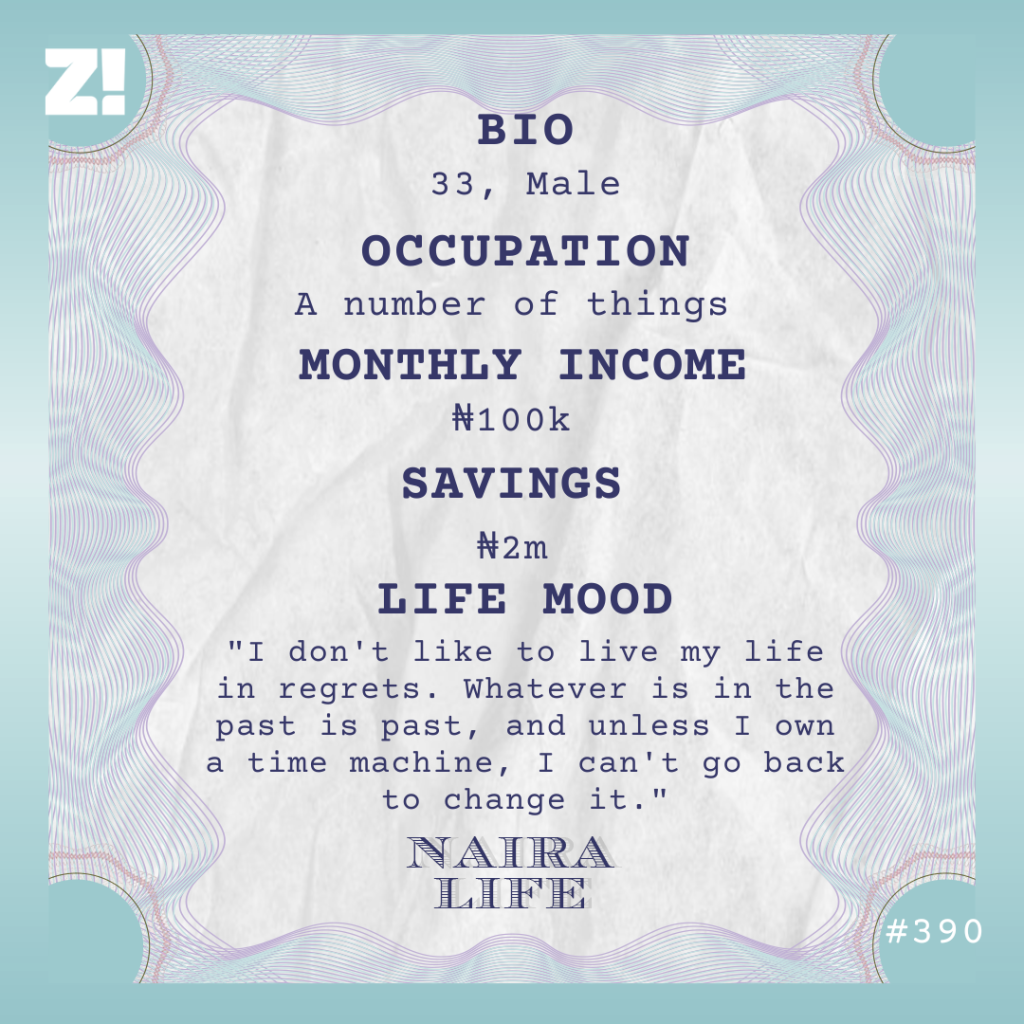
    NairaLife 382 bio

    What’s your earliest memory of money?

    I remember my parents giving my siblings and me ₦20 daily in primary school. It wasn’t big money, but it was the standard among my classmates. We used it to buy sweets and biscuits. 

    I also remember we celebrated special milestones, like birthdays or passing exams, by cooking chicken at home. It wasn’t like we only ate chicken on special days; it was just the sign that something good had happened, or that my dad was in the mood to treat us. 

    What was the financial situation at home?

    My dad was a businessman, and my mum was a teacher. Their incomes afforded us good schools and nice clothes. I vividly remember my mum travelling from Abuja to Lagos just to buy our Christmas clothes, so we weren’t poor.

    We weren’t rich, either. We had periods of lack and experienced the usual landlord kicking us out of the house for late rent and all that. My siblings and I were also driven home from school a few times due to unpaid fees or a lack of textbooks.

    However, even when we had money problems, my parents maintained a high standard. When we were sent home for school fees, they locked us indoors so the neighbours wouldn’t know. They also strictly forbade us from speaking pidgin English. People in our neighbourhood assumed we were wealthy but had hit a rough patch. My parents were just trying their best to raise us.

    When was the first time you did something to earn money?

    JSS 2 or JSS 3. During one holiday, my siblings and I organised lessons for younger children in the neighbourhood. At first, we did it for fun to pass the time, but the class grew to about 20 children. They paid ₦20 or ₦50 each, and we pooled the money to buy biscuits and other minor things.

    We also sold homemade “vim” around the same time. We ground eggshells and mixed them with ash and detergent. Then we sieved the mixture and sold it as scouring powder to scrub cooking pots. It actually sold quite well, considering we did it for fun. We dropped it after two months. I don’t even remember how we spent the money we made.

    The next time I tried something for money was during my diploma, just before university. I don’t know if it counts because it was so short-lived.

    Tell me about it

    It was 2016, and my sister and I were running a diploma programme to get us into uni via direct entry. We lived together away from home and didn’t have a structured monthly allowance. My parents just stocked us up with foodstuff and provisions. We called home if we needed money.

    However, there was one period when we were incredibly broke and hungry. Out of desperation, I took a job at a local restaurant. The pay was ₦5k/month, but my main motivation was the free food. I served food, cleared tables, and washed plates, and in addition to the salary, my employer gave workers breakfast and dinner. 

    I didn’t last more than a week there, though. It was so stressful, and it only took me a few days to realise I couldn’t survive that life. So, I gave them a random excuse and stopped going. I didn’t lose anything because I just wanted to eat, and I did.

    After that incident, I finished my diploma and moved on to uni. I didn’t need to do anything for money until I graduated in 2022 because I was getting pocket money.

    What did you do next?

    I got a job as a special needs teacher. The salary was technically ₦20k/month, but the school remitted only ₦18k to me. They held the remaining ₦2k to save and return it as a lump sum whenever I resigned. I think it was like a pension arrangement. 

    A few months in, I approached the school director and asked for a raise. The woman was quite nice. She agreed, and my take-home pay increased to ₦25k/month. I worked there for eight months and eventually quit when I got tired. I didn’t like the way the teachers struggled to survive. 

    They were trapped in a cycle of collecting salary, spending it all to clear debts, and borrowing again until the next payday. Some teachers would be in school by 7 a.m., work till 3 p.m. and still do private tutoring for extra money until 7 p.m. I knew I didn’t want that life.

    Did you secure another job before you quit, though?

    Somewhat, but it wasn’t exactly a job. Just before I left the school, I got an opportunity with the National Population Commission (NPC) for the proposed 2022 national census. I trained as a Specialised Workforce (SWF) facilitator. If the census had held, my job would have been to train the enumerators.

    The facilitator’s training lasted two weeks, and they paid me ₦171k. Then we started hearing stories of embezzlement and corruption, and the operation was suspended. Later, we heard the census was back on, and we did a three-day refresher training. I made ₦46k from that. However, things scattered again and the census eventually didn’t hold. Some facilitators have actually not been paid to this day. Fortunately, I got mine.

    When it didn’t work out, I decided to go for NYSC. This was in 2023. My Place of Primary Assignment (PPA) was at a government parastatal, where I mostly did admin work.


    The Naira Life Conference is returning on August 22, 2026, in Lagos! Come learn from finance experts and industry leaders, and partake in unfiltered conversations about building wealth and diversifying your income stream in a country like Nigeria. Real stories, expert advice you can actually use, and a community ready to build wealth together. Secure your spot here.


    What was your income like during the service year?

    The parastatal didn’t pay corp members, but luckily, I was posted to the office of a lawmaker representing my home constituency. He graciously decided to pay the corp members a ₦30k stipend on top of the ₦33k NYSC allawee.

    In May 2024, one month before rounding up my service year, I started a business selling wristwatches. The business really pushed me out of my comfort zone because I’m naturally shy, but I had to pack my watches in my bag and knock on random office doors to sell. 

    My efforts paid off, though. The profit margin on each sale was high. I could buy one piece for about ₦10k and resell it for ₦22k or ₦25k. I just had to make sure the watches were non-tarnishable so I could build trust and get returning customers.

    In slow months, I made ₦50k to ₦80k, but in peak months, I cleared ₦100k to ₦150k in profit. 

    What happened after you completed your service year?

    I continued the business since I was still at the office. They’d asked if I was willing to stay on and work full-time, and I excitedly agreed. I even told my mum that our prayers had finally been answered and that my life was changing for the better.

    I assumed that, since it was a government agency, I would make good money. However, at the end of the month, they paid me the same ₦30k stipend I was getting as a corp member. 

    I questioned it, arguing that as a full-time employee, I deserved a proper salary. After dragging out the issue for two months, they added a mere ₦10k, bringing it to ₦40k/month under the title of “Office Assistant.” 

    I did everything from managing the website and compiling lists of over 1,000 names for empowerment programmes to working as the office errand girl and dishwasher whenever guests came to eat. I tolerated it until late 2025 because I had no other options, all while applying for jobs everywhere. I was also still selling my wristwatches. 

    My breaking point came when a position opened up within the office, and instead of giving it to me despite my experience, they nominated a new guy. When I found out and challenged them, they said he was “a man and had more bills to pay.” 

    The heck?

    See. The blatant misogyny was so annoying. Unknown to them, I had been quietly training on the side for a remote debt-collection and customer-support gig. 

    The agency was recruiting people to work for a US-based brand, so the idea was that after the training, I’d get the job. So, when that issue at the government agency happened, I stopped going to the office.

    The remote gig was temporary, though. I did the onboarding and worked for one week, earning ₦75k. Unfortunately, the company suddenly decided to lay off their Nigerian contractors, so I was let go.

    While that was happening, the government agency realised they couldn’t handle the workload without me. They begged me to return, saying they’d removed the guy’s name from the nomination list and put mine instead. They also claimed the job would click within a few months and that my pay would increase. 

    I agreed to return, but on my own terms: I only went in twice a week. Half the time, I only went to the complex to move around and sell my wristwatches because it was the business that kept me afloat.

    Did the government job eventually click?

    It didn’t. I left in January 2026 when I got another job as a personal assistant/secretary to a consultant. My new salary was ₦150k/month.

    At this point, my wristwatch business had slowed down due to a lack of customers. Sadly, the new job turned out to be another misrepresentation. I was promised a project management path with opportunities for interstate travel. Instead, it turned out to just be me running personal errands for my boss all day. I wasn’t satisfied with that. That’s not what I came to this life to do.

    Even worse, the salary payment structure was highly inconsistent. One month, it would come on the 2nd; the next month, on the 11th. I had even spent ₦50k upgrading my laptop’s hard drive from an HDD to an SSD in January because she claimed I would handle some projects remotely, but I never ended up using the laptop for anything meaningful.

    Sigh

    Between April and May, I requested a formal review of my job description so we could align on my actual professional duties. My boss took it as a personal insult and told the mutual connection who introduced us that I was being disrespectful and that she was going to fire me.

    She then went on an unannounced international trip for over a month. I kept showing up to an empty office, reading on my laptop, and sending daily “activity reports” on absolute nothingness just to fulfil righteousness. Before travelling, she intentionally told our mutual contact that she would pay my May salary early so I would “spend it and waste it” before my birthday in June, after which she’d fire me.

    She returned, paid my June salary on July 2nd, and officially fired me on the 10th.

    That’s terrible. How are you handling the sudden loss of income?

    Honestly? I felt relieved. The environment was draining, and I wasn’t growing. I was already exhausted and deeply unhappy with that phase because it wasn’t what I had imagined for myself. The only small positive was the money.

    To keep myself from slipping into a depression or wallowing in anger, I woke up early the following Monday, dressed up sharply, and went straight to a friend’s office at the government agency. I tweaked my CV and have been actively submitting it to different offices and places ever since.

    Do you have savings to fall back on?

    I don’t have any savings. Between the high cost of transportation, black tax and data, it was impossible to keep anything aside. In fact, the very month I received my first ₦150k salary, my phone spoiled. I had to get a new phone through a Buy Now, Pay Later platform. For the next four months, I was paying about ₦50k/month to complete the payment. That money was supposed to go into my savings, but it went into the phone instead.

    Before that, on the ₦40k salary, saving was completely out of the question. Even with the wristwatch business, there was no real structure. I spent the money as it came. If someone bought a watch, I’d immediately use the cash to cover my transport to my main job. 

    I’ll admit that I’m not a big saver. When I really need to keep money away from myself, I have to give it to someone else to hold for me. I used to have a savings app on my phone, but I would always end up going back into the app to withdraw the money. The inconsistency of my income and the sheer cost of things made it hard. Even if you don’t buy big things like clothes, shoes, or hair, you become an adult, and people start looking up to you. Siblings or family members can just ask for ₦3k or ₦5k, and as an adult, you have to turn up for them.

    Can you break down what your expenses used to look like?

    NairaLife 382 expenses

    I live in Abuja, and transportation is a major cost. There are frequent price hikes. Sometimes I had to borrow money from my mum to cover expenses before salary day.

    Pending when you get another job, what’s the plan for day-to-day survival?

    My family is very supportive. I live with my family, so I don’t have to worry about rent or food. It’s just adult things like going out with friends that I can’t afford right now. I’ve even had to ghost most of my friends to avoid the pressure of spending money I don’t have. 

    I believe this unemployment is just a phase, though. I’ll keep searching and hoping for the best. I’ll be alright.

    Fingers crossed. What would be the ideal monthly income you’d expect from a new job?

    ₦300k – ₦400k

    Is there anything you want right now but can’t afford?

    Many things, but mostly the independence of not having to worry about money. I just want to have money for its own sake. I have people who have helped me that I want to be there for, like my mum, but I can’t afford to do anything for them. It’s a concern for me.

    How would you rate your financial happiness on a scale of 1-10?

    4 or 5, even though I really feel like it’s a zero. At least, I have a roof over my head. But there are many things I can’t do because I don’t have money.

    When things finally fall into place, that number should go up to 9 or 10, especially when I am able to make my mum proud and improve the lives of the people around me. For now, I’m continuously applying for jobs and hoping for better days.


    If you’re interested in talking about your Naira Life story, this is a good place to start.

    Find all the past Naira Life stories here.

    Subscribe to the newsletter here.

    Get More Zikoko Goodness in Your Mail

    Subscribe to our newsletters and never miss any of the action

  • The topic of how young Nigerians navigate romantic relationships with their earnings is a minefield of hot takes. In Love Currency, we get into what relationships across income brackets look like in different cities.


    Interested in talking about how money moves in your relationship? If yes, click here.

    How long have you been with your partner?

    Seyi and I have been together since September 2024, so that’s almost two years.

    How did you and Seyi meet?

    We were co-workers. He was already working at the company when I resumed in late 2023, but we worked remotely and were in different departments, so we didn’t cross paths.

    Six months after I started working there, the company laid off staff because of a “restructuring”, and I was affected. I was devastated, especially because I’d left my previous role for the job. Seyi was one of the few coworkers who entered our DMs (the other affected employees and me) to sympathise with us. He took it a step further and promised to send me job openings. I didn’t take him seriously, though. 

    I assumed it was just one of those nice things people say to make you feel better, so while I gave him my WhatsApp number for the promised updates, I wasn’t really expecting him to send anything. But he did. He constantly sent me job vacancies and even helped me revamp my CV.

    That’s so sweet. I gather romance wasn’t on the horizon yet

    Friendship came first. He became the person I ranted to about job applications and interviews. After a while, we realised we had a lot in common. We swapped movie recommendations and song playlists. 

    In August 2024, about two months after I was laid off, he invited me to his brother’s wedding. I remember seeing him at the wedding and thinking, “This guy is actually fine o.” Apparently, he thought the same, too. The vibes shifted after that. We stopped communicating on a “just friends” basis and transitioned into a talking stage. 

    A month later, he asked me out, and we officially started dating.

    Were you still unemployed at this time?

    Very unemployed. I got some virtual assistance gigs here and there, but nothing significant. To make matters worse, my rent was up, and I didn’t have money to pay. I had to endure a few months of squatting with friends all over Lagos because I didn’t want to return to my parents’ house in Ogun State. 

    Seyi was very helpful during this period. He was always sending me random ₦20k almost every week and said it was “so you can focus on job search without worrying”. He essentially bankrolled me. 

    I finally got a job in January 2025, but then I had an issue with the friend I was staying with and had to leave. I didn’t have any money to rent a new place, so I started living with Seyi. It was supposed to be for a few months until I saved enough or got a loan from my siblings to get a new place, but you know how Lagos housing is. Finding a reasonable place that wasn’t expensive as hell took forever. I just moved out in May this year.

    So you cohabited for over a year. What was the financial dynamic like?

    Seyi paid for almost everything. My job was on-site for the most part until I resigned early this year to face virtual assistance. That meant I often returned home late, too tired to cook. So, we mostly ordered food, which Seyi paid for. He also handled other expenses, such as fuel and utility bills. 

    I assisted in my own way, though. I did the chores, chipped in for fuel sometimes, and bought foodstuff for the few times we cooked. 

    Sounds like you both found what worked for you. Was living together all smooth, though?

    For the most part, yes. But of course, there was the occasional friction. One thing we often argued about was Seyi’s tendency to keep the apartment messy. It was almost like he was allergic to picking up after himself. I thought that was wild. How can you be an adult, and someone has to remind you to clean your space? So yeah, we fought quite a lot about that. 

    One time, I was so pissed, I left the house, threatening not to return unless he washed the plates. It took him a few days of dragging it out, but he eventually washed them, and I returned.

    Another source of friction was his spending habits. Before we started living together, I thought he was simply being generous to me because we were dating. After I moved in, I realised that’s how he generally spends money. 


    The Naira Life Conference is returning on August 22, 2026, in Lagos! Come learn from finance experts and industry leaders, and partake in unfiltered conversations about building wealth and diversifying your income stream in a country like Nigeria. Real stories, expert advice you can actually use, and a community ready to build wealth together. Secure your spot here.


    How so?

    Seyi is the type to send money to every health fundraiser he sees on Twitter. One time, he went out to buy fuel and returned home with an empty keg. When I asked why he didn’t buy fuel, he said he’d given the ₦10k to a friend he saw on the way. That was the last ₦10k he had at home and abroad. I had to bring out money to buy the fuel.

    Besides his need for generosity, he spends a bit carelessly. He can see a shirt he likes and buy it on the spot, forgetting there’s such a thing as budgeting for the month. If you ask him why, he’ll be like, “But I need this thing. It’s not like I’ll buy it again tomorrow.” I’m not sure if he understands the difference between a need and a want. 

    He doesn’t save or plan his money. Once it enters his hand, he spends it freely if a need arises. Overspending is the only word for it. It’s like he doesn’t even think of emergencies. It’s particularly worrying because, since being laid off, I’ve been intentional about my finances. He knows I’m always talking about savings and investment options, but he doesn’t seem inclined to change.

    Is that a potential dealbreaker for you?

    It might be. He’s perfect in every other area, but I can’t help thinking finances are important too. Imagine being married and never being at peace because I’m worried my husband will spend our children’s school fees or use the rent to buy a new car. 

    It’s one reason I was deliberate about moving out of his place. It would have been easy to stay there, given the opportunity to save even more of my income. But I didn’t want a situation where I’d be too relaxed, and if, at any point in the future, I realised our financial differences were too much, I wouldn’t be able to leave because I was living with him.

    So, while I’m talking to him and hoping he grows up soon, I’m prepared to leave the relationship if it comes down to it. I don’t foresee a positive future with an overspender who doesn’t plan his finances. Hopefully, things change.

    What do relationship expenses, such as dates and gifts, look like for you both right now?

    Seyi is really good at giving intentional gifts; I’ll give him that. I only need to mention I need something in passing, and he gets it for me. Sometimes, he just notices I might need something and buys it for me. A few weeks ago, I complained about headaches from constant laptop use, and he bought me anti-blue light glasses.

    I buy him things he might need, too. I noticed he was constantly wearing one pair of palm slippers, so I spent ₦20k to buy him another pair two months ago. We really just gift each other like that.

    You mentioned becoming more financially conscious. What does your safety net look like now?

    I try to save between ₦50k and ₦200k monthly, depending on my income. Then I divide it, putting one half into my mutual funds and the other half into my regular savings. Altogether, I have about ₦850k in my portfolio.

    What’s the ideal financial future you’d like for you and Seyi?

    I’m still worried about whether we even have a future. But if things work out, I have a couple of business ideas I’d like us to try. First on the list is building shortlets across Lagos. That business is a goldmine.

    Interested in talking about how money moves in your relationship? If yes, click here.

    *Names have been changed for the sake of anonymity.


    NEXT READ: He Thinks Women Shouldn’t Work, but I Can Change Him

    Get More Zikoko Goodness in Your Mail

    Subscribe to our newsletters and never miss any of the action

  • Every week, Zikoko seeks to understand how people move the Naira in and out of their lives. Some stories will be struggle-ish, others will be bougie. All the time, it’ll be revealing.


    Naira Life 381 bio

    What’s your earliest memory of money?

    When I was in primary school, my dad unexpectedly pulled me out of public school and enrolled me in a private one. It may have been because he got a new job at a company with a staff school. Also, I think he saw my academic potential. I have five siblings, but I was the only one who switched to private school. Even as a child, I could tell that the school fees were extremely high compared to his salary.

    The switch was the first time I realised that some people have significantly more money than others. Suddenly, I was surrounded by rich men’s children. Their parents drove them to school, and their pocket money was on a completely different level.

    What was the financial situation at home?

    My dad was a driver, and my mum was a serial entrepreneur who sold everything from pure water and ice blocks to zobo and food. I remember her enterprises sometimes led to small fights because she’d return home late, and my dad didn’t like it. He wanted her to be a housewife, but she insisted on having her own money. She hated the idea of a woman having to wait for her husband “just to buy matches.”

    We never lacked the basics. My dad was incredibly determined to provide. He was the type to buy a TV at home because I was constantly going to a neighbour’s house to watch TV. One time, I admired a neighbour’s toy gun, and he bought me a new one days later. I never had to focus on what we had or didn’t have because my parents provided for us.

    When was the first time you did something to earn money?

    I was around eight or nine when I started hawking pure water for my mum during weekends and long holidays. I didn’t have to do it; it just felt like a fun way to make money. 

    At the time, my mum sold pure water to people who hawked, so she was like our wholesaler. She would give me a bag of water, then, after selling out, I’d return the cost price to her and keep 100% of the profit.

    I did this on and off until I got to primary five. The “big boy” in me awoke, and I became highly socially conscious. Remember, I was attending a private school with wealthy classmates, and I didn’t want to be known as the street hawker. So, I stopped completely and didn’t try anything for money again till I got into university in 2012.

    Tell me about that

    In uni, I started making money from writing. I’ve been writing since I was in primary school. You know, scribbling stories here and there. Then, when I got into the 100 level, I noticed that content was gaining traction in Nigeria, and people were getting on it. 

    So, I began applying for random writing gigs, website management, and blogging opportunities. I did much of it for free because I enjoyed it, until people noticed my skill and started randomly paying me. That’s when I realised there was money in this thing and began to take it seriously.

    My first paid gig was managing an entertainment gossip blog. I had to rewrite and post 7 to 10 news stories a day while juggling classes.

    How much were you making?

    They paid me ₦30k a month. After a few months, it went up to ₦50k, and eventually capped at ₦70k. I wasn’t writing for just one blog, though. I was constantly applying online and also often got clients via referrals. In a good month, I was easily clearing ₦120k – ₦200k.

    That seems like a decent amount of money for a student in 2012

    It was insane. My tuition fee was only ₦15k at the time. I lived an incredibly soft life. My dad still insisted on sending me ₦1500 every week because he wanted to proudly say he fully trained his child through school without me claiming I had to fend for myself. I took it, but ₦1500 barely lasted two days, so my writing entirely funded my lifestyle.

    I was so comfortable that I practically took care of two of my friends who were struggling to feed themselves. One of them was my roommate, so I bought all the provisions and foodstuff, and they handled the cooking. For my other friend, I was always buying them food, taking them out, and letting them pick whatever they wanted. 

    I was also very big on gadgets in school, changing my phone and laptop every three to six months. So yeah, it’s safe to say I lived a soft life in school.

    Inject it. What about after graduation?

    I finished in 2016 and went for NYSC in 2017. Right before leaving for camp, I landed an international client who paid a lump-sum amount of ₦1 million for a content development project. That was my very first million.

    After the initial lump sum, the contract transitioned into a monthly retainer of around $100 (which fluctuated between ₦30k and ₦45k after conversion). Alongside that, I had two other local writing gigs paying ₦70k and ₦60k every month. In total, I was making close to ₦200k/month during my service year.

    My Place of Primary Assignment was a village school. I never had to touch my ₦19,800 NYSC allawee; I saved the whole thing. I even left my NYSC ATM card at home and only saw the credit alerts. I would buy food in bulk, and fellow corps members would come to my house to eat. The school kids often gave foodstuff to other corps members, but they hardly gave me any because, according to them, “Uncle, you don’t need it na. You’re a rich man.” 

    I’m screaming. What did you do with all that saved allawee, though?

    I used it to get an apartment because I didn’t want to return to my parents’ place. My dad had rented out one of the rooms in our small room-and-parlour apartment to stay afloat. He’d done that since I was in secondary school, and the whole family had been squeezed into a single room for years. Whenever I returned home from school, I had to sleep on a student mattress laid on the floor at the foot of my parents’ bed. I didn’t like the experience at all. 

    In 2019, a few months after passing out from NYSC, I gathered my savings of about ₦230k, added some money, and rented a mini-flat. The total package was ₦575k (including a year’s rent of ₦300k plus an extra three months’ upfront payment).


    The Naira Life Conference is returning on August 22, 2026, in Lagos! Come learn from finance experts and industry leaders, and partake in unfiltered conversations about building wealth and diversifying your income stream in a country like Nigeria. Real stories, expert advice you can actually use, and a community ready to build wealth together. Secure your spot here.


    Were you still strictly freelancing at this point?

    In the same year, I landed a full-time role at a news media company, earning about ₦83k/month. After the first year, my salary jumped to around ₦183k.

    The job forced me to reduce the number of writing gigs I took on since I dedicated most of my time to work. I still took on occasional gigs, though. Then, in 2020, I got an opportunity to work with an international brand as a customer relations and communications person. This job became an additional hustle alongside my 9-to-5, and it paid in Euros based on the number of customers I attended to each month, with a minimum payout of €100. I didn’t even convert the money initially. I just let it pile up in my domiciliary account and lived entirely on my 9-to-5 salary.

    In 2021, I left the media company to join a fintech company as content lead. 

    What was the pay like?

    Around ₦310k/month after deductions. The pay was good, but the work culture was toxic. It got so bad that in 2023, I took a pay cut just to escape. I moved to another company as an account manager, making ₦250k/month.

    Was the new job better?

    It was worse. I lasted only four months there. I still had the Euro-paying gig, and I told myself, “I’m making significantly more money from this gig than from toxic 9-to-5 jobs that require me to wake up early and jump buses.” If I put in more time at the gig, I could make more in the comfort of my own home. So, I quit and decided to face freelancing.

    Also, to celebrate surviving that corporate madness, I decided to reward myself. Remember the Euro income I hadn’t touched for years? I had about €3,000 in my domiciliary account. I emptied it and bought a car for ₦3.8 million. After the purchase, I was left with ₦300k to my name.

    Wasn’t that a scary move? Going fully freelance often means an unstable income

    I’ve always been a risk-taker when it comes to money. Also, I had this huge confidence in my professional network. I knew that if freelance work ever dried up, it would take only one or two phone calls to secure another job. Fortunately, I haven’t had to. 

    I still earn from the Euro gig to this day, and my income has only increased. I also have another steady freelance income, plus other small gigs that come in from time to time.

    Can you break that down?

    So, I have two main sources. The first is the Euro gig. The volume fluctuates, but it brings in between €2,000 and €2,500 per month. However, the workload became too much for me to handle, so I’ve been building a team over the last two years. I now have about seven freelancers working under me on a graduated scale. After paying them their shares (about 50% to 60% of what we make that month), I net roughly ₦1.6 million.

    The second source of income is from my old client, who paid me my first million. We reconnected last year for a short three to six-month project, but it became permanent. I handle their communications, PR, and content strategy. It started at $800/month, but we renegotiated to $400/month (about ₦570k) since it’s long-term and continuous.

    That’s over ₦2 million monthly

    More or less. Some months can be a bit more since my main income isn’t fixed. I also get random gigs from time to time, which bring in extra income.

    Also, you’ll notice that I’m now converting my income to naira. Now that I’m wiser, I realise how careless I was with money in the past. The €3,000 I used to buy my car had just sat in my account for two years, sitting idle and yielding nothing. Looking back, that was a big financial mistake. The money could have been turned into more if I knew what I know now. 

    I’ve worked on my financial literacy over the years, and I’m quite financially conscious now. I make sure that every single dollar or kobo that hits my account is funnelled into investments and assets that generate passive income. My money has to be working for me.

    What does this look like in a typical month?

    Naira Life 381 expenses

    I try to be as frugal with money as possible. 50% – 60% of my income goes to my savings and investments, then I figure out the rest. My relationship with money is highly mature and healthy. I’m the guy my friends come to when they need financial or investment advice. I don’t live as large as I can actually live, but I still live a very okay life. 

    I’m curious about this ₦850k mortgage. How does it work?

    At the end of last year, I signed a contract with a property development company for a house that requires a structured two-year payment plan ending in December 2027. Once I finish paying, I own it completely.

    The payment plan is flexible because you don’t need to pay every month. As long as you pay everything before the scheduled end date, you’re good. So, instead of hand-delivering ₦850k to them every month, my financial strategy is to keep the money in a conservative mutual fund. 

    It accrues interest and generates passive income for me each month. Right before the final payment deadline next year, I will liquidate it and pay them off in one single lump sum. I don’t even know if I’ll move into the house yet; I just wanted the asset.

    Interesting. What does the rest of your investment portfolio look like?

    It’s pretty broad. To break it down:

    Naira Life 381 investment breakdown

    I also heavily invested in agriculture and land banking between 2025 and early 2026. I bought three separate one-acre plots of land managed by different agricultural companies: a palm oil plantation (cost me ₦4 million), a cassava farm (₦3 million), and a plantain farm (₦3.5 million). 

    The cassava and plantain will yield produce by next harvest season, while the palm oil is a long-term play that won’t earn until five years from now. I also bought a ₦12 million plot of land in Ogun State, where I plan to build, and a ₦3 million plot in Ibadan strictly for land banking. I bought both in 2024.

    What is the ultimate goal for all these assets?

    I want to build generational wealth. There wasn’t exactly anything wrong with my childhood, but I always wanted more. Coming from a poor background and being around rich kids all day highlighted the fact that, as much as I had the basics, there were also a lot of things that I didn’t have. I don’t want anybody coming after me to feel that way.

    Also, I want to have enough passive income so I don’t have to work in retirement. I would love to retire between the ages of 45 and 50. By then, I hope to have a portfolio worth millions of dollars.

    Have you considered what you need to do to get there?

    I don’t want to worry too much about that. Maybe it’s because I’ve freelanced for so long, but my approach to life recently has been just winging it.

    I’ve realised that worrying so much about how you want to get things done isn’t really necessary. What scares me the most is how you know you can keep hustling in life, and in the blink of an eye, everything is gone. One could fall sick, die, or anything could happen. Life is fragile. 

    So while I have big targets, I’m mostly winging it day by day. I don’t stress over career milestones or the “next big thing” anymore. I focus heavily on the present. Even the generational wealth I’m chasing is not for me. I just want to lay the foundation for those who come after me.

    Is there anything you want right now but can’t afford?

    A second passport. We all know how terrible Nigeria’s passport has gotten. I want to be able to travel and see the world freely without worrying about access and budgets or anything really.

    Is there an ideal amount you think you should be earning monthly now?

    ₦10 million. I mean, my gross income sometimes gets around there, but then I have to pay my team’s salaries. There’s so much I’d be able to do if I can steadily net ₦10 million monthly.

    How would you rate your financial happiness on a scale of 1-10?

    5. I feel like there’s so much more I should be doing. I made a lot of terrible financial decisions when I was younger. If I had started my investment journey much earlier, I would be way ahead of where I am today.

    Out of curiosity, do you see yourself freelancing for much longer?

    Freelancing has been incredibly good to me, and unlike many others, I have never experienced a dry spell. But I know it won’t be sustainable forever, and I think it’s part of the reason why I’m saving up and investing the way I am. 

    I don’t see myself freelancing forever, but I want to build a portfolio that can sustain me forever without having to actively work. I’m certain I never want to return to the 9-to-5 life, though. Waking up daily to grind at an office desk feels like a meaningless way to exist. We’re born to do much more than just go to the office every day and toil away.


    If you’re interested in talking about your Naira Life story, this is a good place to start.

    Find all the past Naira Life stories here.

    Subscribe to the newsletter here.

    Get More Zikoko Goodness in Your Mail

    Subscribe to our newsletters and never miss any of the action

  • What’s going on?

    Nigeria has developed a strange talent for treating investigations as a fancy thing rather than a red flag. Politicians accused of diverting billions, forging credentials, or hoarding wealth don’t disappear from the public eye; instead, they resurface on ballots and campaign posters, asking for your vote like nothing is happening.

    The most recent example is the former Attorney-General of the Federation (AGF) Abubakar Malami, who is running for governor of Kebbi State under the African Democratic Congress (ADC).

    On July 15, 2026, a Federal High Court in Abuja ordered the permanent forfeiture of 48 properties linked to him, valued at about ₦213.2 billion. The forfeiture is part of an ongoing Economic and Financial Crimes Commission (EFCC) investigation into Malami’s assets, tied to a 16-count money-laundering charge the commission filed against him, his wife, and his son, all of whom have pleaded not guilty.

    Everyone who has heard this news has rightly expressed shock at the sheer number of properties owned by Malami and has urged the EFCC to be thorough with the investigation. We totally agree, but here’s a question that’s been bugging us ever since: Why is he still running for office?

    Of course, the investigation doesn’t automatically mean he’s guilty, but the question was never really about guilt. It’s about why a person whose character is being scrutinised by the EFCC is asking for a public role. 

    The scary thing is, Malami isn’t an isolated case; he’s just the most recent name in a much longer pattern.

    Former Delta State governor Ifeanyi Okowa is under investigation by the Economic and Financial Crimes Commission (EFCC) over the alleged diversion of about ₦1.3 trillion from the 13 per cent derivation funds allocated to the state between 2015 and 2023. He is also the All Progressives Congress’ (APC)  Delta North senatorial candidate for 2027.  

    Former Kogi governor Yahaya Bello is standing trial for laundering about ₦80.2 billion allegedly diverted from the state’s funds, as well as a separate ₦110.4 billion fraud and criminal breach of trust case.  Pick your jaws from the floor, because he just won the APC’s senatorial primary for Kogi Central and will be contesting in 2027. 

    Oh, and there’s former Minister of Innovation, Science and Technology, Uche Nnaji, who went viral in 2025 after a Premium Times investigation found that he had forged his university and National Youth Service Corps (NYSC) certificates.

    He is currently seeking to become the next governor of Enugu State, and has been cleared by a faction of the PDP, even though he is under active investigation by Nigeria’s Independent Corrupt Practices and Other Related Offences Commission (ICPC) for the same issue. 

    At this point, it’s safe to say that in Nigeria, “under investigation” is a signal to politicians to run for office.

    In Malami’s name, there are many mansions

    Malami’s is the only one of the four in which a judge has actually issued a ruling. Justice Joyce Abdulmalik found that the assets were reasonably suspected to be proceeds of unlawful activities and not acquired from legitimate sources of income, leading to his forfeiture of everything from a ₦56 million foundation building to an ₦11.2 billion, 131-room hotel. 


    The Big Daily is your weekday shortcut to the biggest news shaping Nigeria. We cut through the noise, connect the dots, and explain why the news actually matters, all in one quick read.


    ₦1.3 trillion is a lot to misplace

    Okowa’s number is so large that we had thought it was a typo, but apparently it’s not.  

    His camp says the investigation is politically motivated and insists the funds were accounted for. We don’t dispute this, but at this time, it’s just his word against the EFCC’s, and that’s simply not enough for a person hoping to be a Senator, making our laws.

    In April 2025, he defected to the APC, and little has been heard about the investigation, but the EFCC says the probe continues regardless of which party he belongs to. Somehow, none of this stopped Delta North APC delegates from handing him their senatorial ticket.

    Two trials, one ticket

    Bello’s situation might be the most jarring of them all; In addition to his ongoing EFCC trials, people couldn’t quite decide whether he was truly cleared for the primaries.

    He somehow emerged with 72,399 votes to defeat his nearest rival’s 319.

    The EFCC keeps reminding everyone that Bello is innocent until proven guilty, which is true, but also not the point. Nobody’s asking Bello to be convicted; we’re asking why an active fraud trial isn’t enough to put his character in question.

    Show me your particulars

    Nnaji’s story doesn’t involve a single naira — just a degree that, as far as anyone can tell, only existed in his imagination. 

    Shortly after Uche Nnaji’s ministerial screening in August 2023, a whistleblower tipped off Premium Times about suspected discrepancies in his school and National Youth Service Corps (NYSC) certificates. Two years later, the newspaper published an investigation indicting Nnaji, and he responded to the growing scrutiny the way innocent people definitely do: by trying to block the university from releasing his own records. That didn’t work.

    The University of Nigeria, Nsukka (UNN) disowned the certificate he had presented, which was apparently forged, and three days later, Nnaji resigned. The ICPC eventually caught up to him, arresting and arraigning him for forgery. Naturally, none of this is stopping his second attempt at the Enugu governorship, this time on a borrowed PDP ticket. 

    Gaslighting 101

    None of these men is legally barred from running for office because Nigerian law only disqualifies candidates after a criminal conviction, not during an investigation or a forfeiture, and the parties know this. 

    This means the burden of vetting has been quietly outsourced to you, the voter, standing in front of a polling unit. 

    What next? 

    The National Assembly has to close the conviction-only loophole in the Electoral Act so that pending trials over public funds actually affect eligibility. Follow the money yourself. Right, the only people keeping score are EFCC prosecutors, and their case files move a lot slower than election season does.

    Most importantly, we have to be a nation and society in which people with questionable character do not dare to hold public office.

    The Naira Life Conference is returning on August 22, 2026, in Lagos! Come learn from finance experts and industry leaders, and partake in unfiltered conversations about building wealth and diversifying your income stream in a country like Nigeria. Real stories, expert advice you can actually use, and a community ready to build wealth together. Secure your spot here.

  • For many BBNaija fans, the romance is just as entertaining as the ₦150 million prize. Every season gives us new ships to obsess over and defend. But while some have gone from Biggie’s house to the altar, others have crashed and burned once the cameras stopped rolling. 

    With a new season around the corner, here’s what happened to some of BBNaija’s biggest couples and where they are now. 

    Mercy & Ike 

    Pepper Dem season (2019)

    Despite their penchant for chaos, fans couldn’t get enough of them. They continued dating after the house and even had their own reality show. But their Bonny and Clyde-style romance officially packed up in 2021. They both returned for the All-Star season in 2023, and it’s safe to say that ship has long sailed.  

    Kiddwaya & Erica 

    Lockdown Season (2020)

    They had one of the show’s strongest ships and almost tricked fans into thinking they were in it for the long haul.  Just a few months later, though, the relationship quietly fizzled out. 

    Sheggz & Bella 

    Level Up Season (2022)

    Few BBNaija ships divided viewers like Sheggz and Bella. They managed to keep the relationship going for years. This year, however, fans began speculating that they’d split after noticing they’d unfollowed each other on social media. Neither Sheggz nor Bella has confirmed the rumours. 

    Get More Zikoko Goodness in Your Mail

    Subscribe to our newsletters and never miss any of the action

    Khafi & Gedoni

    Pepper Dem season (2019)

    Gedoni and Khafi’s love story is up there among a few of the show’s successful love stories. They took their romance all the way to the altar in 2020 and now have two children. 

    Teddy A & Bambam 

    Double Wahala (2018)

    They were the first BBNaija couple to convince fans that reality TV love could survive in the real world. After finding love in the Double Wahala house, they tied the knot in 2019 and have since built a beautiful family together. They’ve recently been at the centre of breakup rumours, but neither of them has confirmed or denied the speculation.

    Neo & Vee 

    Lockdown Season (2020)

    Neo and Vee looked like a match made in heaven, and fans rooted for them all the way to the Lockdown finale. They stayed together after the show, but the relationship eventually ran its course, with Vee confirming the breakup in 2022. Things got a little messy during the All Stars season when they publicly revisited the split, but they’ve both moved on. 

    Angel & Soma

    All Stars Season (2023)

    Many fans hoped Angel and Soma would go the distance after the show. But in 2024, Angel confirmed they’d broken up. When rumours and allegations about Soma made the rounds, she shut down speculations, insisting they’d broken up amicably and asking people to respect their privacy. 

    Nina & Miracle 

    Double Wahala Season (2018)

    Nina and Miracle’s chemistry kept fans hooked throughout the season, but things didn’t last outside Biggie’s house. Just a few months after the show, Miracle clarified that they’d never been in an official relationship outside the house, bringing an end to the beloved “Mina” ship. 

    Doris & Denari

    10/10 Season (Season 10)

    Doris and Denari had fans rooting for them from the moment they got close in the house. Even after the show, they both insisted what they shared was real, fueling hopes of a post-house reunion. But their last public showing at the season’s reunion left viewers with more questions than answers. Fingers crossed.

    Bright Morgan & Mide 

    10/10 Season (Season 10)

    Their slow-burn romance won over fans despite the complications surrounding Bright Morgan’s relationship outside the house. But less than a year after the season ended, Mide confirmed she’d called it quits. Since then, the breakup has unfolded publicly, with Mide asking Bright to remove the tattoo of her name from his wrist and Bright responding with more cryptic posts. 


  • Sometimes, the most stressful part of your day isn’t the meeting you’re rushing to or the traffic on Ozumba Mbadiwe. It’s the ride that gets you there. We asked Lagosians about their worst ride-hailing experiences they still can’t believe happened. 

    “He picked up other people like a taxi” — Choice*, 24

    The driver wanted to avoid traffic by taking a route I wasn’t comfortable with, but I insisted we stick to the one shown on the app. That’s when he told me I’d have to pay extra if we stayed on that route.

    When I refused, he threatened to pick up other passengers. I thought he was bluffing until he actually stopped and let two strangers into the car while I was still inside. I complained the entire time, but he kept telling me to ‘do my worst’. After reporting the incident, all I got from the app was a discount on my next ride.

    “The fees doubled by the time we arrived” — Bolaji*, 31

    Last December, I booked a ride from the airport to the Island, and the app quoted about ₦24,000. I usually pay before the trip ends, but this time I forgot. When we got to my destination, the driver asked if I’d seen the updated fare. I checked, and it had jumped to ₦55,000.

    I still don’t know how it happened. I definitely didn’t have that kind of money on me, so I had to start calling family members to help me pay. I tried reporting it through the app afterwards, but nothing meaningful came out of it. It honestly felt like a scam.

    “He re-routed so the price increased” — James*, 29

    I was in a hurry and booked a ride to a route I know like the back of my hand. But instead of following the road I kept pointing out, the driver kept taking random turns. Every time I questioned him, he’d insist he knew a better route.

    Then he suddenly drove far off the route and pulled into a filling station. When I asked what was going on, he said his tank was almost empty and this was the closest place to buy fuel. By the time we got back on the road, the fare had jumped from about ₦3,000 to ₦8,000. I refused to pay the extra amount because none of it was my fault, but he started insulting me and causing a scene. I eventually paid because I just wanted to leave. I got to my destination late and frustrated.

    “I was abandoned at a deserted area” — Mary*, 24

    Earlier this year, I booked a ride without any issues because I was happy with the fare the app showed. We hadn’t even covered a quarter of the journey when the driver suddenly said I’d have to pay more than the quoted price.

    I told him I only had enough to pay what the app showed, but he got angry, then pulled over and threatened to drop me by the side of the road if I didn’t agree. Before I could even process what was happening, he drove off and left me in a deserted area. I had to walk a long distance before I finally found a taxi. It was a terrifying experience.

    “The driver threw a stone at me” — Ayo*, 19

    Everything was fine until we got close to my destination. The driver suddenly said he wouldn’t drive down my street because the road was bad. I told him I shouldn’t have to pay the full fare if he wasn’t completing the trip.

    I transferred the money minus ₦1,000 because I’d now have to walk the rest of the way. He completely lost it. As I walked away, he kept insulting me and even threw a stone that hit my back and injured me.

    If there’s one thing these stories prove, it’s that Lagos commuters aren’t asking for too much. They just want rides that are comfortable and drama-free. That’s exactly what VOLTAA is building.

    VOLTAA is a premium, zero-emission, all-electric mobility ecosystem designed around the everyday frustrations Lagosians know too well. An all-electric fleet means no unexpected fuel stops halfway through your trip, while trained, professional drivers help ensure every ride starts and ends smoothly.

    Ready to experience a different kind of commute? Download the VOLTAA app on the App Store or Google Play to join the early access waitlist and receive a welcome discount code.

  • I was born and raised in Lagos, Nigeria, where I spent most of my life. While I had friends and family in my life, my routine was mostly just work. I worked a 9-to-5 in the operations team at a mortgage bank in Marina while also building the content creation journey I started on the side in 2020, during the early days of COVID, to see what else I could create for myself.

    I genuinely loved my main job, but I lived on the mainland and hated the Lagos Island traffic. It was exhausting, and as much as Lagos was home, I never got used to the daily stress. Eventually, I realised I needed a change.

    I was young and wanted more from life. I have always believed that no goal is unattainable if I am willing to work for it. So, when the idea of studying in the UK crossed my mind, I refused to ignore it. I confided in a friend, even though I did not even have a passport at the time. She was the one who told me the first step was to apply for a Nigerian passport and gather all my documents before applying to universities in London.

    Once I had a clear plan, I told my parents about it too. The support I received from my family and friends turned studying abroad from something I simply imagined into something I was determined to achieve. From the moment I started the process, I knew I had to see it through. By the age of 26, I had applied to study Business with International Management at a university in London, and once everything was in motion, turning back was never an option.

    I really could not have done any of it alone. At one point during the process, I needed about 1.1 million naira to keep things moving toward my move. I called three friends and had the full amount before 6 pm that same day because they were confident I would pay it back. My mother prayed over the whole process constantly, because she was scared that I was giving up something stable to chase something uncertain. Honestly, I understood her fear. I was leaving a job I loved and a country I knew for one where I had no family at all.

    By the night before I travelled, that fear had settled into me too, sitting alongside the excitement in equal measure. I did not know what to expect when I landed in London, but I have never been afraid to take bold steps.

    My friend, Anu, also made my transition much easier. Before I even left Nigeria, she had helped me look into houses and jobs, and the minute I landed, she helped me settle in properly.

    School started almost immediately, so I did not get much time to fully take in my new reality before I had to start living it. As a student, I was allowed to work twenty hours a week, and my week fell into a structured rhythm: school on Mondays and Tuesdays, work on Wednesdays and Thursdays, and weekends spent on schoolwork or exploring London with friends I had made through school and church.

    That rhythm made the days manageable, but it did not make every day smooth-sailing. To date, one particular evening still stands out to me. It was winter, everywhere was dark by 6 pm, and it was cold. I was rushing to catch my train when I slipped on the wet ground and missed it anyway. After that happened, I walked into a nearby restaurant, got food, and sat there staring into a blank space, quietly rethinking every decision that had brought me to that point. However, I did not let myself dwell on it for too long because I knew it was just a phase and that it would pass.

    Around this time, I began to lean further into content creation. My page still had a mostly Nigerian audience, and I wanted to grow a UK following, too, so I started sharing what a day in my life as an international student looked like, along with outfit ideas and lifestyle content. My audience slowly began to shift and grow alongside me.

    In 2024, I had a baby girl, and that year became the most beautiful and most challenging of my life. Things did not work out with her father, so not long after she was born, I found myself raising her alone, in a country with no family nearby. I had to figure out, almost entirely on my own, how to earn a living and care for both of us with very little support. Some months I paid rent and other bills and was left with less than fifty pounds, hoping a brand deal would come through before the month ran out.

    My friends lent me money whenever things got hard, and my church helped more than once, too. Through it all, I kept posting fashion, lifestyle, and motherhood content, but I never mentioned what was actually happening behind the scenes. The thing about social media is that it makes everyone’s lives look so perfect, and since I did not want to be judged for struggling as a single mother, I carried my pain alone. My daughter and I always looked our best in public, and no one watching knew how much I was holding together on my own.

    Eventually, I became honest with myself enough to know that I needed real help, the kind only my mother could give. Childcare in the UK is expensive, and I could not focus on work without someone to care for my daughter, so I saved up and began the process of bringing her over. That process stretched me in every sense. I was still postpartum, living on maternity allowance that was not much to begin with, and now had to pull from it to cover the cost of her visa. Because of this, I made sure the Home Office understood exactly what I was dealing with, that I was a new mother and a single parent who genuinely needed her mother’s support, and they granted the visa.

    By the time she arrived, I was more exhausted than I had ever been, worn down by sleepless newborn nights, a caesarean recovery, and the weight of doing everything alone. Her arrival changed everything. She took on the cooking and cleaning, helped care for my daughter, and, for the first time in months, gave me the chance to rest properly. Slowly, I started to feel like myself again, not just as a mother, but as a person.

    Life had just begun to steady when, in July 2025, something happened that changed everything. I am not comfortable sharing what, but it was a serious incident that pulled me into a cycle of police stations, court appearances, and lawyers. It was traumatic enough that I made a decision: I was never going to carry that kind of weight in silence again. So I shared a piece of my story publicly for the first time.

    It reached far more people than I expected. My page grew from around 3,000 followers to 25,000 in just three months, but the growth itself was not what surprised me most. It was the flood of messages that followed, hundreds of women writing to say they had lived through something similar. My experience was not unique. It had never been.

    I began responding to those women personally, encouraging them, praying with some, and reassuring others that things would get better. I did not take it lightly that so many trusted me with their stories. I believed that everything I went through happened so I could be in a position to meet these women. My content shifted too, away from just mother-daughter moments and more toward the real issues affecting women navigating life in the UK.

    As my community grew, I hit the lowest point of my life, and that was searching for a stable home. My daughter and I moved through three different cities and stayed with three different families before we finally found a flat of our own. The day we settled in, I finally felt like I could breathe for the first time in a while. 

    It was then that I started rebuilding in earnest, returning to the things I loved and opening myself up further to the community that had formed around me. That visibility eventually turned into a career of its own, and I have now worked with more than fifty brands, both in the UK and Nigerian brands with a presence in London.

    Honestly, if I could sit with my past self, I would tell her that everything would be fine, that the pain she was carrying was nothing compared to the joy waiting on the other side, and that the pain itself was simply part of the journey. My life is not perfect, but it is beautiful, and everything I went through shaped me into someone more resilient than I used to be.

    To every woman, especially every single mother, quietly carrying something heavy right now, I want you to know that what you are going through is not peculiar to you. 

    So many women are living the same reality in silence, and there is no shame in that. On the other side of the breaking is often the best season of your life. Do not let the judgment of people who never walked your path convince you otherwise. I saw the beauty in mine. You will see it in yours too.


  • In the fifth episode of Zikoko’s 100 Nigerians: Anatomy of a Marriage, we asked married Nigerians what it took to stay together despite their differences.

    From couples navigating interethnic marriages to those learning to bridge religious and cultural divides, these stories paint an honest picture of the compromises and commitment it takes to make love work.

    “Intertribal marriage had more challenges than I’d thought” — Amaka*, 34, F

    I married a Yoruba man and our tribal differences weren’t much of an issue while we were dating. But after we got married, I spent the first few years of my marriage explaining myself, especially to his family. Our different upbringings led to a few clashes, and I also had a difficult relationship with my in-laws. Thankfully, my husband always stood up for me.

    The hardest part has actually been our extended families. Nearly eight years later, relatives still tell me to behave “like a proper wife” according to their traditions. It’s irritating, but these days, I choose my battles.

    “He wants our child to follow only his faith” — Aisha*, 39, F

    As a Muslim woman married to a Christian man, I thought the difficult conversations would end after our wedding. Instead, it feels like we revisit the same arguments every year.

    Before we had our child, my husband promised our kids would grow up learning about both religions. Now he’s changed his mind. He says he isn’t comfortable with the idea of our child becoming Muslim.

    Those words hurt because I love my faith and I’m proud of the person it has shaped me into. In the end, we’re doing things his way. My son goes to church with his dad every week. I still try to read the Quran to him, but he doesn’t seem interested. 

    “I had to teach my husband to relax about money” — Tope*, 50, F

    I grew up in a wealthy family, while my husband didn’t. We thought love would bridge that gap, but our different backgrounds created tension.

    I was raised to spend money on the best and most convenient option. He grew up believing every naira should be stretched because his family genuinely struggled at times.

    During the first few years of our marriage, we argued constantly about money. Not because we didn’t have it, but because we viewed it so differently. I had to teach my husband that he was allowed to enjoy life, especially with the money he’d worked so hard for. He’s still careful with money, but we definitely argue about it far less now.

    “I learned it’s impossible to satisfy everyone” — Chinedu*, 36, M

    I married a Yoruba babe, and the biggest surprise was how political naming our child became.

    What should have been a joyful moment almost turned into a war over whose culture would be represented. The pressure from both families became so overwhelming that my wife and I quickly decided to name our child ourselves and deal with the consequences.

    My mother still hasn’t forgiven me, but honestly, I’m okay with that. They were stressing us out. That lesson has repeated itself throughout our marriage. Sometimes, protecting your peace means disappointing the people you love.

    “I didn’t know how lonely being the outsider would make me” — Hadiza*, 46, F

    When I married into a family from a completely different ethnic group, I underestimated how lonely it could feel.

    There were family gatherings where everyone switched to a language I couldn’t understand. Nobody was trying to exclude me, but I often felt like an outsider looking in. It took years before I truly felt like part of the family.

    Looking back, I wish people talked more honestly about the adjustment period that comes with intertribal marriages. Love helps, but finding your place in a new family takes time.

    Get More Zikoko Goodness in Your Mail

    Subscribe to our newsletters and never miss any of the action

    “My wife pressured me for years to convert to her religion” — Pelumi*, 58, M

    People like to encourage interfaith marriages, but I think they can be very stressful.

    My second wife is a Christian, and she’s the one I’ve had the most trouble with. She converted a few years into our marriage, which I didn’t mind as long as she fulfilled her responsibilities as a wife and mother. But for a long time, almost every argument came back to my refusal to convert. It made me regret taking a second wife.

    Things eventually settled after I got her a separate apartment. We still argue sometimes, though. A few years ago, she said she and our children wouldn’t eat Sallah ram anymore because of something her church preached about. That’s why I always advise people from different faiths to leave each other alone.

    “It was difficult to change how I saw money” — Kemi*, 41, F

    Women are always encouraged to “marry up”, but no one talks about how hard it is to shake certain beliefs about money when you come from a different social class.

    My husband grew up in a wealthy family where money was always available. I grew up comfortable, but without many luxuries.

    Even after we got married and became financially secure, I couldn’t shake the fear that everything could disappear overnight. He thought I worried too much. I thought he was too carefree.

    It took years before I realised we weren’t arguing about money. We were arguing about the realities that shaped us long before we met. Understanding that changed everything. Now, when those fears creep in, I tell him, and he reassures me that we’ll be okay.

    “I had to distance myself from my family for my wife’s peace” — Nnamdi*, 41, M

    The hardest part of marrying outside my tribe was how my family treated my wife.

    Her Itsekiri family welcomed me with open arms, but my own relatives made me feel ashamed. They did everything they could to exclude her whenever we attended major family gatherings.

    Some of them still refer to her as “that girl”, even after more than a decade of marriage. I stopped tolerating it early on and distanced myself from them. We’re now one of those families that rarely attends extended family events. If they can’t accept my wife, they don’t get access to us.

    What annoys me most is that they adore our children, who are half Itsekiri because of their mother, but still refuse to fully accept her. It’s sad, but I think keeping our distance has been the healthiest decision for my family.

    “My in-laws’ wealth makes me feel inferior” — Fatima*, 29, F

    I married a man from a much wealthier family, and nobody told me how insecure marrying up could make me feel.

    In his family, people casually gift each other expensive things like it’s nothing. During our first Christmas together, one of his uncles gave us a present worth more than my annual salary at the time. I felt so embarrassed because all we gave him was a bottle of wine and some diffusers.

    My husband doesn’t understand why I’m so reserved around his family but outspoken everywhere else. It took me a while to realise that I felt insecure because of their wealth. They’ve been nothing but kind to me, but I still sometimes feel like I don’t belong.

    “For years, I thought I had to prove myself to my wife” — Dayo*, 63, M

    My wife comes from one of the wealthiest families in my village, and I was deeply insecure about it, especially in the early years of our marriage.

    Her family was one of the few in town that travelled abroad regularly and sent their children to top schools. They just seemed to move through the world differently. Meanwhile, I paid my way through medical school by doing menial jobs.

    After we got married, I constantly felt like I had something to prove. The funny thing is, my wife never made me feel inadequate. She always reassured me, and her father remained generous to her, so we never lacked at home. Most of that pressure came from me. It took years before I stopped comparing myself to her family and started appreciating what I brought to our marriage.

    “I don’t like the way his family jokes around” — Chioma*, 32, F

    Marrying outside my tribe has come with its own challenges. I love my husband, but his family jokes around more than I’m comfortable with.

    Every time my mother-in-law sees me, she calls me “Omo Igbo mi.” I don’t think she means any harm, but every time I hear it, I’m reminded that I’m not truly one of them.

    These days, I remind myself that what matters most is that my husband respects and values me. That’s what keeps me grounded.

    “After getting married, my friends pulled away from me” — Hauwa*, 35, F

    Nobody told me I’d lose friends after marrying outside my religion.

    I expected my family to oppose my relationship with my husband, but I never imagined my friends would slowly distance themselves too.

    When I eventually asked some of them why, they said they assumed I’d converted to Christianity, even though I hadn’t. I didn’t expect that kind of thinking from people my age who claimed to be open-minded. 

    “My in-laws called me disrespectful” — Osas*, 31, F

    My husband is Yoruba, and I’m Edo. I don’t know if it’s a cultural thing, but I’ve found that Yoruba people are more likely to use euphemisms than speak directly when correcting or disagreeing with an older person.

    I’m naturally a very direct person, and that difference caused a lot of tension when I first got married. My in-laws thought I was disrespectful and stubborn. They were right about the stubborn part, but I never intended to be disrespectful. I simply disagreed and said what I thought.

    My husband eventually pulled me aside and explained that wasn’t how things were done in his family. I had to learn to hold my tongue and let some things go to keep the peace with my in-laws.

    “I converted for my husband, and my family hates it” — Maria*, 40, F

    I converted to Islam so I could marry my husband. He personally had no problem with me remaining Christian, but his family, especially my mother-in-law, strongly opposed it. They insisted the marriage wouldn’t work unless I converted.

    I agreed, but the decision damaged several relationships in my own family. Some relatives distanced themselves from me after my conversion, and a few relationships never recovered. For years, I carried a lot of guilt about that.

    Eventually, I accepted that adults sometimes make choices other people don’t like or understand. My marriage has been worth it, but I wish people were more honest about the sacrifices that can come with choosing love outside familiar boundaries.


    Read Next: Married Nigerians on Facing Crisis Together and Choosing to Stay


  • Ask a certain generation of Nigerians about their first memory of hearing their local music in a video game, and some will name 2Baba and Soul E’s “E Be Like Say” (2006) in a pirated version of PES/Winning Eleven. For some, it was “For Instance” and other songs. Officially, Konami never put them there.

    PES/Winning Eleven is Konami’s football game series, the one that reigned in Nigerian game centres through the 2000s alongside FIFA. It came pre-installed with composed instrumental music and stadium staples, like Queen’s “We Will Rock You.” There were no Nigerian songs on it. The 2Baba and other local songs were a bootleg among Nigerians to create a familiar sound while gaming.

    This is the unofficial origin of Nigerian music in football and football gaming. The song didn’t get there through a licensing deal. It was through piracy. Bootleggers who copied and resold the game swapped its audio, so a whole generation grew up with a Nigerian song built into their football game. Nigerian music got into football through the back door, facilitated by the very people playing it.

    But music has always gone hand in hand with football, and it’s through EA’s FIFA franchise, which launched in 1997, that it became part of gaming. FIFA: Road to World Cup 98 was the first game in the series to license real pop music (not commission its own). Blur’s “Song 2” blared over the intro. That was the beginning. Under Steve Schnur, who has run EA’s music operation for most of the years since, the FIFA soundtrack became a tastemaker. The soundtracks became the reason a teenager in Lagos or London might discover Phoenix through FIFA 09 or Sigur Rós through FIFA 11. EA chose the songs and, in doing so, shaped global taste in music. “That’s a FIFA song” became its own category of music.


    Subscribe to Chronically Online, a Saturday special edition of the Zikoko Daily Newsletter, Where We Break Down Five Topics That Got The Internet Talking That Week


    Africa began showing on that official stage before the decade was out. Nneka, a German-Nigerian singer, had “Kangpe” (sung partly in Nigerian Pidgin) on the 2009 FIFA 10 soundtrack. This makes her the first Nigerian artist on an official FIFA game.

    The next year, EA built a dedicated soundtrack for its 2010 FIFA World Cup South Africa game, and Schnur singled out the Nigerian drummer Babatunde Olatunji among other African artists. But that was world-music curation for a tournament staged in Africa, not Nigerian pop music. Afropop, soon to be everywhere on the current soundtrack, was still warming up.

    The big breakthrough came on FIFA 20. London-based Nigerian singer Obongjayar landed “Frens” on the official soundtrack. There was also “Awa Ni” by American duo The Knocks with Nigerian artist Kah-Lo on it. They became the first of a new generation, and the wave came fast behind them. FIFA 21 brought Fireboy DML’s “Scatter,” with Rema, Skepta and Burna Boy appearing on the game’s VOLTA street-football playlist. By FIFA 23, the presence had swelled: Seun Kuti, Pheelz, BNXN, Olamide, Bad Boy Timz. In the space of four years, Nigerian music went from “Oou, we made it” to expected.

    Then it wobbled. When EA dropped the FIFA name and launched the rebranded EA Sports FC 24, Nigerian music was left entirely off the main soundtrack. The only Nigerian on it was Obongjayar, and only through a guest feature on a British rapper’s track. FC25 brought Nigerian music back the next year, with Rema and Shallipopi’s “Benin Boys,” Omah Lay, and Obongjayar again. Then FC26 dropped it once more, leaving Obongjayar—on his fifth appearance across four editions—as the lone Nigerian-born name while bigger stars came and went. The relationship, in other words, is real but not guaranteed. Each year, EA decides again whether Nigerian music is in or out.


    READ NEXT: The 20 Catchiest Nigerian Choruses of the 21st Century


    This makes the World Cup song a different, higher-ceilinged one than a video game soundtrack. The official World Cup anthem is its own tradition, older than the video game and separate from it. It runs back through decades of tournament songs to landmarks like Giorgio Moroder’s “Un’estate italiana,” the swelling anthem of Italia ‘90, and takes in Ricky Martin’s “The Cup of Life” and Shakira’s own “Waka Waka” along the way. A Nigerian first joined this list in 2022 when Davido shared “Hayya Hayya (Better Together),” the lead single of the Qatar World Cup theme song, with American singer Trinidad Cardona and Qatari singer Aisha.

    Four years later, Burna Boy joined Shakira on “Dai Dai” to make the official song of the FIFA World Cup 2026. It was performed at the opening ceremony of the biggest sporting event on earth, and during its half-time show. The Super Eagles didn’t qualify for the tournament, beaten by DR Congo in a playoff, so the country’s music reached where the team couldn’t.

    This song isn’t a track buried at number sixty on a hundred-song playlist. It’s the official song of the FIFA World Cup, and it’s a different category from a soundtrack slot. A playlist inclusion is a song EA licensed. A World Cup anthem is the sound FIFA chose to represent the entire tournament.

    Thread the timeline, and you can see that pirated games in the mid-2000s, where Nigerians had to insert their own music by force, were door-openers. The music travelled from something game players ripped into the game to something its biggest stage is platforming. But it’s not quite the triumph it looks like yet.


    Get More Zikoko Goodness in Your Mail

    Subscribe to our newsletters and never miss any of the action


    Twice now, a Nigerian artist has been on a World Cup song, and both times as a guest. Davido on “Hayya Hayya” with two other singers. Burna Boy is alongside Shakira on “Dai Dai” which he co-wrote with five others. The song came out on a Latin label Shakira signed to. A World Cup song often brings several countries together on one track, so shared billing is common. But it’s not the rule, as those earlier solo songs show. The format allows a single artist to carry it, which means the supporting role here was a choice rather than something the format forced. But set that beside the rest of the timeline, and a pattern holds rather than breaks. Nigerian music made the FIFA soundtrack, then got dropped, then returned, then got dropped again.

    It reached the World Cup, but as a guest on someone else’s song. At every stage, the genre is present because someone else chose to include it. EA, perhaps, owes Nigerian music nothing. A soundtrack is theirs to fill however they like, and dropping a genre is a normal commercial call.

    Nigerian music hasn’t yet been handed one of these on its own. But that’s a small complaint next to the distance already covered. Twenty years ago, the only way to hear a Nigerian song in a football game was to get a pirated or cracked version. That was a workaround born out of exclusion because the music wasn’t offered a way into the centre.

    Now the music stands on its biggest stage. But getting on the stage isn’t the same as owning it. Nigerian music is present because EA, FIFA, and a Colombian headliner’s label chose to include it, and it holds its place only as long as they keep choosing. It has gone from exclusion to inclusion. What it’s yet to win is command of the room.

    We’ve gone from being ignored to being invited, but the real work won’t be done until we own a seat at the table.


    ALSO READ: 10 Performances from the 2020s that turned Nollywood Actors Into Stars


  • The Nigerian experience is physical, emotional, and sometimes international. No one knows it better than our features on #TheAbroadLife, a series where we detail and explore Nigerian experiences while living abroad. 


    Even though Dickson (27) grew up in Germany, he had been trying to leave because nothing about the country felt like home. In this story, he talks about growing up Nigerian in Germany, the crushing racism he experienced, and his move to the UK.

    Where do you live currently, and when did you leave Nigeria?

    I live in London, United Kingdom (UK). I am fully Nigerian, but I was born in Germany. I left in 2021 to come to the UK.

    Have you visited Nigeria before?

    Yes, I have. I actually just returned after my grandma’s funeral. This recent visit was my fourth time in Nigeria.

    How were the visits?

    They have generally been really good, but the one that has stuck out the most through the years was my first visit. I was only a child, and it was also the first time I ever travelled anywhere. It’s still fresh in my memory; It was with my mum, and we went out a couple of times to eat authentic Nigerian food.

    My mum is a good cook, and I’ve always eaten authentic Nigerian food. I cook as well, but eating in Nigeria was just different.

    Nigeria is a lively and loud (but in a warm way) place, and my visits have generally been so nice.

    That’s beautiful. Let’s talk about Germany; why did you leave?

    Germany has never been nice to me. It simply wasn’t the place for me, and I knew this even as a child. I was only eight years old when I first wanted to leave, but I obviously couldn’t leave because of my mum.

    I always wanted to live in the same country as my other relatives in the UK and the US. The UK was the quickest way to leave because it’s a European country and right next to Germany.

    Do you mind sharing the reasons you didn’t enjoy Germany?

    The racism in Germany was overwhelming. Everything was extra hard because I looked different. They don’t treat you nicely, they don’t care to listen, and they make no attempt to make life easier for you, even a little bit.

    At school, they treat you like shit. I apologise for my language, but that’s how it was for me. I’ve spoken about this on my TikTok multiple times, especially the school systems.


    The Big Daily is your weekday shortcut to the biggest news shaping Nigeria. We cut through the noise, connect the dots, and explain why the news actually matters, all in one quick read.


    What’s that about?

    In Germany, primary school education runs from years 1 to 4, and secondary schools are divided into categories: secondary schools for the smart, semi-smart, and then one for slower or more difficult children.

    After the fourth year of primary school, teachers are required to recommend the secondary school their students should attend. I was the only black kid in my class of 30, and I was the only one my teacher recommended for the last category because she said I was dumb. 

    Having no say over it, I went to the school she sent me to, but I was switched to the school for semi-smart students because my grades were far too good for the one I was in. 

    That’s really bad. I’m sorry you had to experience that.

    Thank you. That’s just one of the ways they make things difficult for you. My parents didn’t have it easy either. Because they couldn’t speak German, I explained all government letters to them and often went with them to government offices for the same purpose. I saw a lot of things, and let me tell you, they weren’t nice things.

    That must have sucked. Were there any positive sides to your time in Germany?

    That’s a good question, but I unfortunately couldn’t answer it properly even if I tried. I feel this question would be much more suited for someone who has fully lived there as an adult. I can’t tell you anything good right away because I spent my childhood, teenage years, and early adult life there. Sure, I had some fun whenever I attended festivals with my friends and cousins, but that’s pretty much it.

    London is far better. There are many things to do here, and more opportunities. 

    What was the weather and food in Germany like?

    I lived in western Germany, where it always rains. Apart from the one month in summer, when we had nice weather, it was always almost grey.

    I can’t really say much about the food because I grew up in a fully Nigerian home and my mum always, always made Nigerian food. It’s actually most recently that she started attempting to make European dishes.

    So, what do you do now in the UK?

    I’m currently at the University, working two jobs. One of them is as an au pair, a live-in nanny.

    Get More Zikoko Goodness in Your Mail

    Subscribe to our newsletters and never miss any of the action

    What made you get into being an au pair?

    I not only like working with children, but it’s more like a gift from God. It just comes naturally to me. I’ve been taking care of kids since I was a kid myself. I was only ten when I had to watch my younger cousins, so it’s always been easy.

    Being an au pair was also one of the easiest ways to leave Germany, so it just worked.

    Nice. So, what are your plans after university?

    I’m currently studying Computer Science. I would love to get into tech once I’m done.

    You’ve been in the UK for five years. What’s been your best experience so far?

    I’ve had so many great experiences, but my best moments are probably the time I travel with the children. We went to Paris two weeks ago, and it was really fun, not just because it was Paris, but because it was with the kids. Earlier, you asked me if being an au pair is fulfilling; it is. I’ve wanted to do this since I was a teenager, but couldn’t because of my mum.

    That’s lovely. What have been the worst moments?

    There was a period when I thought I’d have to leave the UK and move back to Germany. Those were the absolute worst times I’ve had here.

    I was trying to get into school, and there was a lot of back-and-forth about my English proficiency. Because my parents couldn’t speak German, I grew up with English as my first language and picked up German in nursery school. So, obviously, I can speak English, but I had a hard time proving this to school authorities, seeing as my A-level certificate was in German. 

    So there was a period of uncertainty over my stay in the UK, and it weighed heavily on me. Thankfully, it worked out, and I was admitted to the university.

    How do you feel about the recent anti-immigrant sentiment in the UK, given the racism you experienced in Germany?

    Racism is everywhere, but it matters what the system does to combat it, and that’s exactly the difference between living in the UK and Germany. If you experience racism in Germany, you’re pretty much left on your own to deal with it. In the UK, however, you can actually sue someone for being racist. It was a shock to me.

    Sure, it might not always work, but just knowing that the system put something in place is reassuring. 

    So, have you experienced racism at all in the UK?

    I have. But it hasn’t come directly from white people; it’s mostly been from other foreigners.

    Once, when I had just moved here, I went to the corner shop to buy something, and the Pakistani guy who owned it kept following me around because he saw I was black and thought I was going to steal something.

    I haven’t really been around white people enough to experience racism from them; it’s just been other minorities.

    The Naira Life Conference is returning on August 22, 2026, in Lagos! Come learn from finance experts and industry leaders, and partake in unfiltered conversations about building wealth and diversifying your income stream in a country like Nigeria. Real stories, expert advice you can actually use, and a community ready to build wealth together. Secure your spot here.

    That’s interesting. It’s not something we always hear

    I can see how that would be interesting, but I also experienced racism from minorities in Germany.

    One clear example was when I wanted to move out of my mum’s house and was looking for an apartment. I was the only black person among all the people who had lined up to see a particular shared apartment. There were some Turkish guys and a bunch of white people, and then there was me.

    After we had all seen the apartment and were filing out, I was stopped and told that it couldn’t work out. I was so hurt at being the only one who got that response that I asked them aloud if it was because of my skin colour. They just looked at each other.

    So, would you say the UK has lived up to your expectations?

    It definitely has. I’m still introverted, but I’m more outgoing than I ever was in Germany.

    That sounds so nice. Were there any culture shocks that you experienced when you moved to the UK?

    Not exactly. The only thing that I had to adjust to was the traffic. In Germany, it’s on the right, but here, it’s on the left.

    Everything else is pretty much the same. It rains here just as much as it does in Germany, and I really haven’t experienced the British cuisine. I’m a very Nigerian guy; I enjoy Nigerian food and cook everything myself.

    What’s your favourite and least favourite thing about London?

    I love how multicultural London is, and I love that there’s always an option for anything you want to do. You will always find a function to go to.

    My least favourite thing is the amount of planning and time that goes into moving from one end to the other.

    Do you ever see yourself permanently moving to Nigeria in the future?

    I love Nigeria, and I feel at ease anytime I visit. I would definitely want to move there someday, but only if the politics get better. Obviously, every country has its own version of problematic politics, but Nigeria’s is just something else. I know Nigeria has the potential to be great, and I hope it happens soon.

    On a scale of one to ten, how happy are you in the UK?

    It’s a solid eight out of ten. I’m not rating it an eight because something is missing; I just believe things can be better, no matter where I am. I could always have more money, more time, and less stress.


    Do you want to share your Abroad Life story? Please reach out to me here. For new episodes of Abroad Life, check in every Friday at 12 PM (WAT).


    Click here to see what other people are saying about this article on Instagram 

  • When Mary lost her right arm in 2019, she worried about everything she might never do again. Today, she’s a wife, a mother of three boys and a lifestyle creator. In this story, she shares how she rebuilt her confidence and why her children have never made her feel defined by her disability.

    This is Mary’s story, as told to Adeyinka

    My life took an unexpected turn on January 16, 2019.

    I’d been battling arteriovenous malformation (AVM) since 2010, so losing my right arm didn’t happen overnight. But no matter how long I’d lived with the condition, nothing prepared me for the reality of life after the amputation.

    In those first few days, I wasn’t thinking about the future. I wasn’t thinking about the life I’d have or the things I’d still be able to do. I was simply trying to understand how my life would continue. 

    When I finally returned home from the hospital, reality truly set in. I realised life wasn’t going to pause because I’d lost an arm. I still had to wake up every day and figure out how to live.

    That sounded simple, but it wasn’t. The physical recovery was intense and uncomfortable, but the emotional recovery was even harder. Looking back now, I realise what I thought was the end of my story became the beginning of a completely different one.

    Get More Zikoko Goodness in Your Mail

    Subscribe to our newsletters and never miss any of the action

    I had to relearn almost everything. There were days I cried because simple tasks suddenly felt impossible. I’d look at ordinary things like cooking and wonder if I’d ever be able to do them again. I couldn’t imagine carrying babies someday. Even the idea of ever living independently felt uncertain.

    But I had to choose whether I would remain trapped in that pain or start figuring out what my new normal looked like.

    Thankfully, I wasn’t figuring it out alone. My husband, who was my fiancé at the time, became one of my biggest support systems. He encouraged me through the moments when I doubted myself, and my family stood by me, too. 

    Even with that support, there were moments I felt alone.

    No matter how much people love you, they can’t fully understand what you’re feeling unless they’ve lived through something similar. Sometimes, more than anything else, I wanted people to stop feeling sorry for me and believe I was still capable.

    Eventually, I realised I also needed to believe that about myself. I started proving those fears wrong. I learnt to cook again. I became comfortable managing my home. I travelled, worked and created content. None of it happened overnight, but little by little, I realised that many of the things I’d written off as impossible simply required a different way of doing them.

    Motherhood also reinforced that lesson in many ways.

    After losing my arm, I became a mother to three boys. That experience completely changed how I saw myself because my children have never looked at me and seen a disability. They simply see their mum.

    They don’t measure me by how many arms I have. They measure me by my love, presence and the way I care for them. Becoming a mother reminded me that I was still capable of building the family I’d always wanted.

    My marriage evolved in much the same way. Like every couple, we’ve had seasons that required adjustment. Losing my arm meant we had to learn new ways to support each other, and it taught us patience, teamwork, and understanding. We’ve continued to grow together, just like any other family finding its rhythm.

    After I settled into this new life, there were still days I struggled emotionally. And that’s actually how social media found me.

    At first, I wasn’t trying to become a content creator. I came online because I was battling depression. It became a place where I could distract myself and gradually reconnect with life. As time passed, something unexpected happened. People began reaching out to tell me my story had encouraged them.

    That changed how I approached my content. I decided I didn’t want to build a platform centred on disability. I wanted people to see my ordinary life. I wanted them to see me cooking, laughing with my family, raising my children, creating and working with brands. I wanted them to see me making mistakes like everyone else.

    My missing arm is only a part of my story; it isn’t the whole story.

    When I look back at the woman I was in January 2019, I’d tell her not to be afraid. I’d tell her she’s still going to laugh. She’s still going to build a beautiful family and become a mother to three amazing boys. She’s still going to build a community online and inspire people she’s never met.

    Most importantly, I’d tell her that losing an arm will never mean losing herself. That’s also what I hope people remember when they come across my content. I hope they remember my smile before they remember my disability.

    And if someone watches my videos believing that life doesn’t end because something difficult happens to you, then I’ve achieved exactly what I set out to do.

    I want people to see possibilities instead of limitations.


    ALSO READ: My Husband Died After Our Daughter’s Autism Diagnosis


  • GridLocked is a daily pop culture guessing game built for Nigerians. Every weekday by 9am, you’ll get six clues, sixty seconds, and an answer only a Nigerian would know.


    Today’s GridLocked is a drink.

    How many clues do you need to get it right? 👀

    Share your result when done, but don’t spoil the answer for others. (Missed the last GridLocked? Play it here.)

    24 July 2026

    Come back every weekday by 9am for a new grid or subscribe to Z Daily, Zikoko’s daily newsletter, to get new GridLocked puzzles, real Nigerian stories and other fun content in your inbox.


    How to Play GridLocked

    • The Goal: Guess the answer for the day before time runs out. (The answer could be a Nigerian person, place, song, movie, or even slang.)
    • The Lock: You cannot type a guess until you have revealed at least one tile (clue).
    • The Reveal: Tap any tile to reveal a clue. Every clue describes the answer for the day. The fewer tiles you flip, the better.
    • The Clock: You have 60 seconds to guess right. The timer starts the moment you flip your first tile. (You get multiple guesses.)

    The GridLocked Squares: What Do They Mean?

    When the game ends, you see your guess count, total time spent, and the number of tiles flipped. The tiles are shown as white and purple squares.

    • ⬜ (White) = A tile you flipped
    • 🟪 (Purple) = A tile you left closed

    The fewer white tiles you have, the better your result.

    • Best Result = ⬜🟪🟪🟪🟪🟪 | Guesses: 1 (Only needed one clue and one guess to get it right)

  • Love can get complicated when religion, culture or class come into the picture. But these Nigerians and their partners have found ways to make their relationships work while embracing what makes them different.

    Moses Bliss & Marie Wiseborn

    Moses found love with British-Ghanaian lawyer Marie after sliding into her DMs over a worship video she posted. They got married in 2024.

    Juma Jux & Priscilla Ojo

    A missed flight in Rwanda brought Juma Jux and Priscilla Ojo together. The Tanzanian singer and Nigerian influencer later tied the knot in multiple ceremonies that beautifully honoured both cultures.

    Mikel Obi & Olga Diyachenko

    Mikel Obi and his Russian partner, Olga Diyachenko, met as neighbours in London.

    More than a decade later, they’ve built a life together and are raising their twin daughters while embracing both cultures.

    Simi Drey & Julian Flosbach

    Simi Drey’s marriage to husband, Julian Flosbach, is a blend of Nigerian and German cultures. The couple have shared how open communication has helped them navigate their cultural differences.

    Mike Edwards & Perri Shakes-Drayton

    Their marriage blends Nigerian and British cultures. Perri has shared that her British-Caribbean upbringing made embracing Mike’s Nigerian family and traditions feel natural.

    Mercy Aigbe & Kazim Adeoti

    Mercy may be Edo by birth, but years in the Yoruba film industry meant that settling into Kazim Adeoti’s family came naturally.

    She has publicly embraced Islam since they got married.

    Peter Okoye & Lola Omotayo

    Mr P found love with Lola more than 20 years ago. Their marriage blends his Igbo culture and her Yoruba-Russian one.

    They’ve weathered public criticism over their cultural and age difference.

    Babatunde & Abimbola Fashola

    While the former Lagos governor is Muslim and his wife is a devout Roman Catholic, they say religion has never caused conflict in their home. Instead, they celebrate and observe each other’s religious traditions.

    Bola & Oluremi Tinubu

    President Tinubu and his wife have been married for 39 years. While he’s Muslim and she’s a Christian pastor, Tinubu has always respected her faith, saying her prayers are his greatest source of strength.