The Nigerian experience is physical, emotional, and sometimes international. No one knows it better than our features on #TheAbroadLife, a series where we detail and explore Nigerian experiences while living abroad.
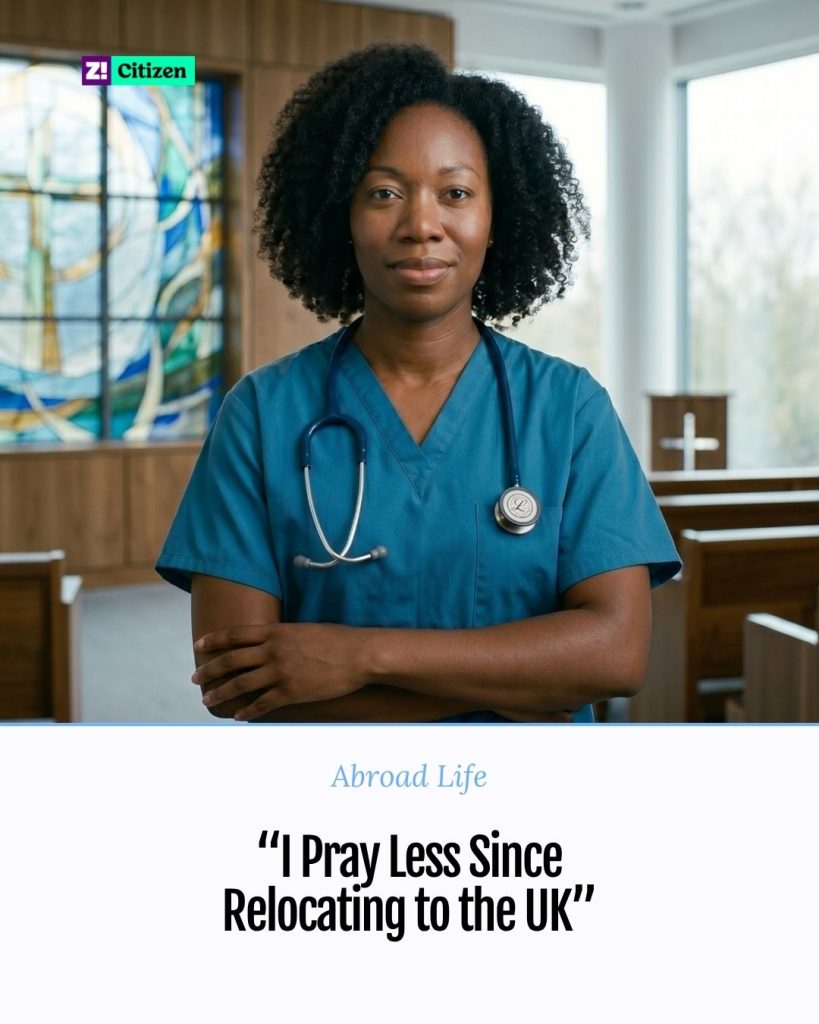
Success* (28) is a medical doctor who moved to the UK to escape insecurity and poor salaries. In this story, she shares her experiences with the culture shocks of British medical practice, racist microaggressions and why she finds herself praying less often since relocating to the UK.
Where do you live currently, and when did you leave Nigeria?
I live in the United Kingdom (UK), and I left Nigeria in early 2025.
What inspired you to leave Nigeria for the UK?
Everything. But let me start with the insecurity. I grew up in the northern part of Nigeria, so I saw firsthand the terrorism and religious intolerance. When I was young, there were times we had to be searched with bomb detectors before we entered church after a church had been bombed on Christmas Day.
Another catalyst for my relocation was the salaries for doctors in Nigeria—it’s just too little. When I practised in Nigeria, I earned ₦300,000 per month, and that was barely enough to cover my basic needs. In addition to the reason I mentioned, I had always wanted to leave Nigeria as early as my primary and secondary school days. I got a peek at what life was like abroad from friends who vacationed abroad with their parents.
It’s the reason I studied medicine. I knew that healthcare workers were highly sought after in many parts of the world. So I knew it would give me a good chance to leave Nigeria.
What was life like for you in Nigeria before you left?
Working in a private hospital, I was making about ₦300,000 a month. I was only able to afford a shared apartment with that. But it was a terrible experience. We only had electricity between 4:00 AM and 6:00 AM. So I had this huge power bank that I’d charge at work and in church on Sundays. That was how my life was in Nigeria; it wasn’t easy.
As you said, doctors are in high demand in many parts of the world. Why did you choose the UK?
I chose the UK because the migration pathway for other countries is quite expensive. Though we are highly sought after, the process doesn’t come cheap. The UK is relatively cheaper than other countries, but it still cost me about ₦7 million to migrate. That was because I passed my exams on my first try. Some people have had to write the exams twice or thrice, and that increases the cost.

The Naira Life Conference is returning on August 22, 2026, in Lagos! Come learn from finance experts and industry leaders, and partake in unfiltered conversations about building wealth and diversifying your income stream in a country like Nigeria. Real stories, expert advice you can actually use, and a community ready to build wealth together. Secure your spot here.
There are very few doctors in Nigeria, currently about one doctor for every 10,000 patients. Do you have any feelings about that?
It does bother me because I’m always thinking about my family back home. What happens when my parents or other loved ones need medical care? Here, people can walk into the hospital almost dead, and we’re able to get very good outcomes because we have all the equipment we need. It makes me think back to my time in Nigeria, where we didn’t have the equipment, and we didn’t even have enough hands. It makes me worry about my family, but I can only put them in my prayers.
I also think about the times when I was back home in Nigeria, when I couldn’t really take care of my basic needs—it was difficult for me to get a place, having a car could only be a dream, and I was basically living off my parents. I think about all of these things.
With the way the Nigerian government is running the country, I don’t think you can blame doctors for leaving. I don’t feel guilty because I know that the Nigerian political system did not create a conducive environment for us to stay.
Doctors spend a lot of time in school, go through a lot of difficult exams, and a lot of money is spent training us. But when we graduate, we get paltry salaries, worth next to nothing. A lot of doctors have to work in multiple hospitals to make ends meet. I did that too: I would work a morning shift in one hospital and then a night shift somewhere else. That’s the reality for many doctors in Nigeria.
Yes, Nigeria needs doctors. But leaving is the best option at this time. We want a good life for ourselves and our families. We want safe lives too. I’ve heard of doctors getting kidnapped back in Nigeria. It’s really crazy.
How has life been in the UK so far?
My life is much better compared to when I was in Nigeria. First of all, I have a better work-life balance. I don’t have to work two jobs just to make ends meet. There’s a 48-hour cap every week. You are not meant to work more than 48 hours a week. So this means I have time to do other things with my life.
I can afford my own place. I have savings and investments now, unlike in Nigeria, where I couldn’t afford to do either.
Food here is actually cheaper than back home. When I was in Nigeria, I always had anxiety about going to the market because the spaghetti I bought for ₦500 this month could become ₦1,000 the next. But here, prices are very stable. I think my life here is better. I can support my family more, and I have a better community. Overall, it’s just better.
What’s your support system like?
I don’t have any nuclear family here; I’m the first person in my nuclear family to actually leave Nigeria. I have some members of my extended family here, but we are not so close.
But I have my church members. I also go to the gym, and I’ve made friends there. I have friends at work too. I know some people say not to make friends at work, but I’ve had a different experience. I have really nice coworkers.
Now my support system is actually growing. I’m getting to know more people and becoming acquainted with my environment.
Are these friends Nigerian?
The majority of friends I’ve made here are Nigerians or fellow Africans. It’s just easier to make friends with people you share similar cultures and backgrounds with. For example, the town I live in is white-dominated, so once you see a Nigerian, there’s this internal joy that you feel. It’s like any Nigerian at your workplace is automatically your friend.
I think if you’re able to have non-African friends, that means you both must have a very strong bond for that friendship to actually work out, because you’ll have very little in common.
Have you felt any sort of discrimination or racism since you arrived in the UK?
I have, but it’s nothing overt. What I feel at times is what we call microaggressions. An example was when I was looking for a house; landlords would see my name,, noticed that it doesn’t sound British, so they wouldn’t call me for house viewings.
But at work, I don’t feel any form of racism from my colleagues or from patients. The National Health Service (NHS) has a strict policy against racism. If any patient is racist to any doctor, that patient can be ordered out of the hospital, as long as they don’t have an emergency condition. So patients are cautious about what they say.
It’s the same with colleagues from other nationalities who are non-African. I notice that whenever they are talking to me, they try to carefully pick their words because they don’t want to come off as offensive. I think that can also affect making friends with non-Africans, because they’re always second-guessing everything they say. That doesn’t allow for real connections to form.
What about the growing anti-immigrant rhetoric? Does that make you feel uncomfortable?
It has created a bit of uncertainty because the policies are constantly changing, and you don’t know which policy they will come up with next, or how it will affect you. The Prioritisation Act, for instance, basically says that UK-trained doctors have to be considered for jobs first before doctors from other countries. This was passed after I came here.
I’ve heard British doctors at work talking about how immigrant doctors are taking their jobs. Initially, when I came to the UK, I was always telling people that I got my job from Nigeria. But I noticed they were not really happy to hear that. It was more like, “Okay, you’re one of the people who took our jobs from us.”
I felt guilty about it for a very long time. But I had to deal with the guilt and tell myself that I got the job because I deserved it, and I worked for it. With time, I stopped telling people how I got my job. I only mention it to people I really feel comfortable with.
But one thing I always say is that there’s love at home. So if they say that I can’t stay here anymore, I’ll go back to my country.
Apart from working, what activities do you get up to in the UK?
I’m kind of an extrovert, so I spend more time outside than at home. During my free time, I go to the gym. I’m also learning how to swim. I sing, so I’ve joined the choir in church. I love going to shows too. During the summer, there are usually events happening around, like Afrobeats concerts. I usually go for those kinds of things.
I visit my friends, and my friends come over to see me. I travel, and it’s safe. I’ve always loved travelling, but in Nigeria, I couldn’t really travel so much because of the insecurity and the accidents. But here, the roads are freer, and it’s safer, so I travel easily without any restrictions or any anxiety that something bad will happen to me.
I also use my free time to bulk cook. You can’t be late to work; there’s a very strong work ethic here. So when I’m not at work, a huge chunk of my time is spent preparing for my next period at work. I clean my house, iron my scrubs, and cook in bulk so that nothing delays me when I’m going to work the next day.
What culture shocks did you experience when you arrived?
They like queuing. There’s a queue for everything. There was a time when I first arrived, and I wanted to jump the queue with my normal Nigerian mentality, and someone confronted me about it.
Another thing is that everyone tries to be polite. Unlike in Nigeria, where people show their anger. For British people, even when they are really angry, they smile, and they try to be calm. Trying to unlearn that Nigerian directness so you don’t get labelled as aggressive is not easy.
It’s also the same at work. You have to learn how they communicate. In Nigeria, we have a direct way of communicating; you can tell people exactly what needs to be done. But you don’t want to look patriarchal in the UK, so there’s a way you try to use flowery words: “Oh, would you like to do this?” “Do you think it will be okay if you do this?”
Also, unlike in Nigeria, where you can gossip and make some jokes at work, you can’t just make any type of joke here because it may be offensive to the next person. I miss the laidback work culture that we have in Nigeria.
As for the accent, when I came here initially, it was difficult to hear what people were saying. In Nigeria, I used to believe I had a very good command of English, but when I came to the UK, I was taken aback by people asking me to repeat myself because they couldn’t understand me. At times, I have to spell a word to make them understand my pronunciation of it. For someone who learned English as a first language back home, that was a big shock.
Definitely. How did you manage?
I try to speak as slowly as possible so that people can hear me, and I don’t get offended if someone tells me to repeat what I say. Also, I try to demonstrate. When I’m conversing with a patient, if I want to talk about any eye pain, I may just point to my eye so that they can easily get what I mean. I also avoid using big words or complex grammar and just try to use the simplest English possible, and that actually helps.
On a scale of one to ten, how happy would you say you are in the UK?
I’ll say 20.
Wow.
I feel that all the things Nigeria took away from me in 27 years cannot be gotten back in one year. It’s a journey, but so far so good.
I am happier in the UK. I’m less anxious, and I’m praying less. I know people might see that as a bad thing, but in Nigeria, most of my prayers were built out of anxiety: “Let me have food to eat,” “As I’m going to work, may an okada not crush my leg,” “May I not be kidnapped,” “May I not have an accident.” All those kinds of things. I don’t have those anxieties anymore.
Do you want to share your Abroad Life story? Please reach out to me here. For new episodes of Abroad Life, check in every Friday at 12 PM (WAT).
Click here to see what other people are saying about this article on Instagram