Someone you know has left or is planning to leave. 1,000 Ways to Japa speaks to real people and explores the endless reasons and paths they take to japa.
Since 2020, Dinma (28) has lived in every country she set her mind to. But she didn’t achieve that by wishing for it. In this story, she shares how she was able to leave Nigeria for Rwanda, Germany, and most recently, the UK.
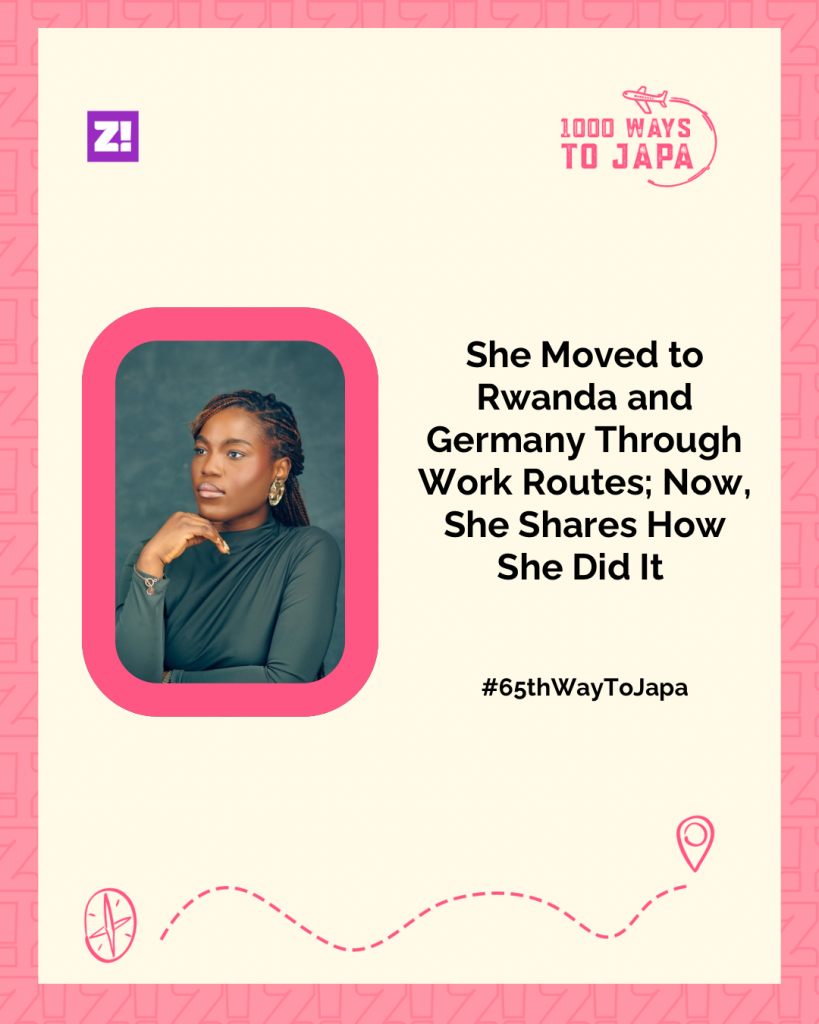
Where do you currently live, and when did you leave Nigeria?
I currently live in the United Kingdom (UK). I left Nigeria in March 2020, but I didn’t directly go to the UK. I first lived in Rwanda and Germany before coming here.
Nice. I’d like to know more about your journey away from Nigeria
Sure. Happy to share.
What were you doing in Nigeria before you left?
I was a Product Designer in Nigeria, and I still am.
What inspired your decision to move to Rwanda?
I left Nigeria for Rwanda because I got a job with an international company that has an office in Rwanda and Lagos.
Immediately after I graduated from university, I got an internship in Lagos, so I moved from Enugu to Lagos alone. After my internship, I got another job and worked there while waiting for my call-up letter from the National Youth Service Corps (NYSC). After I finished the NYSC camp, and it was time for the Primary Place of Assignment (PPA) routine, the company I was working for became my PPA
Towards the end of my service, I got a new job with a Nigerian company that had an office in Rwanda, so I started working there. After NYSC, I moved to their Rwandan office. After 1 year and seven months in Rwanda, I moved to Germany.
How did you get the job that took you to Rwanda?
A friend recommended me for it.
Can you walk me through the visa process for your move to Rwanda?
It was pretty easy. I was required to present a payslip from the company I was going to work for. Other things I had to present were the basic requirements for applying for a visa.
That sounds easy
Yes.
You stayed in Rwanda for nearly two years. What did you like about it?
My favourite thing about Rwanda was how clean and safe it was. Once, someone stole my money, and I got it back after I reported it to the Police. I didn’t have to pay them a dime to do their job. I really appreciated that.
What was your least favourite thing?
Things were quite slow in Rwanda, and I didn’t like that very much, especially coming from Nigeria, where everything is super fast. In Nigeria, you can walk into a restaurant and instantly get whatever food you want, but in Rwanda, you’ll wait an excruciating amount of time. They do love to take their time.
Why did you leave Rwanda for Germany?
I stayed in Rwanda for about two years. But I saw that the opportunity for growth in the country was limited, so I applied for jobs in some European countries; I got one in Germany, and off I went again.
How did you get the job?
I found it on LinkedIn. That’s where I found a majority of the jobs I’ve done.
What was the visa process like?
Since I was going to the country under sponsorship from a company, I was asked to provide an employment letter, a payslip, and a physical copy of my contract, which the company had to send down. Germans are really strict when it comes to visa applications.
I also needed to submit my birth certificate, proof of my address at the time, the basic documents you need for a visa application and others, which I can’t recall now. The company helped, too.
How so?
They provided me with some things from their end to help with the application. They also had their relocation agent help me prepare my documents for the visa.
A few weeks after I submitted my application, the visa came out. I picked up my passport, booked my flight, and left Rwanda for Germany.
I assume the company covered your travel expenses as well
No, they only covered my visa fees. But that’s not because it’s the norm; is because I didn’t know any better. I didn’t know I could negotiate my relocation package, so I didn’t ask for it. I was just excited to leave. I covered my travel expenses and accommodation in Germany.
Back then, people weren’t really open about how they got their jobs. But things are different now; you can find information about these things online.
I advise anyone looking to move from Nigeria to other countries through the job route to do their research and consider all factors when negotiating their salaries and relocation packages. I, for instance, did not consider what my salary would be after taxes and other deductions; I was just excited about what my take-home pay would look like.
What other things should people pay more attention to?
Let’s go back to the relocation package. Some of them cover travel expenses and an accommodation stipend for 1-3 months, depending on the company. So, people should do a thorough job of finding out what their company offers so they can utilise it and ease things for themselves.
Another thing people should negotiate is their salaries. First, consider if the job is remote or on-site, consider the cost of transportation in the city you’d be living in, then negotiate your salary in consideration of the information you’ve gathered. This does not mean you should outrightly tell them you want a certain amount due to the cost of the city where the job is located; it’s just something to have at the back of your mind.
You should also find out if the company has perks like lifestyle spending. There might be things that they give out on a monthly or yearly basis; different companies have different names for it, just find out if the one you’re applying for has them.
Also, find out if your learning budget, stock options, and Restricted stock units (RSUs) are negotiable. The negotiation shouldn’t end at your basic salary. It’s easy to fall into the trap of initial awe after converting your base salary to Naira, but things like cost of living will readily humble you.
What was it like living in Germany?
The first thing that comes to mind is my first day in Germany, which I can never forget. It was in the middle of winter, and my friend had told me to come with something cosy. In my head, I wondered how cold it could possibly be, seeing as I was coming from Rwanda, which was considerably colder when compared to Nigeria. I went to the airport wearing only a hoodie, and I got the shock of my life.
When we landed in Berlin, it was so cold that I had frostbite on my hands. When I got into my apartment, I didn’t come out till the day I resumed work. All my clothes were summer clothes, so I had to rush to Primark to buy a jacket. People were looking at me crazily in my summer clothes because Berlin gets really cold.
I’m sorry you experienced that
Thank you.
Favourite thing about Germany?
My favourite thing about living in Germany was having a blue card. The blue card is like a visa you get when you live in a European country. It allows you to travel to nearby European cities.
Another thing I absolutely loved about living in Germany was their Christmas markets. Winter in Berlin was usually cold and grey, and everyone was inside, but those Christmas markets made winter really enjoyable. We would go there, have some hot mulled wine, get on a ride, or do anything at all.
What else did you experience?
The language barrier. I had a good life in Germany, and I made a few friends, but in the long run, I realised I wasn’t open to learning the language, and I struggled with it. It was quite stressful; once, I got a letter that gave me a jumpscare, and it was all because it was written in German. I saw €6,000 somewhere in the letter and immediately assumed I was being asked to pay that. But when I translated it, it turned out they were merely informing me that my company would pay a certain fee they were supposed to pay. That was one of the things that made me conclude that I had to leave.
I get that. So, how did you leave?
The company I was working for had a London office, so I applied for an internal switch to the UK. I got it, but unfortunately, a week after it was approved, there was a massive layoff in the company, and I was affected. I immediately started panicking about my visa, so I had to think fast about an alternative.
A month before that, I had applied for the Tech Nation visa but was rejected. In the feedback I was given, they said I seemed like a hard worker but not much of a leader. I knew that wasn’t true and that they only saw it that way because I had presented myself solely as a hard worker. I used that feedback to apply again, and I got it two weeks later. After that, I applied for my visa, got it and moved to the UK, where I got another job.
That’s such a happy ending
Thank you.
So now you’re in the UK, do you still plan to move?
I don’t think so. I’ve moved a lot. I’d like to stay put for a while. I also love it here, so that helps.
I currently work as a Senior Product Designer for a UK company, and I enjoy what I do here. I have a few friends here, and I’ve built a community, so it feels like home.
I really enjoy working and living in London. I’m so grateful I moved here.
That’s beautiful. You’ve lived in three countries so far; how would you rate them on a scale of one to ten?
I’d rate Rwanda a seven. This is not because Rwanda was bad; it was a good place, but I just couldn’t strive for more there. The opportunity for growth was limited, and I couldn’t see myself living there long-term.
I would rate Germany an eight. Everything about Germany was good, but I couldn’t find my way around the language barrier.
Even when I managed to get by, I couldn’t really make friends because there aren’t a lot of black people and a lot of Nigerians in Germany. That is not to say I wanted only those groups, I just know it’d have been easier to make friends with people I already have things in common with.
There also weren’t enough places to get Nigerian food, so that was an issue as well.
Finally, the UK, specifically London, is an 8.5. London is super expensive, and Berlin is cheaper in comparison, but I’ll always choose London. I have a community here, and it feels like home.
Want to share your japa story? Please reach out to me here.
Click here to see what other people are saying about this article on Instagram