The presence of women or their involvement in different aspects of society has never been the problem. The challenge has always been visibility; how much of it they’re allowed, and how quickly it’s forgotten. In the political space, for example, women have been participating long enough that 50% representation in government shouldn’t feel like an aspiration in 2026. Yet at the 10th inauguration of the House of Representatives in 2023, just over 4% of the 360 members were women.
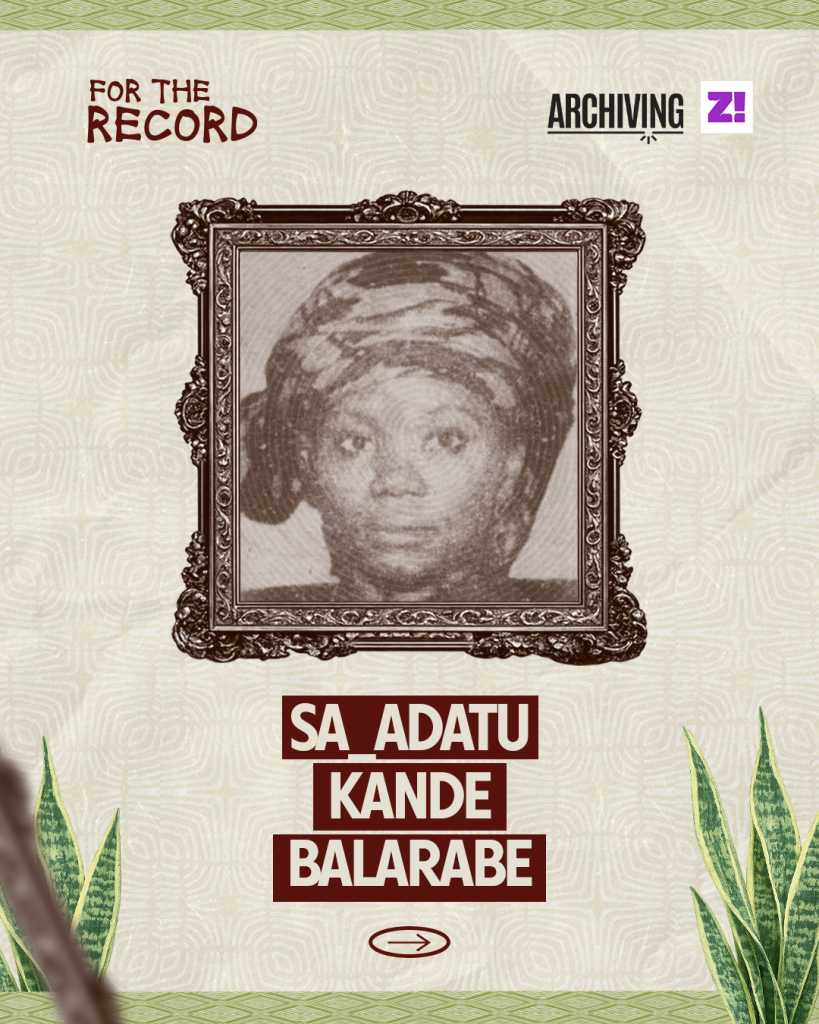
Forty years earlier, in 1983, the first three women were elected into the 450 constituted members of the House of Representatives in Nigeria’s second republic. One of them was Sa’datu Kande Balarabe.
She was born in Sierra Leone in 1951 to a Northern Nigerian businessman during the diamond boom that had seen Nigerians carve out a niche in the industry. Freetown was already home to the first secondary school for girls in sub-Saharan Africa, and its cosmopolitan culture promoted the belief that girls needed education to become ‘proper’ ladies, teachers, or nurses. Growing up in this culture and attending the Freetown Girls School, the high standard of English-medium education helped position Sa’adatu for opportunities abroad.
She went on to study at the Royal School of Nursing in London.
Earning a Nursing degree in the 1960s and 1970s was generally considered the gold standard for a woman. For Sa’adatu, who hailed from Northern Nigeria, where the cultural openness to girl-child education was low, it was a major achievement. Beyond the clinical training, her education likely included a grounding in administration and management, a shift traceable to the Salmon Committee report of 1967, which restructured nursing curricula to formally include leadership preparation. On her return to Nigeria, she rose to become president of the School of Nursing in Kano.
In 1982, she left nursing for politics.
It was a period of ideological growth in Nigeria where the burgeoning politics of the left were perpetuated in Nigeria by a group of progressive politicians, who patterned their philosophy on Marxist ideals.
Becoming the leader of the People’s Redemption Party (PRP) women’s wing in Kano, she would go on to serve in the Constituent Assembly from 1987 to 1989 under the Ibrahim Babangida regime, which would later annul the June 12, 1993, elections.
Sa’adatu was quite vocal about her disappointment at the annulment of the June 12 elections. In a gathering of opinion leaders and leaders of women’s associations at the Abuja women’s centre held on August 2, 1993, she expressed her conviction of how much of an injustice the annulment was:
“I believe in justice and equal rights, and you can’t have peace unless you have these. The election of June 12 was free and fair, and the results should have been announced.”
Expressing her strong opinions appeared to be a practice for Sa’adatu, especially on matters pertaining to the representation of women in the Nigerian political space. In the second book published by the Centre for Development and Population Activities (CEDPA) Nigeria series, ‘Women on the Move’, she is quoted saying:
“There is just one common constitution which does not discriminate between a woman and a man. I was in the Constituent Assembly, so that should be our focus. We have to refer to the constitution; only traditional values are hindering us.”
It is a statement that remains as true today as when she said it, thirty years ago. Sa’adatu spent her career living in that gap and refusing to accept it as permanent.