The Nigerian experience is physical, emotional, and sometimes international. No one knows it better than our features on #TheAbroadLife, a series where we detail and explore Nigerian experiences while living abroad.
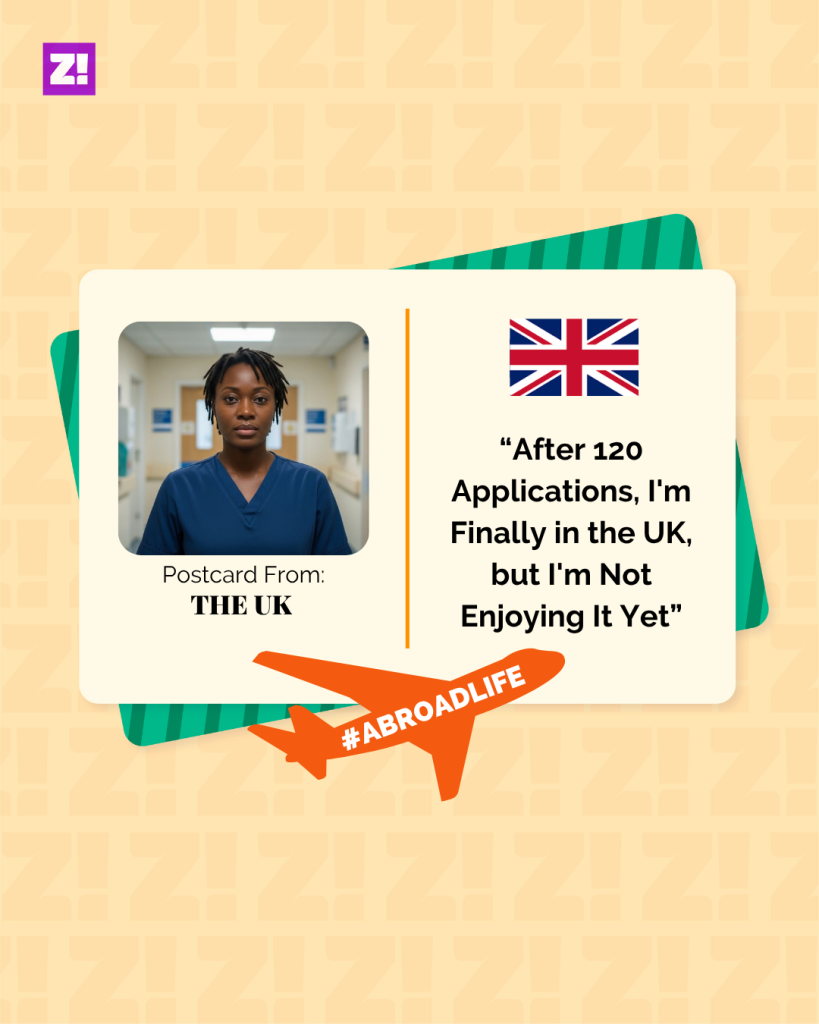
Kainene (28) sent over 120 applications before getting the job that took her to England. In this story, she shares why it was important for her to leave Nigeria, her experiences in England, and dealing with racism as a healthcare professional.
Where do you live now, and when did you leave Nigeria?
I presently live in England, United Kingdom (UK). I left Nigeria around mid-2023.
What inspired you to leave?
I really wanted a better paying job. So, when a colleague who had left told me they had gotten their move to England for a role in the National Health Service (NHS). I thought it was a great idea, so I started the process and eventually landed a job and moved.
What was life like for you in Nigeria?
I’ll say it was fairly steady. After graduation, I was briefly self-employed and worked on private practice gigs. After a year, I got my internship and did the mandatory National Youth Service (NYSC). Shortly after that, I got the last job I had before leaving Nigeria.
So my life back home was fairly steady career-wise, but the economy was failing, and I could sense that. Socially, I was not one to do a lot of outdoor things, so I didn’t have too many expenses. I was content. Thankfully, I also didn’t have to pay rent because I lived with my parents.
All of those factors gave me the sense that I wasn’t doing too badly. But the salaries from the jobs were just not sufficient. If the trend had continued, things would have gotten pretty bad. I didn’t wait to get to a point where I was absolutely frustrated with living in Nigeria, but I could just sense that I needed a plan to get out.
What was the process of leaving like?
Everything took about a year and a half from the time I heard about the opportunity to the time I left.
The process? I had to get a licence to practice in England. I did my research and found the registration link. There were certain fees to pay and a required list of documents, including the ones they needed from my university. I posted those over to England, paid the processing fees, and when they were happy, they informed me when to pay for the registration.
From my application to the registration took about six months. Once I got the license, I started applying for jobs and let me tell you, t’s a numbers game. I sent about 120 applications, and only got four interviews. Of the four, I got two offers, and I picked the one I felt was more favourable. My employer helped me process my visa application, and I just followed through until I travelled.
What was it like arriving in a new country?
I was curious to see what would happen. I was definitely expecting the change in weather, and it didn’t disappoint. I was ready for the cold, but I wasn’t sure how the people would be. I was hopeful that I wouldn’t experience racism, which is always a concern for anybody moving to a different country.
I also looked forward to seeing how I would survive as an adult because all the components of adulthood were happening to me for the first time in a different country. I was going to be living out of my parents’ house, so I was going to pay rent. Even though I had lived away from home for two years during my internship and NYSC, I didn’t have to pay rent then because accommodation was provided. Now, I was truly going to live alone.
I was also thinking about the new things I would learn working in a different healthcare system. Back in Nigeria, we heard great things about the UK’s healthcare system, and I was excited to see the positive differences.
What about your social life? How did you find the people?
My first exposure to people in the UK was in the work setting. My employers and co-workers were alright. People will be people anywhere in the world; some are immediately warm, some need a little time to warm up to you. I felt more settled and relaxed around my co-workers, but a bit anxious around the patients; there’s no obligation for them to be nice to me. They knew that and they used it.
There were times when people were rude and maybe racist. Working in healthcare specifically means you have to grow a thick skin because, all over the world, patients and their families can be tricky to manage.
Initially, I wasn’t focused on making friends. I was focused on learning the ropes and getting along with the people I had to be around most of the day. I just observed people from a distance. Sometimes I would take a walk on my free days or in the evenings and observe how people interact with one another and their environment.
You’ve had some time now. Where would you say you are with all these things?
Work-wise, I think I’ve blended in significantly. I’ve adapted to the system quite well; I’ve given myself time to learn and unlearn things, and I’m quite comfortable now. I know what to expect with various work scenarios. If I can’t manage by myself, I know how to escalate things to my seniors. There is still a lot more learning to do because I want to progress in my career, but for my level, I am quite confident and settled.
Socially, I’ve made a couple of friends. I started making friends locally, and when they moved to other areas, it allowed me the opportunity to visit other places.
Recently, because of my role, I have had to travel around to see my patients. That has got me to move around and see parts of the region away from where I live. You meet nice people like this. You might not necessarily become friends, but each person you meet teaches you something.
Do you have more British friends or more Nigerian friends?
I’ll say more Nigerian friends because most of the British people I meet are through work, and I like to separate work life from social life. I don’t consider my co-workers my friends. I only allow myself to make friends outside of work. If we work together, I automatically put a boundary on how far we can take our relationship.
Having mostly Nigerians is not because I don’t try to make British friends outside of work, but because friendship occurs more naturally when I see fellow Nigerians or other Black people. It flows naturally. I’ve made a couple of British acquaintances who are nice, but there is sometimes a limitation as to how far the friendship can go because of cultural differences. If either party isn’t deeply curious about the other’s culture, it just stays at a surface level.
Did you meet all your Nigerian friends in the UK?
I have a couple of friends who I knew from Nigeria, mostly people I went to university with, because most of us took the same route to relocating. They’re all healthcare workers, too. None of them lives close to me presently, so I communicate with them over the phone.
The friends I see frequently are those I actually met here in different ways. Some I met through mutual friends at social gatherings, and some through apps. The apps are just like dating apps, but for making friends.
Have you been back to Nigeria since you left?
No, I haven’t. If I’m being honest, it’s just due to funds. Ticket prices are quite high. I have channelled a lot of my finances into learning to drive and keeping a car. My job requires me to drive, so I had to take driving lessons. I learned how to drive a manual car, and it took a lot more lessons than I anticipated. That took a lot of money from my savings. I bought a car after I passed the test.
So, these expenses, along with supporting my family in Nigeria, have made me put visiting Nigeria on the back burner for now.
Do you ever see yourself returning to Nigeria permanently?
The short answer is no. But who knows? When making long-term plans, you have to have a reason; I currently can’t find a realistic reason for moving back. I left because the salary I made couldn’t cut it anymore, and things weren’t getting better. Why would I go back when those circumstances haven’t improved?
Have you experienced racism in England?
Yes. Sometimes it’s direct, sometimes it’s indirect. Most of these experiences come from interacting with patients. Sometimes you walk into their room, and they look at you in a way that shows they weren’t expecting to see you. They can be cold or passive-aggressive.
There are also times when people do things they don’t realise can be interpreted as racist. Like when they say, “Oh, your English is good. Where did you learn to speak English?” I have to tell them that English is the official language of Nigeria, and I’ve been speaking it all my life.
A co-worker once asked me if we have fast food chains like McDonald’s or Domino’s in my country. I’ve also been asked if we have ice cream and if we have air conditioning. It’s a lot.
The one that has the most effect on me is in professional situations. Sometimes you share ideas, and they don’t take them seriously because they don’t regard your experience or knowledge, since you didn’t train in their country. They just casually dismiss your ideas. And you know if the same idea came from a local, they’d have taken it.
Did you have any specific culture shocks?
Yes. It was the transportation, especially. I missed my appointments a number of times in my first few months. I would forget that I had to check the bus times. I would think I could just step out to the bus stop as I did in Nigeria and hop onto any moving bus. But that’s not how it works.
I would wake up and realise the bus that should have taken me had left half an hour ago, and the next one isn’t for another half hour. That took some getting used to. I had to start making strict plans and setting several reminders for myself.
The seasons were also different. I arrived in June, and on the first night, I noticed it was still very bright at 10:00 p.m. That was exciting to see. It mostly happens from spring to summer.
I was quite surprised by just how much people smoke here. Adults smoke, and teenagers vape. When taking medical histories, you hear of people who have smoked for more than half their lifetime.
The drinking culture shocked me, too. Going to the pubs purely for drinking is their way of relaxing. In Nigeria, our ideal fun was more about house parties or clubs with dancing, music, and games. There’s alcohol, of course, but it’s more about the activities. Here, they actually care a lot about the drinking itself. It surprises me how much they can fit into their bellies. It’s also like a rite of passage for young men to share a pint with their dads.
What has been your worst experience in England?
The worst experience would be learning to drive. A couple of driving instructors wasted my time and money. A particular one kept cancelling our appointments. She had a rule that I needed to give her 48 hours’ notice if I needed to cancel an appointment. But then she would call me to cancel a few hours before the appointment, and I would have already planned my schedule around it. When I complained, she became even more inconsistent, almost like she was punishing me.
When I finally decided to find a different instructor, I still had to chase after her for a refund, and even then, she only gave me part of my money. I was just so fed up with her that I just took it and left.
Sounds really unprofessional. What about your best experience?
The best experience was when I went to the Hull Fair. I got to go on a roller coaster and a Ferris wheel. It’s one of the greatest fun experiences I’ve had here.
On a scale of one to ten, how happy are you in England?
I’d say 6.6. I miss having proximity to my family. I wish I could see them more and go to Nigeria frequently. If I had the finances to travel more often, I think I’d be much happier because I could have that escape and reset around people I love.
I’m also waiting for when I will truly feel like I belong here. But I also fear I might never feel that way. I think even if you’ve lived here for 20 years, the moment you walk into a room, people judge you based on the colour of your skin. They first see your appearance, and it makes them see you as a second-class citizen, or even a second-class human, to be honest. It might never really feel like home.
I also feel like I’m constantly working. I come home from work, try to reset in a few hours, and then I’m working the next morning again. I haven’t really lived that “UK dream” that people imagine.
I remember a conversation with a friend in Nigeria about skincare products. She was talking about how living here means I have access to the original versions of the products. That may be true, but living here doesn’t mean you can automatically afford them. The enjoyment hasn’t started yet. I’m reserving the remaining three point five points for when I start to feel like I’m enjoying myself.
Do you want to share your Abroad Life story? Please reach out to me here. For new episodes of Abroad Life, check in every Friday at 12 PM (WAT).
Click here to see what other people are saying about this article on Instagram