Someone you know has left or is planning to leave. 1,000 Ways to Japa speaks to real people and explores the endless reasons and paths they take to japa.
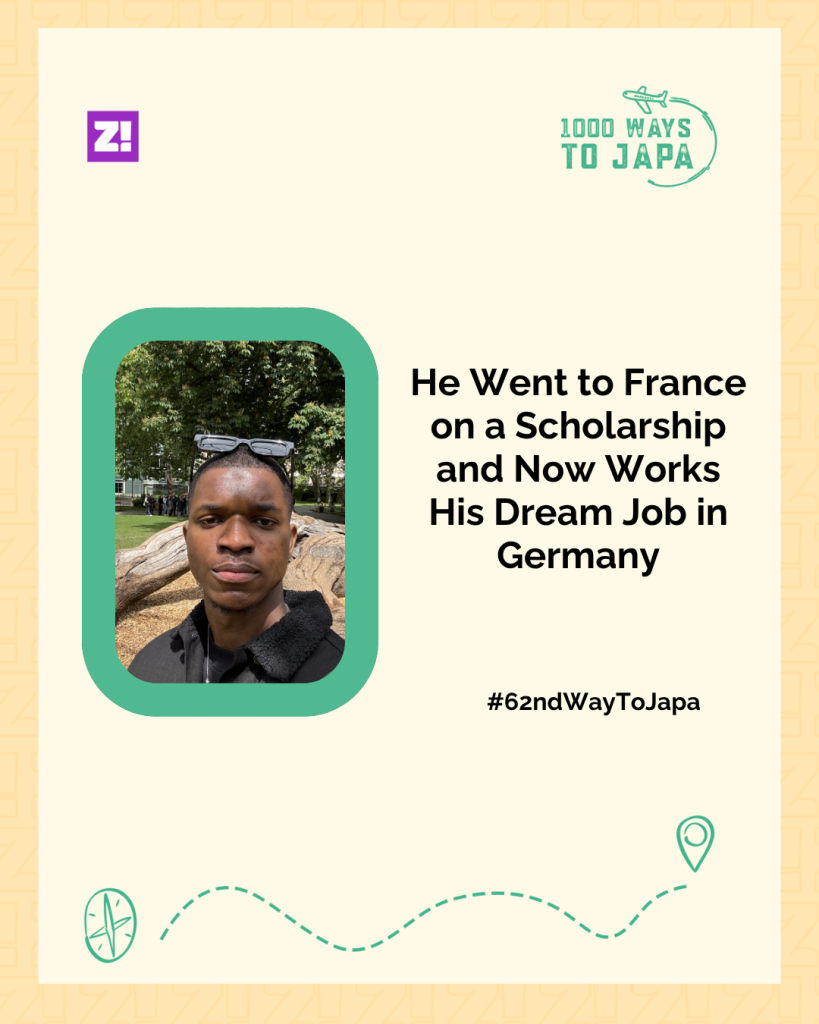
When Vincent (28) developed a passion for Sustainable Development Goals SDGs), he knew his best shot at building a successful career was a master’s abroad, so he worked hard and got a scholarship. In this story, he shares his processes, his journey and how he later landed his dream job in Germany.
Where do you currently live, and when did you leave Nigeria?
I currently live in Munich, Germany, but when I left Nigeria, it was for Paris, and it was in 2021.
What inspired your decision to move?
I was (and still am) passionate about Sustainable Development Goals (SDG), so I was primarily motivated by the desire to pursue a career in that path and partly by the wave of sadness that hit everyone after the outcome of the #EndSARS protests the previous year, 2020.
So, those were the reasons I left Nigeria to do a master’s abroad.
What did you study?
I studied International Management and Sustainability at Sciences Po University.
That’s nice. How did you fund your studies?
I got a 75% scholarship and made up for the rest.
What scholarship was that, and how did you find out about it?
The scholarship is called the Emile Boutmy scholarship, and it’s quite an interesting way how I discovered it; I heard about the opportunity through the MasterCard Foundation Scholarship, which I had initially applied for.
MasterCard Foundation usually partners with select schools for its scholarship. At the time, they had partnerships with schools in Europe. I wanted to study on the continent, so I submitted most of my applications to schools there. Sciences Po was one of them.
My application for the MasterCard Foundation scholarship didn’t turn out successful, but it had also been a blessing because I heard about my school through them, and they indirectly paid for my application.
How so?
After the MasterCard Foundation scholarship reviews your application, it gives you the go-ahead to apply to your school of choice, and it’ll pay for the application fee to enable you to seek admission there. If your admission is successful, you go back to MasterCard for further review of your application, then wait for a shortlist of your name if you made it.
I didn’t make the shortlist, but I had been admitted by the school board at Sciences Po. I deferred my admission by one year and applied again to the MasterCard Foundation scholarship. I still wasn’t successful. But then, I learned through people that there were other scholarships in France that I could access since I wanted to study there. I found out about the Emile Boutmy scholarship, applied and got a 75% scholarship.
This is such a nice turn of events. Love it for you.
It was. Thank you.
So, what was the application process like?
It was rather straightforward. Much more straightforward than the MasterCard application process. I don’t recall writing any essays, which was something I experienced when I applied to different scholarships, not just MasterCard.
For Emile Boutney, I was asked to upload certain documents, and that was it.
What were the required documents?
They asked for a degree certificate to show I had indeed obtained a bachelor’s degree, as I said I had. They also asked for my transcripts and a few other documents I can’t quite recall. But I remember it being so seamless. I think it was the only application I was able to start and finish in one day. I remember sitting in my brother’s room finishing it in one sitting.
After the submission, what’s next?
Once the documents get to the school, they review them and decide what percentage of scholarship to award the applicant— 75%, 40%, or 30%. There was no fully funded scholarship from that organisation at the time.
How long did it take to hear back from them?
It actually took a while to hear back from them. So much so that I had forgotten I applied. I was getting rejections from the scholarships I applied to, so I tried to apply to as many as possible. Emile Boutney was one of them. It also wasn’t top of mind for me because I really wanted a fully funded scholarship, and they weren’t offering one.
When the scholarship came, I had to seek advice from other people and also weigh my options. Deciding to go with it wasn’t an easy choice considering the exchange rate at the time, but honestly, I am so glad I made that choice.
That’s nice. What was the visa application like?
The visa process wasn’t so tedious. I got help from Campus France, a French Agency in Nigeria, which assists Nigerian students intending to study in France.
I took my offer letter to Campus France, and they provided guidance on the entire visa process. I wasn’t particularly alone. Campus France held my hand throughout the process; they do the same for everyone.
What documents were you asked to bring for the visa?
If I recall correctly, I was asked to bring my International Passport, proof of funds and my offer letter (to prove I had indeed gained admission and was headed there to study). It took about one month to get my visa.
Can you remember how much the entire process cost you?
I can make an estimate, and this would be based on the exchange rate at the time. If you’re talking about how much it cost me to move to Paris and fund the rest of my studies, I’d say ₦3.6 million. But I encourage people to do their own research, as the economy has drastically changed since then and the exchange rate with it.
Tell me about your experience at Scienses Po? Do you recommend it?
I fully recommend Scienses Po. It’s a top global school for political sciences and social sciences. In terms of alumni power, career opportunities, global reputation, and diversity, the school is up there. I definitely, definitely recommend.
How did you navigate your classes, seeing as you come from an English-speaking country?
All my compulsory courses were taught in English. There was the option of English and French for the electives. I also had language classes four hours per week, so I picked up French along the way. I am so fluent that it’s become my second language.
What’s your advice to people looking to get this scholarship or something similar?
I advise everyone to do their own research. We live in an era where information is easily accessible, even more so with the advent of AI tools. Take your time to do some research; do not outsource your research and application to third parties. I understand how things can be in Nigeria, but do not be in a hurry; take your time and do the work yourself. Ask the right questions, compare, contrast, and weigh your options carefully.
It’s also important to have a plan. I know things do not always go according to plan, but have one regardless. Having a plan would typically come from being knowledgeable and grounded about certain things, and also being eligible for them. All of these tie back to doing the job of research by yourself. Having vast knowledge will help you decide what’s best for you.
Be one step ahead and opportunity-ready as well. In my case, I knew I had to have an International passport, so I got one about two years before I started applying for scholarship opportunities. Have your transcripts and important documents ready, too.
So, Germany, how and when did you move there?
I finished my master’s programme in mid 2024 and moved to Germany in March 2025. I worked a bit in Paris, doing consulting. But I was also applying for jobs, and I didn’t limit myself to France; I applied to organisations outside of the country and got one in Germany, so I moved. I currently work in Sustainable Finance.
That’s so cool. Were you still on the student visa when you left?
Yes, I was. The visa was still valid at the time. I moved to Germany on a work visa, and that’s what I’m currently on.
What’s Germany’s work visa like?
It’s not a permanent thing; it has to be renewed. But unlike the student visa, which has limitations, it allows you to work any number of hours you’d like and do other things as well.
What’s it like living in Germany?
I am relatively new here, but thankfully, they speak English and have a lot more people open to speaking English than in France. So, even though I only started learning German, it’s been easy to integrate.
I also have hobbies like track and field. I’m part of a run club, and that has helped with my integration. I have a solid work-life balance, so I can’t complain. Life has been good here.
That’s lovely. What’s your favourite thing about Germany?
I like that I’m able to pursue my hobbies and have an identity outside of work; I don’t take that for granted, so it’s what I love the most about Germany.
Another thing is how easy it is to move around in Germany. My monthly transportation pass, for instance, enables me to go to cities within the country and a few European countries.
I also enjoy German cuisine and try it whenever I’m out.
So, yes, I love all these things and also love that I’m surrounded by people who have my best interest at heart.
On a scale of one to ten, please rate life in France and Germany
I will give France a solid eight. If you’re a student in France under the age of 26, you get to enjoy crazy benefits. I got rent support from the French government, my transportation was also subsidised, and so were groceries. I could go to a restaurant and get a solid meal for one euro because I was a student. Life was good there.
I suspect I’d have rated France lower because I was a student my entire stay and would have had to experience life there without those benefits.
For Germany, I’m inclined to give it an 8.5 even though I’ve only been here a year. I think my rating is biased by how safe my city is. In my first week here, I lost my wallet, which had all my bank accounts, on a train and did not realise until two days later. Someone found it, and I was able to retrieve it with everything intact.
That sounds great. I wish you the best of luck in Germany
Thank you.
Want to share your japa story? Please reach out to me here.
Zikoko’s HERtitude is back this April 2026. Grab your tickets here.

Click here to see what other people are saying about this article on Instagram