Someone you know has left or is planning to leave. 1,000 Ways to Japa speaks to real people and explores the endless reasons and paths they take to japa.
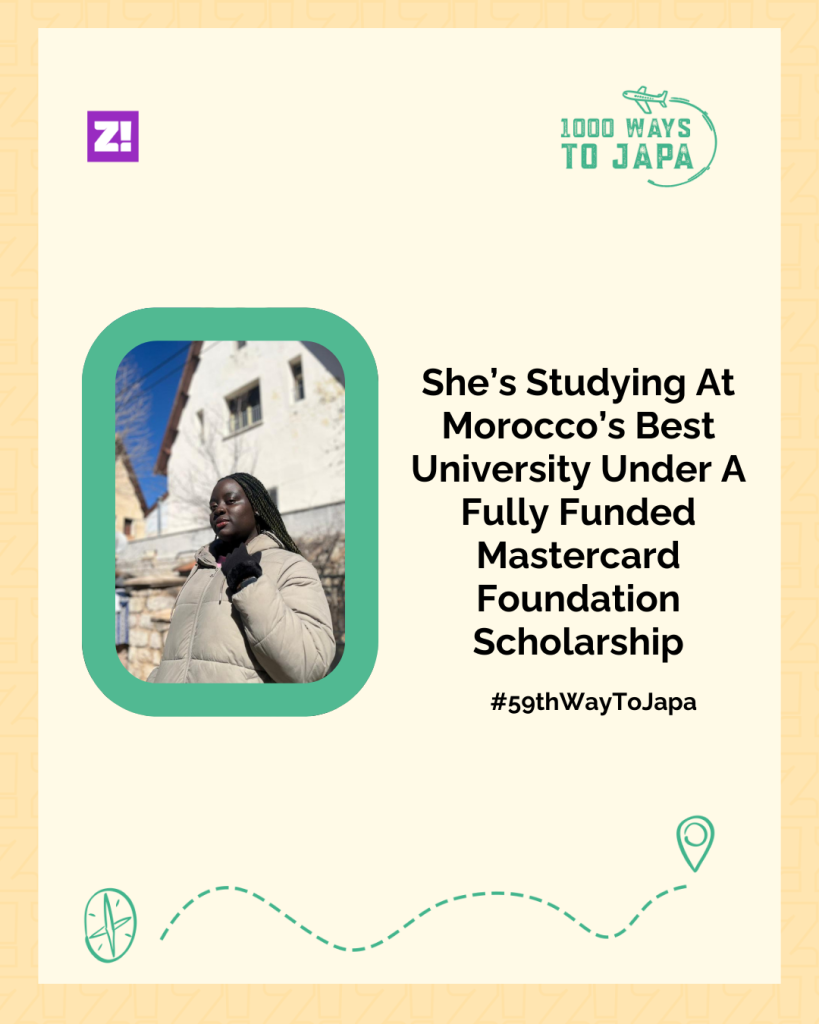
Tolani (25) always wanted to get her master’s degree abroad. So when a conference took her to the Mohammed VI Polytechnic University in Morocco, she knew she had found her school. In this story, Tolani shares how she secured the Mastercard Foundation scholarship and how she enjoys studying in Morocco.
Where do you currently live, and when did you leave Nigeria?
I live in Rabat, Morocco. I left Nigeria in October 2025.
What inspired your move to Morocco?
My master’s inspired me to move; I always knew I wanted a master’s degree, and I also knew I didn’t want to do it in Nigeria. I also knew later on that I wanted to do my master’s at my current school. Before last year, I had visited it twice for a conference, and during those times, I fell in love with the school environment and its systems. The fact that it’s also highly ranked—top 400 in the world, fourth in Africa, and number one in North Africa—strengthened my resolve. As someone who plans to work on the continent, I knew I would benefit from studying in a school with that regional context.
What’s the name of the university you attend?
Mohammed VI Polytechnic University.
What are you studying?
I’m doing my master’s in International Management,
Are you funding yourself?
No, I’m under a fully-funded scholarship.
Can you share more about the scholarship?
I initially got an 85% scholarship from the school itself. Along the line, I got a fully funded scholarship from the Mastercard Foundation, so I went with that instead.
Please share more about both scholarships
The 85% scholarship that I initially got from the school is called the FIRSI scholarship. It’s a needs-based scholarship, so you have to receive admission from the school before they can consider you for the scholarship. You have to submit a couple of documents and answer some questions for them to ascertain that you really need the scholarship. The percentage of funding you get can vary from 30% to 100%, depending on the outcome of the evaluation.
Do they consider your grades in the evaluation process?
The Mastercard Foundation scholarship does, but not entirely. The school admissions process definitely factors in grades in the evaluation.
You need to have gained admission into the school before you can apply for a scholarship. In my case, I applied for a master’s programme; I had a 2:1 grade, and I also had some work experience, which I think helped in the admissions process.
The FIRSI scholarship is divided into two categories: Social and Excellence. You’re eligible to apply for the social scholarship once you gain admission to the school. The questions they’ll ask you won’t be related to your grades, as you already went past that while applying to study in the school.
If you receive the Excellence scholarship, you’ll be notified at the same time you receive your admission letter. The Excellence scholarship is a little different; the evaluation is a combination of your initial grade from past studies and your performance through the admission process; this could include your score on the admission test and your interview. This means that someone with a 2:1 grade can get the scholarship.
The needs-based scholarship is quite competitive. However, if you’re able to prove that you need it, there’s a good chance you’ll get it.
So, how did you get the Mastercard Foundation scholarship?
A major requirement for the scholarship is that you must have already gotten admission into the school. I already got that, so I applied for the scholarship. Apart from my admission letter, I don’t think I had to submit any documents because I was already in the school’s system, and Mastercard Foundation was in communication with them. I was called for an interview; however, the questions I was asked had nothing to do with grades since I was already admitted; they were mostly about my motivations, leadership abilities, professional background, what I want to do next, and other such things.
It didn’t take long before I heard back from them. This could be different for other scholarships and other schools. I believe the response timeline they operated with might have been shortened because we were the first cohort of the scholarship in my school. I got a confirmation email from Mastercard Foundation a few weeks before I resumed school.
Do you work now? Are you allowed to work?
The programme is really intense. So even though I do one or two things on the side, I spend most of my time studying. I still do some community building and consulting work, but the majority of my attention is on my studies. Everything is paid for, so I don’t really have to worry about money. I just want to graduate with perfect grades.
Thanks for the insight about both scholarships. Can you shed some light on the application process to the school itself?
Sure. You need to gather all your documents for this. Please note that I’m speaking from a master’s perspective. You need to have your diploma, your transcripts, and a motivation letter.
Because Morocco is a French-speaking country, the school website is in French. This means you’ll have to translate the website to find the English equivalent of the things you need.
I also had to go to the court a lot to authenticate my documents because they always asked for verified documents. I had most of the required documents, but didn’t have a few. A community of Nigerian students helped me, and others, navigate the documentation process and translations here and there.
After the application process came the next stage- the test. I wrote an online test, which I passed. After that, I was called for a final interview, which had faculty members in attendance.
Can you share the specific things the Mastercard Foundation scholarship covers?
It covers my tuition, campus accommodation, a laptop, one round trip to my home country every year, a monthly stipend, and health insurance.
Do you have any tips for people interested in the Mastercard Foundation Scholarship?
I don’t have a lot of tips, because we’re the first cohort and the rules might change after us; however, there are specifics I can mention. First, the Mastercard Foundation scholarship in this school is for women. It’s not particularly so in other schools, but in Mohammed VI Polytechnic University, it’s for women.
Additionally, they’re looking for people who possess leadership and entrepreneurial potential, so you have to show that you have those.
Did you spend any money during this process?
Yes and no. The only money I spent was 5000 Moroccan Dirhams for my acceptance fee. But this was later refunded to me because I got a fully funded scholarship.
You mentioned having some work experience. What did you do in Nigeria before you left?
I was working in the international development space. I was also a community and programs consultant, also running some of the communities I built.
How would you advise people looking to come to Morocco via the study route?
If they’re undergraduates, I’d tell them to focus on getting good grades because it goes a long way. Try to get at least a 2:1 grade. I studied Structural Engineering for my bachelors and even though I didn’t love the course, I worked hard to get a minimum of a 2:1 grade because I knew I wanted to do my master’s abroad and that I’d like to do that with a scholarship. You can still get a scholarship with a 2:2 grade, but it’ll be more difficult.
You also need to have all your documents intact before you start applying for this scholarship. You can’t be interested in a scholarship without having your diploma, transcripts, and recommendation letters ready. Before I started applying, I went back to my department and got some of the lecturers I was friendly with to write me academic recommendation letters and also got other people to write professional recommendation letters. Some schools require two academic recommendation letters for further studies, while others allow one. But it’s best to have both.
I was also not randomly applying to scholarships just to escape Nigeria, and I don’t advise people to do this. I knew what I wanted within the context of my vision for my career, so I chose the school that best suited me. This intentionality will also come in handy when you’re trying to convince a school to select you for a scholarship. The Mohammed VI Polytechnic University, for instance, had over 90,000 applications last year and only accepted 1,300 applicants.
Additionally, it’d help to find a community of people also applying, so you can help each other out.
Do you plan to stay back in Morocco after your studies?
I might stay back, but I’m still undecided. Morocco is a really nice country. There are lots of lovely places to visit, it has a lot of culture, a lot of character, and it’s also pretty affordable.
How do you cope with studying in a French-speaking country?
The university has French and English-taught courses. During your application process on the website, you’re asked to indicate whether or not you’re fluent in French. The English taught options are not as many as the French taught options, but there’s still a considerable number of them to pick from.
I also don’t have any issues communicating with people in school because a lot of people here speak English. I also don’t have many issues outside of the school environment. On the few occasions that I encounter people who can’t speak English, I use Google Translate. I’m trying to learn French and the local language so I can be well-rounded.
Is there racism in Morocco?
I spend a lot of time on campus, and I don’t experience that here. You might meet one or two people who act a bit weird, but it’s not a constant thing.
I also haven’t experienced it much outside of the school environment. Morocco is a tourist country, so they’re used to having foreigners among them.
They’re unproblematic for the most part and will give you no trouble if you mind your business and don’t go around causing trouble.
My answers are not given to invalidate anyone’s experience. I just haven’t experienced a lot of racism here. It’s been a good experience so far.
Any culture shocks so far?
There have been quite a few. One of the first ones was the level of liberalism I saw here. Coming in, I knew Morocco was a Muslim country, so I was expecting everyone to be all covered up, but that was not the case. You can wear whatever you want on campus; nobody cares.
I was also surprised to see that they wash the roads. They literally use machines to wash the road; I hadn’t seen that before, so it was quite shocking in a good way.
Another culture shock for me was the affordability of life here; I don’t know what I was expecting, but I wasn’t expecting that.
What’s your favourite thing about Morocco?
The affordability I just mentioned. Things are so affordable here, and it’s really great.
I also love the fact that systems work here. I don’t have to worry about basic things and low-quality problems. There’s constant power, the internet is great, the trains and buses are mostly efficient, and things just work.
Love it for you. So what’s your least favourite thing about Morocco?
The cold is my least favourite thing. I fell sick for a couple of months because of it. But I’m used to it now, and it makes my skin glow.
On a scale of one to ten, how do you like studying in Morocco?
I would rate it a solid seven. My university is one of the best in Africa and in the top 400 in the world. The facilities are great, and for the first time in my life, I actually like school; that’s such a big win for me. I’ve also made some really good friends here, and it’s just such a beautiful country. It’s in proximity to Europe, so that’s a good thing for someone like me who loves travelling. I absolutely plan to maximise that.
Love that for you. I wish you the best in your studies and future endeavours.
Thank you so much!
Want to share your japa story? Please reach out to me here.