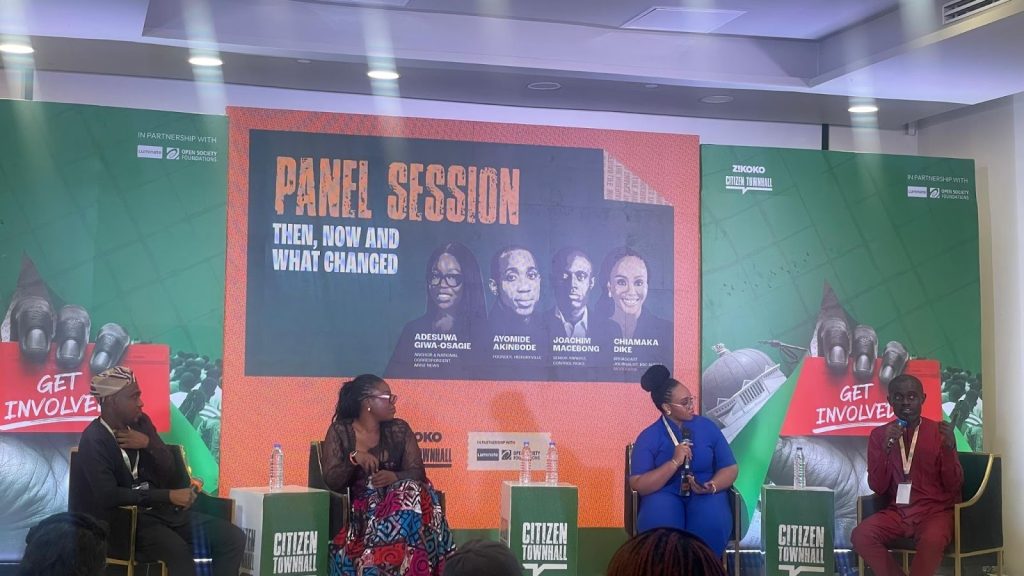
At the just concluded Citizen Townhall 2026, experts strongly challenged the existence of ‘the good old days’ in Nigeria’s history, emphasising critical thinking and active citizenship in creating what many thought had existed.
The Citizen Townhall, organised by Zikoko Citizen on 28th February 2026, saw over 200 Nigerians gather at the Four Points by Sheraton in Lagos to engage with the theme “Who Shapes The Nigerian Life?”
During the panel session titled The Nigerian Life–Then, Now, and What Changed, historians, data analysts, and policy experts dissected the structural failings that have led to a perennial sense of crisis. Moderated by BBC Africa Broadcast journalist Chiamaka Dike, the conversation quickly moved beyond simple nostalgia, identifying the 1970s as a pivotal era that established many of the country’s current institutional weaknesses.
Control Risks senior analyst, Joachim MacEbong, opened the dialogue by identifying the 1970s as the closest approximation to a golden era, though he noted it was a product of circumstance rather than sustainable planning.
“For me, I think that as far as Nigeria is concerned, the closest thing that Nigeria has to the good old days is the 1970s,” MacEbong remarked, attributing this sentiment to sky-high oil prices and a smaller population.
However, he noted that this period also sowed the seeds of future instability. “The biggest problem is the human capital development crisis… that cycle began in the 70s with the purge of the civil service.”
Adesuwa Giwa-Osagie, an anchor and national correspondent on Arise News, challenged the very concept of a “golden age,” suggesting that the perception of a better past is merely a reflection of a deteriorating present.
“There is no such thing as the good old days,” she said. “It’s been consistently getting worse.” She posited that the issues facing Nigeria today—corruption and lack of maintenance—are not new but are “bad behaviour recreating itself and building on itself over the last couple of years.”
Giwa-Osagie further urged citizens to stop personalising institutional failures and start holding local authorities accountable.
Ayomide Akinbode, Founder of HistoryVille, provided a historical breakdown of how policy shifts fundamentally altered the trajectory of the Nigerian youth.
He contrasted the early post-independence era, where “politicians improve the youth [and] see them as the future,” with the subsequent military era. “The military men came and said, ‘you are our boys now,’” Akinbode explained, noting that programmes like the National Youth Service Corps (NYSC) and the War Against Indiscipline (WAI) were designed to “discipline” rather than empower. He argued that this shift led to a modern era in which “present politicians manage” the youth to prevent unrest rather than fostering growth.
Akinbode attributed the failure of various government interventions to the lack of institutional permanence. “Institutions should not be based on the mood of the president or the mood of the political party,” he stated, adding that “our policies are good on paper, but to implement them is so hard or maybe impossible.”
Speaking further, Akinbode called for systemic change through consistent civic participation, as it’s the people, not “lucky technocrats,” who will ultimately ensure the success of policies.
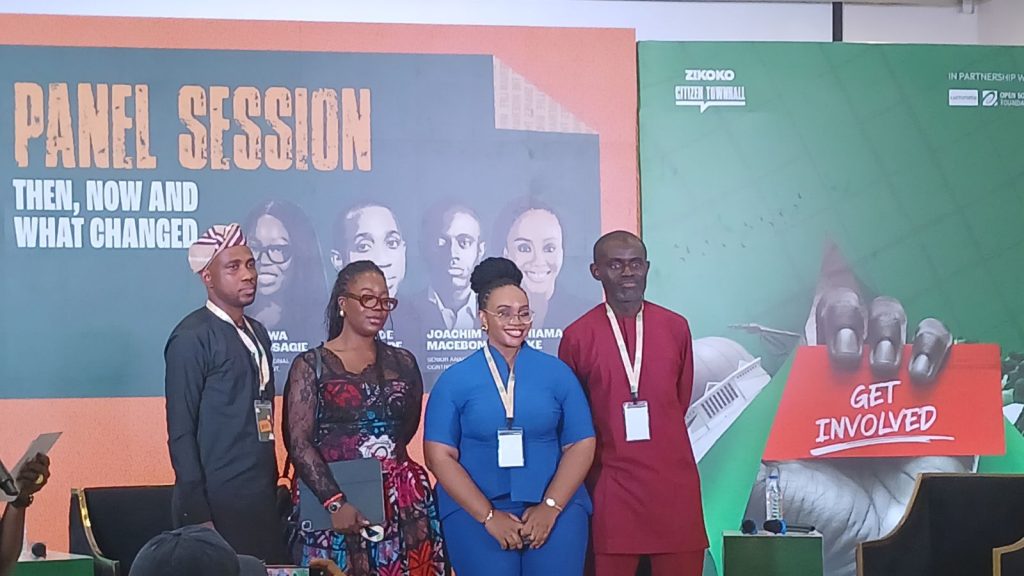
The panel ended with a direct appeal from MacEbong, who warned that the status quo would remain without sustained engagement over multiple election cycles. “If you guys don’t go out to the polls in 2027, nothing is going to change here,” he said.
The consensus among the speakers was that while the “good old days” may be a ghost of high oil prices and lower populations, the path to a functional future requires moving away from the “hustle” of managing crises toward the hard work of building institutions that can survive the whims of any single leader.