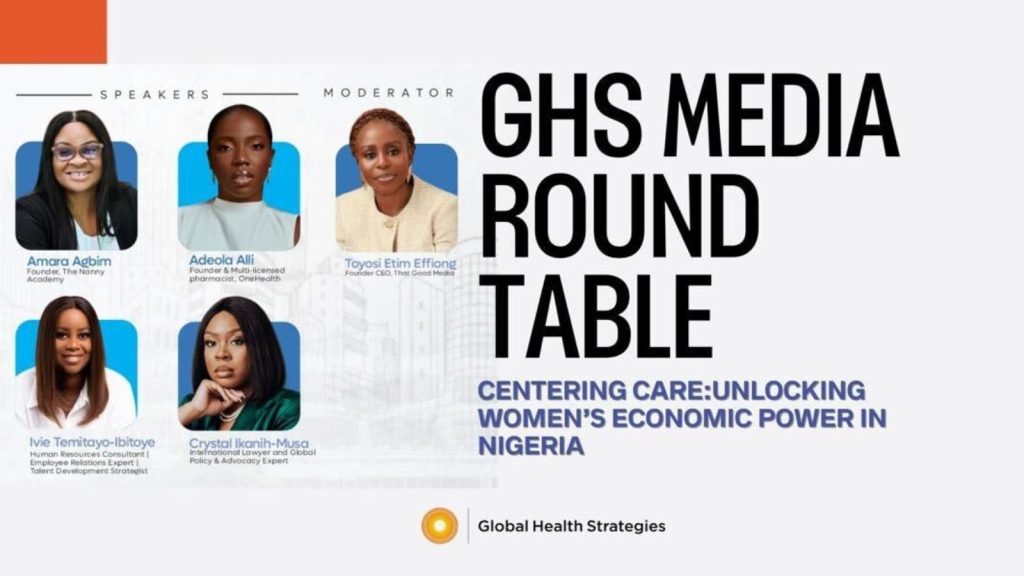
At the GHS Media Roundtable hosted by Global Health Strategies (GHS) in partnership with That Good Media, experts, advocates, and media professionals gathered to discuss the theme “Centering Care: Unlocking Women’s Economic Power in Nigeria.” The conversation spotlighted the urgent need to recognise, value, and structure the care economy as a cornerstone for national productivity and women’s empowerment, ahead of the International Day of Care on October 29.
Opening the session, Adeola Alli, a multi-licensed pharmacist and founder of One Health, a digital pharmacy improving last-mile access to medicines across Nigeria and Africa, shed light on the economic and social realities of unstructured care work. She noted that about 70% of care work in Nigeria — including raising children, caring for the sick, and supporting the elderly — goes unpaid, with the majority done by women. According to her, this imbalance represents both a disservice to women and a missed opportunity for the national economy.
“The global care economy could add 11 trillion dollars annually to the GDP if properly valued. Imagine what that could mean for Nigeria if we recognise caregiving as real work,” she said. Alli called for an economy “where care is capital and every act of healing becomes a driver of wealth.”
Building on this, Amara Agbim, the visionary founder of The Nanny Academy, emphasised the importance of professionalising care work in Nigeria and improving the working conditions of care workers. “Paid care work is essential but suffers from systemic undervaluation. Care workers today are often undocumented, underpaid, and subjected to excessive hours without contracts, social protection, or rest,” she said.
Agbim advocated for formal training and certification structures that would prepare care workers to enter the workforce with dignity and fair compensation — an initiative already being implemented through The Nanny Academy.
Taking the discussion further from a legal perspective, Crystal Ikanih-Musa, an international lawyer and global policy expert, noted that Nigeria currently lacks a national policy guiding the care industry.
“Without comprehensive, evidence-based laws that legitimise care jobs, the needs of women, children, the elderly, and people with disabilities will remain invisible,” she said. She called for the establishment of a national care policy that defines conditions, compensation, and rights for caregivers.
Speaking from a workplace perspective, Ivie Temitayo-Ibitoye, a Senior Human Resources Professional, addressed the realities of balancing paid work with unpaid care. “Care is work in itself and should be treated as such. It’s not a privilege people use to escape responsibilities — it’s a performance enabler, not a distraction,” she said.
Ivie also urged organisations to create systems that help women thrive at home and at work, while removing the stigma around employing professional caregivers. “We need to design structures that enable women to succeed in both spaces; their private homes and workplaces,” she added.
Concluding the roundtable, Toyosi Etim-Effiong, founder and CEO of That Good Media, who was the moderator of the media parley, charged the press to leverage storytelling to drive change. “The media has a huge role to play in shifting the narrative,” she noted. “The stories we tell shape society. If we keep raising awareness about the need to recognise and invest in the care industry, the policymakers and the decision makers will have no choice but to listen.”
About Global Health Strategies (GHS)
Global Health Strategies is a communication and advocacy agency that leverages partnerships to drive enduring change. With regional offices globally, GHS possesses a deep understanding of local contexts and extensive networks to facilitate impactful initiatives. Its strategic approach fosters collaboration with key stakeholders for effective health interventions.