• Every week, Zikoko seeks to understand how people move the Naira in and out of their lives. Some stories will be struggle-ish, others will be bougie. All the time, it’ll be revealing.


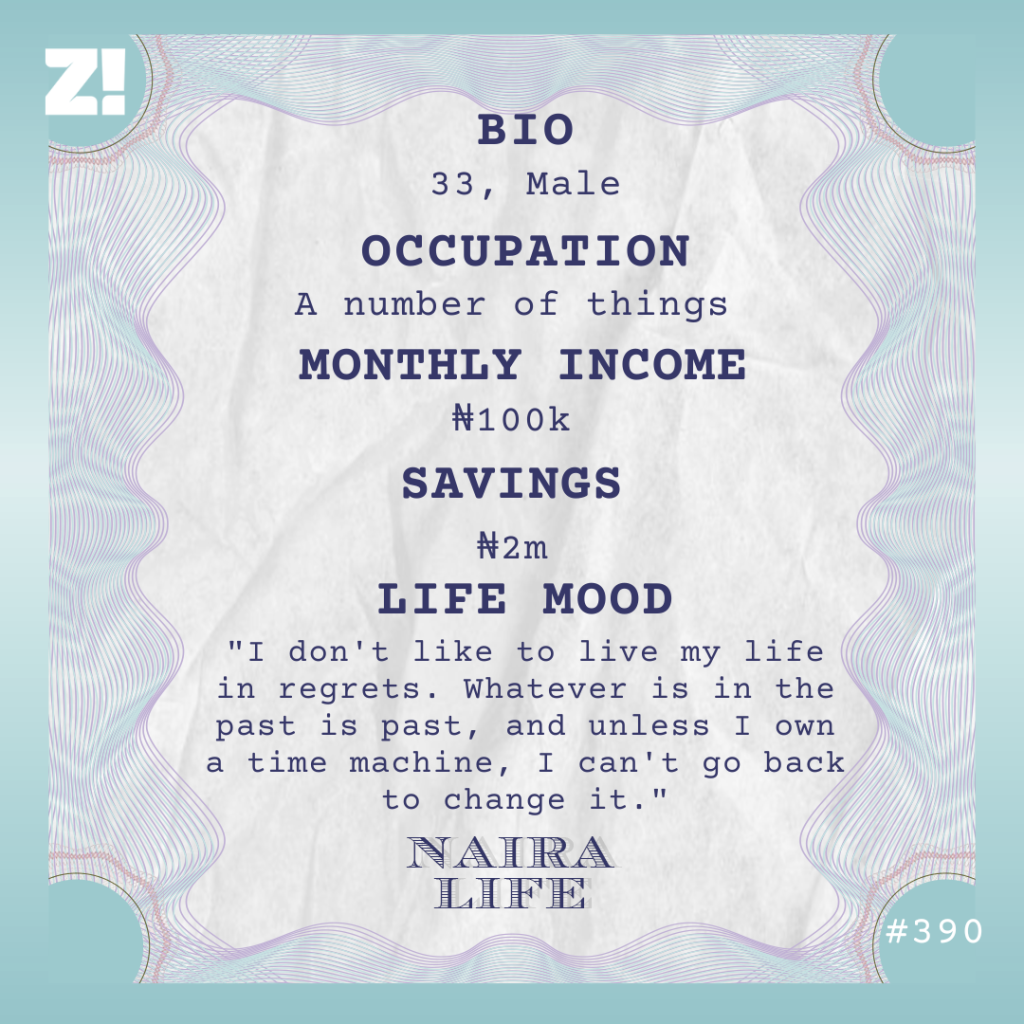
    NairaLife 382 bio

    What’s your earliest memory of money?

    I remember my parents giving my siblings and me ₦20 daily in primary school. It wasn’t big money, but it was the standard among my classmates. We used it to buy sweets and biscuits. 

    I also remember we celebrated special milestones, like birthdays or passing exams, by cooking chicken at home. It wasn’t like we only ate chicken on special days; it was just the sign that something good had happened, or that my dad was in the mood to treat us. 

    What was the financial situation at home?

    My dad was a businessman, and my mum was a teacher. Their incomes afforded us good schools and nice clothes. I vividly remember my mum travelling from Abuja to Lagos just to buy our Christmas clothes, so we weren’t poor.

    We weren’t rich, either. We had periods of lack and experienced the usual landlord kicking us out of the house for late rent and all that. My siblings and I were also driven home from school a few times due to unpaid fees or a lack of textbooks.

    However, even when we had money problems, my parents maintained a high standard. When we were sent home for school fees, they locked us indoors so the neighbours wouldn’t know. They also strictly forbade us from speaking pidgin English. People in our neighbourhood assumed we were wealthy but had hit a rough patch. My parents were just trying their best to raise us.

    When was the first time you did something to earn money?

    JSS 2 or JSS 3. During one holiday, my siblings and I organised lessons for younger children in the neighbourhood. At first, we did it for fun to pass the time, but the class grew to about 20 children. They paid ₦20 or ₦50 each, and we pooled the money to buy biscuits and other minor things.

    We also sold homemade “vim” around the same time. We ground eggshells and mixed them with ash and detergent. Then we sieved the mixture and sold it as scouring powder to scrub cooking pots. It actually sold quite well, considering we did it for fun. We dropped it after two months. I don’t even remember how we spent the money we made.

    The next time I tried something for money was during my diploma, just before university. I don’t know if it counts because it was so short-lived.

    Tell me about it

    It was 2016, and my sister and I were running a diploma programme to get us into uni via direct entry. We lived together away from home and didn’t have a structured monthly allowance. My parents just stocked us up with foodstuff and provisions. We called home if we needed money.

    However, there was one period when we were incredibly broke and hungry. Out of desperation, I took a job at a local restaurant. The pay was ₦5k/month, but my main motivation was the free food. I served food, cleared tables, and washed plates, and in addition to the salary, my employer gave workers breakfast and dinner. 

    I didn’t last more than a week there, though. It was so stressful, and it only took me a few days to realise I couldn’t survive that life. So, I gave them a random excuse and stopped going. I didn’t lose anything because I just wanted to eat, and I did.

    After that incident, I finished my diploma and moved on to uni. I didn’t need to do anything for money until I graduated in 2022 because I was getting pocket money.

    What did you do next?

    I got a job as a special needs teacher. The salary was technically ₦20k/month, but the school remitted only ₦18k to me. They held the remaining ₦2k to save and return it as a lump sum whenever I resigned. I think it was like a pension arrangement. 

    A few months in, I approached the school director and asked for a raise. The woman was quite nice. She agreed, and my take-home pay increased to ₦25k/month. I worked there for eight months and eventually quit when I got tired. I didn’t like the way the teachers struggled to survive. 

    They were trapped in a cycle of collecting salary, spending it all to clear debts, and borrowing again until the next payday. Some teachers would be in school by 7 a.m., work till 3 p.m. and still do private tutoring for extra money until 7 p.m. I knew I didn’t want that life.

    Did you secure another job before you quit, though?

    Somewhat, but it wasn’t exactly a job. Just before I left the school, I got an opportunity with the National Population Commission (NPC) for the proposed 2022 national census. I trained as a Specialised Workforce (SWF) facilitator. If the census had held, my job would have been to train the enumerators.

    The facilitator’s training lasted two weeks, and they paid me ₦171k. Then we started hearing stories of embezzlement and corruption, and the operation was suspended. Later, we heard the census was back on, and we did a three-day refresher training. I made ₦46k from that. However, things scattered again and the census eventually didn’t hold. Some facilitators have actually not been paid to this day. Fortunately, I got mine.

    When it didn’t work out, I decided to go for NYSC. This was in 2023. My Place of Primary Assignment (PPA) was at a government parastatal, where I mostly did admin work.


    The Naira Life Conference is returning on August 22, 2026, in Lagos! Come learn from finance experts and industry leaders, and partake in unfiltered conversations about building wealth and diversifying your income stream in a country like Nigeria. Real stories, expert advice you can actually use, and a community ready to build wealth together. Secure your spot here.


    What was your income like during the service year?

    The parastatal didn’t pay corp members, but luckily, I was posted to the office of a lawmaker representing my home constituency. He graciously decided to pay the corp members a ₦30k stipend on top of the ₦33k NYSC allawee.

    In May 2024, one month before rounding up my service year, I started a business selling wristwatches. The business really pushed me out of my comfort zone because I’m naturally shy, but I had to pack my watches in my bag and knock on random office doors to sell. 

    My efforts paid off, though. The profit margin on each sale was high. I could buy one piece for about ₦10k and resell it for ₦22k or ₦25k. I just had to make sure the watches were non-tarnishable so I could build trust and get returning customers.

    In slow months, I made ₦50k to ₦80k, but in peak months, I cleared ₦100k to ₦150k in profit. 

    What happened after you completed your service year?

    I continued the business since I was still at the office. They’d asked if I was willing to stay on and work full-time, and I excitedly agreed. I even told my mum that our prayers had finally been answered and that my life was changing for the better.

    I assumed that, since it was a government agency, I would make good money. However, at the end of the month, they paid me the same ₦30k stipend I was getting as a corp member. 

    I questioned it, arguing that as a full-time employee, I deserved a proper salary. After dragging out the issue for two months, they added a mere ₦10k, bringing it to ₦40k/month under the title of “Office Assistant.” 

    I did everything from managing the website and compiling lists of over 1,000 names for empowerment programmes to working as the office errand girl and dishwasher whenever guests came to eat. I tolerated it until late 2025 because I had no other options, all while applying for jobs everywhere. I was also still selling my wristwatches. 

    My breaking point came when a position opened up within the office, and instead of giving it to me despite my experience, they nominated a new guy. When I found out and challenged them, they said he was “a man and had more bills to pay.” 

    The heck?

    See. The blatant misogyny was so annoying. Unknown to them, I had been quietly training on the side for a remote debt-collection and customer-support gig. 

    The agency was recruiting people to work for a US-based brand, so the idea was that after the training, I’d get the job. So, when that issue at the government agency happened, I stopped going to the office.

    The remote gig was temporary, though. I did the onboarding and worked for one week, earning ₦75k. Unfortunately, the company suddenly decided to lay off their Nigerian contractors, so I was let go.

    While that was happening, the government agency realised they couldn’t handle the workload without me. They begged me to return, saying they’d removed the guy’s name from the nomination list and put mine instead. They also claimed the job would click within a few months and that my pay would increase. 

    I agreed to return, but on my own terms: I only went in twice a week. Half the time, I only went to the complex to move around and sell my wristwatches because it was the business that kept me afloat.

    Did the government job eventually click?

    It didn’t. I left in January 2026 when I got another job as a personal assistant/secretary to a consultant. My new salary was ₦150k/month.

    At this point, my wristwatch business had slowed down due to a lack of customers. Sadly, the new job turned out to be another misrepresentation. I was promised a project management path with opportunities for interstate travel. Instead, it turned out to just be me running personal errands for my boss all day. I wasn’t satisfied with that. That’s not what I came to this life to do.

    Even worse, the salary payment structure was highly inconsistent. One month, it would come on the 2nd; the next month, on the 11th. I had even spent ₦50k upgrading my laptop’s hard drive from an HDD to an SSD in January because she claimed I would handle some projects remotely, but I never ended up using the laptop for anything meaningful.

    Sigh

    Between April and May, I requested a formal review of my job description so we could align on my actual professional duties. My boss took it as a personal insult and told the mutual connection who introduced us that I was being disrespectful and that she was going to fire me.

    She then went on an unannounced international trip for over a month. I kept showing up to an empty office, reading on my laptop, and sending daily “activity reports” on absolute nothingness just to fulfil righteousness. Before travelling, she intentionally told our mutual contact that she would pay my May salary early so I would “spend it and waste it” before my birthday in June, after which she’d fire me.

    She returned, paid my June salary on July 2nd, and officially fired me on the 10th.

    That’s terrible. How are you handling the sudden loss of income?

    Honestly? I felt relieved. The environment was draining, and I wasn’t growing. I was already exhausted and deeply unhappy with that phase because it wasn’t what I had imagined for myself. The only small positive was the money.

    To keep myself from slipping into a depression or wallowing in anger, I woke up early the following Monday, dressed up sharply, and went straight to a friend’s office at the government agency. I tweaked my CV and have been actively submitting it to different offices and places ever since.

    Do you have savings to fall back on?

    I don’t have any savings. Between the high cost of transportation, black tax and data, it was impossible to keep anything aside. In fact, the very month I received my first ₦150k salary, my phone spoiled. I had to get a new phone through a Buy Now, Pay Later platform. For the next four months, I was paying about ₦50k/month to complete the payment. That money was supposed to go into my savings, but it went into the phone instead.

    Before that, on the ₦40k salary, saving was completely out of the question. Even with the wristwatch business, there was no real structure. I spent the money as it came. If someone bought a watch, I’d immediately use the cash to cover my transport to my main job. 

    I’ll admit that I’m not a big saver. When I really need to keep money away from myself, I have to give it to someone else to hold for me. I used to have a savings app on my phone, but I would always end up going back into the app to withdraw the money. The inconsistency of my income and the sheer cost of things made it hard. Even if you don’t buy big things like clothes, shoes, or hair, you become an adult, and people start looking up to you. Siblings or family members can just ask for ₦3k or ₦5k, and as an adult, you have to turn up for them.

    Can you break down what your expenses used to look like?

    NairaLife 382 expenses

    I live in Abuja, and transportation is a major cost. There are frequent price hikes. Sometimes I had to borrow money from my mum to cover expenses before salary day.

    Pending when you get another job, what’s the plan for day-to-day survival?

    My family is very supportive. I live with my family, so I don’t have to worry about rent or food. It’s just adult things like going out with friends that I can’t afford right now. I’ve even had to ghost most of my friends to avoid the pressure of spending money I don’t have. 

    I believe this unemployment is just a phase, though. I’ll keep searching and hoping for the best. I’ll be alright.

    Fingers crossed. What would be the ideal monthly income you’d expect from a new job?

    ₦300k – ₦400k

    Is there anything you want right now but can’t afford?

    Many things, but mostly the independence of not having to worry about money. I just want to have money for its own sake. I have people who have helped me that I want to be there for, like my mum, but I can’t afford to do anything for them. It’s a concern for me.

    How would you rate your financial happiness on a scale of 1-10?

    4 or 5, even though I really feel like it’s a zero. At least, I have a roof over my head. But there are many things I can’t do because I don’t have money.

    When things finally fall into place, that number should go up to 9 or 10, especially when I am able to make my mum proud and improve the lives of the people around me. For now, I’m continuously applying for jobs and hoping for better days.


    If you’re interested in talking about your Naira Life story, this is a good place to start.

    Find all the past Naira Life stories here.

    Subscribe to the newsletter here.

    Get More Zikoko Goodness in Your Mail

    Subscribe to our newsletters and never miss any of the action

  • The topic of how young Nigerians navigate romantic relationships with their earnings is a minefield of hot takes. In Love Currency, we get into what relationships across income brackets look like in different cities.


    Interested in talking about how money moves in your relationship? If yes, click here.

    How long have you been with your partner?

    Seyi and I have been together since September 2024, so that’s almost two years.

    How did you and Seyi meet?

    We were co-workers. He was already working at the company when I resumed in late 2023, but we worked remotely and were in different departments, so we didn’t cross paths.

    Six months after I started working there, the company laid off staff because of a “restructuring”, and I was affected. I was devastated, especially because I’d left my previous role for the job. Seyi was one of the few coworkers who entered our DMs (the other affected employees and me) to sympathise with us. He took it a step further and promised to send me job openings. I didn’t take him seriously, though. 

    I assumed it was just one of those nice things people say to make you feel better, so while I gave him my WhatsApp number for the promised updates, I wasn’t really expecting him to send anything. But he did. He constantly sent me job vacancies and even helped me revamp my CV.

    That’s so sweet. I gather romance wasn’t on the horizon yet

    Friendship came first. He became the person I ranted to about job applications and interviews. After a while, we realised we had a lot in common. We swapped movie recommendations and song playlists. 

    In August 2024, about two months after I was laid off, he invited me to his brother’s wedding. I remember seeing him at the wedding and thinking, “This guy is actually fine o.” Apparently, he thought the same, too. The vibes shifted after that. We stopped communicating on a “just friends” basis and transitioned into a talking stage. 

    A month later, he asked me out, and we officially started dating.

    Were you still unemployed at this time?

    Very unemployed. I got some virtual assistance gigs here and there, but nothing significant. To make matters worse, my rent was up, and I didn’t have money to pay. I had to endure a few months of squatting with friends all over Lagos because I didn’t want to return to my parents’ house in Ogun State. 

    Seyi was very helpful during this period. He was always sending me random ₦20k almost every week and said it was “so you can focus on job search without worrying”. He essentially bankrolled me. 

    I finally got a job in January 2025, but then I had an issue with the friend I was staying with and had to leave. I didn’t have any money to rent a new place, so I started living with Seyi. It was supposed to be for a few months until I saved enough or got a loan from my siblings to get a new place, but you know how Lagos housing is. Finding a reasonable place that wasn’t expensive as hell took forever. I just moved out in May this year.

    So you cohabited for over a year. What was the financial dynamic like?

    Seyi paid for almost everything. My job was on-site for the most part until I resigned early this year to face virtual assistance. That meant I often returned home late, too tired to cook. So, we mostly ordered food, which Seyi paid for. He also handled other expenses, such as fuel and utility bills. 

    I assisted in my own way, though. I did the chores, chipped in for fuel sometimes, and bought foodstuff for the few times we cooked. 

    Sounds like you both found what worked for you. Was living together all smooth, though?

    For the most part, yes. But of course, there was the occasional friction. One thing we often argued about was Seyi’s tendency to keep the apartment messy. It was almost like he was allergic to picking up after himself. I thought that was wild. How can you be an adult, and someone has to remind you to clean your space? So yeah, we fought quite a lot about that. 

    One time, I was so pissed, I left the house, threatening not to return unless he washed the plates. It took him a few days of dragging it out, but he eventually washed them, and I returned.

    Another source of friction was his spending habits. Before we started living together, I thought he was simply being generous to me because we were dating. After I moved in, I realised that’s how he generally spends money. 


    The Naira Life Conference is returning on August 22, 2026, in Lagos! Come learn from finance experts and industry leaders, and partake in unfiltered conversations about building wealth and diversifying your income stream in a country like Nigeria. Real stories, expert advice you can actually use, and a community ready to build wealth together. Secure your spot here.


    How so?

    Seyi is the type to send money to every health fundraiser he sees on Twitter. One time, he went out to buy fuel and returned home with an empty keg. When I asked why he didn’t buy fuel, he said he’d given the ₦10k to a friend he saw on the way. That was the last ₦10k he had at home and abroad. I had to bring out money to buy the fuel.

    Besides his need for generosity, he spends a bit carelessly. He can see a shirt he likes and buy it on the spot, forgetting there’s such a thing as budgeting for the month. If you ask him why, he’ll be like, “But I need this thing. It’s not like I’ll buy it again tomorrow.” I’m not sure if he understands the difference between a need and a want. 

    He doesn’t save or plan his money. Once it enters his hand, he spends it freely if a need arises. Overspending is the only word for it. It’s like he doesn’t even think of emergencies. It’s particularly worrying because, since being laid off, I’ve been intentional about my finances. He knows I’m always talking about savings and investment options, but he doesn’t seem inclined to change.

    Is that a potential dealbreaker for you?

    It might be. He’s perfect in every other area, but I can’t help thinking finances are important too. Imagine being married and never being at peace because I’m worried my husband will spend our children’s school fees or use the rent to buy a new car. 

    It’s one reason I was deliberate about moving out of his place. It would have been easy to stay there, given the opportunity to save even more of my income. But I didn’t want a situation where I’d be too relaxed, and if, at any point in the future, I realised our financial differences were too much, I wouldn’t be able to leave because I was living with him.

    So, while I’m talking to him and hoping he grows up soon, I’m prepared to leave the relationship if it comes down to it. I don’t foresee a positive future with an overspender who doesn’t plan his finances. Hopefully, things change.

    What do relationship expenses, such as dates and gifts, look like for you both right now?

    Seyi is really good at giving intentional gifts; I’ll give him that. I only need to mention I need something in passing, and he gets it for me. Sometimes, he just notices I might need something and buys it for me. A few weeks ago, I complained about headaches from constant laptop use, and he bought me anti-blue light glasses.

    I buy him things he might need, too. I noticed he was constantly wearing one pair of palm slippers, so I spent ₦20k to buy him another pair two months ago. We really just gift each other like that.

    You mentioned becoming more financially conscious. What does your safety net look like now?

    I try to save between ₦50k and ₦200k monthly, depending on my income. Then I divide it, putting one half into my mutual funds and the other half into my regular savings. Altogether, I have about ₦850k in my portfolio.

    What’s the ideal financial future you’d like for you and Seyi?

    I’m still worried about whether we even have a future. But if things work out, I have a couple of business ideas I’d like us to try. First on the list is building shortlets across Lagos. That business is a goldmine.

    Interested in talking about how money moves in your relationship? If yes, click here.

    *Names have been changed for the sake of anonymity.


    NEXT READ: He Thinks Women Shouldn’t Work, but I Can Change Him

    Get More Zikoko Goodness in Your Mail

    Subscribe to our newsletters and never miss any of the action

  • Every week, Zikoko seeks to understand how people move the Naira in and out of their lives. Some stories will be struggle-ish, others will be bougie. All the time, it’ll be revealing.


    Naira Life 381 bio

    What’s your earliest memory of money?

    When I was in primary school, my dad unexpectedly pulled me out of public school and enrolled me in a private one. It may have been because he got a new job at a company with a staff school. Also, I think he saw my academic potential. I have five siblings, but I was the only one who switched to private school. Even as a child, I could tell that the school fees were extremely high compared to his salary.

    The switch was the first time I realised that some people have significantly more money than others. Suddenly, I was surrounded by rich men’s children. Their parents drove them to school, and their pocket money was on a completely different level.

    What was the financial situation at home?

    My dad was a driver, and my mum was a serial entrepreneur who sold everything from pure water and ice blocks to zobo and food. I remember her enterprises sometimes led to small fights because she’d return home late, and my dad didn’t like it. He wanted her to be a housewife, but she insisted on having her own money. She hated the idea of a woman having to wait for her husband “just to buy matches.”

    We never lacked the basics. My dad was incredibly determined to provide. He was the type to buy a TV at home because I was constantly going to a neighbour’s house to watch TV. One time, I admired a neighbour’s toy gun, and he bought me a new one days later. I never had to focus on what we had or didn’t have because my parents provided for us.

    When was the first time you did something to earn money?

    I was around eight or nine when I started hawking pure water for my mum during weekends and long holidays. I didn’t have to do it; it just felt like a fun way to make money. 

    At the time, my mum sold pure water to people who hawked, so she was like our wholesaler. She would give me a bag of water, then, after selling out, I’d return the cost price to her and keep 100% of the profit.

    I did this on and off until I got to primary five. The “big boy” in me awoke, and I became highly socially conscious. Remember, I was attending a private school with wealthy classmates, and I didn’t want to be known as the street hawker. So, I stopped completely and didn’t try anything for money again till I got into university in 2012.

    Tell me about that

    In uni, I started making money from writing. I’ve been writing since I was in primary school. You know, scribbling stories here and there. Then, when I got into the 100 level, I noticed that content was gaining traction in Nigeria, and people were getting on it. 

    So, I began applying for random writing gigs, website management, and blogging opportunities. I did much of it for free because I enjoyed it, until people noticed my skill and started randomly paying me. That’s when I realised there was money in this thing and began to take it seriously.

    My first paid gig was managing an entertainment gossip blog. I had to rewrite and post 7 to 10 news stories a day while juggling classes.

    How much were you making?

    They paid me ₦30k a month. After a few months, it went up to ₦50k, and eventually capped at ₦70k. I wasn’t writing for just one blog, though. I was constantly applying online and also often got clients via referrals. In a good month, I was easily clearing ₦120k – ₦200k.

    That seems like a decent amount of money for a student in 2012

    It was insane. My tuition fee was only ₦15k at the time. I lived an incredibly soft life. My dad still insisted on sending me ₦1500 every week because he wanted to proudly say he fully trained his child through school without me claiming I had to fend for myself. I took it, but ₦1500 barely lasted two days, so my writing entirely funded my lifestyle.

    I was so comfortable that I practically took care of two of my friends who were struggling to feed themselves. One of them was my roommate, so I bought all the provisions and foodstuff, and they handled the cooking. For my other friend, I was always buying them food, taking them out, and letting them pick whatever they wanted. 

    I was also very big on gadgets in school, changing my phone and laptop every three to six months. So yeah, it’s safe to say I lived a soft life in school.

    Inject it. What about after graduation?

    I finished in 2016 and went for NYSC in 2017. Right before leaving for camp, I landed an international client who paid a lump-sum amount of ₦1 million for a content development project. That was my very first million.

    After the initial lump sum, the contract transitioned into a monthly retainer of around $100 (which fluctuated between ₦30k and ₦45k after conversion). Alongside that, I had two other local writing gigs paying ₦70k and ₦60k every month. In total, I was making close to ₦200k/month during my service year.

    My Place of Primary Assignment was a village school. I never had to touch my ₦19,800 NYSC allawee; I saved the whole thing. I even left my NYSC ATM card at home and only saw the credit alerts. I would buy food in bulk, and fellow corps members would come to my house to eat. The school kids often gave foodstuff to other corps members, but they hardly gave me any because, according to them, “Uncle, you don’t need it na. You’re a rich man.” 

    I’m screaming. What did you do with all that saved allawee, though?

    I used it to get an apartment because I didn’t want to return to my parents’ place. My dad had rented out one of the rooms in our small room-and-parlour apartment to stay afloat. He’d done that since I was in secondary school, and the whole family had been squeezed into a single room for years. Whenever I returned home from school, I had to sleep on a student mattress laid on the floor at the foot of my parents’ bed. I didn’t like the experience at all. 

    In 2019, a few months after passing out from NYSC, I gathered my savings of about ₦230k, added some money, and rented a mini-flat. The total package was ₦575k (including a year’s rent of ₦300k plus an extra three months’ upfront payment).


    The Naira Life Conference is returning on August 22, 2026, in Lagos! Come learn from finance experts and industry leaders, and partake in unfiltered conversations about building wealth and diversifying your income stream in a country like Nigeria. Real stories, expert advice you can actually use, and a community ready to build wealth together. Secure your spot here.


    Were you still strictly freelancing at this point?

    In the same year, I landed a full-time role at a news media company, earning about ₦83k/month. After the first year, my salary jumped to around ₦183k.

    The job forced me to reduce the number of writing gigs I took on since I dedicated most of my time to work. I still took on occasional gigs, though. Then, in 2020, I got an opportunity to work with an international brand as a customer relations and communications person. This job became an additional hustle alongside my 9-to-5, and it paid in Euros based on the number of customers I attended to each month, with a minimum payout of €100. I didn’t even convert the money initially. I just let it pile up in my domiciliary account and lived entirely on my 9-to-5 salary.

    In 2021, I left the media company to join a fintech company as content lead. 

    What was the pay like?

    Around ₦310k/month after deductions. The pay was good, but the work culture was toxic. It got so bad that in 2023, I took a pay cut just to escape. I moved to another company as an account manager, making ₦250k/month.

    Was the new job better?

    It was worse. I lasted only four months there. I still had the Euro-paying gig, and I told myself, “I’m making significantly more money from this gig than from toxic 9-to-5 jobs that require me to wake up early and jump buses.” If I put in more time at the gig, I could make more in the comfort of my own home. So, I quit and decided to face freelancing.

    Also, to celebrate surviving that corporate madness, I decided to reward myself. Remember the Euro income I hadn’t touched for years? I had about €3,000 in my domiciliary account. I emptied it and bought a car for ₦3.8 million. After the purchase, I was left with ₦300k to my name.

    Wasn’t that a scary move? Going fully freelance often means an unstable income

    I’ve always been a risk-taker when it comes to money. Also, I had this huge confidence in my professional network. I knew that if freelance work ever dried up, it would take only one or two phone calls to secure another job. Fortunately, I haven’t had to. 

    I still earn from the Euro gig to this day, and my income has only increased. I also have another steady freelance income, plus other small gigs that come in from time to time.

    Can you break that down?

    So, I have two main sources. The first is the Euro gig. The volume fluctuates, but it brings in between €2,000 and €2,500 per month. However, the workload became too much for me to handle, so I’ve been building a team over the last two years. I now have about seven freelancers working under me on a graduated scale. After paying them their shares (about 50% to 60% of what we make that month), I net roughly ₦1.6 million.

    The second source of income is from my old client, who paid me my first million. We reconnected last year for a short three to six-month project, but it became permanent. I handle their communications, PR, and content strategy. It started at $800/month, but we renegotiated to $400/month (about ₦570k) since it’s long-term and continuous.

    That’s over ₦2 million monthly

    More or less. Some months can be a bit more since my main income isn’t fixed. I also get random gigs from time to time, which bring in extra income.

    Also, you’ll notice that I’m now converting my income to naira. Now that I’m wiser, I realise how careless I was with money in the past. The €3,000 I used to buy my car had just sat in my account for two years, sitting idle and yielding nothing. Looking back, that was a big financial mistake. The money could have been turned into more if I knew what I know now. 

    I’ve worked on my financial literacy over the years, and I’m quite financially conscious now. I make sure that every single dollar or kobo that hits my account is funnelled into investments and assets that generate passive income. My money has to be working for me.

    What does this look like in a typical month?

    Naira Life 381 expenses

    I try to be as frugal with money as possible. 50% – 60% of my income goes to my savings and investments, then I figure out the rest. My relationship with money is highly mature and healthy. I’m the guy my friends come to when they need financial or investment advice. I don’t live as large as I can actually live, but I still live a very okay life. 

    I’m curious about this ₦850k mortgage. How does it work?

    At the end of last year, I signed a contract with a property development company for a house that requires a structured two-year payment plan ending in December 2027. Once I finish paying, I own it completely.

    The payment plan is flexible because you don’t need to pay every month. As long as you pay everything before the scheduled end date, you’re good. So, instead of hand-delivering ₦850k to them every month, my financial strategy is to keep the money in a conservative mutual fund. 

    It accrues interest and generates passive income for me each month. Right before the final payment deadline next year, I will liquidate it and pay them off in one single lump sum. I don’t even know if I’ll move into the house yet; I just wanted the asset.

    Interesting. What does the rest of your investment portfolio look like?

    It’s pretty broad. To break it down:

    Naira Life 381 investment breakdown

    I also heavily invested in agriculture and land banking between 2025 and early 2026. I bought three separate one-acre plots of land managed by different agricultural companies: a palm oil plantation (cost me ₦4 million), a cassava farm (₦3 million), and a plantain farm (₦3.5 million). 

    The cassava and plantain will yield produce by next harvest season, while the palm oil is a long-term play that won’t earn until five years from now. I also bought a ₦12 million plot of land in Ogun State, where I plan to build, and a ₦3 million plot in Ibadan strictly for land banking. I bought both in 2024.

    What is the ultimate goal for all these assets?

    I want to build generational wealth. There wasn’t exactly anything wrong with my childhood, but I always wanted more. Coming from a poor background and being around rich kids all day highlighted the fact that, as much as I had the basics, there were also a lot of things that I didn’t have. I don’t want anybody coming after me to feel that way.

    Also, I want to have enough passive income so I don’t have to work in retirement. I would love to retire between the ages of 45 and 50. By then, I hope to have a portfolio worth millions of dollars.

    Have you considered what you need to do to get there?

    I don’t want to worry too much about that. Maybe it’s because I’ve freelanced for so long, but my approach to life recently has been just winging it.

    I’ve realised that worrying so much about how you want to get things done isn’t really necessary. What scares me the most is how you know you can keep hustling in life, and in the blink of an eye, everything is gone. One could fall sick, die, or anything could happen. Life is fragile. 

    So while I have big targets, I’m mostly winging it day by day. I don’t stress over career milestones or the “next big thing” anymore. I focus heavily on the present. Even the generational wealth I’m chasing is not for me. I just want to lay the foundation for those who come after me.

    Is there anything you want right now but can’t afford?

    A second passport. We all know how terrible Nigeria’s passport has gotten. I want to be able to travel and see the world freely without worrying about access and budgets or anything really.

    Is there an ideal amount you think you should be earning monthly now?

    ₦10 million. I mean, my gross income sometimes gets around there, but then I have to pay my team’s salaries. There’s so much I’d be able to do if I can steadily net ₦10 million monthly.

    How would you rate your financial happiness on a scale of 1-10?

    5. I feel like there’s so much more I should be doing. I made a lot of terrible financial decisions when I was younger. If I had started my investment journey much earlier, I would be way ahead of where I am today.

    Out of curiosity, do you see yourself freelancing for much longer?

    Freelancing has been incredibly good to me, and unlike many others, I have never experienced a dry spell. But I know it won’t be sustainable forever, and I think it’s part of the reason why I’m saving up and investing the way I am. 

    I don’t see myself freelancing forever, but I want to build a portfolio that can sustain me forever without having to actively work. I’m certain I never want to return to the 9-to-5 life, though. Waking up daily to grind at an office desk feels like a meaningless way to exist. We’re born to do much more than just go to the office every day and toil away.


    If you’re interested in talking about your Naira Life story, this is a good place to start.

    Find all the past Naira Life stories here.

    Subscribe to the newsletter here.

    Get More Zikoko Goodness in Your Mail

    Subscribe to our newsletters and never miss any of the action

  • There is an abundance of Nollywood YouTube movies across different genres, but it doesn’t always feel that way. The most popular titles are often built around romance, relationships and heartbreak, which is great until you want something that isn’t centred on love.

    So, for those moments when you need a break from romantic drama, this list spotlights Nollywood YouTube movies that explore other stories, from family drama and suspense to crime, comedy and everything in between.

    Blood War (2026)

    Running time: 2h 4m

    Director: Tobi Makinde

    Genre: Drama

    After the sudden death of his father, Dayo (Maurice Sam) and his wife must fight his mother (Uche Jumbo) and her son for the late father’s inheritance. It explores themes of betrayal, legacy and the family conflicts that arise when greed takes control.

    Watch Blood War on YouTube

    Madam Firewood (2026)

    Running time: 1h 11m

    Director: Stephen Okonkwo

    Genre: Drama

    A woman (Ruby Ojiakor) constantly feeds her community with love, but her household is falling apart with a husband demanding she births a son and a stubborn daughter (Favour Etim) who just wants her mother to be fine. 

    Watch Madam Firewood on YouTube

    Monica (2026)

    Running time: 2h 3m

    Director: Omoruyi Wallz Efosa

    Genre: Drama

    After Monica (Uche Montana) cuts off her leeching, ungrateful family, she is forced to return after the death of her father. Family debts pile up and she runs the risk of falling back into the cycle of her toxic family. 

    Watch Monica on YouTube

    Behind Her Smile (2026)

    Running time: 1h 48m

    Director: Barnabas Benjamin 

    Genre: Drama

    A single father (IK Ogbonna) finds out he has six months to live and does all he can to ensure his daughter’s future, but it is to no avail when the people who are supposed to take care of her end up exploiting her father’s kindness.

    Watch Behind Her Smile on YouTube

    Teacher’s Boy (2026)

    Running time: 1h 38m

    Director: Olubunmi Akingbola 

    Genre: Inspirational drama

    A young boy (Eronini Osinachi) is abandoned at boarding school but goes on to form an extraordinary bond with a kind teacher who takes him in as his own despite the fallout in his marriage and reputation. 

    Watch Teacher’s Boy on YouTube

    Mirrors and Reflections (2026)

    Running time: 2h 13m

    Director: Great Val Edochie

    Genre: Drama

    Identical twin, Ifeoluwa (Bimbo Ademoye), assumes her sister’s identity after a tragic event and navigates a high stakes legal career with ripple effects. It explores themes of identity, deception and family secrets. 

    Watch Mirrors and Reflections on YouTube

    Brothers In Arms (2026)

    Running time: 1 hr 35m 

    Director: John Ekanem

    Genre: Faith based drama

    Three friends (Stan Nze, John Ekanem, Eso Dike) band together as business partners to build a successful company based on their shared ambition. As the business flourishes, so do the challenges grow and they must face them head on without ruining their friendship. 

    Watch Brothers In Arms on YouTube

    I Swear To God (2026)

    Running time: 1 hr 6m

    Director: Jide Jblaze Oyegbile

    Genre: Fantasy Comedy

    Yinka (Bimbo Ademoye) is fond of saying “I swear to God” so often. Heaven finally decides that they’ve had enough and give her one last chance to make things right or lose everything. 

    Watch I Swear To God on YouTube

    Loko Laya (2025)

    Running time: 2h 

    Director: Adekunle Azeez

    Genre: Comedy

    The film centres around a loving couple (Afeez Eniola and Wumi Toriola) whose domestic bliss is upended by the arrival of both their mothers (Fausat Balogun and Remi Surutu) leading to a clash of mother in laws. It goes from passive aggressive comments to outright confrontations in a film that hilariously explores the family dynamics we are all familiar with.  

    Watch Loko Laya on YouTube

    Broke and Proud (2024)

    Running time: 2h 7m

    Director: Okey Ifeanyi D.G.N

    Genre: Comedy 

    A man (Uzor Arukwe) is attempting to keep his dignity and his household despite his poverty. This leads him on a series of hilarious misadventures which gets even more complicated when he finds out his wife (Jessica Obasi) is pregnant. 

    Watch Broke and Proud on YouTube

  • Every week, Zikoko spotlights the unfiltered stories of women navigating life, love, identity and everything in between. 

    What She Said will give women the mic to speak freely, honestly and openly, without shame, about sex, politics, family, survival, and everything else life throws our way. 


    The subject of today’s #WhatSheSaid is Énàre Abang Gideon, a growth strategist and founder in her twenties, originally from Cross River State, Nigeria, now based in Luxembourg. She talks about selling everything she owned to chase a visa-sponsored job in Estonia, surviving three rejections in Egypt with an empty wallet, and how the worst period of her life became the foundation of everything she has built.

    Can you tell me about yourself?

    My name is Énàre Abang Gideon. I am from Cross River State, Nigeria, and I am currently based in Luxembourg. I am a growth strategist and the founder of InstaGo Travels, a global travel agency providing tailored mobility solutions, and Giena Consulting Group, a business development and marketing firm. I also founded a rapidly growing community for women founders in Luxembourg, dedicated to empowering and connecting ambitious women worldwide.

    Can you tell me about the family you grew up in? What kind of child were you?

    I grew up in a household where both my parents were educated, yet they placed an immense value on hard work. Some of my earliest memories involve planting cocoa seedlings on my father’s farm, where I was always eager to take on more seeds, not just for the work itself, but because I saw it as a path to earning enough to buy my own treats. That early exposure to industry and the desire to build my own capital shaped me into a curious, driven child, always looking for the next challenge or opportunity to create something of my own.

    What did success look like to you growing up? Did you always imagine you would build a life outside Nigeria?

    Growing up, success was about independence and the ability to build from the ground up. I did not necessarily have a fixed vision of leaving, but I always possessed an expansive view of what was possible, knowing I wanted to operate on a global stage even if the path was not yet written.

    What was your life like before everything changed?

    I had just completed my National Service in Abuja and was deeply involved in community services while learning about finance and investment in the stock market. I enrolled in an academy that shaped my mindset on success and the financial markets. I was browsing the internet one day when I received a job opportunity notification in Estonia. I applied, went through three interview rounds, and they gave me the offer. There was, however, one huge problem: I had to apply for the visa from Egypt, as there is no Estonian embassy in Nigeria.

    What exactly was the opportunity?

    It was a role as a business support associate with a fintech company in Estonia. The interview sessions were held over Zoom, and I got to ask questions and clarify my doubts with all the hiring managers. After the interview rounds, I was offered the position, and I believed it was worth the risk because I saw it as the beginning of a new chapter and the answer to my desire for a life that felt big enough for everything I carried inside me.

    So you decided to travel to Egypt for the Visa. What did that decision to go all in actually look like?

    I was convinced that I was meant for more than the life I was living. I had received confirmation from people who had already arrived in Estonia that the contracts and paperwork were legitimate, so I decided to move everything at once to avoid making the trip twice and to minimise the financial risk of multiple international journeys. I believed in that opportunity with everything in me because it was the proof I needed that my potential was not limited by my environment.

    Visa

    What did moving everything at once actually mean? What did you have to let go of?

    I let go of my apartment and sold all my properties, including downsizing from my two-bedroom apartment in Kubwa to a self-contained apartment a month before my trip. Saying goodbye to my life also meant saying goodbye to my pet. The closest company I had then was my cat, whom I gave away to the Uber driver who took me to the airport. It was very painful, but it had to happen. I was mentally done with my life in Nigeria and was looking forward to a fresh start.

    How did your family react when they found out?

    My family was excited for me because they have always wanted the best for me. There was some scepticism until they saw proof of others who had successfully received the visa, which is natural, but as I have always been someone who follows a conviction once I am sure of it, they were not surprised at all.

    What was life like in Egypt while you waited?

    Egypt was intended to be a brief stop, so initially it was fun and less heavy. When you are living in a new country as a tourist with a timeline, things feel different. But it soon became a space of waiting, torture, and eventually, a profound curriculum. My expectations were high, and I spent that period in a state of bracing for the future. My life in Egypt was sustained only by the grace of God. My visa application was rejected 3 times, but people kept showing up for me in ways that defied logic. 

    The first wait was short and less painful, and I was less anxious because I was almost 100% certain of approval. But the second and third waits tested me in more ways than I could have imagined. It forced me to stop seeing myself as a victim and start seeing myself as a strategist navigating life. Because that period contained so many lessons I could never fit into a single interview, I am currently writing a book about that journey, with an expected release next year.

    Tell me about receiving the first rejection. What did that moment feel like?

    That morning, I was excited and just a little anxious. I was looking forward to my next flight out of Egypt, but could not see what lay ahead. Upon arriving at the embassy, I saw many people who had already been rejected, as well as others whose visas had been approved. I was hoping to be among the latter, but I had no idea that I was holding a rejection letter until I opened it. Looking at that paper for the first time was heavy and sobering. It was one of the most confusing and loneliest moments of my life.

    Get More Zikoko Goodness in Your Mail

    Subscribe to our newsletters and never miss any of the action

    What She Said: I Lost My Sight at 11 and Refused to Lose Anything Else


    What made you decide to apply again?

    After the first rejection, the company itself was confused. They had seen many other candidates receive approvals, so they reached out and strongly encouraged me to apply again. That external validation gave me the glimmer of hope I desperately needed, but ultimately, I kept going because the “why” behind my journey remained true. Even when the evidence was thin, I clung to the belief that it would work out. At the time, I seemed to forget that we make plans and God laughs, and God must have laughed quite hard at my plans, because clearly that specific path was not mine to follow. I simply needed the lessons that period of waiting contained, and I was not finished learning them yet.

    By the third rejection, what was going through your mind?

    That moment made me question my judgment and my direction. I had to face the difficult truth that my savings were entirely finished, and I had no backup plan before leaving Nigeria, so going back home would mean hitting rock bottom all over again. By the third rejection, I reached a profound self-realisation about life’s survival limit. I knew I had to act immediately, so I began job hunting in Egypt. 

    A Good Samaritan I met at an African restaurant eventually referred me to a job as an animator at a resort in Sharm el-Sheikh. Working long, gruelling hours, dealing with frustrated guests while carrying the heavy mental weight of my own failed relocation was intensely humbling. It stripped away every ounce of ego I had left, but it provided the bridge I needed to sustain myself until I could finally return to Nigeria.

    When you got back to your hotel room after each rejection, what was actually happening inside you?

    When I got back to my hotel room from the embassy, sitting there with an empty wallet and a rejected stamp was the moment I genuinely asked God what he was doing with my life. I cried my eyes out and prayed more times than I can remember, asking for a miracle. Eventually, I learned to treat those doubts as temporary visitors rather than permanent residents.

    What did coming home feel like after all of that?

    It was a humbling return, but I realised that I was not the same woman who had left. I discovered that even without resources, I was still standing and formidable. It was a hard and heavy experience, and because I could not explain to everyone what had happened, only a few close friends even knew I was back. I refused to let the setback define me, so I applied for an MBA upon my return and secured a visa to study in Paris a few months later. It was not easy, but I am deeply grateful to my family, who never gave up on me.

    Financially, emotionally and mentally, what did starting over actually look like?

    It looked like extreme discipline and the realisation that I could not do it alone. I had to move past the pride of being the one who figures it out and learn to accept help when it is offered. I was drained and wanted it to end. I spent most of my time at a friend’s place until I was stable enough to stand on my own feet. I learned the necessary survival skills to move forward, and when my flight out of Nigeria finally left, I was determined to make it, and I never looked back.

    At what point did you decide that the rejection would not be the end of your story?

    The moment I realised that my ability to build and my mental grit were not tied to a visa or a geographical location. I decided that if I could build a business once, I could build it again and again.

    How did InstaGo Travels come to life?

    InstaGo was born from the intersection of my personal experience navigating complex travel systems and the academic rigour of my MBA programme. During my time in Egypt, the travel agent who planned my trip showed no sympathy, support or transparency, which became incredibly draining. Once I returned to Nigeria, friends and contacts began asking for my support with their own trips. When we were tasked with a mini-project in business school, I chose to develop a concept to solve the very problems I had faced. InstaGo became that project, and I eventually brought it to life outside the classroom because I realised there was a better, more sustainable way to serve travellers. I have trained my team to treat every client’s application as a strategic project because I know they are really buying their future in a new environment, not just a service.

    How has the journey with InstaGo been?

    It feels surreal, especially when I recall where and how InstaGo started. It was not a smooth path, but I am grateful for the vision. It feels like a blessing to give back in a way that makes people feel seen, heard and supported.

    You also founded The Fem Founders. Where did that come from?

    I wanted to create the space I needed when I was starting out, to surround myself with women who are building and pushing boundaries. Most of the women in our community are expats and career-driven professionals looking to navigate life or business in a new environment, and my goal is to ensure that no female founder feels she has to face that loneliness alone. The growth has been beyond what I imagined. In just two months, we have welcomed over 200 members from around the world. I believe that when you pool collective intelligence, you reduce the time it takes for every woman in the room to reach her goal.

    Looking back, do you think you would have built the life you have today if that visa had been approved the first time?

    No. Never. I believe the rejection timeline was the best professional development I ever had, and I never looked at life the same way again.

    What is the biggest lesson rejection has taught you?

    Rejection has taught me countless times that a NO from a system is not a NO to your potential. It is simply an invitation to innovate. If you can survive the process of building from nothing, you can lead in any market or environment.

    What do people misunderstand about starting over from scratch?

    People think you lose your progress, but you do not. You lose your things, but you keep your experience, your network and your capacity to solve problems, which is the only real currency you ever need in life.

    If another woman is reading this while navigating a major setback, what would you want her to know?

    I want her to know that this, too, shall pass. Giving up should never be an option, and asking for help when you need it is not a sign of weakness. It is actually the first step toward understanding the true power of community. While you are in the thick of it, never give up and do not stop praying, because I truly believe God has a better plan for you than what you can see right now.

    What are you most proud of, not because the world celebrates it, but because you know what it cost you?

    I am most proud of my mental agility. I honestly did not think I had it in me until life showed me that I did. You never really know how strong you are until the only choice you have left is to survive, and in that space, you realise you are far more capable than you ever imagined.

    When people remember your story years from now, what do you hope they remember most?

    I stood in the middle of my own fire and built a path out of it despite the challenges life threw at me. I hope my story serves as a reminder to everyone, especially women, that if I could do it, so can they.


    The Naira Life Conference is returning on August 22, 2026, in Lagos! Come learn from finance experts and industry leaders and join unfiltered conversations about building wealth and diversifying your income stream in a country like Nigeria. Real stories, expert advice you can actually use, and a community ready to build wealth together. Secure your spot here.

  • The second season of Zikoko’s Life Production series is out soon, and Siraam is part of the lineup. Genoveva Umeh plays the eponymous character of Siraam. A young creative with big ambitions and a messy personal life. Siraam has the kind of spirit that refuses to be smothered by circumstance. Written and directed by Uzoamaka Power, Siraam was brought to life through a collaboration between BluHouse Studios and Zikoko.

    In this interview, Genoveva talks about falling in love with playing Siraam’s character. What it means to see a Nigerian woman be fully herself on screen and why the only thing worth striving for is great work.

    When you first read the script for Siraam, what did you think of the character?

    I read it and thought, she’s really fun. She felt colourful and animated, and I just wanted to play her. I remember thinking, Uzoamaka is such a phenomenal writer. Because there was something about the way Siraam was written that just jumped off the page. She had this incredible timing, this warmth, this physical personality. Siraam wasn’t just a character. She was a whole experience.

    When I was cast, Uzoamaka sent me a message saying she’d had a great feeling about it, and hoped it would mean something to both of us. I thought it was so honest. We make a lot of things and appear in a lot of things, and sometimes you’re just asking yourself, how does this story move the needle? That’s what I hoped Siraam would do.

    This is not the first time you’ll be playing a bold, imperfect character. In what ways did Siraam stretch or challenge you as an actor?

    Playing her was easy because I loved her. But what she gave me the space to do? That’s where it gets interesting. She has this gift of physical personality. She’s musical, young and unashamed. And she speaks Igbo, that felt so important to me.

    Growing up, speaking your language sometimes felt uncool. I was raised between Nigeria and London, so even though my Igbo isn’t perfect, I understand it. I’m proud of that. And Siraam gets to carry that pride on screen. Uzoamaka and Blessing were so generous in guiding me through the Igbo-speaking parts. I felt comfortable exploring it as best as I could. That felt like a gift.

    Siraam is a blend of so many things: whimsical, creative, chaotic. Why was it important to bring a story like this to life on screen?

    I saw it for the first time at S16. Despite being on set and even having been in the writer’s room, I wasn’t fully prepared for what watching it with an audience would feel like. There’s something completely lost on set that only comes together on screen. And in that room, it hit me. 

    Stories like Siraam will find girls who haven’t seen themselves reflected anywhere. Nigeria can be aesthetically and environmentally uninspiring. But Siraam says, you can still build whimsy in your head. You can still decide what your room looks like, where you eat and who you speak to. You have autonomy, even in an environment that rarely encourages it. I’m so glad that this story exists in the Nigerian sphere, told by Nigerians, about a Nigerian woman who wins in the end.

    How did you prepare yourself for this story, from the first read to the last scene on set?

    It started with a self-tape, and really wanting the role. Once I got the role, I talked to Uzoamaka about her writing, and all the characters Siraam reminded me of. I told her she reminded me of Michaela Coel’s character in Chewing Gum. Someone who wants to explore the world and break free from something. Then there’s the messy, bleeding-on-people energy of Fleabag. Siraam has a bit of both.

    From there it became about rehearsing the big monologues. Sitting with the scenes, and allowing myself to feel whatever feelings she had. I think that was my approach. Allowing myself. The pink hair also helped, because in real life I made it a tradition to get pink braids every Christmas from 2018 to 2021. When I saw that was Siraam’s choice too, I was instantly aligned. I also vlogged the entire production. We filmed for three days and I vlogged every single day. It was a way of staying in Siraam’s energy. Whimsical and joyful. I even opened the first vlog with a prayer that we’d have an easy time and that God would give me direction with my choices.

    What are the things you loved about this collaboration, and how does it speak to young women navigating the complexities of being themselves in Nigeria?

    Blessing Uzzi and Uzoamaka Power knew the story they wanted to tell. From production design down to how Siraam’s hair would be styled. When you find a partnership that aligns in friendship and in work, you feel it. They made the set so comfortable, and that comfort showed up in the delivery.

    I’ve always been a fan of Uzoamaka. I watched her on MTV Shuga when I was in uni in London, gathering my friends around my single bed to watch. When I got to Lagos and saw her at an audition, the first thing I said was, I think you’re amazing. Seeing her blossom into this, and finding this partnership with Blessing, it’s not just great for their careers. It’s great for the kind of work that comes out of Nigeria, out of Nollywood. I’m honoured to be part of that journey.

    Can you share one thing you particularly love about Siraam that Genoveva would definitely do, and another thing she did that made you think ‘oh no’?

    The pink hair, absolutely. I already lived that life, so that was instant recognition. As for the oh no moment, I don’t want to judge her. Her experiences are too relatable for that. But what I will say is that I’d want her to be a little more careful with who she chooses to be intimate with. To hold herself like an egg. To pamper herself. But when a girl gets there, a girl gets there. And Siraam does get there.

    Sexual agency is a core theme in this story. Why do you think young women need to be unashamed about theirs?

    Having sexual agency doesn’t mean being sexually active or ignoring consequences. It means having the freedom to choose. Whether to have sex or not, who to be with, what boundaries to set, when to say yes or no. That autonomy belongs to every woman, whether she’s choosing abstinence, casual dating, marriage, or celibacy.

    We only live once, and we’re only young once. Our sexual autonomy needs to be explored confidently. We have to be prepared that not everyone will accept those choices. But the decisions are ours. Society doesn’t get to dictate what’s acceptable. We have to be happy with our own decisions regardless of whether we’re supported.

    And part of that agency is showing up for your own health. Going to the clinic and taking the test. I know how scary those spaces can feel. Especially when the person attending to you is a male staff member, and you’re worried about being judged. But prepare your mind, set your goal, and show up anyway. Be cautious about who you’re intimate with. There’s so much we’re not taught about what can be passed between people, even through oral sex. Condoms are non-negotiable. Taking control of your sexual health is part of taking control of your life.

    Another wholesome element of this film is the relationship between Siraam and Chidaalu. Can you speak to the critical nature of female friendships in the life of a young woman trying to find herself?

    Female friendships are literally the light of my life. And the actress who plays Chidaalu? She and I go way back without even fully realising it. She recently sent me videos from the very first party I ever threw when I landed in Lagos. We’d been in each other’s orbit the whole time. So playing alongside her was easy. We brought our friendship into it, and you can feel that on screen.

    There’s also Chidaalu’s brother. That dynamic adds something meaningful to the mix. Siraam respects the friendship so much that she doesn’t even clock that he’s pining for her. Real friendship creates space for things to unfold the right way, and that’s what happens between them. In my life, my friendships with women are everything. They make me laugh when my head is full. 

    I have a best friend from uni who used to do my makeup before I’d head to film premieres at Greenwich. When I’d come back, she’d give me mock interviews because she loved watching them on YouTube. She was practising, but she was also helping me dream. Our friendship is over ten years now, and she’s still part of how I show up. There’s just such warmth when women love each other. When it’s completely safe, it’s a beautiful thing.

    Can you speak to the importance of not giving up, especially for women whose dreams are unconventional and who tend to be misunderstood?

    Being misunderstood is often a side effect of seeing a future that others are yet to see. Especially for women whose ambitions don’t fit into what society expects. Whether that’s acting, entrepreneurship, sports, or activism, the challenge often isn’t the work itself. It’s carrying the weight of not being understood.

    But you have to keep going. History is full of women who were considered unconventional and became defining.  Don’t abandon the parts of yourself that feel called to bigger things. Even when you’re the only one who can see the vision.

    What we see in Siraam is a woman who had those big dreams. A woman who experienced the backlash and the uncertainty, stuck it out and got her big break. And I think that’s the question she’s asking all of us. Are you going to stick it out? Are you going to keep showing up for the things that matter to you? Strive to do great work. Don’t strive to be liked.


    Read Next: Overthinkers Anonymous: EDK Is Not Here For Hot Takes

    Get More Zikoko Goodness in Your Mail

    Subscribe to our newsletters and never miss any of the action

  • Buying airtime in Nigeria in the early 2000s was a difficult and mostly offline affair. You may have to walk a distance to find a vendor, then buy a scratch card, carefully scratch it, and dial the number. The whole process can take from a few minutes to hours.

    Then came virtual Top-Ups(VTU) and USSD in the late 2000s. Banks and telecos partnered to top up phones automatically. It was a huge uplift.

    But in 2015, fintech and third-party apps burst onto the scene to change airtime recharge forever. These apps powered fast, cashless transactions, offering extra flexibility without requiring a debit card. The best ones are known for great deals, cashbacks, and occasional discounts.

    This piece discusses some of the best networks to buy airtime online in Nigeria today.

    Top Platforms to Buy Airtime Online in Nigeria 

    The best platforms to buy airtime online in Nigeria include Cardtonic, BuyCard, VTpass, Tingtel, AidaPay, and VTU.ng

    1. Cardtonic

    Mostly known for gift card trading, Cardtonic offers a multi-purpose platform to buy airtime from every single network provider in Nigeria: Airtel, MTN, GLO, and 9Mobile. Its services are highly reliable, with instant delivery and 24/7 availability.

    There is simply no time off; the support team is available at any time to promptly address issues should they arise.

    Purchasing airtime on the Cardtonic app is really straightforward. With just a few taps, it’s done. And then you get about 2% discount on your recharge.

    Payment options are flexible; you can use a digital wallet, bank transfers, or gift card trading. No extra inconvenience of carrying your debit card around.

    Furthermore, Cardtonic’s advanced app encryption ensures you have nothing to worry about. The safety of user data and funds is guaranteed. Always.

    2. BuyCard

    BuyCard doesn’t just help you buy airtime online. It also allows you to pay for any type of utility bill, including exam scratch cards. Its simple web interface ensures great ease of use for tech- and non-tech-savvy users alike.

    BuyCard also offers a mobile app for extra flexibility and payment security. You enjoy flexible payment options: debit card or bank transfer. As such, you can make a payment in-app without hassles. Once done, BuyCard delivers airtime recharge instantly without delays. 

    Customer support is just a tap away via WhatsApp or a call. BuyCard ensures zero service disruptions even at dusk. And then, loyal customers enjoy occasional bonuses on the app. 

    3. VTpass

    VTpass lets you pay all sorts of utility bills, including airtime, data, TV, and event tickets. It offers extra flexibility by providing a simple web and mobile app interface.

    And then, payment options aren’t limited to a single option; you have cards, bank transfers, and even mobile money. You also get fast response times via chat, call, and socials. 

    On VTpass, users enjoy extra perks such as occasional cashbacks and points for eligible transactions. Beyond that, more opportunities exist. You could choose to partner as an agent or affiliate to earn on VTpass.

    4. Tingtel

    Tingtel isn’t a regular payment app. It’s an all-in-one bundle. Tingtel lets you buy airtime from just any provider in the country. Unlike other providers, Tingtel allows you to top up airtime for your staff or customers in bulk via airtime vouchers.

    Tingtel also stands out, with its unique Airtime-to-Cash feature. You can sell your excess airtime and have the cash credited to your bank account without hassle. 

    Other extra addons include the transfer-airtime-to-another-network feature as well as the contactless airtime. You can practically deduct airtime from your available balance and fund your digital wallet for other payments. So many workarounds within a single app.

    5. AidaPay

    AidaPay offers cheap airtime and data for everyday users in Nigeria. It provides the best deals on airtime and data, and about ₦20 cashback when you use the app.

    The payment options are extra flexible. You can choose the AidaPay wallet if you’ve got funds already. Otherwise, you can use a card payment or a bank transfer.

    AidaPay recently launched ScanPay to make it easier for users to make transfers. You just need to scan any bank account number and make instant transfers.

    The real flex is becoming an AidaPay agent. You enjoy even more cashback and more earning opportunities. 

    6. VTU-ng

    VTU-ng offers up to 2% discounts and cashback for regular customers and up to 2.5% for resellers and API users. It is built to let you buy airtime without stress. 

    VTU-ng provides not only a web app but a mobile app for easy access and flexibility. It is also one of the select platforms where you can easily resell your excess airtime and data. You just have to register to start.

    Payment options within the app aren’t limited to digital wallets; you enjoy extra options such as debit cards, USSD, and bank transfer. 

    Frequently Asked Questions About Buying Airtime Online in Nigeria

    1. What’s the Best Platform to Buy Airtime Online in Nigeria?

    Cardtonic is arguably the best platform to buy airtime online in Nigeria. It combines high reliability, security, and diligent customer support. Furthermore, Cardtonic offers as many features within a single app: bill payments, gift cards, and virtual cards.

    1. How to Buy MTN Airtime Online?

    To buy MTN airtime online, you can use either the MTN app, eShop, or third-party apps like Cardtonic. Unlike custom apps, Cardtonic lets you recharge not just MTN but other networks from a single app.

    For other networks, buying airtime online is the same as before. You can opt for a native app, website, or third-party apps. Remember to choose your preferred provider and follow the prompt to complete.

    1. Is it Safe to Buy Airtime Online in Nigeria?

    Yes, it is generally safe to buy airtime online in Nigeria, even if you’re just starting out. You just need to set up your physical SIM or install an eSIM; then proceed to use trusted platforms like BuyCard, Cardtonic, or VTpass.

    1. How Do I Pay for My Airtime? 

    Most third-party apps let you pay for airtime online using digital wallets. They are often the first option. However, alternative options include direct bank transfer and debit cards.

    1. What Should I Do if My Airtime Doesn’t Reflect? 

    If your airtime recharge doesn’t reflect after 5 minutes of completion, you may want to check your transaction history and balance. If this fails, you may proceed to contact customer support.

    1. How to Convert Excess Airtime to Cash? 

    If you wish to swap excess airtime credit for cash, you may want to use third-party apps like Tingtel, AirtimeToCash, and Airtimeflip.

    Conclusion

    Times have changed, but airtime platforms are not all the same. They all have their unique strengths and features. As such, each user must determine the platform that best serves their needs.

    Cardtonic offers the best of both worlds: reliability, in-app security, and customer support. While Tingtel is versatile, allowing users to do more within a single app. 

    In contrast, BuyCard and VTpass are favoured due to their simple interface. While VTU.ng and AidaPay are the best options for users seeking pure discounts.


  • GridLocked is a daily pop culture guessing game built for Nigerians. Every weekday by 9am, you’ll get six clues, sixty seconds, and an answer only a Nigerian would know.


    Today’s GridLocked is a company.

    How many clues do you need to get it right? 👀

    Share your result when done, but don’t spoil the answer for others. (Missed the last GridLocked? Play it here.)

    22 July 2026

    Come back every weekday by 9am for a new grid or subscribe to Z Daily, Zikoko’s daily newsletter, to get new GridLocked puzzles, real Nigerian stories and other fun content in your inbox.


    How to Play GridLocked

    • The Goal: Guess the answer for the day before time runs out. (The answer could be a Nigerian person, place, song, movie, or even slang.)
    • The Lock: You cannot type a guess until you have revealed at least one tile (clue).
    • The Reveal: Tap any tile to reveal a clue. Every clue describes the answer for the day. The fewer tiles you flip, the better.
    • The Clock: You have 60 seconds to guess right. The timer starts the moment you flip your first tile. (You get multiple guesses.)

    The GridLocked Squares: What Do They Mean?

    When the game ends, you see your guess count, total time spent, and the number of tiles flipped. The tiles are shown as white and purple squares.

    • ⬜ (White) = A tile you flipped
    • 🟪 (Purple) = A tile you left closed

    The fewer white tiles you have, the better your result.

    • Best Result = ⬜🟪🟪🟪🟪🟪 | Guesses: 1 (Only needed one clue and one guess to get it right)

  • If Lagos set the pace, Abuja proved the Knorr Jollof Fest was no one-city wonder.

    On Sunday, July 12, Harrow Park came alive as hundreds of food lovers, music enthusiasts and culture lovers gathered for the second stop of the Knorr Jollof Fest, a multi-city celebration of food, music and culture. With this year’s theme, For The Culture, Knorr once again brought together everything Nigerians love in one place, from unforgettable flavours to music, art and immersive experiences. Hosted by fan favourites, Tobi Bakre and Kaylah Oniwo, the energy barely dropped from start to finish.

    Here are five highlights we simply couldn’t ignore.

    1. You Could Literally Eat Your Way Around the Festival

    Nobody left Knorr Jollof Fest hungry.

    One of the biggest crowd magnets was the Jollof sampling stations, where guests enjoyed different variations of Nigeria’s favourite dish completely free. Whether you preferred Smokey Party Jollof, Coconut Jollof, Spicy Jollof or even Jambalaya-inspired flavours, there was something for every palate. All it took was a quick QR code scan before receiving a steaming plate of Jollof goodness.

    Safe to say, many people went back for seconds… and thirds.

    2. Every Corner Had Something Fun Waiting

    Calling it a food festival doesn’t quite do it justice.

    There was something to discover around every corner. Guests explored the Knorr Herbs & Spices Garden to learn about the ingredients behind their favourite seasonings, tapped into their creative side at the complimentary Sip & Paint sessions, adorned themselves with intricate henna designs at The Henna station, challenged friends in the gaming zone and stopped by vibrant photo installations to capture memories. 

    The experiences didn’t stop there. Guests also gathered around the Gist & Jollof Podcast, where Taymesan led lively conversations that added another layer to the day’s celebration. With food and drink vendors serving everything from local favourites to refreshing beverages, every corner of the festival offered something worth exploring. 

    3. The Masterclasses Put a Fresh Spin on Jollof

    Who says Jollof can’t evolve?

    Knorr’s culinary collaborators, Chef Ahr, Chef Amaka, Chef Cupid and Chef Dee, took festival-goers on a delicious journey through creative interpretations of Nigeria’s most iconic dish, all powered by the new Knorr Smokey Party Jollof Seasoning.

    Chef Dee surprised everyone with his inventive Jollof Sushi, while Chef Ahr drew inspiration from Northern Nigeria with her flavour-packed Jollof Taushe. It wasn’t just cooking—it was proof that Jollof can wear many hats without losing its identity.

    4. Knorr Made Sure Nobody Missed a Moment

    In 2026, if it isn’t online, did it really happen?

    Thankfully, Knorr had that covered. Guests stayed connected throughout the festival with free WiFi, making it easy to livestream performances, upload content, share photos and flood social media with real-time updates from Harrow Park.

    Because great memories deserve great internet.

    5. The Entertainment Delivered a Proper Abuja Shutdown

    As the sun went down, the party turned all the way up.

    From DJ Burna’s electric sets to Dope Caesar’s crowd-moving transitions and Do2dtun’s infectious energy on the mic, the entertainment lineup kept the festival buzzing until the very end. The soundtrack of the day was elevated with music from Adekunle Gold’s FUJI album, creating the perfect backdrop for an evening that celebrated culture in every sense.

    One of the biggest moments of the day came with the official Abuja unveiling of the new Knorr Smokey Party Jollof Seasoning. Introduced with a confetti-filled stage reveal, the newest addition to the Knorr family promises to bring that unmistakable smoky party Jollof flavour into kitchens across Nigeria.

    With Lagos and Abuja now successfully checked off, all eyes are on Port Harcourt for the final stop of the Knorr Jollof Fest trilogy. If the first two editions are anything to go by, the grand finale promises even more flavour, fun and unforgettable moments.

    Missed the Abuja edition? Catch all the highlights in Knorr’s official recap video and see what everyone has been talking about. And if you’re planning to be part of the final stop, head over to Knorr’s social media for updates on the next stop. 

  • Skincare is having its moment right now. From serums to gels, we’re spoilt for choice when it comes to keeping our skin healthy and glowing. But one area often left out of the conversation is our underarms. They face daily stress from shaving, sweat, and friction, yet rarely get the same level of care as the rest of our skin.

    That’s where the new NIVEA Derma Control range comes in. Made with 100% Pure Hyaluron and enriched with vitamins, it’s designed to give your underarms the same attention you give your face or body. It goes beyond sweat protection to provide superior care for your skin.

    Two Solutions, One Goal: Healthier Underarms

    • Derma Control Defend: made with Pure Hyaluron enriched with Pro-Vitamin B5, which reduces skin irritation and prevent itchiness caused by friction inducing activities such as shaving, it nourishes your underarms and delivers reliable sweat and odour protection.
    • Derma Control Natural Tone: combines Pure Hyaluron with Vitamin C to reduce dark marks and restore your natural tone, alongside long-lasting protection, it supports smoother, healthier-looking skin.

    While both deodorants are designed for specific functions, they both provide strong antiperspirant protection paired with skincare benefits beyond the basics.

    Get More Zikoko Goodness in Your Mail

    Subscribe to our newsletters and never miss any of the action

    Why Choose NIVEA Derma Control Deo

    • Nourishes for softer, healthier underarms
    • Reduces dark underarms 
    • 72h sweat and odour protection
    • Strengthens skin resilience against irritation
    • Prevents itchiness and discomfort caused by shaving

    Your underarms deserve more than just staying dry. With the NIVEA Derma Control range, you get protection that lasts and care that makes a visible difference. Whether it’s defending against irritation or restoring your natural tone, these deodorants are sure to give your underarms the same attention you already give the rest of your skin.

  • For many people, discovering a semi-permanent tattoo on their partner wouldn’t be enough reason to end a promising relationship. But when Funke* (26) stumbled across the explicit design on her boyfriend’s thigh, it changed everything about her feelings.  Here’s why she stands by her decision to walk away. 

    This is Funke’s explanation as told to Mofiyin:

    I met Dayo* at a mutual friend’s birthday dinner last November, and we hit it off almost immediately. He worked offshore as a marine engineer in Port Harcourt, so after December, we couldn’t see each other often. Still,  he was intentional. We spoke every day, and on Valentine’s Day, he asked me to be his girlfriend.

    About two weeks later, he finally got some time off work and spent the weekend with me. While we were lying in bed, I noticed what looked like a tattoo on his thigh. At first, I couldn’t make it out, so I leaned in for a closer look. It was a topless woman with a penis in her mouth. I was shocked. I hadn’t noticed it when we’d hooked up in December. When I asked about it, he laughed it off and said he’d gotten it in January after following his friends to get semi-permanent tattoos. They’d all picked ridiculous designs, and he’d chosen this one because he thought it was funny. 

    I didn’t find it funny. I couldn’t understand why a grown man would willingly put something like that on his body, even as a joke. Even worse, he couldn’t see why I’d find it offensive.

    When I challenged him, he asked whether he needed my permission to get a tattoo and argued that if I got one, I wouldn’t ask for his approval either. 

    Get More Zikoko Goodness in Your Mail

    Subscribe to our newsletters and never miss any of the action

    I tried to let it go because ending a relationship over a tattoo sounded ridiculous, even to me. But for the rest of that weekend, I couldn’t look at him the same way. I was surprised by how quickly my attraction disappeared.

    After he left, I hoped the feeling would fade, but it only grew stronger. The more I thought about the tattoo, the less it felt like a harmless joke and the more it seemed a reflection of how he viewed women. 

    I started replaying old conversations and stories he’d shared about himself and his friends. Things I’d dismissed before suddenly took on a different meaning. I found myself wondering if he’d been showing me who he was all along, and I’d chosen not to see it.

    When he messaged to say I’d seemed distant, I told him the tattoo really bothered me and asked if he’d consider removing it. He refused. 

    He said I was making a big deal of something that was hidden and would eventually fade away. 

    That response made things worse. He simply dismissed my feelings and expected me to move on. 

    Over the next few weeks, I kept waiting for my feelings to change. They never did. By then, I no longer wanted him touching me because I couldn’t separate that tattoo from the person who’d chosen it.

    When he wanted to visit again in May, I made excuses because I couldn’t bring myself to see him. Eventually, I ended the relationship. We’d only been together for four months, and I decided it was better to walk away early than stay and hope I’d eventually stop caring.

    He didn’t take the breakup well. He told people I’d ended our relationship over a tattoo. I haven’t spoken to our mutual friend in over a month because she agreed with him. She said I was being too sensitive and stereotyping him.

    Whether other people agree or not, I don’t believe a grown man chose a tattoo like that, even temporarily, without it saying something about his mindset. 

    I still think he’s a decent person in many ways, and I don’t hate him. But once my perception of him changed, I couldn’t undo the damage. I’d rather end a relationship after four months than spend years compromising on something that goes against my values. 


    Read Next: I Left My Long-Term BF for a Fling with My Best Friend

  • After financial struggles forced him to drop out of the university in his final year, Idris Akewusola started working as a delivery rider to make ends meet. But when a sudden quit notice left him staring down homelessness in Lagos, an unexpected ₦1 million reward from the food delivery platform he worked for changed everything overnight.

    This is Idris’ story, as told to Boluwatife.

    Two years ago, I was a final-year student at the University of Lagos (UNILAG). I was right at the finish line, but financial setbacks caught up with me. There was no money to continue, and I had no help, so I had to drop out.

    For a while, I was stuck asking myself, “What do I do now?”

    I needed money to survive, but I didn’t want to take just any available job. I had tried marketing before, working for fintech brands as a campus ambassador, but it was too stressful. What I actually enjoyed was cycling. I realised I could deliver packages on a bicycle to earn a living and escape life’s troubles while doing what I loved.

    That was how I became a delivery rider.

    Moving to Swoop

    Sometime in March/April, I was working with another delivery company. I wasn’t satisfied with how stressful the setup was, but I kept pushing because I needed to move forward. One day, someone shared a flyer for a new food delivery app called Swoop.

    I downloaded the user app and thought, “Why not check if they have a rider app?”

    They did.

    I signed up, my account got approved, and I decided to give it a shot the next day. The moment I completed my first order, I liked how straightforward it was. On Swoop, you just pick up food from the restaurant and take it to the customer; no complicated steps. The pay per delivery was higher, and I was getting consistent orders. Within four days, I decided to focus on Swoop full-time.

    It was a new platform, but one thing I’ve learned from years in the delivery business is that customers don’t necessarily change across platforms. In this industry, you deal with all kinds of people every day. 

    Some customers look down on you like you’re nobody, acting like, “Just give me my order and get out.” But I never let it get to me. I always remind myself that a hungry man is an angry man. Once you understand that, it’s easy to stay calm and treat everyone with respect, no matter their attitude.

    And then there are the great days and customers who tip well. I once had a Swoop customer who was so impressed by my speed and politeness that they tipped me ₦5,000 on a single delivery. Those small moments made the daily hustle feel worthwhile.

    Three months into the job, my income was starting to stabilise, and things were looking good. I didn’t know a massive storm was building in the background.

    Facing homelessness

    One day in early July, my landlord handed my roommate and me a quit notice. They wanted to renovate the building, and we had to move out.

    Anyone who lives in Lagos knows a quit notice might as well be a death sentence. 

    Finding a house in this city is a nightmare. An apartment’s rent might be ₦300,000 or ₦400,000, but by the time agents add agreement, commission, and total package fees, the total bill jumps to over ₦1 million. My share of the money needed to secure a new apartment was around ₦500,000 to ₦600,000 — money I did not have sitting in an account.

    Right in the middle of this panic, Swoop reached out to me. They said they wanted to do a media feature and would spend a full day filming me to understand how I work, interview me about my background, and document my daily routine as one of their top riders.

    Honestly, my head wasn’t fully there. I was tired, stressed about housing, and thinking, “Abeg, nobody should stress me today.” But of course, I couldn’t let my emotions show.

    On the day of the interview, I put on my gear, smiled for their cameras, and did my deliveries professionally. As a delivery rider, I simply can’t pass my personal frustrations onto customers. I just kept praying for God to help me. I needed a miracle because there was no way I was going to solve my housing crisis without help. 

    The turnaround

    The Swoop media team spent the entire day following me around while I worked. At some point, I began hoping they’d at least gift me something. 

    Surely, they couldn’t be following me around without a reward in mind, right? But every time my mind strayed to the possibility of getting a gift, I pushed the thought out. I’m a bit unlucky when it comes to hoping for things. My predictions don’t often turn out well, so I tried to let it go and just focus on doing my thing.

    By nightfall, it started raining heavily. I was exhausted, cold, and just wanted to get something to eat and go home to sleep.

    After shooting what I thought was the final scene in the rain, they said, “There’s one more thing.”

    They handed me a letter. I joked to myself, asking if it was a love letter. But when I opened it and read the words inside, my brain froze:

    “From all of us at Swoop, we would like to give you a token of appreciation of ₦1,000,000.”

    I pulled off my raincoat cap in complete disbelief. I asked them if they were joking because it honestly felt like a prank. I’d never touched that amount of money at once before in my entire life, and it felt so unbelievable. I was moved to tears right there in the rain.

    The first person I called was my best friend and roommate.

    “Baba, where are you?” I shouted over the phone. “Come meet me at UNILAG right now!”

    He’s a rider too, and he flew all the way from Mushin to meet me. When I showed him the letter, he started jumping up and down right there on the road. We both knew the pressure we had been living under regarding the quit notice.

    What came next

    The very first thing I did was take out ₦500,000 for my share of the house rent and deposit it with my roommate so I wouldn’t be tempted to touch it. It’s still unbelievable to think that, in a matter of hours, the threat of homelessness disappeared.

    After sorting out house rent, I addressed the second most important thing in my life right now: my cycling dream. My ultimate ambition is to become a professional cyclist and compete globally, specifically in the Tour de France. 

    I bought myself a proper racing bicycle so I could apply to official cycling clubs in Lagos. I also bought a better phone to document my journey, though it was unfortunately stolen shortly after. Still, I refuse to let that ruin the bigger picture.

    Days after Swoop posted videos of my win online, of course, billing followed. As Nigerians, we are used to this. The moment people hear you’ve touched money, people who haven’t called you in forever suddenly remember you exist. To protect myself, I made sure I settled the housing and my racing bike first. Whatever little was left, I used it to gift the few people I could, telling the rest straight up what was left.

    At the same time, the video has consistently led people my way, all wanting to learn more about Swoop. Even my fellow delivery riders from other platforms began calling me, teasing me as the “Swoop Golden Boy” and asking how to join. I’m not surprised. I’ve never heard of a delivery company gifting a rider this much. 

    Consistency really pays. I was focused on my work and showing up in style. See how far that has brought me. When Swoop handed me that letter, they didn’t just make my day, they made my year, and changed the entire trajectory of my life. 

    I still have the letter, and I intend to keep it for my grandchildren. It’s a major achievement for me, and they need to see it, too.


    Get More Zikoko Goodness in Your Mail

    Subscribe to our newsletters and never miss any of the action

  • In Nollywood, sometimes an actor will play a character so exceptionally well that the Nigerian public unanimously decides to shred their birth certificate. It’s the hallmark of a legendary performance in the Nigerian movie industry.

    Becoming this iconic takes more than just a great acting performance. The character must establish a distinct cultural persona, birth everyday slang, or capture a specific Nigerian reality so well that the script becomes a part of them. Here’s a look at ten legendary Nollywood actors whose iconic characters have hijacked their real names.

    1. Funke Akindele as Jenifa

    Before 2008, Funke Akindele was known for her roles in Yorùbá movies. Then came Jenifa, the hilarious village girl trying to live a fake big life on the university campus. Jenifa became such a huge success and cultural reset that Funke Akindele eventually built an alter ego, a movie sequel (the second-highest-grossing in Nollywood), and a television series around the character. Today, millions of Nigerians refer to her as Jenifa and she hasn’t stopped answering the iconic name.

    2. John Okafar as Mr. Ibu

    The late comic legend lived and breathed the Mr. Ibu character in the 2004 movie of the same title. The character of the dim-witted, funny father with a big belly was so iconic that he gets called Mr. Ibu before John Okafor. Even in media headlines, he was generally referred to as Mr. Ibu until his passing. Today, his cultural staying power remains unmatched, as his iconic facial expressions and funny movie scenes continue to live on as some of the internet’s most viral memes and reaction images.


    Subscribe to Chronically Online, a Saturday special edition of the Zikoko Daily Newsletter, Where We Break Down Five Topics That Got The Internet Talking That Week


    3. Chinedu Ikedieze and Osita Iheme as Aki and Pawpaw

    The 2002 comedy Aki na Ukwa introduced us to two mischievous characters who acted as brothers. The chemistry between Chinedu (Aki) and Osita (Pawpaw) was so natural that they became a package deal in Nollywood for over a decade. Many years later, they’re still globally recognised by these names, especially with Pawpaw becoming a worldwide internet meme sensation.

    4. Nkem Owoh as Osuofia

    Osuofia in London was a cultural movement when it was released. Nkem Owoh played a cunning, loud village man who inherits wealth and travels to London. While he was already a veteran actor, this specific role cemented his legendary status. You could yell “Osuofia!” anywhere in West Africa in the mid-2000s, and the majority would know exactly who you meant.

    5. Hafiz Oyetoro as Saka

    If you asked 100 Nigerians on the street for Hafiz Oyetoro’s real name, 95 of them would fail. He’s known entirely as Saka, a comical, slightly naive character he once played and later carried over into viral telecom advertising campaigns, famously porting from Etisalat to MTN.


    READ NEXT: If Nollywood Remade The Odyssey, This is Who We’d Cast


    6. Bolaji Amusan as Mr. Latin

    The current president of the Theatre Arts and Movie Practitioners Association of Nigeria (TAMPAN) is known to everyone simply as Mr. Latin. He got the name way back in a 1992 movie titled 50-50. During a scene, he was speaking French, but the movie’s producer mistook the language for Latin and started calling him “Mr. Latin”. The name stuck, and it’s been his brand ever since.

    7. Abiodun Ayoyinka as Papa Ajasco

    When you say Abiodun Ayoyinka, it rarely rings a bell. But when you say Papa Ajasco, everyone instantly pictures the bald, wrapper-tying, hilarious man hitting his head and shouting “Ojigbigbigbi!” Ayoyinka brought the beloved comic book character to life in Wale Adenuga’s famous television series Papa Ajasco and Company. He completely surrendered his real identity to the role.


    Get More Zikoko Goodness in Your Mail

    Subscribe to our newsletters and never miss any of the action


    8. Olaniyi Afonja as Sanyeri

    When you hear Sanyeri, the first thing that comes to mind is the tribal-marked actor known for playing a mischievous village rascal in movies. He earned the stage name early in his theatre career, but it permanently swallowed his real identity as he rose to dominate Yoruba comedy in the 2000s and 2010s. Sanyeri often starred alongside his frequent collaborator Adekola Tijani (who similarly adopted his character’s name, Kamilu Kompo).

    9. Ime Bishop Umoh as Okon Lagos

    In 2011, Ime Bishop Umoh starred in the comedy Okon Lagos, playing a funny, food-obsessed guy from Akwa Ibom trying to navigate life in Lagos. His comedy and heavily accented English were so hilarious that he became a popular face in Nollywood comedy. The viewers loved the character so much that Okon Lagos became his name. He went on to star in several spin-offs (Okon Goes to School, I Come Lagos), establishing the alias.

    10. Kudirat Atinuke Kazeem as Mama No Network

    Kudirat Atinuke Kazeem found her propeller to fame when she played the character of Mama No Network. The character is a woman who constantly struggles to hear what people around her are saying because she has no “network” in her ears. She’s always quick to say “Enipe” (meaning “you said what?” or “come again?”). The genius of the character lies in her ridiculous misinterpretation of normal conversations. Today, this is her identity and how she’s addressed in both movies and real life.


    ALSO READ: The 10 Best Nollywood Epics of the 2020s