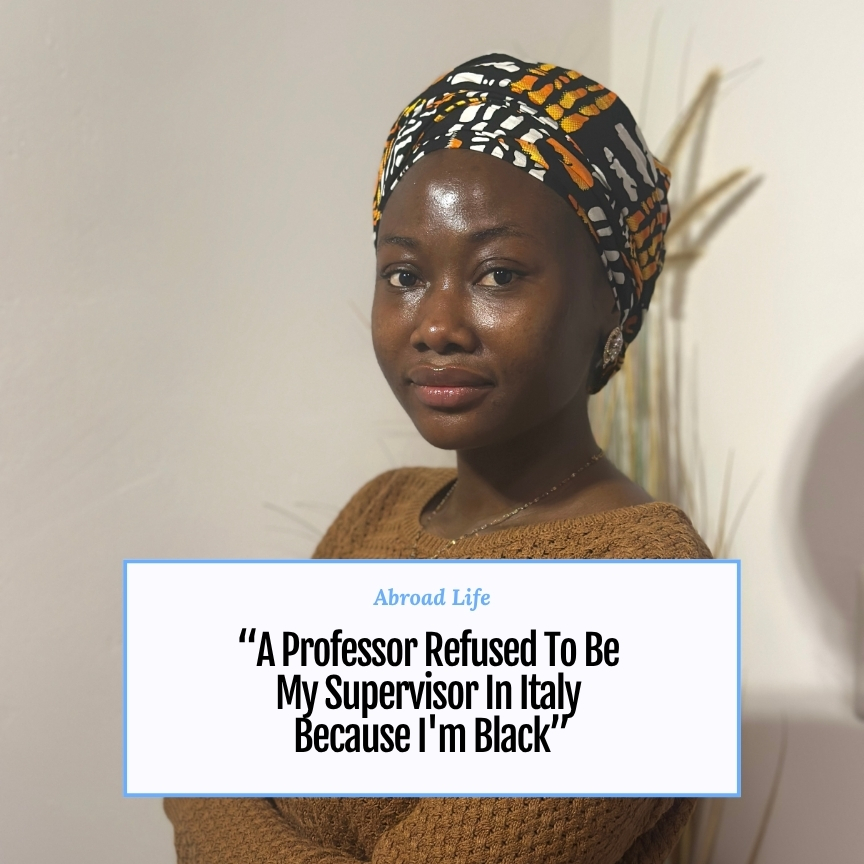
• The Nigerian experience is physical, emotional, and sometimes international. No one knows it better than our features on #TheAbroadLife, a series where we detail and explore Nigerian experiences while living abroad. 


    Elizabeth (33) has moved between Nigeria and the UK throughout her life. In this story, she shares some truly scary experiences she has had in Nigeria, explains why she can’t wait to leave the UK, and opens up about what it’s like connecting with Nigerians who see her as an outsider. 

    Where do you currently live, and when did you leave Nigeria?

    I live in the United Kingdom, and I left Nigeria in 2019. I’ve moved between both countries throughout my life.

    Tell me more about that.

    I was born in the UK and grew up here, but I went to Nigeria for three years of boarding school, a month of A-levels, and then again for university.

    Going to Nigeria for medical school was a way to connect with my culture. I had worked with Nigerian doctors in the past, and they were just built differently. They had incredible confidence and grit; they were resilient in a way that other doctors were not. I wanted to know how they were trained so I could be like them, because they truly inspired me. So, I chose a Nigerian university.

    What inspired you to move back to the UK?

    I wanted to stay in Nigeria for my National Youth Service Corps (NYSC) year. I was very into public health at the time, and wanted a chance to work in that area for service.

    But my parents said, “Absolutely not.” They actually bought the tickets themselves and sent them to me. They insisted that Nigeria was not safe and that I had to come back home.

    Let’s talk about life in Nigeria. What was it like coming here for school?

    It was a rollercoaster. It’s the type of experience that makes you realise you’re not exactly like the people you think are yours. I came back believing I’m Nigerian and in my country, but people were very much giving me the vibe that I was not one of them. To them, I was “oyinbo.”

    With time, I learned the mannerisms and the cultural nuances that make Nigerians, and things got better. For example, learning that “come and eat” is just something people say even when they don’t really want you to eat with them.

    But medical school was a different experience altogether. It was very challenging by itself.

    How so?

    Sometimes your colleagues, senior students, lecturers, and doctors can have issues with you for intangible reasons. For example, when I was working in a state hospital in Nigeria before I left, a superior who was two levels above me at the time just really hated my accent.

    I used to put on an intentional Nigerian accent in my attempt to blend in, but there were certain words that I hadn’t yet learned to say in a Nigerian accent, so my original British accent would peek through at times. Because of that, she used to make life horrible for no reason, just assuming I thought I was better than her. I would wonder, “How can I think I am better than you? You are my senior.” She just had it out for me and made sure I suffered whenever I worked with her, which was all the time.

    I had to accept that people just wouldn’t like me because of their own preconceived notions of what I represent, even if I don’t actually possess those traits. It was a similar thing in boarding school, but it was worse there because they could physically beat you, and they did beat me a lot.

    On the other hand, some people also just adore you because you came from abroad. They would talk to me just to hear my voice and accent. They didn’t really care about what I was saying; they just wanted to hear what I sounded like. For them, I was their first experience of someone from overseas.

    So it was a mix of both—one half idolised me and the other half hated me. I never knew which it would be when I met anyone new.

    How did that make you feel at the time?

    It was hard. After completing Junior Secondary School, I went back to the UK. I remember deciding I was never going to go back to Nigeria again. I was completely over it. The experience was much harder than I expected because growing up in the UK, no one had ever disliked me for no reason.

    But it made me stronger, because by the time I came back to Nigeria for university and encountered it again, I was a bit more prepared. I just didn’t like the concept of being treated as an outsider in a place where I’m supposed to belong. It was difficult because the whole point of going to university there was to connect with my Nigerian culture and not be an outsider.

    Have you been back to Nigeria since you left in 2019?

    Yes, I have been back for holidays, weddings, and to see friends.

    What has been your best holiday experience in Nigeria so far?

    Bridesmaid duties in Abuja

    I’ll say last year. I went to Abuja for a wedding, and then I went to Lagos and Ibadan, all within about 10 or 11 days. I got to see many places that I hadn’t seen in a long time, and visited spots I had only ever heard about on podcasts. The restaurants were good, the gym was great, and everything was fun.

    Since it was a short burst of ten days and we kept moving across different states, the novelty stayed very much alive. If I had stayed longer, I probably would have started experiencing the typical fatigue that comes with the travel, transport, and infrastructure issues.

    Do you see yourself settling permanently in Nigeria in the future, or is the UK home for you?

    I hope to retire in Nigeria down the line, maybe when I’m like 70 years old. Of course, that’s based on the hope that the country doesn’t get worse by that time.

    Get More Zikoko Goodness in Your Mail

    Subscribe to our newsletters and never miss any of the action

    What has been your worst experience in Nigeria?

    There are so many, but I can talk about the top ones.

    Wow. Okay, go ahead.

    So, first was a scary police encounter. I was in an Uber ride, coming back from the Island to the Mainland late at night, around 2:00 a.m. The police stopped the car near the Lekki Phase 1 gate and ordered us to get out of the vehicle.

    My heart was in my mouth because you hear all these stories of what has happened to other people in those exact circumstances with the police. They didn’t physically harm us; they just made us get down and asked, “What do you have for us?” But the fact that they ordered us out of the car entirely made it much scarier than a regular checkpoint stop.

    That’s always scary. Glad to hear it wasn’t worse than that.

    Thanks. Next was a near-death experience at Tarkwa Bay. At the jetty, the boat wasn’t secured properly, so as I stepped off, it slipped, and I fell into the water. There was maybe only an inch between my head and the concrete wall as I tumbled all the way into the water. It was very close to being a completely different story.

    Thank God I can swim. I swam up, and people from the shoreline and staff members ran over to pull me up because the jetty wall is quite high, and it’s hard to get out on your own. I still proceeded to do what I went to Tarkwa Bay to do before going home, because I couldn’t come all that way for nothing.

    What could possibly top a near-death experience, though?

    Getting sexually harassed by a senior doctor?

    It was my very first night in the Obstetrics and Gynaecology department at the hospital where I was working. In between operations, while waiting for the nurses to prepare the next patient for the theatre, the senior doctor asked me to follow him to a separate location to copy some case notes.

    We got into the room, and he locked the door behind us. When I asked what was going on, he said, “You know why we are here.” I replied that I only thought we came to write notes. Then he said something that infuriates me to this day: “You’re from London na.” As if there is some automatic correlation between being from London and being promiscuous.

    I demanded he let me out or I would scream. He still wouldn’t, so I began counting down, “Three, two…” and then he opened the door. I was so afraid because he was a senior doctor who had been there for years; I thought people wouldn’t believe me.

    I chose not to file a formal report because I’d experienced something similar before during my one month in a Nigerian A-level school. The authorities didn’t believe me over the maths teacher who’d worked there for years. Anyway, I told my fellow house officers. They were males, and they agreed to protect me by immediately offering themselves instead whenever that specific doctor tried to pick me as his house officer. Thankfully, about a week later, he was transferred out of the team entirely.

    Sorry you had to go through that.

    Thanks.

    What about your best experiences in Nigeria?

    Enjoying Lagos

    I’ll start with winning the inter-house sports events at my secondary school three years in a row. I was a sprinter—I ran the 100m, 400m, and 800m—and I did cheerleading as well. Graduating from medical school was also a major happy moment.

    It was also great randomly running into celebrities in Lagos. You could just attend a launch party for a drink brand and find yourself taking pictures on stage with celebrities.

    What are your favourite and least favourite things about Nigeria?

    My least favourite thing is the sense of helplessness within the country. There is a lot of helplessness about what can be done to improve or change things; people are demoralised, and while I can’t completely blame them, it is unpleasant to experience.

    My favourite thing is the exact opposite side of that same coin: when given the right opportunity to succeed, Nigerians do incredibly well. It is very inspiring. That was the main reason I went there for university in the first place—seeing Nigerians who were doing super well globally. It is interesting how a Nigerian in one context can be so inspiring, yet in another context, the environment can be deeply demoralising.

    The Naira Life Conference is returning on August 22, 2026, in Lagos! Come learn from finance experts and industry leaders, and partake in unfiltered conversations about building wealth and diversifying your income stream in a country like Nigeria. Real stories, expert advice you can actually use, and a community ready to build wealth together. Secure your spot here.

    Let’s talk about life in the UK now. What is your typical routine?

    My routine is quite simple. I get up, pray, go to the gym, come back, and get my baby ready for nursery. I take him to nursery, or my mum-in-law helps drop him off, and then I go to work.

    When I get back from work, I pick him up and handle his evening routine. Then I take care of any additional administrative tasks that come home with me from work. On some evenings, I go to church for choir practice, and on others, I hang out with friends. I don’t go out on weekday nights, but I do on weekends.

    What do you do for fun in the UK?

    I schedule hangouts with my friends. We plan activities like pottery, painting, arts and crafts, or anything novel to us. During the summer, there are a lot more events, so we go to concerts, parks, and swim.

    What are your favourite and least favourite things about living in the UK?

    My least favourite thing is the tax. I pay 40% tax. I understand that it’s a necessary evil, but it’s still a lot.

    My favourite thing is having most of my family here. I have my husband, my son, my parents, my grandparents, and my cousins, all here with me.

    There’s a growing wave of anti-immigrant sentiment in the UK. What has that been like for you?

    It is very sad to see because the UK depends heavily on immigrants to function across every single sector. It hasn’t affected me directly, but I do academic research on this topic regarding International Medical Graduates (IMGs). My research looks into how they are disadvantaged by the exam culture in the UK because they weren’t brought up in the same system, leading to higher failure rates.

    On a societal level, it is very worrying. In 2024, the year I gave birth, there were major riots across the country with rioters trying to harm people of colour. The police put it down, but the sentiment is still there; there was another march just a few weeks ago. It makes you worry about who you are working next to and whether they are online, writing hate comments.

    The political rhetoric claims immigrants are taking all the jobs, but it’s not true. For example, I have taken part in hiring processes here. By law, we have to assess all the British applicants first, and we can only look at international candidates with visas if those local options are exhausted. The right-wing media simply stoked the sentiment because it is an easy way to divide the country.

    Have you encountered racism on a personal level?

    The last time someone was overtly racist to me was on a bus in London, which is ironic given how multicultural London is. I had my headphones in, so thank God I didn’t hear the exact words she was saying, but it was an elderly white lady. I was sitting in a regular, non-priority seat, and she had plenty of options to sit elsewhere.

    Instead, she stood right in front of me and demanded I give up my seat. I just kept playing my music and watched her face squeeze as her mouth moved. The passengers around us looked deeply offended by the horrible profanities she was spewing, but nobody stopped her. That is how the UK is—unless it is outright physical violence, people generally mind their own business.

    I chose not to let it ruin my day or get offended, so I just kept my headphones in and remained seated until my journey ended. It didn’t make a difference to me.

    On a scale of one to ten, how happy are you in the UK?

    I’ll say seven. I still want a better quality of life than I can get here. So, I am actually hoping to leave the UK very soon. With the medical work that I do, I can get paid a lot more and live a much happier life in places like Australia, Canada, or even the United States. The time is coming for me to move somewhere else, and to be honest, I can’t wait.


    Do you want to share your Abroad Life story? Please reach out to me here. For new episodes of Abroad Life, check in every Friday at 12 PM (WAT).


    Click here to see what other people are saying about this article on Instagram

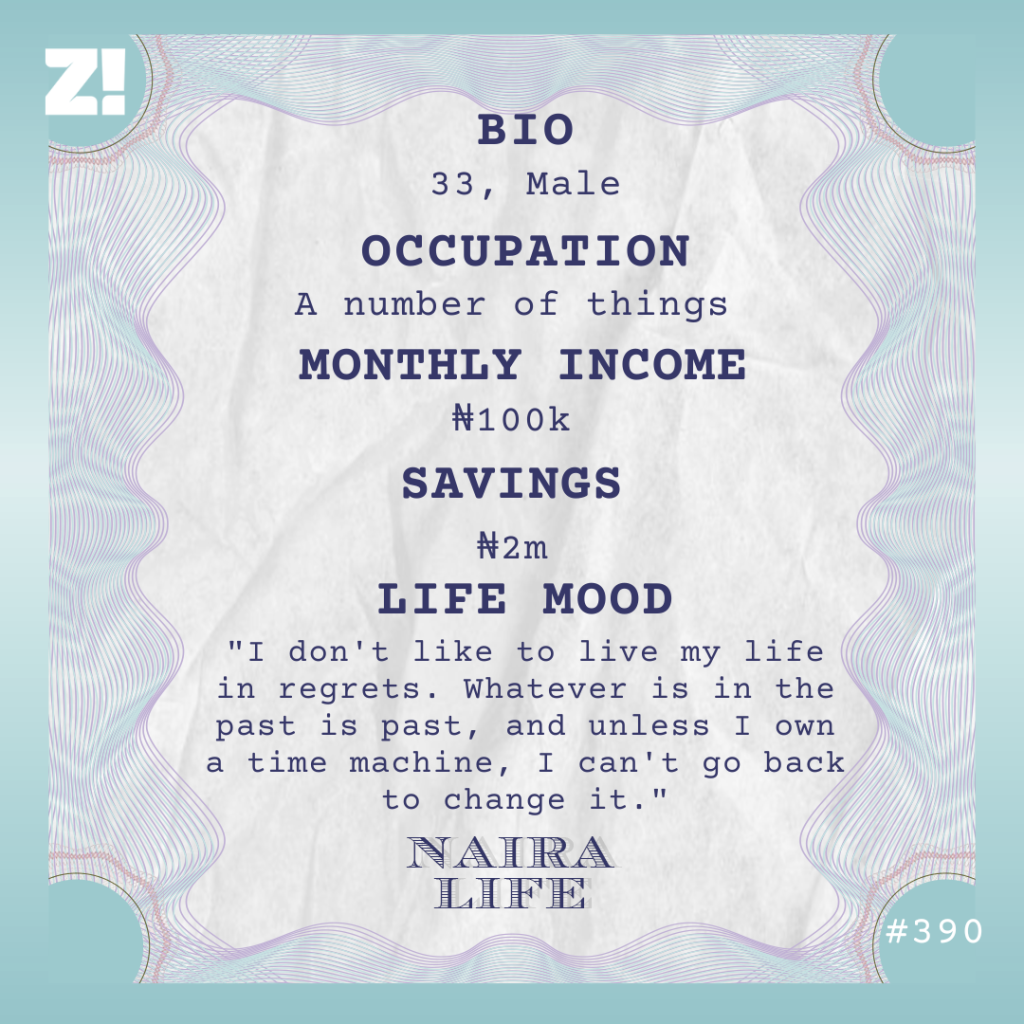
  • Every week, Zikoko seeks to understand how people move the Naira in and out of their lives. Some stories will be struggle-ish, others will be bougie. All the time, it’ll be revealing.


    Nairalife #374 bio

    What’s your earliest memory of money?

    Growing up, I had a rich aunt who, every time she visited or we visited her, gave my siblings and me brand-new currency notes. They felt so nice to hold. Of course, I never got to hold them long enough because of the typical Nigerian family, “Let Daddy and Mummy keep it for you.” 

    I didn’t truly realise that money was important to do things until my first year of university in 2012. My family’s finances took a massive, sharp turn for the worse.

    Let’s back up a bit. Could you paint a picture of your family’s fortune prior to this? 

    We weren’t rich, but we were comfortable. Before I was born, my mum was a schoolteacher, but she later moved into banking. My dad worked in the oil and gas business. We lived in a two-bedroom apartment with two other extended family members. 

    My parents worked late a lot, so we were pretty independent kids. Eventually, my mum left banking to start a fabric business, which did really well for a while before she discontinued it. We had typical average-household moments, like using candles when there was no generator, but it never felt like a lack. I had no lavish wants. There was always food, and that was enough.

    From my senior secondary school days up until my first year of university, things were actually great. My dad’s business had peaked. I had a car in uni and pocket money to do whatever I wanted. If I ran out of money at school, I’d just call my mum, and she’d just send it to my account.

    Then 2012 happened.

    Yeah. Towards the end of my 100 level, my dad discovered that his business partner was embezzling money. It was a serious issue because they executed government contracts. I was genuinely scared my dad would go to prison. 

    He had to sell some land and a car, and we moved to the outskirts of Lagos. Gradually, the money stopped flowing in, and my dad stopped travelling as much.

    How did that directly hit you?

    I stopped getting money “just because”; my monthly pocket money became smaller and smaller. I think my world generally became smaller; I couldn’t just do things like I used to.

    Around that time, my university went on a long strike. Initially, I was throwing tantrums, demanding that they send me to a university in Ghana or somewhere else since the strike was wasting my time. But the new reality had already crashed my brother’s UK plans, and my dad definitely couldn’t afford Ghana.

    While sitting at home frustrated, my cousin told me about an internship at the media company where she worked. I loved reading and writing, so I took it just to get out of the house. That was my entry into employment.

    Was it a paid internship?

    Yes. They paid me ₦40k/month. At that point, I had never considered a career path. I didn’t even like the course I was studying in school. But that internship changed everything. I was writing for the blog, reviewing restaurants, and interviewing musicians and actors. I was having the time of my life.

    The funny thing was that ₦40k couldn’t even fully cover my expenses, since the office was hours away from where we lived. My dad still had to help with fuel money so I could drive to work. I think he was fine with that extra expense because we all viewed the financial crisis as a temporary bump in the road, and things would get better soon. We didn’t know the bump would keep getting higher.

    What happened with the internship after school resumed?

    The company was incredibly flexible. During the strike, I worked full-time. When school resumed, I went part-time, working two or three days a week after classes or on weekends. The media house was expanding into video production, doing short films and series, and I completely threw myself into it. I assisted on sets and wrote scripts.

    By my third and fourth year in uni, that ₦40k salary became my entire life. There was zero allowance coming from home. That money fed me at school, paid my tuition (about ₦15k then), and helped my siblings when they were broke. Things got so bad at home that my mum would occasionally call me to borrow ₦10k, which I’d never get back.

    Wait. Your pay didn’t change?

    No. Four years as an intern, and the pay stayed exactly at ₦40k. But I saw a path there. I just felt, “This is what I have to do.” Even if they didn’t pay me, I was willing to work until I found my way into something else.

    My work helped me build industry networks, and I got the opportunity to do some freelance stuff here and there. My boyfriend at the time was in the film industry, so I often assisted him on set. One time, he landed a two-day gig in another state and took me along. When he asked how much I wanted, I was like, “Just pay me whatever,” and he was like, “No, you have to know how much you want to make. Put a figure in the budget.” 

    So, I asked for ₦60k per day. At the end of the shoot, he handed me ₦120k. It felt like crack. ₦120k for two days of work when my monthly salary was ₦40k? Crazy. I sent ₦15k each to my mum and dad, gave some to my brother, and it felt good to do it. That experience made me realise I possessed a skill people would actually pay money for.

    By the time I reached my final year in 2016, I had completely lost interest in university. I failed a couple of papers, looked at the stress of rewriting them, and said, “Fuck this.” I walked away and went to the media company to let them know I was ready to work full-time.

    How did your parents handle your decision to drop out?

    They don’t know. To this day, I have never told them.

    You say?

    My parents are the type who let me be because I grew independent very quickly. If I don’t want to answer a question, I will pivot the conversation expertly. Because I immediately went into full-time work, there was no gap where I was sitting at home acting like a graduate. I was constantly on movie sets or at the office.

    I’m not a big fan of pageantry, so I didn’t care about graduation pictures or birthday shoots. When my younger brother graduated later, he didn’t go to his convocation either, so nobody at home really minded. They saw I had my life together and was financially supporting everyone, so they didn’t ask questions.

    Fair enough. What did the full-time role look like?

    When I went full-time in 2016, my pay was bumped to around ₦60k or ₦70k. Still small, but the economy was better then, so it could stretch until the end of the month.

    I finessed my way from being just a content writer to an assistant producer. I made sure I was highly likeable, pitched ideas constantly and stayed available. One day, the head of the media house was stressed because a fashion stylist on a shoot was messing up. She asked me to go into the wardrobe room and piece outfits together. I did it, everyone loved it, and suddenly, she appointed me as the head of wardrobe for one of our shows.

    I had never done wardrobe in my life. I didn’t even know what continuity was, but I was like, “I can do it. Don’t worry.” It was three months of pure torture. I cried every day and barely slept because we filmed late into the night, and I’d stay up figuring out what everyone would wear the next day. Nigerian filmmaking is chaotic, and I was dealing with veteran actors who were kind but still intimidated the hell out of me. 

    At some point, my car became the wardrobe trunk. It was awful, but I hustled through it. My pay was ₦120k/month for the three months of shooting, which was hilarious because I’m sure an actual stylist would have spat at that amount. But I was just a young person looking for a chance.

    When the show wrapped up, I walked straight to the head of production and said, “Hey, I want to be a producer, and I think you should give me a chance.” She was like, “Okay,” then handed me a show to run and raised my salary to ₦150k.

    Energy!

    The new pay felt good. I was the youngest, coolest kid in the office, so they routed all the millennial and Gen-Z digital lifestyle and music shows to me. I created formats that went viral and pulled massive numbers for the company. I was there for about two more years and left in 2018.

    Why did you leave?

    The ₦150k was why I left. The company started hiring new assistant producers. I would spend weeks training them from scratch, only to discover, in a casual conversation, that these new hires were being brought in at a ₦200k salary. Meanwhile, I was carrying a much heavier workload and producing their hit shows on ₦150k.

    I went to the head of production and requested to be paid the same as what others were earning. She told me to “convince” her why I think I deserved it. I decided I wasn’t going to try to convince anyone. They could see the work I was doing, and if that wasn’t enough proof, then it wasn’t the right place for me.

    While still at the job, I started job hunting. A contact connected me with a fintech company looking for someone to produce and do social media content. I interviewed, and they offered me ₦350k/month. I resigned instantly. My time at the fintech was incredibly short-lived, though.

    What happened?

    I worked there for three months and got fired. I was young, hot-headed, and foolish. I had an issue with someone in management, and I didn’t handle it well. I lost my temper, and we got into a loud argument. Of course, they couldn’t let a lowly employee speak to management that way, so I lost the job. 

    I was unemployed for about six months, and it was a really tough period for me. My parents still lived far away, so I’d moved in with my partner when I still had a job. After I got fired, I struggled to find any kind of work, whether freelance or 9-5, despite all my applications. I hated being dependent. 

    I hated relying on someone else to buy airtime or food. It made me incredibly angry and sad. I also couldn’t ask my parents because things were still bad at home. In fact, the worse things got for my family financially, the more religious they became. I became a hardcore atheist because it all felt performative.

    Then in 2019, I caught a break. One of my LinkedIn applications was successful, and I landed a senior producer role at a media publication. The pay was ₦200k/month, a pay cut from the fintech job, but I was desperate for survival.

    I feel you

    The workload was hell, though. I was working Monday to Sunday and dying on the line. My commute meant waking up at 5 a.m. to battle traffic, working all day, and driving back late. 

    I was severely depressed. I’d get home, turn off all the lights, roll up, smoke, and pass out. Then repeat. I felt like I was working myself to the grave because if I stopped, I wouldn’t eat.

    The major positive was that I was able to save enough within a few months to rent an apartment with a roommate. 

    Then COVID hit in 2020.

    Did lockdown affect your employment?

    Lockdown was ironically the best time of my life. The company laid off many people, but my boss fought for me, so I kept my job.

    That was my first taste of remote work. No traffic or physical office politics. We had press passes, so when we went out to film, we’d finish a shoot in three hours because the roads were bare. I had time to exercise and rest. My salary remained at ₦200k. One of my siblings even moved in with me.

    The funny thing is, my own layoff came right after the lockdown lifted in August 2020.

    Mad o

    See! I had barely anything saved because of endless family emergencies. For the rest of 2020, I survived entirely on intense freelancing, working as a production manager, manager, or anything else I could find.

    In January 2021, an advertising agency reached out to me on LinkedIn. They offered ₦250k/month. I took it because I wanted experience in every industry possible, but it turned out to be a mistake. I had zero work-life balance again. I could be at the beach with my friends on a Sunday, my laptop open on my knees, taking client meetings right there.

    At some point, it clicked that I really didn’t have to endure misery. So when, in September 2021, a friend told me about an opportunity at a crypto company, I was open to it. I interviewed, and they offered me ₦400k/month.


    The Naira Life Conference is returning on August 22, 2026, in Lagos! Come learn from finance experts and industry leaders, and partake in unfiltered conversations about building wealth and diversifying your income stream in a country like Nigeria. Real stories, expert advice you can actually use, and a community ready to build wealth together. Secure your spot here.


    Back to tech money

    Yes! It was a chill environment. Everyone was young, and the vibe was amazing. I spent two years there. Early in 2023, they offered to start paying our salaries in USDT to hedge against inflation, which pushed my take-home pay to the equivalent of ₦500,000.

    But by late 2023, the crypto company ran into issues. They began defaulting on salaries and eventually laid off my entire team. The only silver lining was that they let us keep our official MacBook Pros as an apology for sacking us without notice. To me, that was a fantastic exchange.

    Skrimmm. How long were you unemployed this time?

    Only about two months. Once again, LinkedIn came through. The CEO of a media company messaged me directly. My new salary was ₦700k/month.

    The work was so easy I felt like I was collecting free money. I could do it with my eyes closed. Of course, in the corporate world, you always have to look busier than you are, so they don’t question your salary. I was also getting freelance gigs, earning between ₦600k and ₦700k for random shoots.

    During this period, my landlord got into debt and sold the house, so I had to move. I rented a bigger place, and my siblings and my mum all moved in with me. My brother and I took over the household fully so our parents wouldn’t have to worry about survival. I paid the bills, fed everyone, and covered our youngest sibling’s school costs.

    But I still wanted more. I was tired of living paycheck to paycheck and felt I should be earning money. Moreso, black tax and inflation were aggressively eating into the ₦700k. I had no savings. I didn’t exactly have a strong savings culture, but I knew my income could be better. So, I was applying to jobs.

    Then came June 2025.

    What happened in June 2025?

    An abroad-based headhunter reached out to me on LinkedIn for a creative project manager/producer role in Africa. The very next day, another recruiter messaged me about the exact same role. I told myself, “This job belongs to me.”

    At this point, I have to ask what’s in your LinkedIn stew

    I don’t even know! I don’t even post there, so it’s not like I’m doing anything. It’s crazy.

    Anyway, the interview and assessment process took just four days. I remember I did the negotiations right in my workplace’s studio. They offered me $3k/month. My headphones stopped working mid-call, and I had to unplug them to continue. My coworkers were there, but I didn’t care. Nothing was going to stop me. I resigned that very day. 

    I’m dying. To be fair, doing that for $3k was very valid

    You get it. In fact, after I signed the contract that day, they were like, “Can you start next tomorrow?” I was like, “I can start now.”

    After conversion, my salary usually lands anywhere between ₦4.1 million and ₦4.5 million. The first time it hit, I just stared at the screen. I couldn’t believe it. Besides the money, I have more free time. My work hours are 7 a.m. to 3 p.m., meaning I finally have a life. I also travel internationally two or three times a year on the company’s dime to meet my global team.

    I still take on freelance work whenever an opportunity comes. I usually make an additional ₦1 million from those every two to three months. Last December, I worked on a music video, shot two commercials, and made an extra ₦5 million in side gigs outside my salary. I recently moved my family and I to a bigger apartment. The rent is ₦3.5 million, and I’ve paid for two years, so I don’t have to worry about it for a while.

    How has your income growth impacted how you think about money?

    Having money means a lot to me as a woman. It’s independence and the ability to dictate how my life goes. I don’t need to rely on anyone. Money gives me freedom and power, and I can’t trade that for anything.

    My quality of life has generally improved. I don’t worry about money as much anymore since I can meet my needs. I know there’s so much more money to be made in this world, and I’m going to make it, regardless of what anyone wants to do. I’ll keep pushing, and the money will keep increasing.

    Inject it. Now’s the part where we talk about your monthly spending

    Nairalife #374 expenses

    For the savings, I just started taking it seriously around March, mostly because of the people who kept pushing me to save something. I set up a direct debit from my income to my savings app, so I’m not tempted to touch it. 

    I’m also exploring investment options such as stocks and treasury bills. I understand the need to invest and make my money work for me. So, I’m working on that.

    What does your portfolio look like right now?

    I have about ₦2 million in my savings. I also put about ₦400k into US stocks. I’m a bit wary of the stock market because it feels like advanced sports betting to me, but I’m doing my research. 

    I’m currently waiting for the Dangote Refinery to list its shares so I can invest and earn returns. I refuse to invest in local businesses because I’ve seen people lose everything when a business collapses. I want my money where I can see it.

    How would you describe your relationship with money?

    I like having money, but I’m an incredibly anxious person. You know how I said I don’t worry about money as much anymore? Well, my new worry is how long I can keep this going. 

    Life has shown me that I need to worry. I’ve been laid off several times, so I don’t feel entirely secure. If the company closes down today or decides they don’t want to work with me anymore, where will I find another company that’ll pay me this much? I constantly feel like I am one bad day away from losing it all and going back to where I started.

    To deal with this anxiety, I’m constantly editing my CV and applying for jobs on LinkedIn every single morning before starting work. It sounds greedy, but $3,000 is no longer my endpoint. I know people earning $7,000 to $10,000 a month on retainer deals doing exactly what I do. If they can get it, why can’t I? I don’t have a degree or fancy certifications, and I’ve finessed my way through my career, but I actually have proof of work.

    I also think I could have more self-control when it comes to spending money. I tend to spend whenever I feel like, which isn’t bad, but I need to do better if I want to have some sort of cushion for whatever comes. I just need to be stronger and come disciplined in my relationship with money.

    What’s something you want right now but can’t quite afford yet?

    I need a new car. I also want to move into my own solo apartment. I love my family, but I have spent my entire adult life living with and caring for people. It would be nice to be alone in my own space.

    My wildest dream is to take a 6-month holiday to travel the world or across Europe. It will cost an insane amount of money, but check back with me in eight months. You never know.

    What about the last thing you bought that made you genuinely happy?

    A PlayStation 5. I’ve wanted it for years. Early this year, I realised I could just buy it without blinking. It cost me ₦600,000. I bought a few games with it, and it brought me so much joy. I also spent about ₦2 million on a high-end work laptop, but that felt like an expense. The PS5 was pure happiness.

    How would you rate your financial happiness on a scale of 1-10?

    6. I’m comfortable, and I can buy almost anything I want within reason. I can take my friends and family out, buy them stuff and fix household emergencies without breaking a sweat. But I don’t think I have a safety net, so I don’t feel secure yet. There’s a lot of room for improvement.

    My ultimate dream is to earn so much money that I never have to work a day in my life again. But to get to the point where I don’t have to work, I have to work a whole lot. And that’s exactly what I’m chasing.


    If you’re interested in talking about your Naira Life story, this is a good place to start.

    Find all the past Naira Life stories here.

    Subscribe to the newsletter here.

    Get More Zikoko Goodness in Your Mail

    Subscribe to our newsletters and never miss any of the action

  • The Nigerian experience is physical, emotional, and sometimes international. No one knows it better than our features on #TheAbroadLife, a series where we detail and explore Nigerian experiences while living abroad. 


    Success* (28) is a medical doctor who moved to the UK to escape insecurity and poor salaries. In this story, she shares her experiences with the culture shocks of British medical practice, racist microaggressions and why she finds herself praying less often since relocating to the UK.

    This model is AI-generated and not affiliated with the story in any way

    Where do you live currently, and when did you leave Nigeria?

    I live in the United Kingdom (UK), and I left Nigeria in early 2025.

    What inspired you to leave Nigeria for the UK?

    Everything. But let me start with the insecurity. I grew up in the northern part of Nigeria, so I saw firsthand the terrorism and religious intolerance. When I was young, there were times we had to be searched with bomb detectors before we entered church after a church had been bombed on Christmas Day.

    Another catalyst for my relocation was the salaries for doctors in Nigeria—it’s just too little. When I practised in Nigeria, I earned ₦300,000 per month, and that was barely enough to cover my basic needs. In addition to the reason I mentioned, I had always wanted to leave Nigeria as early as my primary and secondary school days. I got a peek at what life was like abroad from friends who vacationed abroad with their parents. 

    It’s the reason I studied medicine. I knew that healthcare workers were highly sought after in many parts of the world. So I knew it would give me a good chance to leave Nigeria.

    What was life like for you in Nigeria before you left?

    Working in a private hospital, I was making about ₦300,000 a month. I was only able to afford a shared apartment with that. But it was a terrible experience. We only had electricity between 4:00 AM and 6:00 AM. So I had this huge power bank that I’d charge at work and in church on Sundays. That was how my life was in Nigeria; it wasn’t easy.

    As you said, doctors are in high demand in many parts of the world. Why did you choose the UK?

    I chose the UK because the migration pathway for other countries is quite expensive. Though we are highly sought after, the process doesn’t come cheap. The UK is relatively cheaper than other countries, but it still cost me about ₦7 million to migrate. That was because I passed my exams on my first try. Some people have had to write the exams twice or thrice, and that increases the cost.

    The Naira Life Conference is returning on August 22, 2026, in Lagos! Come learn from finance experts and industry leaders, and partake in unfiltered conversations about building wealth and diversifying your income stream in a country like Nigeria. Real stories, expert advice you can actually use, and a community ready to build wealth together. Secure your spot here.

    There are very few doctors in Nigeria, currently about one doctor for every 10,000 patients. Do you have any feelings about that?

    It does bother me because I’m always thinking about my family back home. What happens when my parents or other loved ones need medical care? Here, people can walk into the hospital almost dead, and we’re able to get very good outcomes because we have all the equipment we need. It makes me think back to my time in Nigeria, where we didn’t have the equipment, and we didn’t even have enough hands. It makes me worry about my family, but I can only put them in my prayers.

    I also think about the times when I was back home in Nigeria, when I couldn’t really take care of my basic needs—it was difficult for me to get a place, having a car could only be a dream, and I was basically living off my parents. I think about all of these things.

    With the way the Nigerian government is running the country, I don’t think you can blame doctors for leaving. I don’t feel guilty because I know that the Nigerian political system did not create a conducive environment for us to stay.

    Doctors spend a lot of time in school, go through a lot of difficult exams, and a lot of money is spent training us. But when we graduate, we get paltry salaries, worth next to nothing. A lot of doctors have to work in multiple hospitals  to make ends meet. I did that too: I would work a morning shift in one hospital and then a night shift somewhere else. That’s the reality for many doctors in Nigeria.

    Yes, Nigeria needs doctors. But leaving is the best option at this time. We want a good life for ourselves and our families. We want safe lives too. I’ve heard of doctors getting kidnapped back in Nigeria. It’s really crazy.

    How has life been in the UK so far?

    My life is much better compared to when I was in Nigeria. First of all, I have a better work-life balance. I don’t have to work two jobs just to make ends meet. There’s a 48-hour cap every week. You are not meant to work more than 48 hours a week. So this means  I have time to do other things with my life.

    I can afford my own place. I have savings and investments now, unlike in Nigeria, where I couldn’t afford to do either.

    Food here is actually cheaper than back home. When I was in Nigeria, I always had anxiety about going to the market because the spaghetti I bought for  ₦500 this month could become ₦1,000 the next. But here, prices are very stable. I think my life here is better. I can support my family more, and I have a better community. Overall, it’s just better.

    What’s your support system like?

    I don’t have any nuclear family here; I’m the first person in my nuclear family to actually leave Nigeria. I have some members of my extended family here, but we are not so close.

    But I have my church members. I also go to the gym, and I’ve made friends there. I have friends at work too. I know some people say not to make friends at work, but I’ve had a different experience. I have really nice coworkers.

    Now my support system is actually growing. I’m getting to know more people and becoming acquainted with my environment.

    Are these friends Nigerian?

    The majority of friends I’ve made here are Nigerians or fellow Africans. It’s just easier to make friends with people you share similar cultures and backgrounds with. For example, the town I live in is white-dominated, so once you see a Nigerian, there’s this internal joy that you feel. It’s like any Nigerian at your workplace is automatically your friend.

    I think if you’re able to have non-African friends, that means you both must have a very strong bond for that friendship to actually work out, because you’ll have very little in common.

    Get More Zikoko Goodness in Your Mail

    Subscribe to our newsletters and never miss any of the action

    Have you felt any sort of discrimination or racism since you arrived in the UK?

    I have, but it’s nothing overt. What I feel at times is what we call microaggressions. An example was when I was looking for a house; landlords would see my name,, noticed that it doesn’t sound British, so they wouldn’t call me for house viewings.

    But at work, I don’t feel any form of racism from my colleagues or from patients. The National Health Service (NHS) has a strict policy against racism. If any patient is racist to any doctor, that patient can be ordered out of the hospital, as long as they don’t have an emergency condition. So patients are cautious about what they say.

    It’s the same with colleagues from other nationalities who are non-African. I notice that whenever they are talking to me, they try to carefully pick their words because they don’t want to come off as offensive. I think that can also affect making friends with non-Africans, because they’re always second-guessing everything they say. That doesn’t allow for real connections to form.

    What about the growing anti-immigrant rhetoric? Does that make you feel uncomfortable?

    It has created a bit of uncertainty because the policies are constantly changing, and you don’t know which policy they will come up with next, or how it will affect you. The  Prioritisation Act, for instance, basically says that UK-trained doctors have to be considered for jobs first before doctors from other countries. This was passed after I came here.

    I’ve heard British doctors at work talking about how immigrant doctors are taking their jobs. Initially, when I came to the UK, I was always telling people that I got my job from Nigeria. But I noticed they were not really happy to hear that. It was more like, “Okay, you’re one of the people who took our jobs from us.”

    I felt guilty about it for a very long time. But I had to deal with the guilt and tell myself that I got the job because I deserved it, and I worked for it. With time, I stopped telling people how I got my job. I only mention it to people I really feel comfortable with.

    But one thing I always say is that there’s love at home. So if they say that I can’t stay here anymore, I’ll go back to my country.

    Apart from working, what activities do you get up to in the UK?

    I’m kind of an extrovert, so I spend more time outside than at home. During my free time, I go to the gym. I’m also learning how to swim. I sing, so I’ve joined the choir in church. I love going to shows too. During the summer, there are usually events happening around, like Afrobeats concerts. I usually go for those kinds of things.

    I visit my friends, and my friends come over to see me. I travel, and it’s safe. I’ve always loved travelling, but in Nigeria, I couldn’t really travel so much because of the insecurity and the accidents. But here, the roads are freer, and it’s safer, so I travel easily without any restrictions or any anxiety that something bad will happen to me.

    I also use my free time to bulk cook. You can’t be late to work; there’s a very strong work ethic here. So when I’m not at work, a huge chunk of my time is spent preparing for my next period at work. I clean my house, iron my scrubs, and cook in bulk so that nothing delays me when I’m going to work the next day.

    What culture shocks did you experience when you arrived?

    They like queuing. There’s a queue for everything. There was a time when I first arrived, and I wanted to jump the queue with my normal Nigerian mentality, and someone confronted me about it.

    Another thing is that everyone tries to be polite. Unlike in Nigeria, where people show their anger. For British people, even when they are really angry, they smile, and they try to be calm. Trying to unlearn that Nigerian directness so you don’t get labelled as aggressive is not easy.

    It’s also the same at work. You have to learn how they communicate. In Nigeria, we have a direct way of communicating; you can tell people exactly what needs to be done. But you don’t want to look patriarchal in the UK, so there’s a way you try to use flowery words: “Oh, would you like to do this?” “Do you think it will be okay if you do this?”

    Also, unlike in Nigeria, where you can gossip and make some jokes at work, you can’t just make any type of joke here because it may be offensive to the next person. I miss the laidback work culture that we have in Nigeria.

    As for the accent, when I came here initially, it was difficult to hear what people were saying. In Nigeria, I used to believe I had a very good command of English, but when I came to the UK, I was taken aback by people asking me to repeat myself because they couldn’t understand me. At times, I have to spell a word to make them understand my pronunciation of it. For someone who learned English as a first language back home, that was a big shock.

    Definitely. How did you manage?

    I try to speak as slowly as possible so that people can hear me, and I don’t get offended if someone tells me to repeat what I say. Also, I try to demonstrate. When I’m conversing with a patient, if I want to talk about any eye pain, I may just point to my eye so that they can easily get what I mean. I also avoid using big words or complex grammar and just try to use the simplest English possible, and that actually helps.

    On a scale of one to ten, how happy would you say you are in the UK?

    I’ll say 20.

    Wow.

    I feel that all the things Nigeria took away from me in 27 years cannot be gotten back in one year. It’s a journey, but so far so good.

    I am happier in the UK. I’m less anxious, and I’m praying less. I know people might see that as a bad thing, but in Nigeria, most of my prayers were built out of anxiety: “Let me have food to eat,” “As I’m going to work, may an okada not crush my leg,” “May I not be kidnapped,” “May I not have an accident.” All those kinds of things. I don’t have those anxieties anymore.


    Do you want to share your Abroad Life story? Please reach out to me here. For new episodes of Abroad Life, check in every Friday at 12 PM (WAT).


    Click here to see what other people are saying about this article on Instagram 

  • For these Nigerian men, learning they might never have children went beyond the diagnosis. These six Nigerian men share how infertility changed their relationships and self-worth. 

    Charles*, 43

    I was diagnosed with a varicocele as a teenager after years of pain and swelling. Even then, I didn’t totally accept that it could mean infertility. I told my wife before we got married, and we agreed we’d face whatever came. But it wasn’t until we started trying for children and nothing happened that the reality truly sank in.

    We’ve been married for almost seven years now. Watching our friends have children has been one of the hardest parts. Every naming ceremony invitation feels like a reminder of what we’re missing. Even sex has become difficult. It no longer feels separate from the issue. My wife has never made me feel less than a man, but I still find myself apologising.

    When she eventually told her parents, I became convinced they saw me differently. She says it’s all in my head, but I can’t help noticing how much warmer they seem with their other sons-in-law.

    We’re still exploring treatment options, and I’m saving for advanced care abroad. If that doesn’t work, we’ll probably adopt. Until then, I’m holding on to faith. What makes it bearable is having a partner who never makes me feel less than myself.

    Ahmad*, 37

    My wife and I lived in different states after we got married in 2018, so having children wasn’t an immediate priority. But once we settled down and started trying during lockdown, we realised something wasn’t right.

    Tests eventually revealed I had a very low sperm count. I’ll never forget that appointment. The moment the doctor told me, everything else became background noise. I left feeling completely defeated.

    There was still hope through IVF, and after a year and a half of trying, we finally had a successful cycle. Five weeks later, my wife miscarried. Around the same time, we also discovered she had fibroids.

    Since then, it’s felt like carrying a hole in my chest. You can have a good career and money, but none of it fills the emptiness of coming home to a house without children.

    We haven’t given up, but we’re slowly learning to accept that things may not happen the way we imagined. The hardest part has been talking about it. My wife can discuss it openly with her siblings, but I’ve told no one. Even now, I struggle to say it out loud.

    Get More Zikoko Goodness in Your Mail

    Subscribe to our newsletters and never miss any of the action

    John*, 56

    For years, my wife was the one undergoing tests because it was hardly assumed the man would have an issue. After four years of trying, I finally agreed to get tested. That’s when I learnt I was sterile.

    I didn’t believe it at first. I spent years convincing myself that if we prayed harder or waited longer, things would change.

    The reality didn’t set in until 12 years into our marriage. One morning, my wife asked what the point of working so hard was if we had nobody to inherit the rewards. I went to work as usual, but when I sat at my desk, I broke down crying.

    That was the day I suggested we adopt. We eventually took in a young relative and raised him as our own. But now that he’s a teenager, he acts out and sometimes says he wants to go back to his parents. 

    Even now, people still ask when we’re having children and quote the story of Sarah and Abraham. My wife always smiles and says we’re praying, but what hurts most is knowing that people automatically blame her.

    Chibuzor*, 39

    I did drugs and smoked heavily from my teenage years until my late 20s. I’d left that life behind, so when my wife and I started trying for children soon after marriage, infertility never crossed my mind.

    Two years in, we got tested. That’s when a urologist told me I had immotile sperm. After asking about my lifestyle in my twenties, it became clear that my past had likely contributed to my condition. My choices had finally caught up with me.

    For years, I blamed myself. I grieved the children I’d never have and carried a guilt that seeped into every part of my life. My wife eventually pushed me to try therapy, and it helped more than I expected. I was able to forgive myself and focus on the way forward.

    In 2022, we adopted a baby girl. I love her completely, but the grief hasn’t disappeared. A part of me still aches for the biological child we’ll never have.

    Prince*, 37

    My wife and I were celibate until marriage, so when we struggled to conceive, she suggested we get tested. That’s when I learnt I had low testosterone and erectile dysfunction.

    The diagnosis was difficult, but what hurt most was what it did to my marriage. My wife felt betrayed and believed I’d knowingly put her in that situation.

    I was willing to do anything to keep us together. If she wanted adoption, a sperm donor, or even to have a child with someone else, I would’ve accepted it. But she couldn’t move past it, and after four years together, she left me.

    I’ve never fully recovered from the divorce. Losing my marriage shattered my confidence. Even now, I find myself wondering whether anyone would willingly choose a man who can’t give them children.

    Mubarak*, 28 

    I got gonorrhoea from a sexual partner and didn’t realise it until I started experiencing serious symptoms. By the time I saw a urologist, he said they could treat it, but I’d developed epididymitis, and there was a high chance I might never be able to father children.

    I remember sitting in the doctor’s office wondering how I was supposed to continue my life with that information.

    I know there’s a small possibility I could have children, but I’m preparing myself for the worst. Surprisingly, the hardest part hasn’t been the diagnosis itself, but telling other people.

    When I confided in a few friends, they mocked me. One of them often jokes that I don’t need condoms anymore since I can only shoot blanks. I regret opening up to them.

    I’m dating someone now, and I haven’t told her. Part of me feels guilty, but I’m terrified of how she’ll react. If my friends could reduce my situation to a joke, what would someone I plan to build a future with think?


    Read Next: We Were Planning Our Wedding. Then He Got Cancer

  • A guide for first timers, regulars, and everybody in between – Powered by Olmeca Tequila.

    Photo by Bishop Ebuka Duke 

    WHAT IS SWEAT IT OUT?

    Sweat It Out is a Lagos-based underground rave and community centered around electronic music and dance culture.

    Started by Ebi Atte (Dr Love) and Ejiro Otito (Sons of Ubuntu), what began as a small community gathering has grown into one of the city’s most recognizable rave movements.

    Over time, Olmeca Tequila has become part of the experience — from free shottails to moments and spaces designed for people to connect throughout the night.

    Photo by D3ola

    WHAT TO EXPECT

    The vibe: 

    A dark warehouse by the sea. Lights & lasers cutting through smoke. Bass thumping through your chest. Sweaty bodies moving on the dancefloor. The feeling that you’re about to have the best night of your life.

    The music policy:

    Afro-house, techno-house, minimal, afro-tech and other electronic sounds. No Afrobeats here.

    The Olmeca experience:

    • Free Olmeca shottails during the first hour (so get there early!)
    • Polaroid photo moments with the crew
    • Olmeca Tequila available to purchase as shots, cocktails or by the bottle all night long

    HOW TO PREPARE

    Whether it’s your first Sweat It Out or your fifth or thirtieth, the biggest thing to know is this: the energy is sweaty, expressive and music-led — it’s not a “sit down and pose” kind of night.

    A few tips:

    • Wear light clothes and comfortable shoes. If you can’t dance in it for hours, rethink the fit.

    • Eat and hydrate before you arrive. You’ll probably dance more than you expect.

    • Carry light. A small bag with essentials only — phone, cards/cash, power bank, lip gloss.

    • If you need a little help loosening up, grab an Olmeca shottail early and ease into the energy of the night.

    Photo by Bishop Ebuka Duke 

    HOW TO PREPARE (PART 2)

    • Come with an open mind. Don’t force it – let yourself settle into the music.

    • Don’t be afraid to hang back and observe at first. Once the music catches you, the dancing comes naturally.

    • Protect your hearing if you’re sensitive to loud sound. The speakers are serious.

    • Keep phone filming to a minimum and avoid flash on the dancefloor. People come to raves to feel present and immersed.

    Most importantly: nobody cares if you’re “good” at it. The best Sweat It Out experiences usually happen when people stop trying to look perfect and just surrender to the music.

    Photo by Bishop Ebuka Duke

    THE SPIRIT OF SWEAT IT OUT

    Sweat It Out is built on freedom — to dance, experiment, express yourself and exist without pressure.

    It’s a space where underground sounds take center stage. Afro-house, tech-house, minimal, afro-tech and electronic music that pull people out of their heads and into their bodies.

    More than anything, it’s community-driven. Strangers become dance partners, friends reunite at the bar, and everyone is connected by the music.

    The energy is open, inclusive and welcoming — whether you’re a longtime raver or just discovering the scene for the first time.

    Photo by D3ola

    Come as you are.

    Lose yourself in the music with Olmeca Tequila

    Photo by Bishop Ebuka Duke
  • He that goes a-borrowing goes a-sorrowing

    Benjamin Franklin was famously convinced that borrowing and sorrow go hand in hand. But if the United States’ founding father were alive in Nigeria today, Bola Tinubu would probably tell him he has it all wrong.

    Tinubu and borrowing—a romance better than Twilight. At the national level, he has built a government that runs completely on credit. In three short years, Tinubu has borrowed an estimated ₦65.9 trillion. That is a massive mountain of debt that future generations will somehow have to pay back.

    But the president does not just want the government to borrow. He wants regular Nigerians to get perfectly comfortable with living on credit, too. Nowhere is this vibe more obvious than with the Nigerian Education Loan Fund (NELFUND).

    Is NELFUND a genuine lifeline keeping poor students in school, or is it a ticking time bomb designed to trap a new generation of Nigerian youth in debt?

    What is NELFUND?

    Tinubu signed the Student Loan Act, which created NELFUND just 14 days after taking office. The plan sounds simple: The government gives zero-interest loans to students in tertiary institutions to cover their fees. Students who apply for upkeep allowance may also get a monthly stipend. The fund claims that it has given out ₦242.4 billion to over 1.3 million students as of April 2026.

    The government says this initiative will remove financial barriers and give poor Nigerian youth equal access to higher education. It’s ironic because it’s this same administration that made higher education unaffordable in the first place.

    He that taketh away

    First, Nigerians have become significantly poorer under Tinubu. The country went from a 56% poverty rate in 2023 to a crushing 63% in 2025. That is almost 20 million freshly minted poor people thanks to Tinubunomics. Naturally, a poorer population will struggle to pay for school.

    But while the president was making Nigerians poorer, he also pulled the safety net from under them.

    Get More Zikoko Goodness in Your Mail

    Subscribe to our newsletters and never miss any of the action

    Less than a month after Tinubu signed the Student Loan Act, several public universities announced massive fee hikes. For example, the University of Lagos increased its fees by five to ten times, depending on the course. Fees jumped from ₦19,000 to over ₦100,000 for non-STEM courses and over ₦190,000 for medicine.

    Under the hood, the government had quietly cut its funding to these institutions. This left them to fend for themselves by charging students higher fees. They took away subsidised education and replaced it with an invitation to borrow.

    In September 2024, the government announced that it was funneling 30% of the Tertiary Education Trust Fund (TETFund) into the student loan scheme. TETFund is mainly funded by a special tax collected from corporate entities operating in Nigeria to fund education.

    This means the government took money that it was always supposed to spend on public education infrastructure and turned it into a personal loan for students. The NELFUND scheme is essentially the Nigerian government robbing its youth and giving them back their own money as a loan.

    Look out, it’s a trap!

    If you ignore the fact that the government defunded education to force you into it, a zero-interest loan might look great on paper. But the gloss quickly wears off once you read the fine print on the official NELFUND website.

    The Terms and Conditions state: “The Loan amount shall become fully and immediately due and payable 2 years post NYSC.”

    Here is the kicker. As long as you owe NELFUND, you are legally barred from taking any other loans. Nigeria has a job-scarce economy that forces many young graduates into entrepreneurship. Imagine not being able to take a business loan for your startup because you are still tied down by NELFUND.

    Owo mi da!

    In Tinubu’s Nigeria, studying medicine at a federal university like UNILAG will cost you over ₦1 million in mandatory fees. If you add the ₦20,000 monthly upkeep allowance from NELFUND, you will graduate with over ₦2.2 million in debt.

    How would that work in a country with a ₦70,000 monthly minimum wage?

    You would have to save every single kobo of that minimum wage for almost three years just to pay the government back. Until you do, you cannot access a business loan or a mortgage.

    The Naira Life Conference is returning on August 22, 2026, in Lagos! Come learn from finance experts and industry leaders, and partake in unfiltered conversations about building wealth and diversifying your income stream in a country like Nigeria. Real stories, expert advice you can actually use, and a community ready to build wealth together. Secure your spot here.

    A very bad example

    We do not need to guess how this story ends. We can just look at the United States, where the president claims to have gotten his accounting degree.

    The US government aggressively cut its funding for tertiary education after the 2008 financial crisis. That move led to an explosion of student loans over the next decade. Today, about 43 million Americans owe a combined $1.7 trillion in student debt.

    It is a massive disaster. The National Consumer Law Centre, a US non-profit, reports that paying back these loans is keeping low-income individuals trapped in poverty, with some even facing homelessness.

    The US is now looking for a way out of the crisis it created for its citizens. The Biden administration even floated the idea of forgiving the loans entirely.

    The point is that we already know exactly where mass student debt leads. So, why is Tinubu so determined to recreate that same American nightmare here in Nigeria?

    The birth of a debt-trapped generation

    This is where the major tragedy of the Tinubu presidency becomes clear. The administration is taking its own worst habit, which is an absolute addiction to debt, and forcing it on individual citizens.

    For decades, higher education was the one reliable equaliser for poor Nigerian families. It was the only clear path to moving up the financial ladder. A university degree was the single asset you could acquire without starting your adult life in the negative.

    By shifting the financial burden of public universities onto the backs of teenagers and young adults, Tinubu is ensuring that the next generation of Nigerian professionals will enter the economy already financially handicapped.

    The government has successfully turned tertiary education into a massive financial risk that poor Nigerians simply cannot afford to take.

    In just three years in office, Tinubu’s legacy in education is defunding institutions and a debt trap disguised as assistance.


    We want to hear about your personal experiences that reflect how politics or public systems affect daily life in Nigeria. Share your story with us here—we’d love to hear from you!


    Click here to see what other people are saying about this article on Instagram

  • Between nurses who treat patients like sinners, health centres with little to no privacy, and the very real threat of becoming campus gossip by sundown, getting tested for STIs on a Nigerian university campus is its own kind of ordeal.

    In this article, four Nigerian University students tell us why getting tested for sexually transmitted infections (STIs) sometimes feels like a nightmare.

    1. “I Don’t Have Money for Treatment, So I’d Rather not Know” – Daniella*, 23

    The clinic on campus is genuinely terrible. I went in once to treat malaria and left feeling like I’d done something wrong. The nurse looked at me like I was wasting her time. So the idea of walking in there and asking specifically for an STI test? I can’t even picture it.

    It’s not just the attitude. There’s no privacy, either. The waiting area is open; everyone can see who’s sitting where, and people talk. My school isn’t that big. By the time you leave, three people you know have already seen you and started drawing conclusions.

    I’ve had unprotected sex before, and I know I probably should get tested, but every time I think about actually doing it, I talk myself out of it. What if it’s positive? I don’t have money for treatment, and I can’t tell my parents. So I’d rather just not know.

    2. “I’d Rather Wait It Out or Pray It Away” – Anna*, 20

    There’s a way people in school look at girls who aren’t bothered by sex. The moment they notice you’re not ashamed of it, they start talking about you. Honestly, I’ve seen it happen to other girls in my hostel and class. Just snippets of gist here and there about what they must be up to.

    My friend once went to the campus clinic for a routine check. Somebody saw her there and assumed the worst. Now the entire department knows her for being the girl who took tests at the clinic. She hadn’t even done anything, yet that story followed her for the rest of the semester.

    I’m in 200 level, so I still have years left in this school. I can’t afford to have a rumour about me being spread. So even when I’m worried or something feels off, I just wait it out and pray it resolves itself.

    Get More Zikoko Goodness in Your Mail

    Subscribe to our newsletters and never miss any of the action

    3. “My Girlfriend Thinks Asking to Get Tested Means I Don’t Trust Her” – Bazzy*, 24

    My babe and I have been together for about two years. A few months ago, I brought up the idea of us both getting tested, just to be responsible. She wanted to know why I was suddenly suggesting it, whether I’d been with someone else, or if I didn’t trust her. I dropped it so fast, and I haven’t brought it up ever since.

    The thing is, I actually want to get tested, but testing has this loaded meaning in relationships. It feels like I’m starting to make a statement about my babe’s loyalty, and it’s going to keep causing unnecessary drama. I’ll probably just go alone one day without telling anybody.

    4. “My Parents Don’t Know How To Mind Their Business” – Bibi*, 18

    I’m really dependent on my parents for all my finances. They pay my fees, my allowance, everything. And because my account is connected to theirs, they’re able to monitor the account. So any unusual transaction is a conversation waiting for me on the next phone call. And that’s assuming they don’t immediately call to ask.

    Going to the clinic isn’t free. I’ll pay for registration to get a card, a consultation and the testing. Even if I could explain away a random clinic charge, the follow-up questions are going to be crazy. My mum, especially. She would want to know exactly what I was tested for and why.

    I’m not ready for that conversation, and I don’t think I’ll ever be while I’m still depending on them.


    Next Read: The Reality of Working as a Tech Babe in Nigeria

  • Those who grew up in Nigeria between 2000 and 2010 already know this was the golden era of Nigerian pop music. Before the days of streaming algorithms, Apple Music, Spotify and TikTok, we were out here relying on Alaba mix CDs, infrared transfers and waiting for our favourite jams to play on Channel O or MTV Base.

    For this list, I didn’t just pick the “best” songs from each year. We picked the songs that defined the year. The metrics used to select these specific heavyweights are cultural impact, street penetration, nostalgia value and unrivalled dominance.

    Here are the Nigerian songs that defined every single year from 2000 to 2010. Let’s get into it.

    2000: “Mathematics” — Sound Sultan

    This is one of the earliest Nigerian pop songs to explore social commentary and bring it into the mainstream. Sound Sultan’s “Mathematics” uses humour, satire, pidgin, poking lyrics and arithmetic language to break down inflation, corruption and survival. More than two decades later, Nigerians still sing and quote lines from it.

    2001: “My Car” — Tony Tetuila

    “You don hit my car, oyinbo repete!” Tony Tetuila gave the perfect Nigerian soundtrack for everyday Lagos traffic. Fresh off his split from The Remedies, Tony Tetuila reinvented himself with a dramatic anthem different from almost everything dominating Nigerian radio at the time. The song’s conversational storytelling, memorable hook and street appeal made it a national obsession. It was played everywhere, from beer parlours to buses, and instantly transformed Tetuila from “former group member” into a solo star.


    Subscribe to Zikoko Pop newsletter, The Feed, for the most important pop culture news


    2002: “Mr Lecturer” — Eedris Abdulkareem

    “Mr Lecturer” became one of the most talked-about Nigerian songs of the early 2000s because it confronted sexual harassment in universities head-on. Eedris Abdulkareem approached the subject with the rawness and aggression that characterised much of his music, and Nigerians couldn’t stop talking about it. It cemented Eedris as one of the country’s loudest cultural voices.

    2003: “Danfo Drivers” — Danfo Driver (Mad Melon & Mountain Black)

    Were you even alive in Nigeria in 2003 if you didn’t do the Suo dance to this banger? Mad Melon and Mountain Black took the gritty, everyday reality of Lagos bus conductors and the humour of danfo culture and turned it into a national hit. It was so huge it even crossed over, and three years after release, it made the soundtrack of a Hollywood movie, Phat Girlz (2006).

    2004: “African Queen” — 2Baba (FKA 2Face Idibia)

    Released as part of 2Baba’s debut solo album Face 2 Face, the song became a continental hit thanks to its smooth songwriting and timeless romantic appeal. It helped Nigerian music gain international visibility at a time when global attention on it was still limited. More importantly, it established 2Baba as one of the defining stars of modern African pop music.


    READ THIS: Nigerian Albums Gen Zs Will Call ‘Classics’ When They Become Parents


    2005: “Bizzy Body” — P-Square

    By 2005, P-Square had figured out the formula for domination: infectious hooks, polished choreography and music videos Nigerians couldn’t stop replaying. “Bizzy Body” became one of the duo’s biggest breakthrough hits because it fused R&B melodies to fit the Nigerian party setting. The song took over clubs, weddings and TV countdown shows, while helping establish the pop-star model that many Afrobeats acts would later follow.

    2006: “Ijoya” — Weird MC

    Produced by Don Jazzy and JJC Skillz, “Ijoya” was a cultural shift. Weird MC fused hip-hop, Yorùbá folk influences and Fuji-inspired delivery into a record that completely exploded across the country. The song’s call-and-response hook made it impossible to avoid at parties. At a time when female rappers faced even tougher industry barriers, Weird MC delivered one of the biggest songs in the country with an iconic animated music video and forced everybody to pay attention.

    2007: “Yahooze” — Olu Maintain

    Love it or hate it, “Yahooze” completely owned 2007. It was the year of the two-finger salute. Olu Maintain created a flamboyant club anthem inspired by the flashy lifestyle associated with internet fraud culture, and Nigerians ran with it instantly. The dance became a nationwide craze, and celebrities publicly embraced it, including Colin Powell, the former US State Secretary.

    2008: “Gongo Aso” — 9ice

    “Gongo Aso” was both the title of his second album and its defining track. 9ice blends Yoruba proverbs, Fuji influences and street-hop swag into the song while keeping it fresh and modern. From the Alapomeji intro to the boastful chorus, this song was  a big hit at every party, street carnival, club and local award show that year. It also helped push indigenous-language pop music further into the mainstream, as Nigerian pop was rapidly evolving.


    Chronically Online is a Saturday special edition of the Zikoko Daily Newsletter


    2009: “Bumper 2 Bumper” — Wande Coal

    Wande Coal’s Mushin 2 Mo’Hits is arguably one of the greatest Nigerian albums of all time, and “Bumper 2 Bumper” was the crown jewel. It was released during his incredible run under Mo’Hits Records and it became one of the biggest club records in the country. It also reinforced Wande Coal’s reputation as one of the most naturally gifted hitmakers of his generation.

    2010: “Oleku” — Ice Prince

    Produced by Jesse Jagz, the song mixes rap, melody and sleek contemporary production together to make the flyest Nigerian song of that year. A rap song having this much mainstream pop dominance was rare, but Ice Prince and Brymo pulled it off effortlessly. Brymo’s legendary hook, combined with Ice Prince’s cool-kid verses, made this the most remixed and covered song of 2010. You couldn’t escape it even if you tried.


    ALSO READ: Nigerian Artists Who Have Never Released a Mid Album


  • We don’t always recognise ripple effects, and oftentimes never know who is touched by them. For Elizabeth Afadzwana Ivase, that moment came at just nine years old, at a political rally where she heard figures like Funmilayo Ransome-Kuti speak on independence and the role of women. It would go on to define the trajectory of her life and ignite her lifelong passion for equality and public service.

    Elizabeth Ivase hails from Gboko, Benue State. At 18 years old while a student at Sacred Heart Teachers’ College in Kaduna, she testified before the Willink Commission, a body appointed by the colonial government to investigate the concerns of minority groups and recommend safeguards. Chaired by British lawyer Sir Henry Willink, the commission intended to address the anxieties of ethnic minorities ahead of Nigeria’s 1960 independence. 

    Ivase’s testimony in Kaduna boldly advocated for Northern women’s civic rights, including the vote, which they lacked due to regional customs. In doing so, she challenged Northern leaders such as the NPC’s legal adviser, Abdul Ganiyu Abdul Razaq, despite discouragement from peers like Ladi Kwali. Her intervention contributed to the broader momentum that would secure women’s franchise nationwide by the 1979 elections.

    An astute educator,  Elizabeth’s career began in 1957, the year she testified before Willink, as a teacher. She rose and became the first Tiv woman appointed Chief Education Officer. She made significant contributions on the Board of Governors for Women Teachers College in Kabba, where she served from 1959 to 1961, and the Tiv Local Education Authority, where she championed the establishment of day secondary schools to expand access to education in rural Benue, particularly for girls. 

    Her dedication earned her a Bachelor of Education and Master of Education, which further solidified her as a leading proponent of education for the girl child during Nigeria’s second republic. She supported institutions like Katsina Ala College of Education and facilitated policies to reduce barriers for female students in the North.

    Before joining politics at the federal level, she served as a Gboko Town Council member in 1971 and was involved in the Benue-Plateau State administration as the first female member of the Benue Plateau Scholarship Board and the first and only female member of the Benue-Plateau Leaders of Thought group from 1973 to 1974.  She eventually rose from grassroots activism, formally entering politics during the Second Republic when she was appointed by Benue State Governor Aper Aku as the first woman in the state’s Executive Council in 1979. 

    She went on to serve as Commissioner for Special Duties between 1979 and 1982.  In this role, she initiated infrastructure projects like the Taraku Soya Mill and the Ahungwa Earth Dam, which boosted local agriculture and economy. 

    She also broke national barriers in February 1982 when President Shehu Shagari named her Federal Minister of State for Education, a role she held until 1983 and a historic first for any woman from Northern Nigeria. In this position, she focused on educational reforms and women’s inclusion.

    Following the 1983 military coup that ended civilian rule, Elizabeth transitioned from core politics to community and civil society leadership. She served as chair of the Benue Women’s Commission for two years in 1991, a role that enabled her to further empower women economically and socially. 

    Afterwards, she served as chair of the Nigerian Association of Women Entrepreneurs Board of Trustees. She also led the Mzough U Kase Tiv Wives Association worldwide, promoting cultural preservation and support for Tiv women and culture. 

    Elizabeth’s legacy lives on as the first woman in Northern Nigeria to serve in several political roles and the first woman from the region to be appointed a federal minister. 

  • Six years ago, Ima* (27) earned ₦80k/month. Today, she’s a product manager in the UK earning £65k/year. Despite earning more than ever, her relocation has triggered an era of strict budgeting and radical money boundaries.

    In this story, she shares her income growth trajectory, how she’s navigating corporate UK as an immigrant, and why she is aggressively cutting down her black tax to protect her financial future.

    As Told To Boluwatife

    My career started in 2020, right after NYSC. 

    I studied English in university, which meant I had no clear idea what I wanted to do with my life. I was desperately broke and willing to take anything that paid.

    That was how I landed a role as a Business Development Executive at a jewellery company, earning ₦80k/month. It was a glorified sales role heavily tied to commission, but I still lived with my parents, so ₦80k was enough to buy myself stuff occasionally. 

    However, it quickly became obvious that my salary couldn’t fund the life I wanted. It couldn’t even get me a place of my own in Lagos. 

    So, in September 2021, I quit without a backup plan. I wanted something different, but I still didn’t know what my options were. I figured I might fit into Human Resources based on my personality. So, I gathered my savings and paid roughly ₦110,000 to get professional certifications from the Chartered Institute of Personnel Management (CIPM).

    The pivot: Following the bag

    The HR job hunt lasted a few months, but the CIPM certification paid off. It got me through the door at a tech company as a management trainee earning ₦150k/month in 2022. During onboarding, the recruiters explicitly told me they had hired me only because they saw the CIPM certification on my CV and knew I was serious about HR.

    The company was structured to let management trainees rotate through a few departments. It was here that I heard the phrase “Product Management” for the very first time. Intrigued, I asked the team: “Can I try this out for just one month before I go back to my designated HR department?” They agreed.

    I spent a month in product, and then spent the next month back in HR, where I had access to the payroll data. I saw what HR people were earning and what product managers and engineers were taking home. The latter group earned more, so I decided to follow the bag. It took some audacity and a lot of persuasion, but I managed to convince my employers to let me move to Product Management.


    The Naira Life Conference is returning on August 22, 2026, in Lagos! Come learn from finance experts and industry leaders, and partake in unfiltered conversations about building wealth and diversifying your income stream in a country like Nigeria. Real stories, expert advice you can actually use, and a community ready to build wealth together. Secure your spot here.


    Scaling the income ceiling

    Once I got in, my focus was growth. My salary bumped up to ₦250k, but it plateaued there. I needed to scale my income, so I kept an eye on the market.

    In December 2023, after nearly two years at the job, I moved to a fintech company, and my new starting salary was ₦680k. A year later, I was promoted to Senior Product Manager, and my salary climbed to ₦1.4 million.

    On paper, I was making significantly more than the average Nigerian, but the reality of living in Lagos was draining. I was paying roughly ₦250k/month for a tiny, serviced studio apartment. That’s nearly ₦3 million a year just on rent for a small space.

    On top of that, the economic uncertainties in Nigeria were soaring, and my family responsibilities were incredibly heavy. The money wasn’t compounding; it was just going out. I also felt like I had hit a ceiling for my career level in Nigeria. Very few companies in the country would pay higher than what I was already making. To get a substantial bump, I needed a drastic lifestyle and geographical shift.

    My husband had already been living in the UK for a while. So, it was an obvious decision to relocate too. 

    Navigating the UK market

    Immediately after deciding to move, I started testing the job market. I overhauled my CV, changed my LinkedIn location to the UK, and used my husband’s British phone number.

    Initially, the application process was brutal. I was applying and getting zero callbacks. I managed to get a few interviews, but one company explicitly rejected me because I was “overqualified” for a role that would have paid me double my Nigerian income.

    I stopped applying entirely and shifted my strategy to visibility. I started posting consistently on LinkedIn, optimising my profile so recruiters could find me.

    The strategy flipped the script. Suddenly, recruiters were reaching out to me every week. 

    I moved to the UK in February 2026. By the end of March, I had secured a full-time Product Manager role in the insurance sector. My new salary is £65,000/year. After taxes, that leaves me with roughly £4k in monthly take-home.

    I should be ecstatic about this because it is a lot of money. However, I feel conflicted. 

    For one, I’ve found myself wrestling with intense imposter syndrome. Coming from Nigeria, I never had to worry about proving my basic competence. But there is subtle racism in the UK, and the pressure to perform and make a flawless impression for those coming after me is immense. Sometimes, I wonder if I’m just a diversity hire. 

    Also, insurance is a new industry for me. I want to get back into fintech, but UK fintech regulations are incredibly stringent, making the hiring process much tighter.

    How relocation has changed my attitude to money

    The biggest transformation since moving has been my relationship with money.

    In Nigeria, I was the financial centre of my extended family. Aside from my rent and basic food, almost all my money vanished into family demands.

    Moving to the UK has forced me into an era of radical financial prudence. Nobody cares about flashy displays of wealth here. My husband and I live below our means. We drive a pre-owned car and live in a modest apartment.

    We also started mapping out every single pound using a budgeting tool. This year, I made a strict rule not to disclose my salary to my family. They knew how much I earned in Nigeria, and I think it contributed to my black tax load. 

    At some point, I was paying roughly ₦500k in black tax every month. For almost a year, I was paying ₦300k monthly to offset a ₦3 million debt my parents incurred to finish the roofing on their house after a landlord served them an eviction notice. I was also paying ₦100k monthly for my sister’s upkeep, along with other regular family expenses.

    I no longer tell my family what I earn, but family demands are still heavy, even more so since I’m in the UK. To manage it, my husband and I have formalised our black tax into a tight monthly budget of £600 (roughly ₦1.2 million) for our parents and siblings. The rest of our income goes into sorting bills and trying to be strict with savings and investments.

    It’s hard not to feel guilty about reducing black tax when I think about how I’m living here, while people are back home struggling. But I’m now at a point where I have to pay attention to my finances and find a way to make sense of them. 

    Looking ahead

    Right now, my investment portfolio is almost nonexistent. I have just £500 sitting in stocks. I could count the ₦5 million resting in my Nigerian pension pot, but I can’t touch that until I’m 55.

    My goal is to aggressively build wealth from scratch. My husband and I are looking to hit £100k in our investment portfolio within the next three to five years by maintaining our low cost of living, even as our incomes grow. By the end of next year, we want to pool capital to fund higher-risk investments back in Nigeria or another African country to generate a solid yield. The long-term goal is to accumulate £1 million, retire early, and live comfortably.

    I recognise how incredibly lucky I am to have scaled my income this quickly as a non-technical immigrant who started out earning ₦80k just six years ago. But I’m still healing my relationship with money. 

    I want to reach a place where budgeting is second nature, my portfolio is compounding, and I can support my family without an ounce of underlying resentment. Until everyone stands firmly on their own two feet, the journey continues.


    *Name has been changed to protect the subject’s identity.


    NEXT READ: I Make ₦45m/Year at 21. Here’s How I’m Building a ₦1bn Net Worth by 30

    Get More Zikoko Goodness in Your Mail

    Subscribe to our newsletters and never miss any of the action

  • Avoiding debt feels like a responsible thing, but sometimes refusing to borrow is the most expensive financial mistake you can make all year. These are the moments it costs Nigerians real money.

    1. The bulk-buy deal that expired while you waited for salary

    Your supplier gracefully offered 20% off for upfront payment, but salary was two weeks away, so you decided to wait, but unfortunately for you, the deal expired, and you bought the same stock at full price and spent the “savings” you were trying so hard to protect.

    A 20% discount on a N500,000 order is N100,000 left on the table, and a two-week loan would have probably cost a fraction of that. A planned credit decision means you call the supplier, accept the deal, and repay the moment your salary enters your account.

    2. The contract you won but couldn’t execute

    The client picked you out of a hundred people, then you realised you needed N900,000 upfront and had N300,000 in your account, so you asked for more time, and unfortunately, they moved on to other prospects. Or you took the job anyway, struggled to fund it, delivered late, and spent six months managing a reputation you used to be sure of.

    3. The investment window that closed while you were “sorting it out”

    Land in that estate was going for N3.5 million, and you spent three weeks trying to gather the funds together before it sold out in the fourth week. A year and six months later, the same plots are now going for N6 million.

    Not every opportunity justifies borrowing, we agree, but when the numbers are clear, and the repayment is mapped out, the question is not whether to borrow but whether you have a loan option you already trust before the window closes.

    4. The certification that would have paid for itself in three months

    Your company was hiring one level above you, but the role required a certification that cost N180,000, and since you couldn’t front it at the time, you decided to save up, only for the role to be filled by someone who had done the course eight months earlier.

    That salary band difference compounds every year you stay below it, and when N180,000 repaid over four months at N45,000 a month is all it takes, you’re cash-flow positive the moment the cert moves your income up by more than that.

    5. The panic scramble that cost more than a loan would have

    You needed N400,000 urgently, so you cashed out an investment early and paid the penalty. You borrowed from three friends, two of whom you’re still awkward around, and promised your elder sister you’d pay her back before her rent for the next year was due, and the total cost of that scramble was probably higher than any reasonable interest rate would have been.

    A pre-approved loan you can access in hours gives you a clean, structured way to handle emergencies without raiding your savings or affecting your relationships.

    6. The side hustle that never launched

    You were able to build the idea and the plan from the ground up, but not the N400,000 for equipment, inventory, and setup, so you deferred until six months became a full year, while someone else launched the same idea, worked out the kinks, and built the customer base you could have had.

    A startup loan with a repayment plan tied to projected revenue is not necessarily reckless. It’s actually how most small businesses start.

    7.  The emergency that reset months of progress

    You had N500,000 saved, but out of nowhere, a medical bill arrived and consumed almost all of it, and you watched months of progress disappear in a week while the mental weight of rebuilding from near-zero hits differently than the numbers suggest.

    A short-term loan to cover the emergency, repaid over a few months, lets you handle the crisis without any issue, because keeping your savings intact during emergencies is a strategy, not avoidance.

    None of these is stories about reckless borrowing; they’re about people with real needs and clear repayment paths who waited instead of acting. The responsible move is not avoiding credit but knowing when it’s the right tool and using it with a plan.

    That’s what Carbon is built for. Download the app here 


  • Growing up, Teniola*(35) watched the men in her mother’s life come and go, and those experiences made marriage feel more frightening than desirable. 

    In this week’s Marriage Diaries, she talks about navigating intimacy that feels like routine, learning patience with a slow-to-react husband and why she sometimes misses the carefree version of herself that existed before motherhood.

    This is a look into her Marriage Diary.

    Got a marriage story to share? Please fill the form and we’ll reach out.

    I grew up watching men come and go from my mother’s life

    I didn’t have many positive thoughts about marriage until I was in my early twenties. My parents separated when I was still very young, so for most of my childhood, it was just my mum raising us.

    At some point, she started dating again. I knew at least two of the men she was involved with because they came around often enough for us to notice. I didn’t like either of them.

    The first one always tried to act like my father whenever he visited. Suddenly, my mum would become extra attentive and start making us do more chores just so he would feel comfortable in the house. Meanwhile, as far as I knew, the man wasn’t paying rent or taking responsibility for us. After a while, he just stopped coming around.

    The second man was better. By then, I was already in secondary school, and he genuinely helped me. In fact, he was instrumental in helping me secure admission into the university. But one day, he and my mum got into a serious argument that turned physical. Watching that happen really affected me.

    So for a long time, marriage didn’t look appealing to me. I didn’t fantasise about weddings or husbands the way some girls did. What I knew for certain was that I never wanted a relationship where a man could boss me around or lay hands on me. Whether in marriage or dating, I wanted an equal say and the ability to defend myself if necessary.

    Get More Zikoko Goodness in Your Mail

    Subscribe to our newsletters and never miss any of the action

    My husband changed my mind about marriage

    Maybe the biggest surprise is that marriage turned out not to be as terrible as I imagined.

    I met my husband through a friend, but I didn’t give him a proper chance for almost a year. At the time, I just wasn’t emotionally available for a relationship. Plus, he wasn’t exactly the kind of man I had pictured for myself.

    First of all, he wasn’t tall. I used to have this silly dream about marrying a very tall man because I wanted tall children who could play basketball. I love basketball, but my height has really deprived me of the opportunity. So height was genuinely important to me then.

    The second thing was that he was too calm. That man barely spoke. Even when I was rude to him sometimes, he wouldn’t react. I knew I wanted a relationship where I could speak my mind freely, but I also didn’t want a partner who felt passive or overly soft.

    Everything changed after we attended a party together. A man spoke to me rudely, and my husband completely lost it. It took another mutual friend stepping in before the situation escalated. That was the first time I saw another side of him.

    After that, I realised he wasn’t weak or passive. He was simply calm and controlled. We started dating shortly after and got married two years later. Life has honestly been good. Even my mum constantly says she’s grateful that, despite everything she went through, her daughter still ended up in a good marriage.

    Of course, it hasn’t been perfect. There have been difficult moments, too.

    Childbirth made me question if I was truly ready for marriage

    I think childbirth was the biggest thing that tested me. For some reason, I was deeply afraid of having children. I don’t know if there’s a proper term for that kind of fear, but mine was intense. Part of it came from losing a friend during childbirth.

    I was at the hospital with her when it happened. One minute she was alive and speaking to me. They asked me to go get something quickly, and by the time I returned, they said she was gone. That experience traumatised me badly.

    Anytime I thought about pregnancy afterwards, I would have panic attacks. So when my husband started talking seriously about children after marriage, I kept suggesting we wait a few more years. He didn’t really agree with me, and eventually it became a serious issue between us.

    At one point, I even bought birth control pills without telling him. I never used them, but he found them in my wardrobe one day, and it caused a major argument. That period forced me to ask myself difficult questions. If I wasn’t ready for children, was I truly ready for marriage?

    Eventually, I had to let go of the fight. Even throughout my pregnancy, there was a part of me that genuinely believed I might die. It was such a dark, mentally exhausting time. Thankfully, everything went well.

    When I had my second child, the fear wasn’t as intense, but those thoughts still came occasionally.

    Marriage made me realise intimacy doesn’t just maintain itself

    One thing nobody really prepares women for is how complicated intimacy can become in marriage.

    People always give vague advice like “satisfy your husband” or “take care of your home,” but nobody really talks honestly about sex itself. And interestingly, men rarely receive the same kind of pressure to learn how to satisfy their wives. There’s this assumption that men automatically know what they’re doing.

    My husband is knowledgeable to an extent, but intimacy has honestly become one of the more difficult parts of our marriage.

    At the beginning, he was eager and intentional. If I told him I liked something, he would try it immediately. But over time, that eagerness reduced. The issue isn’t that he refuses things. If I suggest something today, he’s usually open to it. The problem is initiative.

    I want to feel desired. I want spontaneity. I want someone who takes the time to learn about me, surprises me and introduces new experiences without waiting for instructions every single time.

    Now that we have children and busy schedules, sex sometimes feels like another responsibility on the list. We still have sex, but there are moments where it genuinely feels like we’re ticking a box instead of connecting emotionally.

    And I can’t lie, motherhood changed me too. Before children, I had more mental space to explore intimacy and initiate things myself. But between raising kids, running my business, preparing meals and keeping the household functioning, I’m exhausted most of the time.

    So these days, I don’t always want to be the one driving things sexually. Sometimes I just want to be babied completely. That’s why his slow nature frustrates me in so many areas, not just intimacy.

    I married a man who processes emotions slowly

    My husband is very slow to react to things emotionally. It doesn’t matter what the issue is; he processes everything on his own time. And honestly, sometimes it comes across as selfish.

    If I’m having a bad day, I expect my partner to notice immediately. Even if he doesn’t have solutions, at least show concern. But my husband can watch me be visibly upset for hours before finally asking what’s wrong.

    There was a time I travelled to Ekiti to see my sick mum. He dropped me at the park and didn’t call until much later, when I was already settled. Meanwhile, my mum — the sick person — was calling every hour to check if I was safe. I was furious by the time he eventually called.

    Another thing is that when I bring emotional concerns to him, he almost always says he needs time to process. And to be fair, this isn’t new behaviour. He’s always been like this. But as I’ve gotten older, I’ve also become more emotionally needy.

    Maybe it’s motherhood. Maybe it’s stress. Maybe adulthood just changes people. I honestly don’t know. What I do know is that I now need emotional responsiveness much more than I used to, and sometimes my husband simply doesn’t move at the pace I need.

    We’ve fought about this many times. Still, one thing I’ll give him is this: when he finally shows up emotionally, he shows up properly. Sometimes I even find myself wondering if it’s the same man who was detached hours earlier.

    So I’m learning patience. I’m learning that not everybody expresses care urgently or loudly.

    Marriage has made me softer and more patient

    Marriage has definitely changed me. I’ve become far more patient than I used to be. Honestly, with a husband like mine, you either learn patience or spend your entire marriage fighting.

    That patience mostly applies inside my home, though. Outside, I still know how to stand my ground because people can easily take advantage of someone who is too slow or too soft.

    I’ve also changed sexually and emotionally since becoming a mother. Sometimes I miss the version of myself that had the time and energy to be mischievous and adventurous with intimacy. Back then, I could spend hours thinking about romance or trying new things with my partner.

    Now, my brain is constantly occupied with children, school runs, food, work and responsibilities. So even though I still crave intimacy, I also want to feel pursued and cared for without always spelling it out.

    If I could advise my younger self, I honestly wouldn’t tell her to leave this marriage. Five years is enough to know that no marriage is perfect and no partner comes without flaws.

    I think marriage is about understanding your threshold. Know what you can tolerate, what you cannot tolerate and what kind of life genuinely works for you.

    And once you reach a point where your marriage consistently destroys your peace or sense of self, then it’s okay to choose yourself and walk away.

    *Names have been changed to protect the identity of the subjects.


    Got a marriage story to share? Please fill the form and we’ll reach out.