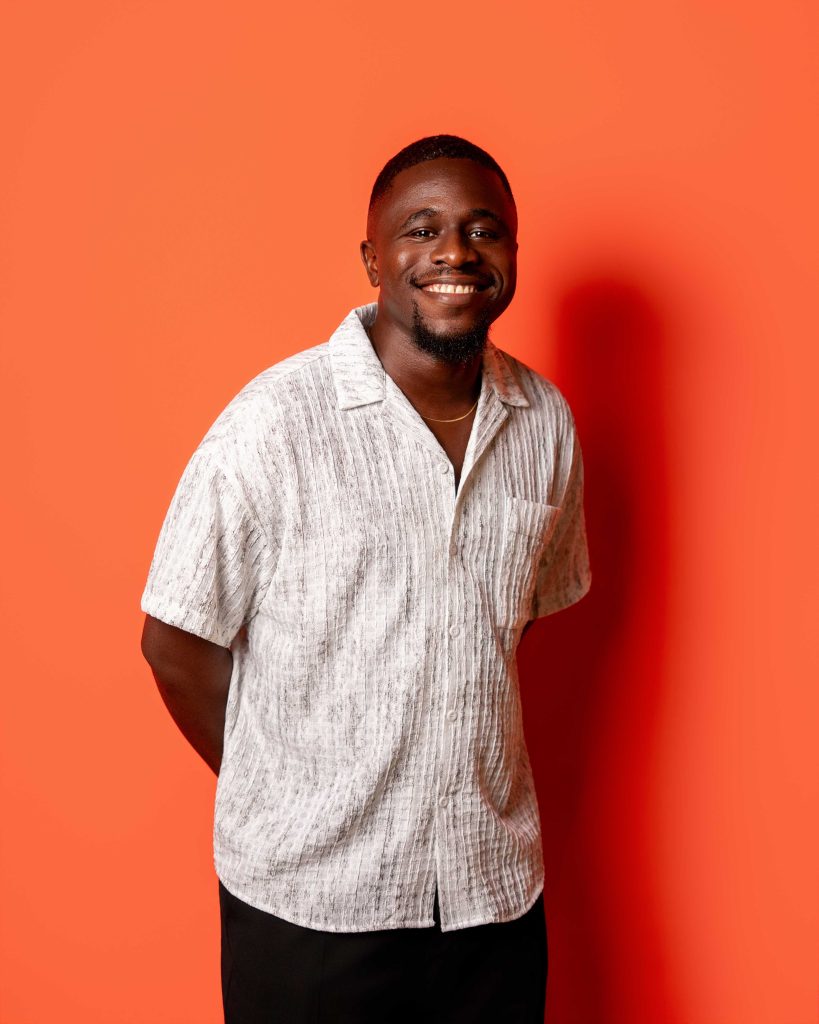
We’re nine episodes into Overthinkers Anonymous, the weekly living room where we geek out about money, masculinity, relationships and everything in between. Osato “EDK” Edokpayi has been there from day one, bouncing hot dilemmas with co‑host Deji Osikoya and somehow making our collective confusion feel like group therapy with banter.
From years on the radio to podcasting, EDK has built a career out of talking through the wahala in people’s heads. In this episode, he breaks down the art of listening, adulting in Nigeria and why life’s messiest questions deserve more than one‑minute hot takes.
What does being an overthinker mean to you?
I think it’s beyond brooding over things that are bothering you, which is what people generally would say. For me, overthinking is staying with a problem until I find clarity or a path forward. It can look like brooding from the outside, but it’s usually how I work through things.
So, how would you describe Overthinkers Anonymous to someone who hasn’t seen an episode?
It’s a podcast about guys and women geeking out about everyday issues. Typically the types that have young people thinking, ‘What is going on in my life?’
On most podcasts, people just come to talk about things, but nobody’s really solving anything. When Overthinkers Anonymous was pitched to us, we were told dilemmas would be a part of it. To be fair, that’s what a lot of podcasts have become. Dilemmas everywhere. Everybody loves a good dilemma, but we’re not using them for content or talking points. There are actually solutions in there. Listening to guests and my co-host, I realised I’d find these conversations genuinely useful if I were the one facing those dilemmas.
How do you handle the feeling of responsibility that comes with discussing people’s real-life problems on a public forum?
The truth is, somebody on the other side of the screen is being vulnerable to strangers. They’ve gotten to a point in life where they see sharing their problems on a public platform as the only way out. You have to respect the vulnerability of the person sharing and the audience listening. The people engaging are spending time or, in our case, resources like data to engage. Those things are very valuable, especially for MTN users.
Is this your first time solving dilemmas for strangers?
Yes and no. I’m a radio host, and I produce my radio shows. We have a dilemma segment on the show as well. I don’t typically have a co-host on my show, so I created an AI co-host. Then I took a step further and created a personality for the AI entity. She’s sassy, a bit snarky, and really hates me. But then she loves the listeners, and they love engaging her. One of the things that was a big hit with the AI co-host is that she answers dilemmas on air.
Wow
Of course, it’s the people on the team who feed her the answers, and we have to think quickly., But we also take care that the same principles apply here. The beauty of radio is that people share really intimate moments with you. People are in their bathrooms and sitting in their cars alone listening to you. They get really vulnerable very quickly. I’ve heard kids on their way to school talk about trouble with classmates, and adults share stories about friends who left the country without telling them. People obviously ask what’s wrong with the government. If it’s football season, people ask what’s going on with a particular team. The AI co-host that we created always has an answer.
I never give the answers myself on air. Even though, technically, it is me speaking through the AI co-host. She also sometimes shares thoughts that I wouldn’t want to say on air.
Why wouldn’t you want to say those things on air? Are you afraid of being dragged?
No, no. People know me for being funny and pleasant. But sometimes I just want to yab people. In a lighthearted way, of course. If you just heard me say something really nice and then the next moment you’re hearing me diss someone, there can be a bit of a dissonance. On radio, we have co-hosts to prevent that. So everybody plays a part. My role is to drive the show and find all the things that will make Lagos rock for a few hours. Then this AI entity that we created comes in to cause trouble.
Do you and your co-host on Overthinkers Anonymous also have some form of this dynamic?
To be fair, I don’t think we ever had that conversation. But I can understand the dynamic because of my training. This is Deji’s house, and it’s nice to come in occasionally to talk about life. Even though I’m always there when things are being sorted, it’s not my house. In terms of how a show like that would work, Deji has to drive the show, and I’m cool being the co-pilot.
Also, he has the best cold opens I’ve seen in a long time. I like the way we start the show. There’s never a ‘welcome to our show today’ and so on. It’s just ‘hey, I’ve rocked up to your house, bro, and e get this thing wey I dey think…’ Then we pick it up from there. Ultimately, it is a team effort. We need listeners to understand that it’s a show for them to come in and feel like they’re in that living room, having those conversations with us in real time. These are conversations they can have with their own friends.
What kind of conversations do you want people to take from the show?
As I said, it’s important that people see themselves having these conversations. Look at everything we spoke about in this season, from why men don’t read to the role of money in relationships and family dynamics. We touched on addiction and many other things that are affecting a lot of young people today. I’m sure we’ve not even scratched the surface of everything we need to talk about. I have people sending me screenshots from some of their guys who watched the show. Some of them are saying things like ‘omo, it’s only 48 Laws of Power I’ve read o’ or ‘so there are other books out there for me as well’.
A couple of guys could see this and decide to challenge this thing where men don’t have book clubs. They could make that happen. I mean, we get together and play ball; who says we can’t get together and discuss books??
What exactly does Overthinkers Anonymous do differently from other relationship and culture podcasts?
There are not a lot of shows that give you the experience of everyday people who are honest about their experiences. We’re not looking for virality. So we don’t go into episodes looking for things that would blow up the internet. Certain people like to say outrageous things to provoke emotion. On the radio, we call these people shock jocks. You see a lot of shock jocks on mainstream relationship and culture podcasts. There is a tendency to want to sensationalise things or play up a personality to appeal to extremes of people’s tastes. But what Overthinkers Anonymous has shown is that you can take the other path and still resonate with people. We can tell that people really like the personalities that they hear and see. Nobody is out here trying to be the most extreme version of themselves to get likes. The people you see on the couch act and talk like that in real life.
In what ways do you think men and women differ in the way that they overthink things?
I think the difference is in how they share what they’re thinking about. What I find interesting is that it takes a bit of time for men to share what they are thinking. You need to almost always create the right environment for it to happen. The right environment could be fish and beer or a PS5. But there needs to be a setup for it to happen. It’s very hard to hear men sharing what they are thinking unprovoked. They need to be eased into it.
Women, on the other hand, are very quick to open up. We could just be driving past Ozumba Mbadiwe, and everybody in the car would start to talk about what’s happening in their lives.
What’s something you have stopped overthinking as you’ve gotten older?
It is money o. I said it in the first episode; I just don’t overthink money anymore. Maybe because I’ve hung out in the northern part of the country and interacted with a lot of Muslims. I can’t help but think everything I have can be gone in a second. This whole rat race is a bit stressful, to be honest. If you wake up every day and you’re thinking of how you must make money, it becomes exhausting. I would rather think of ways I can add value and make an impact. It eventually leads to wealth creation anyway. Why not just do the things that lead to wealth creation instead of being obsessed with chasing wealth? As I’ve gotten older, I realise that as long as I’m able to survive and be comfortable, I’m good. If I have a little extra for enjoyment, good. Otherwise I’m okay.
Basically, life is short, buy ice cream and do what you love.
Exactly! Life is too short to be taken seriously.
Next Read: Deji Osikoya Wants To Inspire Vulnerability: One Living‑Room Conversation At A Time