• Every week, Zikoko seeks to understand how people move the Naira in and out of their lives. Some stories will be struggle-ish, others will be bougie. All the time, it’ll be revealing.
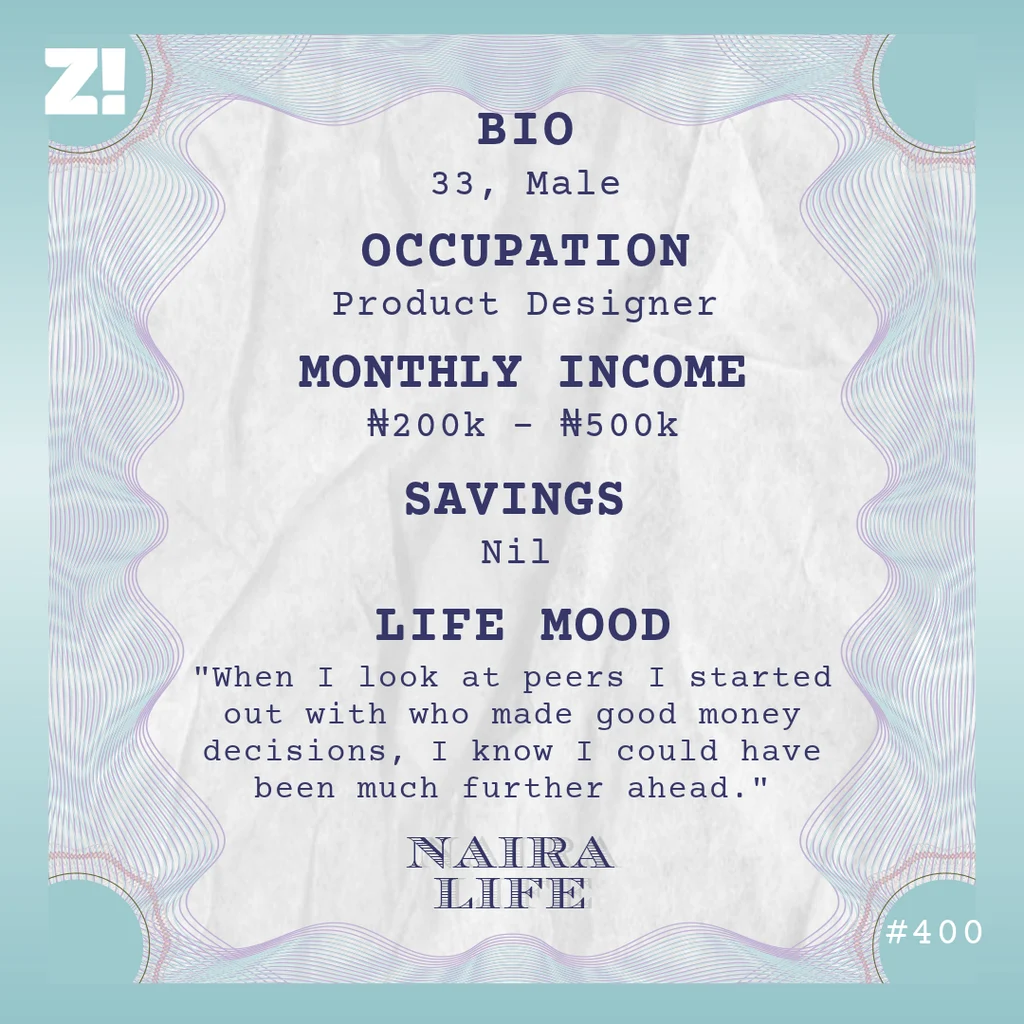

    Nairalife #400 bio money trauma

    When did you first realise the importance of money?

    It was when I got into university in 2012. Actually, it was in my 300 level. I was living in the hostel with different kinds of people: people whose parents sent them allowances, and people who would deprive themselves to save up and buy things. 

    The concept of saving was alien to me, let alone the fact that they were getting actual allowances. It was really strange, considering how my family back home treated money.

    Tell me more about your family

    Money wasn’t a priority in my house. In fact, it’s similar to this guy’s experience. You know the statement, “The love of money is the root of evil”? In my case, it wasn’t even the love of money; it was having it itself that was the evil. 

    I came from a Christian home, and that’s just how my parents brought all of us up. There was this idea that the rich were evil and the poor were good. My dad was a civil servant, and my mum was a trader who eventually had to stop working because my dad didn’t want us kids to mingle too much with people in our environment.

    He lived in a different state and became the only one working, so each month he sent money strictly to cover basic needs like food and school fees. We could never get anything outside those without extensive explanations and justifications.

    It was so bad that my parents even denied me a scholarship I had won to attend a Federal Government College after I did well in my common entrance exam. They felt that if I went there, I’d be exposed to rich people. So, they made me go to a nearby secondary school instead. Same thing for university. I wanted to go to a private university and applied for a scholarship, and they said, “No, go to your state university. At least it’s almost free for indigenes.”

    But you were now in university and seeing people living differently

    Yes, and it was a lot to take in. My upbringing was all I knew, and it was my normal. Growing up, whenever I saw people with a lot of money, it felt like they were doing something shady. As a result, I tried as much as possible not to think about or hold on to money at all because I didn’t want it to corrupt me.

    In fact, after secondary school, I spent a year at home before gaining admission to uni. During that time, I started hanging around a cybercafé because I loved doing things with my hands. I worked as an attendant for free, just to leave the house, until the owner started giving me ₦2k – ₦4k stipends here and there. Whenever it came, I’d just buy something random, like junk or food I didn’t need, just to finish the money. I knew I couldn’t just keep it with me. I wasn’t even doing it for the money in the first place.

    But when I got into uni and moved into the hostel in 300 level, I realised I needed money to survive. I only got transport fare and foodstuffs whenever I visited home on weekends, and that wasn’t enough to sustain me.

    So, what did you do?

    I started doing graphic design for campus fellowships and student campaigns. I had learnt the skill while working at the cybercafé, from watching a guy who often bought internet time to design on the system and practising on my own. 

    The fellowships paid me about ₦1,500 per design. I also started inflating the prices of textbooks to my parents. I’m not proud of it, but it was the only way to get extra money from them. If a textbook cost ₦3k, I’d say it was ₦5k so that the ₦2k extra would be mine.

    Even then, I wasn’t saving. I was just making enough to eat. In my head, keeping money was like inviting “the devourer”— like you’re inviting an evil spirit that will start controlling you. So once money comes, it has to go. 

    That’s interesting

    Fast forward to 2017. I was now in 500 level and decided to drop out.

    Wait why?

    My CGPA was really low, and I had lots of carryovers. I could tell I would have two or three extra years, so I just stopped going. 

    The thing is, I wasn’t taking my studies seriously because the course wasn’t what I wanted to do in the first place. I had wanted to leave in 200 level, but my parents said they’d already wasted two years of school fees and couldn’t waste another one. To them, the money was more important than what I wanted to study.

    When I dropped out, I didn’t tell them for about a year. I gave them the impression that I was doing clearance. Instead, I was running a T-shirt printing business on campus. I would design shirts, take them to a printer, and sell them to students for money to survive. My parents eventually found out I’d left school through my sister. 

    She was also at my uni, and we’d entered at the same time. When she graduated, they started asking questions. They made their findings and discovered that no one in my department had seen me all year. Everything blew up at home. My parents told me they wouldn’t spend on me again. I was still living at home, but I was on my own.

    We surveyed 5,000 workers across Nigeria’s formal and informal sectors to examine what Nigerians earn, where the money goes, and whether hard work actually translates to financial security. This is what we found. Download the Zikoko State of Income Report.


    Was the profit from the T-shirt business enough to sustain you?

    The problem was that in my head, it wasn’t even meant to be a business; it was a survival method. I couldn’t count my profits or losses. I could spend ₦3,000 on production and make a profit of ₦200 or ₦500, and that was fine with me. Even as the business grew over time and I had two people working for me, I still applied that thinking. 

    Every time we made a profit, I was always looking for the next random thing to buy just to let the money go. My staff earned ₦25k each, and sometimes I couldn’t even pay them, so I was constantly owing loan apps, then clearing the loans when a job came in.

    If I wanted to buy a shoe worth ₦50k, I couldn’t save ₦10k five times because I’d be restless until the money left my account. I had to wait until I got a single job that would pay me ₦50k at once to buy the shoe.

    I did that for years until I began to rethink my money habits.

    What led to the rethink?

    A little backstory: During the 2020 COVID lockdown, when I couldn’t sell shirts, I was making small cash teaching people how to design on their phones using Canva. One day, I stumbled across a three-month product design course for ₦10k. 

    Honestly, I didn’t even know what product design was. I thought it meant designing physical products like paper bags and backpacks. That ₦10k was the only money I had at the time, and I didn’t want it to stay with me, so I just paid for the course.

    With my design background, I learnt quickly and finished in the top three. My instructor plugged me into a remote internship with the US-based company he worked for, paying ₦70k a month. By October 2020, they hired me full-time and doubled my salary to ₦140k. I resigned three months later, in December.

    Why did you resign?

    I felt like an imposter in a big place. Remember, I grew up not accepting to stay among “big people.” Once they doubled my salary, it became a problem for me. I’d never touched that kind of money before. 

    I kept asking myself, “Why am I earning ₦140k? What am I doing with ₦140k?” I wanted to go back to my survival business where I could justify earning little. So, I returned to selling shirts.

    The wake-up call came in early 2021 when I lost my dad. As the only son, the responsibility of the burial fell on me, and I didn’t have the money. I had to speak with our tenants to have them pay their rent in advance so we could cover the burial costs. After we did, I sat down and thought about my whole childhood, and it dawned on me: if there’s an emergency right now, I’m stuck. 

    I shut down the business in May 2021, moved out of my father’s house for the first time into a ₦400k self-con, and went looking for a job.

    Get More Zikoko Goodness in Your Mail

    Subscribe to our newsletters and never miss any of the action

    How did the job search go?

    I got one almost immediately, but it was an unpaid role. I handled projects and operations for a blockchain company. They had an online community, and I helped manage it. They only gave me transport stipends once in a while, and I just figured the job was a good way to stay busy. Also, I still had some money left over from my dad’s burial and pension, so that was a buffer. 

    I worked at this company for a year, then in 2022, I got a product design teaching role at a startup paying ₦150k. For the first time, I started saving about ₦80k out of my ₦150k every month. I only did it because I knew I had rent to pay. I still squandered the remaining salary on random things or gave it away because I felt guilty buying things for myself. 

    How long were you at the new job?

    Six months. After that, I moved to another company that paid me ₦180k/month. I stayed at this one for over a year. I also got married around this time.

    Then in June 2024, I landed an $800-a-month contract. With the exchange rate at the time, my income jumped from ₦180k to about ₦1.2 million. Instead of saving, my old mindset kicked in on a much bigger scale. I had “big money,” so I needed a bigger expense to exhaust it. My old rent had increased to ₦620k, so I moved into a bigger house costing ₦2 million a year.

    It was a huge mistake. Eight months later, in March 2025, the contract ended, and I was stuck with a ₦2 million rent bill.

    Yikes. How have you been coping since the contract ended?

    I pivoted to freelancing, and right now my income isn’t stable; it ranges between ₦200k and ₦500k a month, mostly from long-term projects. 

    This year has been particularly tough. Last month, my rent wasn’t complete, so I had to drain my entire savings to raise the money. I’m still in the ₦2 million apartment because with current rent prices, even downsizing costs almost the same.

    What’s your relationship with money now?

    Getting married forced me to become self-aware. When there’s a responsibility attached — like paying rent or providing for my family — I know things will suffer if I don’t save.

    I’ve also had to build systems to outsmart my own brain. When we first got married, we opened a joint account so my wife would get notified if I tried to make a transfer, forcing me to justify every spend. Now, whenever money enters my account and I feel that familiar itch to buy something random, I immediately transfer the money to my wife’s account so it’s out of my possession.

    I also use a strict percentage system now: whenever income drops, I immediately split it in half. 50% goes straight into a locked account for rent. I treat the remaining 50% as my new 100%.

    How do you split this across your monthly expenses?
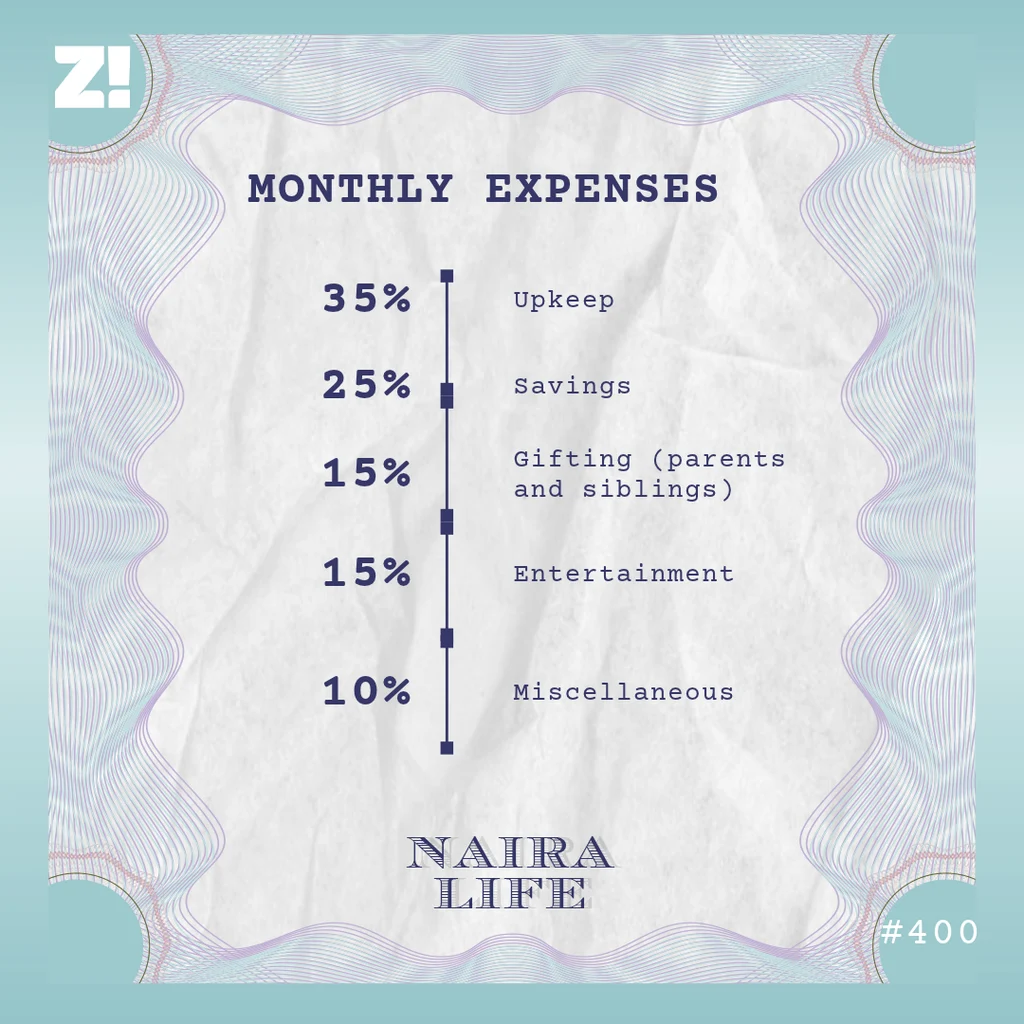
    Nairalife #400 expenses

    I’ve also started reading about stocks and investments, and I’ve mastered delayed gratification. If I feel the urge to buy something for ₦10k today, I force myself to wait three days. Usually, by day three, the urge is gone. Ironically, I now offer financial structuring as a service to small businesses based on everything I’ve had to unlearn.

    I’m curious. Do you ever regret the years spent with that old mindset?

    Every day. Leaving my old apartment for a ₦2 million house is one of my biggest regrets. When I look at peers I started out with who made good money decisions, I know I could have been much further ahead.

    What’s an ideal amount you think you should be earning right now? 

    Ideally, I should be earning ₦1.5 million to ₦2 million a month. Based on the value I provide and what I know now about managing money, if I earned that consistently for five years, I know exactly how to build with it.

    What’s something you want right now that you can’t afford?

    I really need a car, but it’d cost around ₦8 million to ₦10 million. We had to sell my dad’s car after he passed because it was giving us issues. I can’t afford one now, but I’m actively looking to get back into a stable 9-to-5 alongside my freelancing. At least now, I know I don’t have to wait for a miracle bulk payment; I can actually save toward it.

    How would you rate your financial happiness on a scale of 1 to 10?

    4. With freelancing, most of my jobs are long-term. You collect a deposit for a six- or seven-month job, the deposit runs out before the job finishes, and by the time the balance comes in, there are bills to pay again.

    Once I get back into a structured 9-to-5, I know I’ll be able to build a real safety net.


    If you’re interested in talking about your Naira Life story, this is a good place to start.

    Find all the past Naira Life stories here.

    Subscribe to the newsletter here.

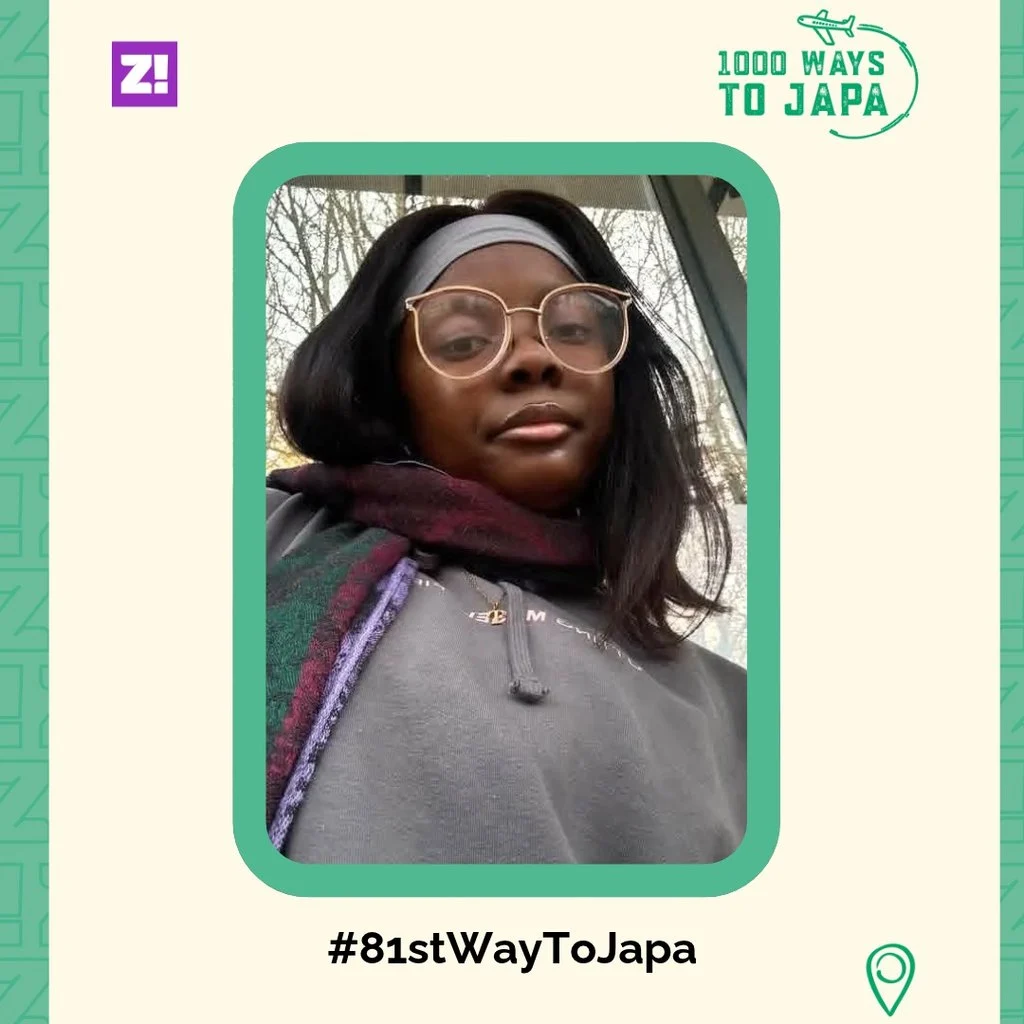
  • Someone you know has left or is planning to leave. 1,000 Ways to Japa speaks to real people and explores the endless reasons and paths they take to japa.


    Toke (19) finished secondary school at 16, spent a year in pre-degree, another year at a Nigerian private university, and then moved to Poland to study medicine in February 2026. Here, she tells us how she found her way past unaccredited schools, why medical scholarships are so hard to find, and what part-time work can actually cover.

    Toke, a 19-year-old Nigerian student who moved to study medicine in Poland

    Where are you now, and when did you leave Nigeria?

    I left Nigeria in February 2026, and I currently live in Northeastern Poland.

    Nice. So what was life like before you left?

    I finished secondary school in 2023 when I was 16. The plan had always been to go abroad, but it didn’t happen immediately. I completed a year of pre-degree in 2024, then 100-level at a private university in 2025. My parents didn’t want my life to stagnate while we waited, so they said I should go to school, and if the japa happened along the line, fine. In February this year, I left.

    Was moving abroad something you wanted, or did you follow your parents’ wishes?

    I wanted it. I’d always known, because my parents want a better life for us. I also have family members abroad, so we hear what they’re doing, and I’d daydream about living like that. I just didn’t know what the process would look like.

    Interesting.! Why Europe, and not Canada or the US?

    I’m studying medicine, and my first thought was Canada or the US. My dad didn’t want that for me. In Canada, the UK and the US, you have to finish an undergraduate degree before you can study medicine. I was fresh out of secondary school, and he didn’t want me to do a degree, then four more years of medicine, because I’ll probably be too tired by then. Europe is friendlier because they admit students straight from secondary school.

    Understandable. Why Poland specifically?

    Well, I chose it because I did my research. My parents wanted me to have somewhere I could settle and work, or move on from. Poland offers an international degree. It’s recognised across the Schengen area and the EU, and you can use it if you want to move to the UK, US or Canada. I wasn’t sure I’d want to stay in Poland, so I wanted a degree that wouldn’t tie me to the country where I studied.

    Walk me through the research. Where did you start?

    YouTube and Google first, then ChatGPT. I watched people talk about their experiences and how to do the documents, because sometimes the website says one thing and reality is another.

    Then I stumbled upon a website called Medlink Students. It lists countries and universities that offer medicine, dentistry, or veterinary medicine in English, along with their requirements and application processes. They even offer a free consultation, which made my research a lot easier.


    The Big Daily is your weekday shortcut to the biggest news shaping Nigeria. We cut through the noise, connect the dots, and explain why the news actually matters, all in one quick read.


    What were you looking out for in a school?

    Accreditation. I’d heard on TikTok about students who studied in Russia and were told their degrees weren’t valid when they graduated, and about a school in Ukraine, I think, that wasn’t even real. I didn’t want to waste six years, so I looked for good accreditation and schools with partnerships in places like the US and Canada.

    Wow, that’s scary. Once you picked a school, how did you apply?

    I went through their website, but some schools don’t update it in a timely manner. So I emailed to say I was a prospective student interested in studying medicine in English and asked for the requirements, and they sent them to me. Then I applied in January last year.

    And the visa? How did that go?

    I’m not exactly sure about the process, as my parents handled most of it. What I can say is that it depends on what you’re applying for, because study, work and the Schengen visa are all different. It’s very unpredictable. I’ve heard of people on government scholarships in Poland who were still denied by the embassy, and others who appealed and were denied again. The process is honestly crazy.

    Were there any scholarships for Nigerians or international students?

    I didn’t find any for myself, because you rarely find scholarships for medicine. There are scholarships for other courses, but they’re mostly for master’s and PhD, though I think there are some for undergraduates. There’s the Narodowa Agencja Wymiany Akademickiej (NAWA) scholarship and the Nicolaus Copernicus scholarship, which is for African countries and specifically includes Nigeria.

    How did you feel once you got admitted and your visa was approved?

    Relieved, honestly. I’d taken an unintentional gap year after finishing 100 level, and I felt behind because my mates were entering 300 and 400 level while I was starting again. It was exciting too, with a new country, new place and new people. But mostly, it was a relief to finally be passing that stage.

    Okay, so you land in Poland. What were the first few weeks like?

    I came with my mom, so I wasn’t alone. That helped, because we don’t have family there. We were jet-lagged, but I wouldn’t call it culture shock, because I’d watched a lot of YouTubers who live there.

    The weather was the only real shock. Everyone kept saying it’d be cold; I expected it, and I still wasn’t ready. The other things were that everybody minds their own business and doesn’t eat spicy food. I love pepper, so that was hard.

    Was it hard finding community?

    I lived in Warsaw for six months before I resumed school this month. My parents wanted me there because it’s the capital and I’d integrate faster than in a smaller city. They know that if left to me, I won’t go out.

    For the first month, I didn’t go out at all, so I knew nobody. Then a YouTuber I watch posted about a church service she attended, and it was a church I’d attended back in Nigeria. So I went, introduced myself to her, and joined the community; it’s so lovely. After a month alone, it was so nice to see other Nigerians.


    Read this: She Moved to Canada Without a Job and Rebuilt Her Career From Scratch — 1000 Ways to Japa 


    Did you meet people outside church?

    I’m a homebody, so not really. The other events I went to were from church too, like a fake traditional wedding in August that people I knew from church organised. If I hadn’t gone to church, I probably wouldn’t have met anyone.

    How are you handling the language barrier?

    In Warsaw, I completed a four-month semester at a language school, which helped me understand bits and pieces of Polish. I’m also taking language classes as part of my course, because you can’t do clinical rounds without learning the language.

    Let’s talk money. Can you work as a student, and does the minimum wage cover the cost of living?

    I don’t work right now because my schedule is jam-packed, but I’ve looked into it. Student workers have privileges until 26, like no bank charges and discounts on train tickets.

    The minimum wage is about 31 PLN per hour. If you worked seven to eight hours a day as a part-time student, that’s roughly 3,000 a month. Rent is around 1,500, depending on where you live; groceries are about 400; transport is about 110; and miscellaneous is 150 to 200. So it covers everything, with some left over. It’d take a toll on you stress-wise, but I think it’s worth it.

    Do you miss Nigeria?

    Honestly, no comment! (laughs) I miss the spicy food. Sometimes I wake up at night craving food I can’t eat. I also miss my friends and family.

    Is there anything Nigeria could have done differently to keep you here for medicine?

    A lot. The requirements are strict; you need at least a C in subjects like biology, chemistry, maths and physics, and not everyone meets them. Student life isn’t always favourable, and the universities that are have tuition fees that are off the charts. If Nigeria had the kind of opportunities Europe offers, I might have considered it. Unfortunately, it hasn’t reached that level yet.

    Do you see yourself coming back to practise?

    If, by some miracle, Nigeria ends up paying doctors more than Australia, which I heard pays the most, then why not?

    What’s one thing you love about living in Poland?

    The small things. There are pedestrian crossings where cars actually stop. I was about 50 metres from a crossing once, and the first car already stopped for me. Nigeria had scarred me, so I was like, “You could have just gone; why are you waiting for me?” I also love the self-checkout at supermarkets. Those two made my life better.

    What would you say to someone thinking of studying in Poland?

    Just go for it. If you’re contemplating it, literally, just go for it.

    On a scale of one to ten, how would you rate life in Poland right now?

    I’d give it a seven. It would honestly be a ten if not for the weather.

    Thank you so much, Toke! Anything you’d like to add?

    Thank you for having me.


    Want to share your japa story? Please reach out to me here

  • Every week, Zikoko seeks to understand how people move the Naira in and out of their lives. Some stories will be struggle-ish, others will be bougie. All the time, it’ll be revealing.


    Hisa lets you buy and sell Nigerian and US stocks straight from your phone, all in one app. And with Hisa’s zero-commission campaign, new users who sign up before the end of 2026 can trade in both markets without paying trading commissions during the promotion. Ready to own a piece of the companies you know? 

    Download Hisa, create an account and start investing. Terms apply.


    NairaLife 399 bio toxic bank job

    What’s your earliest memory of money?

    I grew up in what I would call a very comfortable family. I had everything I wanted and needed, so I never really understood how money worked. All I knew was that if I wanted something, it was available, and if it wasn’t, all I needed to do was ask, and it would be provided.

    I didn’t handle money as a child. I wasn’t one of those kids who would do petty things and get rewarded with cash. My parents provided everything. It wasn’t until I lost my dad and the dynamics shifted that I understood the value of money.

    I’m sorry about your dad

    It’s okay. He passed when I was 12, around the time I was in JSS 2 or 3.

    Can you share some more about what things were like before he passed?

    We had a lot of domestic staff; people who handled the driving, the logistics, and household needs. I was pretty much a nepo baby. 

    My dad was very wealthy. He ran chains of businesses in Kaduna, from hotels and guesthouses to other side ventures. My mum was a housewife. All she had to do was look pretty and take care of the family.

    When my dad died, I didn’t immediately clock that I would never see him again. I didn’t even cry because I didn’t know what I was supposed to feel. That’s to show just how much of a bubble I was in. I didn’t understand that my living conditions might change. I thought everything would still be alright and we wouldn’t lack anything. It wasn’t until a few months, and then years, down the line that I realised there was a huge void.

    When did that void first hit you?

    The first time it hit me badly was during my JSS 3 graduation. I didn’t attend because my mum couldn’t foot the bills for the party. That morning, right after our family devotion, she called me aside and said, “After your exams, that will be it. No graduation, no preparation, nothing, because I need to channel the money elsewhere for your siblings.”

    I can never forget that morning. Prior to that, I had already been making plans with my classmates about the outfit and hair I’d wear to the junior prom. Having my hopes dashed like that felt terrible. It was the first major sign that things had changed.

    Did things keep shifting from there?

    Definitely. There were a couple of times when my school fees were delayed, and I had to pass up certain luxuries because we didn’t have them anymore. For instance, we had about three or four cars, and after my dad passed, my mum had to sell every single one of them. We moved from changing cars to shuffling between public transport.

    My mum took over managing one of my dad’s businesses, but the hospitality industry in the North was changing, becoming even more conservative, and the boom it had experienced while I was in primary school had died down.

    When did you first start thinking about making your own money?

    I tried getting receptionist and nanny jobs right after secondary school to make money, but my mum never endorsed it. She didn’t want my siblings and me to have the mindset that, because our dad was gone, we had to forget school and start working to make money.

    Because I didn’t get admission immediately, I stayed at home for two years writing JAMB and attending lessons, then completed a brief pre-degree programme in 2015 before enrolling in a state university in 2016 to study microbiology. It wasn’t until I got into uni that I started doing things for money.

    What were you doing in uni for money?

    Not to toot my own horn, but I am quite smart, and people around me knew I was very book-focused. I started attending night classes from my very first year. So whenever people needed someone to cover attendance, do assignments, or write exams for them, they knew to reach out to me.

    If I didn’t want to take the risk of actually writing an exam paper for someone, I’d go into the hall with them and let them copy from my sheet.

    How much did that pay?

    Exams were usually between ₦10k and ₦15k per course. Sometimes, if I met big girls who had money, I could charge ₦20k or ₦25k, and they’d pay. Assignments were much cheaper, around ₦3k to ₦5k. Other times, on really hungry days, I’d do an assignment and tell the person, “You know what, just give me food.”

    In a good month, especially in my third and final years when I met a lot of unserious students with carryovers, I was making an average of ₦30k to ₦40k writing exams.

    You mentioned knowing that what you did for money was risky. Why do it still?

    My pocket money was like ₦3k to ₦5k per month, and sometimes it didn’t even come. As the first daughter, my mum expected me to understand her financial situation and make sacrifices. It could be something like, “Oh. I can’t afford to send you money because of your younger siblings.” And I couldn’t question it. I just had to accept and manage somehow.

    I knew that getting caught impersonating during exams meant automatic rustication, or paying serious bribes to junior lecturers, so there was always tension. But I felt like I was helping my mother help me. I used the money to take care of myself and buy clothes. 

    By my final year, I was even making enough to outsource chores like laundry and fetching water. I didn’t save anything from those hustles, though. I didn’t feel a need to keep money somewhere. I’ve always felt money is meant to be spent.

    I did that throughout my time in uni, until I graduated in 2019. 


    We surveyed 5,000 workers across Nigeria’s formal and informal sectors to examine what Nigerians earn, where the money goes, and whether hard work actually translates to financial security. This is what we found. Download the Zikoko State of Income Report.


    What came next?

    I went back to Kaduna, and then COVID hit in 2020. I ended up spending the whole of 2020 and 2021 at home because I didn’t have the money to return to school for clearance. I needed about ₦250k – ₦300k because clearance at my school was incredibly slow and often took months. That money was to cover transportation, rent for an apartment (I’d left mine after graduation), and pay any outstanding school bills.

    I didn’t have that much, and my mum didn’t have it either. Those two years at home were some of the most frustrating years of my life. Classmates whose exams I literally wrote were posting pictures from NYSC camp, while I was stuck at home.

    My mum didn’t let me take menial jobs, so I spent my time doing house chores, taking care of my siblings, and reading novels and poetry. I subscribed to foreign magazines and tried submitting articles and poems to get paid, though none of those panned out.

    Finally, in November 2021, my mum raised the money, and I returned to school and finished my clearance in six months.

    Six months is wild

    See, I know people who spent years trying to get cleared and were stuck in the system due to one issue or another.

    Fast forward to November 2022, I finally got called up for NYSC. I served in the East and worked as an administrative assistant in an elite secondary school.

    NYSC paid ₦33k/month, and the school paid me ₦30k. It was later increased to ₦40k right before I finished my service in October 2023. The school also provided accommodation, so I didn’t pay rent. 

    Sounds like you had a great service year

    Not exactly. Working in that school stressed me out. With rich kids, you’re constantly walking on eggshells because if you speak to a child a certain way, they report you, and the school deducts a fee from your small salary. 

    After NYSC, I returned to Kaduna in January 2024 and started applying for jobs online. Most roles were in Lagos, and I didn’t have anyone to stay with there. Luckily, in March/April, a close family friend of my mum connected me to someone at a commercial bank. After a few interviews, I was invited to banking school in Abuja in May 2024.

    Nice. How did that go?

    Banking school lasted two months, and during that time, they paid me about ₦60k/month. In July 2024, I was assigned to a branch as a Relationship Manager. My starting pay was ₦350k, plus a housing allowance, bringing my net pay to around ₦380k.

    At first, I was so excited. ₦350k felt like a lot of money. In fact, the very first month I got paid, I exhausted the entire ₦350k in one week on hair, nails, clothes, bags, and sending money home. I even had to call my uncle to send me urgent ₦100k after I’d spent my entire salary.

    The excitement didn’t last long, though. When the actual workload hit me, I realised ₦350k was trash. “Relationship Manager” was just a fancy title for marketer. Every morning, they would grill us about leads and deposits and talk to us anyhow. Every day, CRM this and that. I would wake up in the middle of the night crying and having panic attacks. Even when I got customers who brought in deposits, as soon as they took their money, I was back to square one. Management would always make us feel like we were doing nothing and were just coming to collect our salary for free.

    One night, I stayed in the banking hall until almost midnight because my manager refused to let me finish a presentation the next morning. She wanted it sent that night. It was hell.

    Phew. That’s a lot

    Still, I kept enduring. In July 2025, there was a salary review, and my pay grew to about ₦420k. But it didn’t do anything to relieve the stress and burnout I was feeling. I was literally dreading going to work every morning.

    One day in December, I just woke up and told myself, “You know what? I’m done.” I resigned without any plan or savings. I just walked out.

    Ah. Just like that?

    I couldn’t do it anymore. Also, December marks the end of the financial year, and we were already hearing that targets for January 2026 would be tripled. I told myself I wasn’t entering a new year with that kind of pressure, so I just walked out.

    I didn’t even tell my mum until after I resigned, and she was furious. I didn’t mind. I’d been complaining about the job to my family before, and the person who wears the shoe knows where it pinches most.

    Get More Zikoko Goodness in Your Mail

    Subscribe to our newsletters and never miss any of the action

    So, how did you survive without a job or a plan?

    It was very tough. I knew I didn’t want to do on-site work anymore and wanted to work only remotely, so I needed a good laptop. I also had a ₦100k monthly ajo commitment (₦50k each for two ajo groups) that I had joined in 2025 to get an apartment. I didn’t want anyone to embarrass me for owing ajo, so I had to pay that on time too. 

    To be honest, my family saved me during that period. I survived on small stipends from my mum, my aunt abroad, and close friends who gifted me money without me having to beg. I also collected one of my ajo payouts (₦250k) around this time, so that helped.

    In March, I reached out to that same uncle who always rescues me, and he loaned me ₦500k. I used ₦420k to buy a laptop and used the balance to offset an ajo payment.

    How long did this period of unemployment last?

    It lasted about five months. I was looking for any kind of remote job — data entry, call centre, customer service, even sales. I just wanted something.

    Thankfully, in May 2026, I got a BPO role for a US real estate company calling leads who had filled out forms on their website. It started as a base-pay role, then they switched it to commission-only, paying $14 per sale. I could call 100 people and only convert two. In a good week, I made $30 to $40. I only worked there for a month and made about ₦150k.

    I left in June when I got my current role, which is also a remote BPO setup, working for a Fortune 500 insurance company in the US.

    What do you do there, and what does it pay?

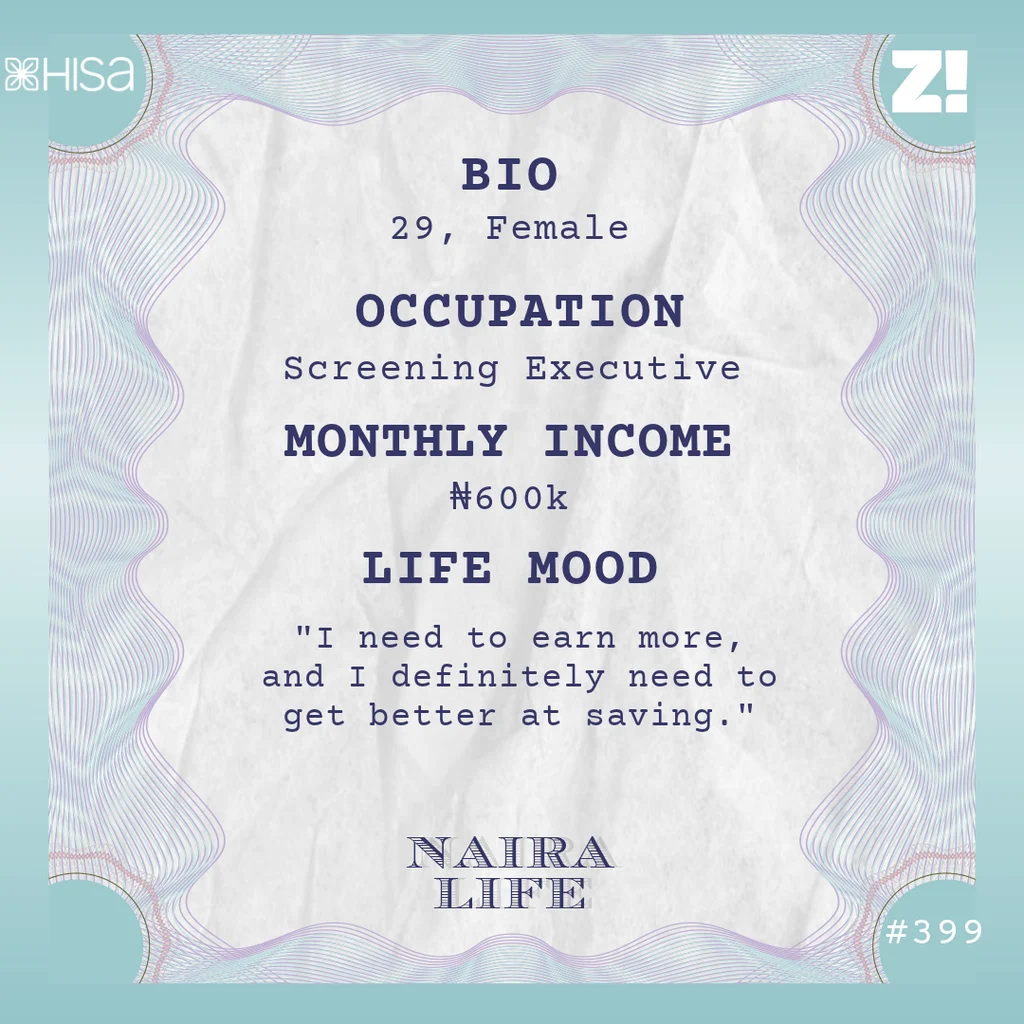
    I’m a screening executive, basically HR. I conduct initial phone interviews for candidates who applied to the company and book qualified ones for second interviews.

    It pays $3 an hour. I’m expected to work 40 hours a week, which is 160 hours a month — roughly $480, or about ₦600k. When they told me ₦600k during the interview, I was so happy because it was higher than what the bank paid me, and I didn’t have to leave my house. 

    I work a graveyard shift, from 5 p.m. to 2 a.m., and it can be exhausting because I make between 250 and 400 calls a day. But I still think it’s a better situation than working onsite. My real passion is non-voice customer service, so I’m still applying for chat and email support roles, but for now, I’m grateful.

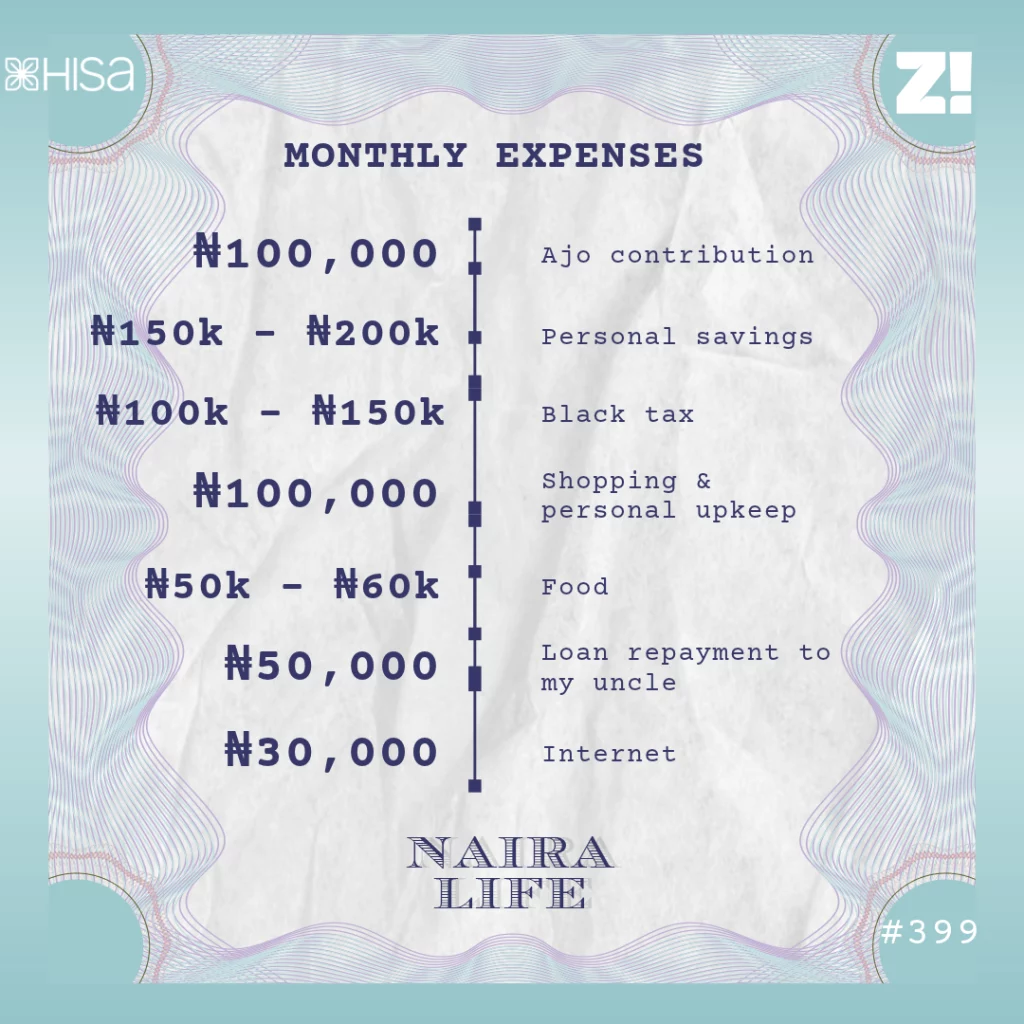
    How do you typically break down your expenses on a ₦600k income?

    I don’t always hit the full 40 hours every week, so my actual take-home fluctuates a bit, but here is how my money usually goes:

    Nairalife #399 expenses

    How would you describe your relationship with money right now?

    I’m an impulsive spender and a very materialistic girl. Because I grew up having everything I wanted, adjusting has taken a lot out of me. If I see a dress I like, it makes zero sense to me not to buy it. I love the fancy things of life.

    At the same time, going months without a job earlier this year taught me the value of having something to fall back on. I just started forcing myself to be consistent with savings and currently have about ₦500k set aside. If I had been more diligent since June, I’d probably have triple that amount by now.

    What’s an ideal amount you think you should be earning?

    I think I deserve to earn between ₦1.5m and ₦3m monthly. In the remote world, there are always better-paying opportunities, so I just need to keep positioning myself.

    Is there anything you want right now but can’t afford?

    I really want an international vacation. That will probably cost between ₦10m and ₦15m, which I definitely can’t afford at the moment.

    Looking back, do you think quitting the bank without a plan paid off?

    100%. I don’t regret resigning at all. In fact, if I had known what I know now about remote work, I wouldn’t have wasted almost two years there. I would have left within a year and bought my laptop with my salary instead of taking a loan.

    However, I would never advise someone in my shoes to just wake up and quit their job without a plan. I have a very spontaneous, “I don’t care” attitude that makes me take wild risks, and it could have easily gone left. Get another job first before you walk away.

    How would you rate your financial happiness on a scale of 1-10?

    6. I’m grateful for where I am, especially compared to where I was at the start of the year, but there’s a lot of room for improvement. I need to earn more, and I definitely need to get better at saving.


    If you’re interested in talking about your Naira Life story, this is a good place to start.

    Find all the past Naira Life stories here.
    Subscribe to the newsletter here.

  • GridLocked is a daily pop culture guessing game built for Nigerians. Every weekday by 9am, you’ll get six clues, sixty seconds, and an answer only a Nigerian would know.


    Today’s GridLocked is a musician.

    How many clues do you need to get it right? 👀

    Share your result when done, but don’t spoil the answer for others. (Missed the last GridLocked? Play it here.)

    23 NOVEMBER 2026

    Come back every weekday by 9am for a new grid or subscribe to Z Daily, Zikoko’s daily newsletter, to get new GridLocked puzzles, real Nigerian stories and other fun content in your inbox.


    How to Play GridLocked

    • The Goal: Guess the answer for the day before time runs out. (The answer could be a Nigerian person, place, song, movie, or even slang.)
    • The Lock: You cannot type a guess until you have revealed at least one tile (clue).
    • The Reveal: Tap any tile to reveal a clue. Every clue describes the answer for the day. The fewer tiles you flip, the better.
    • The Clock: You have 60 seconds to guess right. The timer starts the moment you flip your first tile. (You get multiple guesses.)

    The GridLocked Squares: What Do They Mean?

    When the game ends, you see your guess count, total time spent, and the number of tiles flipped. The tiles are shown as white and purple squares.

    • ⬜ (White) = A tile you flipped
    • 🟪 (Purple) = A tile you left closed

    The fewer white tiles you have, the better your result.

    • Best Result = ⬜🟪🟪🟪🟪🟪 | Guesses: 1 (Only needed one clue and one guess to get it right)

  • Nigeria carries the heaviest malaria burden of any country, accounting for 30.3 percent of global malaria deaths. That is one insect and one disease. Add the cockroaches behind the fridge, the flies moving between bin and table, and the ants in the sugar, and insect protection for homes in Nigeria stops looking like housekeeping. The diseases caused by household insects are ordinary here, and the households that stay ahead of them never stop.

    The Household Insects in Nigeria You Live With

    Four insects turn up in almost every home. The risks are not equal.

    Mosquitoes

    Alt text: “Common household insects in Nigerian homes”  

    Anopheles mosquitoes carry the malaria parasite and bite mainly between dusk and dawn, which is the fact everything else rests on, because the highest-risk hours are the ones you spend asleep.

    So how do mosquitoes spread malaria? One bites someone infected and picks up the parasite, which develops inside it over several days and passes on at a later bite. The diseases caused by mosquitoes go beyond malaria, since Aedes species carry dengue and yellow fever, but malaria is the one Nigerian households meet most.

    Cockroaches

    Cockroaches move between drains, bins and food surfaces, the contamination problem everybody assumes. The part most households have never been told is the allergy one.

    Their droppings, saliva and shed body parts contain proteins that go airborne in house dust, and these rank among the most common indoor allergens. Exposure is linked to asthma, and children in heavily infested homes are most affected. So a cockroach problem is not only what they walk across. It is what everyone is breathing.

    House Flies

    Asking “what diseases do house flies carry” is a fair question, and the answer is that they mostly transport rather than carry. A fly lands on waste, then on your food, moving organisms across on its feet and body.

    Houseflies are documented mechanical vectors of Shigella and other organisms behind diarrhoeal disease, and fly-control trials that cut fly density saw diarrhoea cases and child deaths fall alongside. Covered bins and covered food do most of the work here, well before any spray does.

    Ants

    Ants are the least dangerous of the four, worth saying plainly rather than inflating the risk to make a point. They are a contamination and nuisance problem, following chemical trails to food, getting into sugar and bread and anything sweet left uncovered.

    The health case against them is far weaker than the case against flies or cockroaches. The reason to deal with them is simpler. Food you throw away is money, and an ant trail in your kitchen does not speak so well about your hygiene..

    Why the Dry Season Is Not a Break in Nigeria

    Transmission peaks with the rains, roughly June to October, when standing water multiplies and mosquitoes breed faster and survive longer. Nobody argues with that.

    What gets misread is what happens afterwards. Malaria transmission continues year-round across most of Nigeria, running all year in the south and shortening to around three months in the far north. The rains raise the stakes. They do not create them.

    The other three are not seasonal at all. Cockroaches, flies and ants live indoors on what your household produces, and December makes no difference to them.

    That is the case for year-round mosquito protection, and for treating the rest as continuous. Stopping in November gives populations room to rebuild.

    What “Reliable” Actually Means

    Reliable is not the same as strong.

    Consistency beats intensity. Something used every night at moderate strength beats a heavy use once a month, because populations recover in the gap.

    Cover the hours you cannot defend yourself. Dusk to dawn is when Anopheles feeds and you are asleep, so that window needs something running on its own.

    Use layers that do not overlap, since a net protects whoever is under it, a plug-in mosquito repellent covers the room, and a spray handles what is inside.

    Building Protection That Works

    Alt text: “GoodKnight Power Activ+ plug-in mosquito repellent”

    For most homes this runs three deep. A treated net over anyone sleeping is the baseline, with more evidence behind it than anything a household can buy.

    GoodKnight Power Activ+ is the continuous overnight layer and the part people skip. The combi pack comes with the machine and a 45ml refill, and runs two settings, normal for quiet nights and Activ when the room is busy. Switch it on before bed to start your night with peacefully.

    Alt text: “GoodKnight Power Shots multi insect spray”

    GoodKnight Power Shots covers the rest. It acts on mosquitoes, cockroaches, ants and flies with up to eight hours of protection, handling the fly in the kitchen and the cockroach behind the fridge as well as the one you hear at 2am. Power Activ+ holds the night, Power Shots deals with what walks in, and both are in the GoodKnight range at The Diva Shop.

    Underneath those, nets on windows and doors, bins with lids, weekly water clearing all matter too to protect your family.

    Protecting Children and Older Family Members

    Children under five and pregnant women carry the highest malaria risk, so their sleeping space is where protection should be strongest, while older relatives with asthma or a chest condition are the ones most affected by cockroach allergens.

    Nets first, tucked under the mattress and checked nightly, since a child pressed against loose mesh can be bitten through it. For the room, a plug-in beats anything that burns, and GoodKnight states that Power Activ+ is safe around children and families. 

    If a child runs a fever, get a malaria test.

    FAQs

    What Diseases Do Household Insects Spread?

    Mosquitoes transmit malaria, and Aedes species carry dengue and yellow fever. House flies move Shigella and other organisms behind diarrhoeal disease from waste onto food. Cockroaches contaminate surfaces, and their droppings are a documented asthma trigger. Ants are a contamination problem rather than a disease risk.

    Do I Need Insecticide During the Dry Season?

    Yes. Malaria transmission continues year-round across most of Nigeria, running all year in the south and shortening to around three months in the far north. Cockroaches, flies and ants are not seasonal at all. Stopping in the dry season lets populations rebuild before the rains return.

    Are Cockroaches Dangerous to Health?

    Yes, in two ways. They move between drains, bins and food surfaces, which is the contamination risk most people know about. Their droppings, saliva and shed body parts are among the most common indoor allergens and are linked to asthma, with children most affected.

    Conclusion

    Insects in a Nigerian home are not an event. They are a condition, and conditions get managed rather than solved. Pick two or three things covering different hours and rooms, run them without gaps, and the problem stops rebuilding every time you look away.

  • Alt text: “What to look for when choosing crochet hair in Nigeria

    Crochet is supposed to be the easy one. Shorter time to fix, nothing dragging at your edges, out again in twenty minutes. Then you buy the wrong pack and end up with something thin at the ends, tangled by week two and heavier than braids. Choosing crochet hair in Nigeria comes down to six things, and the price is not one of them.

    What Crochet Hair Actually Is

    So what is the difference between crochet and braids? Braids are built into your own hair strand by strand. Crochet hair is looped onto a cornrow base with a hook, so it goes in fast, sits light and comes out quickly. Crochet is a method, not a texture, so the same twist can be ready to hook in or worn as loose hair. It is the same crochet braids Nigeria’s salons have installed for years, just with better fibre now.

    Pre-Looped or Bulk

    Alt text: Pre-looped crochet hair compared with bulk crochet hair

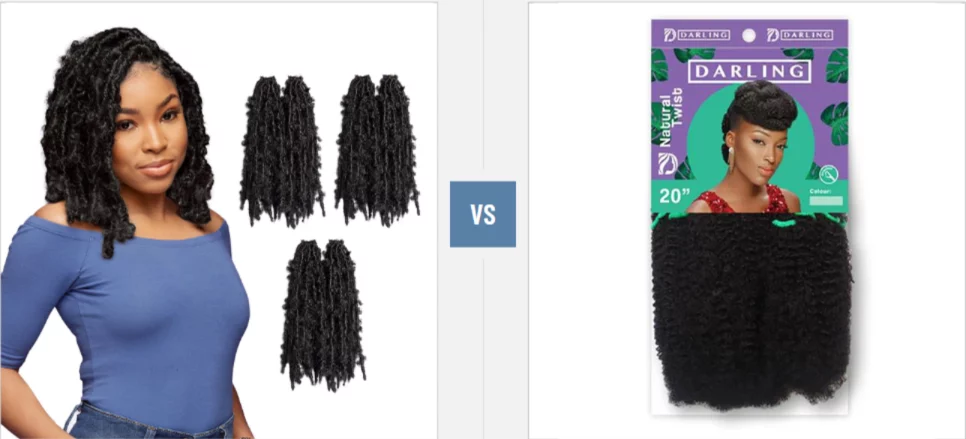
    Pre-looped crochet hair comes already twisted or curled into finished pieces with a loop at the top, ready to hook straight in. It is faster, consistent from pack to pack, and the sensible pick for a first-timer.

    Bulk is loose hair you shape as you go, giving you control over density, fuller at the crown and lighter at the ends. It also takes longer and puts the result in your stylist’s hands. A good stylist makes bulk look better than anything pre-looped. An average one does not.

    They do different things.

    The Six Checks Before You Buy Crochet Hair in Nigeria

    Work through these before you pick your next crochet hair.

    Texture and Curl Pattern

    Alt text: Darling Passion Twist crochet hair for twist styles

    This is where the money decision happens, because curl expands. A curly or twisted texture takes up more space than a straight one, so it gives more volume per pack.

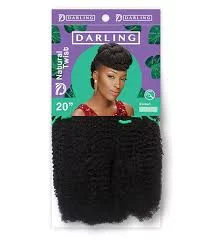
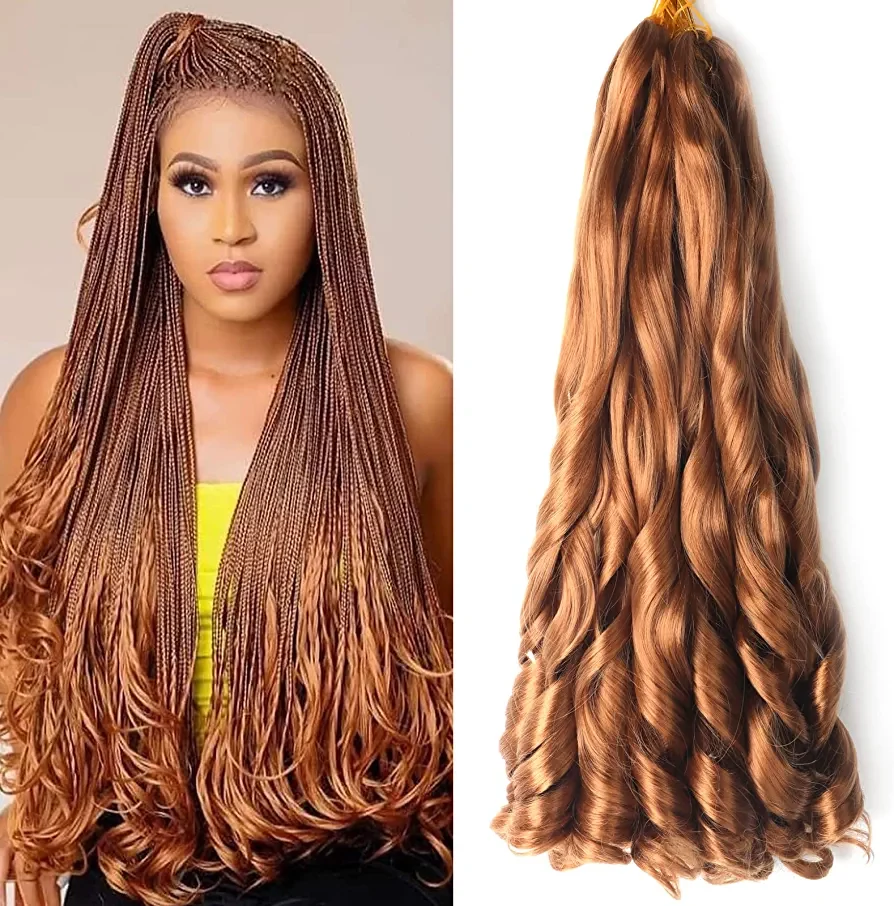
    Darling Natural Twist sits closest to your own texture, making classic kinky twists and kinky wraps at twenty inches, and it blends well enough that people assume it is your hair. Darling Passion Twist is the smooth, long option at thirty inches, light and adaptable.

    Alt text: Darling Bohemian Passion Twist crochet hair

    Darling Bohemian Passion Twist runs loose, wavy pieces along the twist for the boho finish, at thirty-two inches. Pick your texture first. Everything else follows.

    Alt text: Darling Natural Twist crochet hair for natural-looking twists

    Fibre Quality and How to Judge It

    You can judge fibre in the shop, and you should. Run a strand between your fingers. Good fibre is smooth in one direction and has some weight to it, while cheap fibre squeaks, feels waxy and smells strongly of plastic the moment you open the pack.

    Then pull a single strand until it breaks. Quality fibre stretches a little first. The bad ones snaps clean and fast, and it will do the same on your head after a little time of wearing it.

    Pack Count

    Alt text: How many packs of crochet hair are needed for a full head

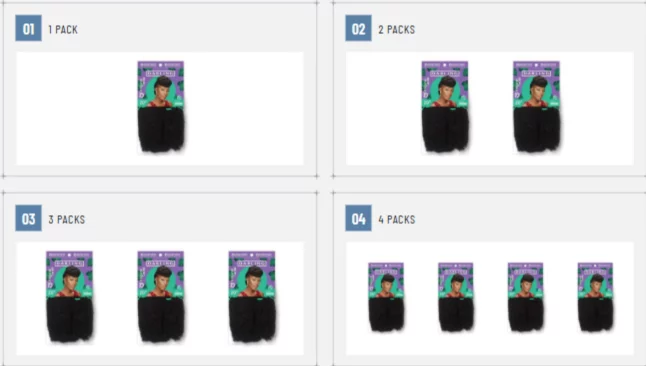
    The question is always how many packs of crochet hair are needed for a full head, and the answer is a range from three to six depending on texture, length and fullness. Curly and twisted textures need fewer than straight or wavy at the same length, because curl fills space; straight fibre leaves empty.

    Darling lists pack counts on its product pages and lets you filter the crochet range by packs per head, which beats guessing at the salon. Natural Twist is listed at two packs, Passion Twist at three, or five to six if your hair is long.

    Then buy one extra pack. Every time.

    Length Against Fullness

    Long hair stretches vertically and adds no width. A thirty-inch installation on three packs looks thin from the shoulders down, because the same fibre is spread over twice the distance.

    If you want long, plan the density for it. Add a pack, or go shorter and fuller. Twenty inches with proper weight looks richer than thirty inches stretched thin.

    How It Handles Heat and Harmattan

    Nigeria puts crochet through two different tests every year. Humidity swells fibre and encourages stray hair, worst on anything smooth and straight, and then harmattan arrives around November, pulls moisture out of everything and leaves fibre brittle and quick to tangle.

    Defined curl survives both better than a loose wave or a straight finish. The frizzy hairs look like texture rather than damage, and a twist holds its shape when the air dries out. Bohemian Passion Twist sits in between, since the twist holds but the loose wavy pieces want more attention once harmattan starts. If you are buying in October, buy with December in mind.

    Cost Per Wear, Not Cost Per Pack

    Crochet hair prices in Nigeria run from around ₦3,500 to ₦7,800 a pack across the Darling crochet range, and the cheaper pack is not automatically the cheaper style. Four packs at ₦3,500 that last six weeks cost less per day than three packs at ₦7,000 that tangle by week three.

    Do the math. Packs times price, divided by the weeks you will really wear it. The best crochet will show itself in your mental and emotional calculation

    Where to Buy Crochet Hair in Nigeria Without Getting Counterfeit

    Price is the first tell. When a pack sits far below what everyone else is charging, something is wrong, and fibre is one of the easier things to fake.

    Check the print on the packaging next. Pixelated fonts, colours slightly off. Then open it, because they can copy the packaging well but they can’t get the fibre.

    Buying from an authorised seller removes the problem, which is why the Darling crochet range at The Diva Shop is worth the small difference over a retailer you do not know.

    Making It Last

    People ask does crochet hair damage your hair, and the honest answer is that the method is gentle but the take-down is not. Rushing it with scissors near your own hair is how women lose length on a style meant to protect your hair.

    Wash the cornrows, not the hair. Oil the scalp twice a week. Wear satin bonnet at night, without exception.

    FAQs

    How Many Packs of Crochet Hair Do I Need for a Full Head?

    Three to six packs for a full head, depending on texture, length and desired fullness. Curly and twisted textures need fewer than straight ones. Darling Natural Twist is listed at two packs and Passion Twist at three, more if your hair is long. Always buy one spare.

    How Long Does Crochet Hair Last?

    Six to eight weeks with proper care. The fibre usually outlasts the cornrow base underneath, so most people take the style down when the braids beneath start loosening rather than when the hair gives out. Curly textures hold their look longer than straight ones.

    Is Crochet Hair Less Damaging Than Braids?

    Generally yes, because the hair is looped onto a cornrow base rather than pulled into your own strands, so there is far less tension at the roots. The risk sits in the take-down. Cut carefully, well away from your own hair, and unravel slowly.

    Conclusion

    Pick the texture, count the packs honestly, and buy from somebody you can go back to. Crochet is still the easiest protective style there is, but only when the pack matches the style in your head.

  • Welcome to another edition of the Zikoko Citizen weekly news roundup. Here is your curated breakdown of the finest drama our public officials served us this week, from Tinubu’s Diana London interview to labour union peace talks.

    nigerian news recap

    Winner oh oh oh!

    Huge congratulations to Gabriel Suswam, the senatorial candidate for Benue North-East, on having his primary election victory officially blessed by the courts. Our politicians are already locking in for 2027, and you should lock in too; go get your PVC ready and actually show up at the polls when the time comes.

    Best friends in the world

    In what can only be described as two ops finally working it out on the remix,, the Nigeria Labour Congress (NLC) and the Trade Union Congress (TUC) have finally agreed to stop fighting over the ₦70,000 minimum wage allowance. After weeks of throwing Real Housewives-style shade and press conference wars, we’re glad peace is finally here, at least for now.

    Liar, liar, pants on fire

    UNESCO is officially sick of watching Nigerian lie their way all over the internet for engagement, so they’re setting up a hub in Nigeria to combat the spread of fake news. Hopefully, we can finally stop getting insane WhatsApp BCs. Those of you who love to forward any message forwarded to you on WhatsApp, your days are numbered.

    We listen, we don’t judge

    The news that the government possibly paid a US PR strategist, Diana London, $4.5 million to interview President Tinubu has pissed everyone off. Including Nigerian journalists whom the President has avoided like the plague since taking office..  Let’s not judge sha. Maybe quality time is not his love language.

    Tinubu and Diana London

    90-day miracle

    Presidential candidate for the SDP, Adewole Adebayo, said he’ll wipe out Boko Haram in 90 if elected. We stan an ambitious king, but we’re going to need details on how you plan to do this. Even if it’s just you pulling a Samson and running around with a donkey’s jawbone and wiping them out. 

    “Release the grains!!!”

    The Federal Government is dusting off its superhero cape to save us all from the same food inflation it caused! The rescue mission involves them opening the grain reserve. Grab your cooking pots, and hope this works as well as Joseph’s plan to help Egypt survive the famine. 

    Generational debt begins at home 

    NELFUND is reminding civil servants that their kids, too, deserve the premium experience of starting adulthood in debt. Genuinely, why just inherit a pension delay when you can pass down student loans? Start filling those forms; the future isn’t going to owe itself!

    Never back down, never what?

    Kwara State’s Education Commissioner, Dr Lawal Olohungbebe, revealed that he sat for the UTME exam eight times before finally gaining admission. He honestly gets major props for his unshakable determination because having to repeat an exam many times would’ve been my villain origin story. 

    Allowances unpaid keep the doctors away

    Healthcare workers in Abuja have given a 7-day strike notice over unpaid allowances. If you live in the Buj, you’d better avoid falling sick or any Final Destination-style shenanigans because there might not be anyone to attend to your medical needs.

    Tinubu: Coming to a city near you!

    President Tinubu originally promised to stop by just 12 states, but he has now upgraded the nationwide tour to 19 states plus the FCT, because why stop at 12 when you can spread the joy of “renewed hope” to 7 more lucky states? 

  • Sunken Ships is a Zikoko weekly series that explores the how and why of the end of all relationships — familial, romantic or just good old friendships.


    Isabella* (26) and Peace* (26) became close friends in their first year of university. Their families knew each other, and by their final year, they were living together. But during a visit, Isabella discovered that Peace had been secretly putting weed in the food she served her. 

    For Sunken Ships, Isabella shares how the discovery changed her relationship with Peace and made her rethink what it means to be a good friend.

    How did you and Peace become friends?

    We became friends in our first year at the college of medicine. We started as study buddies, and by our second year, we had become very close. We visited each other’s homes so often that our families became close, too.

    In our third year, she had some issues with her accommodation and moved in with some cousins near the school. But after one of her cousins tried to assault her, she moved into the hostel. By my final year, I was tired of taking night classes and getting home late every day. My parents didn’t like me returning home so late, so I suggested staying with Peace. They agreed because they knew her well.

    What was living together like?

    Peace was my friend, and I really enjoyed her company. I loved the idea of living together because I felt like it would be a never-ending sleepover with my bestie, but that wasn’t the case. There were a few things I didn’t like about our arrangement.

    I grew up in a house where we shared responsibilities. If one person had an exam, the rest of us would help with their chores so they could concentrate. I assumed it would be the same with Peace.

    Whenever she had back-to-back assessments, I made sure there was food waiting for her when she returned. I wanted her to focus on studying without worrying about cooking. But when I had assessments, I didn’t get the same consideration. Nobody made sure I had food or helped me out.

    Another thing was that she smoked weed recreationally. I didn’t have a problem with it because she respected that I didn’t use it myself. 

    When did you start noticing that something was wrong?

    A few months after we moved in together, she suddenly withdrew and didn’t spend as much time with me. I think that was around the time she changed her mind and wanted me out of the space we were sharing. But she didn’t try to talk to me about it. I was the one mostly funding our lifestyle, so I think she found it difficult to ask me to leave.

    Instead, she went to the hostel’s accommodation manager and told him that I was staying there without permission. He told me I had to move out immediately because Peace reported me, and I had to find somewhere else to stay. 

    After I was forced to move away, I was still speaking to Peace, though. She didn’t know I knew she had been the one who reported me, and I didn’t want to turn it into a big fight. I had already decided it would be best to leave, since I was done with my own studies.

    Oh. What happened after you moved out?

    After I moved out, I still visited her at the hostel. I had finished school and was doing my clearance. I knew I would leave soon after for an internship, and I wanted to spend as much time as possible with my friends before that happened.

    One day, I was in her room while she was cooking. She stepped out briefly, and when she returned, I noticed something in the food. Her roommate made a joke about it, and that’s when I realised Peace had added weed to the food. 

    I was shocked because I’d eaten food she prepared for me countless times. I knew she smoked, but I thought she respected the fact that I didn’t. I had no idea she was putting weed in the meals she served me. I asked her about it, and she flippantly admitted that it wasn’t the first time she’d done it. 

    I was upset for several reasons. What if I’d had an allergic reaction? What if I had to take a drug test for something and I confidently said I didn’t use drugs, only for the result to say otherwise? I hadn’t consented to any of it. I should have been the one to decide whether I wanted to take something.

    That’s wild. How did Peace respond when you confronted her?

    She tried to make it seem like it wasn’t a big deal. It made me furious, and I left her place. I sent her voice notes explaining how angry I was and how she had hurt me. 

    But I still wanted to try to mend our friendship. I told her that if we were going to remain friends, she needed to take responsibility for what she’d done. I didn’t think that was an unreasonable thing to ask. 

    She responded with a long defensive message. She said she was surprised I hadn’t realised how strained our friendship had become. She talked about how she struggled with my successes and how she felt we were moving through life at different paces.

    She also said she valued our friendship too, but wouldn’t be “bullied into changing herself”. 

    Ah. What did you do next?

    I shared the message with another friend. She pointed out that Peace had essentially admitted to being jealous of my successes because I had graduated and had an internship on the horizon. She also asked why I was still trying to fix things with someone who had put me in a position where I was unknowingly consuming drugs and was unapologetic about it.

    That conversation made me think deeply about why I wanted to remain friends with Peace. I decided not to respond to Peace’s message. I just stopped trying.

    When I’m done with a close friendship, the person might not immediately realise it. I may still greet them, have a conversation and be cordial when we run into each other. But they won’t know what’s happening in my life anymore. Peace didn’t realise how much I had withdrawn until much later.

    Did you ever speak to Peace about what happened?

    No. We eventually crossed paths months later at my induction. She showed up at my parents’ house early in the morning to help with the cooking and cleaning.

    My mum saw her and asked me, “I thought you people were no longer friends.” I didn’t even know what to say. She had come to help, so I let her.

    At the end of the day, I thanked her and gave her food. I wasn’t going to be rude to someone who had come to help my family. But that didn’t mean we’d repaired our friendship. I’d already moved on emotionally.  

    Would you ever consider being friends with Peace again?

    No. I don’t think we can be friends again. There were too many things that happened, and the food situation was a major turning point for me.

    Has this experience changed how you approach friendships?

    Yes. I used to be a very self-sacrificing friend. Now, I’m more careful about people taking advantage of me. I only reciprocate the energy they send my way. I’m also very firm about my boundaries, and I’ll cut off anyone who disrespects them.

    I still want to be a good friend, but I don’t want to lose myself or put myself in harm’s way trying to prove it.


    Read Also: Sunken Ships: My Parents Couldn’t Afford My School Fees, but Bought My Brother an iPhone


    Hey, if you’d like to share your own #SunkenShips story with Zikoko, fill out this form!


  • Wedding guest hairstyle for Nigerian women using Darling hair

    Why Wedding Photos Are Harder on Hair Than You Think

    At a Nigerian wedding, your wedding guest hairstyles have to survive more than the ceremony. From the church or mosque service to the late reception, you may be photographed by the official photographer, friends, family and strangers with phones. Bad angles, indoor lighting and phone flash can expose every detail. For wedding guest hairstyles for black women, the goal is not simply to look good at 10 a.m.; it is to still look intentional after nine hours in an aso ebi, a crowded hall and a gele.

    Phone flash is especially unforgiving. It can flatten depth and turn excess shine into a bright patch, while smooth styles lose impact when clean partings blur with sweat, movement, or touching. Texture holds visual interest because it catches light differently. So when deciding which hairstyles photograph best, choose a shape that still reads clearly from a distance and up close.

    Styles That Hold Up in Photographs

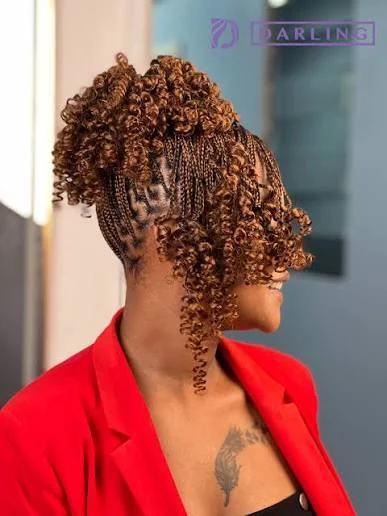
    French curl braids

    French curl braids have the movement that makes a still photograph feel lively. The curled ends create texture, while the braid frames the face. They work especially well for a large wedding with plenty of full-length and close-up pictures. Curly Braids can give the style its defining finish. The limitation is maintenance: curls can tangle, catch on clothing or lose definition after hours of dancing and hugging. Keep the ends protected and avoid constantly touching them.

    Ghana weaving and patterned cornrows

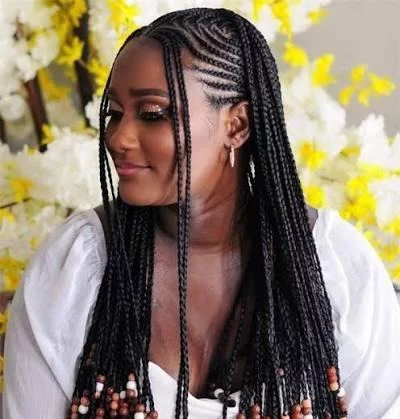
    Ghana weaving and patterned cornrows photograph well because their strength is in the lines. A neat pattern remains visible in group photographs, while the flat shape keeps the face and outfit unobstructed. These styles suit a big owambe, particularly when your aso ebi is detailed. Super Star is a practical choice when you want firm strands holding through a long day. The trade-off is installation time and tension: detailed cornrows need a skilled hand, and an overly tight style can become uncomfortable before the reception ends.

    Bohemian twists

    Bohemian twists bring softness and movement without looking too polished. Their textured finish works beautifully with makeup, statement earrings and the relaxed energy of a Nigerian reception. Bohemian Passion Twist looks its loose, dimensional character. They suit medium-sized and large celebrations, but the honest trade-off is frizz. After hours of movement, humidity, hugging and dancing, the texture can become less defined. Start with a clean install and avoid excessive touching if you want the texture to look intentional rather than messy.

    A low bun or gathered updo

    A low bun or gathered updo is the quiet option for a woman who wants her face, neckline and aso ebi to do most of the talking. The clean silhouette photographs especially well at smaller weddings, civil ceremonies or elegant receptions. It also leaves room for earrings and a dramatic neckline. The limitation is that smoothness shows everything under direct flash: flyaways, uneven edges and excess product. The style needs a careful finish and may need a small touch-up before the reception if the day begins with a long service.

    Boho braids worn long

    Long boho braids photograph beautifully because they create movement around the body. They frame the shoulders in portraits, show length in full-body photographs and add a relaxed contrast to a structured aso ebi outfit. Boho Braids are a strong choice for a large wedding or lively reception. They are not the lowest-maintenance option, though. Long lengths can tangle, catch on bags or clothing and feel heavier as the day goes on. If you will be dancing for hours, make sure the length and weight are comfortable before committing.

    Two-strand twists for a smaller wedding

    Two-strand twists are a good fit for a smaller, more intimate, or daytime-focused wedding when you want your natural texture to remain part of the look. Their repeated pattern gives photographs detail without feeling too elaborate. Natural Twist can help create a consistent finish. The limitation is definition: moisture, humidity and frequent touching can make twists loosen or look less crisp. They work best when you want understated polish rather than a highly sculpted hairstyle, especially for a civil ceremony or intimate reception.

    If You Are Wearing a Gele

    A gele changes the calculation. The best hairstyles that go with gele are not necessarily the ones with the most height. Too much crown volume gives the gele nowhere to sit comfortably and can create an awkward shape. Flat Ghana weaving and patterned cornrows work well because they sit close to the scalp. A low gathered style can also work, while long braids can fall below the gele and remain visible in photographs.

    Think about the reveal, too. If the gele comes off at the reception, your hair has already been compressed for hours. A style that depends on height or perfectly placed volume may not recover. Choose something that still looks deliberate when uncovered, rather than something that only works while the headwrap is on.

    Surviving the Whole Day

    The best hairstyles for wedding guest are the ones you can forget about once you leave the salon. If you are planning aso ebi hairstyles, consider the full schedule: service, photographs, greetings, food, dancing and the journey home. Do not test a new style on the wedding morning if you already know your scalp is sensitive to tension.

    If you are choosing attachments, Curly Braids can preserve the curled texture, Super Star can keep cornrow lines defined, Bohemian Passion Twist supports the textured twist look, Boho Braids gives long styles their movement, and Natural Twist works well for consistent two-strand twists. You can browse the full Darling range through the Darling collection at The Diva Shop.

    For Nigerian weddings, choose the hairstyle that can survive the entire story of the day, not just the first photograph.

    FAQs

    What hairstyle should I wear to a wedding as a guest?

    If you are asking “what hairstyle should I wear to a wedding”, start with the outfit, ceremony length and headwear. Choose a style that complements your aso ebi without competing with it. Braids, twists, low updos and neat cornrows all work; the best choice is the one that remains comfortable and defined through the reception.

    What hairstyle works best under a gele?

    If you are asking “what hairstyle works under a gele”, choose something that lies relatively flat or gathers low. Ghana weaving, patterned cornrows, low buns and long braids are practical options. Avoid excessive crown volume because it can make the gele difficult to place and may leave your hairstyle badly compressed when the headwrap comes off later.

    How many days before a wedding should I do my hair?

    “How many days before a wedding should I do my hair?” depends on the style and how quickly your hair loses freshness. For most braids and twists, one to three days before gives you time to settle the style without leaving it exposed for too long. A sleek updo is usually better done closer to the event for maximum neatness.

    Conclusion

    Great owambe hairstyles do not need to compete with the bride or the outfit. They need to complement your face, survive the Nigerian wedding schedule and remain recognisable in photographs taken from every possible angle. Whether you choose French curl braids, Ghana weaving, bohemian twists, a low bun, long boho braids or Natural Twist two-strand twists, think beyond the first mirror check. The best wedding guest hairstyles are the ones that still look considered when the church service becomes dancing, the gele comes off, and the camera keeps clicking.

  • Tura is one of those skincare products that never really disappears. Some Nigerians remember the bar from childhood, while younger shoppers are discovering it without the same nostalgia. That makes a Tura soap review interesting: does a familiar medicated soap still make sense today?

    The short answer is yes, for the right person. Tura Medicated is a straightforward cleansing bar that makes sense for someone looking for everyday cleansing and freshness, rather than a product promising to transform their skin overnight.

    Why an Old Bar Is Back in Younger Bathrooms

    Younger consumers now have access to body washes, exfoliating acids, serums and products built around specific skin concerns. Yet that does not automatically make a simple bar irrelevant.

    Part of the appeal of old Nigerian skincare brands is familiarity, but affordability and simplicity matter too. Tura Medicated is currently listed at ₦1,400 on The Diva Shop, with two packs recommended per head. That makes it accessible for someone who wants a basic medicated soap without building an elaborate body-care routine.

    What Is Actually in It

    Tura Medicated is presented as a medicated cleansing soap. The current product listing highlights wheat germ oil, allantoin and vitamin E, alongside a minimum TFM of 70%. The product is also described as suitable for all skin types.

    There is another reason to pay attention to the pack rather than relying on social media descriptions. NAFDAC records show TURA GERMICIDAL MEDICATED SOAP 65G under registration number 615467, with Godrej Nigeria Limited listed as the applicant in its 2019 analysed-products record.

    That does not mean every claim you see online is automatically true. Product registration and marketing claims are separate questions.

    What It Does Well

    So, is Tura soap good? As a basic cleansing bar, it has a clear proposition. It is designed to cleanse the skin and the retailer describes it as helping protect against body odour and other skin infections. It also contains vitamin E, allantoin and wheat germ oil.

    This is where some of the Tura soap benefits make sense in an everyday routine. If you prefer bar soap, want something simple for regular bathing and are mainly concerned with feeling clean and fresh, it can be a practical option.

    What is Tura soap used for? Primarily, it is a bathing soap intended to cleanse and support everyday skin hygiene. That is a more useful expectation than treating it as a solution for every skin problem.

    If you are considering Tura soap for oily skin, pay attention to how your own skin responds. Oily skin can still become irritated or dehydrated from over-cleansing.

    What It Does Not Do

    Tura is not a miracle treatment for acne, dark spots, uneven skin tone or every type of skin infection. A cleansing bar can be part of a routine, but persistent skin conditions may need targeted treatment from a qualified professional.

    It is also not a skin-lightening product. There is no reason to buy it expecting your natural skin tone to become fairer.

    The same applies to the question, “does Tura soap really work?” It can work well as a cleanser and for the everyday freshness its product description focuses on. That is different from promising that it will solve every skin concern.

    Who It Suits, and Who Should Skip It

    Tura Medicated makes sense for adults who want a simple bathing bar, like the feel of traditional soap and are looking for everyday cleansing and freshness.

    Who should not use Tura soap? Anyone who finds it irritating, excessively drying or uncomfortable should stop using it. People with very sensitive skin or an existing skin condition should be cautious about introducing any new cleansing product and should seek professional advice if symptoms persist.

    If your main goal is treating a diagnosed skin condition, do not substitute a cosmetic cleansing bar for medical treatment.

    How to Use It Properly

    The current product instructions recommend using Tura Medicated twice daily, morning and evening, and rinsing well with water after use.

    That does not mean more is always better. If twice-daily use leaves your skin tight, itchy or unusually dry, reassess the routine rather than forcing yourself to continue.

    Store the bar where it can dry between uses. A soap that sits constantly in water will disappear faster and become unnecessarily messy.

    The Verdict

    Tura Medicated is worth buying if you want a straightforward bathing soap with a familiar medicated positioning, particularly if you value simplicity and affordability. It is not worth buying if you expect it to lighten your skin, erase stubborn pigmentation or replace treatment for a persistent skin condition.

    At ₦1,400, the current listed price also makes it an accessible option for shoppers who want to try it without committing to an expensive routine. You can find it through The Diva Shop’s Tura collection.

    FAQs

    Does Tura soap really work?

    Yes, if the job you expect it to do is cleansing and supporting everyday skin hygiene. The product is not a universal treatment for acne, pigmentation or diagnosed skin conditions. Results will vary by skin type, so irritation or excessive dryness is a reason to stop rather than keep using it.

    Who should not use Tura soap?

    Anyone who experiences persistent irritation, excessive dryness or discomfort after using it should stop. People managing a diagnosed skin condition should not rely on a bathing soap as a replacement for appropriate treatment. If symptoms continue, speak with a qualified healthcare professional.

    How long does Tura soap take to work?

    There is no reliable universal timeline for a medicated soap to “work” because it depends on what you expect it to achieve. As a cleanser, its effect is immediate. For an ongoing skin concern, avoid assuming that more frequent use will produce faster results.

    Conclusion

    The interesting thing about Tura is that its appeal does not have to depend entirely on nostalgia. A younger consumer can choose a classic product for the same reason someone chooses any other basic skincare staple: it fits their routine, does its intended job and does not demand unnecessary complexity.

    That is ultimately the fairest way to judge the bar. Tura does not need to be everything. It simply needs to be useful at what it is designed to do.

  • Alt text: Tribal braids styles Nigerian women are wearing

    Back is the wrong word for it. Tribal braids never went anywhere. Your mother wore them, your aunt still does, and half the primary school photographs in this country are full of them. What changed is the appetite. Women book these styles on purpose now and pay properly for them, instead of treating them as the quiet option at month end.

    What People Mean by Tribal Braids

    Tribal braids is the catch-all for indigenous braiding styles, and in Nigeria that covers kolese, shuku, patewo, koroba and the Fulani braid. What they share is that the pattern is the point. The partings are the design.

    People ask where do Fulani braids come from and expect one country. The Fulani are twenty-five to forty million people spread across the Sahel, with communities in Guinea, Senegal, Mali, Niger, Cameroon, Chad and Nigeria, so the style belongs to all of them, not one place. The signature is a cornrow running front to back down the centre, face-framing braids at the sides, and beads, cowries or cuffs at the ends. Silver coins and amber were traditionally worked in, often family pieces, and a finished head carried information about background, marital status, age and standing.

    Why Tribal Braids Are Back in Demand

    Nothing about them disappeared. Kolese has been on Nigerian heads for as long as anyone remembers. What shifted is the money people now put behind it.

    The interesting part is how far the form has stretched without breaking. Colour, curly ends, jumbo sections, boho texture, none of it traditional, and yet a Fulani braid with burgundy ends and loose curls still reads instantly as a Fulani braid. The centre parting and the beads do the identifying work. Not many hairstyles survive that much handling.

    The Versions Nigerian Women Are Wearing

    These are the tribal braids Nigerians are actually wearing right now.

    Classic Fulani Braids with Beads

    [Image. Alt text: “Classic Fulani braids with beads using Darling Super Star”]

    Cornrows with beads is where most people start. A centre cornrow front to back, two or three braids either side of the face, the rest taken back, beads at the ends. 

    It lives or dies on the partings, since a crooked line has nowhere to hide. Darling Super Star is the sensible hair, because a firm strand holds a cornrow line clean for weeks instead of fuzzing by the second wash.

    Stitch Braids and Patterned Partings

    Image credit: Jaliza

    Alt text: Stitch braids with patterned partings using Darling Easy Vibes

    Stitch braids are cornrows with the partings set around half an inch apart and fed in as they go, which produces the ridged, stitched look and those razor-clean lines. They are the modern face of the whole category, and they will hold for four to seven weeks.

    This is where stylists get ambitious, curving the rows, splitting them, running them diagonally. Darling Super Star again for the crispest version, or Darling Easy Vibes if you want it lighter and quicker to install, which counts when a patterned set can run five hours in the chair.

    Fulani Braids with Curly Ends

    Image Credit: Paulee’s Blog, Pinterest

    Alt text: Fulani braids with curly ends using Darling Curly Braids

    The most-booked variation of the moment, and the one filling everybody’s feed. The braid stays traditional through the top and sides, then the ends are left curly instead of sealed off, so the head reads structured up top and soft at the bottom. It photographs beautifully, which is most of the reason it took off.

    Darling Curly Braids gives you the French and Spanish curl for those ends. Keep the beads on the face-framing braids only, since beads and curls on the same braid get busy quickly, and the curl already needs finger detangling most nights.

    Tribal Braids with Loose Boho Pieces

    Image Credit: Magicandssss on Facebook

    Alt text: Tribal braids with loose boho pieces using Darling Boho Braids

    The crossover style, and the one your mother will certainly have an opinion about. The partings and the centre cornrow stay exactly where tradition puts them, and then loose curly pieces are dropped in along the length to soften the whole outline.

    Darling Boho Braids carries those wavy pieces, and Darling Curly Braids works if you want the loose sections more defined. It suits anyone who likes the structure of a Fulani braid but finds a full set of tight cornrows too severe against their face. Beads still work here, just fewer of them than usual.

    Shuku, Patewo and Koroba

    Image Credit: Organic Beauty Essence on Instagram

    Alt text: Shuku, patewo and koroba tribal braids styles with Darling Easy Vibes

    The Yoruba styles, and the ones most likely to be sitting in your childhood photographs. Shuku gathers everything up into a raised crown. Patewo takes its name from applause, because the rows meet in the middle like two hands clapping. Koroba radiates out from the centre like an upturned basket.

    All three are pure pattern, which is why they carry an office and a wedding equally well and cost less than almost anything else here. Darling Easy Vibes keeps them light enough to sleep in from the first night, which the originals certainly were not.
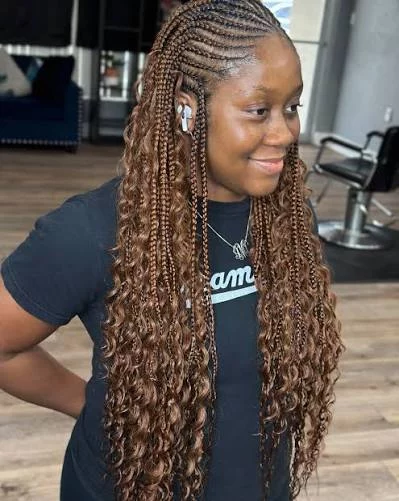
    Getting the Details Right

    Three things sink these styles, and only one is braiding.

    Fuzzy partings come first. When the whole look is pattern, a soft parting is not a small flaw, so check the lines in a hand mirror before you leave.

    Then bead weight. A full row on fine hair pulls your hair all day, and it lands on the braids framing your face, where traction damage shows first. Fewer beads, or cuffs, or beads only on the thicker braids. Worth knowing if your hairline is fine.

    Six to eight weeks is a good timeline to rock your hair, and beads need re-securing as the style loosens. Look through the full Darling range at The Diva Shop for the right hair to complement your own hair.

    FAQs

    What are tribal braids?

    Tribal braids are indigenous African braiding styles built around patterned partings rather than length. In Nigeria the term covers kolese, shuku, patewo, koroba and Fulani braids. The Fulani version is the most recognised, with a centre cornrow, face-framing braids and beads at the ends.

    What is the difference between tribal braids and Fulani braids?

    Fulani braids are one kind of tribal braid, not a separate category. Tribal braids is the broad term for indigenous braiding styles across many communities. Fulani braids are the specific style with a cornrow running front to back, braids framing the face, and beads at the ends.

    How long do tribal braids last?

    Six to eight weeks with proper care. The partings soften before the braids do, so most people take them down when the pattern stops reading cleanly rather than when the hair itself gives out. Beads need re-securing as the style loosens.
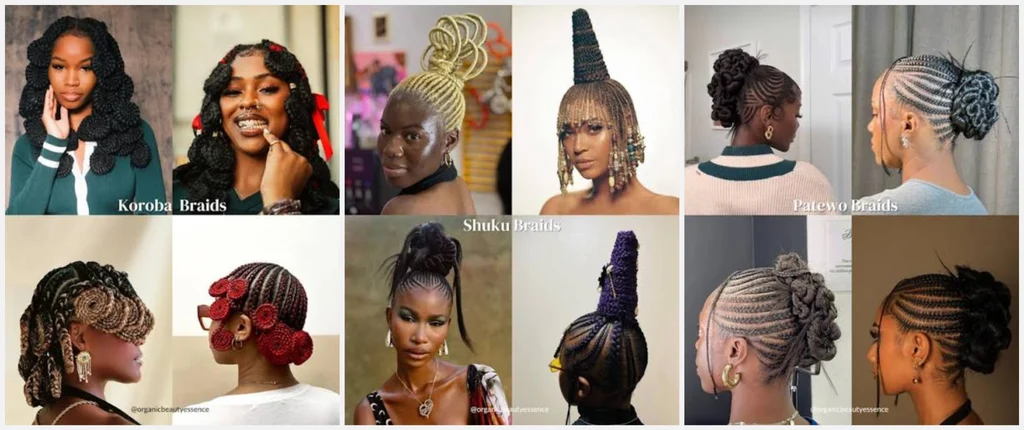
    Conclusion

    Choose the pattern first and the length second, because the pattern is what anybody actually sees. And whichever one you book, pay for the partings. That is where the whole thing lives or dies.

  • Alt text: The best braids for every face shape

    Face shape is a useful guide and a bad rule. It tells you something real about where hair should sit, then gets treated like law, which is how people talk themselves out of styles that would have suited them. So here is the honest version of the best braids for your face shape, plus the two things that decide more than shape does.
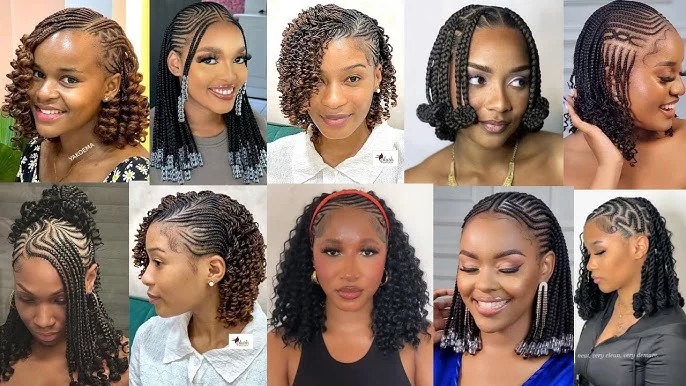

    How to Work Out Your Face Shape

    Alt text: How to identify round, oval, square, heart and long face shapes

    Do it properly and it takes a minute. Pull your hair back, stand square to a mirror in good light, and look straight ahead. Compare three widths first, forehead, cheekbones and jaw, and note the widest. Then compare the length of your face to its width.

    ‘Round’ is width and length close together, with soft angles rather than corners.

    ‘Oval’ is length greater than width, with the three widths fairly balanced.

    ‘Square’ is a strong jaw, with width and length close.

    ‘Heart’ is a wider forehead narrowing to a smaller chin.

    ‘Long’ head is one with length noticeably greater than width.

    Most people land between two of these, which is fine. The nearest one is close enough.

    The Two Rules That Matter More Than Shape

    The first is proportion, which means your whole frame, not your face alone. A big volume of hair looks completely different on someone five foot tall and slight than on someone tall and broad, so the same braids can swallow one person and barely register on another. Judge the amount of hair against your body, not just your jaw.

    The second is finishing. Clean partings, edges that are not straining, ends properly sealed. A well-executed style on the supposedly wrong face shape beats a badly executed one on the right shape every time, and it is not close.

    Matching Braids to Your Face Shape

    Find your shape below. Each section stands on its own.

    Braids for a Round Face

    Alt text: Braids for a round face with Darling Super Star

    The best braids for round face shapes add height and length, which means long braids and twists past the shoulder. Length carries the eye downward, so width across the cheeks is not what anyone registers first. What works against you is heavy volume level with those cheeks, pushing width out where you already have plenty.

    Waist-length knotless braids are the reliable pick. Long two-strand twists do the same job, and a high bun with the rest hanging adds height at the crown. Darling Super Star gives cornrows a firm strand that holds its line without fluffing at the sides, while Darling Natural Twist handles the twisted version with texture that passes for your own hair.

    Braids for an Oval Face

    Alt text: Braids for an oval face with Darling Natural Twist

    Braids for oval face shapes are the easy case, since balanced proportions carry almost anything. This is the shape all the other rules are quietly written for, so your real question is not what suits your face. It is what suits your week and your patience on a Monday morning.

    Choose on lifestyle instead. Cornrows if you want four weeks of no thinking, a braided bob if you are tired of the weight, curls if you want movement. The whole Darling range is open, from Darling Super Star cornrows to Darling Natural Twist for something softer. The only thing to watch is very long, very straight braids with no texture, which stretch the proportions.

    Braids for a Square Face

    Alt text: Braids for a square face with Darling Bohemian Passion Twist

    With braids for square face shapes, soft texture at the jawline does more than anything pulled back tight. A strong jaw is a feature worth keeping. The job is putting something soft beside it so the outline reads rounder. Slicked-back styles with hard lines sharpen the corners you already have.

    People search for what hairstyle suits a strong jawline and expect a style name back. The real answer is texture at the right height. Bohemian twists are the strongest option, because the wavy pieces sit where the softness needs to be, and Darling Bohemian Passion Twist is the range. Darling Boho Braids does it in braided form, with loose curly pieces breaking the line down the side.

    Braids for a Heart-Shaped Face

    Alt text: Braids for a heart-shaped face with Darling Curly Braids

    Fullness low around the chin is what braids for heart-shaped face proportions need, because a wider forehead reads better when the weight of the hair sits near the bottom. Volume piled at the crown does the reverse, adding width where there is already width.

    Braids finishing in curls are the cleanest way there. The braid stays lean and opens out at the ends, landing the fullness around the jaw and collarbone. Darling Curly Braids gives you the French and Spanish curl for exactly that finish. A shoulder-length set does more for you than a very long one, since the curls then sit near your face rather than halfway down your back.

    Braids for a Long Face

    Alt text: “Braids for a long face with Darling Curly Braids

    Braids for long face shapes want width at the sides, and curls or loose boho pieces at mid-length deliver it better than anything else. The eye picks up width across the middle and the proportions settle. Very long straight braids do the opposite, running the line downward and drawing the face out further.

    Look for texture that begins between cheekbone and jaw, not only at the ends. Darling Curly Braids work beautifully cut to collarbone length, and Darling Bohemian Passion Twist builds soft width through the middle without much weight. Curtain-style side pieces are worth asking for. Skip a blunt centre parting on very sleek braids, which lengthens the line again.

    The One Thing to Tell Your Stylist

    Tell her where you want the hair sitting against your face. Not the style name, the position. Saying you want the curl at your jaw and not your cheekbone changes where she places the loose pieces in a set of Darling Boho Braids, and that is the difference between a style suiting you and the same style not landing. Look through the full Darling range at The Diva Shop so you can point at what you mean.

    FAQs

    Which braids suit a round face?

    Long braids and twists falling past the shoulder suit a round face best, because length carries the eye downward. Waist-length knotless braids, long two-strand twists and high buns all work. Avoid heavy volume level with the cheeks, which adds width where the face is already widest.

    How do I know my face shape?

    Pull your hair back, face a mirror straight on, and compare the width of your forehead, cheekbones and jaw. Then compare your face’s length against its width. Round is close in both, oval is longer than wide, square has a strong jaw, heart narrows to the chin, and long is clearly longer than wide.

    Do braids make your face look slimmer?

    Braids change proportion, not size. Length and vertical lines make a face read longer and narrower, while width and volume at cheek level make it read wider. Nothing about your actual face changes. What changes is where the hair sits, and what the eye notices first.

    Conclusion

    Treat your face shape as a starting point and let proportion and finish decide. The best braids for your face shape are usually the ones you were already drawn to, installed properly and placed where you want them.