Every week, Zikoko seeks to understand how people move the Naira in and out of their lives. Some stories will be struggle-ish, others will be bougie. All the time, it’ll be revealing.
You can have the drive, the plan, and the timing. But until the money is locked in, you aren’t fully ready.
Opportunities move fast, and saying “yes” on the spot requires a bank that keeps up. That’s where Carbon comes in. Access up to ₦1 million instantly, with clear, fair rates that keep your momentum going without the late-night stress. When the big moment lands, move with full backing.
Move different. Download Carbon
What’s your earliest memory of money?
Funny story: As a child, I used to think money was an actual scary person, like those witches in old Nollywood films, because my parents were always praying against it.
Against money?
Yes. Every day, during our morning and night prayers, my parents would ask God for protection against the “evils of money and the spirit of worldly riches.”
See, my dad was — still is — a full-time pastor in a small church. When I was growing up, my mum assisted him in the church, but she also had a small provisions store near our house. These days, she runs the church with him full-time.
We were very poor and mostly depended on financial assistance and food from church members, but my parents weren’t bothered by it. They constantly drummed it into my and my siblings’ heads that anyone who had a lot of money had likely done money rituals, or would go to hell.
“Good” money, according to my parents, was only the little you needed to survive each day, or give out to people. But gathering money and spending it on yourself? Nope. They quoted scriptures like, “It is easier for a camel to go through the eye of a needle than for a rich man to enter the kingdom of God.”
So, for a long time growing up, I believed money was something I should be scared of, like those witches in movies. It also didn’t help that the few rich people I knew weren’t nice.
What rich people did you know?
I attended a private secondary school, thanks to a church member who paid my school fees, and one of my classmates was the son of a prominent local politician.
That boy was a wicked bully. He would beat fellow students, steal their food and throw it away. I was his regular customer. He would literally come and look for me in my class to beat me. I’m still not sure what I did to him. I couldn’t report the bullying either because all the teachers feared his father.
And it wasn’t just because his father was rich; everyone in our town knew that the man was into ritual practices. We always heard rumours that he did human sacrifices around election season. He and his son were the perfect examples of what my parents used to say about the evils of money. That family, along with my parents’ teachings, really convinced me that wealth and evil were two sides of the same coin. I told myself I would never want to be rich if it meant turning out like them.
I still sort of have the same mindset. Not that everyone who has money must be evil, but I truly believe that too much money can be corrupting.
Let’s talk about the first time you worked to earn your own money
That was in JSS 2, when I was around 12. My parents believed it was biblical for everyone, regardless of age, to work to avoid idleness and support their families. So, I started helping neighbours fetch water from the borehole down our street.
A 25-litre jerrycan was ₦5, and they would pay me ₦10 to carry it up three flights of stairs. After school, my brother and I would hawk sachet water and soft drinks for my mum along the expressway. We did that throughout secondary school and submitted the money to our parents.
In 2013, I gained admission into university to study Computer Science. My parents could only afford to pay my tuition. Other school expenses and surviving in school were strictly on me.
How did you fund that?
I started working from my 100 level. I just walked into one of the cyber cafés near our campus gate one day and asked the owner if there was any available work. The man liked my boldness and hired me as an assistant.
I assisted students with typing assignments, passport photos, and photocopies, and did practically any work for ₦5,000 a month. I also joined a fellowship at school and volunteered as a leader. Volunteering came with free accommodation, and occasionally foodstuffs from other students in the fellowship. That was extra helpful because the cyber café guy never increased my pay from that ₦5,000.
We surveyed 5,000 workers across Nigeria’s formal and informal sectors to examine what Nigerians earn, where the money goes, and whether hard work actually translates to financial security. This is what we found. Download the Zikoko State of Income Report.
How long did you work for him?
Throughout my time in uni. In fact, my 100 to 400 level was a combination of hustle and fellowship. When I wasn’t working, I was busy with fellowship things.
However, my third year came with an opportunity that changed my life. One of the guys who lived with me in the fellowship lodge was learning to program and was part of various tech communities. The way he talked about tech was so contagious, and I decided to try my hand at it too. It turned out to be really enjoyable, and I learnt quickly.
Fortunately, I had unrestricted internet access at the café. Whenever customers weren’t there, usually at night, I learnt and practised HTML, CSS, and eventually JavaScript using free tutorials on YouTube and W3Schools.
By my final year in 2017, I was making ₦10k here and there, building small websites for people. The most I made in school was ₦50k, from a department that got me to design a voting page for their association’s elections. I think I used that money for my final-year project expenses.
But after I graduated, I didn’t code for a few months.
Why not?
Leaving school meant I no longer had access to the laptops at the café. Thankfully, I worked at a primary school for NYSC in 2018, and the principal took a liking to me and became like my mentor. I told him about my coding skills, and he gifted me a brand-new laptop. He just said he felt led to sow the laptop into my life. That’s how I got back to coding.
Beyond the laptop, the principal also connected me with several people who needed my services. I was making an extra ₦30k – ₦50k every other month from side gigs, in addition to my ₦19,800 allawee. Once I took out what I needed to survive, I usually sent the rest of the money home to my parents.
In 2019, a few months after NYSC, I got my first proper software engineering job at an agency. This connect also came through the principal.
Love it. What was the pay like?
₦120k/month. It felt like all the money in the world. It took me a long time to get used to it. For the first few months, I would forget the money in my account for days, only removing transport fare.
Whenever I noticed money was beginning to feel “too much” in my account, I would send some home or give it to a church or to beggars around me.
Was your reason for this still based on the mindset that “too much money corrupts”?
I guess so. It didn’t even occur to me to spend my money on myself. Also, my parents raised me only to require the basic necessities. There was no reason to keep money lying around in my account when people around me had needs.
My career accelerated quickly. In 2021, I switched to a fintech startup earning ₦350,000. By late 2022, I landed a remote role with an international company, and my salary jumped to $1,200 (around ₦650,000 at the exchange rate then).
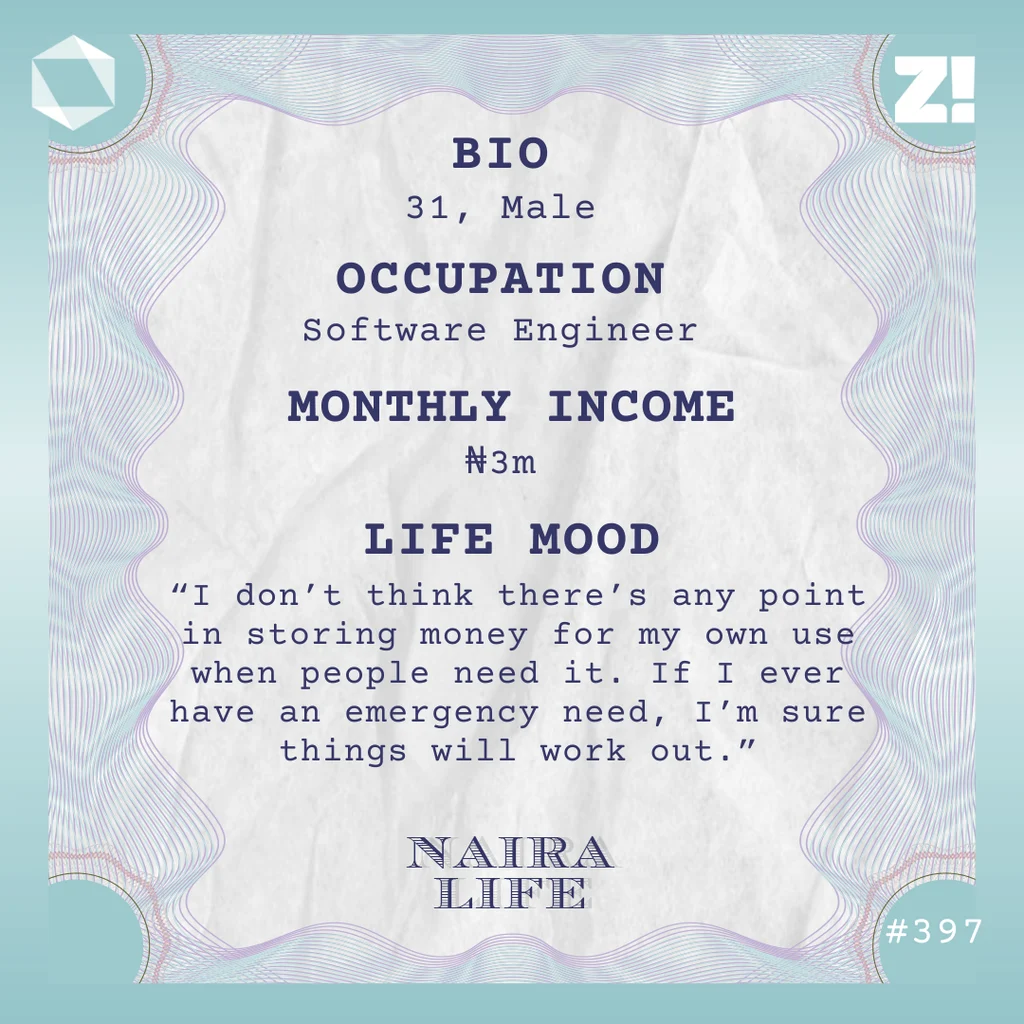
Over the last few years, I’ve grown professionally, and my pay has increased. In late 2025, I got my current senior role at a fintech, and my pay is around ₦3 million.
₦3 million is a long way from carrying jerrycans. How did it feel when that first salary hit your account?
Honestly, it was terrifying. I didn’t sleep that night. I was supposed to feel accomplished, but a massive wave of guilt and panic washed over me. I kept feeling like I was becoming too greedy.
For context, I was the one who had negotiated my pay to that amount. They wanted to pay about ₦2 million, but I told them I wanted more. Now that the money had hit my account, I kept wondering why I needed so much in the first place. I was even thinking maybe I had lost my soul already, like the money had changed me, like my parents used to say.
Because really, to be honest, what’s one single human being supposed to do with ₦3 million every 30 days?
I mean, a couple of things come to mind. So, how do you spend it?
I give away most of it. That’s the workable solution I’ve found to be able to live with this much money. I only live on 20% of my income, and I’m even trying to reduce that percentage.
Interesting. Who do you give the 80% away to?
So, 80% is ₦2.4 million. I send about ₦300k to my parents. They use it to sort out home and church needs. A small confession: They believe I earn ₦600k. They would be too worried that I earn too much and could backslide if they knew the actual amount.
I spread the rest of the money across tithe, church giving, and goodwill giving. I support friends and extended family who need money. I also give a lot to crowdfunding on Twitter. So many people need help in this world. If you see the amount of posts about medical emergencies and ransoms I see every day ehn. I’m just happy I can do my part and help. The moment money leaves my account for a good deed, I feel so much relief.
What does the remaining 20% cover?
It covers my typical monthly expenses. As I said, I’m still trying to figure out how to cut down my expenses.
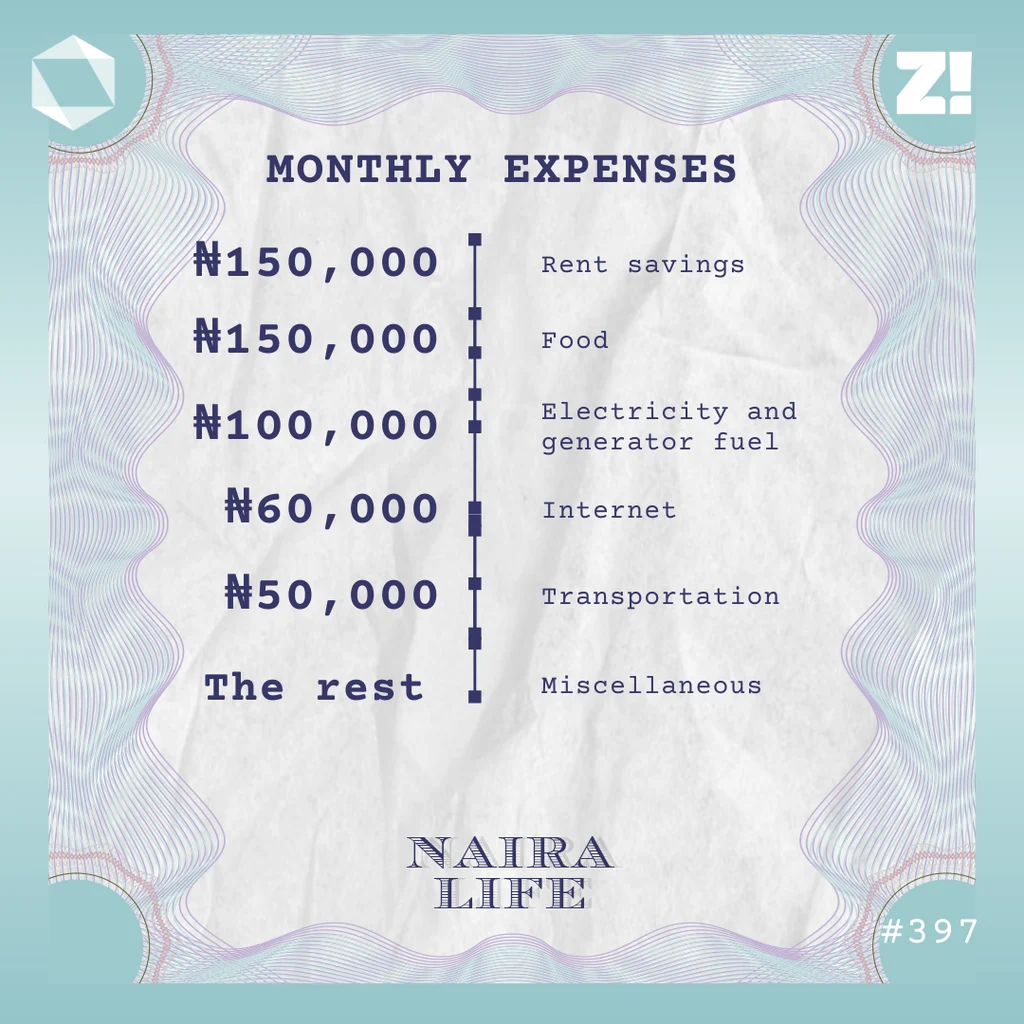
Do you have any savings, outside what you keep for rent?
No. I don’t think there’s any point in storing money for my own use when people need it. If I ever have an emergency need, I’m sure things will work out. Even if God doesn’t raise anyone to help me — which I think is impossible — I have the professional skill and experience to ensure I’m never broke for long.
And you still want to cut down on the 20% on expenses?
Yes. Again, I’m not on the extreme like my parents, believing money is evil. It can be used for good too, and that’s what I’ve been doing since I started earning money.
That said, I think holding on to money is pointless, and that’s when it can become corrupting. It’s why people earn so much and never feel completely satisfied. They always want more. I don’t want to get to that stage where I’ll always want more money and be willing to do questionable things for it. So, spending less is a way of training myself to be content with little and open enough to spend money on what matters. God blessed me with this money. I should bless others too.
I feel guilty when I spend on unnecessary things like ordering food on delivery apps. I could’ve just cooked at home and given the money to someone else who needs it. But I’m trying to be more deliberate about tracking my expenses, so I can be more intentional with my money.
Out of curiosity, do friends and colleagues know about your lifestyle?
A few of them do. A few weeks ago, a colleague visited my apartment and was surprised to see that I had only one sofa and my workstation in my sitting room. I’m sure he feels like I’m being too frugal or just enjoy “suffering myself”, but I live alone, and there’s no point stacking up furniture. When I get married, I’ll be happy to add more things, but for now, I just don’t need much.
Speaking of marriage, do you think your spending will change when you do get married?
I’d like to continue helping people. I don’t even have a girlfriend, but I’m trusting God that the woman I’ll marry will have the same heart for people that I do. She should know and accept that you don’t need countless riches to live a good life. As long as we have food to eat and a roof over our heads, we’ll be fine.
Is there anything you want right now that you refuse to buy?
A car. I can easily afford one, but I reason that I’m mostly indoors because I work remotely. The only time I need one is when going to church or work events. Spending ₦10m on a car just to use it a few times feels like a waste, especially considering how many people that money can help. So, I just use cabs when I need to go out.
How would you rate your financial happiness on a scale of 1-10?
10. I’m grateful for how far I have come and for being able to show love to people with my money.
If you’re interested in talking about your Naira Life story, this is a good place to start.
Find all the past Naira Life stories here.