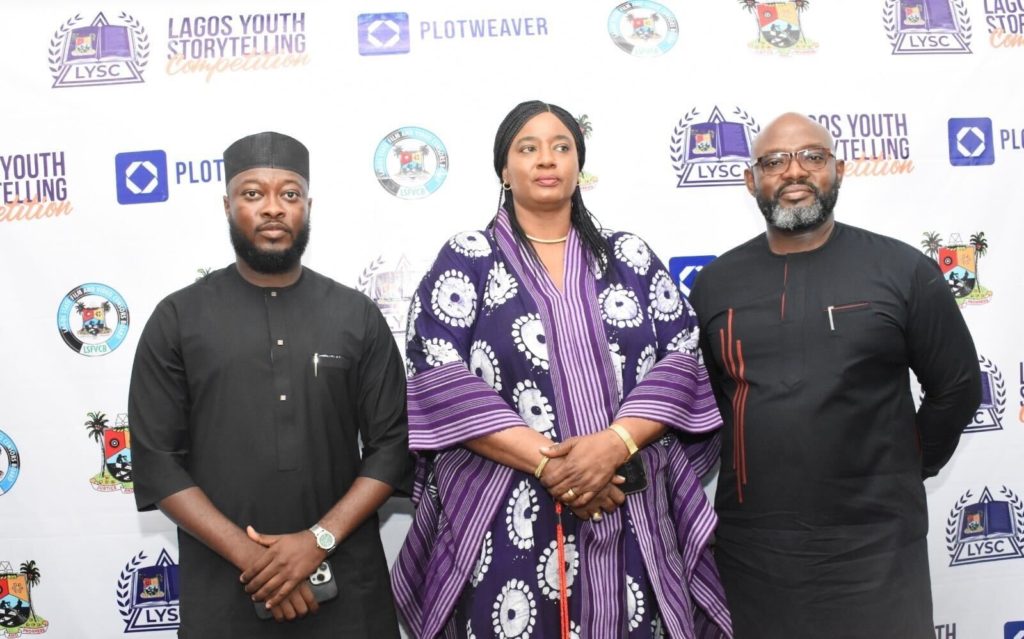
The Lagos State government has appointed PlotWeaver as Technology Partner for the Lagos 2025 Youth Storytelling Challenge.
The endorsement came after a thorough evaluation and review of PlotWeaver’s proposal to serve as technology partner to the competition by the Lagos State Films and Videos Censorship Board (LSFVCB).
In its letter of approval to PlotWeaver signed by LSFVCB’s Executive Secretary, Agbaminoja Adebukola, the board said PlotWeaver’s proposal was found to be credible.
“Sequel to your proposal to provide technology partner for the Lagos State Youth Storytelling Challenge 2025, we write to notify you that the proposal has been found credible for the agency’s endorsement.
After a thorough evaluation, we recognise Plotweaver’s ability to provide a digital platform to engage over 200,000 students across Lagos State’s six educational districts,” Adebukola said in a letter addressed to Olumuyiwa Ojo, PlotWeaver’s Chief Partnership Officer (CPO).
The partnership between the Lagos State Films and Videos Censorship Board and PlotWeaver marks a significant step in the state’s quest to set a new standard in creative education in Nigeria by investing in her youths.
Get More Zikoko Goodness in Your Mail
Subscribe to our newsletters and never miss any of the action
Terms of the deal include the delivery of a digital platform, real-time analytics, a post-event archive, and opportunities by PlotWeaver to help showcase the challenge internationally and promote films and video works — especially those that educate and celebrate values and culture. PlotWeaver is also expected to seek sponsorship from other organisations toward the actualisation of the project.
Meanwhile, the Lagos State government, through the state Films and Videos Censorship Board (LSFVCB), will provide regulatory support, ensure content compliance, and widely promote the initiative. The challenge includes a robust prize structure, featuring full production of the winning script, scholarships, mentorship, and media exposure.
Speaking on the development, PlotWeaver’s CPO, Olumuyiwa Ojo, said the firm plans to extend the gesture to other states and the Federal Capital Territory (FCT) after the Lagos event is concluded.
Oluwole Fagbohun, CEO of PlotWeaver, added:
“At PlotWeaver, we believe storytelling is a superpower. This partnership gives hundreds of thousands of young people in Lagos a chance to discover their voices, sharpen their creativity, and showcase their brilliance to the world. We’re honoured to support the state’s vision for youth development through purposeful technology.”
PlotWeaver is an innovative AI-powered end-to-end storytelling and film production platform which has revolutionised content creation for filmmakers, producers, and media houses across Africa.
By integrating AI-driven script development, production automation, and collaboration tools, PlotWeaver has empowered African storytellers to scale their content globally while streamlining production workflows.
[ad]
A Week in the Life is a weekly Zikoko series that explores the working-class struggles and victories of Nigerians. It captures the very spirit of what it means to hustle in Nigeria and puts you in the shoes of the subject for a week.
The subject of today’s A Week in the Life is Efe Edosio, a video producer. His work involves planning, implementing and supervising all of the elements of a video project. He tells me about having to dial back on his creativity with difficult clients and what it’ll take to get him to 10/10 career satisfaction score.
MONDAY
Mondays are pretty chill for me. I wake up at 9 a.m., and I’m glad I don’t have to get up and go. I even call my friends who have nine-to-fives and remind them that I’m at home while they’re at work.
But I do have to work. I like to describe myself as a visual storyteller with a focus on video content. My Mondays are for admin work. I have meetings scheduled with my editors from 10 a.m. till noon. In these meetings, we set the tone of work for the week. We assess the videos that were shot over the previous week and decide on things like post-production processes and delivery timelines.
I’m a freelancer who has built a network of clientele, so I get all my gigs from referrals. This means I also have to report to clients and stakeholders directly. After the editorial meeting, I meet with clients and go over the projects with the information from the discussion with my editors.
Today, I finished all my meetings at 1 p.m. and was free for the rest of the day. Last week was really stressful, and I’d spent the weekend working. Since I was free, I decided I needed a real break, so I went to Landmark beach and relaxed for a couple of hours, taking in the sights and de-stressing.
By 6 p.m., I booked a cab and headed home, but the two-hour traffic from VI to Iwaya almost destroyed all the relaxation I’d gained during my time-out. Still, I managed to get home in high spirits. I cooked myself dinner, watched a movie and went to bed.
TUESDAY
The hardest part of my job is having to cut down on my creativity just to meet clients’ expectations.
As a creative video producer, here’s what happens when I’m in talks with clients. I’m building up the story and the angle I believe is the best way to tell the story that the client wants to be told. My creative juices are pumping, and I’m excited about the project. Then the client comes in and is like, “Noooo. We don’t like this angle. Can you do it like this?”
Having to bend my creativity to suit clients is usually hard, but the client is king, and I have to find that point where my creativity and the client’s expectations complement each other. That way, I’m delivering what they want in the most creative way possible. But some clients are indecisive and keep changing things. Like today.
The client had agreed with my ideas and direction, and we had gone into pre-production on their ad. Midway through shooting, one of the founders came on set and said, “Yeah, I don’t think this should be like this. I don’t think this’ll work.” And in my head, I was like, “What the hell?” This is something we’d already agreed on with his team. We were all on the same page, so where’s all this coming from? I was in the middle of doing what they wanted.
A lot of people underrate how much work is done, and how expensive it is to produce a professional video. People also think shooting is the main work, but that’s not true; a lot of work is done during pre-production before we even bring out our cameras.
But you can’t blow up on your client. I was like, “You know what? Hold on.” I called their team’s liaison who was on set and said, “So, can you run through the plans for us again?” Because the founder’s complaints would have cancelled all the work we’d done already. Some clients do that and don’t want to pay extra, so in this job, patience is really a virtue.
I eventually sorted things out by going over the initial plan again with the liaison and explaining why the story was being told that way to the co-founder.
WEDNESDAY
During break on set today, I let my mind drift. Last year, I’d seen stories of a child named Ferdinard, who turned out to be a chess genius after being discovered by the Chess in Slums project. I pitched the idea for a documentary and the organisation agreed.
Everybody knows Makoko is a slum, but being in the middle of it is a completely different experience. With documentaries, you get the chance to plan things out, but for the most part, you have to go with the flow and follow the story.
While in Makoko, I was holding onto my equipment while trying to film and stay afloat on a boat at the same time. I was scared AF. But in the end, it was a lot of fun because I got to tell the remarkable story of the boy genius and showcase these wonderful kids to the world. I had full creative control and was able to document the contrast between where these gifted kids came from and the places they were going. The documentary has been nominated for awards at film festivals and won Best Documentary at one of them.
THURSDAY
Today was interesting. I was in discussions with two very different prospective clients. I met the first totally by accident. I walked into their office like a regular customer, and while the business owner was convincing me to patronise her brand, she walked me through the brand story. That’s when it clicked. I liked what she was doing — it was fresh and unique — so I pitched a storytelling angle to her. She loved it and told me she wanted to create a visual story but she hadn’t quite found someone who understood her vision. By the time I walked out of her office, we had agreed to work together, and I know I’m going to enjoy the project.
But the second perspective client I met? Totally different story. The man underpriced me so badly that if I hadn’t had the encounter with the first lady, he would have ruined my day. I have never turned down a client so fast. People like them will stress your life.
FRIDAY
It’s the drive to document culture that gets me out of bed in the morning. I don’t have any side hustle. An ideal future will be one where I’m involved in the most compelling stories coming out from Africa. But right now, I’m content. I can’t think of anything else I’d be doing if I wasn’t visual storytelling.
After my meeting with one of my editors today, I wondered what I’d score if I were to rate my career on a scale of one to ten. But I didn’t have to think too long because I decided it’d be a solid eight. When I no longer have to worry about money, I’ll give myself a ten — along with a pat on the back.
By 6 p.m., it’s TGIF time. I’ll spend my weekend cooking, watching documentaries and movies and relaxing. I’ve earned it.
Hi, I’m Ama Udofa and I write the A Week in the Life series every Tuesday at 9 a.m. If you’d like to be featured on the series, or you know anyone interesting who fits the profile, fill out this form.
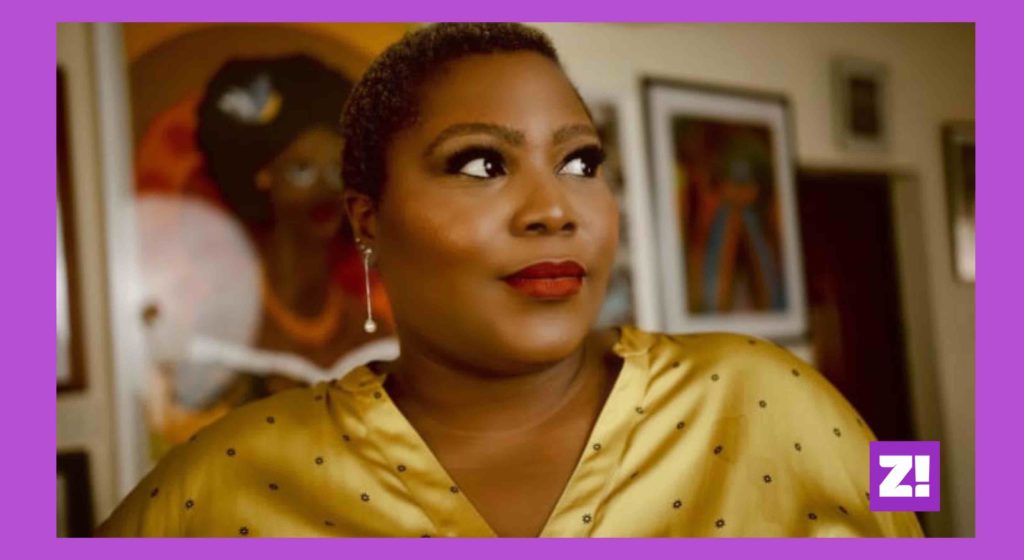
Wana Udobang is the definition of good vibes. Popping up on my screen with the biggest smile and carrying our conversation with laughter and jokes, it’s hard to believe she’s only days away from trying something new with her career — organising her first poetry installation. But when you think about it, Wana is no stranger to trying new things.
Over the years, Wana, popularly known as Ms. Wana Wana has done everything from performing poems in Europe to making documentaries and hosting her radio shows in Nigeria. But despite all of this, trying something new still scares her.
I recently caught up with her to talk about being a badass multitasking queen, why she didn’t feel intellectual enough for poetry, why we all need to be shameless, and why her new installation, Dirty Laundry, might be her most important work yet.
Writer, poet, director and radio host. Wana, abeg, how do you juggle all these things?
It sure sounds like I’m doing a lot when you list them all out like that. But the truth is, it’s never that much work because they’re all the same thing to me — storytelling. I always tell people I’m a storyteller, and I work using different mediums. So it doesn’t matter if I’m writing a podcast, an investigative journalism piece, a poem or a show. They’re all different forms I use to tell stories.
It also helps that I’m very organised and try not to do all these things at once. I might do two or three this year and another batch next year.
So which one came first?
My primary degree is in journalism, but I’ve always done poetry since I was about 16. I didn’t know what it was, but I just knew I was depressed, and I would write these things that didn’t rhyme, and cry my eyes out. I’d do this and immediately feel better. Somehow, my best friend in university saw it and was like, “Wana, this is some poetic shit”.Me, I couldn’t see it. I was an art student in secondary school, and my idea of poetry was from the work I had access to back then. I didn’t think my work could be defined as poetry. My friend later got me a journal to write all my work and I guess that’s when poetry actually became a thing for me.
I started consciously researching poetry, but I didn’t understand or emotionally connect to most of the things I read at the time. I was young and deep in my teen angst, so the emotional connection was important to me. I eventually discovered Def Poetry Jam and realised poetry could be performance art, which I loved.
I moved back to Nigeria after university, and with my degree, I started working in radio but still wrote poems for myself on the side. During that time, Gbogobiri opened, and they had poetry readings that allowed me test my poetry with an audience and build a community. And because I was on the radio, I started hosting events which led to TV gigs and then writing columns. Honestly, everything in my career happened organically. If something interested me and the opportunity came, I took it.
I’m curious about how your approach to storytelling changes when it moves from being a hobby to an actual source of income.
One of the things I try to do is always be grateful. While it’s great that I have this skill and can make a living out of it, I’m also privileged that I get to work on projects I genuinely care about. They’re meaningful to me. Most of the things I’ve done have been personal projects I enjoyed, so it didn’t really feel like work to me.
How are you able to make poetry that connects with a large audience?
I don’t write because I want to sound smart. I write what I know and what I can relate to. I was also part of the audience that didn’t feel intellectual enough for poetry for the longest time. Connection is essential to approaching my work, and I rate it above the craft or the structure. I want people to feel something soulful.
I remember thinking one of my poems, Catfish, was lame when I wrote it because it didn’t feel deep. My friend convinced me to perform it at Gbogobiri and everyone loved it. When it got published on Brittle Paper, someone commented that it was “simple.” To the literary community, your work has to be complex and hard to understand for it to mean something. LOL. These people don’t know that it takes a lot of effort to simplify complex ideas. The poetry that saved my life did so because they were honest and not because they were deep. If I can maintain honesty in my work, then I’m good.
I stan. So talking about honest work, tell me about your latest work, the Dirty Laundry installation.
I’m taking 20 of my poems — a lot of them connected to women’s issues, gender violence and feminist agency — and printing them on these big ass canvases that will be displayed in an art space. I’m also hanging them with a peg on a line, so it’s like putting out your dirty laundry in public.
The idea came to me 12 years ago. My brother watched one of my poetry performances and said that while my poetry reminded him of our childhood, it felt like I was hanging out our dirty laundry in public. It stuck with me and I knew I had to use it. The problem was that I didn’t see myself as an artist. I was just a poet. That doubt held me back. I finally decided to do it two years ago, but the pandemic hit, and production shut down. While I took this as a sign to kill the project, things kept happening to remind me of its importance.
Things?
Yes. I’d try to shelf the idea and then hear someone killed their wife, or a girl was raped in church. All these unfortunate events proved that it was still timely and important. It’s really about how our shame is hoisted at us as women. We’re victims, but they still want us to be silent. There’s a part of the exhibition where people can write down what brings them shame and purge themselves.
Why do you think we need to face our dirty laundry?
Because shame is something that kills us. I told someone recently that I’d take pain over disgrace any day. That’s how we’re wired as Nigerians. We’re ready to stomach pain over being disgraced or publicly embarrassed. And the things we find shameful are not even that serious. In school, you’d see a girl get her period, and all the other girls would run around covering her up because God forbid anyone sees that she’s menstruating. Why? I’m interested in removing this veil of shame because we’re more connected than we are disconnected. See ehn, left to me, we should all be shameless.
#YouCantShameTheShameless! What was the most challenging part for you putting this together?
Planning. I’d prefer just to show up and do my thing, but I had to coordinate all the moving parts like location scouting. This experience has taught me that I don’t have to be in control all the time. I hired people to do their job, so I needed to let them do it.
There’s also the fear that people wouldn’t show up. I mean, it’s one thing for people to hype you on social media, but will they come? I also want them to receive and understand the work. It means so much to me that people experience my work and something shifts in their life, even if it’s temporary. I always want people to leave with something. And of course, I’m always nervous about that.
And the best part?
Seeing all I’ve worked for come to fruition. I feel like it’s not real until I enter that room and see everything hanging. I’m also proud of myself for securing the funding to do this. Support from the Ford Foundation doesn’t validate my idea; it just affirms it and reiterates that it’s important. I also get to collaborate with Naomi Edobor, my brilliant curator.
Describe the installation in three words
Immersive, glorious and joyful.
We exist in a time where women like you, Eloghosa Osunde and Titi Sonuga are killing it. Why is it important for women to tell stories and occupy space?
It’s magnificent to be existing at this time. Not just because other brilliant women like me are telling their stories, but because we’re building worlds for ourselves. That’s powerful. Even though we’re standing on the shoulders of women before us, we’re still creating something new and true to who we are. Eloghosa is fucking things up with her stories, and Titi is doing the same with her spoken word and plays. I feel like we can stand on the shoulders of our elders and still build expansive worlds. That’s what makes it so gorgeous. I’m in awe of our audacity and our world-making.
What does legacy mean to you?
I want my work to outlive me. That’s a big deal for me. I want people to reference my work in their thesis and use my processes as a study. I also wish to be able to leave tangible legacies like funding and support for young artists. The legacy I want is that people encounter my work, and there’s a shift for them. Someone can say, “I listened to that, and it changed my relationship with my mother.”
What’s next for you?
I can sit here and talk about everything I want to do, like write a Nike ad or perform on a world stage with an orchestra. But the truth is, our dreams can sometimes be limiting. I don’t dictate what happens anymore. I just open my mind and let the opportunities present themselves to me. My goal is less about what I’m doing and more about being free to do anything I want.