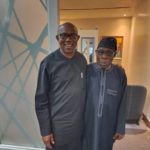
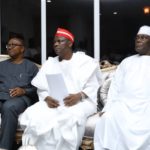
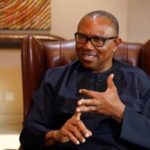
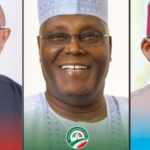
• On December 13, 2022, the Labour Party’s (LP) Presidential Campaign Council (PCC) paid a visit to the Ibadan traditional council. In a viral video shared by Doyin Okupe, the Director-General of the Obi-Datti Campaign Organisation, a member of  the traditional council could be seen praying for Peter Obi. 

    Okupe captioned the tweet, “Emphatic endorsement for Peter Obi from Ibadan traditional council.”

    However, it appears the Olubadan of Ibadanland, Oba Lekan Balogun, Alli Okunmade II, isn’t on the same page with Okupe.

    How has the Oba reacted?

    A statement released by the palace on December 14, 2022,  described the endorsement as a false and self-concocted one. The palace said the prayer shouldn’t have been twisted to appear as an endorsement of the candidate. The statement further cautioned politicians to leave the palace out of their power play and stick to facts. 

    The palace said, “Let it be emphasised that Olubadan and his cabinet members don’t and can’t belong to any political party and they would never express preference for any candidate or political party in the public no matter the degree of temptation.”

    What the palace basically told Obi and other politicians is, “You’re on your own (OYO)”.

    Why’s this significant?

    Endorsement power plays aren’t new in Nigerian politics. As we’ve explained before, politicians seek endorsements from powerful figures in the hopes they can help sway voters in their favour. We only need to go back to October. Then, the Afenifere backed both the All Progressives Congress (APC) and the LP presidential candidates.

    The issue, though, is that it’s difficult to accurately measure the impact of endorsements. More significantly, publicly backing a candidate as a traditional ruler has its risks. If they win and turn out to be unpopular, the people can turn against the ruler in the grassroots for leading them astray.

    If, on the other hand, a traditional ruler backs a losing horse, the winning horse won’t forget and might be vindictive. The safe bet is to stay in the middle and avoid staining your white as the Olubadan has done.

    Endorsements may be useful for campaign PR, but politicians are better served appealing to voters directly. Because in the end, people will vote who they want — endorsement or not.

  • After two months of back and forth, we’re pleased to announce the presidential candidate of the Labour Party (LP), Peter Obi, has finally released his manifesto!


    The manifesto has attracted mixed reactions from fans and haters alike since Obi announced the 72-page document on December 4, 2022.

    But, what exactly is the content of this document? 

    Introduction of a state police system

    Obi plans to put in place policies that would implement the principles of a state police system in the Nigerian constitution. But these could create some problems.


    The Senate is already hostile against state policing due to fears that officers will become errand boys for governors who may also neglect to pay them well. 

    This could become an issue as Obi needs a National Assembly aligned with his interests and plans for the country to succeed. But how many Labour Party candidates are likely to win seats in the National Assembly in 2023? 

    The All Progressives’ Congress (APC) controls a majority of the current Senate with 66 members and only one of the remaining 43 members is an LP senator.

    According to the list released by the Independent National Electoral Commission (INEC), the Labour Party is contesting for only 78 seats out of the 109 seats in the Senate. It also doesn’t help that most of the vacant slots will favour Obi’s rivals more, as there are no Labour Party candidates in key states like Kebbi, Katsina, Lagos, Borno, and Ekiti. 

    Hourly national minimum rate

    Peter Obi’s answer to Nigeria’s low minimum wage problem is to introduce a minimum rate based on one’s productivity per hour instead of the current ₦30,000 per month.

    It’s not hard to know where the inspiration for this came from, as Western countries such as Canada, the United Kingdom, and the United States all run a minimum wage per hour system.

    The plan creates a semblance of fairness, as workers would get paid based on how much time they work. The more hours you work, the more money you get to put in the bag.


    Also, this section of the manifesto mentioned the “criminalisation of non-payment of salaries, wages, pensions, entitlements, benefits, and violation of collective bargaining agreements,” which means the law will start frowning at horrible bosses who delay payment of workers.

    This is how we imagine every worker would feel if that happened:

    Equal pay for politicians and civil servants

    Obi intends to implement a Common Regimentation Emolument Structure Table (CREST). This is a policy that’ll enable elected politicians and appointed officials to earn the same as civil servants.

    But are the National Assembly lawmakers interested in earning the same paycheck as civil servants?


    The move from consumption to production

    “Consumption to production” has become a catchphrase of the Obi campaign. We’re not surprised the idea appeared in his manifesto. How does he plan to make it happen for Nigeria? 

    • Re-skilling youths in the Science, Technology, Engineering, and Mathematics (STEM) field for the nation’s economy. This is needed given that most students in Nigeria don’t feel the need for STEM. This is due to the slow rate of curriculum updates, and poor funding, especially in rural areas.
    • Venture capital fund for young entrepreneurs 
    • Apprenticeship system for technical skills.
    • The rise of a “Green Army” whose mission is to use the $3 trillion from international climate finance to create economic growth and employment for youths.

      But how does he intend to do that? That definitely wasn’t specified.

    Multiple exchange rate system

    In his manifesto, Obi expressed his feelings about Nigeria’s current exchange rate system. Here’s what he had to say:

    While these problems are true as Nigeria currently has rates from the Central Bank and black markets, we’re still waiting on Obi to give us a solution to the problem.


    The Afro-centric diplomacy 

    Obi also plans to protect the rights of Nigerians abroad through Afrocentric diplomacy. Compared to Nigeria’s current foreign policy which only seeks to promote relations among member countries, his Afrocentric policy has benefits. This would help to both protect Nigerian citizens abroad as well as promote their businesses.

    This would be done by rebuilding Nigeria’s military power, establishing leadership roles in African affairs, and even using our top position in entertainment to enhance economic strategies.


    This will definitely be a welcome change. Nigerians are suffering from physical harassment overseas even as many more are using any means necessary to japa.

  • On December 4, 2022, Arise TV hosted a town hall with leading 2023 presidential candidates in attendance. Only the regular absentee, Bola Ahmed Tinubu of the All Progressives’ Congress (APC), was missing from the party. Those present were Atiku Abubakar of the People’s Democratic Party, (PDP), Peter Obi of the Labour Party (LP) and Rabiu Kwankwaso of the New Nigeria People’s Party (NNPP).

    What were the highlights?

    Despite the fact they’re all contesting on different mantras and platforms, the candidates seemed to agree on certain policy issues. All three believe in education being a driver of growth. They also shared, to varying degrees, sentiments that the constitution needs to be revised and an emphasis on health insurance for all.

    But they had their differences too. Obi believes strongly that an investment in human capital development is vital to pulling Nigeria out of poverty. He spoke on reviving the bank of agriculture in Kaduna to enable farmers get easier access to loans.

    Kwankwaso believes strongly in education but also in greatly expanding Nigeria’s security forces. He also said he would make strides in other sectors like in infrastructure and construction. He claimed that as Kano governor, he built three major cities in four years with ₦‎40 billion without borrowing.

    Atiku believes the private sector is the driver of prosperity and plans to incentivise it. He is also particular about agriculture being a mainstay of the economy and spoke on plans to expand the sector to employ more people. The PDP candidate also spoke on his achievements as vice president, how he was in charge of local government administration in his first nine months in office and how he plans to sustain programmes the PDP launched.

    Any touchy subjects?

    On the issue of medical tourism, Kwankwaso seemed the boldest on the matter when he said he’s in good health and that his doctor has certified he has at least 30 years of life left in him.

    The former Kano State governor said he’d keep using Nigerian health facilities if he becomes president. “We’ll introduce some policies that’ll improve healthcare service delivery through the NHIS. We’ll make healthcare accessible to every Nigerian.”

    Atiku appeared evasive on the matter by saying he would declare his health status if the need arises. On medical tourism he said, “The Nigerian health facilities that cater for my health may not be available. You know that we have limitations. We have been talking about those limitations.”

    Obi also didn’t fully commit to ending medical tourism when he said, “It’s actually required that those aspiring to lead should be able to make their medical records available to the public. And two, I have served as a governor. While serving as governor, I resuscitated some facilities and used them. I’m still using them till today. 

    “I believe if there’s any issue of referral from them, I mean if there’s a situation our healthcare can’t handle, I’ll not say everybody must be restricted here. As for my position, I use the facilities here and I believe in them. And I can tell you they’re very competent. All we need is to believe in them. I’ve shown you how we can use insurance to prove everyone can be cared for.”

    What else?

    All three candidates made pledges to Nigerians. Atiku doubled down on his mantra of unifying the country as president, Obi pledged to form a government of national unity, while Kwankwaso pledged to provide quality education and train as many Nigerians as possible. 

    But as every Nigerian knows from experience, talk is cheap. The one good thing we can take from this town hall is we can hold whoever becomes president accountable based on the promises they’ve made to us.

  • Election season in Nigeria isn’t only about who can hold the biggest rallies or make the most eye-catching promises, it’s also about who can throw the biggest insults. 

    That’s why it’s not a surprise that the camps of the presidential candidates of the Labour Party (LP), Peter Obi, and All Progressives Congress (APC), Bola Tinubu, have been at each other’s throats lately.

    How did the argument start?

    Tinubu struck the first blow during a rally in Delta State on November 25, 2022 when he accused an unnamed candidate of always giving the wrong statistics. He also stated that mentioning the person’s name would be a disgrace to him. 

    Even though he didn’t mention anyone’s name, anyone following the campaigns closely would know which presidential candidate loves dishing out statistics:


    It’s… Peter Obi [Leadership News]

    The chief spokesperson of the LP’s Presidential Campaign Council, Dr Yunusa Tanko, then cut Tinubu down to size by saying he’s “someone who cannot even identify his own mother”. He also challenged Tinubu to show up for an open debate with Obi. He was confident the former Anambra State governor would win and humiliate Tinubu.

    It didn’t take long before the APC flung its own dirt when Tinubu’s campaign spokesperson, Festus Keyamo, told Obi not to expect his candidate to debate with him based on “ideas in his head”.


    According to Keyamo, there are some key documents Obi should reveal to Nigerians if he ever wants an intellectual faceoff with the BAT:

    • A release of Obi’s manifesto for scrutiny.
    • A comparison of his achievements as Anambra State governor versus Tinubu’s achievements as the governor of Lagos State.
    • A list of current associates he mentored in politics as the governor of Anambra.
    • Names of any political party Obi has helped to form or partner with which he still belongs to today.

    While it’s obvious Keyamo used some of his points as a cheat code for Tinubu  — given his track record of infrastucture in Lagos and godfatherism — his point on Obi’s manifesto is indeed one that has caused some concern for voters as he’s yet to release his manifesto.


    What’s the update on Obi’s manifesto?

    In October 2022, a document believed to be Peter Obi’s manifesto trended on social media. But the candidate announced later that day that the document wasn’t his manifesto but an earlier draft copy under review.

    Weeks later, he’s still not released a final version of his manifesto. His failure to release one stands out because he’s the only major candidate yet to do so. Candidates of the APC, Peoples’ Democratic Party (PDP), New Nigeria People’s Party (NNPP) and even the Social Democratic Party (SDP) have all dropped their manifestos.


    What’s taking so long?

    According to LP’s Special Adviser on Public Affairs, Katch Ononuju, the manifesto is still being “fine-tuned”, as the party is trying to be careful not to plagiarise other party manifestos. 

    He also told Nigerians not to worry about the manifesto, as it’s not a “big deal”, since what Obi would have written as a manifesto has been said in interviews anyway. 

    Are manifestoes a big deal?

    Unlike Nigeria, countries in other parts of the world don’t play with their manifestos. In Mexico and even Bhutan in South-Asia,  political parties are required by law to submit a copy of their election manifesto to the electoral commission before general elections. Citizens can only access these manifestos with the approval of the commission.

    Why should you care about manifestos?

    In all this, you must be asking — why should you care whether manifestos are released or not?

    The answer is quite simple — for accountability. If a politician makes a set of promises and it’s properly documented, it makes it easier for us to hold them by the neck when they fail to deliver. 

    So even though we know Tinubu is just looking for an excuse not to debate anyone in public, the question still remains — where’s Obi’s manifesto?

  • If we asked you to describe the 2023 presidential election campaigns, what word would you use? 

    Whichever word just ran through your mind, we know it doesn’t rhyme with “boring” or “dry”, because the campaign season has been entertaining. 

    Millions of Nigerian voters have picked their candidates for the 2023 presidential election, but we won’t know who has more supporters until February 2023. But because some people want to see the future, they’ve been organising polls to frame the picture of what will happen. These polls represent the most dominant public opinion and we looked at five of the biggest polls to see which candidate is leading.


    NOI Poll — Peter Obi

    According to a poll conducted by the NOI Polls Opinion Learning Center (NOPC) in September 2022, Labour Party (LP) presidential candidate, Peter Obi, will most likely win the election with 21% of the votes.

    Bloomberg Poll — Peter Obi

    The candidate of the People’s Democratic Party (PDP), Atiku Abubakar, and the All Progressive Congress (APC) candidate, Bola Tinubu, ended up with 13% each. Rabiu Kwankwaso of the New Nigeria People’s Party (NNPP) finished last with only 3% of voters rooting for him.

    Obi was also projected to win another poll conducted by American media company, Bloomberg. He finished the poll with a whopping 72% of decided voters rooting for him.


    Tinubu finished the poll with 16% of voters in his corner and Atiku finished in third place with 9%.

    Fitch Institute Research — Bola Tinubu 

    Obi’s flawless record as the winner of presidential polls ended when Fitch Solutions, a research company, released its own report and crowned Tinubu the most likely winner. 

    However, Tinubu’s projected victory wasn’t without a comma as Fitch also projected it would cause social unrest in Nigeria especially due to his choice of another Muslim as vice-president.

    We2Geda — Peter Obi

    When We2Geda asked 15,438 registered voters across Nigeria in September 2022 who they plan to vote for, 51% of them crowned Obi. 25% of them ended up in Atiku’s corner and Tinubu had to settle for 19% of respondents.

    Further analysis also showed Obi remained a favourite in four geopolitical zones: North-Central, South-South, South-West, and South-East, while Atiku was the poll leader in the North-East and North-West zones.

    Nextier — Peter Obi

    When Nextier polled 2,000 Nigerians in rural areas, they also crowned Obi as Nigeria’s next president. Nextier excluded the home states of the leading presidential and vice-presidential candidates in conducting the poll.

    Who’s the winner?

    After much deliberation and collation of facts, the winner of the 2023 presidential election polls is… Peter Obi!

    But how effective are opinion polls on Nigerian elections?

    Polls aren’t considered a big deal in Nigerian elections, but facts don’t lie and neither does history. In 2010, 53% of people from the NOI poll believed that Jonathan would win the 2011 election, and he did. Buhari also won the NOI poll of 2014 with 32% and later became president in 2015. He also won the NOI poll of 2018 ahead of the 2019 election and look who’s still our president.

    If the history of polls tells you anything, it’s that they can be very reliable. However, it’s still nothing but a waiting game until Nigerians elect their new president on February 25, 2023.

  • All eyes are set on the 2023 presidential candidates in the race to become Nigeria’s next president and move into Aso Rock Villa. We’ve already profiled the candidates and profiled the wives of the top contenders. But what do we know about their children who could also follow them to Aso Rock Villa next year?

    Bola Tinubu — All Progressives Congress (APC)

    We know Bola Ahmed Tinubu (BAT) has fathered at least six children. They are: Olajide Tinubu (late), Folashade Tinubu-Ojo, Seyi Tinubu, Zainab Tinubu, Habibat Tinubu and Olayinka Tinubu. 

    BAT with his wife and two daughters, Zainab and Habibat. [Daily Post]

    From all indications, only Folashade and Seyi are at the forefront of BAT’s campaign. Seyi, especially, has featured heavily on his father’s campaign trail, most recently in Kano where he led a one-million man march. 

    https://twitter.com/tvcnewsng/status/1594369342652964867

    Seyi describes himself as a serial entrepreneur and happens to have many powerful friends just like his dad.

    Seyi playing with the Oba of Lagos. [Twitter/@BolanleCole]

    With the way he’s moving, Seyi might get an appointment in his father’s administration if he wins. 

    Atiku Abubakar — Peoples’ Democratic Party (PDP)

    As the husband to a total of six wives over the years, Atiku Abubakar has fathered enough children to fill two football teams. As at last count, he’s fathered at least 30 children but we certainly won’t be listing all of them here

    Atiku with one of his wives and children. [DNB]

    In the book titled “Atiku – The Story of Atiku Abubakar”, he explains that his choice of polygamy was to expand his family having been born without siblings.

    We’re not aware of any of his children actively involved in his campaign though and who can blame them? The man is on his sixth run for the presidency since he started running back in 1993. If it was you, wouldn’t you be tired?

    Peter Obi — Labour Party (LP)

    Peter Obi of the Labour Party has two children: Gabriella Nwamaka Frances Obi and Gregory Oseloka Obi. As far as we know, Gabriella is a teacher based in Nigeria and Gregory is an actor based in the United Kingdom (UK). 

    Obi with his family and Archbishop Valerian Okeke [DNB]

    Like Atiku, we’re not aware of any of Obi’s children actively involved in his campaign. The one time he spoke of his children publicly was to say his son, who was almost 30, had no car. This caused some funny reactions online

    ALSO READ: One of These Women Is Nigeria’s Next First Lady

  • Peter Gregory Obi has gone from a dismissed, little-known candidate to a household name in the race for Nigeria’s 2023 presidential election. Since May 2022 when the Labour Party (LP) candidate made the controversial switch from the People’s Democratic Party (PDP), there have been rallies, lawsuits, allegations, and even a passionate and unified ‘Obidient’ force fuelling his campaign to become Nigeria’s next president.

    [Source: BusinessDay]

    On Day 4 of “The Candidates” presidential town hall series hosted by Daria Media in partnership with Zikoko Citizen, Obi appeared alongside his running mate, Dr Yusuf Baba Datti-Ahmed, to discuss their plans for Nigeria with the host, Kadaria Ahmed.


    We highlighted some of Obi’s plans and what it means for Nigerians if he becomes president:

    “Economy is the base of our problems”

    For Peter Obi, the answer to almost all of Nigeria’s problems is transitioning from consumption to production. 

    The candidate said, “The economy is at the base of all our problems. Yes, we have security problems, but one can link it directly to the economy. When over 130 million people don’t know where their next meal will come from, one is bound to have a crisis.

    “One needs to first and foremost look at food production, and how you can feed the country. The greatest physical asset in the country is the uncultivated land in the North.”

    All of this sounds nice, but it takes close to two years for uncultivated land to be made suitable for farming. What exactly would Obi do before then? These were questions Kadaria asked but no specific answers were given.

    “My government will be a government of national unity”

    According to Obi “It’s my commitment to ensure the security of lives and property of Nigerians and ensure there’s a united Nigeria, through equity, justice and doing things following the rule of the law.”

    To drive home his point about championing unity, he sneaked in a diss directed at the presidential candidate of the All Progressives’ Congress (APC), Bola Tinubu, who recently vowed to “send Peter Obi back home” from Lagos to his native Anambra State.


    “If you check our utterances, we’ve never said things like “let’s send Peter Obi back to where he’s coming from.” I’ve lived everywhere and I’ve maintained that no one should vote for me because I come from the southeast, or vote for me because it’s my turn, but go for our track record.”

    Part of Obi’s unification plan includes “aggressively” pulling people out of poverty in the North. Despite not getting a concrete roadmap for how this would be done, it’s a welcome change to see a candidate in the town hall series highlight the poverty in the North. A United Nations (UN) report states that 70% of residents in the North-West live below the poverty line.

    “Subsidy must go”

    If Obi becomes president, fuel subsidy is going to be a thing of the past, as he doesn’t understand why a large chunk of Nigeria’s ₦‎6 trillion deficit goes into subsidy. He also believes subsidy is “organised crime” and should no longer be a part of Nigeria’s economy. 

    But what does it mean for Nigerians? For one, the cost of fuel and commodities in the market will rise since citizens would bear the full cost of fuel production. However, Obi plans to make sure refineries are up and running as soon as possible, so as to cushion the effects of pricing.

    How well can this work? Only time can tell.

    The solution to IPOB’s agitation is dialogue”

    Military intervention isn’t top of Obi’s list in tackling the separatist agitation of the Indigenous People of Biafra (IPOB). Instead, he’s more interested in sitting with them for a dialogue.

    According to Obi, “Everywhere in the country is full of agitation, which is a result of leadership failure over the years. There is nothing wrong with agitation. We’ll dialogue and discuss with everybody. The reason why IPOB is agitating is because of injustice.”

    Well, we can only wonder how far dialogue would help here as IPOB members have already established the fact they don’t even want an Igbo president. What if IPOB doesn’t listen?

    “I will declare a war on power”

    Nigerians may have the chance to experience uninterrupted power supply, as Obi believes Nigeria has the capacity to transmit 12,000MW of electricity. He promised to fix the problem of transmission infrastructure to make this a reality.

    The candidate also promised justice for middle and low-income earners for tariffs, as he plans to charge those who can afford and subsidise for those who can’t. At least, the days of seeing things like this are over:

    Obi also promised that any of the privatised companies that could generate 100MW of power without licensing would be supported.

    “I will pull people out of poverty”

    For Peter Obi, the days of Nigerians struggling in the trenches are over, especially for owners of small businesses. How will he do this?

    The candidate said, “People know that MSMEs are the foundation of every economy, even in the West. Big countries like China and Indonesia know this.”

    When pressed for specifics, Obi promised to create fiscal and monetary policies with government grants through the Bank of Industry (BOI). But how useful will this be for new startups? The BOI only caters to startups with three years of acceptable track performance; not to mention the strict conditions beneficiaries have to pass.

    If Peter Obi is going to address MSMEs, it should be looked at with a more critical point of view, and also with the consideration of “baby businesses”.

    ALSO READ: Here’s What Rabiu Kwankwaso Wants To Do As Nigeria’s Next President

  • Day Four of “The Candidates” town hall series for 2023 presidential candidates hosted Peter Obi of the Labour Party and his running mate Datti Baba-Ahmed on November 21, 2022. The duo faced some tough questions from the host of the series, Kadaria Ahmed, and the studio audience. Here are the highlights of the evening.

    Petrol subsidy

    Kadaria asked Obi his plans on how to deal with Nigeria’s budget deficit. This led to a debate on petrol subsidy payments and Obi didn’t mince words. “I believe that subsidy must go. What we have today as subsidy is organised crime.” 

    Obi said petrol subsidy payments have taken a huge chunk of Nigeria’s budget and promised to provide an alternative. He pointed to modular refineries and Aliko Dangote’s refinery as options to explore to reduce the cost of refining oil.

    Foreign exchange rate

    Obi said to solve the exchange rate problem, Nigeria needs to look at its underlying cause. “The naira is weak because we have weak reserves driven by low exports. There aren’t enough exports bringing foreign revenue.” Obi believes that once Nigeria becomes productive, the naira would rebound.

    IPOB

    A couple of tricky questions about the Indigenous People of Biafra (IPOB) surfaced. Kadaria asked Obi about his stance on self-determination and Nigeria’s unity. 

    “Once you do things based on fairness and equity, you’ll see unity. We’ll form a government of national unity.”  

    Obi said he would listen to all agitators and dialogue with them. “There’s nothing wrong with agitation. You can’t attack people for expressing their opinion. People agitate everywhere, even in my house. You sit down and listen to them before you say yes or no.”

    Climate change

    On climate change and Nigeria’s flooding crisis, Obi believes part of the problem is rooted in the management of Rivers Niger and Benue. He said that Egypt’s Nile River, which is much larger, is properly managed. 

    “Over the years, contracts have been awarded to dredge the Niger and Benue. If they’d been doing that, we’d have water transport and (properly) channel the water. Nobody will collect contracts and go away under our government.”

    Pressed on whether he was committing to dredging the rivers, Obi said yes.

    Electricity

    Obi plans to revamp the power sector, despite the cost. “I’ve done the numbers well,” he said, “we can fund the power sector.” His strategy includes varying tariffs which would exist across various bands for low income and high income neighborhoods. Obi wants richer neighborhoods to fund the poorer ones. He says he’ll get subsidised tariffs for them. “I’ll declare war on power,” he added. 

    He said Nigerians will be able to generate up to a certain number of megawatts without license while cutting down on taxes and levies. “There’ll be regulation, but we won’t waste people’s time.”

    Fighting corruption 

    Obi said he’ll bring corruption to a minimum. “I’m not going to fight corruption by being vindictive. We’re going to make sure there are proper investigations and everything. We’ll operate by the rule of law. Where we even need to negotiate, we will. There are other countries who have done it better and I’ve learnt from them.” 

    Folks, that’s Day Four of our coverage of “The Candidates” presidential town hall series. Follow us on Twitter, Instagram, and Tiktok for more coverage of the series. You can also follow Daria Media on Twitter and Facebook and Instagram.

    ALSO READ: Here’s What Rabiu Kwankwaso Wants to Do as Nigeria’s President

  • It’s the World Cup in a few days and while Nigeria won’t be taking part, there are no hard feelings as there’s enough drama at home to keep us occupied. With things getting intense ahead of the 2023 elections, we’ve seen presidential candidates buckle under pressure with twists and slips. 

    Being the troublemakers that we are, we’ve compiled the top four embarrassing moments  of the presidential campaigns so far.

    Atiku has his “emi lokan” moment

    We start with the unifier. Atiku Abubakar of the People’s Democratic Party (PDP), had his first major gaffe at an interactive session on October 14, 2022. Addressing the Arewa Joint Committee, Atiku was asked what his plans were for the North. 

    We should have known he was up to no good when he turned up in sneakers. He took the mic, and the words that came from his mouth were in stark contrast to his goal of unifying Nigerians. 

    His words: “I think what the average northerner needs is someone who is from the North, and who also understands the other parts of Nigeria, and who has been able to build bridges across the rest of the country. This is what the northerner needs. He doesn’t need a Yoruba candidate, or an Igbo candidate. This is what the northerner needs.”

    Nigerians had interesting reactions to this online.

    BAT loves bad things

    Bola Tinubu (BAT) of the All Progressives Congress (APC) is no stranger to controversies. If anything, he delights in them. At a summit in Kaduna, around the same time Atiku was pulling his “emi lokan” stunt, BAT reminded us that he’s the true king of comical errors. 

    In what was supposed to be a compliment to Nasir El-Rufai, BAT still found a way to throw a jab at him. He said: “I’m begging Nasiru El-Rufai not to run away for (an) additional degree. Your vision, creativity and resiliency in turning a rotten situation into a bad one is necessary at this critical time.”

    His spokesman called it a “slip of tongue”. But as you’ll find out soon, that would be one of several slips to come.

    Obi and his unverifiable facts

    Peter Obi (The Rock) of the Labour Party (LP) has no doubt captured a lot of supporters, building his Obidient army. And if there’s anything he is famous for, it is quoting statistics to back up his claims. However, not all rocks are solid, as Obi has shown us.

    His most prominent gaffe came in an interview on Channels TV. On July 25, 2022, he claimed that of the 150 players playing in the National Basketball Association (NBA), almost 100 are Nigerians. 

    You know how Obi always says “Go and verify”? Well, fact-checkers did and they found his claim to be untrue. Turns out that among the 109 international players registered for the league’s 2021-2022 season, only five — and not “almost 100” — are from Nigeria.

    The BAT strikes again

    BAT’s most recent gaffe places him head and shoulders above the presidential pack. At a rally on November 15, 2022, in Plateau state, the BAT lost track of his own political party when he asked God to “bless the PDAPC”. We checked, and there’s no party by that name. 

    Naturally, we have questions.

    And theories.

    And a winner.

    Are there any other moments you think we left out? Let us know in the comments.

    ALSO READ: Atiku Joins Tribal Olympics and BAT’s Lips Are Loose Again

  • If there was anything we learned on Monday, it is that nobody is above political breakfast. The Labour Party (LP) presidential candidate, Peter Obi got his in the form of a ₦50 million lawsuit from an activist, Wale Ojo-Lanre, on the use of a toddler, Chioma as a “poster child” in his political rally in Lagos.

    According to Lanre, he decided to be a voice for the voiceless and fight for the rights of this toddler as a “concerned Nigerian and a friend of litigation.” 


    However, Obi doesn’t have to bear the cross alone, as his comrades were also mentioned in the suit. They include the mother (Queen), the Labour Party, the Federal Government, and the Attorney-General of the Federation.

    But that’s not all, folks. Not only does Lanre want N50 million from Obi’s pockets, but he also decided to make some other demands:

    • Peter Obi and the Labour Party should delete their tweets and several other posts on their social media accounts about the underage girl-child.
    • The Federal Government and Attorney-General are to separate the mother and daughter and the girl should be placed in welfare custody.

    But was Peter Obi wrong in the eyes of the law?

    Here’s what the law says. 


    Sections 29 and 33 of the Child Rights Act of Lagos State, states that anyone who exploits a child in any form or way not already mentioned in this Part of this Act which is prejudicial to the welfare of the child commits an offense.

    The punishment is either a fine of N500,000 or imprisonment of up to five years. Even though the amount charged may sound like a hefty sum, count Obi out if you think he’s going to choose imprisonment when he wants to be president.


    The use of underage children in politics

    Sadly, this is not the first time underage kids will be used in the course of political ambitions. It is quite common during election season.


    In 2018, Umar Ganduje, a Kano State governor was accused of using schoolboys in Kano. This was in response to a viral video of him receiving a $5 million bribe. The boys were seen campaigning for Ganduje and asking viewers to vote for him. But INEC later checked it out and decided that the video was from Kenya and not Nigeria.

    In 2012, a video went viral in Sokoto showing dozens of kids and teens voting with fake voter cards. 

    Recently in November 2022, underage kids were spotted as registered voters in INEC’s online voter registration. This is a crime under the 2023 Electoral Act of Nigeria.

    Keep in mind that according to INEC, the ideal age for voters is from 18 years and above.

    Why are underage children used in elections?

    Some electoral officials claim that sometimes the children are used because their parents insist they are up to 18. 

    They also claim that they allow children to vote because any attempt to stop them could lead to violence in these usually “volatile” parts. But what violence is an underage child capable of? 

    What can INEC do?

    If an underage child is used illegally for a rally, or in the polls, it is the duty of INEC to specifically investigate such rallies and polling units and take necessary action.

    INEC, we are waiting for you to do your job.