• The topic of how young Nigerians navigate romantic relationships with their earnings is a minefield of hot takes. In Love Currency, we get into what relationships across income brackets look like in different cities.

    Interested in talking about how money moves in your relationship? If yes, click here.

    How long have you been with your partner?

    Leke and I have been together for five years, and married for one.

    How did you meet?

    We’ve been best friends since secondary school. You know those kinds of friends everyone tells to be a couple, but they keep shouting, “We’re just friends”? We were like that for years until we woke up one day in 2020 and realised we were meant for each other.

    I’m very curious about how the switch happened

    It was actually a gradual process. If I’m being honest, my feelings had started going beyond friendship as far back as 2018, but I didn’t want to admit it to myself. I couldn’t act on it. I couldn’t risk entertaining those feelings if Leke didn’t feel the same way.

    I later realised Leke had felt the same way even longer, but he kept quiet because he didn’t want to ruin our friendship. Then lockdown happened, and everyone thought the world was ending. Two close friends and a family member died from COVID-19. Leke said, “Well, we’re going to die anyway, but before that happens, I have something to tell you.”

    I was just like, “You this big head, I feel the same.”

    Romcom writers are shaking right now 

    Haha. We didn’t live happily ever after. Transitioning from friends to lovers was tough, and we argued a lot. Suddenly, things we didn’t mind became big deals because the dynamic had changed. We even broke up two months into the relationship because we just couldn’t find a common ground. But love won, and we got back together three days later. 

    What were these disagreements about?

    They were mostly small issues like not calling as often as the other person liked or stubbornly refusing to see the other person’s perspective. 

    One of our major fights happened around my NYSC call-up in 2021. I wanted to pay a sure plug ₦120k to work my posting to Lagos, but Leke thought it was a waste of money and discouraged me. I didn’t understand his problem with it because he wasn’t even the one paying, plus I was doing it because I didn’t want us to live in different cities for a year. 

    The whole issue deteriorated, and I thought he wanted me far away because he wanted to chase other girls. It was such a funny issue, but we fought about it for days. In the end, Leke’s uncle helped me with the NYSC matter, and I got posted to Lagos without paying anything.


    Join 1,000+ Nigerians, finance experts and industry leaders at The Naira Life Conference by Zikoko for a day of real, raw conversations about money and financial freedom. Click here to buy a ticket and secure your spot at the money event of the year, where you’ll get the practical tools to 10x your income, network with the biggest players in your industry, and level up in your career and business.


    What was your and Leke’s financial situation at the time?

    It wasn’t great in those early days. Leke graduated from uni a year before me and was working as a designer at an ad agency. I can’t remember his salary, but it was less than ₦100k. He mostly survived on side gigs and freelance projects. 

    My own salary was the ₦33k allawee from NYSC. I also sold thrift clothes and shoes on Instagram between 2021 and 2023, but I’m really terrible with money and never kept track of my profit. I even had some stints of corporate employment during that time, but my salary often went back into my business. 

    There was no clear demarcation between what I made from the business and any other money that entered my hands. I just knew I was selling and making extra money to buy stuff for myself. 

    When I got broke, I ran to Leke for help, and he loaned me money. Sometimes, I paid him back. Other times, which was most of the time, I paid him back “in kind.” There was always some form of repayment.

    It’s giving 419. Did he ever complain about having to rescue you with money, though?

    He jokingly complained sometimes, but he just learnt to accept me as I am. Money hardly causes issues because he had realised I didn’t have the best relationship with money since we were just friends.

    I’m very easygoing, and unfortunately, this extends to how I deal with money. If I have money, I don’t mind spending it on both important and unimportant things. I love to get things for myself, have a nice time, and treat people well. 

    Money is a tool for comfort, and I don’t like to overthink it. If I enter the market and see two drivers fighting because one bashed the other’s car, I can offer to foot the bill so that they stop fighting and causing traffic on the road.

    Interesting

    I can be frugal when I’m broke, but let money just enter my hand first and see the wonders I can do. I know it’s not great, and I’m working towards more intentionally tracking how I spend money. 

    While I work on that, I have Leke for balance. He’s been our financial manager since we got married. He tracks everything and makes the major financial decisions because, left to me, our money will fly away.

    Speaking of marriage, how did you both handle wedding expenses?

    We both contributed to the expenses. I landed a ₦370k/month job at a fintech company a few months before our wedding in 2024, and was able to handle a few expenses like my wedding dresses and makeup. Leke also had some savings, and our friends and parents pitched in. We spent at least ₦3m on the two wedding ceremonies. 

    How about your home’s expenses now that you’re married?

    We both contributed initially. After the wedding, we had to move into a new two-bedroom apartment, which we set up from scratch. Leke paid the rent and agent fees (₦1.9m in total), while I paid ₦480k for the curtains and a single sofa. 

    By the way, we’re still setting up our apartment. Everything is so expensive, we must get things one at a time. The visitors’ room still doesn’t have a bed or a chair. Luckily, we received many kitchen appliances and electronics as wedding gifts, saving us some money.

    Then, for daily living expenses like food and utility bills, we just paid for them as they came. Leke could give me ₦20k for food, and I could add ₦10k because I felt like eating snails.

    However, I quit my job in February, so Leke has been handling all the expenses on his ₦770k/month income. 

    Why did you quit your job?

    I hated my job and was severely depressed and burned out. It was so bad that I’d wake up in the mornings and start crying. I wanted to quit, but didn’t want to leave without a backup plan. Most importantly, I didn’t want to be a housewife who depended on her husband for money.

    Ultimately, Leke begged me to quit because he feared I would break down. We sat down to discuss what I wanted to do with my professional life, and we decided it was best for me to take time to restrategise. I shared my fears about depending on him, and he said something that stuck with me: “If you can’t depend on me, who will you depend on? What am I here for?” 

    Right now, I’m pursuing a master’s degree and taking professional courses online to position myself for the career path I believe aligns with my passion. I’m grateful I have Leke’s full support, but I’ve given myself two years to figure things out. I don’t plan to be a housewife with no income for long. I need to make money, not just to support my home but to have some form of independence. 

    How does budgeting for dates and romance work in your relationship?

    We don’t have a strict budget or plan around dates. Whenever we want to go out, we just talk about it.

    We buy each other things randomly. Last week, I bought him a ₦3k pair of (imitation) Crocs because I didn’t like that he wore his palm slippers everywhere. Leke randomly orders food to surprise me, so I don’t have to cook.

    We’ll probably reduce the frequency of these random purchases because we have a single income source now, and there are still school expenses to worry about. It makes sense to be more frugal.

    Do you both have safety nets?

    At this point, it’s already clear I’m not the best saver. Leke is the one who reminds me to keep money aside. I did have ₦120k in my savings after I quit my job, but that went into settling part of my school expenses. We’ve spent ₦700k so far on the school matter, and Leke paid most of it. 

    Leke also saves ₦200k monthly. Most of that goes into paying rent. I also know he saved some dollars in a savings app for emergencies. I’m unsure how much it is, but it’s less than $2k.

    What’s your ideal financial future as a couple?

    I just want us to be comfortable — the kind of comfort where we can afford to take two international trips annually without breaking a sweat.

    Interested in talking about how money moves in your relationship? If yes, click here.


    *Names have been changed for the sake of anonymity.


    NEXT READ: This Virtual Assistant Saves Half of Her Salary With Her Boyfriend

    Get More Zikoko Goodness in Your Mail

    Subscribe to our newsletters and never miss any of the action

    [ad]

  • The topic of how young Nigerians navigate romantic relationships with their earnings is a minefield of hot takes. In Love Currency, we get into what relationships across income brackets look like in different cities.


    How long have you been with your partner?

    My husband, Ebuka, and I dated for six months before we got married in November 2023, so almost two years. 

    How did you meet?

    We’ve always known each other from a distance. Our mums are friends, but Ebuka and I didn’t really interact until our mums matched us. 

    Ebuka was rounding up his master’s degree abroad, and his mum told him she had someone for him. She gave him my WhatsApp number and kept reminding him to reach out to me. My mum also told me someone was interested in me, but I didn’t take her seriously — she’d been trying to marry me off since the day I left uni in 2015. 

    Nigerian mothers 

    You get it. Ebuka finally reached out to me when his mum refused to leave the matter, and it turned out to be her friend’s daughter. We first joked about the situation, but our mothers must’ve seen something we didn’t because we became inseparable within a few days.

    My bank job didn’t allow me to stay on my phone so much, but I’d go to the toilet to sneakily do video calls with Ebuka. We were so unserious. Sometimes he’d even fall asleep on the call, and I’d stay on just to stare at his face.

    God, when?

    We dated long-distance for the first four months before Ebuka returned to Nigeria. The plan wasn’t actually for him to return. The master’s was supposed to be his japa route, but he had visa issues and couldn’t find a job on time. 

    So, we agreed that he’d return to Nigeria briefly, then we’d get married and process our japa to a different country together. He returned in September, and the wedding happened in November. 

    How did you guys handle wedding expenses?

    Ebuka handled most of it. He’d done many odd jobs during his school program abroad and saved most of his earnings. I think it was around ₦5m. That’s one thing about Ebuka, he’s very prudent and saves a lot. That attribute has its advantages and disadvantages.

    For instance, even though I paid for my white wedding gown, he insisted on knowing how much I spent. I almost bought a ₦500k dress, but when I couldn’t defend the cost-effectiveness of my choice to Ebuka, I had to settle for one that cost ₦120k. I wasn’t thrilled, but now I’m glad I didn’t buy the expensive dress because it’d have just been a waste of money.

    What’s the disadvantage?

    The disadvantage of Ebuka being prudent is he tends to feel he’s the only one who can make sound financial decisions. 

    During our wedding, he kept everything on a tight leash. I wanted a different decorator, but he insisted on getting someone cheaper—the same for the baker and the MC. Now, I hate looking at some of our wedding pictures because they just didn’t give me the vibe I wanted. We’ve been married for a year, and Ebuka is still the same: He doesn’t like to spend, in his words, unnecessarily, and he likes everything to go his way.

    Anyway, I understand Ebuka’s need for control. I guess it’s just a personality thing. I know he just wants the best of us, so I try to make a conscious effort to trust him. While I try to chip in my thoughts on matters, I ultimately leave him to make the decisions, especially regarding finances. 

    Besides, he makes the money — I haven’t worked since we got married — so he should automatically have the final say on how it’s spent.

    Why haven’t you worked since you got married?

    I was pregnant during my traditional wedding, but the stress of the wedding prep affected me, and I fell sick. Ebuka thought it’d be too risky to keep working after the health scare, so we agreed I’d resign. 

    At most, I was supposed to be unemployed for only a year and a half. Remember, we were still planning to japa. We thought the process would click soon. Worst case scenario, Ebuka would japa alone, and I’d join him later with our child. 

    But the japa has still not clicked, and we’re still here. I don’t know much about it because Ebuka doesn’t really involve me. Right now, I just want to get a job to earn money while we figure things out. I’ve been trying to get a remote job since January — I want to be home to care for my child — but nothing has come out of my efforts. It’s frustrating.

    Get More Zikoko Goodness in Your Mail

    Subscribe to our newsletters and never miss any of the action

    I hope something clicks soon. Does your employment status impact the kind of conversations you both have about money?

    Not really. I’m the only one bothered about my job situation. Ebuka likes that I’m home, and I think he doesn’t even want me to work. He doesn’t complain about providing or make me feel like I should be bringing money home. But I don’t like constantly justifying why I need money and not having a say in matters because he’s the only breadwinner.

    For instance, I don’t like our curtains. They’re black, and Ebuka bought them because “they’ll last longer.” I’ve been trying to get him to change it, but it’s like, “You want to waste my money?” I could buy what I want if I had my own money.

    He gives me a ₦100k allowance for the house, but it’s often not enough. By the time I stretch the money to buy food and other necessities, there’s nothing left for data. Ebuka has a portable WiFi, which I use when he’s home, but I still need data when he’s not around. Whenever I ask, he makes me feel like I just want to be on my phone all day. So, I dip into my savings to save myself the long talk.

    Where do the savings come from?

    Sometimes my siblings send me money. Other times, I save the odd ₦5k from market runs. I currently have ₦60k in a savings app. Ebuka doesn’t know about my stash — not because he’ll collect it or anything, but because he’ll try to oversee how I spend it, and that’s another wahala. 

    I sometimes feel guilty about not telling him because he’s open about his finances. I know he earns ₦525k from his finance job and has about ₦11m in our japa safety net, but I don’t even determine how he spends money, so I feel there’s nothing wrong with doing the same.

    How do you both plan for dates and romance stuff?

    Haha. No plan o. Sometimes if I complain very well, Ebuka will come home with pizza and ice cream. That’s another reason I want to make my own money. I can decide to treat us both to restaurants and outdoor activities. He’ll have no choice but to follow me if I’m the one paying.

    Plus, I think if I’m able to help out with some of the home’s expenses, Ebuka won’t be able to use “There are many bills to pay, babe” as an excuse when I nag him about dates.

    However, Ebuka doesn’t miss gifts for special occasions like birthdays and Valentine’s Day. He makes sure to buy perfumes, bags or shoes. I try to reciprocate. I got him some cufflinks and a shirt for his birthday last month. The whole thing cost ₦28k. Hopefully, the job will come, and I can do more for my baby. 

    If you think about it, a job would even help us have a healthier, happier marriage. I would be happier because I don’t feel limited and unheard, and he would be less stressed. 

    What’s your ideal financial future as a couple?

    It’s for us to get visas and get enough money to leave this country. Every month we delay, the exchange rate increases, and our japa safety net feels increasingly insufficient. 

    I sound like a broken record at this point, but with a job, I can contribute to making our dreams come true and still achieve some form of financial freedom.

    Interested in talking about how money moves in your relationship? If yes, click here.


    *Names have been changed for the sake of anonymity.


    NEXT READ: The Content Marketer Who’s Helping His Girlfriend Fix Her Money Problems

    Join 1,000+ Nigerians, finance experts and industry leaders at The Naira Life Conference by Zikoko for a day of real, raw conversations about money and financial freedom. Click here to buy a ticket and secure your spot at the money event of the year, where you’ll get the practical tools to 10x your income, network with the biggest players in your industry, and level up in your career and business.

    [ad]

  • Every week, Zikoko seeks to understand how people move the Naira in and out of their lives. Some stories will be struggle-ish, others will be bougie. All the time, it’ll be revealing.


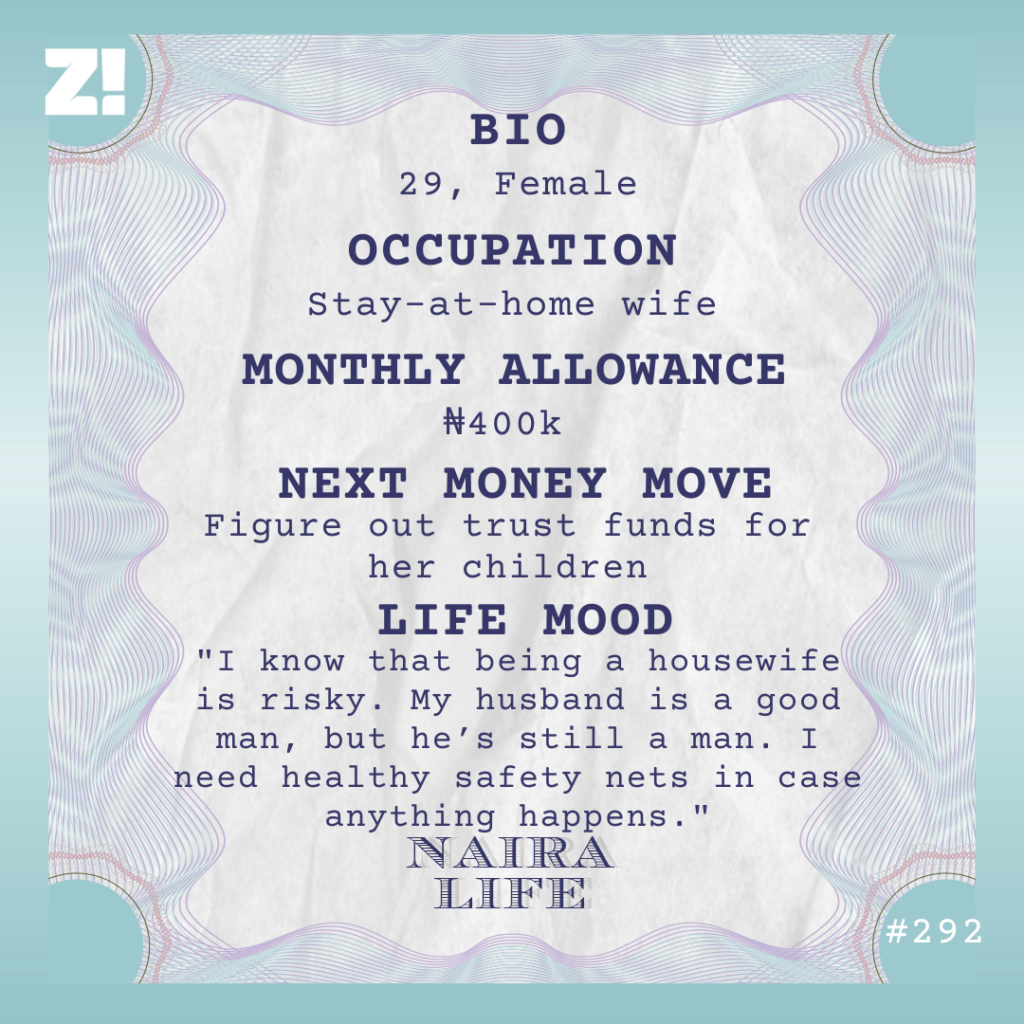
    Nairalife #292 bio

    Tell me about the first time you made money

    I was 13 years old and in SS 1. I had the bright idea of selling my sister’s time to senior boys in boarding school. She was in SS 3 then, and the finest girl in our school, and all the boys followed her like bees to honey. So, I monetised it.

    How did it even work?

    My sister and I are really close, but she’s quiet to a fault. I’m the stubborn, outspoken one. There was this boy in her class who liked her, but my sister was blissfully unaware. He came to me to help him talk to her, and I jokingly suggested he pay me ₦100 to arrange a time for them to talk during prep. 

    He paid, and I convinced my sister to talk to him. Then I did the same for another boy, then another. I got away with it five times before my sister stopped cooperating. 

    I still jokingly tell her we could’ve made serious money if she’d been more open-minded. Maybe she’d have agreed if I’d given her a cut of the money. But to be honest, it’s not like we needed the money.

    That means there was money at home, yeah?

    Oh, there was money. I come from a polygamous family; my dad had four wives and plenty of concubines, but he did right by everybody. My dad had filling stations, and all his women had their own houses. 

    My mum was the last wife and didn’t work — except for a lace store she kept for keeping sake — and my sister and I didn’t lack. I can also say we were spoiled. When I graduated from secondary school in 2010, my mum gave me a brand new Blackberry as a present. Blackberry phones were the iPhones of 2010. I was a big girl. 

    My mum doesn’t even know this, but I gave the phone to one foolish boy I liked at university. He broke my heart and refused to return my phone. 

    Breakfast … we’ve all been there. Talking about university, did you do anything for money while studying?

    I tried my hand at several small businesses, but I was a classic case of “money miss road.” I had too much money, and I’ll explain. 

    The minute I got into uni in 2011, I began receiving double allowance from both parents. They didn’t live together, so they sent me money separately, and I never mentioned that the other parent had already sent money. My mum sent ₦40k/month, and my dad sent ₦60k. Apart from the money, my mum regularly sent me foodstuff through other relatives. 

    Me, I was just spending like Mother Christmas. I had an off-campus apartment, and my friends loved to visit because I’d either cook or take them out. If I wasn’t buying my friends food, I was dashing them money. I once paid a friend’s ₦80k hostel fee because I was tired of looking at the money in my account. It was the same friend who suggested I try a business since I didn’t have anything to do with money.

    I’m screaming. So, what did you do?

    I decided to sell chiffon tops and jeans in 300 level. My sister introduced me to a friend who sold them wholesale. I think I bought each top between ₦1k – ₦2k, and a pair of jeans for around ₦2k. The first batch I bought cost ₦50k, and I added a profit of between ₦2k – ₦3k on each item and made good sales. But I didn’t see any money. Both capital and profit, I didn’t see. Everyone bought on credit and didn’t repay me.

    I think a major reason my friends were comfortable buying and not paying was that I already had a reputation for being Mother Christmas. Me too, I didn’t know how to pursue people for money, so I only asked a few times and left them. The business didn’t last three weeks.

    Next, I decided to sell makeup products. I used ₦30k to buy powders and brushes, but I ended up giving them out because marketing them was too stressful. Imagine someone asking whether the IMAN powder I was selling for ₦2500 was original. How will original IMAN be ₦2500? Nigerians should fear God. I sha left that one too.

    Then I tried to sell sneakers, but after I kept “collecting” my goods for personal use, I decided to hang up my entrepreneurial boots and call it a day. I survived on my allowance until I eventually left university in 2016.

    Let me guess. NYSC came after

    Yup. NYSC posted me to the north, but I wasn’t about to risk my life for ₦19800. So, I worked out redeployment through my dad’s friend to my home state. My PPA was a local government, and the only thing I did was to buy food for my supervisor. I did that twice before I gave myself brain and  decided I couldn’t use my one-year service to play errand girl, so I disappeared. I paid my supervisor ₦5k from my allawee monthly so I could leave to look for better opportunities.

    Did you find better opportunities?

    Not immediately. I wanted to get a job with one of the Big Four accounting firms, but omo, I saw shege with the assessment exams. When nothing came out of those, I took a gap year to just relax. I planned to rely on allawee and my mother’s food — an advantage of living at home. 

    But I almost didn’t survive that gap year sef — I was so broke. I didn’t realise just how little ₦19800 was until I had to live on it. I never went hungry o, but I was so limited. I couldn’t eat out with my friends or buy clothes and shoes. It was terrible. I couldn’t even whine my parents to give me money because they’d be like, “What are you using money for? Aren’t you at home?”

    I tried to find jobs halfway through the year, but the only one I found was a ₦50k accounting job, and the office was so far from my house. I’d have spent the whole salary on transportation. I didn’t take it.

    That period made me realise the importance of savings or a safety net before making foolish decisions like not wanting to work. Maybe if I’d saved when I was receiving so much money in school, I wouldn’t have felt like poverty was knocking on my door.

    Real. Did you have better luck with job search after NYSC?

    Not really. I wanted a job that paid nothing less than ₦120k. But I was broke, and beggars don’t have a choice. So, I settled for one at a small firm at ₦70k/month. This was in 2018.

    The salary wasn’t too bad, sha. My boss lived in my neighbourhood, so I hitched free rides with her daily. I wasn’t flexing as much as I did in uni, but I could afford to buy myself a nice bag after collecting my salary. I also tried to save at least ₦10k/month for my emergency savings.

    I worked at the job for almost two years before I got married and left in 2020. By the time I left, my salary had grown to ₦105k.

    Did marriage mean you had to stop working?

    Yes. My husband requested it before marriage, and he probably thinks I stopped because of him. Oga doesn’t know I was only happy to leave the workforce.

    A little backstory: My husband was widowed when I met him in 2019. His wife had passed away a few years before, leaving him with two children. He wanted someone who’d be there for him and the children. So, he was clear that he wanted a housewife.

    On the other hand, I was already looking for how to get paid to do nothing. I didn’t enjoy working and the idea of slaving all month for a salary that didn’t last two weeks. I was already checked out. But I didn’t tell my husband this sha. I made him believe he was asking too much of me. We came to a compromise — He’d pay me ₦300k/month as “salary” so I wouldn’t have to work.

    I have no choice but to stan

    Haha. That’s minus money for food at home and the children’s expenses. The salary is for me to spend as I like. My salary increased to ₦400k earlier this year after complaining about Tinubu’s economy and how inflation has made everything expensive. 

    However, the truth is, I hardly spend the salary. The ₦500k allowance I get for the home’s upkeep is enough to cover the necessities, and I still squeeze out a little to buy the random shoe or bag. I also whine my husband to give me extra money for aso-ebi and gold for family functions.

    My attitude to money has changed since I got married. I’m now very intentional about having different safety nets. I save and invest first before doing anything. I have about ₦2m in a secret savings account and two landed properties in my hometown. I also have a considerable gold collection I can sell in an emergency.

    Is there a reason for the sudden interest in safety nets?

    I know that being a housewife is risky. My husband is a good man, but he’s still a man. I’ve heard several stories about how men can suddenly start acting funny because their wives are 100% dependent on them. 

    Plus, he’s a Muslim. What happens if I wake up tomorrow and hear he wants to marry another wife? That might reduce my allowance. I also suspect he has a girlfriend, but I won’t bother myself with that. 

    I just need to make sure I have healthy safety nets in case anything happens. He doesn’t know about my properties, and I’m trying to convince him to build me a house as my next birthday gift. If anything goes south, I want a secure future for myself and our children.

    What needs to happen for you to know you’ve hit this goal?

    Hmm. I haven’t really thought deeply about this. I think the biggest indicator of a secure future is when I can afford to create a trust fund for my children’s school fees up until university. I’m not sure what that’ll cost yet, but this question has got me thinking about how I can do that. At least if anything happens, I should know I can keep my kids in school.

    Let’s go back to the monthly allowance and salary. How do you spend that in a typical month?

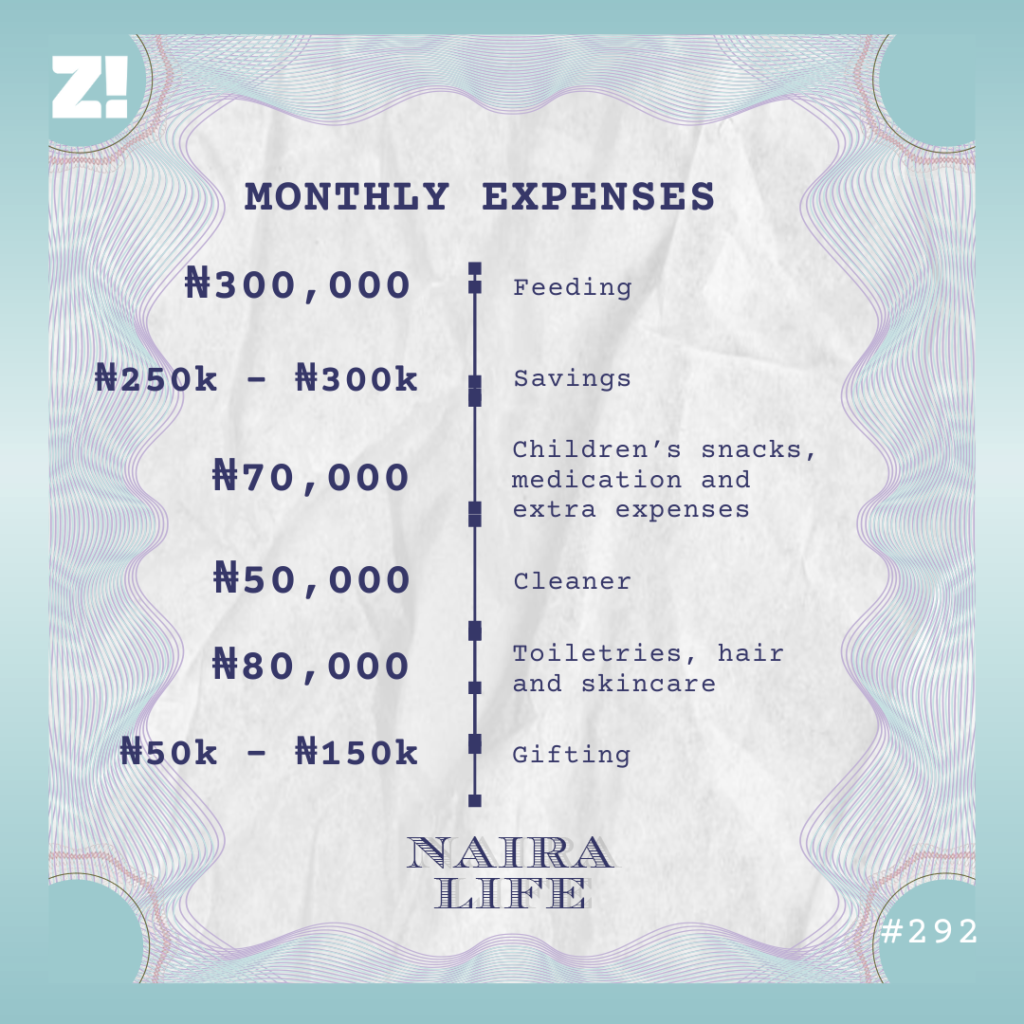
    Nairalife #292 monthly expenses

    My gifting budget is for the biweekly bulk cooking I do for charity. Sometimes, part of the money goes to settling people who come to me with needs. I send my mum a monthly ₦80k allowance, but that comes from my husband. It’s not part of my salary or home upkeep allowance. 

    Do you think you’d ever return to the workforce?

    What for? What am I looking for there? I intend to avoid having to work as much as I can. It’s not like I spend my days lazing around. I’ve had two more children since I got married, and taking care of four children isn’t beans at all. 

    A cleaner comes in twice a week, but I still feel like I’m constantly cleaning, cooking, and shouting at the children. I can’t add a job or business to the stress I already experience daily. That’s why I’d rather focus on having good investments and emergency savings to fall back on. 

    What’s an ideal investment portfolio for you?

    Real estate, gold, naira, and dollar savings. I’d like to own at least two houses and rent them out for extra income. If my husband builds me one, I’ll just have to focus on getting money to build the second one.

    I’m considering using one of my lands as a farm as I’m not building yet, but I’ll need to figure out how to get someone to run it so I don’t stress myself out. But then, I don’t trust Nigerians like that. I can employ someone to oversee the farm now, and they will use my money to enrich their own pockets. So, I may not do the farm thing. 

    I don’t have a cap on how much money I’ll have in naira and dollars that’ll be enough for me. I just want to have money.

    I get it. What’s the last thing you bought that significantly improved the quality of your life?

    This is funny, but I bought a child leash for my 1-year-old last month. We spent part of the summer holiday in my husband’s hometown, and I know my child likes jumping up and down. He literally watches for when you’re distracted so he can snatch his hand from your grip and rush into the road.

    I didn’t want him walking around, so I bought a child leash online for ₦50k and put it on him. It’s like a mini bag pack with a rope that I can snap on my wrist so he doesn’t go far. People kept looking at us weirdly, but I was so happy with my purchase. I wish I had known about child leashes for the other kids earlier.

    How would you rate your financial happiness on a scale of 1-10?

    7. I have all my needs met, and I don’t regret dumping my career. It’ll be a 10 when I have my houses.


    If you’re interested in talking about your Naira Life story, this is a good place to start.

    Find all the past Naira Life stories here.

    Subscribe to the newsletter here.

    [ad]

  • A Week In The Life” is a weekly Zikoko series that explores the working-class struggles of Nigerians. It captures the very spirit of what it means to hustle in Nigeria and puts you in the shoes of the subject for a week.


    The subject of today’s “A Week In The Life” is a full-time housewife. She walks us through the struggles of taking care of three kids, the difficulty of her routine, and how she has accepted her role in the grand scheme of things.

    MONDAY:

    I’m up at 5 a.m. because I have to prepare my three children for school. My eldest child bathes herself while I focus on cooking and bathing her younger siblings. After I’m done, I start to dress them but I can’t seem to find their socks. God. I hate looking for socks. It’s a tough cycle because after searching for socks, the next thing I look for is their shoes.

    It’s 7 a.m. by the time my children are all packed to leave the house. I sigh a little with relief because they won’t get flogged for late-coming today.

    Once the children are gone, my day begins — I sweep the compound, I sweep and mop inside the house, I dust the TV stand, shelf and standing fan. Around 9 a.m., I pack all the dirty clothes from yesterday and sit down to wash.

    It’s mid-afternoon by the time I’m done washing. I’m tired and haven’t had a single meal all day. I try to quickly eat something because I have to go to the market and cook lunch before the children come back from school. 

    It’s 4 p.m. by the time I’m done with market runs and the children are home. The first thing my children shout when they see me is, “Mummy, our teacher said you should help us do homework.” 

    I drop my market bag and go over to help, grudgingly. In my head I’m calculating my to-do list:

    1. Help the young kids with homework.
    2. Google the answers to the questions for the older kid.
    3. Prepare dinner.
    4. Give the young kids a night bath.

    Give or take I know that whatever happens, I’ll be in bed by 11 p.m. or latest at midnight. 

    TUESDAY:

    Being a full-time housewife is not easy because we do so much without receiving a salary. If you have a regular job, you can rest after work or during the weekend. As a housewife, you don’t have that luxury because you work from morning to night taking care of the house and children. When you try to sleep during the day, your mind will keep disturbing you that there’s work to be done that no one will do for you. Especially for people like me who don’t have paid or voluntary help. 

    There’s also the part where everyone blames the housewife for everything that happens while they are away. If the kids get injured, they’ll blame you. If the kids become sick, you’ll be blamed. If food is not ready by the time your husband comes home, you’ll also be blamed. And the blame always ends with: “Were you not at home, what were you doing?”

    I spend today thinking about how unhappy I am as a full-time housewife. For someone like me who once had a business selling akara, staying at home is hard. It’s even harder because my husband is the one who ordered me not to work. With how expensive things are in present-day Nigeria, money from only one source in a marriage is extremely tight. The allowance for food for a month can no longer buy anything. All I can do is watch helplessly as things become expensive without being able to do anything about it. 

    I’m fed up with everything. I wish I could disappear for a while.

    WEDNESDAY:

    Today I’m trying to remember the last time I wasn’t taking care of someone or doing one chore or the other and I can’t. 

    The only place in this world where I can rest is my mum’s house outside Lagos. However, if I tell my husband that I want to travel, he’ll pick a fight. And I don’t like wahala or getting annoyed. If I get annoyed, it means I don’t want the best for my children because getting annoyed can lead to a couple’s separation. My husband may ask me to go with the children or leave the children and go. Guess who’ll suffer? The children. So anytime there’s friction, I turn to prayer and leave my troubles with God. 

    You can’t fight someone when you’ve not gotten what you want from them. It’s when you’re stable enough and independent that you can damn the consequences. For now, I’ll endure because he’s paying the school fees of my children and training them. After all, there are working-class people facing worse situations where the husband doesn’t drop money at all. 

    There’s no enjoyment in marriage. Before you get married these men will tell you, “I love you.” In the marriage, you’ll see changes that will confuse you. And since you’re from different backgrounds, one person must cool down for the other person. I’ve decided to be the one to cool down and endure. I’m kuku the one that wants something. 

    THURSDAY:

    My husband is at home for the first time in over three weeks today. I asked him to kindly assist me with some tasks since I was overwhelmed with washing and cleaning after everybody. He told me that he went away for three weeks to do his own job, so I should face my own job. He then proceeded to sleep. I felt bad, but for peace to reign, I just unlooked. 


    FRIDAY:

    As a housewife, you’re at the mercy of another person. You have to take whatever is given to you. No one asks if you have clothes or pant and bra, or how you even buy sanitary products. That’s why you have to be wise about these things. When my husband sends me to buy something, I use his remaining change to sort all these little things. Yorubas will say: “You must not eat with all your ten fingers.”

    Every day I stay at home is an unending repetition of washing, cooking, cleaning. And before you know it, the day has finished and you’ve started another one again.

    I prefer to go out to work so that if my husband says why didn’t I do x and y chore, I can just say it’s because I went to work. Unlike when I’m at home all day and he’ll say what’s my excuse for not doing the chores. 

    There are no days off — no sick days, no public holidays, no weekends. It’s work, work, work. I’ve just accepted that it’s my cross to bear and I have no grudges against the father of my children. If people don’t forgive him, I forgive him. I have no choice but to play my part. I’m just praying for a miracle in form of a job or a shop so I can have something of my own. 

    Until then, we go over and over again. Tomorrow is another day of washing, cooking and cleaning. 


    Check back every Tuesday by 9 am for more “A Week In The Life ” goodness, and if you would like to be featured or you know anyone who fits the profile, fill this form.

    [donation]