• This December, Amstel Malta brought the magic and warmth of Christmas to life across three major cities — Enugu, Port Harcourt and Aba — with spectacular light installations that transformed streets into festive destinations for families, visitors, and returning loved ones.

    L-R: Chinwe Ude, Zonal Business Manager, East Zone, Nigerian Breweries PLC; Thibaut Boidin, Managing Director, Nigerian Breweries Plc; Olufumilayo Akande, Non-Executive Director, Nigerian Breweries Plc; and Yibo Koko; DG/CEO, Rivers State Tourism Development Agency RSTDA; at the Amstel Malta Legendary Christmas Light up ceremony at the GRA Junction in Port Harcourt.

    From December 2nd to 4th, thousands gathered across the three cities to witness the lighting ceremonies, marking the official start of Amstel Malta’s 2025 festive campaign themed “Be Your Best all Season Long.”

    This initiative, a part of Nigerian Breweries ‘Legendary Christmas’ campaign, was designed to celebrate homecoming, inspire joy, and strengthen community connection during the most anticipated time of the year.

    Speaking on the significance of the three-city celebration, Sarah Agha, Marketing Director, Nigerian Breweries Plc, explained that this year’s activities were anchored on Amstel Malta’s Be Your Best All Season Long message,  a reminder that encourages Nigerians to show up for one another, reconnect during homecoming, and embrace the warmth and joy that help us bring our best selves into the season.

    “The reason we are here today is rooted in the purpose of our company — to brew the joy of true togetherness. That is what we care about most. At Nigerian Breweries, we are a company committed to spreading joy, and this season holds a special place in the hearts of Nigerians. December is not just a date on the calendar; it is a time when distance no longer matters, when families come home to reconnect, share meals, settle differences, and celebrate as one.

    “So, when we asked ourselves how we could make this season even more meaningful, the answer was clear: we would light up cities across the country. And we are a company that has the credibility to do this because our footprint spans across Nigeria.”

    She added “We want to thank you — for showing up, for choosing Amstel Malta, for supporting us through the years, and for embracing a brand that inspires Nigerians to be the best version of themselves.”

    In each city, the lighting ceremonies attracted dignitaries, government representatives, cultural leaders, residents, and visitors, who applauded the brand’s commitment to enriching public spaces and creating meaningful festive moments.

    Popular personalities, including Stan Nze and Natacha Akide (Tacha), also joined in celebrating the light-up moments, adding excitement and colour to the festivities. They were received by consumers who came out to share in the experience and be part of Amstel Malta’s historic street light-up.

    The highlight of this year’s Christmas calendar is the maiden edition of Amstel Malta Festiville in Aba, scheduled to hold between the 23rd to 27th of December, a full-scale festive village created to immerse families and communities in music, art, entertainment, and unforgettable holiday experiences.

    The Festiville experience includes the Amstel Malta Grotto, a soulful Christmas carol night, and much more . Children will also enjoy a dedicated Kids’ Playground and Games Arena, ensuring that families of all ages share in the magic of the season. 

    Designed as a festive wonderland, Amstel Malta Festiville is set to capture the warmth, excitement, and togetherness of the Christmas season, giving families and communities a place to reconnect, celebrate, and create meaningful memories. With this year’s celebrations, Amstel Malta invites Nigerians everywhere to come home to joy, share in the light of the season, and Be Their Best All Season Long.

    In addition to the Street Light Up tour and Amstel Malta Festiville in Aba, Amstel Malta will also be present at the  Lagos Food Fest, a vibrant culinary and entertainment experience happening at Muri Okunola Park on December 14, 2025, giving Lagos residents another exciting opportunity to celebrate the season with the brand.

    As the lights continue to shine throughout the festive season, Amstel Malta encourages residents and returning families to visit the installations, create memories, and celebrate love, gratitude, and togetherness. 

    To join the celebration, participants can take a selfie or group photos, videos at any of the installations and tag @amstelmalta using the campaign hashtag #LegendaryChristmasNB for a chance to win exciting prizes and Christmas surprises.

    For more information on all the festive events by Amstel Malta, follow @amstelmalta on all social media platforms.

  • When Monkey Shoulder’s Press Play rolls into a city, there are signs. The music is electrifying, the vibes are high, the glitz, the games, and the glam: the city lights up! This April, for the first time ever, the party hits Enugu, and the city is about to feel a difference

    On Monday, April 14, Monkey Shoulder, one of the world’s leading blended malt Scotch whisky brands, teams up with In The Yard, the biggest monthly party series in the South East, to throw down a night that promises to be nothing short of iconic.

    Set to take place at Base Landmark, Independence Layout, this edition marks the official Enugu launch of the Monkey Shoulder Press Play Concert: a live, interactive escape from the grind, built to deliver unforgettable moments of play, electrifying music, high-spirited games, twists and mixes of great whisky. 

    When Monkey Shoulder throws down, expect a lineup of DJ masterminds designed to keep the crowd moving. On deck for the night are DJ powerhouses like DJ Consequence, Mazexmxtreme, Commissioner DJ Wysei, DJ Casper Sandra, (DJ Delrhita, and Big Swagz) with hype-man Slym Shady, Skye and Fresh and King Swagz on the mic, firing up the crowd from start to finish. And that’s not all – the party will also feature show-stopping performances by Magixx and MJ the chart-topping “Manzi Nte” sensation from South Africa!

    And, of course, it wouldn’t be a Monkey Shoulder event without serious heat on the ground. It’s not just about the music, we are talking games—competitive, heart-racing, type of games. Enugu, get ready to bring your A-game to the FIFA tournament for the Giant Tic Tac Toe, Basket Ball, snooker, and Jenga games, not just for the fun but also for the irresistible cash rewards. To celebrate this launch, the brand hints at providing a whopping 1 million reward for the FIFA Tournament. 

    Because fun is fun—but fun that pays? That’s the catch!

    Nothing bonds a group like shared first-time experiences. True to the Press Play vibe, the night will be packed with immersive experiences: delectable cuisine, engaging conversation, and, even more importantly, the monkey shoulder-infused cocktails. Whether you are a whisky pro or a curious first-timer, there will be plenty of Monkey Shoulder mixes to explore, sip and enjoy your way. 

    Enugu has never seen a party like the Monkey Shoulder’s Press Play Concert, and you won’t want to just hear about it later. The City is about to Press Play: Loud, bold, and unforgettable on a whisky-fuelled playground for those who know how to have fun.

    Spaces are limited. The memories won’t be.

    Hurry now and secure your spot at https://shopurban.co/events/3 

  • People say your twenties are the best years of your life. But currently, it’s starting to look like, for many Nigerians, our twenties might be filled with groceries, floating berries and discovering new ways to cover Nigeria by foot. 

    It’s been barely two months since the fuel prices more than doubled from N197 to N537 per litre following the fuel subsidy removal on May 29, 2023. And while still trying to adjust to our new economic realities, on June 18, fresh news broke of yet another surge in fuel price to over N600 per litre. 

    According to Chinedu Okoronkwo, the President of the Independent Petroleum Marketers Association of Nigeria (IPMAN), the recent price hike is to help the petrol marketers themselves stay in business. He explained that the subsidy removal adversely affected their business so much that many have been unable to raise enough money to load from depots and the Nigerian National Petroleum Company (NNPC) Limited. 

    It’s alarming that we’re hardly 100 days into this new government, and life’s already unbelievably hard for citizens. It will now cost almost triple the amount it did in May to fill your vehicle’s fuel tank, and due to the current 22.79% inflation rate, food will get even more expensive. 

    And I really hate to have to say this, but it looks like maybe Bubu wasn’t that bad. We know being president was more of a side gig for him, and his real job was touring Europe, but at least we weren’t at risk of having a $1 to N1000 exchange rate. President Tinubu promised us renewed hope, but the only thing that has been renewed is our subscription to another four years of suffering in 4D. 

    What Else Happened This Week?

    Police Arrest Suspected Cultists in Enugu State

    On July 18, 2023, the Enugu State Police Command announced the arrest of 18 members of the Black Axe Confraternity who allegedly had plans to cause trouble during their 7/7 day celebration.  

    Download the Citizen Election Report: Navigating Nigeria’s Political Journey

    The cultists were found in different locations in the state, and along with their arrest, the police recovered one pump action gun, six live ammunition (cartridges), three black berets with the inscription “Black Axe”, one sharp battle axe, three drums, three black-yellow face-caps with “Ezeagu Sub Zone 7 7” inscribed on them, and one yellow scarf. According to DSP Daniel Ndukwe, the spokesperson for the Enugu State Police Command, the suspects will be arraigned in court once investigations are concluded. 

    If you’ve ever wondered what the legal punishment for cultism in Nigeria is, under the Criminal Code Act, anyone found guilty of cult activities or permitting meetings to be held in their residence is liable to a 3-year imprisonment. On the other hand, the Penal Code, which applies to Northern Nigeria, allows for 7-year imprisonment.

    Question of the week

    It’s not news that there has been a recent hike in the tuition fees of federal universities. Do you think this surge will improve Nigeria’s quality of education?

    Video of the week

    @zikokocitizen

    FCCPC & Google is putting loan apps in their place! In this video, we explain how the regulator and tech giant plans to crack down on loan apps that shame borrowers who don’t pay back their loans. Watch, like and share this video #zkkcitizen #zikoko #nigeria #techcabal #politics #loan

    ♬ Scary music horror mystery(1040775) – parts di manta

    Ehen one more thing…

    People change their names for many reasons, such as marriage, career demands, or simply a desire for a new identity. Changing your name in Nigeria is relatively straightforward, but you need to take a few important steps.

    To ensure you don’t miss out on the next edition of Game of Votes, subscribe to the newsletter here.

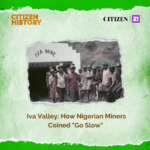
  • Every Nigerian is familiar with the term “go slow”, whether you live in go-slow hubs like Lagos or places with lesser go-slows.

    For Nigerians today, go-slow means traffic congestion.

    But have you ever wondered how that name come to be? We do, and here is your answer to this week’s episode of Citizen History.

    Traffic congestion [Guardian Nigeria]

    It’s a sad tale of maltreatment by the British government, fierce resistance, and a massacre.

    The Story of the Iva Valley Massacre 

    Enugu State in eastern Nigeria is known as the Coal City because of the massive coal deposit in the capital Enugu City.

    Coal, often used as fuel for locomotive engines, was valuable in pre-colonial Nigeria due to Nigeria Railway Corporation’s high coal consumption. 

    In 1915, the British colonial government opened the Udi Mine after discovering coal in Ngwo at the top of Milliken Hill. However, it closed two years later and was replaced with the Iva Valley mines in 1917. 

    Poor welfare of workers

    In the 1940s, there was a persistent issue of poor workers’ welfare for people working with the colonial government in Nigeria. A series of protests occurred, leading to a nationwide strike in 1945.

    The 1945 general strike in Nigeria [Alamy]

    With that, the importance of trade associations to improve working conditions, pay etc., grew with the formation of the Trade Union Congress of Nigeria in 1942. Workers knew they could bring about change if they dared to stand up together.

    However, the trade unions established around that time had internal beef, allowing their Opp, the colonial government, to be one step ahead.

    Excerpt from “THE ENUGU COLLIERY MASSACRE IN RETROSPECT: AN EPISODE IN BRITISH ADMINISTRATION OF NIGERIA” by S. O. Jaja

    By 1949, Enugu was already a cosmopolitan town with about 25,000 inhabitants and approximately 8,000 employed coal miners.

    But the growing production did not reflect the life of an average miner, who worked underground six days a week with poor oxygen. The pay was also minimal, as they experienced pay cuts and inflation due to the economic recession led by World War 2. 

    The colonial government also weaponised tribalism by making indigenes of the Ngwo community where the mine was located work as coal miners while non-indigenes worked above ground and did more clerical duties.

    Taking a leaf from the growth of trade unions in Nigeria, two unions came together to form the Colliery Workers Union (CWU), and their leader was the charismatic Isaiah Okwudili Ojiyi, a former schoolteacher.

    On November 1, 1949, the CWU demanded better pay for all workers, improved working conditions, upgrading the mine hewers to artisans, and the payment of housing and travelling allowances. Naturally, the capitalist colonial government rejected their demands and doubled down on intimidation, assault, and promoting infighting.

    The Go Slow strike 

    The workers at Iva Valley [Pulse Nigeria]

    In 1941, the colonial government created Nigeria General Defense Regulations (NGDR), which banned workers from going on strike.

    Therefore, the 1949 protesters had to be smart; otherwise, the miners would be fired altogether.

    So they devised an industrial action called the “Go-Slow”. 

    The workers would not lay down tools but work very slowly, affecting production. A handful of coal was being produced daily instead of wagon loads. But as they were “working”, they couldn’t be punished by the angry government.

    Reluctantly, the colonial government started a negotiation and reached an agreement but also breached it when it sacked more than 200 miners between November 10 and 12, 1949. 

    The Go-slow method escalated to a stay-in strike in which the workers came to the mine but did no work. This also prevented the colliery managers from simply replacing the protesting miners this time.

    It was then decided that the police would remove the protesting miners. To justify this, they claimed that a set of explosives used for work in the mine had gone missing.

    The Police were there to remove the bomb.

    The Massacre 

    On November 18, 1949, 50 armed riot police officers arrived at Iva Valley led by a Senior Superintendent of Police, F.S Philips.

    Superintendent F.S Phillips [BBC/Getty Images]

    The miners had tied strips of red cloth to their helmets as a mark of protest and as was their custom. They faced the armed police and began to dance and chant to boost morale.

    Philips decided that the miners looked menacing, “indulging in a war dance,” and started shooting.

    Twenty-one miners were killed, and many of them were shot in the back.

    The Aftermath

    The tragedy spread across places like Aba, Port Harcourt, Onitsha and even London, resulting in mass protests. 

    Nigerians at a rally in Trafalgar Square over the Iva Valley Massacre [Asiri Magazine]

    Eighteen prominent Nigerians created the National Emergency Committee (NEC) to coordinate a national response to this atrocity against humanity.

    The Iva Valley protest and massacre contributed to nationalist movements in Nigeria. It also helped in restructuring the trade unions, and the creation of a Nigeria Colliery Commission handled by Nigerians.

    The method of the go-slow strike was also seen as revolutionary and was exported to the UK as a form of industrial strike.

    Think about this the next time you find yourself in a “go slow”.

  • Image credit: @obisomto on Twitter

    I grew up in Abuja, and okpa was one meal that I saw all the time. There were always women at street corners with basins and okpa stacked into transparent nylon bags. They looked like light-skinned moi-moi and didn’t seem particularly interesting to me. I didn’t think anyone cared for them but my Igbo friends thought otherwise.

    In boarding school, every day, my mates would jump the fence to buy okpa from an uncompleted building close by.  You could see the unbridled joy on their faces as they tore open the okpa nylons. But why was it such a big deal? I still haven’t been adventurous enough to try it, but I’ve never stopped wondering what makes it so special. 

    So today, I asked Oluchi to explain why okpa excites her Igbo blood. She explained her love for okpa, tricks to preparing it and why okpa has remained constant in her life as an adult.

    As told to Steffi O.

    Okpa was part of my childhood

    Okpa is a local dish made from bambara nuts. As someone from Enugu, okpa has always been a part of my life. One way or the other, it was a treat my family found a way to enjoy in Lagos. If anyone was coming from Enugu, they’d make sure to bring it, specifically the ones from Ninth Mile. It’s said to be the best okpa spot in the East. 

     My mum would whip up a mean batch of the flour for me and my brothers to enjoy. It was a meal we constantly looked forward to having, and then it became much more than a great meal.

    Experiencing okpa in Nsukka

    When I was nine, I spent my first three years of secondary school at Nsukka. It was my first time away from Lagos and my family, so the culture shock hit me when the Nsukka dialect was so different. I was the girl that understood Igbo but couldn’t speak it and I had to learn quickly. Yet, being amongst my people was interesting even though I’d lived away from home for so long. In between trying to figure out life away from my family, okpa brought some sense of familiarity. I’d literally buy it every day during break time and each bite reminded me that Enugu was my home. 

    Eventually, I realised that okpa was part of the Igbo tradition. During festivals, a major masquerade that roamed the streets of Nsukka was called Ori Okpa which means “the Okpa eater”. 

    RELATED: A Masquerade Flogged a Youth Corper in Kogi and He’s Really Vexed

    In Nsukka, I spent holidays with an uncle who was a traditional man. On one of my mid-term breaks from school, he’d asked if I could cook, and at that point, I didn’t know how. On one of my longer breaks, he wrote a letter to my mother about why it was important for me to learn how to cook as a woman. She didn’t want it to seem like I was being spoilt and so the cooking lessons began. At ten, I started learning to cook.  

    What exactly is okpa?

    To anyone who hasn’t had okpa before, it’s a weird meal. I like to think of it as eating light-skinned moi-moi because of the palm oil that’s mixed into the okpa mix. 

    Okpa is simple to make, but one wrong move can ruin everything. Ground bambara nuts are the main ingredient. Like beans, the bambara nuts are ground without the back being removed and then milled dry. 

    My mother never adds seasoning cubes or chicken stock to the mix. To us, it’s sacrilege. Bambara nuts have a distinct flavour that needs only salt and pepper. My mother also never grinds or blends her red peppers. Everything is finely cut into the okpa as it’s mixed with palm oil and warm water. And unlike moi-moi, okpa is a watery mix. My mum’s trick to keep the flavour while the okpa steams is shaking the nylon or banana leaf right before dropping it into the pot. 

    RELATED: 12 Beautiful Delicacies From All Over Nigeria

    Having a family that dislikes okpa

    Okpa is something I loved to enjoy with my family — it still is.  But unfortunately for me, I married a Delta man that doesn’t care for okpa. The first time I made it on my own was after our wedding, and I ended up eating the whole thing alone. 

    Our son doesn’t like okpa too. Funny enough, the only time my body has ever rejected okpa was when I was pregnant with him. I ate okpa and threw everything up. Imagine me not being able to stand okpa for nine whole months. There was no point trying to make him eat it when he was born. He’d already given me an answer right from the womb: he disliked it.

    At least I still share my love for okpa with my parents and siblings. My brother and I live 20 minutes away from my mother, and every two weeks, we know there’s a bag of okpa waiting for us at her house. It’s become our own tradition here in Lagos. Okpa will always be a constant part of my life because of family.

    ALSO READ: 9 Nigerian Meals We Love to Eat but Never Cook Ourselves