• In an economy troubled with inflation and rising costs, it’s not strange that the average Nigerian juggles a 9-5 with a side hustle to maximise cash flow. But what happens when the side gig becomes the main squeeze? What does it take to make the leap?

    We spoke with young Nigerian entrepreneurs who’ve successfully turned their passions into full-time ventures. They shared their stories, struggles, and how the switch has impacted their finances. 

    Emmanuel, 29. Business Consultant 

    Last income at 9-5: ₦450k

    Current average income: ₦600k – ₦1m

    I started my career during NYSC as an account executive at an experiential marketing agency in 2018, where I earned ₦50k/month. In the same year, I began a mini side hustle building pitch decks and company profiles for older colleagues and friends. They had seen the quality of my work and trusted me with these projects. 

    Over time, my consulting gigs became a steady income, and I started an agency to consult for  SMEs. In 2020, COVID hit and experiential agencies started struggling, so I made a move to go full-time.

    An ex-boss sent me consistent freelance gigs, and I made between ₦100k – ₦350k on each one. I didn’t even have a registered business name yet. Those jobs kept me going for the rest of the year. I returned to corporate work the following year, but the seed had been planted—I could make money from this.

    In January 2022, I took the final plunge and became a full-time consultant. I realised I preferred working with multiple clients and projects rather than being tied to one office or sector. Business wasn’t great at some points, and my bills took a hit. I had a social media and content manager who I owed salaries because we didn’t get clients. But that was all part of the journey. Over time, I built a team of ten full-time staff and contractors. We now help businesses with process optimisation, pitch decks, business plans, and, more recently, websites and mobile apps.

    The agency generates about ₦2m – ₦2.5m in monthly revenue, sometimes more. 60% of that goes into operations, staff, contractors, reinvestment, and some savings. Then, I pay myself. 

    I can confidently say my decision to go full-time with my side hustle is paying off — not just financially, but in growth and purpose. I have become a better operator. I own my time, and I’ve figured out how I work best. I can show up for things that matter. I have flexibility, even if the work itself can get intense.

    It does get intense. There is no guaranteed salary unless I bring in clients. I’m the CEO, marketer, salesperson and people manager. If I hire the wrong person, the business takes the hit. They will leave and get another job, but I will bear the cost.

    Also, dealing with rising costs is a challenge. Many of the tools I use are priced in USD, and the exchange rates affect everything. Contractors sometimes ask for rates I cannot afford. It is a lot to manage at once.

    But I’m better off for it. I understand what it really takes to run a business, and the mindset shift helps me treat my clients’ businesses with the same level of care. I pay close attention to the economy, the cost of tools, and currency fluctuations because they all directly affect my work. These things matter when you are trying to build something sustainable. 

    That said, the real upside has been the relationships. Some clients have grown with me and seen how we have evolved over time. That kind of loyalty, not just from me to them but from them back to me, has been rewarding. It shows that people believe in what we are building together.

    Join 1,000+ Nigerians, finance experts and industry leaders at The Naira Life Conference by Zikoko for a day of real, raw conversations about money and financial freedom. Click here to buy a ticket and secure your spot at the money event of the year, where you’ll get the practical tools to 10x your income, network with the biggest players in your industry, and level up in your career and business.


    Pearl, 36. Entrepreneur and Instagram Ads Specialist

    Last income at 9-5: ₦90k

    Current average income: ₦1m – ₦2.5m

    Two years into my job at an accounting and auditing firm, I noticed I was good at selling and marketing any product. This was in 2016, and since then, I’ve been selling anything I could on Instagram: sneakers, shoes, fabrics—everything. Then, I took it further by charging people to set up sales pages online. 

    My first client paid me ₦30k and referred me to others. Between 2016 and 2018, I juggled my 9-5 and side hustle as a social media manager and Instagram ads specialist. Sometimes, I got up to 4 clients in a month. 

    In 2018, I decided to leave my corporate job and focus on my side hustle. I’d just given birth to my first child and had to resume work after three months. Plus, the creche close to my office cost over ₦200k. It was too expensive, so I took the risk and resigned. I set up a social media agency and added TikTok as another channel to sell my goods. 

    Today, my agency manages the social media presence of six clients, and I have three remote assistants to help me. My agency makes around ₦500k monthly: ₦300k returns to the business to pay my staff, and I pay myself ₦200k. The sales from my online stores on Instagram and TikTok typically amount to ₦1m/month. It can get as high as ₦2.5m in a good month. 

    Entrepreneurship hasn’t been all rosy. It’s a round-the-clock job, which can be overwhelming. Then there’s the risk — I almost lost everything between 2020 and 2021 when I sold thrift clothes. I got a bad batch of clothes, which totally destroyed my capital. But I’ve learned from that experience and moved on. 

    Leaving my 9-5 was the best decision for me. I have two kids now, and I have the time for them and my craft. I recently added video editing to my skills and service offerings. Things can only get better. 


    Eleojonigwu, 25. Ghostwriter 

    Last income at 9-5: ₦30k

    Current average income: ₦350k – ₦450k

    Between 2015 and 2021, I jumped from one secretarial job to another, earning peanuts until I realised I could earn more with a skill I’ve always had: writing. 

    In 2021, I started getting ghostwriting gigs and making far more than my ₦30k salary. One time, I made ₦75k  from a gig. When another gig paid me ₦150k in one month in 2022, I decided it was time to pack my bags. Plus, I didn’t fancy going out, and a physical job didn’t match my personality. Realising I could make more money without leaving my house was all the push I needed.

    But going full-time was challenging. My income was inconsistent for about two years, and I was always broke. It was so bad I couldn’t even afford sanitary towels. Also, I’d go hungry sometimes. 

    I lived with a friend and her family who were from an entirely different tribe, and they had traditional meals that I didn’t exactly fancy. So, they’d make these meals, and being a picky eater, who doesn’t like food adventures due to allergies, I’d stylishly go hungry without my friend’s mum’s knowledge on some days. Because person wey no get money no suppose get choice.

    However, I began to hit stability in 2024. I grew confident in my skills and started charging what I’m worth. Now, I earn more than 10 times my previous salary, and I work from home on my own terms, albeit with deadlines sometimes.

    The disadvantage of doing my own thing is that I tend to be a workaholic, so work spills into my sleep time. And sometimes, I feel sick from not stepping out for a while. I can’t explain it. So, I’m looking to enrol in a gym soon.

    I also function properly when I take occasional breaks from social media, but I can’t do that because most of my gigs come from and require social media.

    That said, quitting my job has been beneficial to me. I recently moved states, got my own place, and am settling in gradually. I’ll choose it over and over again.

    Sharon, 24. CEO, Personal Branding Agency 

    Last income at 9-5: ₦83k

    Current average income: ₦1m

    I started my side hustle before landing a proper 9-5. In October 2023, I began offering LinkedIn optimisation services, which extended to CV writing and social media management after people kept asking for those services. 

    A month later, I went for NYSC and worked as a social media manager for a management consulting company. The company paid ₦50k/month, in addition to my ₦33k allawee, but the job was stressful. My life flashed before my eyes many times, and I often considered absconding because it wasn’t good for my health. I’m just a baby girl. 

    So, after my service year in 2024, I didn’t look for another job. Instead, I decided to treat my side hustle like my 9-5. I set up a personal branding agency and slowly built a remote team of social media strategists, writers and graphic designers to offer services ranging from LinkedIn optimisation to social media management. 

    The income trajectory was like a bullet. I’d spent a lot of time building my personal brand while working 9-5, so people trusted me to help them. In no time, I was making almost 20x my former salary. 

    Now, the agency makes between ₦1.5m and ₦2m in monthly revenue, and ₦500k goes into settling operational costs. The naira devaluation keeps reducing the value of the money I make, so even though I earn more now, the value just isn’t the same. I can only hope things get better.

    My brand is still growing; I know we’ll keep improving. The best thing about entrepreneurship for me has been growing my team. I mostly hired interns, so I’ve trained them, and we’re all still constantly learning from each other and growing. I’m presently plotting how to get us to $4k in monthly revenue. 


    Ronke, 24. Fashion Designer 

    Last income at 9-5: ₦60k

    Current average income: ₦300k – ₦450k

    In 2020, I learnt tailoring and fashion design to pass the time. The pandemic had affected my ₦50k/month waitressing job, so I decided to learn a skill since I was unemployed. My teacher was a family member, so I didn’t have to pay anything to learn. 

    I didn’t start making money from tailoring immediately. I had no sewing machine, so I couldn’t practice sewing or get clients. I still survived by jumping from one job to another. Then, in 2023, while working as a personal assistant, I decided to take tailoring seriously. My boss was toxic, and I didn’t want to quit without a backup plan.

    I was earning ₦60k/month, and I saved for two months to buy a sewing machine. I started by making designs for my sister and myself, and posting them on social media. I’m quite creative, so I usually have a mental picture of what to create. I even started amateur sketching and improved my skills by watching YouTube videos. 

    Two months after I started posting my designs online, people started placing orders. By the end of 2023, I was making an additional ₦100k/month from my side hustle. So, on New Year’s Day 2024, I texted my boss and told her to hold her job. 

    That’s how I became a full-time fashion designer, and it’s only been an upward journey since then. The income isn’t always consistent, especially with how expensive materials become every day, and it’s literally back-breaking work, but I’m at peace. 

    I still work from my balcony, but I plan to get a studio space later in the year. A studio will allow me to hire apprentices, reduce my stress, and increase my earning potential because I’ll be able to accommodate more orders. 

    Entrepreneurship has already helped me achieve dreams I didn’t think possible, so I’m certain the studio will happen soon. Look at me, I have almost ₦1m in my savings, and I’m largely financially independent. I never believed I’d be at this level before 25.


    *The responses have been slightly edited for clarity.


    NEXT READ: 5 Nigerians Open Up on How Parenting Has Impacted Their Finances

    Get More Zikoko Goodness in Your Mail

    Subscribe to our newsletters and never miss any of the action

    [ad]

  • Every week, Zikoko seeks to understand how people move the Naira in and out of their lives. Some stories will be struggle-ish, others will be bougie. All the time, it’ll be revealing.


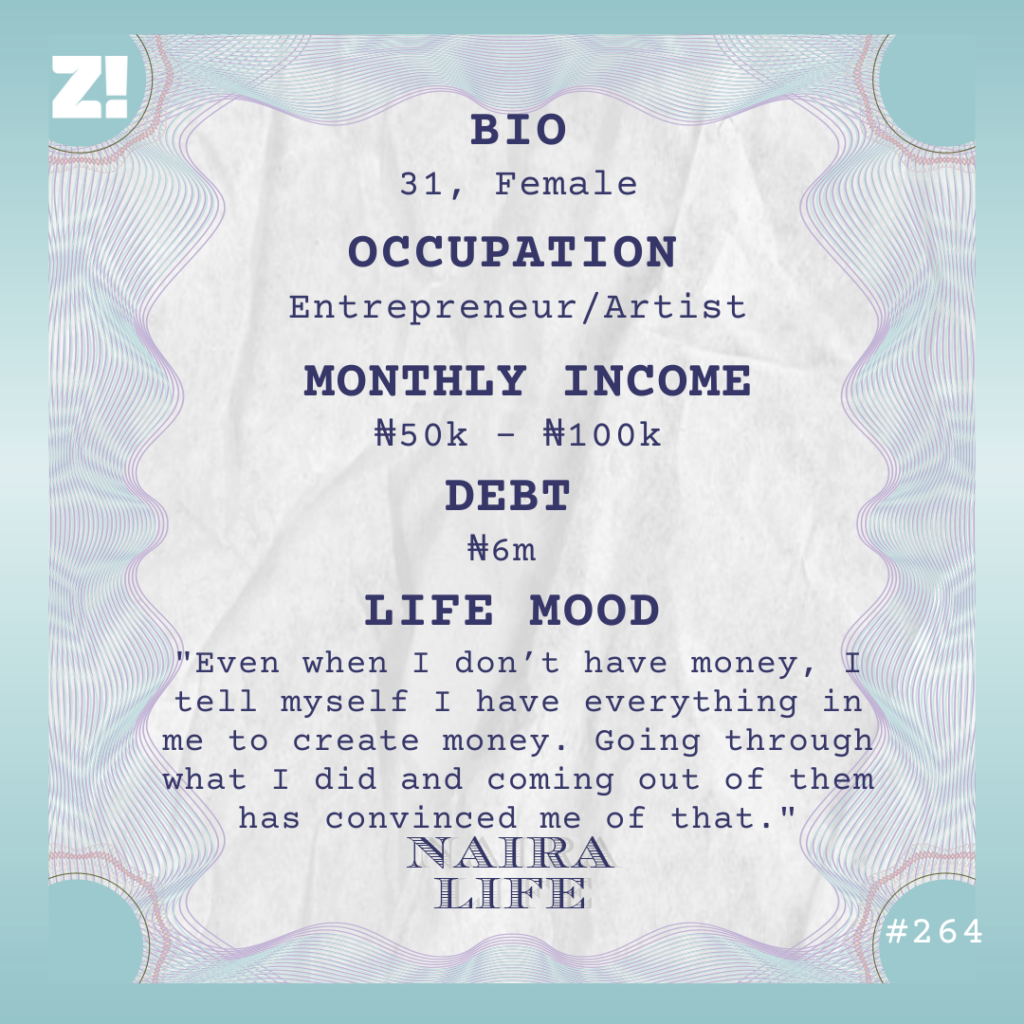
    Nairalife #264 bio

    What’s your earliest memory of money?

    I grew up believing we had money— I never lacked anything — so it was quite shocking for me when, in 300 level, I asked my parents for ₦50k for textbooks and some personal effects, and they said they didn’t have money.

    They’d never turned down a request for money before?

    Nope. It made me realise that money wasn’t something that was just there. It actually took my parents working hard and pulling resources together to cover any financial gaps. 

    My dad was an accountant, and my mum was a lecturer. So, combining their resources meant my siblings and I were well provided for. But at the time of the textbook incident, two of my younger siblings were also at university, so our finances weren’t what they used to be. I’d make a list of school supplies, and my parents would slash the amount by more than half. I understood why that had to happen, but I also realised I couldn’t rely on my parents for all my needs. I had to make my own money.

    What was the first thing you did that fetched you money?

    Dancing. I danced a lot in school, so I started taking occasional gigs with a dance ministry. I  made ₦3k – ₦5k per gig. This was in 2013. 

    I also had a friend in final year who sold jewellery, so we started a reselling arrangement where I marketed her jewellery in my hostel and added between ₦300 – ₦700 to the cost price. The additional cost was my profit after selling. 

    I did that until 400 level when I decided to sell shawarma in school.

    Why shawarma?

    I like cooking for people, and I like to think I have an eye for business opportunities. Shawarma was newly popular in my school in 2014. Every other shawarma stand sold one for ₦500 – ₦1k, and I thought I could make a profit if I took advantage of the demand and sold mine cheaper.

    So, I started learning how to make shawarmas. I watched videos and reached out to a friend who used to sell shawarma before he came to school. I went to his lodge every day for a week, and he taught me what I needed to know.

    The next thing I needed was money. I reached out to a cousin, who used to live with my family, with the business idea, and he agreed to invest. I got a space in my school’s market area, and my cousin paid for the container we used as the kiosk, a fridge and some other equipment. The whole setup cost him about ₦300k. I also had about ₦70k, which I’d saved from an unpaid six-month internship I did just before 400 level.

    How were you able to save from an unpaid internship?

    My internship was at a lab popular among politicians and big men. They’d dash the lab staff money when they came with their girlfriends to run tests before “the show”. The free money came regularly. I lived with a relative during the internship, so I didn’t need money for anything. I just kept depositing my windfall in the bank.

    I eventually used the money to buy two shawarma machines and contributed the rest to set up the space. I wanted my money in the business so we’d be like partners rather than have him pay for everything.

    Did you start making a profit soon like you imagined?

    I can’t say for sure because while the business was immediately lucrative, most of what I made either went to my cousin or back into the business. So, I made between ₦8k – ₦25k in sales every day — The highest amount I ever sold in a day was ₦55k because I sold at one of my school’s all-night events. 

    I sent ₦10k to my cousin weekly as his returns on the business. I was supposed to pay him ₦500k in total for his ₦300k investment. I wasn’t paying myself anything.

    At one point, I spent ₦60k trying to add ice cream to my list of products, but after I bought them, we didn’t have light for the next couple of days and the whole thing spoiled. That’s how that money went.

    Damn. Sorry about that

    Thanks. I graduated in 2015 and had to shut down the business because there was no one else to manage it. I had only paid my cousin about ₦350k out of ₦500k, so he kept the fridge and sold the container for ₦70k. I kept the equipment I bought.

    What did you do next?

    I waited a year before going for service. I lost my dad in 2015 too, so it was a tough time for me. I was hoping to get dance contracts to make money in the meantime, but I stumbled on detergent distribution.

    Stumbled?

    A relative visited our house and came with a very nice-smelling detergent. I asked where he got it from, and he said his brother was a distributor. My mum and I were interested, so I went to the detergent factory in a different town to make enquiries. I got in touch with the CEO and pitched my idea of becoming a distributor in my state. He liked my energy and allowed me to buy a few bags to start. That initial purchase cost around ₦150k.

    My mum was also part of the business, and we went from carrying a few bags per time to filling 14-seater buses with bags of soap — We did at least one bus-filled consignment monthly. We made payments to the factory only after selling the product. We’d sell to supermarkets and retailers for three weeks, then make payment by the fourth week. We made between ₦150k – ₦200k profit on each bus trip.

    It was all going well until I introduced the person I was dating at the time to the business.

    What happened? 

    He lived in another state where the detergent wasn’t being sold. I thought it’d be a way to help him get extra money, so I gave him goods worth ₦150k with the promise that he’d pay back the capital after he sold the goods. I even paid for the bus delivery of the detergents to his state.

    That’s how this guy started telling me story when it was time to pay. I had to scrap my savings together to pay back the debt to the company. I couldn’t even tell my mum because it was so embarrassing after what happened the last time.

    What do you mean?

    I’d loaned him ₦300k a year before — basically an investment. He was into movie production and said he needed it for a movie. I borrowed the money through an ajo contribution I was doing with my friends. 

    When he defaulted, my friends started disturbing me about it, and I had to involve my mum. She was the one who helped me settle the money. So, I couldn’t even tell her when he did the same thing again.

    Yikes. Did he ever repay any of the debts?

    Never. The relationship ended shortly after — not because of the money; I just realised he was malicious. He’s tried to beg me from afar, but anytime I see him, he’ll enter prison until he pays me back every kobo.

    The soap debt affected the business because it took a while for me to pay the company back, and it almost became an issue. Fortunately, NYSC came right after, and I left my state for service in 2016.

    What was your service year like?

    I was posted to a rural area, but the main town had a dance studio. I worked at the studio during the weekends, teaching dance workout classes. I was paid on a commission basis — ₦5k per every person who signed up for my class at the end of the month.

    I still continued taking the classes after my service year ended. I also had a stint managing the studio’s social media and organising dance festivals. I loved the work and dancing, but I couldn’t live on commissions for the rest of my life. Plus, my mum didn’t think dancing was a real job. You know how Nigerian mums are.

    Oh. I do. So, what did you do?

    In 2018, I got a brand activation gig — Those ones where you follow the truck around and try to get stores to buy — with a noodle brand. It paid ₦17k/month, which wasn’t much of an upgrade. I also did small social media management for them.

    I stopped after four months because the job stressed me out. Imagine jumping up and down from trucks all day. The constant body pain was terrible. I returned to dancing for a bit till a friend helped me land a ₦150k/month business development job at a company in Lagos in 2019. It was even the same friend who sent me the ₦15k I used as transport fare to relocate to Lagos. 

    I squatted with some people for a month until I rented a room and parlour apartment for ₦350k/year. The full rent package was around ₦550k, and I took a salary advance from work to settle it.

    Sounds like things were looking up

    I wish. The job was on the Island, and I lived on the mainland. I woke up at 4 a.m. and returned at 11 p.m every weekday. There was a time when I got home at 12.30 a.m. because of terrible traffic, slept for three hours and went right back to the road. I was so frustrated. I’d get to work most mornings, enter the toilet and cry. 

    I didn’t stay at the job for longer than six months. I couldn’t deal. Within that time, I entered one-chance buses twice and had my office laptop stolen. I had to pay ₦190k for that laptop from my salary. 

    Fortunately, I got another business development role at an agricultural firm almost immediately. The salary here was also ₦150k. But six months later, COVID hit, and I was laid off. They didn’t mind that I’d raised ₦10m for the company in that short time. 

    Damn

    I was also in another relationship then, and my partner had moved in with me. We were living on the little savings I had left. I’d gotten experience working at the agric firm, and decided I could focus on building my own. 

    My plan was to deal with grains. So, I’d work with farmers and northern traders to grow and supply corn, rice, beans, soya beans and millet to production companies. I made my partner a co-owner even though she brought in zero capital and wasn’t business-inclined. She handled the admin front, though.

    Did you bring in all the capital? How much was it?

    I needed ₦10m to start, which I didn’t have. So, I pitched to five investors and raised the money through them. We started in late 2020, and that period was crazy. I did 90% of the heavy lifting and interfaced with the farmers and clients.

    I made a mistake, though. I agreed to pay the investors 70% of the monthly profit for six months. Looking back now, that was too much to promise for a new business. My partner and I shared 10% and put the remaining 20% back into the business. In a good month, I made between ₦70k – ₦100k.

    Why was the 70% plan a mistake?

    It should have been spread over a year, rather than monthly. I could only afford to pay them for four months. The business started to fall apart; the 20% we were putting back in wasn’t enough to cover the logistics cost. So, I paused the investor payments and started brainstorming ways to revive a dying business. 

    Around the same time, my partner began complaining that she didn’t feel like a part of the business, that sharing 10% was nothing, and that she only held a ceremonial position. I was baffled, but I briefly increased her percentage to 40% to satisfy them.


    [ad]


    How did the investors react to the suspended payments?

    I tried to explain the situation, but it definitely caused a strain. Some of them were known people, and there was just a period of long silence. I was still trying to make small payments here and there, but it wasn’t regular. My focus was on making the business work. I also stopped paying me and my partner a salary.

    I was able to stretch the business till 2022 by getting grains on credit and paying later, but the economy became too unfavourable. The grain merchants refused to sell on credit, and it just wasn’t working anymore. By then, the investors had gotten back their capital, and it was just about ₦13m in profits and ROI left.

    But some of them grew tired of waiting and arrested me. I slept in the cell for a day before my family came to release me. They had to pay ₦1m to one investor so they’d let me go. My partner didn’t contribute anything financially. I felt bad, but she said her family asked her not to get involved.

    That’s a lot. Sorry you went through that

    Thank you. I had to pause the business and take up random dancing and script-writing gigs to make money so I could repay the debt. So far, I’ve settled about ₦7m out of the ₦13m. That also included support from my family. 

    Around this time, my partner started making plans to japa. To support her, I gave her ₦90k to add to what was needed for a passport.

    Were you bothered that she wasn’t there for you during the arrest, though?

    I was bothered, but I believed that she did everything she could at the time. I didn’t use that as a yardstick to withdraw support for her travel plans. But then she relocated in 2023 and broke up with me after a few months, leaving me to handle the debt.

    Omo…

    I should mention that I couldn’t renew my house rent when the debt and arrest issue happened in 2022. My landlord was kind and allowed me to stay for free for a whole year. After my partner left in 2023, the landlord asked me to leave. He actually tried for me, waiting that long. That’s how I became homeless in 2023.

    Damn. That’s a string of bad things happening all at once

    It was a lot. I sold most of my properties and for five months, I was moving between the houses of multiple friends. I held onto my sanity by attending dance workshops. 

    In October 2023, I eventually got a job as a personal assistant. My salary was ₦120k/month.

    Phew. How did that feel?

    It felt like a lifeline. Landing that job after an uncertain five months was a relief. Though I wanted ₦250k because of the workload, I had to take what I was offered. 

    By November, I’d moved into my own apartment. I unexpectedly got ₦500k as a birthday gift from a friend, and it went into getting a place. Things were starting to take shape again. But I left the job in February 2024.

    Why?

    The work environment became toxic, and my workload was what four people should ideally have to share. It wasn’t worth it, so I left.

    Before I left, I’d already begun to take my art seriously and had started to paint commercially.

    Wait, when did art come into the picture?

    I was introduced to painting in secondary school, but then I stopped to face adulting. I took it up again briefly during the pandemic. I’m mostly self-taught, really.  

    How do you make money as an artist?

    Mostly through commissions. People reach out to me to paint them something. Other times, I paint and sell. I’m somewhat active on social media, and there’s also word-of-mouth marketing. In a really good month, I can make between ₦50k – ₦100k, but clients’ budgets aren’t fixed, so that figure changes a lot. If I can get more people to commission me for paintings, I’ll honestly have nothing to worry about again.

    Fingers crossed. How have your experiences impacted your perspective of money?

    Money comes and goes. Even when I don’t have physical cash, I tell myself I have everything in me to create cash. Going through what I did and coming out of them has convinced me of that.

    I also think saving is crucial. My savings have helped me out a good number of times, and if I weren’t trying to set up a home studio, I’d be setting aside 30% of whatever I make into a savings account.

    You’re setting up a studio?

    Yes, for my painting. I deliberately rented an apartment with space for a future studio, so I’m working on that now. I’ve spent about ₦250k designing murals, painting and construction work. I do most of the manual labour myself.

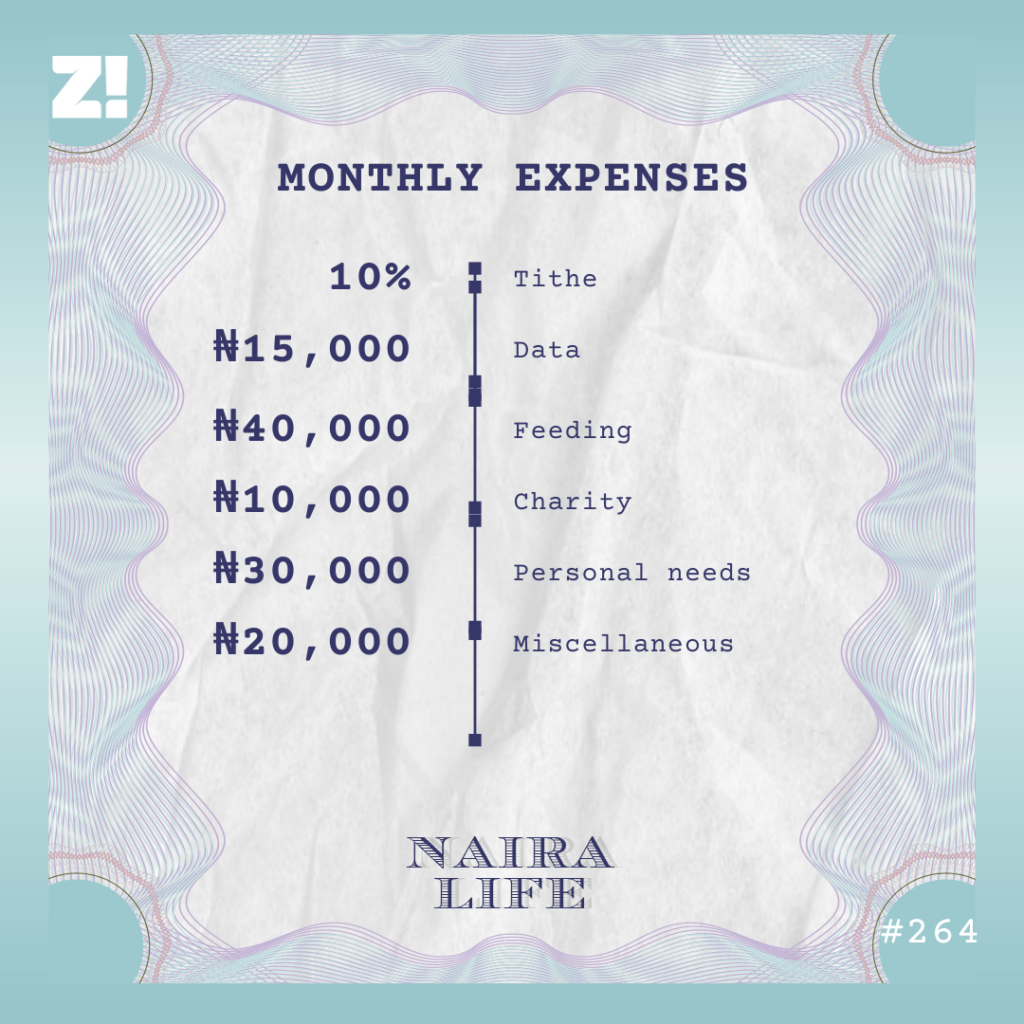
    Let’s break down your typical monthly expenses

    Nairalife #264 monthly expenses

    What’s the last thing you bought that significantly improved your quality of life

    ₦40k worth of art materials. That’s how I stay away from depression. If I can find Arolake’s money bag now, the quality of my life will skyrocket sharp-sharp.

    How are you thinking of future plans?

    I hope to own a creative haven for artists one day; where they can stay away from the hustle and bustle of the city and just create. I also hope to raise capital to revive my agric business. With the state of the economy now, I’ll probably need like ₦50m – ₦100m to even consider rice, but it’s a lucrative business. I believe I’ve gotten the business experience I need to not repeat the mistakes I made again.

    How would you rate your financial happiness on a scale of 1-10?

    4. I’m literally rebuilding from scratch, but I know it will get better. If I hadn’t experienced all I have, I wouldn’t have the confidence and tenacity I have now to try new things and just keep going even when they don’t work out.


    If you’re interested in talking about your Naira Life story, this is a good place to start.

    Find all the past Naira Life stories here.

  • Every week, Zikoko seeks to understand how people move the Naira in and out of their lives. Some stories will be struggle-ish, others will be bougie. All the time, it’ll be revealing.


    What’s your earliest memory of money?

    My mum made sure all our holidays — right from primary school— involved me and my four sisters learning a handicraft to keep us busy. When I was about to enter JSS one, we learnt how to make beads, and I sold some beaded bags I made for ₦150 – ₦300 at a church’s Children’s Day display. 

    Did that spin off into a proper business?

    Not really. My siblings and I made those bags from the spare beads left over from what we used to learn. We just brought them to the display and ended up selling them. 

    We also learned how to make beaded flower vases and sold a few at church for around ₦800 each. We spent nothing on procuring the materials; my mum got them for us, so we just shared what we made among ourselves and used it to buy wara, suya or ice cream at school. My mum didn’t like that because we always got lunch boxes, but you know what they say about outside things being sweeter.

    Talking about your parents. What was growing up like financially?

    Both my parents are medical professionals, so we didn’t lack anything. We even had a driver who took us to school. 

    Plus, we lived in Maiduguri where things were affordable. Thinking about it now, growing up in the North was one of the best times of my life.

    How so?

    It was quiet and secluded. The people were also good with crafts. It wasn’t strange to find a four-year-old braiding her hair. 

    Fun fact: my siblings and I first heard about stuff like the Home Alone movies and Boney M Christmas songs after we relocated to the North Central in 2012 —years after the rest of the world had seen them. That’s how secluded it was up north.

    Why did you relocate?

    The Boko Haram crisis had started to gain ground, then my dad got another job. So we used the opportunity to move. I remember my sisters and I had to be picked up from school to leave in a hurry because everyone was just running helter-skelter.

    That must’ve been terrible. Were you still making stuff?

    Before we moved, I had a stint making beaded yarn crochet mini purses, and I sold about four of them to classmates for ₦100 each. I also made some crochet tops for my siblings.

    After we moved, my mum paid ₦15k for a one-week training at a baking school so my siblings and I could learn how to bake cakes and snacks. Of course, that meant I had to monetise my skill somehow.

    Let me guess. Another business?

    Yes, also a stint. I baked a cake for a neighbour’s wedding but was only paid for the ingredients. I didn’t try to bake for money again after that.

    The next one-off gig I did was play the piano for a Valentine’s Day program in 2013. I was paid ₦2k for it.

    How did you even get the gig?

    I learned how to play the piano when I was seven years old — thanks to my mum for getting someone to train us. I got the gig through some of my secondary school friends who also played instruments. Some of them were playing the drums and guitar, so they just told me to join them and play the piano, and the organisers paid me afterwards.

    It looks like you’ve always had an entrepreneurial calling

    Tell that to Nigerian parents. Now, everyone knows you can make money from business or on social media without a certificate. But medicine was what my parents knew. To them, it was: Study medicine, enter the labour market, and you’ll get money.

    I was confused when it was time for uni because I knew how to do a lot of things. For example, I was good at graphic design from practising on our home computer. But I was also considering biomedical engineering. Eventually, I followed my parents’ advice and got into uni to study dentistry in 2017. I’m in my final year now.

    Do I even need to ask if you’ve tried your hand at any business since you’ve been in school?

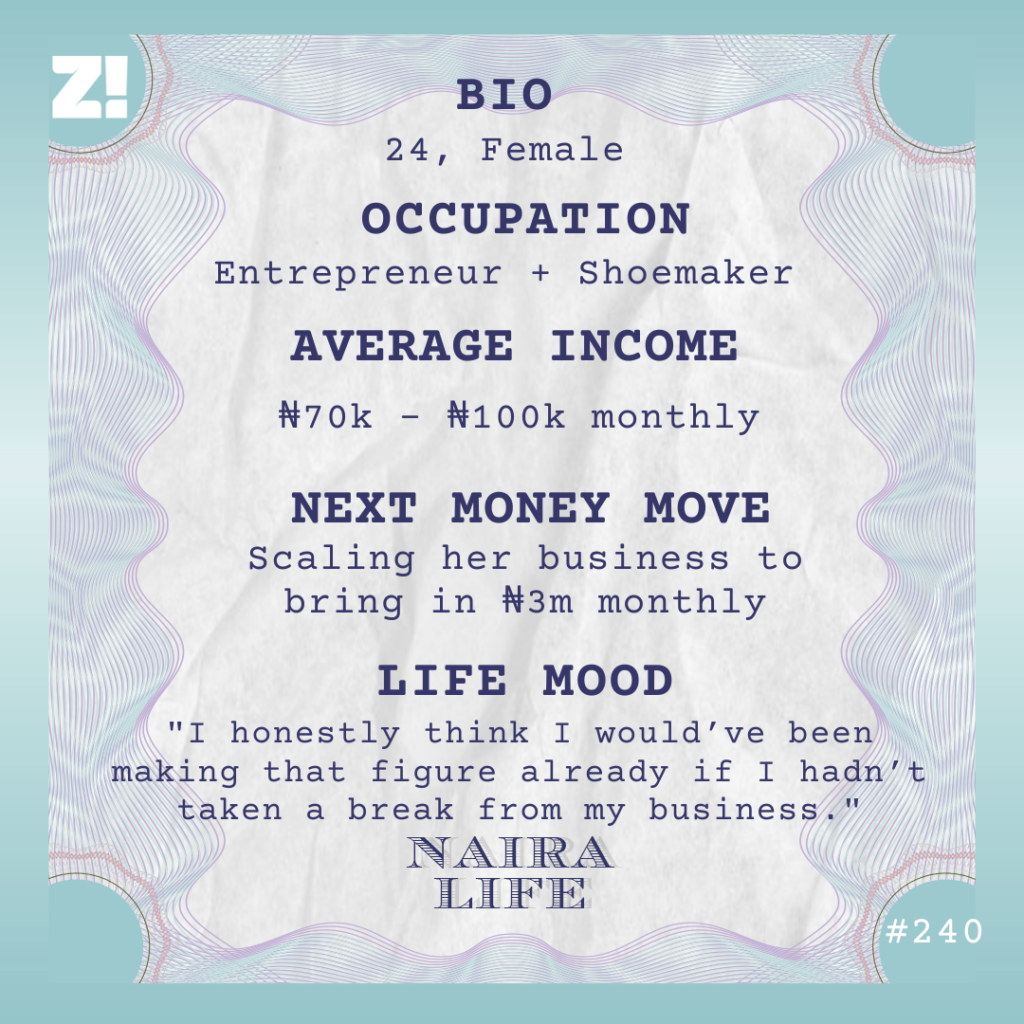
    LOL. I currently run a shoe-making business I started a few weeks before starting uni.

    How did it happen?

    During the waiting period between getting provisional admission to the university and resuming the new session, my cousin was supposed to visit from the U.S, and I decided to gift them something unique.

    I didn’t want to crochet a blouse because it was too basic. So I thought, “Why not crochet sandals?” I had a design in mind and wanted to use the stronger cobbler threads instead of typical yarn, so I bought some for about ₦300 each and started work. I had to change the design several times because it wasn’t working.

    I finally designed the top of the sandals, then I found a shoemaker to help cobble the sole. He gave me a list of materials to buy, which cost me about ₦1,500 and in three days, he taught me all I needed to know, and we produced the sandals. Unfortunately, my cousin didn’t visit Nigeria that year, but I was so proud of my production.

    What did you later do with it?

    I carried myself to a studio and paid ₦100 for professional pictures of the sandals on my crusty feet for Facebook.

    LOL

    The Facebook post helped. Two coursemates saw it and asked me to bring one each for them when school resumed. It cost me ₦700 to produce one, and I sold it for ₦2k.

    When we resumed, I made a couple more shoes and sandals for my personal use. Then, my hostel roommates started asking me to make one for them too. My bestseller was a crochet beaded gladiator sandal that I sold for ₦1,500 each. 

    Subsequently, I started advertising to students outside my hostel. I even got someone who bought fifteen pieces at once to retail. In my first year, I averaged ₦20k in monthly profits.

    What was it like just starting school and getting thrown into a successful business?

    It was crazy. I’d be at lectures all day and return home in the evening to work all night so I could meet up with orders. I was also running around different shoemaker shops to borrow their filing machines to finish the shoes because I didn’t have one.

    Now, I realise I was underselling myself. Because how was I spending seven hours making one sandal only to make ₦1k as profit? 

    It was big money to me then because I had no responsibilities and still got a ₦25k/month allowance from my parents.

    When did you start charging more for your skills?

    2019. Word-of-mouth advertising wasn’t working again, so I stepped up and became intentional about advertising on social media. After one tweet blew up my business and helped me sell about 50 sandals, Twitter quickly became my major channel. I sold each sandal at ₦4,500, making ₦3k in profit on each. I used the money I made to buy most of the machines I needed. 

    Several people also reached out to support me, and the goodwill meant I could get a generator and register my business with the CAC. Someone even gave me a filing machine for free. I still use it till now.

    So, 2019 was the year your business blew

    2020 and 2021 were even better. I got part-time staff to assist me with the shoemaking, running deliveries and taking pictures for content. At some point, I had six people working with me and paid them based on how much work they did per week. But it usually ranged from ₦10k to ₦50k weekly for each of them. 

    How much were you making yourself?

    Between ₦500k – ₦800k monthly. I usually had to set aside about ₦250k to settle my staff. By 2022, I was making ₦800k in a good month after paying salaries and other business expenses.

    That’s serious balling figures. What were you spending on?

    I was barely spending anything I made from my business because my mum sent me foodstuff in addition to my ₦35k monthly allowance.

    I only touched it when I wanted to pay rent for my off-campus accommodation, which was ₦400k. The other thing I constantly spent money on was fuel for the generator I used for the business — the rest I just saved. 

    I should add that I hardly spend on unnecessary things. I’d rather take a keke than spend money hailing a cab. Besides, I can’t take a car to the market where I go to buy shoe materials. I only use cabs when absolutely necessary. I’ve been using the same phone since 2019. It’s doing its work, so why change it?

    [ad][/ad]

    You mentioned saving most of your income

    Yes. I used most of it to rent a two-bedroom apartment for my workshop in 2022. It cost me about ₦6m to settle rent, set up the space, and get more machines for work. To be honest, I initially wanted to buy a car, but I thought about it and decided to invest in my business.

    How are you still juggling everything with medical school, though?

    I’m not juggling —it’s been very tough doing both full-time. One aspect always suffers; if I’m not having logistics issues, my staff will come with their own. I’ve failed a lot of tests, and reading is a hassle. I don’t have a social life because school and business take up all my time. I even had to pause my business at the beginning of this year and only resumed a few weeks ago.

    What happened?

    I had a mental breakdown in 2018 due to some personal issues, which kept me out of school for roughly six months, and I had to repeat a year. So, this year came with many back-to-back exams and the backlog from that year. I also had to move back to the hostel since I wasn’t really making money anymore.

    You weren’t making sales at all?

    My shop was still there, and we still had a few walk-ins and repeat customers. But I wasn’t advertising on social media, so sales slowed to about ₦70k – ₦100k monthly. 

    I laid off some staff when I started running at a loss. Since I was busy with exams, I couldn’t monitor what my staff were doing, and they’d typically deliver poorly finished jobs to customers who’d complain and ask for a refund. Sometimes, I’d remake the shoe and send it again at my own cost. I often had to dip into my personal allowance to fill those gaps.

    Some other staff stopped coming because I couldn’t afford to pay them. At the moment, I work with only three people. 

    Omo. How’s it going now?

    I just resumed advertising again, so I’m still trying to find my feet, but making sales isn’t difficult for me, and I know I’ll get back to 2022 figures soon. I’ve had to become even more prudent with money. I’ve only braided my hair once this year; the rest of the time, it’s been in twists. 

    I even switched to an old 3G sim one time because I knew data wouldn’t finish as fast as it would on 4G. I also sometimes turn off data mode on most of my apps and avoid Instagram and TikTok. But I still have to be online because of my business, so data is a necessary expense.

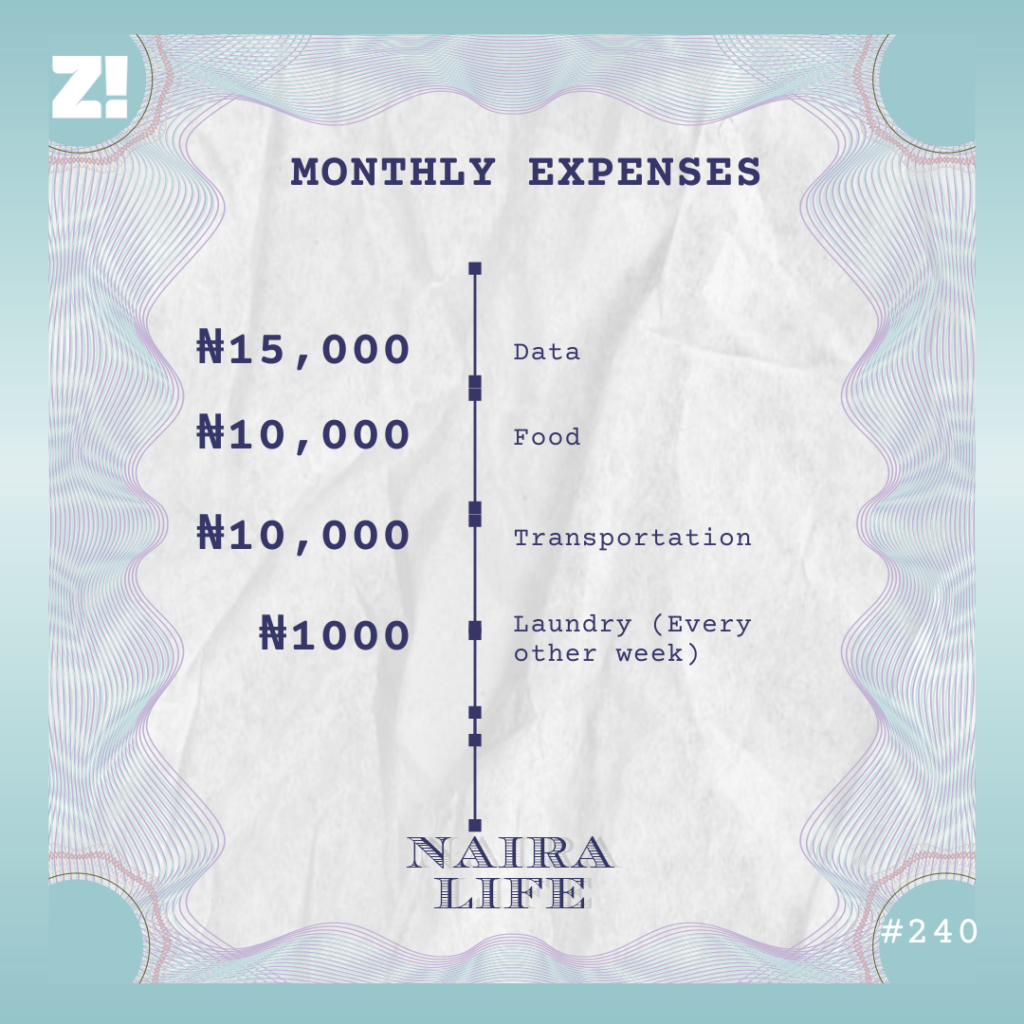
    Let’s break down the expenses in a month

    My mum still sends most of the foodstuff I need, so my food expense only includes perishable items. 

    What would you say is the toughest part of being a business owner?

    Apart from the obvious challenge of doing it as a student, managing staff is really tough. When they don’t do the work properly, we end up remaking the product multiple times, which comes at a cost. It’s difficult getting people who actually care about the work; they’re just interested in the money. 

    That part is confusing for me because it also affects them when we run at a loss. So, why misbehave?

    You’ve been at this for six years. What are some things you’ve learnt?

    I now know how to better determine my price point, based on how my competitors are pricing, the rising cost of materials and how much effort I put into a piece of footwear. On average, one piece costs ₦30k now. Some people still tell me I should charge more, but I can’t do that. Is it until I get 500% ROI on one item?

    On the other hand, I noticed that there were some people who never patronised me until I increased my prices. It’s a Nigerian mindset. People think the more expensive, the better it must be. 

    So, you’re in your final year. What does the future look like for you?

    I’m still unsure about whether I’d practise after medical school, but I know I’m going to take a full year to give all my attention to my business. The business is here to stay, no doubt about that.

    I also want to get an MBA, partly to add a title to my name, and also to get actual business insights. I may also go back to study biomedical engineering like I wanted before listening to my parents and studying dentistry. 

    Is there anything you want right now but can’t afford?

    I’ve always wanted to go into bag-making, and there’s this tagging machine I’ve been eyeing. I’d also like to get a better phone and filming gadgets to make shoemaking tutorials on YouTube and take better pictures for content. Everything should cost about ₦900k.

    How much do you think you should be making from your business now?

    ₦3m/month. I honestly think I would’ve gotten there already if I hadn’t taken a break.

    Rooting for you. How would you rate your financial happiness?

    Currently a 4, but I’m hopeful that once I settle into pushing my business again, it’ll be a 7 by the end of the month.


    If you’re interested in talking about your Naira Life story, this is a good place to start.

    Find all the past Naira Life stories here.

    We’re cooking THE biggest meat festival in Nigeria, and we’re assembling all food lovers. Sign up HERE.

  • Everybody wants to be their own boss, but starting a business is the real ghetto. That’s why you should know how much of a CEO material you are before you start.

    Take this quiz and find out:

  • Running a business as a woman in Nigeria is no small feat. Here are some mistakes to avoid as a female entrepreneur, according to Oluremi Martins, Founder and Chief Experience Officer of Natural Girl Wigs. 

    oluremi martins

    1. Don’t be a Know-It-All

    Women are often excluded from the workspace, which means that even as a business owner, your exposure in your industry might be limited. Don’t assume you know it all. Go out of your way to learn new things and hire people that are smarter than you. 

    2. Don’t mix business money with personal money

    This is a more common theme with small businesses and because of the patriarchal society we live in, many women see their business as a means to solely support their families. It’s important to separate your business finances from your personal finances. The business itself is an entity and you want that entity to be able to survive on its own. 

    3. Don’t let overthinking stop you

    Many people don’t start because they’re anxious. When I get anxious about something, I think about the upside vs downside of the issue. If the benefits from the upside outweigh the consequences of the downside, I go for it. 

    4. Don’t be afraid of rejection

    I often shrivel when I get some form of rejection, but I remember that I am not the only one being rejected. Don’t let rejection stop you. 

    5. Don’t overwork yourself

    Learn to make rest a part of your life. Also, try to manage your anxiety around your business. There’s this saying in Yoruba, “Work doesn’t kill, it’s anxiousness and worry that kills.” Do things that soothe and energize you as often as you can. Running a business is one hell of a journey. Be ready for the ride. 

    Subscribe to our HER newsletter for more stories about African women and how they navigate life.

    QUIZ: What Kind Of Entrepreneur Are You?

    female entrepreneurs

    Take the quiz now.

  • A Week In The Life” is a weekly Zikoko series that explores the working-class struggles of Nigerians. It captures the very spirit of what it means to hustle in Nigeria and puts you in the shoes of the subject for a week.


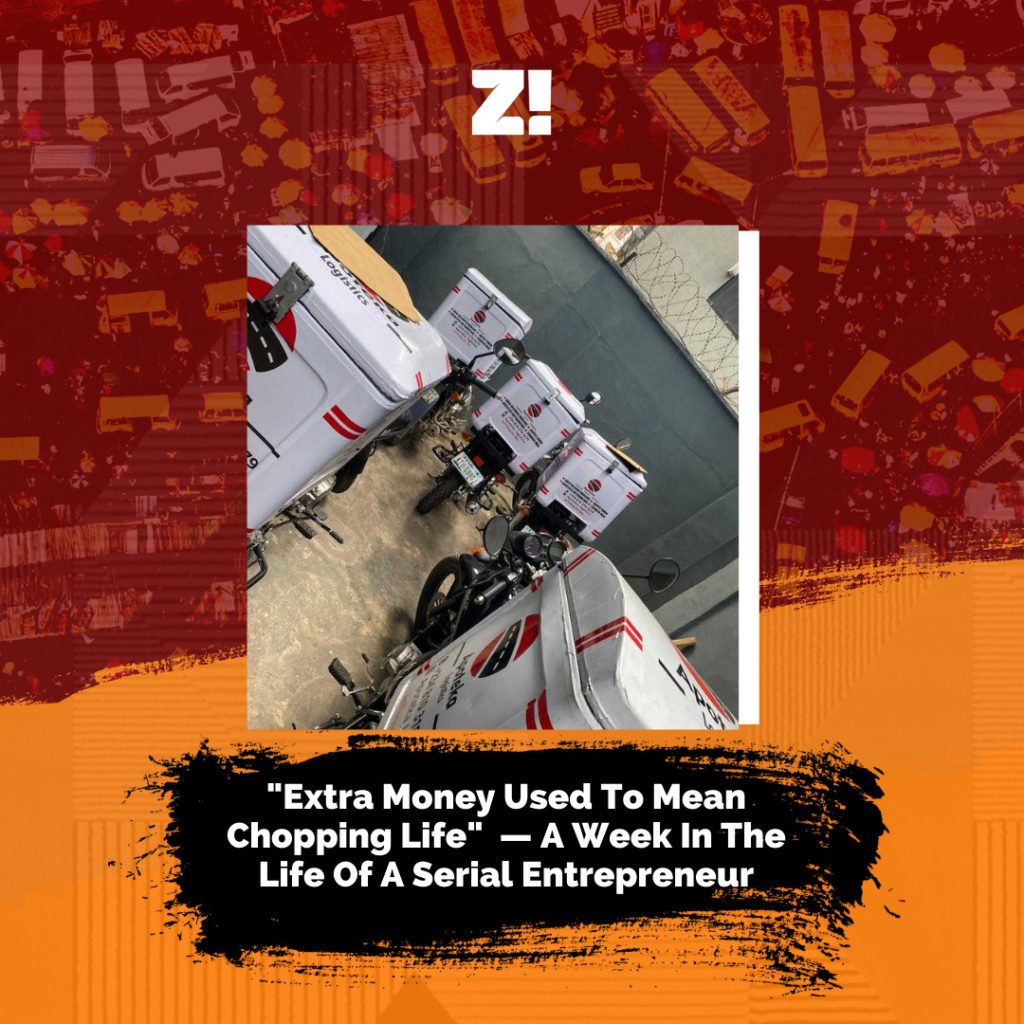
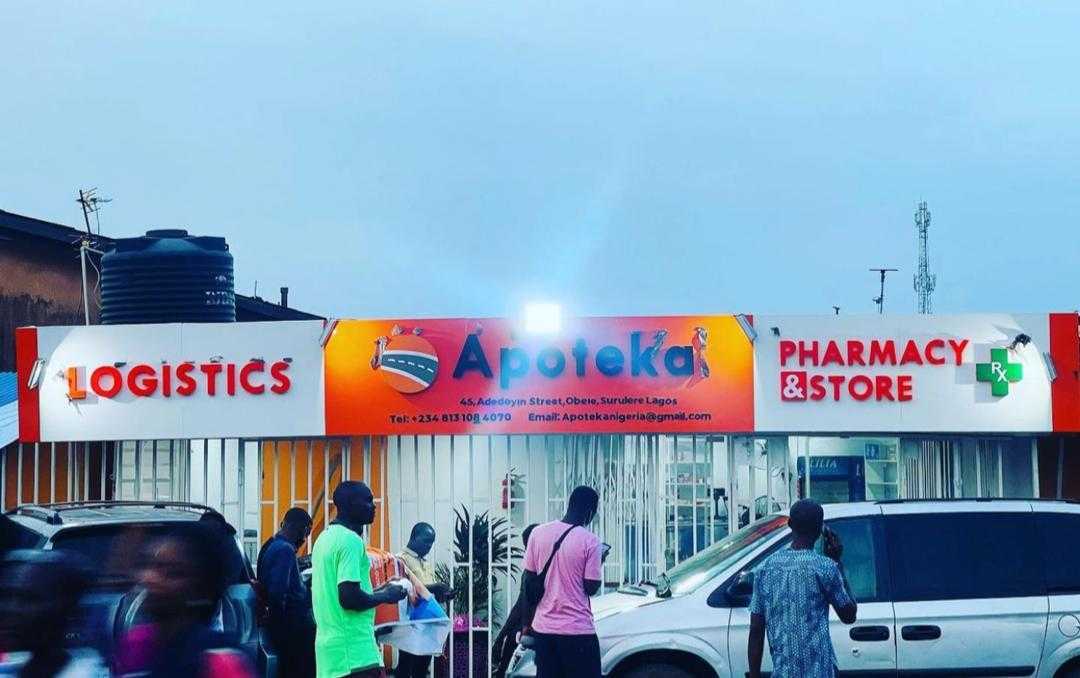
    The subject of today’s “A Week In The Life” is an entrepreneur running two businesses — a pharmacy and a delivery business. He talks about why he no longer considers working a 9-5, becoming more responsible as a result of entrepreneurship and how he struggles with being called “boss”.

    MONDAY:

    Come rain, come shine, I open my eyes every morning at 7 a.m. My eyes adjust to the light in the room, and I roll out of my sturdy but squeaky bed and pick up my grey coloured iPhone. 

    I manage two businesses — a logistics company and a pharmacy — but I start my day dealing with the logistics business. This means I start everyday texting: “Thanks for patronising us, you’ll get your package today.” or “Apologies for yesterday, police arrested my rider but you’ll get the package today.” 

    Today is more of the first one so I’m feeling positive about this week. By 8:05 a.m., I’m done accepting delivery orders for the day, and I make plans to leave my house. It’s time for phase two, the hardest part of being a CEO — being physically present at the office. 

    A quick bath, clean clothes, comfortable sneakers and a couple of sprays of perfume later, I’m ready for work by 8:35 a.m. It helps that my office is 5–10 minutes away from home because I resume at 9 a.m. I look through my bag to ensure that I’m not forgetting anything, and satisfied, I leave for work. 

    At work, which is where I run both businesses, I meet the pharmacy shop open. This is unsurprising because I have a full-time pharmacist, supported by sales girls, that resumes by 8:00 a.m. every day. I sit at my desk in the office, write and sort the packages to be dispatched today. After I’m done, I call in the riders, give them packages for their respective routes and wish them luck. 

    Then I turn my attention to the pharmacy. I look through the inventory, take note of out-of-stock medications, monitor drugs sold versus money made and mark the fast-moving drugs. To make my book-keeping experience smoother, I plug in music and open a carton of cold Lucozade boost to set the mood. Work can be good if you’re having fun.

    TUESDAY

    My friends call me CEO millions, but I don’t feel like I have millions. Especially on days like today when entrepreneurship is kicking my ass. The pharmacy part of my business doesn’t stress me too much, but you see that logistics/dispatch part? Run!

    I had an order to pick up and deliver yoghurt worth ₦15,000, and it ended up pouring inside the rider’s carriage box. The driver says he was careful, the client says they were careful. Yet, I, who had no part in their interaction, had to refund the yoghurt money. 

    Even with this stress, I don’t think I can do a 9-5 again, especially as a pharmacist. Imagine employers not paying the previous month’s salary until the middle of the next one? Or employers stealing medicines and blaming the employee? After my experience meeting wicked bosses in several places, I was motivated to start my own business. I guess I got tired of complaining. 

    I’m grateful for the lessons from my old jobs. Because of how I was treated, I vowed not to be an asshole. It costs nothing to treat workers well.  I’m also super proud of the fact that I pay my workers before the end of every month. 

    WEDNESDAY:

    I wake up late today so I have to rush. I haven’t sorted the dispatch orders for today. I also have to buy medicines for the pharmacy. Thankfully, my supplier is close to the office. I decide to pick the medications before getting to the office. 

    On the drive, I can’t help but think about how every business has its challenges. Using my businesses as examples, I’d say running a pharmacy is pretty straightforward. My pharmacist sits, waits for patients to come, counsels and dispenses drugs. When she’s done, she balances inventories, tallies the medicines and is on top of things. Very straightforward. 

    For logistics, you’ll first have 20 people texting you at once. What do they want? They all want their packages delivered at the same time, and that’s impossible. But you also can’t refuse the orders. So you’ll beg, plead or negotiate for a more open agreement — same-day delivery instead of promising a specific time. Sometimes, you’ll promise to deliver by 6 p.m. and you’ve still not delivered by 8 p.m. Why? Unforeseen circumstances. 

    A list of my favourite reasons: “LASTMA catch me.” “My bike chain cut.” “My tyre burst.”  “Them arrest me in Lagos for not having Ogun state sticker.” 

    It’s crazy, but we dey rough am. After a stressful day, my only consolation is when people pray for me after they receive their parcel or medication. This gingers me to give out my best every day. 

    There are bad days, but the good days outnumber them. Hopefully, today turns out good too. 

    THURSDAY:

    It’s a slow day at the pharmacy today so I have time for self-reflection. I’m thinking about how entrepreneurship changes you. It bends you in certain ways that the light of responsibility starts reflecting against your skin. At least, that’s true for me. 

    In eight months of running both businesses, I’ve seen myself become responsible for myself and others. It’s crazy that I have a combined total of nine staff on my payroll. Every day I get to work and they call me “boss,” my first instinct is to say “who?” Me too I’m winging it. But I understand that my staff look up to me, so I try to be a role model. I comport myself and try to lead by example. I don’t drink alcohol at work. I don’t slack either, and I make sure everyone sees me giving my best. That way, the culture of excellence spreads from top to bottom. 

    Even my personal life hasn’t been spared. In the past, extra money meant chopping life. These days, I’m always thinking about how I can either use it to buy another bike for my logistics business or drugs for my pharmacy. As a Nigerian businessman, you can’t spend money anyhow because the business environment is too risky. Laws can change at any time and you’ll be stranded. 

    I’m grateful to God for everything and where I am, but my God! Running a business is so difficult. 

    FRIDAY:

    There are days when we use the TGIF caption on our pictures, but today is not one of them. Today is for work and shopping for medications. Today is also for dreaming about the future and possibilities. 

    I keep asking, where does all this all lead to? My ideal answer is that I build a noble brand that’s well known across Nigeria. A brand so big people want to drop their money to invest under my franchise. 

    Another answer is that this success enables me to upgrade my nickname from CEO millions to CEO billions. And I won’t be receiving logistic orders or directly running the pharmacy — everything will be handled by a manager. 

    But, truthfully, based on where I am right now, the most realistic answer is to trust God, take one day at a time and just keep showing up. 

    From where I’m standing, that doesn’t sound like a bad plan at all. Hope for better days is all we have.


    Check back every Tuesday by 9 am for more “A Week In The Life ” goodness, and if you would like to be featured or you know anyone who fits the profile, fill this form.

  • [donation]

  • The Nigerian experience is physical, emotional, and sometimes international. No one knows it better than our features on #TheAbroadLife, a series where we detail and explore Nigerian experiences while living abroad.


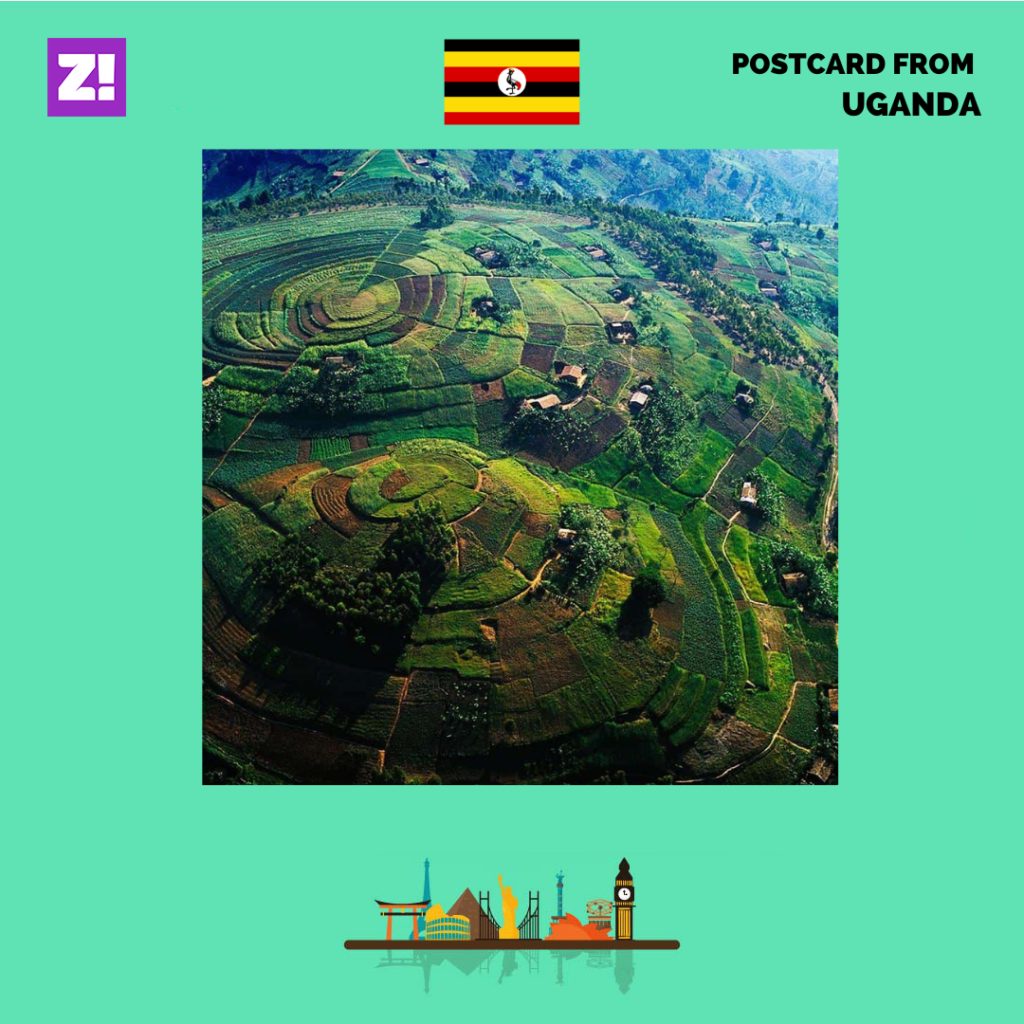
    Today’s subject on Abroad Life is a woman who schooled in Kampala, Uganda because she didn’t want to go somewhere mainstream like Canada or The UK. She talks about how similar Nigeria and Uganda are, how to have fun in Uganda and the things that make living in Uganda difficult. 

    So where were you before you returned to Nigeria?

    I was in Kampala, Uganda.

    What was happening there?

    I was there for school for three years. I came back this year. 

    Why did you choose to go to Uganda?

    I didn’t want to go to school in Nigeria because of how things are here. Nigerian schools are stressful. So I started searching for countries to school in. I wanted somewhere not so common like Canada, the UK and the US. I wanted somewhere unknown.

    Why did you want that?

    I’m the type of person that doesn’t like to go the same way as everyone. I believe there are different routes to the market, so the question is, why do I have to take the same one that everyone does?

    That’s interesting. So why did you choose Uganda?

    I got home one day and my mother told me, “You’re going to Kampala International University.” I was so confused. I had to do a lot of research because I did not know that there was a country named Uganda. But from my research, I found out that it was a nice place, and I’d be done with school in three years, so I thought I’d give it a try.  

    What was applying for school there like?

    They were looking for A-Levels results or WAEC results, so I just plugged in my WAEC result, got admitted and bounced. The visa application was fast and simple; it took about two weeks and the entire process cost about $100. That was in 2018 though. 

    Arriving in Uganda, what were your first impressions?

    The only thing that surprised me was the constant electricity. Apart from that, it’s like every other African country. This is how I’d describe it: it’s like a miniature version of Victoria Island, Lagos. I don’t think Uganda’s population is up to Lagos and Ibadan combined, and that’s with the high number of foreigners that live here.

    Are there a lot of Nigerians? 

    Yes. The thing they say about Nigerians being everywhere is very true. 

    If I find myself in Uganda now, how can I tell the difference between where I am and Nigeria?

    Their culture and style of living. Just like us, they were colonised by the British. But they retained some of the British culture, like driving on the right-hand side and drinking as much tea as they possibly can. 

    So they’re not traditional people?

    Not really, no. They have some annual traditional events though. In school, there’s usually a cultural gala where people come to showcase their culture and all that stuff. There’s this culture where they put clay on their faces. It’s an unexplainable vibe. But in everyday dressing, it’s corporate culture. But it’s nice to note that in all of this, English is not the main language spoken. There’s Luganda and Swahili.  

    Do you understand Luganda and Swahili?

    Nope.

    So how do you survive?

    It’s easy when you have a lot of international students that you blend with. Everyone in these communities around universities speaks English, and there are many universities.

    Is it more expensive living there than living in Nigeria?

    Ugandan shillings is devalued, so for some people here, it might be expensive. Take rent for instance. Nigerians pay rent annually, but they pay monthly. You can have a place at 500,000 Ugandan shillings per month, and that’s like ₦50,000 naira. To them it’s expensive, but I can pay it comfortably. 

    Did you have a job there?

    No, I don’t have a job. At least not yet. Without knowing anyone in the country. you cannot really get a job. 

    Wow. What about a side hustle?

    You can’t do that at all.

    Why?

    Except you want to be a musician or a model, it’s hard to do anything else. You have to register anything you do with the right authorities, no matter how small it is. You can’t just start a business because you have a passion for it. The best thing you can do, let’s say you know how to make hair, is to offer your services to only people you know and keep it on the low.

    What happens if the authorities find out?

    Their own version of  EFCC would swoop in and investigate you, and you could get jailed in the process.

    Wow. What is a Nigerian reality that affected your Ugandan life? 

    I don’t think there’s anything. They just tend to ask Nigerians a lot of questions. They ask about our musicians and stuff like that. 

    What’s your craziest experience in all your time there?

    Ugandans are known for their nightlife. It’s much more intense there than in Lagos. They love their booze and their weed and their shisha. One night when I went out, I missed my hostel curfew, and there was no way for me to get in. I had to jump in through the fence. It was crazy. 

    I got bored with that life quickly though. It became repetitive. I would go out late at night, get home late, go to class late and sit in the back, wearing dark shades. Many times I missed classes too, but at some point, I just got tired of the whole thing.  

    So what else did you try to explore?

    Uganda is also known for its lakes and tourist attractions. I went on an adventure to Lake Victoria, where the River Nile starts from, and some other natural reserves. It was really nice. 

    Are you done with school?

    No, I’m going back next year. I’m only back in Nigeria because of Coronavirus. The school was closed, and my parents just kept paying rent. I came home because I wanted to take that strain off them. When the pandemic clears, I’ll go back. 

    Do you see yourself living there when you’re done with school?

    No. It’s a fun place, but I’m not the kind of person to stay in a place for a very long time. I’m a wanderer, and I need to move. 

    What other countries have you stayed in?

    I won’t say I’ve stayed in a lot of places, but I’ve been through many states in Nigeria. I’ve also been to the UK, stayed in Dubai for a while and been through Rwanda.

    What states in Nigeria have you been through?

    Rivers, Oyo, Lagos, Osun and some others. 

    What’s one thing you love about living in Uganda?

    The constant electricity.

    What’s one thing you hate?

    Some Ugandans are very rude, and that puts me off. Their president is a dictator. He’s been here for 40 years plus and has refused to step down. Things are normal, but a lot of the time, he has the final say. Foreigners like him because he lets them in easily, but you don’t want to get on his bad side. He came into power through a coup d’état and no one has had the courage to overthrow him.

    So are you saying Nigerians are enjoying the type of president we have?

    Yes. Exactly. 


    Want more Abroad Life? Check in every Friday at 9 A.M. (WAT) for a new episode. Until then, read every story of the series here.

    [donation]


  • The woman in today’s What She Said thinks of herself as a hustler. At 29 years old, she has a decade-old career spanning industries without a university education. Now she’s committed to expanding her business. She loves what she does and runs from men who try to offer her money to stop her business. 

    Tell me how it began.

    Back when I was about 10, I used to tell everyone I was going to be a doctor. This was after reading Ben Carson’s Gifted Hands. I wasn’t the brightest student and my parents were not the most educated or the wealthiest, but they supported me. My mum used to call me her baby doctor. My dad, who bought me Gifted Hands, bought me more medical books to read. I was determined to become a doctor. 

    How did that change? 

    Nigeria is a dream killer. First of all, it was hard to get into university to study medicine after two attempts at JAMB. I really didn’t want to take another course. My final option was to go abroad to study. As we were preparing, my dad got scammed by yahoo boys and lost a ton of money. The dream ended there. 

    I’m sorry. How old were you at that point? 

    I was 18. He eventually lost his job. It was a difficult time in our life. 

    My mum was a pensioner at that point, and it wasn’t even as if the pension came regularly or was worth anything. I became their primary caretaker at barely 18. 

    I was so frustrated and tired. One day, I was home and there was nothing to eat. For some odd reason, I just took flour and made chin chin. And it just hit me that I could start selling chin chin. 

    I had planned that the year I turned 19, I’d take JAMB again and go for my medicine, but the idea of hustling and making my own money took root in my head. I still took the JAMB, but do you know that I never checked my result? I was so sure that I had failed and was purely interested in the little money I was making. 

    Haha. Wow. 

    I was selling the chin chin to schools around my area. I would wake up as early as 4 a.m. to start making them and then supply to supermarkets and small kiosks in the area before I even did any retail selling myself. My mum used to help distribute too. Before this point, I knew exactly nothing about business. But I pushed myself anyway. 

    What was the money like? 

    It was just enough to ensure that there was food on the table every day. I’m the only child, so that responsibility was mine. I couldn’t afford to buy myself nice things or go to nice places, so I avoided my old friends like a plague. A few months after my 19th birthday, I had a talk with an old friend who was worried about me. It felt like a condescending conversation because chile, this girl and her parents were rich and her advice and concern seemed to come from a place of privilege. She told me that I can’t live for my parents alone, that I had to live for myself.  She kept asking where the baby girl that wanted to become a doctor was. 

    And I was like, it’s true oh. I just let my years of dreaming come to an end because of JAMB. 

    Did you decide to go back to school? 

    Nah. I decided to learn how to sew and juggle that with making chin chin. My mum became solely in charge of distributing it. 

    How did that work out? 

    Nonsense. I didn’t finish tailoring school. Barely spent two months there. 

    Why? 

    The male instructor used to sexually harass me. It started on the first day. By month two, I had had it. I never showed up again. 

    Eesh. I’m sorry about that. 

    That was when the next opportunity opened up to work at an organisation. I got a job as an office assistant in a small microfinance bank while still making my chin chin in the morning and allowing my mum to handle distribution. I think because the chin chin was so good, it actually gained some popularity in my area. I didn’t even realise it was picking up steam until one day, my dad was doing the accounts for the month, and we made ton of money in profit. I was like, wow!

    So I added some of my salary in that first month, paid for a shop for my dad to run a small cyber cafe and sell drinks and chin chin. The shop didn’t pick up at first, but my mum’s distribution to schools really did well.

    Then I got tired, existential crisis and depression followed. It was a struggle to manage everything and still work full time. And I was just 20/21. I couldn’t stop. I didn’t know how to stop. 

    What did you do?

    Impulsively quit my job at the bank — which I really enjoyed — and tried to rest for one month. At the same time, I decided to explore selling egg rolls. That one failed badly, so I stuck to chin chin and continued for about a year — no additional jobs. Then my mum got sick and we couldn’t afford the bills. I was literally using everything I had saved up to pay for treatment. The day she died, it was because we didn’t have enough money to pay for some drugs. 

    I promised myself from then on that poverty and I were enemies. 

    I’m so sorry. 

    Thanks. Since then, I’ve worked as an escort, an usher, a personal assistant, a nail technician, a hairstylist. I even went back to sewing at some point. Then I worked as an office manager at a couple of places. But in all this time, it’s chin chin that has stayed with me, and now I’m doing it full time. 

    I and my dad have carried the business on our head, especially in memory of my mum.

    I was dating someone who promised to take care of me and wanted me to stop the chin chin business, and I was like huh? There’s a kind of shame some people I’ve dated associate with what I do. But that one was the height. He was like, a beautiful woman shouldn’t have to work. He had several promises to fix my life if I stopped the chin chin business, and I said no. Making my own money actually makes me so happy. 

    Haha. You do sound very excited. 

    In fact, I’m addicted to it. Before, I couldn’t do accounts by myself, but now I can. I’ve taken a ton of business classes to help me learn how to run my business. 

    I am by no means shaming women who have sugar daddies or people to help, but doing this makes me happy. When I think about the money in my account and the sales of the day, things like that make me want to orgasm. 

    Mad oh. 

    It’s true. That’s my own turn-on. One day, a client called and said they wanted a certain amount of chin chin supplied for an engagement party. This was a few years ago. It was a lot of money —  rent money. I just went to my room to go and lie down. I didn’t realise when I brought out my dildo and came.

    Lol. Do you spend money on yourself now?

    I’m just learning how to do that. Before, I was saving and saving for a rainy day. Now I’ve realised that if I die, someone else will spend that money. So I take care of myself and my dad. If there’s something I need, I don’t have to do math a lot before I get it. 

    Do you ever feel like you want to go back to university?

    I won’t lie that I do. I’ll be in some gatherings and start feeling inferior because I don’t have a BSc. So I really do. But, not now. I have some new ideas I’d like to work on over the next couple of years. I have a target sum. I want to expand to all of Nigeria and then outside. 

    My story isn’t complete yet. 

  • “A Week In The Life” is a weekly Zikoko series that explores the working-class struggles of Nigerians. It captures the very spirit of what it means to hustle in Nigeria and puts you in the shoes of the subject for a week.


    The subject for today is Toyin, a 28-year-old proposition manager at a financial institution. She walks us through how her job allows her to empower women, empower herself, and what it’s like to run a demanding business in the middle of a pandemic.

    MONDAY:

    I wake up at 6 am today. In the past, I used to wake up at 4 am every morning and leave my house at 5 am because I had to join the staff bus. However, since the lockdown started, I’ve been working from home. This means I get to wake up by 6 am.  

    I like being an early riser because it gives me alone time before the whole frenzy of work and business begins. It helps me to set the tone for the day because I believe in praying and speaking into my day. If I don’t do that, I make a mess of the day.

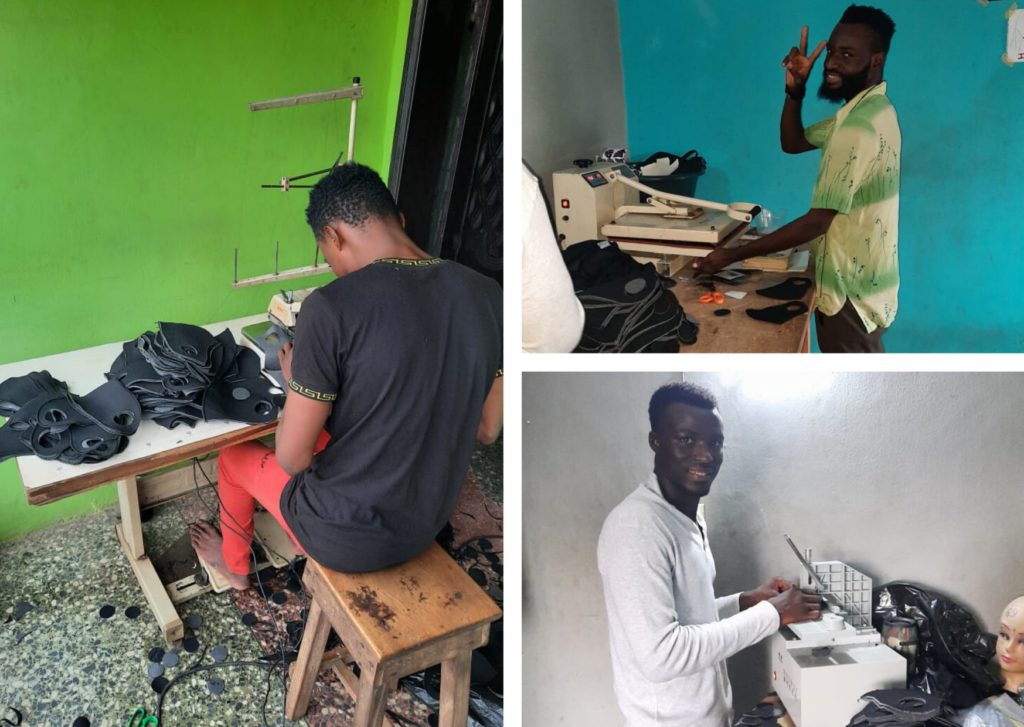
    I work in a financial institution as my 9-5, I also run a mask business on the side so it can be overwhelming. Since I started combining both, I have had an emotional breakdown. I’ve had times where I just wanted to leave everything or pull my hair out. The only good thing is that my business is a family business so I’ve been able to take breaks. It also helps that I have an understanding boss who communicates her expectations and timelines so that makes doing my job easier. I can plan my time and follow through on my tasks while still running my business.

    The first thing I do most mornings is to ensure that business orders from the previous day are picked up for delivery. After that, I block Twitter and other social media channels so I can focus on work. I write out all I want to achieve for the day and I allocate time to each thing.

    It has been a productive day, work-wise but frustrating on the business side. Today, a customer told me he wanted to get a mask but he didn’t want to pay for delivery. His excuse was that I didn’t tell him before that he was supposed to pay for delivery. I kept wondering what he was expecting to happen. I even tried to find a middle ground for both of us. but he was still being difficult. We sha did not find a solution after all the back and forth.

    I am feeling stressed, so I play some episodes of Friends to relax and reset.

    TUESDAY:

    The thing about this mask business is that it was unplanned. My mum has been a fashion designer for over 30 years. My brother is also learning fashion designing at Yabatech and he’s into printing; he does that a lot. When COVID started, they made masks for all the neighbours. 

    Then, my mum made another set of masks and she was like the second batch was better than the one she did for the neighbours. My brother then suggested that we could print on it. So we went on Pinterest, saw designs and realized that we weren’t the first, but our design was unique. Then we started thinking of fun stuff to print on masks and made some. The first batch sold out so fast because people were like “wow, this is a mask that doesn’t remind you of COVID.” From then on, we started doing other designs and growing. 

    But it was challenging. Eh, it was challenging! 

    People and their expectations. It’s amazing how Nigerians forgive inferior things they buy abroad but expect so much from locally sourced materials here. Some people have compared my mask to Adidas. I have had to remind them that I’m a small business. We’ve even had to buy over 4 machines since we started – we bought a machine to make holes, we bought a machine to do the finishing. We just had to up our standards, but there’s no time to learn in this business, no incubation period.

    Sometimes when I see people wearing the old masks we did before we got the machines, I want to apologise to them. We are sorry, but it is what it is. Nobody knew last year that masks were going to be a mega profitable business so no one learnt how to make masks. We had to learn on the go, but I’m glad that we are improving.

    Today, for instance, we launched 7 new designs. and the responses have been amazing. Apart from the positive responses, I have also learned about the Nigerian market. I realized that people want what they can’t give you and you need to strike a balance between being rude and standing your ground. You need a lot of patience because of the bashing. 

    At one point, I had anxiety attacks because when people called I wasn’t sure if they wanted to complain about the mask or something else. I have learned to separate who I am as a person from the mask business. I’ve had to tell myself that when people are complaining about the masks. they are not complaining about me.

    WEDNESDAY:

    Even though I run a business, I love my job. I work as a proposition officer in the bank. My job is to think of ideas that can make accounts and loans more appealing to women and to implement those ideas.

    What do women want? – This is a very hard question that no one has been able to answer. 

    My job is to cater to these needs using banking services. While it might not necessarily come as banking services, the end goal is to make more women become customers.

    There was a time we found out based on our research that women actually have money but they don’t use the money in ways that secure their future. Many women give out money without tracking where the money is going, especially if their husband is well to do. Instead of trying to make the money work and investing in their future. A lot of women after working for years, look back and realize that they have nothing to their name. They had just been living day in, day out.

    So we came up with financial literacy engagement classes where we went to teach women about money and how it could be used to secure their future. They were informal conversations where we talked about investments, mutual funds, etc. Then we directed them to the bank products that could help with these. The surprise on their faces when they realized what they could achieve was priceless. 

    For some, we even insisted that their husbands join the program because their wives being financially literate also makes their lives easier. So that if they are not there, everything doesn’t die with them.

    During work today, one of the women who got a soft loan through one of our classes called me.  She explained that before the loan, her business was doing fine, but she didn’t have the confidence to expand because of lack of funds to push a particular product line. However, after she got the loan and started to produce more items, this opened her up to the possibilities of applying for grants and fellowships.

    She called to inform me that she applied for a US grant and was picked. She won it and it blew her mind. She kept on thanking me and calling all of us at the bank her friends. She kept on going on and on about how we helped her when she was at her lowest.

    Hearing this made my day. Things like this are a reminder that this is not just a job, it’s a mission, and I’m helping people change their lives. 

    THURSDAY:

    My work really helps me because it has shown me that I need to put myself on a pedestal where I am not sidelined because I’m a woman. If anything, I am as qualified as any other person in the room because I’ve done my work and I have everything that makes it easy for me to be picked for a job.

    Before we started making masks, I was buying and selling accessories. I registered the business and made a business plan. This made it easy when we sent out proposals to companies for the mask business. They saw the work I had done, and it was easy for them to trust me to handle their work. I had even started designing a smart website for the accessory business but I had to let it go and focus on the money which is the mask business. Registering my business showed these companies that I was serious.

    We’ve had companies tell us to supply 200 pieces, 500 pieces, 1000 pieces of masks. Today, as I am sorting out my duties at my 9 – 5, my family members are processing 2,000 pieces of masks due for delivery tomorrow. This is the highest number we have ever done and we are so so excited. 

    Once my day is over like this, I have to look for something interesting to eat. I don’t know what it is yet, but my spirit is telling me that there must sha be chicken involved.

    FRIDAY:

    Since we started this business, we all agree at home that the quality of life has improved. I know this because I’m the first child so the responsibility of someone wanting something has reduced. Now I look at my salary in surprise. Last month, they paid salary and I was like “oh, they’ve paid? I didn’t even know.” My mum was shocked to hear me say that.

    Business is not always this sweet. In the past, I have also run into loss because I bought stock that didn’t move. 

    One thing I am thankful for in my family is contentment. Like any other family, we’ve had our struggles with finances and what not, but we have always been content. Even now as we are making money, you won’t see us living luxurious lifestyles. Our aim is to make products so affordable that people feel good without breaking their pocket. We’ve also given out masks for free because we are also about impact. We have given out masks to people on our streets, to the neighbours. My mum has also given the security men at our gate.

    https://www.instagram.com/tv/CAvIdn4gXEC/?utm_source=ig_web_copy_link

    It’ll be foolish for us to think this mask boom will go on forever. We see this as a learning phase to prepare us for the launch of our retail ready to wear clothing line. We’re just systematically registering ourselves in the mind of people so that when we make other things they can trust us based on the quality of our masks.

    Even with this learning period, life has improved. I won’t lie, having money when you need it is a huge relief.

    SATURDAY:

    Weekends are for sleeping until my eyes open on their own without the help of any alarm. Today, I plan to catch up on things I didn’t have time for during the week like books and movies. I’m currently reading my ‘Sister the Serial Killer’ but it hasn’t caught my attention yet. Or maybe, I’ll just call my boyfriend and gist. Or, maybe scroll through Twitter and IG. I don’t know my plans for today yet, but I know it doesn’t involve chatting. I feel like I have chatted so much in these past 4 months of lockdown and I am tired.

    I need another round of sleep. 

    When I wake up, I’ll do whatever catches my attention.

    SUNDAY:

    Sundays used to be for attending church. I attend an Orthodox church where we don’t count time for the holy spirit. So, church used to last from 8 am to 5pm because of back to back meetings. Now, we are online. The church I attend online ends their service by 10 am, so I now have time to do other things.

    Things like thinking about the future. Today, I’m looking forward to a time when we can mingle the way we used to. I really miss human interaction because these days, I don’t have any reason to go out unless I want to make deliveries. 

    I was telling someone that even though my house is far from the office, I’ll give anything to go back just so I can hug people. And I’m not even a hugger. I am just looking for things to go back to normal. 

    I also think that when things return to normal, my priorities will change. I’ll spend more time taking care of myself. During this stay at home, I’ve seen the difference between waking up very early every day and getting back home late. I plan to be better at time management, I just hope that Lagos traffic allows me to be great. 


    Glossary:

    “Not counting time for the Holy Spirit” – Spending as much time as possible in church without rushing.

    Check back every Tuesday by 9 am for more “A Week In The Life ” goodness, and if you would like to be featured or you know anyone who fits the profile, don’t hesitate to reach out. Reach out to me: hassan@bigcabal.com if you want to be featured on this series