• Every week, Zikoko seeks to understand how people move the Naira in and out of their lives. Some stories will be struggle-ish, others will be bougie. All the time, it’ll be revealing.
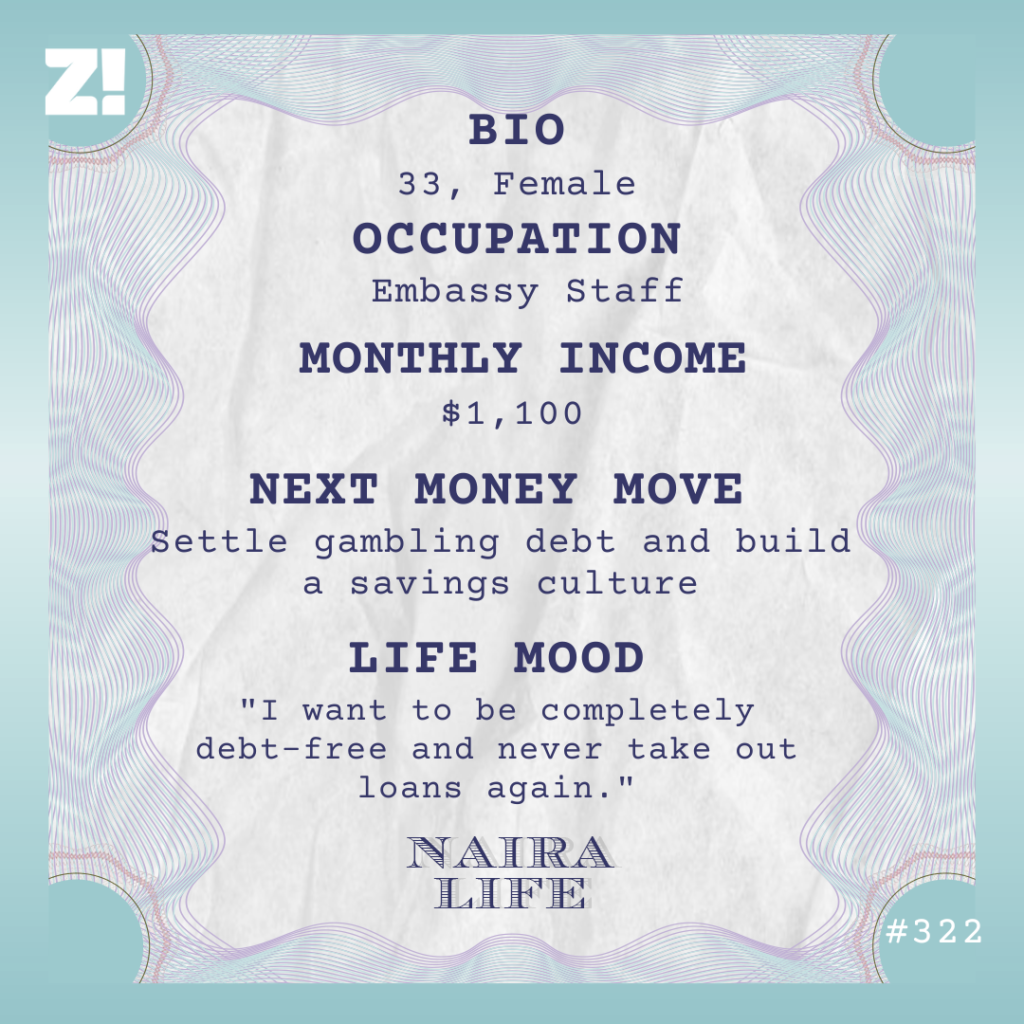

    Nairalife #322 bio

    When did you realise the importance of money?

    In the university. I attended a boarding secondary school and didn’t handle much money as a child. I think that’s why, the first time my dad gave me a ₦40k allowance in uni, I went wild and finished the money in one week. And this was in 2007.

    The whole thing? 

    Yes. It was the first time I realised that money could come easily but go just as quickly. My dad was surprised when I called to ask for more money after a week. 

    He was like, “You know what? I’ll only give you ₦20k for the whole month from now on.” So I had to learn to manage. It wasn’t difficult to adjust; I just knew what I had and managed my expectations accordingly. That was the only option after my dad made it clear I’d only get money from home once a month.

    Speaking of, what was the financial situation at home?

    We were middle class. My parents are divorced, so I grew up with my dad. I’m not sure if my mum contributed financially, but my siblings and I lived with my engineer dad. 

    There were occasional periods of lack growing up, but my dad took care of the bills and gave us a comfortable life. I didn’t need to do anything extra for money, though I tried once in my final year at uni.

    Tell me about it

    I had a printer in school because of my final year project. So, I thought of charging people for printing services.

    I had plenty of customers because students always need to print something. I might have charged ₦50 per page and made about ₦10k/month. The business only lasted two months because I didn’t know I was supposed to keep business money aside; I spent it all. When it was time to replace the printer ink, I had no money left. That was the end of my money-making attempt in uni.

    I graduated in 2011 and moved to the UK for my master’s degree.

    How did you handle your day-to-day expenses in the UK?

    My dad gave me a £150/month allowance, which covered all my expenses. In fact, I lived a pretty comfortable life. Food was cheap in the UK. I’d buy foodstuff in bulk for £30 at the beginning of the month and cook when I needed. The rest of my money went into occasionally eating out and using the train.

    I returned to Nigeria after my degree in 2013, and NYSC was the next step. I served in the army because they wanted people who could teach them a language I studied. My NYSC allawee, plus the stipend I received from the army, brought my monthly income to ₦60k.

    Was ₦60k good money?

    This was 2013, so it was good money. The ₦60k took me the whole month and then some. I wasn’t partying so much, but I hung out with friends regularly. My dad had bought me a car at this point, and fuel wasn’t expensive, so things were great.

    After NYSC, my dad helped me get an interview with a bank. I got the role and interned for three months, earning ₦100k/month. Training school came after, and I was there for two months, also earning ₦100k. It was a lot of money back then. 

    2014 was my most active year; I spent most of it outside. There was no restaurant in Lagos I didn’t visit. I met up with friends for drinks, went to the beach, and just generally was everywhere. I had zero savings. 

    Then, just before the end of training school, I decided I didn’t want to work in a bank and quit. If I’d stayed, my salary would’ve been increased to ₦250k, but I had to leave.

    Why?

    I couldn’t deal with the stress. I was undiagnosed at the time, but I’d developed bipolar disorder. I’d been manic for most of the year, and at that point, I just felt like I’d die if I didn’t leave. I could tell something was off. 

    My dad was understandably upset and tried hard to convince me to stay. When I insisted, he took my car and said, “You want to be an adult? Be an adult. Do things how you want to do them, but know there will be consequences.” 

    He later forgave me, but he thought I threw an opportunity away. 

    Get More Zikoko Goodness in Your Mail

    Subscribe to our newsletters and never miss any of the action

    When did you get diagnosed?

    A few months later, in 2015. I also started taking medication, so I became more stable. I wasn’t sure what I wanted to do with my career, but I thought marketing would be a good fit because I consider myself creative. 

    I told my dad, and he supported me. He paid for the online marketing courses I took, and after I got my certificates, he linked me up with a marketing agency. I got the job as an assistant manager for client services, and my salary was ₦100k/month.

    Did you prefer the job to banking?

    Yes, in many ways. There was a better work-life balance, and my workplace was five minutes away from my house, which was great.

    The only downside was that there wasn’t much prospect for income growth, and they often delayed salaries. Some months after I got in, I found out my supervisor earned less than I did; she’d been there for five years.

    You say?

    They had a thing where the salary you negotiated at the beginning is what you get, and the salary only increases by like ₦3k or ₦4k as the years go by. Even my ₦100k was the gross pay; my actual pay was about ₦80k+ after deductions. 

    I supplemented my salary with a side hustle. I got close to my supervisor, and she introduced me to the foreign company she worked for on the side. I got paid in naira, and my job was to provide client services (remotely). My income from that was ₦60k/month. 

    How long did you juggle both roles?

    Two years. I left the marketing agency in July 2017 because they kept owing salaries. I lived on my income from the side hustle until January 2018, when I had a massive manic episode that landed me in the hospital for a few weeks. 

    Even after I was discharged, I didn’t feel like myself. My dad suggested I visit with my mum in the UK to recover, so I did. I stayed in the UK for six months. I even stopped my medications because I felt they weren’t working. What was the point of taking medication if they couldn’t keep manic episodes at bay? 

    So, I rawdogged life without medication for about a year. Looking back, I was manic throughout without realising it. 

    I started job-hunting when I returned to Nigeria in August 2018. Again, my dad helped, and I got interviewed for a project management role with an oil servicing firm in October. I asked for ₦500k, but they could only pay ₦120k, so I took it. I should mention that I’d taken a project management course in the UK, which helped. I worked there for two years, and my salary grew to ₦150k. I left when the place became too toxic.

    Did you have another job lined up?

    Yes. A job in communications and business development at a startup. It was practically two roles in one, and the salary was ₦200k/month. I tried to negotiate higher, but I think I’m bad at negotiations. 

    At this point, I was living alone. My family had moved further away, and my dad didn’t want the longer commute to trigger another manic episode. My rent was ₦700k/year for a one-bedroom apartment. Living on my own made it clear my salary wasn’t great. I had to save and manage money to meet my living expenses.

    Fortunately, six months into the job, a job I’d applied for at a foreign embassy in Nigeria came through. I applied for the job the previous year, and it took six months before they called me, and another six months to complete the interview process. This was in 2021, and I’m still at the job today. I work in the passports and citizenship office.

    I imagine the salary was a big jump from your pay at the startup

    It was. When I got in, my salary was ₦770k/month. It has increased several times over the years because of inflation. It went from ₦770k to ₦800k, then ₦1m. After a few more bumps, my employers just decided to pay in dollars, so now I earn $1,100, which is around ₦1.7m after conversion.

    I wouldn’t say I’ve really enjoyed the pay increases because, sometime in 2020, I got into gambling. Right from when I got this job in 2021, I was already repaying gambling loans.


    Click here if you’re interested in talking about your Naira Life story


    How did you get into gambling?

    It was a period when I needed extra money to supplement my salary. I’d dabbled in putting money on horse racing and casinos in the UK, but it was nothing too serious. I also tried once from Nigeria using my UK card details and won £90, but the betting companies got stricter about only allowing UK residents to use their services. 

    I decided to try casinos again in 2020, and won ₦500k with a ₦20k stake. That’s how I got hooked. The thing about gambling is, one never really makes progress. If you keep gambling, especially at casinos, you’ll certainly win up to a point and then start losing money. 

    I didn’t know how to stop, so I constantly lost money. When I earned ₦770k, I took out ₦200k for feeding and ₦298k for rent, and spent the rest gambling. When my salary finished, I moved on to loans. At first, I used loan apps, but after they embarrassed me once, I moved on to banks for loans and kept racking up debt. 

    I initially planned to use a percentage of my salary to repay the loans every month, so I’d still have money for other living expenses. But as my debt increased, my ability to repay decreased.

    My dad stepped in twice and paid off all my debt, but I just went back and racked up more debt. It was a full-blown addiction. All my money went into the casinos and settling debt. I barely had anything left for food. I didn’t know it then, but my constant gambling was linked to my mental illness. 

    How so?

    In 2024, I started taking active steps towards recovering from my gambling addiction. I reached out to an NGO for therapy. When the therapist noticed I was on medication for bipolar disorder, they pointed out that my medication wasn’t strong enough. 

    It turned out that impulsive spending is a symptom of my condition, and my medication wasn’t fully managing it. So, I switched medications and noticed that the urge to gamble went away. But the new medication came with serious side effects: weight gain, constant sleepiness, and my monthly flow disappeared. 

    I stopped the medication for a while because of the side effects, and the urge to gamble returned with a vengeance. It was so bad that whether I had money or not, I’d find a way to get or borrow money just to gamble it all away. My worst day in gambling ever was when I gambled away ₦2.2m in one day. 

    Wow

    I returned to the stronger medication a few months ago and accepted the side effects like that. I also gave my dad all my money to hold so I wouldn’t have quick access to it.

    It’ll take a while for the medication to kick in with full effect, so the urge to gamble still comes once in a while. But it’s nothing compared to before. I’ve blocked gambling websites on my phone, and whenever I manage to find a new website, I set ₦20k wager limits so I can catch myself before I go overboard. Once I realise I’m gambling again, I close the account and practice self-exclusion. 

    It’s not easy, but I’m managing it well. Right now, I’m focused on settling my debts and learning how to manage my money again. I keep most of my money locked away in fintech apps, so I get minimal access at certain times. Also, I often send my salary to my dad after taking out what I need to repay loans monthly. 

    I’d like to increase my self-control to the point where I don’t need to send money to my dad; it’s not the best locking-money-away measure. My dad still gives me my money if I ask for it, which isn’t really effective.

    You mentioned settling debts. How much do you currently owe?

    About ₦5m. It used to be around ₦9m across three banks and a UK credit card, but I’ve been actively repaying monthly since last year. I currently pay ₦600k in loan repayments every month. At my current repayment rate, it should take another year to pay everything off.

    While we’re on the subject, what do your typical monthly expenses look like?
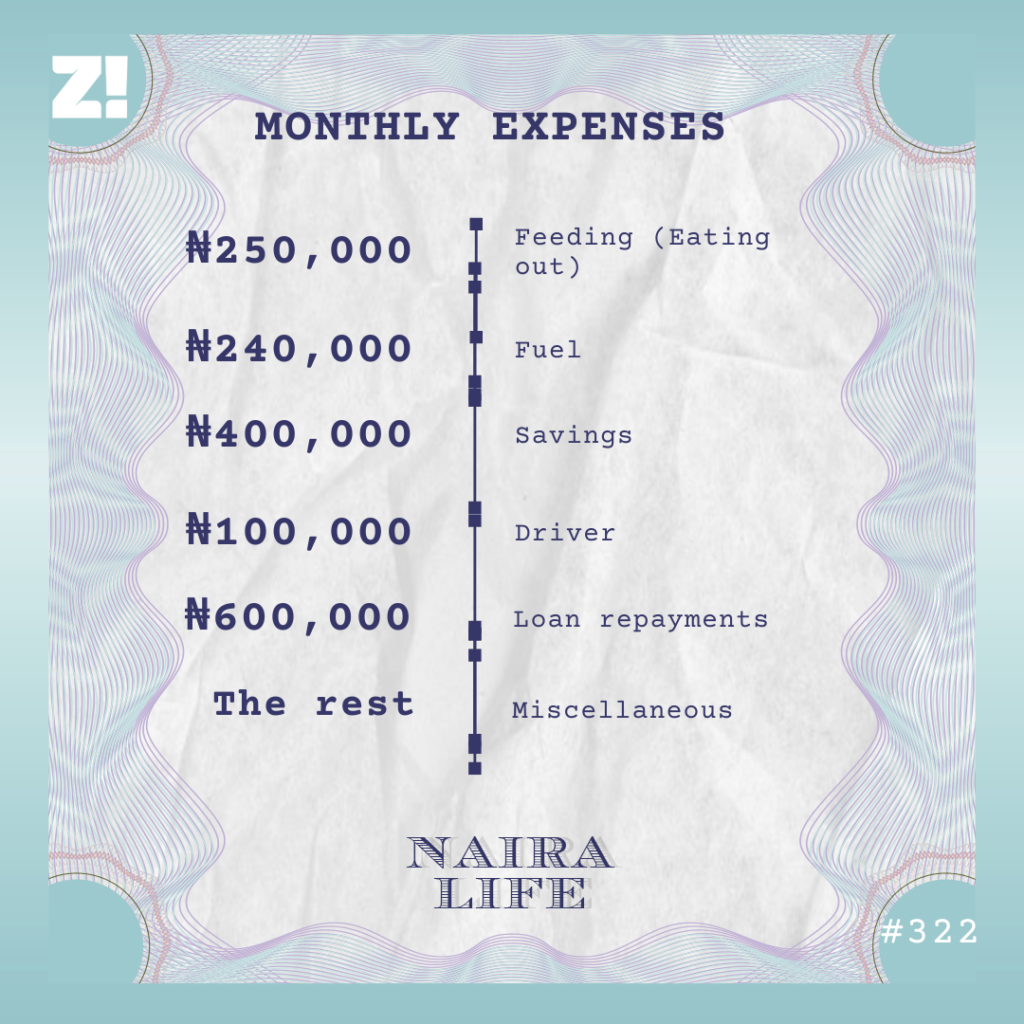
    Nairalife #322 expenses

    I no longer pay rent because I moved back home in 2024. I needed to make some lifestyle changes and save money, so instead of paying rent, I pay a driver to take me to work.

    I have about ₦500k in my savings account right now, which is puzzling because I save ₦400k monthly. I don’t know if it’s because I’m still gambling or haven’t figured out a good spending habit.

    How have your experiences impacted your relationship with money?

    At some point, all I thought about was gambling with money. Now, I’m trying really hard to save. I understand that money doesn’t need to come quickly; it can also go quickly. Regardless of how long it takes to make money, it can go fast because there’s always something to spend on. 

    I’m still learning how to manage money. I think I didn’t learn earlier because of my background, so I’m playing catch-up. I’ve started with savings and hope to build on that and find more ways to accumulate wealth. 

    I would have tried investments, but I think I’ve expended all my risk in my gambling days. So, I’ll stick to savings plans that allow me to lock up my money for now.

    What do you imagine the next few years will look like?

    First, I want to be completely debt-free and never take out loans again. I also hope to grow my savings to ₦6m within two years.

    I’m considering moving to Canada in the next few years, so I could either do that or stay in my role. By the way, I really enjoy my work, so I wouldn’t mind continuing what I’m currently doing. 

    That said, I still want to have a side hustle. This might be the only job I’ve had without something else on the side. Some options I’m considering are content writing or something in marketing. I haven’t been able to actively pursue gigs because my medication always makes me tired, but I’m on the lookout.

    What was the last thing you spent money on that made you happy?

    My phone. I got it in February for ₦570k after the previous one got stolen in traffic. I know having a phone increases the risk of returning to gambling, but I still do other things with my phone, and I was happy I could replace it.

    How would you rate your financial happiness on a scale of 1-10?

    3. I still have a long way to go. It’ll be a 10 when I’m debt-free and have at least ₦6m savings.


    If you’re interested in talking about your Naira Life story, this is a good place to start.

    Find all the past Naira Life stories here.
    Subscribe to the newsletter here.

    Join 1,000+ Nigerians, finance experts and industry leaders at The Naira Life Conference by Zikoko for a day of real, raw conversations about money and financial freedom. Click here to buy a ticket and secure your spot at the money event of the year, where you’ll get the practical tools to 10x your income, network with the biggest players in your industry, and level up in your career and business.

    [ad]
  • Fola* (40) got diagnosed with bipolar disorder and depression at 19 after surviving an abuse-related mental breakdown. She shares her frustrations with how mental illness has affected her relationships, quality of life and her ability to parent her children.


    TW: Sexual abuse, domestic abuse and self-harm.


    As told to Boluwatife

    Image designed by Freepik

    I’ve lived with bipolar disorder for 22 years, but I wasn’t always like this. 

    Growing up, I was the regular fun-loving child who played with her siblings and stayed over with her cousins during school holidays. But then my uncle started sexually abusing me, and my “regular” life ended.

    The first time it happened, I was 10 years old. He lived with my parents for a few months and constantly made me and my siblings touch him. Sometimes, he’d touch us. It didn’t occur to me to say anything, and it stopped when my family moved out of the area, so I just pushed it to the back of my head.

    Three years later, my parents separated, and I had to go live with my grandmother. At this time, my uncle was an undergraduate. He also lived in my grandma’s house when he wasn’t at school. I was in JSS 3. The abuse started again and continued on and off for three years whenever he was home on holiday.

    This time, it came with threats. He’d warn me to tell anyone unless he’d kill me. I think my mental health issues started accumulating from there. Whenever he wasn’t around, I simply forgot he’d abused me. Then he’d return and begin again. I now know from therapy that forgetting was my subconscious way of protecting myself. I just locked the memories away in my head.

    One time in SS 3, I overheard him tell his girlfriend that he’d “destroy Fola’s life”, and I started having panic attacks. My heart raced for days, and I kept having thoughts of death. I was preparing for my WAEC exams, but I couldn’t concentrate. It was like all my bottling up eventually reached a breaking point. 

    I remember when I finally broke down. It was the day of my chemistry exam for WAEC. I walked into the lab, and my friends were waving at me to join them when I ran out. The school’s secretary had to call my mum to let her know I was behaving strangely. She took me home, and I grew worse. I couldn’t bathe, eat or talk to anyone, and I kept crying.

    My mum thought I had acute malaria that was affecting my brain and took me to a hospital. I spent about three months there and honestly don’t remember most of what happened. There was a time when I was unconscious, and the doctors had to resuscitate me. When I started trying to cut myself and drag injections from the nurses, the doctor referred me to a psychiatric hospital.

    It took two years of regular hospital visits and consultation for the psychiatric hospital to officially diagnose and start treating me for bipolar disorder and depression in 2001. The doctor didn’t admit me to the hospital, and it took that long for an official diagnosis because I’d blanked out a lot, and it took a while for me to remember specific details. 

    I also told my mum about what my uncle had done. The family was involved, and the matter ended with begging and assurances that it’d never happen again.

    But the damage was already done. I was 19 years old, and suddenly, I was faced with the reality that I’d have to be on medication for the rest of my life.

    It took a while for me to adjust. I’d take my medication religiously for a while, but then I’d get tired and refuse to take anymore. I relapsed three times before I accepted that I couldn’t run away from medication. 

    I almost emptied my family house during one of those relapses. I stopped my drugs and had this huge burst of energy. So, I decided I was going to clean and rearrange the house. It wasn’t even dirty, but I wasn’t thinking straight. I called an aboki and told him to pack everything, even the valuable things. Luckily, my mum returned before he could take them away. 

    Living with bipolar disorder is one thing. Navigating relationships with it is another thing entirely. At different points in time, men came to me wanting to date me, but once I told them about my sickness, they ghosted me. It didn’t even matter that I was on medication, and I was always upfront about my condition. They just disappeared.

    Even when I decided to focus my attention on church and let relationships rest, this sickness still didn’t let me be. I joined the choir but couldn’t meet up with the early hours and vigils required as a church worker. 

    One of the side effects of my medication is excessive sleep. An average person sleeps eight hours, but I sleep 15-16 hours daily. That also affected my university studies, but fortunately, I still graduated. 

    I met my husband, Robert*, just after NYSC service year in 2012. We met in a keke, and he asked for my number. I remember he had one small torchlight phone, and I thought, “See the phone this one is using to toast woman?”

    Anyway, we got talking, and I immediately told him about my condition. He didn’t mind. He even declared that my uncle was now his enemy and he’d never talk to him if he ever saw him. 

    Robert and I got married within a year of dating. My mum was happy I’d found a man willing to marry me with my condition because not many men would want someone with bipolar disorder in their house.

    The early days of our marriage weren’t too bad. Robert understood that my medications left me tired and always oversleeping, so he helped with the chores. I also didn’t work, so he took care of the bills. I did try to run a salon, but the stress of standing for a long time affected me, and I had to stop.

    Then, Robert started hitting me. It wasn’t regular, and it happened when he grew frustrated with my inability to do certain things. He’d complain about it, I’d try to defend myself, and he’d respond with slaps. We moved to a different state after marriage, and none of my family members were close. 

    Whenever he hit me, he’d quickly call my parents to report to them about how I was in the wrong — I think he was just trying to talk before I did. He never told them about the beatings, and I didn’t say anything either.

    I had my first child in 2013. I have three children now, and each time I get pregnant, the doctors change my medication to prevent birth deformities in the kids and so that the trauma of birth and blood loss wouldn’t affect my mental health. 

    I’ve gone from using four tablets daily to eight, and my energy levels have dropped with each birth. I can’t concentrate well and can no longer do as much as I used to. As of 2015, I could still go to the market, cook in bulk and store soups in the freezer. Now, I can only cook soups thrice a month, and even that is with serious determination. 

    [ad]

    I had my last child in 2022, and my doctor instructed me not to have any more if I didn’t want to be totally useless. 

    My husband is aware of how much childbirth has affected me, but it still doesn’t change the fact that most of our issues are because of my condition. I do try my best. I run a provisions store, which I started in 2023, and I try to go in the evenings when I feel well enough to do so. But then my husband comes home from work and wants me to cook fresh food, but I can’t do it. It’s really affecting our relationship.

    To be honest, he tries his best. When he’s in a good mood, he helps me out and tries to make sure I’m fine. He cooks, helps with the children’s school runs and provides for us. But when he’s tired, he takes it to the extreme. He says things like, “What kind of wife did I even marry?” and accuses me of faking my weakness. Does he think I’m happy that I can’t be much of a wife and mother to my kids? I can’t even be actively involved with my children. 

    Sometimes, I cry all day and question God. Like, why did this have to happen to me? But then I console myself that I won’t live forever. I’ll be gone one day, and the drugs will stop.

    I guess Robert’s feelings are valid. I know my condition isn’t the easiest thing to manage, but this is a lifelong thing, and I wish he’d be more understanding. I know he has many female friends he goes to meet whenever he leaves the house angry, but I don’t even mind. If I’m not giving him the joy he wants, maybe it’s okay for him to find it elsewhere. There’s nothing I can do. I can’t stop my medication so I can have more energy because it’d only make my condition worse. So, what’s the point?

    I’ve tried to talk to him about how I feel on numerous occasions. Sometimes, he listens. Other times, it’s like, “Abeg, I’m tired of all these stories.” I’m glad he’s even stopped hitting me. I finally told my mum last year, and she threatened to arrest him. He hasn’t hit me since. 

    In all this, I’m glad I have my family as a support system. Most days, I think less of myself and worry about the things I can’t do. But my mum calls me weekly to talk to and encourage me. She was there when I first broke down and constantly reminds me how far I’ve come. I survived, I have children, and my condition is manageable even with the side effects of medication. I’m grateful to God for the little wins.

    *Names have been changed for the sake of anonymity.


    NEXT READ: “Don’t Tell Anyone”: The Sexual Abuse Of Nigerian Boys


  • The subject of this week’s What She Said is a Nigerian woman in her early twenties who was diagnosed with bipolar disorder. She talks about her mental health journey in Nigeria, and why she thinks she was misdiagnosed.  

    What’s your earliest memory of your childhood? 

    The earliest memory I can recall is being molested by my uncle. I have no memory of anything before the age of eight, and I think that’s my brain trying to suppress the trauma from the assault and my parents neglecting me as a child. I lost my memories after the assault, and I only started recovering them again as an adult, but in fragments. 

    I’m so sorry that happened. Did your parents ever find out? 

    My parents eventually found out about it when I was nine or ten. I think they walked in while he was trying to molest me, but I don’t really remember. I just remember the aftermath and the questions they asked. He had to leave the house, but he was welcomed back so many times over the years. When they asked me what really happened, I was unable to tell the full story and had to lie that he only attempted to molest me.

    I lied because my parents were hysterical, and I was scared. My mum wouldn’t stop crying and calling me ruined. This was the first time I ever saw people so hysterical, so I thought I had to protect them. I was a child, I didn’t even know what protecting my parents meant. I just knew I did not want my mother to be so hysterical. 

    Would you say your mother reacted strongly?

    My mum was always an emotional person, so I witnessed a lot of her breakdowns and anger in a very extreme manner. When she got angry at me, she would call me names or hit me. Her moods were chaotic, so I never knew what to expect. 

    I think it affected my mood regulation, and showed me extreme expressions of anger, such as breaking things, saying horrible things and overall frantic efforts to avoid abandonment to be socially acceptable. Honestly, I believe she actually had some mental issues as well, but she never got any help. In fact, when she found out I tried to kill myself when I was 16, she opted to pray for me instead of actually helping me access help. My parents believe in faith therapy.

    Did you tell your parents about the suicide attempt? 

    I did not tell anyone I tried to kill myself, so there was nobody to urge me to get help. My mother only found out because she read my diary, but she never confronted me about it. My parents do not talk about or confront things that make them uncomfortable. 

    Then I was diagnosed with bipolar disorder type II in 2016 when I was 18.  A friend of mine who had been my support system at the time encouraged me to get one because of my behaviour. I always knew I was not like the average person so getting the diagnosis made me feel validated. Like I was not imagining it. 

    I am so glad you were able to get a diagnosis. Did they put you on any medication?

    Yes. After I was diagnosed, I was put on medication, but I stopped after a year. The medication did more harm than good. It did help sometimes, but it also made me fatter and sicker. There were headaches, diarrhoea, nausea, and sexual problems like dryness and being unable to cum. Now, I’m relatively untreated. It’s difficult because I have episodes three to five times a day. 

    What’s an episode like for you? 

    A memory from years ago can resurface in my mind and trigger an episode. I can then spend the next two hours crying and having anxiety attacks about this memory. My mind tells me that I am a horrible and stupid person that is undeserving of love. I start to remember all the people who have left me and I feel unloveable. On more intense days, the voices in my head may tell me to cut myself. 

    On a more extreme day, I burned myself as punishment for being a horrible person to someone I loved when, in fact, I just couldn’t see that these were efforts to avoid abandonment by him. 

    And these are just normal for people with bipolar disorder? 

    Technically, I don’t think I have bipolar disorder. I think I have BPD —  borderline personality disorder. It is a disorder in which the sufferer experiences and expresses extreme mood swings and socially unacceptable, uncontrollable anger, usually in frantic efforts to avoid abandonment or perceived abandonment. Unlike bipolar disorder, which episodes last at least 2 weeks, BPD episodes can happen multiple times a day.

    I emotionally abused a guy once. We were friends with benefits and I really liked him and I placed him on a pedestal, but I always felt threatened that he would leave me for someone else — that’s called splitting. I constantly called him names, checked his phone, was controlling and bullied girls that were around him. My lack of control over my anger was punishing him. It took me three years to figure this out, and I apologised. He said he has forgiven me, but I still struggle to forgive myself. 

    After losing a lot of friends and relationships, I realised something was definitely wrong with me. The feelings I had did not match my thoughts or feelings. My fear of abandonment would come out as anger, and my hurt as contempt. After reading a lot and inquiring about my behaviour from people, I think BPD is a more accurate diagnosis. 

    If you think you got a wrong diagnosis, why not go back to the doctor? 

    My experience with the mental health resources like medication and therapy is not great. The resources are ineffective, and mental health professionals are not understanding. It’s also not as affordable for the average person. Even though I can afford it right now, mental health professionals are judgmental or like to include faith healing. As someone who has traumatic experiences related to religion, this turns me off. 

    I think that mental health resources here are like a band-aid on a gunshot wound. They don’t help holistically but will help you feel better in the moment. 

    So with no medication, a misdiagnosis and your dislike for mental health resources in Nigeria, how do you navigate life? 

    I have a DBT (dialectical behavioral therapy) textbook. I read it when I have episodes to help me remember that I am seeing things in black and white. It helps but not much.

    I’m very lucky that I am self-aware and more high-functioning than some other people. However, I don’t think I can work in a public space anymore. The last experience was traumatizing for me, and I enjoy working remotely now. It’s easier to deal with episodes at home. 

    What was your last job like? 

    I was a digital marketer and it stressed me out so much that I started to have episodes every time. I started having PTSD trauma nightmares about my sexual assault and when I finally got fired, I thought my life was over because I had hyper focused on my job and was so obsessed with trying to live up to expectations that I had neglected my health. 

    Is there anything that’d make life easier for you to navigate? 

    I think we need professionals to separate religion from their jobs, and go through empathy training. It’s not just about writing exams and passing. Medication should also be more accessible. 

    Nigerians also need more education on mental illness and how to relate with people with mental illnesses. People look at me as weak or foolish for being sick when I have episodes, they will either laugh or think I am dangerous and trying to harm them. 

    They should be more open-minded towards friends and family who have mental illness and learn how to navigate our behaviours that may be considered socially unacceptable. Also, the culture of bullying and microaggressions here needs to change. 

    For more stories like this, check out our #WhatSheSaid and for more women like content, click here


    [donation]